
Ecological insights from three decades of animal movement
- Slides: 3
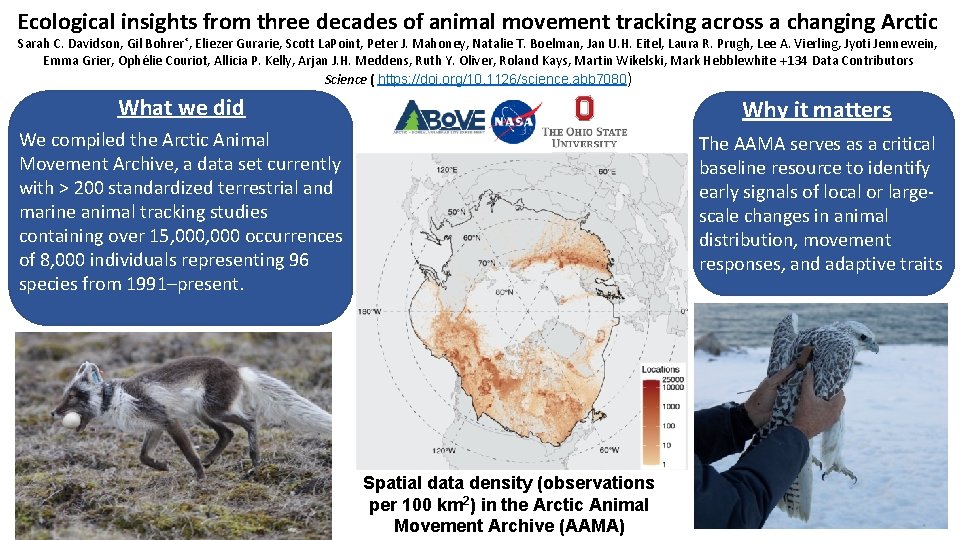
Ecological insights from three decades of animal movement tracking across a changing Arctic Sarah C. Davidson, Gil Bohrer*, Eliezer Gurarie, Scott La. Point, Peter J. Mahoney, Natalie T. Boelman, Jan U. H. Eitel, Laura R. Prugh, Lee A. Vierling, Jyoti Jennewein, Emma Grier, Ophélie Couriot, Allicia P. Kelly, Arjan J. H. Meddens, Ruth Y. Oliver, Roland Kays, Martin Wikelski, Mark Hebblewhite +134 Data Contributors Science ( https: //doi. org/10. 1126/science. abb 7080) What we did Why it matters We compiled the Arctic Animal Movement Archive, a data set currently with > 200 standardized terrestrial and marine animal tracking studies containing over 15, 000 occurrences of 8, 000 individuals representing 96 species from 1991–present. The AAMA serves as a critical baseline resource to identify early signals of local or largescale changes in animal distribution, movement responses, and adaptive traits Spatial data density (observations per 100 km 2) in the Arctic Animal Movement Archive (AAMA)
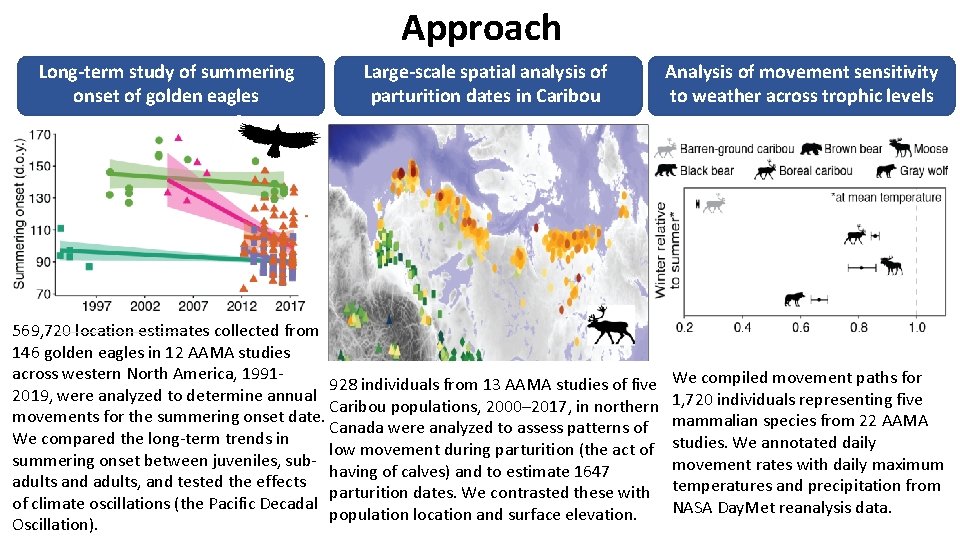
Approach Long-term study of summering onset of golden eagles Large-scale spatial analysis of parturition dates in Caribou 569, 720 location estimates collected from 146 golden eagles in 12 AAMA studies across western North America, 1991928 individuals from 13 AAMA studies of five 2019, were analyzed to determine annual Caribou populations, 2000– 2017, in northern movements for the summering onset date. Canada were analyzed to assess patterns of We compared the long-term trends in low movement during parturition (the act of summering onset between juveniles, subhaving of calves) and to estimate 1647 adults and adults, and tested the effects parturition dates. We contrasted these with of climate oscillations (the Pacific Decadal population location and surface elevation. Oscillation). Analysis of movement sensitivity to weather across trophic levels We compiled movement paths for 1, 720 individuals representing five mammalian species from 22 AAMA studies. We annotated daily movement rates with daily maximum temperatures and precipitation from NASA Day. Met reanalysis data.
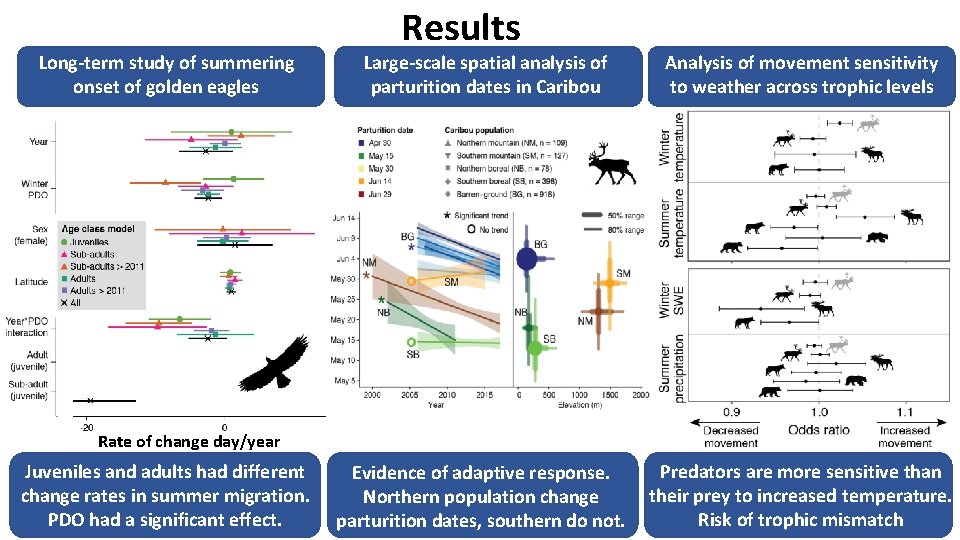
Long-term study of summering onset of golden eagles Results Large-scale spatial analysis of parturition dates in Caribou Analysis of movement sensitivity to weather across trophic levels Evidence of adaptive response. Northern population change parturition dates, southern do not. Predators are more sensitive than their prey to increased temperature. Risk of trophic mismatch Rate of change day/year Juveniles and adults had different change rates in summer migration. PDO had a significant effect.