
ECOLEAD SUMMER SCHOOL 2006 VBE Value System and
ECOLEAD SUMMER SCHOOL 2006 VBE Value System and Metrics ITESM Arturo Molina, David Romero, Nathalie Galeano armolina@itesm. mx, a 00778276@itesm. mx, ngaleano@itesm. mx
Course Details Objectives • The course aims to characterize a generic Value System and its Metrics, to describe the approaches to develop a Value System for VBEs. • At the end of course the lecture should understand the concept of Value, Value System and Performance Measurement in the context of VBEs. Target audience • SMEs, academic community, governmental organizations, non governmental organizations and public in general, interested on Virtual Breeding Environments and related topics. Level of the Programme • Introductory
Module Introduction • The present training model gives an introduction of the elements involved in the definition of a Value System for Virtual Breeding Environments (VBEs); such definition is an important aspect in the VBE operation, because it allows: – The Identification of the main elements that generate value in a VBE (measured in terms of capitals) and the forms of value in each VBE member. – The improvement of the overall performance of VBEs and its members by providing meaningful performances indicators to evaluate and manage their strategies and processes. – The identification VBE member’s capacity to generate value by combing its capitals with other VBE members (VO Creation). – The identification of the total value generated by a VBE, to evaluate the increase/decrease of value in the VBE during its life-cycle. – The involvement of social values (behaviour, ethics and culture) with operational performance in order to create a common functioning environment to better respond in business collaboration. – The support of the decisions about adding/retreating members by evaluating their performance through a pre-established indicator system. • The Value Generation Process in a VBE will be evaluated from different perspectives: the different values that can be generated (economical, ethical, cultural, social and strategic) and the different stakeholders that the VBE has (members, support institution, VBE administrator, opportunity broker, VO planner, VO Coordinator).
Content of Presentation • Basic Concepts – Value System – Performance Measurement • VBE Value System and its Elements – VBE Value Generation Objects: Capitals in an Organization – VBE Performance Measurement System – VBE Ethical Values: Culture and Ethical Code • VBE Value Transfer (Branding and Marketing) • Relations Between the Value System Elements • Tools to support the VBE Value System
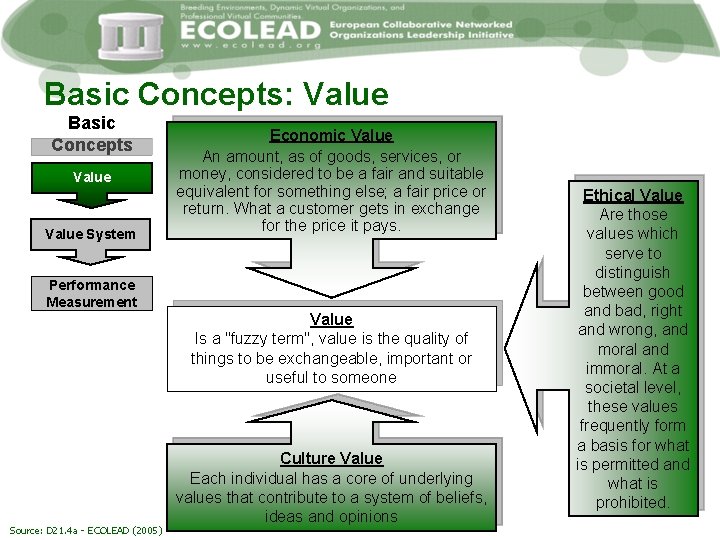
Basic Concepts: Value Basic Concepts Value System Economic Value An amount, as of goods, services, or money, considered to be a fair and suitable equivalent for something else; a fair price or return. What a customer gets in exchange for the price it pays. Performance Measurement Value Is a "fuzzy term", value is the quality of things to be exchangeable, important or useful to someone Source: D 21. 4 a - ECOLEAD (2005) Culture Value Each individual has a core of underlying values that contribute to a system of beliefs, ideas and opinions Ethical Value Are those values which serve to distinguish between good and bad, right and wrong, and moral and immoral. At a societal level, these values frequently form a basis for what is permitted and what is prohibited.
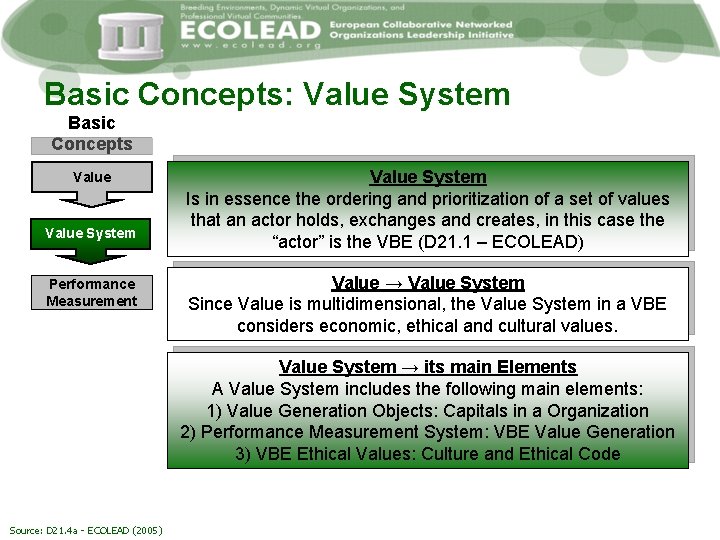
Basic Concepts: Value System Basic Concepts Value System Performance Measurement Value System Is in essence the ordering and prioritization of a set of values that an actor holds, exchanges and creates, in this case the “actor” is the VBE (D 21. 1 – ECOLEAD) Value → Value System Since Value is multidimensional, the Value System in a VBE considers economic, ethical and cultural values. Value System → its main Elements A Value System includes the following main elements: 1) Value Generation Objects: Capitals in a Organization 2) Performance Measurement System: VBE Value Generation 3) VBE Ethical Values: Culture and Ethical Code Source: D 21. 4 a - ECOLEAD (2005)
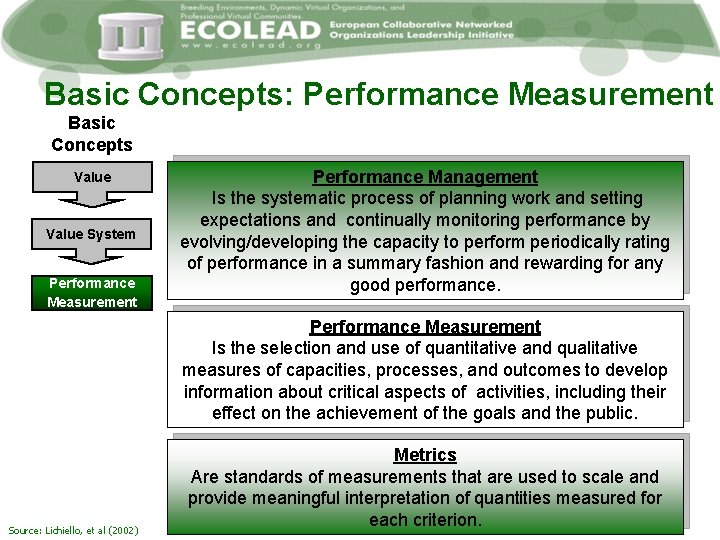
Basic Concepts: Performance Measurement Basic Concepts Value System Performance Measurement Performance Management Is the systematic process of planning work and setting expectations and continually monitoring performance by evolving/developing the capacity to perform periodically rating of performance in a summary fashion and rewarding for any good performance. Performance Measurement Is the selection and use of quantitative and qualitative measures of capacities, processes, and outcomes to develop information about critical aspects of activities, including their effect on the achievement of the goals and the public. Source: Lichiello, et al (2002) Metrics Are standards of measurements that are used to scale and provide meaningful interpretation of quantities measured for each criterion.
Content of Presentation • Basic Concepts – Value System – Performance Measurement • VBE Value System and its Elements – VBE Value Generation Objects: Capitals in an Organization – VBE Performance Measurement System – VBE Ethical Values: Culture and Ethical Code • VBE Value Transfer (Branding and Marketing) • Relations Between the Value System Elements • Tools to support the VBE Value System
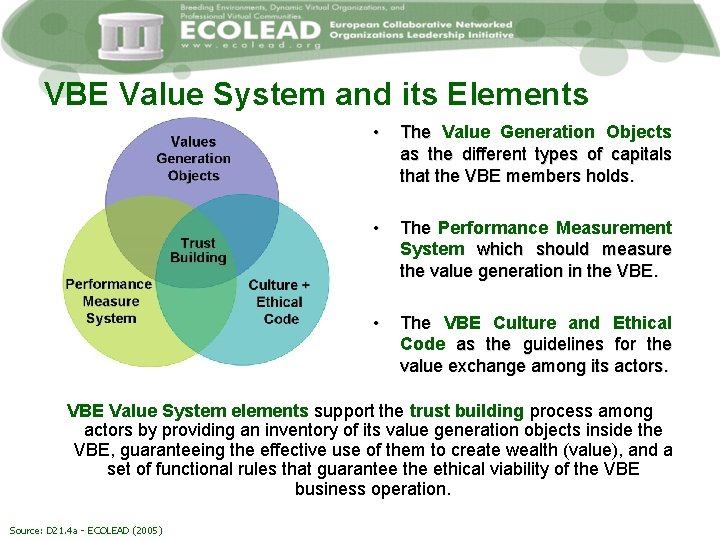
VBE Value System and its Elements • The Value Generation Objects as the different types of capitals that the VBE members holds. • The Performance Measurement System which should measure the value generation in the VBE. • The VBE Culture and Ethical Code as the guidelines for the value exchange among its actors. VBE Value System elements support the trust building process among actors by providing an inventory of its value generation objects inside the VBE, guaranteeing the effective use of them to create wealth (value), and a set of functional rules that guarantee the ethical viability of the VBE business operation. Source: D 21. 4 a - ECOLEAD (2005)
Content of Presentation • Basic Concepts – Value System – Performance Measurement • VBE Value System and its Elements – VBE Value Generation Objects: Capitals in an Organization – VBE Performance Measurement System – VBE Ethical Values: Culture and Ethical Code • VBE Value Transfer (Branding and Marketing) • Relations Between the Value System Elements • Tools to support the VBE Value System
VBE Value Generation Objects • The purpose of the Value System is to identify main values and benefits, such as economic success, and other types of valuable benefits (productivity related, strategic, social) for VBE members and their stakeholders. • VBE members participate in a VBE by converting their competences and knowledge into tangible and intangible deliverables that should have value for other VBE members, VO clients and VBE stakeholders. • In a successful VBE every VBE member contributes and receives value in ways that sustain their own success and the success of the VBE as a whole system. Source: D 21. 4 a - ECOLEAD (2005)
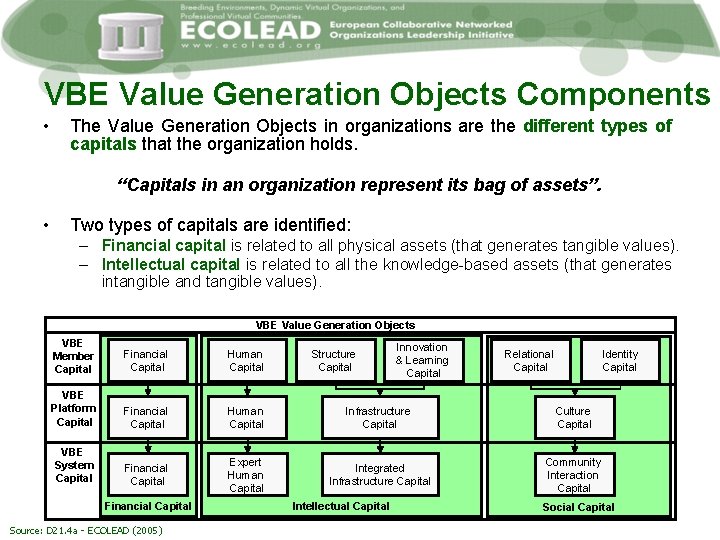
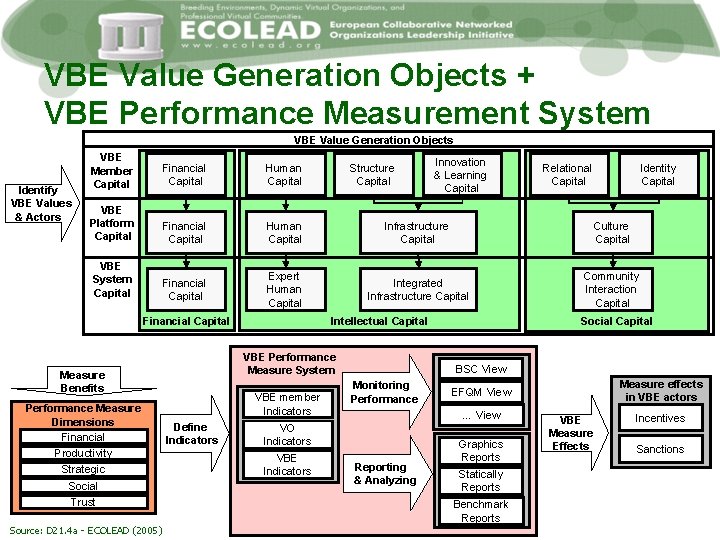
VBE Value Generation Objects Components • The Value Generation Objects in organizations are the different types of capitals that the organization holds. “Capitals in an organization represent its bag of assets”. • Two types of capitals are identified: – Financial capital is related to all physical assets (that generates tangible values). – Intellectual capital is related to all the knowledge-based assets (that generates intangible and tangible values). VBE Value Generation Objects VBE Member Capital Financial Capital Human Capital VBE Platform Capital Financial Capital Human Capital Infrastructure Capital Culture Capital VBE System Capital Financial Capital Expert Human Capital Integrated Infrastructure Capital Community Interaction Capital Financial Capital Source: D 21. 4 a - ECOLEAD (2005) Structure Capital Intellectual Capital Innovation & Learning Capital Relational Capital Identity Capital Social Capital
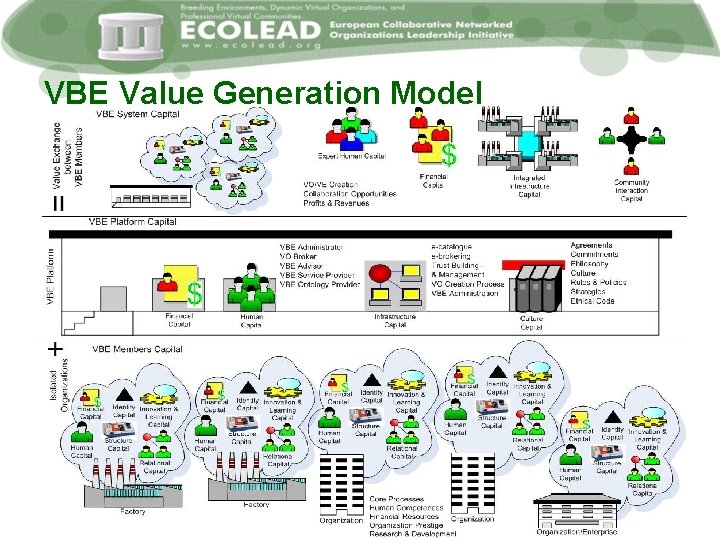
VBE Value Generation Model
Content of Presentation • Basic Concepts – Value System – Performance Measurement • VBE Value System and its Elements – VBE Value Generation Objects: Capitals in an Organization – VBE Performance Measurement System – VBE Ethical Values: Culture and Ethical Code • VBE Value Transfer (Branding and Marketing) • Relations Between the Value System Elements • Tools to support the VBE Value System
VBE Performance Measurement System “The Performance Measurement System should measure the value generation in the VBE”. • The VBE Performance Measurement System is a formed by a set of Performance Indicators. The role of a Performance Indicator is to translate the VBE value generation process in “numbers”. • Without meaningful performances indicators, the VBEs will find a difficult way to evaluate their strategies, members, processes, quality of products and/or services. “Organisations that measure and manage its performance can be better focused in the achievement of their operational and financial goals”. Source: D 21. 4 a - ECOLEAD (2005)
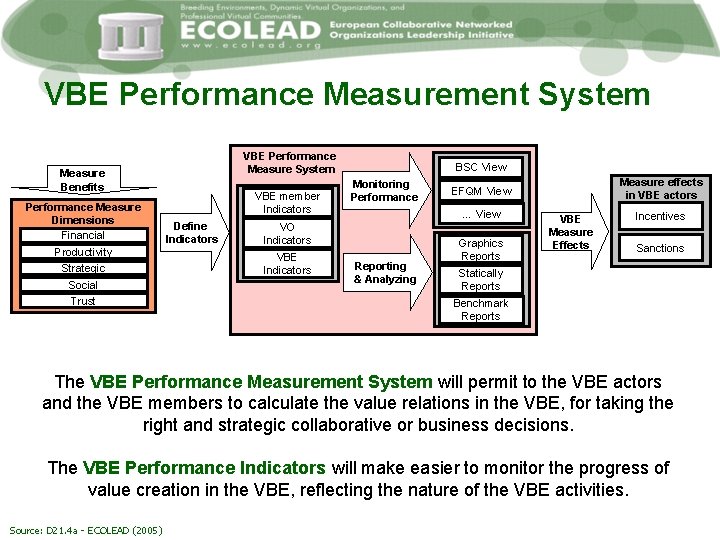
VBE Performance Measurement System VBE Performance Measure System Measure Benefits Performance Measure Dimensions Financial Productivity Strategic Social Trust VBE member Indicators Define Indicators BSC View Monitoring Performance … View VO Indicators VBE Indicators Reporting & Analyzing Measure effects in VBE actors EFQM View Graphics Reports VBE Measure Effects Incentives Sanctions Statically Reports Benchmark Reports The VBE Performance Measurement System will permit to the VBE actors and the VBE members to calculate the value relations in the VBE, for taking the right and strategic collaborative or business decisions. The VBE Performance Indicators will make easier to monitor the progress of value creation in the VBE, reflecting the nature of the VBE activities. Source: D 21. 4 a - ECOLEAD (2005)
VBE Performance Measurement System • In order to monitor the VBE performance the Performance Measurement System (PMS) can be supported by the BSC model. • BSC is a model that shows the balance between the present and the future of an organisation, including its internal and external perspectives. It permits the organisations to analyze their final results (financial and non financial) and at the same time to monitor the progress of the construction of intangible assets for which the organisation need to create more value. • The measures depend on the indicators, which need to be aligned to the activities originated by the organisation strategy. Source: D 21. 4 a - ECOLEAD (2005)
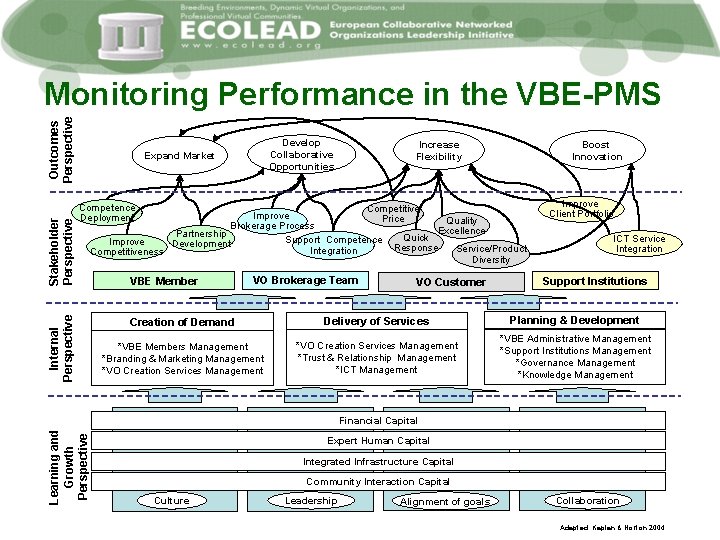
Develop Collaborative Opportunities Expand Market Increase Flexibility Competence Deployment Internal Perspective Stakeholder Perspective Outcomes Perspective Monitoring Performance in the VBE-PMS Boost Innovation Competitive Improve Price Quality Brokerage Process Excellence Partnership Quick Support Competence Improve Development Response Service/Product Integration Competitiveness Diversity VBE Member VO Brokerage Team VO Customer Improve Client Portfolio ICT Service Integration Support Institutions Creation of Demand Delivery of Services Planning & Development *VBE Members Management *Branding & Marketing Management *VO Creation Services Management *Trust & Relationship Management *ICT Management *VBE Administrative Management *Support Institutions Management *Governance Management *Knowledge Management Learning and Growth Perspective Financial Capital Expert Human Capital Integrated Infrastructure Capital Community Interaction Capital Culture Leadership Alignment of goals Collaboration Adapted: Kaplan & Norton 2004
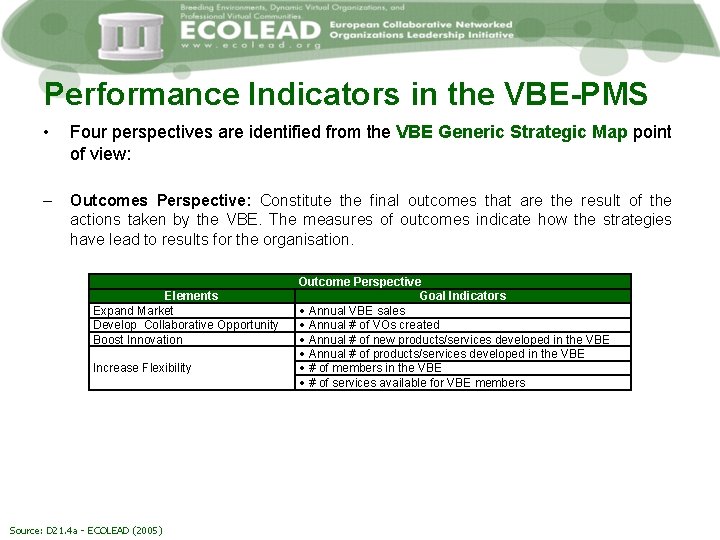
Performance Indicators in the VBE-PMS • Four perspectives are identified from the VBE Generic Strategic Map point of view: – Outcomes Perspective: Constitute the final outcomes that are the result of the actions taken by the VBE. The measures of outcomes indicate how the strategies have lead to results for the organisation. Elements Expand Market Develop Collaborative Opportunity Boost Innovation Increase Flexibility Source: D 21. 4 a - ECOLEAD (2005) Outcome Perspective Goal Indicators Annual VBE sales Annual # of VOs created Annual # of new products/services developed in the VBE Annual # of products/services developed in the VBE # of members in the VBE # of services available for VBE members
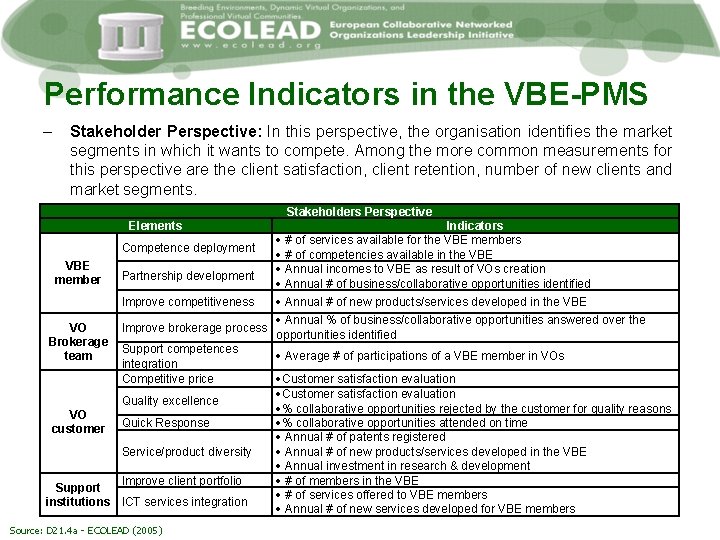
Performance Indicators in the VBE-PMS – Stakeholder Perspective: In this perspective, the organisation identifies the market segments in which it wants to compete. Among the more common measurements for this perspective are the client satisfaction, client retention, number of new clients and market segments. Stakeholders Perspective Elements Competence deployment VBE member Partnership development Indicators # of services available for the VBE members # of competencies available in the VBE Annual incomes to VBE as result of VOs creation Annual # of business/collaborative opportunities identified Annual # of new products/services developed in the VBE Annual % of business/collaborative opportunities answered over the Improve brokerage process VO opportunities identified Brokerage Support competences Average # of participations of a VBE member in VOs team integration Competitive price Customer satisfaction evaluation Quality excellence % collaborative opportunities rejected by the customer for quality reasons VO Quick Response % collaborative opportunities attended on time customer Annual # of patents registered Service/product diversity Annual # of new products/services developed in the VBE Annual investment in research & development Improve client portfolio # of members in the VBE Support # of services offered to VBE members institutions ICT services integration Annual # of new services developed for VBE members Improve competitiveness Source: D 21. 4 a - ECOLEAD (2005)
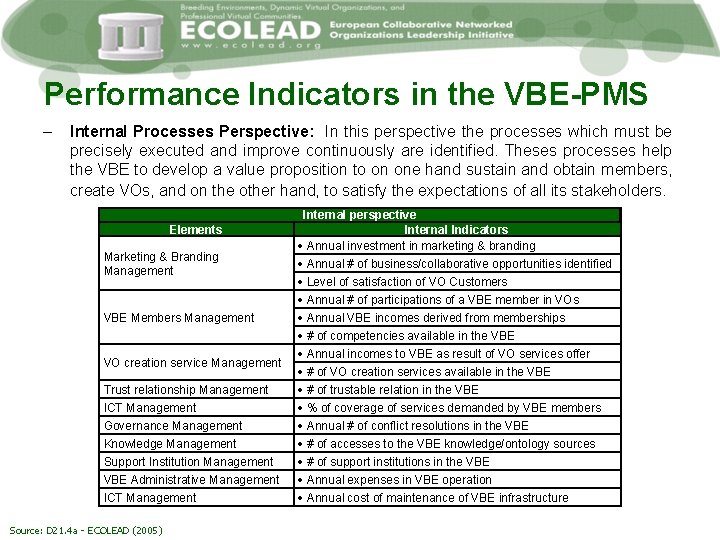
Performance Indicators in the VBE-PMS – Internal Processes Perspective: In this perspective the processes which must be precisely executed and improve continuously are identified. Theses processes help the VBE to develop a value proposition to on one hand sustain and obtain members, create VOs, and on the other hand, to satisfy the expectations of all its stakeholders. Elements Marketing & Branding Management VBE Members Management VO creation service Management Trust relationship Management ICT Management Governance Management Knowledge Management Support Institution Management VBE Administrative Management ICT Management Source: D 21. 4 a - ECOLEAD (2005) Internal perspective Internal Indicators Annual investment in marketing & branding Annual # of business/collaborative opportunities identified Level of satisfaction of VO Customers Annual # of participations of a VBE member in VOs Annual VBE incomes derived from memberships # of competencies available in the VBE Annual incomes to VBE as result of VO services offer # of VO creation services available in the VBE # of trustable relation in the VBE % of coverage of services demanded by VBE members Annual # of conflict resolutions in the VBE # of accesses to the VBE knowledge/ontology sources # of support institutions in the VBE Annual expenses in VBE operation Annual cost of maintenance of VBE infrastructure
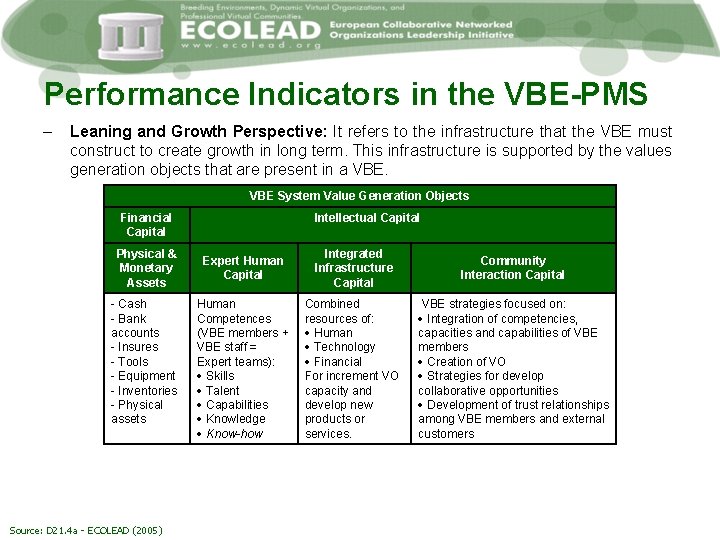
Performance Indicators in the VBE-PMS – Leaning and Growth Perspective: It refers to the infrastructure that the VBE must construct to create growth in long term. This infrastructure is supported by the values generation objects that are present in a VBE System Value Generation Objects Financial Capital Physical & Monetary Assets - Cash - Bank accounts - Insures - Tools - Equipment - Inventories - Physical assets Source: D 21. 4 a - ECOLEAD (2005) Intellectual Capital Expert Human Capital Integrated Infrastructure Capital Community Interaction Capital Human Competences (VBE members + VBE staff = Expert teams): Skills Talent Capabilities Knowledge Know-how Combined resources of: Human Technology Financial For increment VO capacity and develop new products or services. VBE strategies focused on: Integration of competencies, capacities and capabilities of VBE members Creation of VO Strategies for develop collaborative opportunities Development of trust relationships among VBE members and external customers
Content of Presentation • Basic Concepts – Value System – Performance Measurement • VBE Value System and its Elements – VBE Value Generation Objects: Capitals in an Organization – VBE Performance Measurement System – VBE Ethical Values: Culture and Ethical Code • VBE Value Transfer (Branding and Marketing) • Relations Between the Value System Elements • Tools to support the VBE Value System
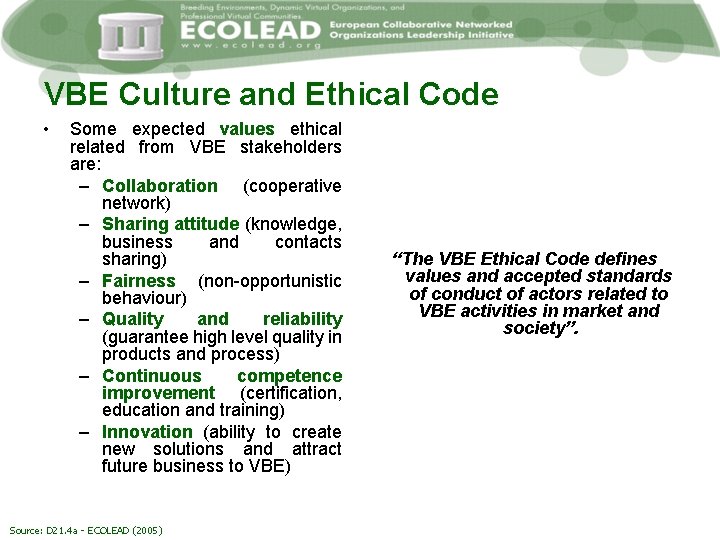
VBE Culture and Ethical Code • Some expected values ethical related from VBE stakeholders are: – Collaboration (cooperative network) – Sharing attitude (knowledge, business and contacts sharing) – Fairness (non-opportunistic behaviour) – Quality and reliability (guarantee high level quality in products and process) – Continuous competence improvement (certification, education and training) – Innovation (ability to create new solutions and attract future business to VBE) Source: D 21. 4 a - ECOLEAD (2005) “The VBE Ethical Code defines values and accepted standards of conduct of actors related to VBE activities in market and society”.
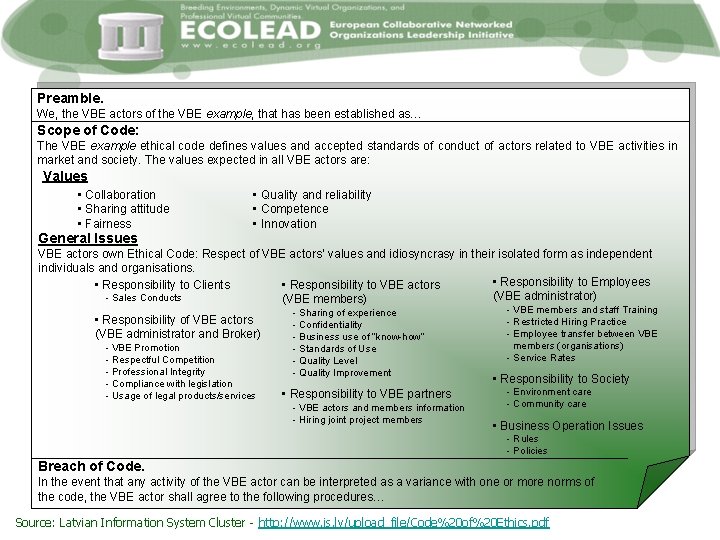
Preamble. We, the VBE actors of the VBE example, that has been established as… Scope of Code: The VBE example ethical code defines values and accepted standards of conduct of actors related to VBE activities in market and society. The values expected in all VBE actors are: Values • Collaboration • Sharing attitude • Fairness • Quality and reliability • Competence • Innovation General Issues VBE actors own Ethical Code: Respect of VBE actors’ values and idiosyncrasy in their isolated form as independent individuals and organisations. • Responsibility to Employees • Responsibility to Clients • Responsibility to VBE actors (VBE administrator) - Sales Conducts (VBE members) • Responsibility of VBE actors (VBE administrator and Broker) - VBE Promotion - Respectful Competition - Professional Integrity - Compliance with legislation - Usage of legal products/services - Sharing of experience - Confidentiality - Business use of “know-how” - Standards of Use - Quality Level - Quality Improvement • Responsibility to VBE partners - VBE actors and members information - Hiring joint project members - VBE members and staff Training - Restricted Hiring Practice - Employee transfer between VBE members (organisations) - Service Rates • Responsibility to Society - Environment care - Community care • Business Operation Issues - Rules - Policies Breach of Code. In the event that any activity of the VBE actor can be interpreted as a variance with one or more norms of the code, the VBE actor shall agree to the following procedures… Source: Latvian Information System Cluster - http: //www. is. lv/upload_file/Code%20 of%20 Ethics. pdf
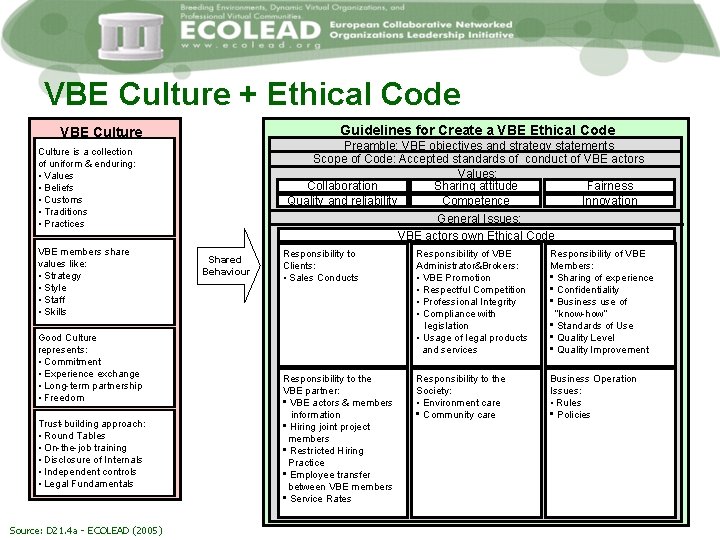
VBE Culture + Ethical Code Guidelines for Create a VBE Ethical Code VBE Culture Preamble: VBE objectives and strategy statements Scope of Code: Accepted standards of conduct of VBE actors Values: Collaboration Sharing attitude Fairness Quality and reliability Competence Innovation General Issues: VBE actors own Ethical Code Culture is a collection of uniform & enduring: • Values • Beliefs • Customs • Traditions • Practices VBE members share values like: • Strategy • Style • Staff • Skills Good Culture represents: • Commitment • Experience exchange • Long-term partnership • Freedom Trust-building approach: • Round Tables • On-the-job training • Disclosure of Internals • Independent controls • Legal Fundamentals Source: D 21. 4 a - ECOLEAD (2005) Shared Behaviour Responsibility to Clients: • Sales Conducts Responsibility of VBE Administrator&Brokers: • VBE Promotion • Respectful Competition • Professional Integrity • Compliance with legislation • Usage of legal products and services Responsibility of VBE Members: • Sharing of experience • Confidentiality • Business use of “know-how” • Standards of Use • Quality Level • Quality Improvement Responsibility to the VBE partner: • VBE actors & members information • Hiring joint project members • Restricted Hiring Practice • Employee transfer between VBE members • Service Rates Responsibility to the Society: • Environment care • Community care Business Operation Issues: • Rules • Policies
Content of Presentation • Basic Concepts – Value System – Performance Measurement • VBE Value System and its Elements – VBE Value Generation Objects: Capitals in an Organization – VBE Performance Measurement System – VBE Ethical Values: Culture and Ethical Code • VBE Value Transfer (Branding and Marketing) • Relations Between the Value System Elements • Tools to support the VBE Value System
VBE Value Transfer (MKT & Branding) • The value transfer process comprises the elements of the VBE Value System in terms of Branding and Marketing, as means to transfer the values of the VBE to: new members, potential VO customers, society and in general to main VBE customers. • In the collaborative network context (e. g. the VBE), applying the concept of co-branding and relationship marketing to the VBE Value System has resulted in a recognition model. Source: D 21. 4 a - ECOLEAD (2005)
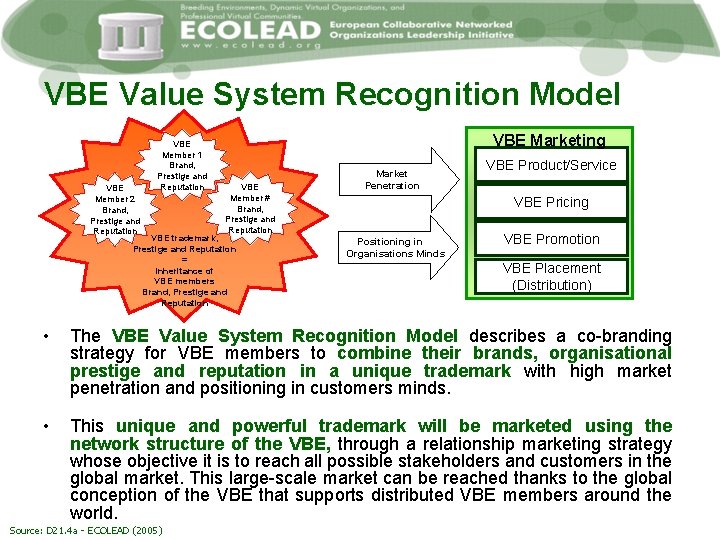
VBE Value System Recognition Model VBE Member 2 Brand, Prestige and Reputation VBE Member 1 Brand, Prestige and Reputation VBE Marketing VBE Member # Brand, Prestige and Reputation VBE trademark, Prestige and Reputation = Inheritance of VBE members Brand, Prestige and Reputation Market Penetration VBE Product/Service VBE Pricing Positioning in Organisations Minds VBE Promotion VBE Placement (Distribution) • The VBE Value System Recognition Model describes a co-branding strategy for VBE members to combine their brands, organisational prestige and reputation in a unique trademark with high market penetration and positioning in customers minds. • This unique and powerful trademark will be marketed using the network structure of the VBE, through a relationship marketing strategy whose objective it is to reach all possible stakeholders and customers in the global market. This large-scale market can be reached thanks to the global conception of the VBE that supports distributed VBE members around the world. Source: D 21. 4 a - ECOLEAD (2005)
Content of Presentation • Basic Concepts – Value System – Performance Measurement • VBE Value System and its Elements – VBE Value Generation Objects: Capitals in an Organization – VBE Performance Measurement System – VBE Ethical Values: Culture and Ethical Code • VBE Value Transfer (Branding and Marketing) • Relations Between the Value System Elements • Tools to support the VBE Value System
VBE Value Generation Objects + VBE Performance Measurement System VBE Value Generation Objects Identify VBE Values & Actors VBE Member Capital Financial Capital Human Capital VBE Platform Capital Financial Capital Human Capital Infrastructure Capital Culture Capital VBE System Capital Financial Capital Expert Human Capital Integrated Infrastructure Capital Community Interaction Capital Financial Capital Source: D 21. 4 a - ECOLEAD (2005) VBE member Indicators Define Indicators Innovation & Learning Capital Intellectual Capital VBE Performance Measure System Measure Benefits Performance Measure Dimensions Financial Productivity Strategic Social Trust Structure Capital Identity Capital Social Capital BSC View Monitoring Performance Reporting & Analyzing Measure effects in VBE actors EFQM View … View VO Indicators VBE Indicators Relational Capital Graphics Reports Statically Reports Benchmark Reports VBE Measure Effects Incentives Sanctions
VBE Value Generation Objects + VBE Performance Measurement System • The VBE Value System combine the Value Generation Objects (financial capitals and intellectual capitals) of the VBE platform (the system that support the VBE operation) and VBE members in meta-value; thanks to the value exchange (e. g. collaborative and business opportunities) that take place between VBE members. • The values generated in the VBE should be measured to encompass the assessment of performance and results achieved by VBE actors; five dimensions are defined for measure the value generation: financial, productivity, strategic, social and trust. • The VBE Performance Measurement System include indicators, monitoring and reporting tools. Performance indicators should focus in the VBE members, the VO and the VBE itself in the five dimensions. Monitoring tools could be based on actual valuation models (such as BSC and EFQM) and reporting tools should support graphic, statistics and/or benchmark reports. Source: D 21. 4 a - ECOLEAD (2005)
Content of Presentation • Basic Concepts – Value System – Performance Measurement • VBE Value System and its Elements – VBE Value Generation Objects: Capitals in an Organization – VBE Performance Measurement System – VBE Ethical Values: Culture and Ethical Code • VBE Value Transfer (Branding and Marketing) • Relations Between the Value System Elements • Tools to support the VBE Value System
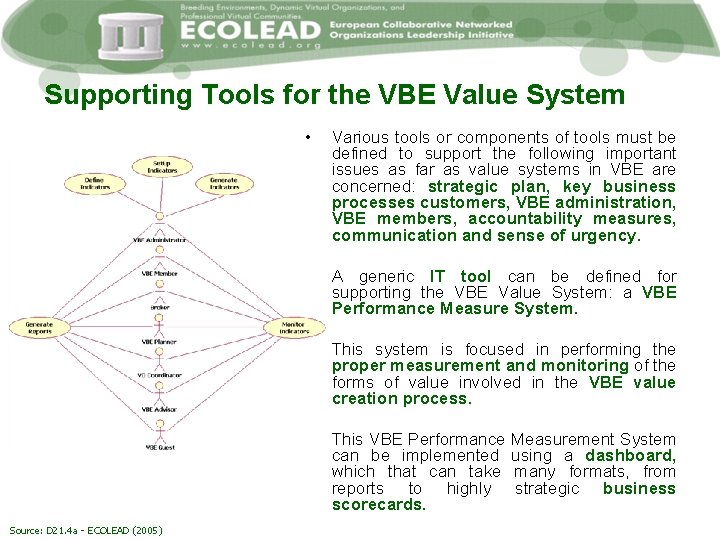
Supporting Tools for the VBE Value System Source: D 21. 4 a - ECOLEAD (2005) • Various tools or components of tools must be defined to support the following important issues as far as value systems in VBE are concerned: strategic plan, key business processes customers, VBE administration, VBE members, accountability measures, communication and sense of urgency. • A generic IT tool can be defined for supporting the VBE Value System: a VBE Performance Measure System. • This system is focused in performing the proper measurement and monitoring of the forms of value involved in the VBE value creation process. • This VBE Performance can be implemented which that can take reports to highly scorecards. Measurement System using a dashboard, many formats, from strategic business

THANK YOU FOR YOUR ATTENTION
References • ECOLEAD D 21. 4 - Romero, D. and Galeano, N. (ed. ) (2005). “Characterization of VBE Value System and Metrics”. ECOLEAD internal document deliverable 21. 4, • Lichiello, P. and Turnock B. J. . “Guidebook for Performance measurement”. Turning Point - Collaboration for a New Century in Public Health. 2002.
- Slides: 36