
Ecohydrological Forecasting Laurel Larsen laurelberkeley edu UC Berkeley

Ecohydrological Forecasting Laurel Larsen, laurel@berkeley. edu UC Berkeley
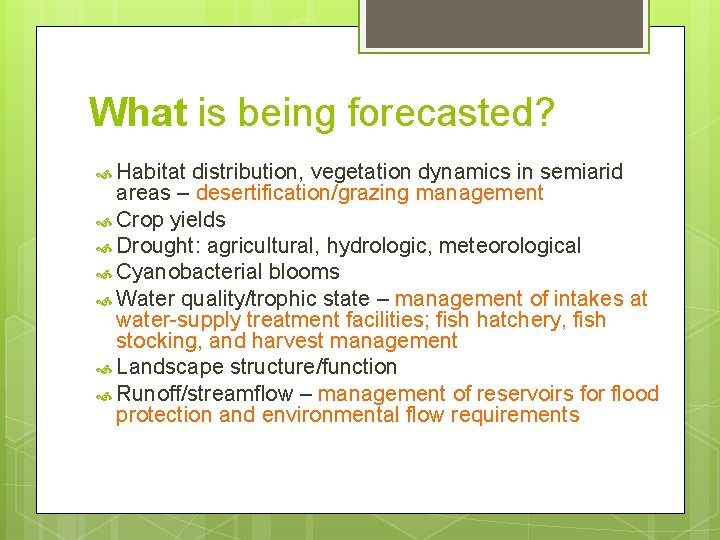
What is being forecasted? Habitat distribution, vegetation dynamics in semiarid areas – desertification/grazing management Crop yields Drought: agricultural, hydrologic, meteorological Cyanobacterial blooms Water quality/trophic state – management of intakes at water-supply treatment facilities; fish hatchery, fish stocking, and harvest management Landscape structure/function Runoff/streamflow – management of reservoirs for flood protection and environmental flow requirements
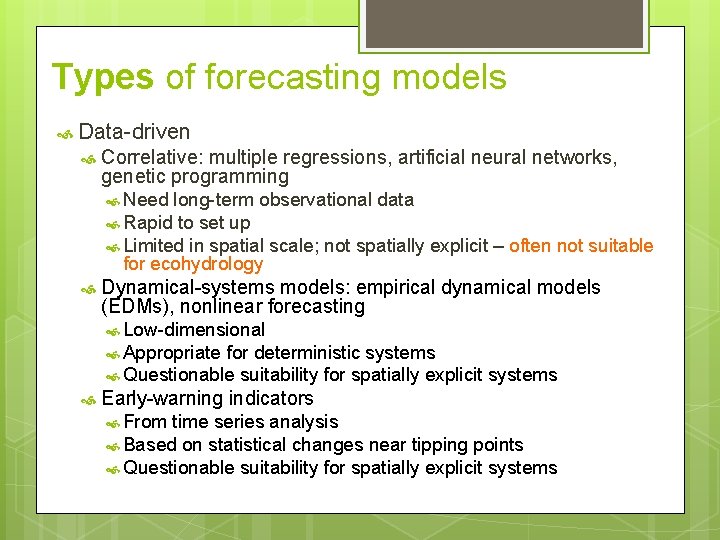
Types of forecasting models Data-driven Correlative: multiple regressions, artificial neural networks, genetic programming Need long-term observational data Rapid to set up Limited in spatial scale; not spatially explicit – often not suitable for ecohydrology Dynamical-systems models: empirical dynamical models (EDMs), nonlinear forecasting Low-dimensional Appropriate for deterministic systems Questionable suitability for spatially explicit systems Early-warning indicators From time series analysis Based on statistical changes near tipping points Questionable suitability for spatially explicit systems
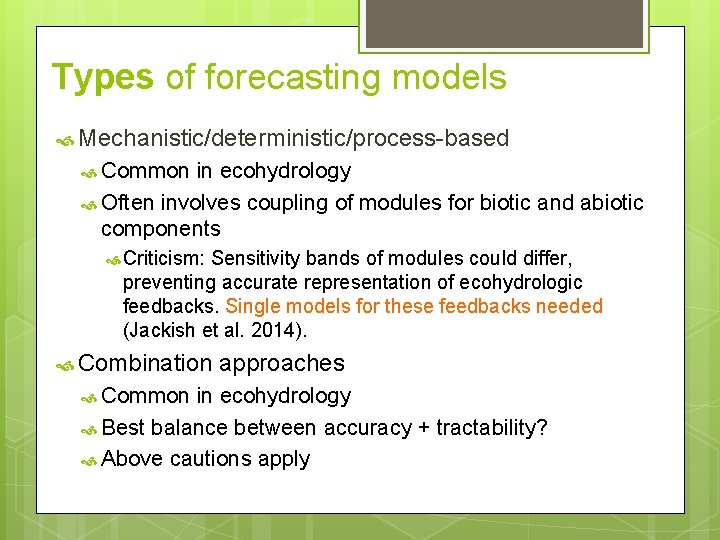
Types of forecasting models Mechanistic/deterministic/process-based Common in ecohydrology Often involves coupling of modules for biotic and abiotic components Criticism: Sensitivity bands of modules could differ, preventing accurate representation of ecohydrologic feedbacks. Single models for these feedbacks needed (Jackish et al. 2014). Combination Common approaches in ecohydrology Best balance between accuracy + tractability? Above cautions apply

Sawada et al. , Water Resour. Res. , 2014 Hydrologic models linked to vegetation models in drought forecasting
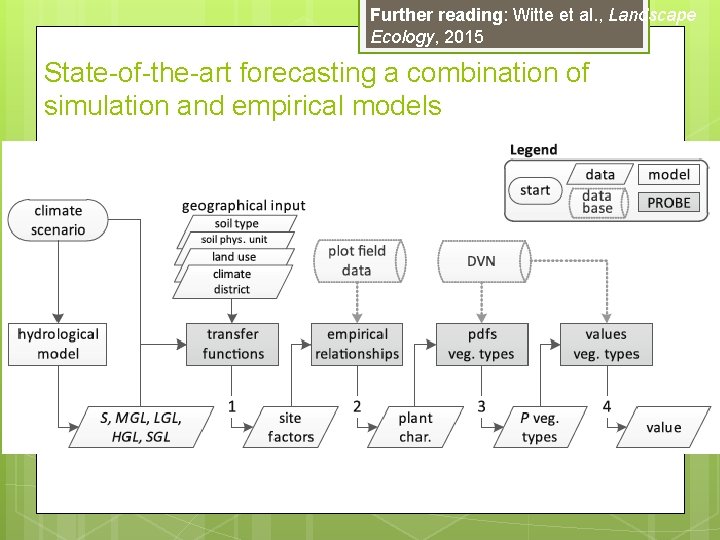
Further reading: Witte et al. , Landscape Ecology, 2015 State-of-the-art forecasting a combination of simulation and empirical models
Further reading: Witte et al. , Landscape Ecology, 2015 Challenges with Habitat Distribution Models (HDM) Relationships between climate and vegetation typically correlative and indirect Don’t work for hydroclimatic conditions with no current analogue Typically targeted for coarse-scale prediction (countries, continents) Predictor variables often not available on fine scales Often do not simulate key driving variables Groundwater Soil moisture
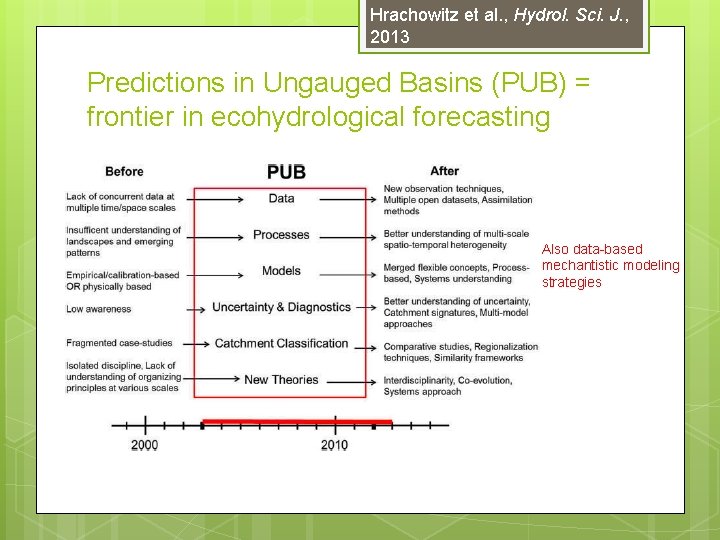
Hrachowitz et al. , Hydrol. Sci. J. , 2013 Predictions in Ungauged Basins (PUB) = frontier in ecohydrological forecasting Also data-based mechantistic modeling strategies
Further reading: Hrachowitz et al. , Hydrol. Sci. J. , 2013 Data-based forecasting methods in hydrology (hydroinformatics) Characterize baseflow recession through construction of nonlinear master curves Complete rainfall-runoff response of certain catchments can be described as simple firstorder nonlinear system. One equation, maximum of 4 parameters Parameters inferred from observed streamflow fluctuations Invertible to estimate spatially averaged precipitation and actual evapotranspiration
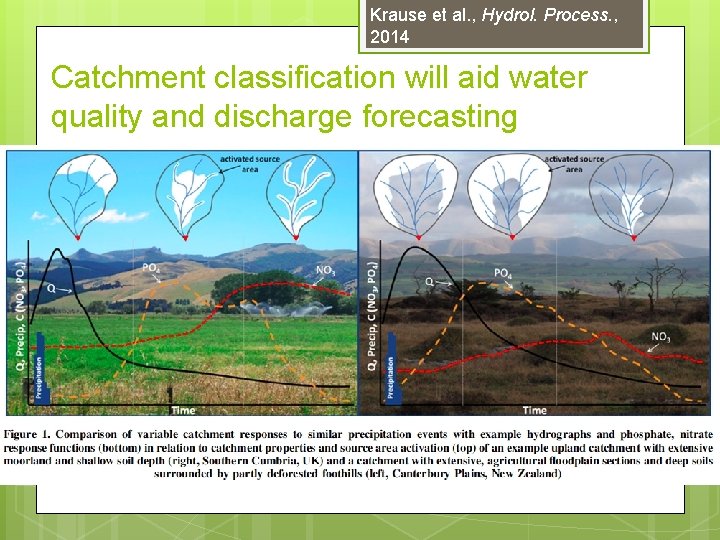
Krause et al. , Hydrol. Process. , 2014 Catchment classification will aid water quality and discharge forecasting
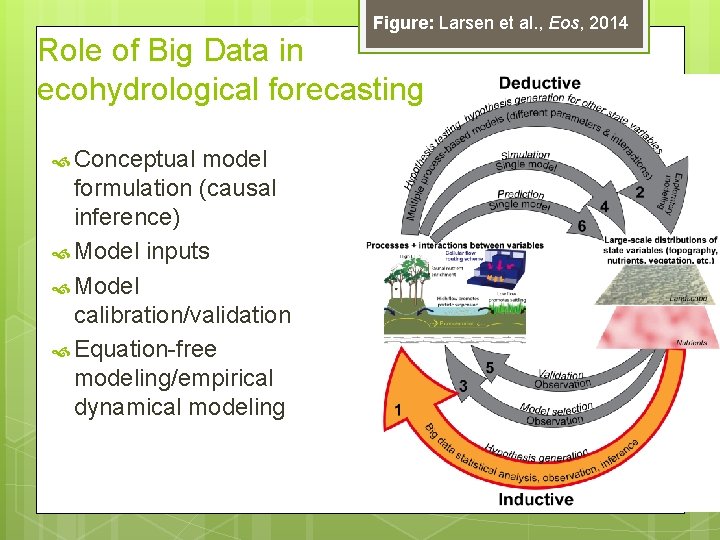
Figure: Larsen et al. , Eos, 2014 Role of Big Data in ecohydrological forecasting Conceptual model formulation (causal inference) Model inputs Model calibration/validation Equation-free modeling/empirical dynamical modeling
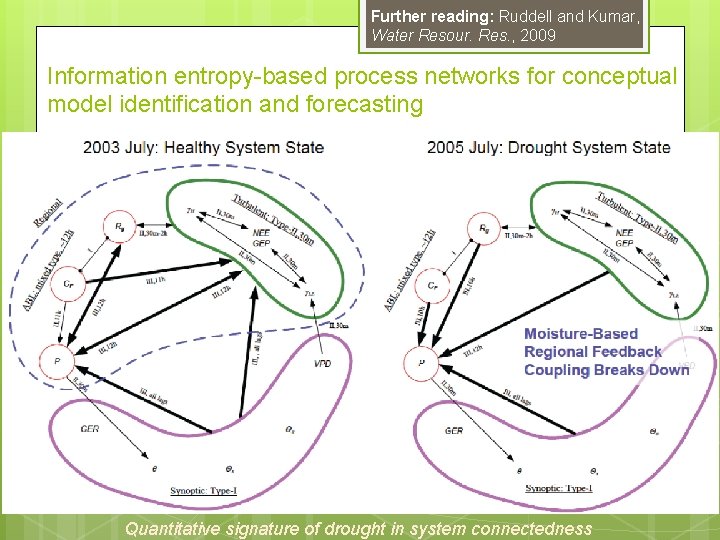
Further reading: Ruddell and Kumar, Water Resour. Res. , 2009 Information entropy-based process networks for conceptual model identification and forecasting Quantitative signature of drought in system connectedness
Forecasting and Big Data needs More focus on soil moisture, soil infiltration capacity, and groundwater (Jackish et al. 2014; Sawada et al. , 2014; Witte et al. , 2015) Discharge data of utmost importance – the more the better (Jackish et al. 2014) More water quality data (Krause et al. 2014) Improved methodologies for spatially explicit processes Dynamic spatial and temporal resolution of monitoring networks to capture “hot spots and hot moments” (Krause et al. , 2015) Long-term empirical forecasting methods? Integrated models of ecohydrologic feedbacks (Jackish et al. 2014) Better incorporation of human decisionmaking (Sawada et al. 2014) Sensors Models Land use Reservoir operations Culture of open science streamlining of scientific process (Peters et al. 2014) Improved data accessibility and data pooling (Hrachowitz et al. 2013; Hampton et al. 2013)
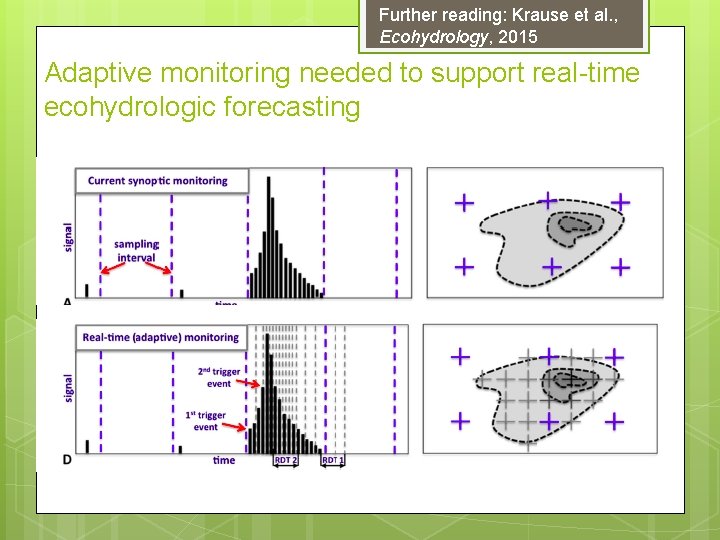
Further reading: Krause et al. , Ecohydrology, 2015 Adaptive monitoring needed to support real-time ecohydrologic forecasting
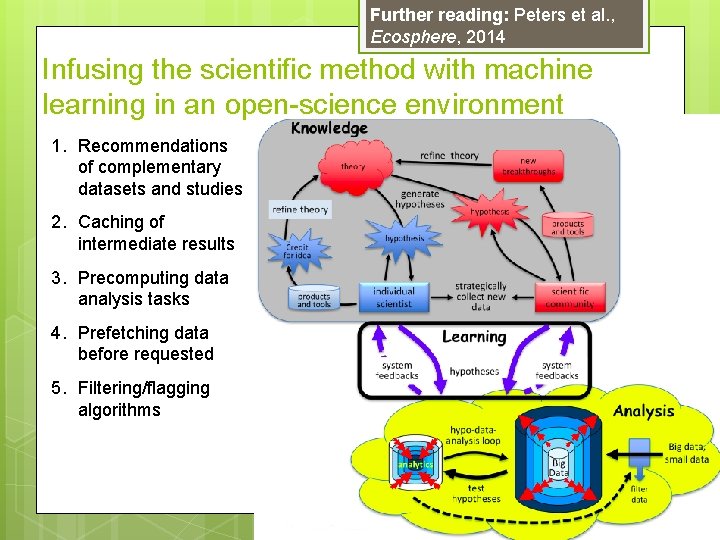
Further reading: Peters et al. , Ecosphere, 2014 Infusing the scientific method with machine learning in an open-science environment 1. Recommendations of complementary datasets and studies 2. Caching of intermediate results 3. Precomputing data analysis tasks 4. Prefetching data before requested 5. Filtering/flagging algorithms
Questions? Thanks to the Gordon and Betty Moore Foundation for support of LL through the Data-Driven Discovery Investigator Program! Credit: Scott Adams
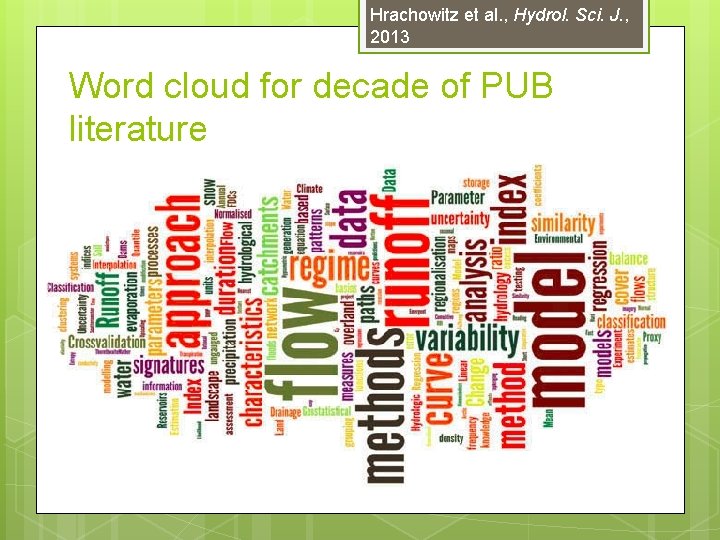
Hrachowitz et al. , Hydrol. Sci. J. , 2013 Word cloud for decade of PUB literature
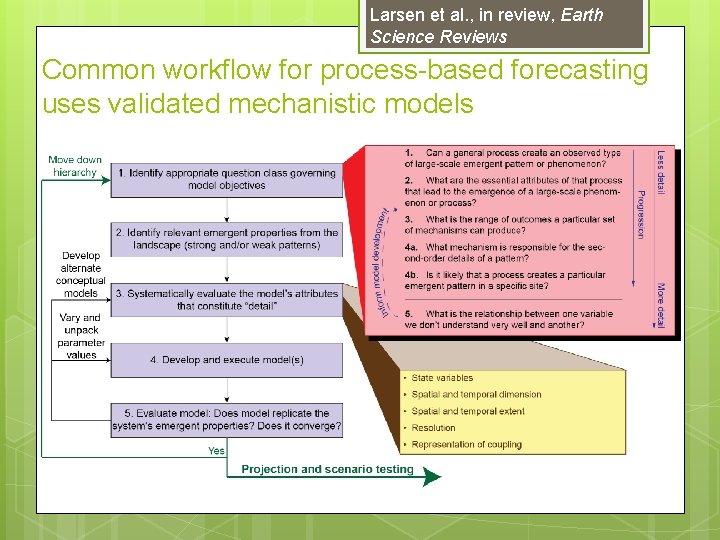
Larsen et al. , in review, Earth Science Reviews Common workflow for process-based forecasting uses validated mechanistic models
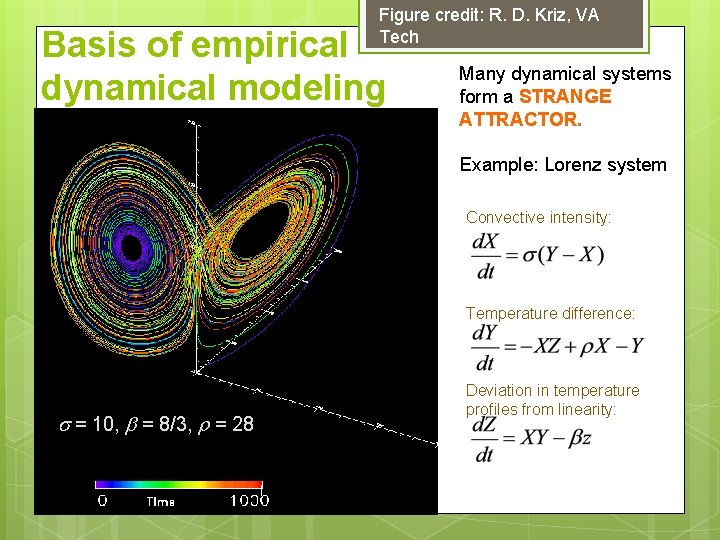
Figure credit: R. D. Kriz, VA Tech Basis of empirical dynamical modeling Many dynamical systems form a STRANGE ATTRACTOR. Example: Lorenz system Convective intensity: Temperature difference: s = 10, b = 8/3, r = 28 Deviation in temperature profiles from linearity:
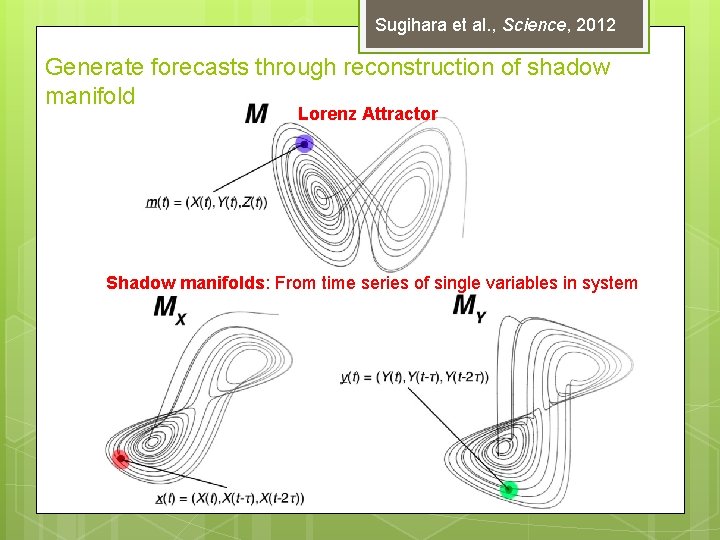
Sugihara et al. , Science, 2012 Generate forecasts through reconstruction of shadow manifold Lorenz Attractor Shadow manifolds: From time series of single variables in system
Further reading: Witte et al. , Landscape Ecology, 2015 Process-based models needed forecasting vegetation Availability of soil moisture for transpiration Groundwater levels and zones of recharge/discharge
- Slides: 21