
ECOFRIENDLY LINEAR MODULE THROUGH HYDROSTATIC BEARING CONFIGURATION Introduction
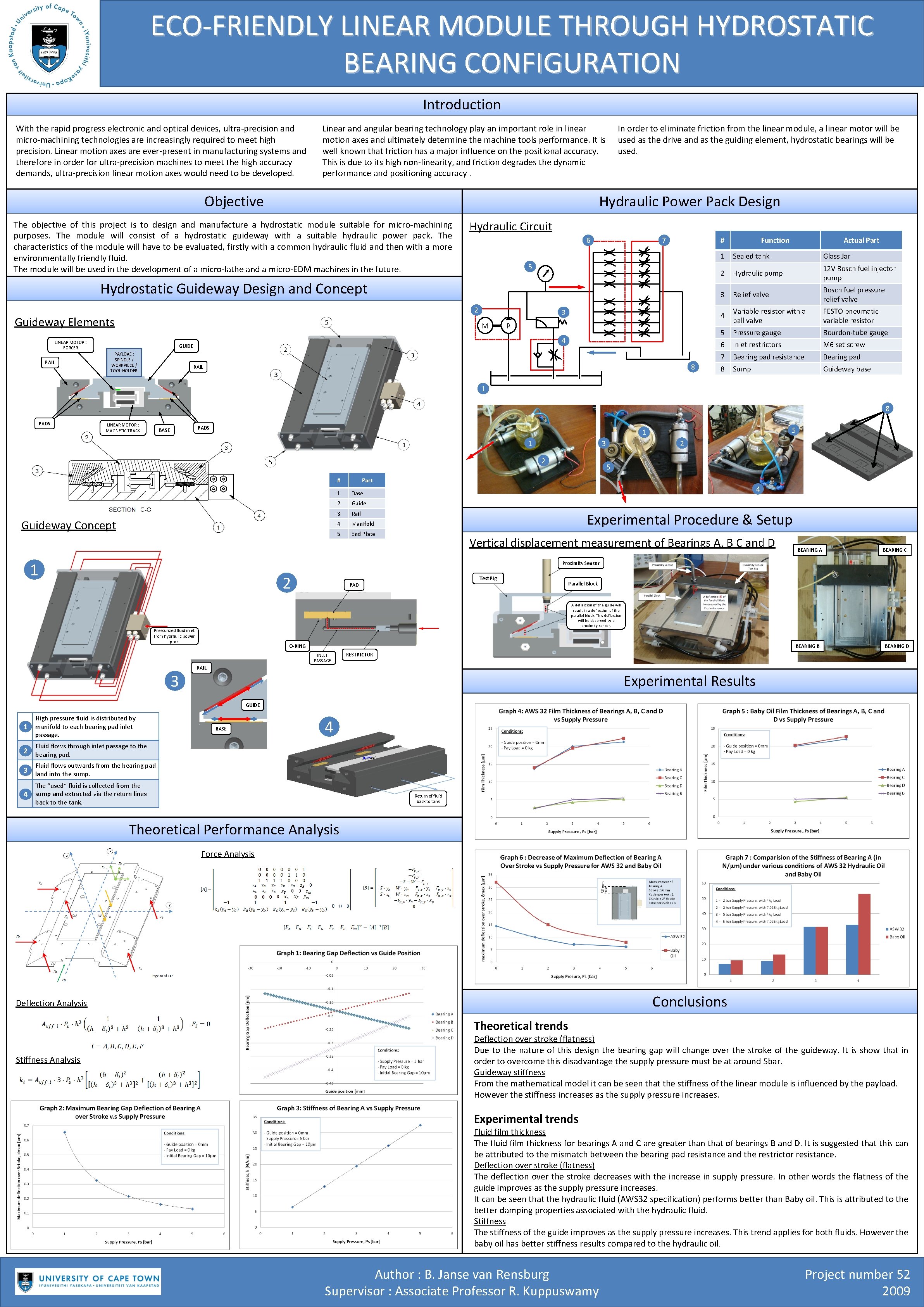
ECO-FRIENDLY LINEAR MODULE THROUGH HYDROSTATIC BEARING CONFIGURATION Introduction With the rapid progress electronic and optical devices, ultra-precision and micro-machining technologies are increasingly required to meet high precision. Linear motion axes are ever-present in manufacturing systems and therefore in order for ultra-precision machines to meet the high accuracy demands, ultra-precision linear motion axes would need to be developed. In order to eliminate friction from the linear module, a linear motor will be used as the drive and as the guiding element, hydrostatic bearings will be used. Linear and angular bearing technology play an important role in linear motion axes and ultimately determine the machine tools performance. It is well known that friction has a major influence on the positional accuracy. This is due to its high non-linearity, and friction degrades the dynamic performance and positioning accuracy. Objective Hydraulic Power Pack Design The objective of this project is to design and manufacture a hydrostatic module suitable for micro-machining purposes. The module will consist of a hydrostatic guideway with a suitable hydraulic power pack. The characteristics of the module will have to be evaluated, firstly with a common hydraulic fluid and then with a more environmentally friendly fluid. The module will be used in the development of a micro-lathe and a micro-EDM machines in the future. Hydraulic Circuit 6 7 # 5 Hydrostatic Guideway Design and Concept 2 Guideway Elements M LINEAR MOTOR : FORCER RAIL 3 P 4 GUIDE PAYLOAD: SPINDLE / WORKPIECE / TOOL HOLDER 8 RAIL Function Actual Part 1 Sealed tank Glass Jar 2 Hydraulic pump 12 V Bosch fuel injector pump 3 Relief valve Bosch fuel pressure relief valve 4 Variable resistor with a ball valve FESTO pneumatic variable resistor 5 Pressure gauge Bourdon-tube gauge 6 Inlet restrictors M 6 set screw 7 Bearing pad resistance Bearing pad 8 Sump Guideway base 1 8 PADS LINEAR MOTOR : MAGNETIC TRACK PADS BASE 5 1 1 3 2 # Guideway Concept 1 2 5 Part 1 Base 2 Guide 3 Rail 4 Manifold 5 End Plate 4 Experimental Procedure & Setup Vertical displacement measurement of Bearings A, B C and D BEARING A BEARING C Proximity Sensor 2 PAD Parallel Block A deflection of the guide will result in a deflection of the parallel block. This deflection will be observed by a proximity sensor. Pressurized fluid inlet from hydraulic power pack O-RING BEARING B INLET PASSAGE 3 Test Rig BEARING D RESTRICTOR RAIL Experimental Results GUIDE 11 High pressure fluid is distributed by manifold to each bearing pad inlet passage. 22 Fluid flows through inlet passage to the bearing pad. 33 Fluid flows outwards from the bearing pad land into the sump. 44 The “used” fluid is collected from the sump and extracted via the return lines back to the tank. BASE 4 Return of fluid back to tank Theoretical Performance Analysis Force Analysis Conclusions Deflection Analysis Theoretical trends Stiffness Analysis Deflection over stroke (flatness) Due to the nature of this design the bearing gap will change over the stroke of the guideway. It is show that in order to overcome this disadvantage the supply pressure must be at around 5 bar. Guideway stiffness From the mathematical model it can be seen that the stiffness of the linear module is influenced by the payload. However the stiffness increases as the supply pressure increases. Experimental trends Fluid film thickness The fluid film thickness for bearings A and C are greater than that of bearings B and D. It is suggested that this can be attributed to the mismatch between the bearing pad resistance and the restrictor resistance. Deflection over stroke (flatness) The deflection over the stroke decreases with the increase in supply pressure. In other words the flatness of the guide improves as the supply pressure increases. It can be seen that the hydraulic fluid (AWS 32 specification) performs better than Baby oil. This is attributed to the better damping properties associated with the hydraulic fluid. Stiffness The stiffness of the guide improves as the supply pressure increases. This trend applies for both fluids. However the baby oil has better stiffness results compared to the hydraulic oil. Author : B. Janse van Rensburg Supervisor : Associate Professor R. Kuppuswamy Project number 52 2009
- Slides: 1