
Ecodesign Directive and Its Impact on Product Development


- Slides: 31
Ecodesign Directive and Its Impact on Product Development Iain Notman Sustainable Energy Using Products 16 March 2011
Contents • Importance of product policy • Overview of Ecodesign Directive • Future measures • Ensuring compliance
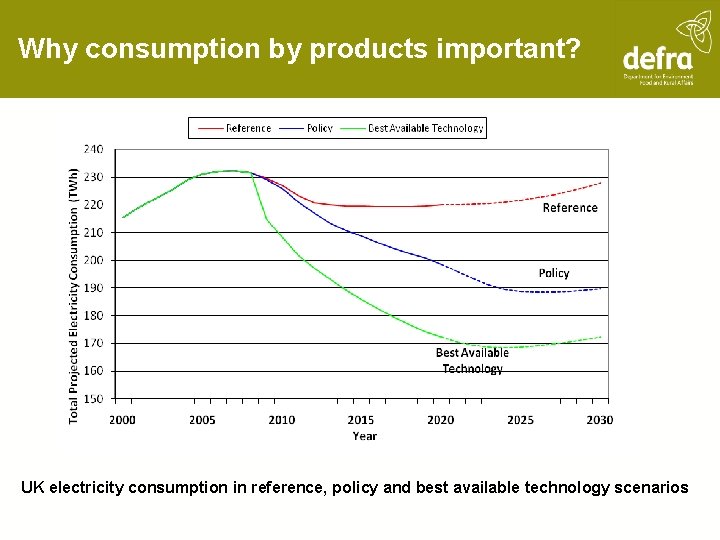
Why consumption by products important? UK electricity consumption in reference, policy and best available technology scenarios
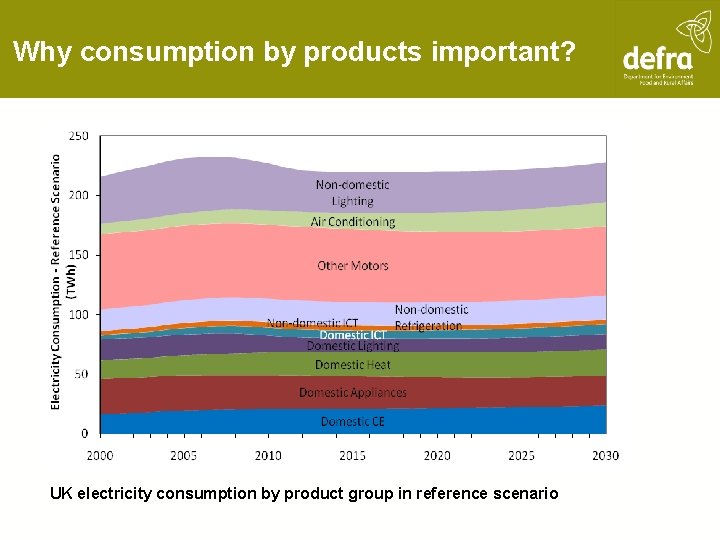
Why consumption by products important? UK electricity consumption by product group in reference scenario
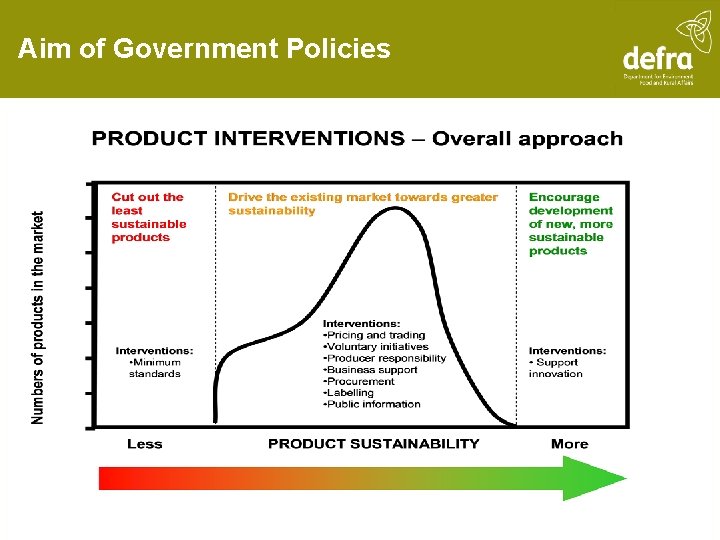
Aim of Government Policies
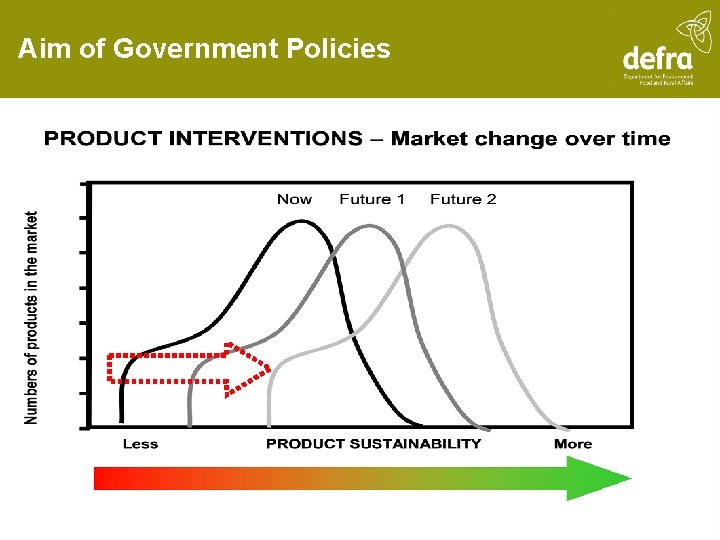
Aim of Government Policies
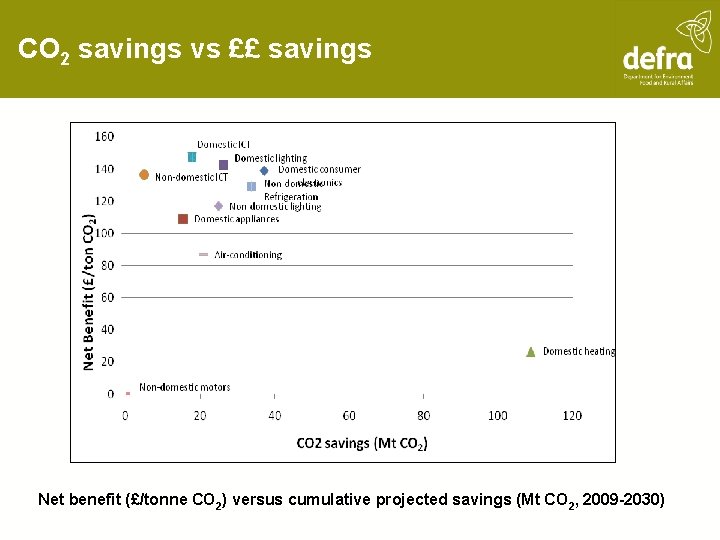
CO 2 savings vs ££ savings Net benefit (£/tonne CO 2) versus cumulative projected savings (Mt CO 2, 2009 -2030)
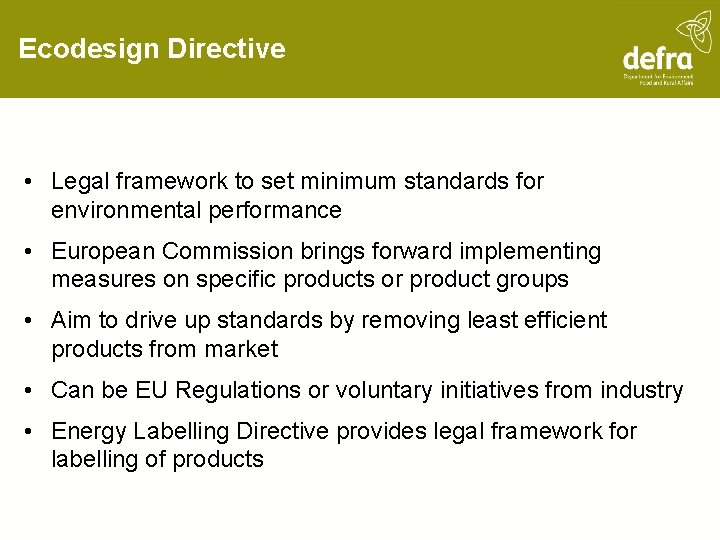
Ecodesign Directive • Legal framework to set minimum standards for environmental performance • European Commission brings forward implementing measures on specific products or product groups • Aim to drive up standards by removing least efficient products from market • Can be EU Regulations or voluntary initiatives from industry • Energy Labelling Directive provides legal framework for labelling of products
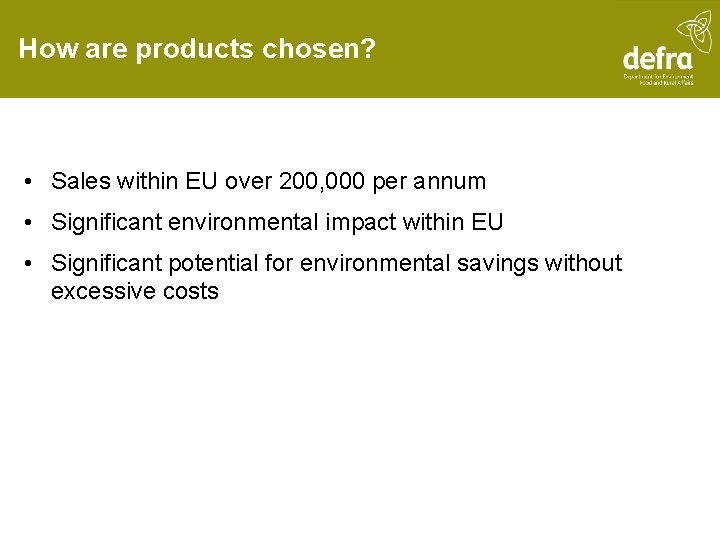
How are products chosen? • Sales within EU over 200, 000 per annum • Significant environmental impact within EU • Significant potential for environmental savings without excessive costs
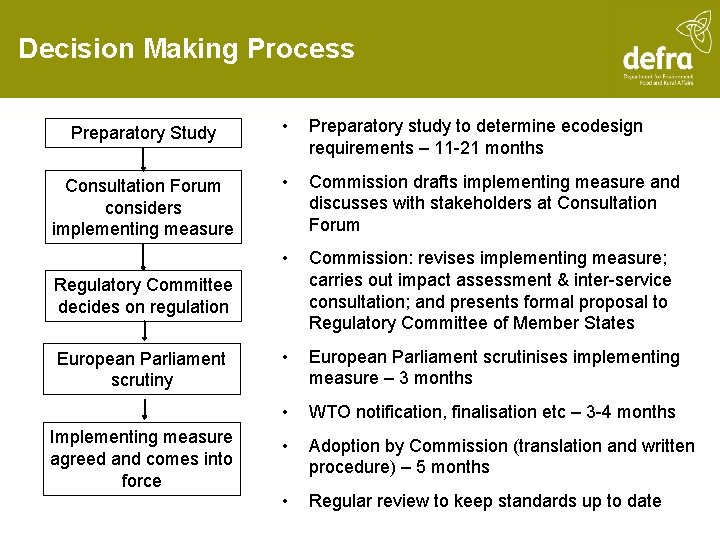
Decision Making Process Preparatory Study • Preparatory study to determine ecodesign requirements – 11 -21 months Consultation Forum considers implementing measure • Commission drafts implementing measure and discusses with stakeholders at Consultation Forum • Commission: revises implementing measure; carries out impact assessment & inter-service consultation; and presents formal proposal to Regulatory Committee of Member States • European Parliament scrutinises implementing measure – 3 months • WTO notification, finalisation etc – 3 -4 months • Adoption by Commission (translation and written procedure) – 5 months • Regular review to keep standards up to date Regulatory Committee decides on regulation European Parliament scrutiny Implementing measure agreed and comes into force
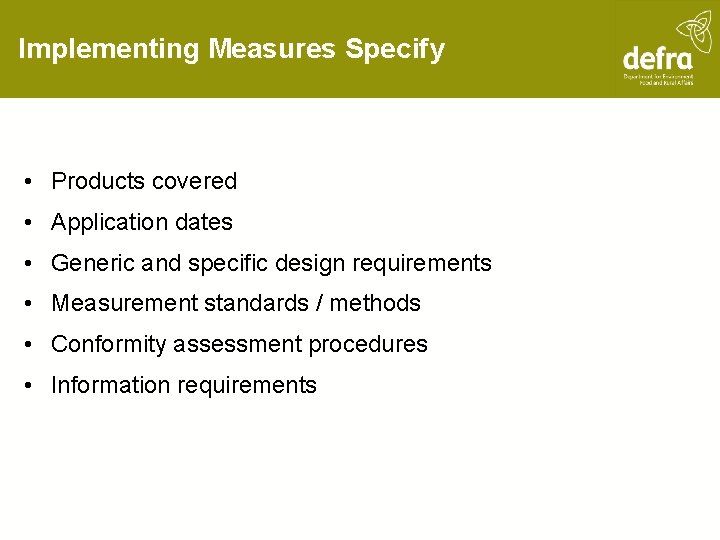
Implementing Measures Specify • Products covered • Application dates • Generic and specific design requirements • Measurement standards / methods • Conformity assessment procedures • Information requirements
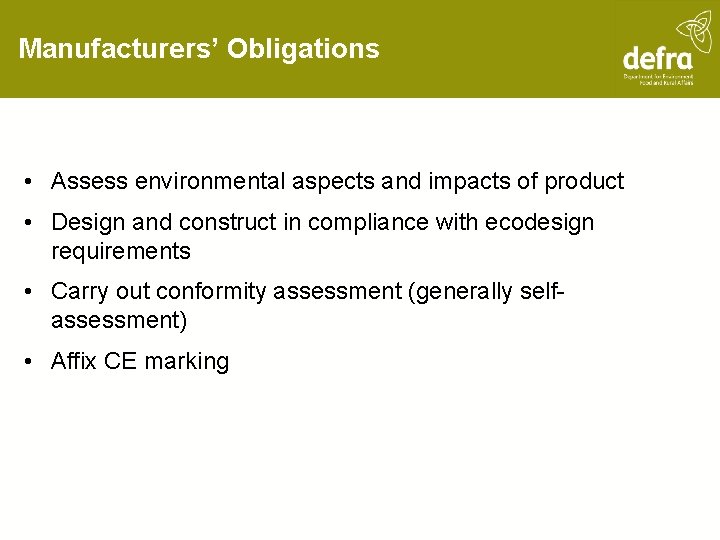
Manufacturers’ Obligations • Assess environmental aspects and impacts of product • Design and construct in compliance with ecodesign requirements • Carry out conformity assessment (generally selfassessment) • Affix CE marking
Voluntary Initiatives • Industry can propose voluntary initiatives as alternative to regulation • Commission decides whether to accept • UK Government favours voluntary initiatives when • Supported by industry • Market conditions correct • Sufficiently ambitious • Commission officials: • Recommending Commissioners accept proposed voluntary agreement for CSTBs • Carrying out impact assessment of proposed voluntary agreement for imaging equipment
Where Next for Ecodesign? • First phase: addressing electricity consumption of residential and tertiary sectors • Second phase: focusing on energy consumption of industrial sector • Where next?
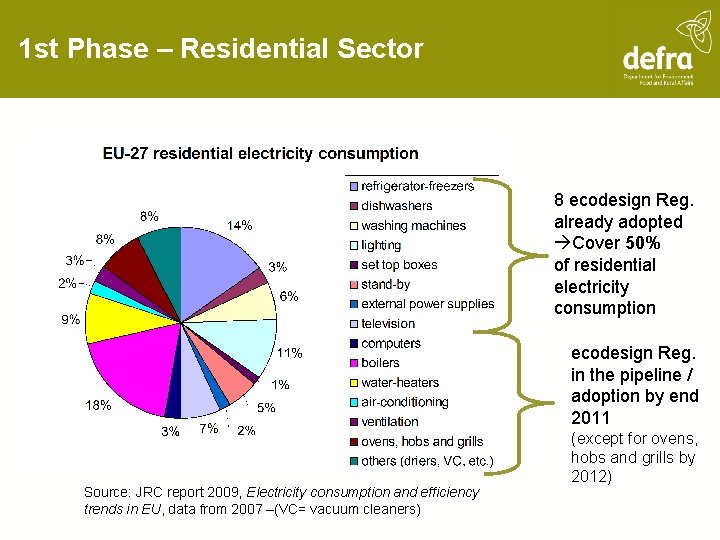
1 st Phase – Residential Sector 8 ecodesign Reg. already adopted Cover 50% of residential electricity consumption ecodesign Reg. in the pipeline / adoption by end 2011 Source: JRC report 2009, Electricity consumption and efficiency trends in EU, data from 2007 –(VC= vacuum cleaners) (except for ovens, hobs and grills by 2012)
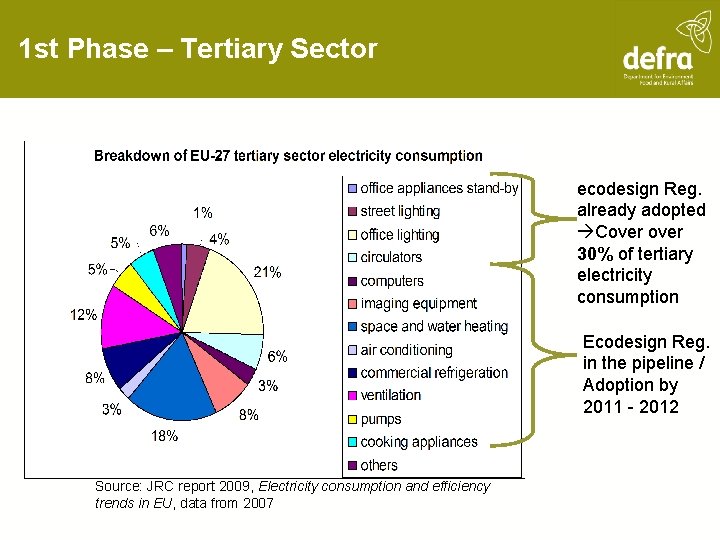
1 st Phase – Tertiary Sector ecodesign Reg. already adopted Cover 30% of tertiary electricity consumption Ecodesign Reg. in the pipeline / Adoption by 2011 - 2012 Source: JRC report 2009, Electricity consumption and efficiency trends in EU, data from 2007
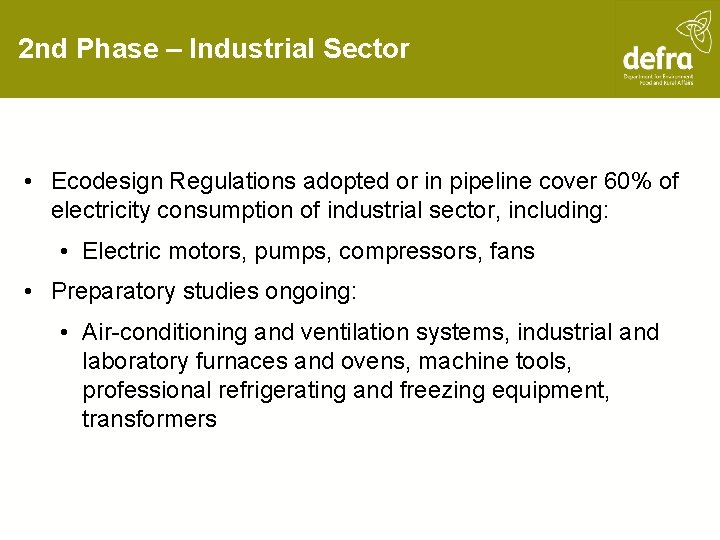
2 nd Phase – Industrial Sector • Ecodesign Regulations adopted or in pipeline cover 60% of electricity consumption of industrial sector, including: • Electric motors, pumps, compressors, fans • Preparatory studies ongoing: • Air-conditioning and ventilation systems, industrial and laboratory furnaces and ovens, machine tools, professional refrigerating and freezing equipment, transformers
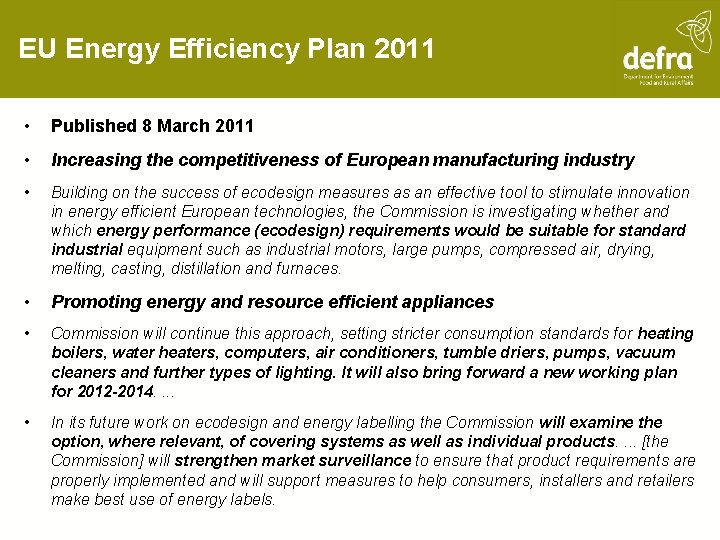
EU Energy Efficiency Plan 2011 • Published 8 March 2011 • Increasing the competitiveness of European manufacturing industry • Building on the success of ecodesign measures as an effective tool to stimulate innovation in energy efficient European technologies, the Commission is investigating whether and which energy performance (ecodesign) requirements would be suitable for standard industrial equipment such as industrial motors, large pumps, compressed air, drying, melting, casting, distillation and furnaces. • Promoting energy and resource efficient appliances • Commission will continue this approach, setting stricter consumption standards for heating boilers, water heaters, computers, air conditioners, tumble driers, pumps, vacuum cleaners and further types of lighting. It will also bring forward a new working plan for 2012 -2014. . • In its future work on ecodesign and energy labelling the Commission will examine the option, where relevant, of covering systems as well as individual products. . [the Commission] will strengthen market surveillance to ensure that product requirements are properly implemented and will support measures to help consumers, installers and retailers make best use of energy labels.
Building Blocks for Future 1. Independent evaluation of functioning of Directive • Due to end December 2011 2. Study to provide background information and analysis for (second) Working Plan • Due to end October 2011 3. Review and update of methodology for preparatory studies • Due to end September 2011
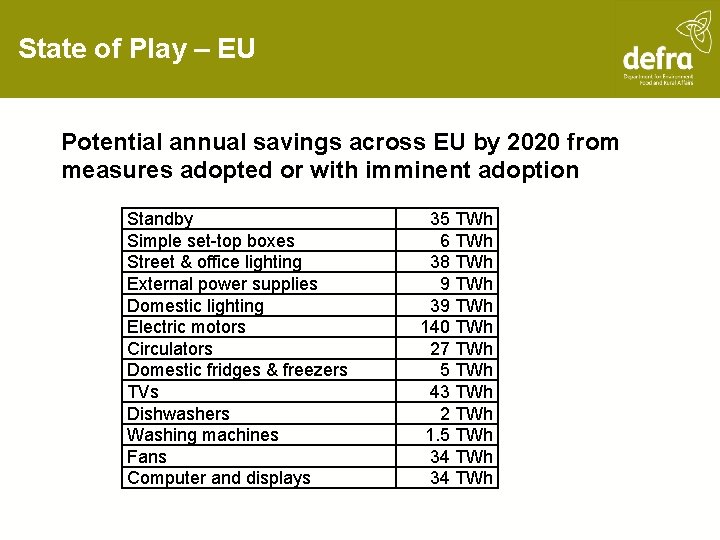
State of Play – EU Potential annual savings across EU by 2020 from measures adopted or with imminent adoption Standby Simple set-top boxes Street & office lighting External power supplies Domestic lighting Electric motors Circulators Domestic fridges & freezers TVs Dishwashers Washing machines Fans Computer and displays 35 TWh 6 TWh 38 TWh 9 TWh 39 TWh 140 TWh 27 TWh 5 TWh 43 TWh 2 TWh 1. 5 TWh 34 TWh
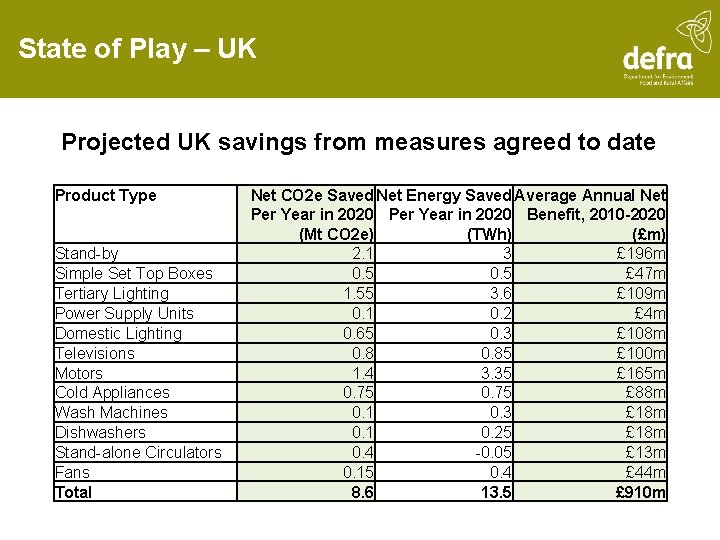
State of Play – UK Projected UK savings from measures agreed to date Product Type Stand-by Simple Set Top Boxes Tertiary Lighting Power Supply Units Domestic Lighting Televisions Motors Cold Appliances Wash Machines Dishwashers Stand-alone Circulators Fans Total Net CO 2 e Saved Net Energy Saved Average Annual Net Per Year in 2020 Benefit, 2010 -2020 (Mt CO 2 e) (TWh) (£m) 2. 1 3 £ 196 m 0. 5 £ 47 m 1. 55 3. 6 £ 109 m 0. 1 0. 2 £ 4 m 0. 65 0. 3 £ 108 m 0. 85 £ 100 m 1. 4 3. 35 £ 165 m 0. 75 £ 88 m 0. 1 0. 3 £ 18 m 0. 1 0. 25 £ 18 m 0. 4 -0. 05 £ 13 m 0. 15 0. 4 £ 44 m 8. 6 13. 5 £ 910 m
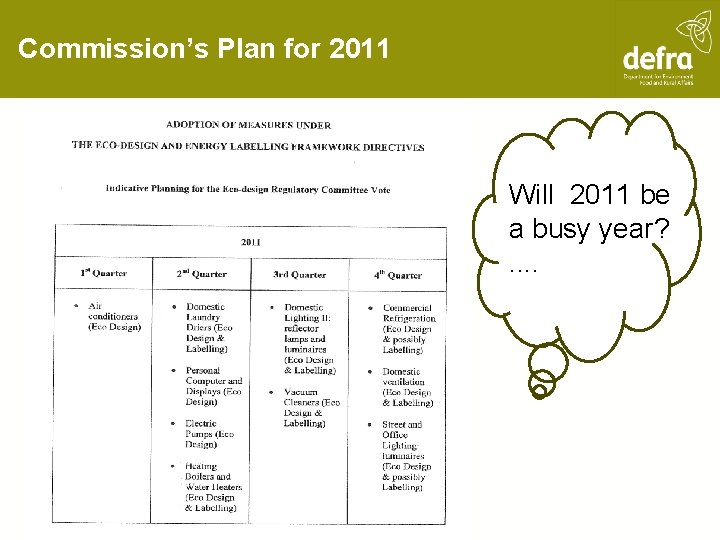
Commission’s Plan for 2011 Will 2011 be a busy year? . .
Energy Labelling Directive • Transposition deadline 20 June, proposing: • Single overarching UK SI – will revoke existing UK labelling regulations, and refer directly to EU delegated acts • Same enforcement regime (NMO for suppliers, TSOs for dealers), but with ASA monitoring advertising requirements • Considering introducing civil sanctions • First new labels will be mandatory from Nov/ Dec 2011 (dishwashers, washing machines, cold appliances, TVs)
Importance of Enforcement • Effective enforcement is essential to – Deliver desired economic and environmental benefits – Protect businesses from unfair competition – Ensure consumers benefit financial savings • Previously only criminal sanctions available • Aim to create more flexible and proportionate enforcement regime
UK Regulations • Ecodesign Regulations – Ecodesign Regulations 2010 transpose Ecodesign for Energy Related Products Directive (2009/125/EC) into UK law • Came into force – 20 November 2010 – Include civil sanctions and cost sharing • Labelling Regulations – Will introduce Regulations in 2011 to transpose Recast Energy Labelling Directive (2010/30/EU) – Will consider inclusion of civil sanctions and cost sharing
New Sanctions Regime • Aim to resolve non-compliance through informal collaborative processes • Where these fail, new civil sanctions available • Criminal penalties remain for most serious cases
Types of Civil Sanction • Compliance Notice: Written notice requiring actions to comply with law • Stop Notice: Written notice requiring end to activity causing harm or serious risk of harm • Enforcement Undertakings: Voluntary agreement to actions to address non-compliance • Variable Monetary Penalty: Monetary penalty which market surveillance authority may impose for more serious offence
Cost Sharing • Government initially funds all tests on product • If proven that product does not comply, can require business to reimburse all testing costs • Right of appeal to First Tier Tribunal against civil sanctions and cost sharing
Next Steps • Developing guidance on civil sanctions and cost sharing in consultation with stakeholders • Work with stakeholders to assess use of new sanctioning powers • Carry out formal review in two years
Ecodesign-ADCO • Administrative Cooperation for Market Surveillance Group for the Ecodesign Directive 2009/125/EC • Brings together MSAs from EU and others applying Ecodesign Directive • Discuss understanding of legislation to enable consistent approach • Share testing plans and results in confidence
• For further information: efficient. products@defra. gsi. gov. uk