
EcoAuditing Assessing sustainability impacts in design Spring 2021
Eco-Auditing: Assessing sustainability impacts in design Spring 2021 / Teaching Period III Tuesdays 12. 1. , 19. 1. & 26. 11. (13: 15 -16: 30) Teachers: Tatu Marttila (@aalto. fi) 12/24/2021 Sustainable Product & Service Design: Eco-Auditing 1
Course information & schedule 12/24/2021 Sustainable Product & Service Design: Eco-Auditing 2
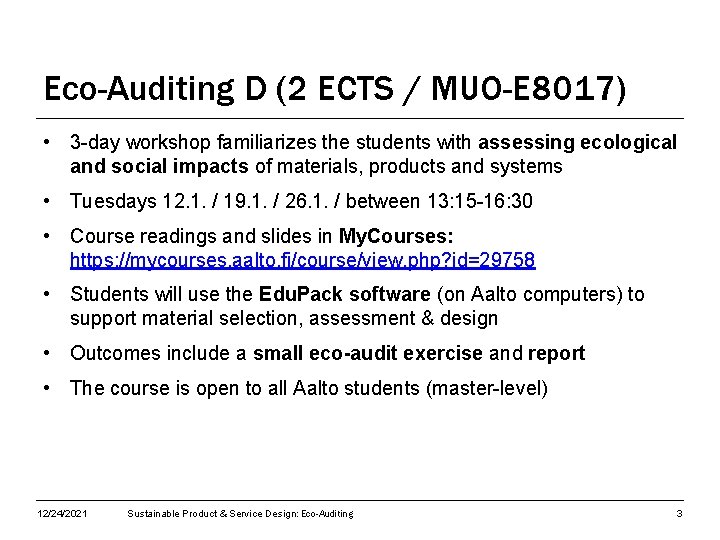
Eco-Auditing D (2 ECTS / MUO-E 8017) • 3 -day workshop familiarizes the students with assessing ecological and social impacts of materials, products and systems • Tuesdays 12. 1. / 19. 1. / 26. 1. / between 13: 15 -16: 30 • Course readings and slides in My. Courses: https: //mycourses. aalto. fi/course/view. php? id=29758 • Students will use the Edu. Pack software (on Aalto computers) to support material selection, assessment & design • Outcomes include a small eco-audit exercise and report • The course is open to all Aalto students (master-level) 12/24/2021 Sustainable Product & Service Design: Eco-Auditing 3
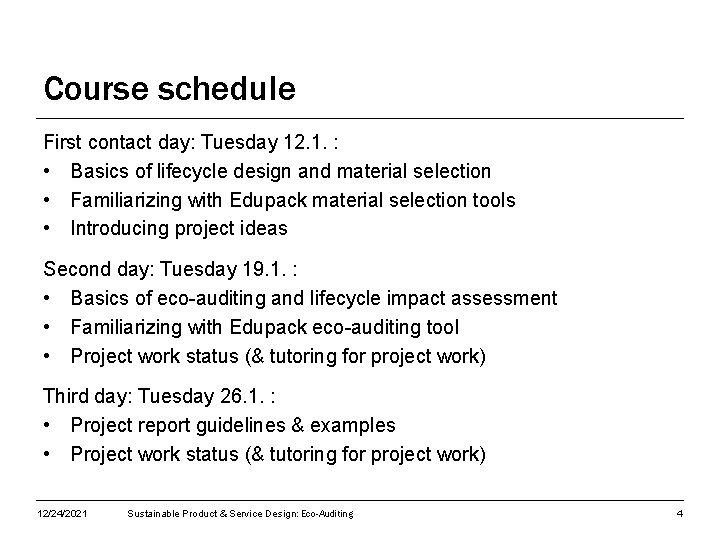
Course schedule First contact day: Tuesday 12. 1. : • Basics of lifecycle design and material selection • Familiarizing with Edupack material selection tools • Introducing project ideas Second day: Tuesday 19. 1. : • Basics of eco-auditing and lifecycle impact assessment • Familiarizing with Edupack eco-auditing tool • Project work status (& tutoring for project work) Third day: Tuesday 26. 1. : • Project report guidelines & examples • Project work status (& tutoring for project work) 12/24/2021 Sustainable Product & Service Design: Eco-Auditing 4
Final project work reports Final reports on project work due 21. 2. : • Around 5 -7 pages (or more) PDF document with: – Description of the project idea – Assessment of focus materials (system boundaries, material inventory, life phases) – Description of the eco-auditing process/comparison – Reflection on results • Can be essay-like document or presentation type • Example project reports presented on session 3 (26. 1. ) • Upload to course My. Courses after course! 12/24/2021 Sustainable Product & Service Design: Eco-Auditing 5
Granta Edupack program During remote working, to have access to Granta Edupack program: 1. Use Virtual Desktop to access Granta Edupack on Aalto online from your own laptop, this is easiest way to go but might be slow… See: https: //www. aalto. fi/en/services/vdiaaltofi-how-to-use-aaltovirtual-desktop-infrastructure 2. You can also download Granta Edupack from https: //download. aalto. fi/ (this works unfortunately only for PC computers, though Mac users could use Bootcamp or emulator to run Windows on Mac). 12/24/2021 Sustainable Product & Service Design: Eco-Auditing 6
12. 1. Eco-Auditing course: Ecodesign, life-cycle design and material selection strategies 12/24/2021 Sustainable Product & Service Design: Eco-Auditing 7
Material crisis 12/24/2021 Sustainable Product & Service Design: Eco-Auditing 8
Natural resources “Natural resources are materials, energy, and their attributes that are derived from the Earth and are useful or of value to the maintenance and improvement of the quality of human life. “ -Encyclopedia of life support systems Sustainable development is considering “ecosystem services” and “natural capital” as shared commodities, even across generations 12/24/2021 Sustainable Product & Service Design: Eco-Auditing 9
Renewable & non-renewable materials Renewable materials: • “refer to those resources that originate from storage of energy from sun by living organisms including plants, animals and humans. Providing that sufficient water, nutrients and sunshine are available, renewable resources can be grown in continuous cycles” • resources are rapidly renewable if the crop takes under three years to regrow, • annually renewable resources (the crops which grow and are harvested in one year) Non-renewable materials are those that do not renew at those speeds. Thus, also e. g. peat can be considered non-renewable. 12/24/2021 Sustainable Product & Service Design: Eco-Auditing 10
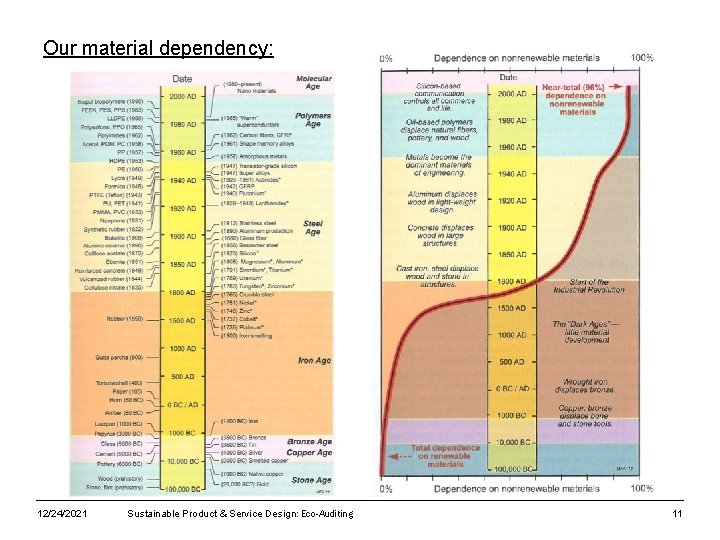
Our material dependency: 12/24/2021 Sustainable Product & Service Design: Eco-Auditing 11
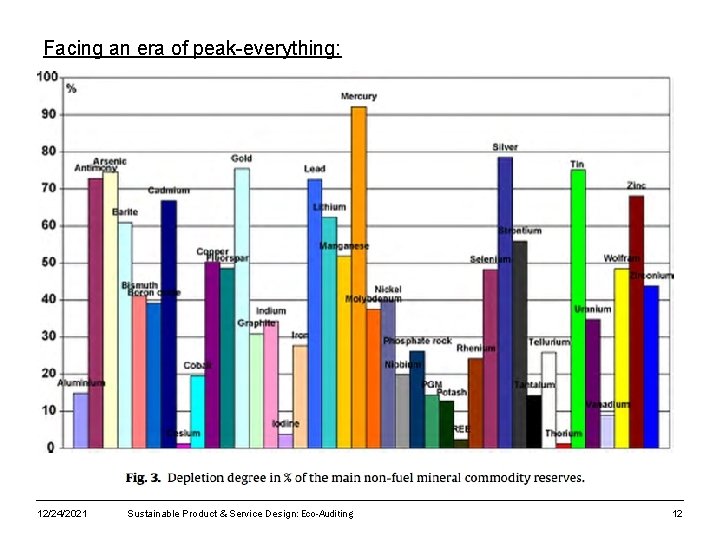
Facing an era of peak-everything: 12/24/2021 Sustainable Product & Service Design: Eco-Auditing 12
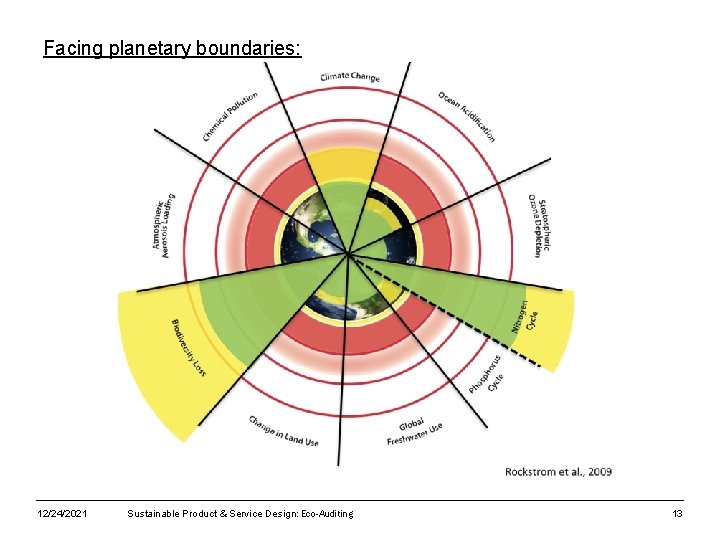
Facing planetary boundaries: 12/24/2021 Sustainable Product & Service Design: Eco-Auditing 13
Materials, design & sustainability 12/24/2021 Sustainable Product & Service Design: Eco-Auditing 14
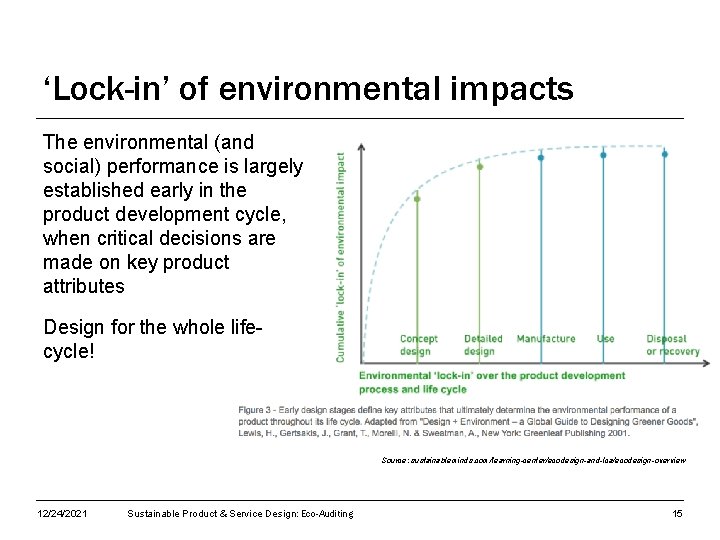
‘Lock-in’ of environmental impacts The environmental (and social) performance is largely established early in the product development cycle, when critical decisions are made on key product attributes Design for the whole lifecycle! Source: sustainableminds. com/learning-center/ecodesign-and-lca/ecodesign-overview 12/24/2021 Sustainable Product & Service Design: Eco-Auditing 15
Global material sources Relatively simple products can have parts from all around the world. Sometimes transporting goods is justifiable (complex products), but many times it’s not (food from abroad or other simple products). Some materials are more problematic than others. A lot of fossil fuels is used for transport of materials, components, and products. Sustainable design solutions acknowledge these dependencies. Material flows within a product or a system should be somehow identified. See e. g. Sourcemap https: //www. open. sourcemap. com/ 12/24/2021 Sustainable Product & Service Design: Eco-Auditing 16
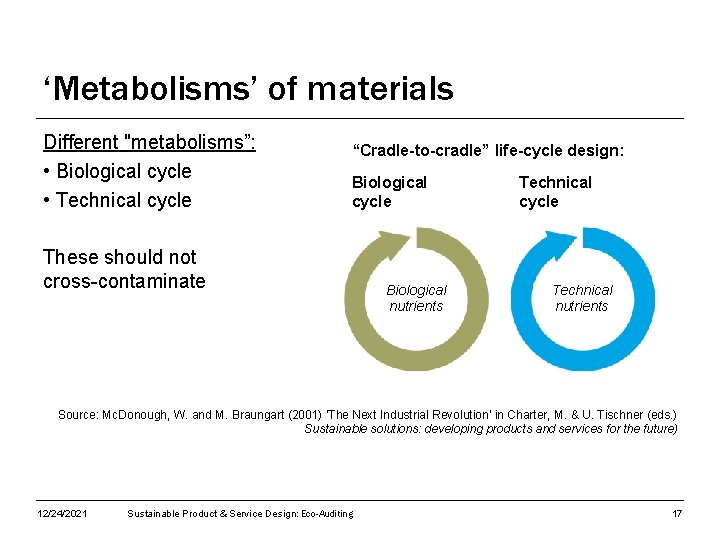
‘Metabolisms’ of materials Different "metabolisms”: • Biological cycle • Technical cycle “Cradle-to-cradle” life-cycle design: Biological cycle These should not cross-contaminate Biological nutrients Technical cycle Technical nutrients Source: Mc. Donough, W. and M. Braungart (2001) ‘The Next Industrial Revolution’ in Charter, M. & U. Tischner (eds. ) Sustainable solutions: developing products and services for the future) 12/24/2021 Sustainable Product & Service Design: Eco-Auditing 17
Closing the loops for material flows Correct cycling of materials: Organic waste cannot be tossed to landfill, where it cannot build new soil. Depositing synthetic materials and chemicals in natural systems, on the other hand, harms environment. Technical nutrients should be designed to go back into the technical cycle in such a manner that it allows materials to retain their quality, and that they are not contaminating the biological cycle. Source: Mc. Donough, W. and M. Braungart (2001) ‘The Next Industrial Revolution’ in Charter, M. & U. Tischner (eds. ) Sustainable solutions: developing products and services for the future) 12/24/2021 Sustainable Product & Service Design: Eco-Auditing 18
Material impacts and life-cycle design & assessment (LCA) 12/24/2021 Sustainable Product & Service Design: Eco-Auditing 19
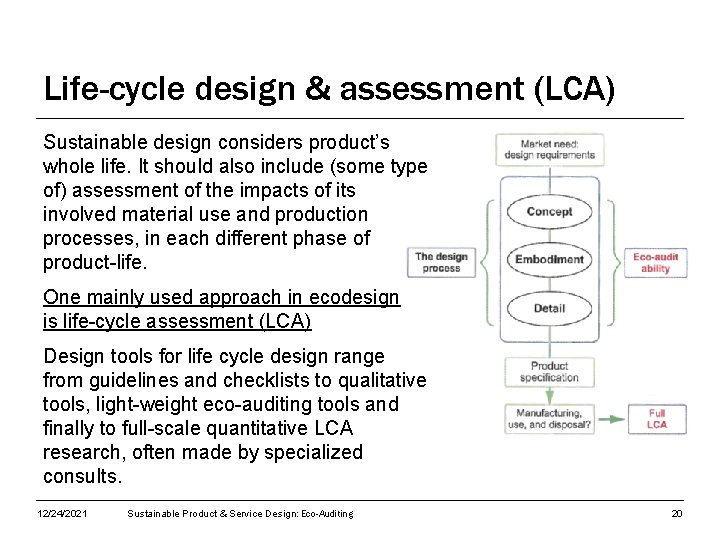
Life-cycle design & assessment (LCA) Sustainable design considers product’s whole life. It should also include (some type of) assessment of the impacts of its involved material use and production processes, in each different phase of product-life. One mainly used approach in ecodesign is life-cycle assessment (LCA) Design tools for life cycle design range from guidelines and checklists to qualitative tools, light-weight eco-auditing tools and finally to full-scale quantitative LCA research, often made by specialized consults. 12/24/2021 Sustainable Product & Service Design: Eco-Auditing 20
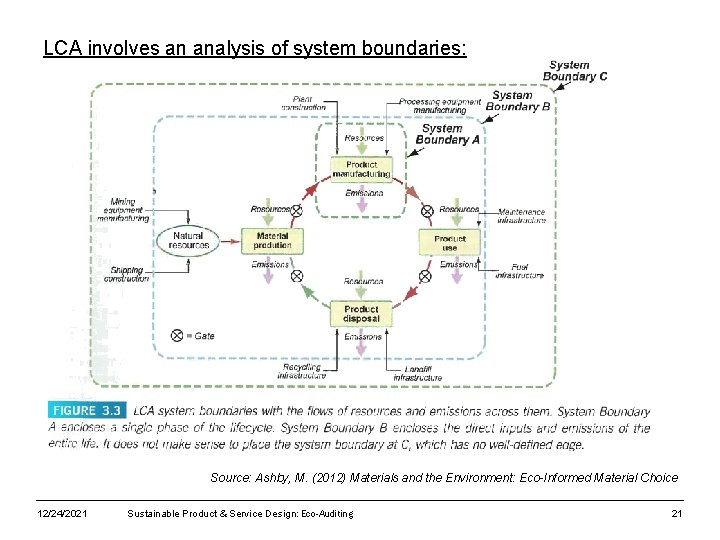
LCA involves an analysis of system boundaries: Source: Ashby, M. (2012) Materials and the Environment: Eco-Informed Material Choice 12/24/2021 Sustainable Product & Service Design: Eco-Auditing 21
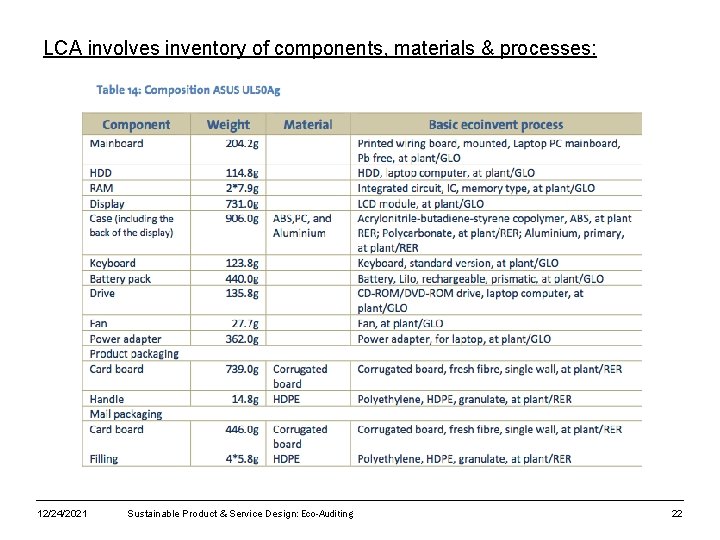
LCA involves inventory of components, materials & processes: 12/24/2021 Sustainable Product & Service Design: Eco-Auditing 22
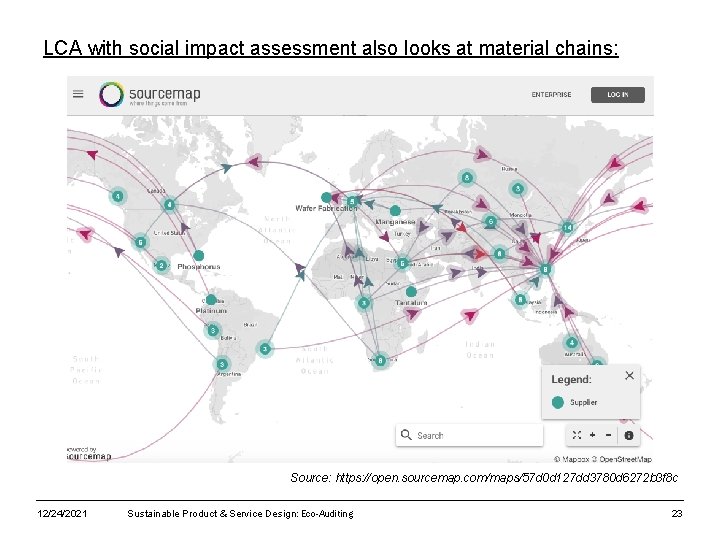
LCA with social impact assessment also looks at material chains: Source: https: //open. sourcemap. com/maps/57 d 0 d 127 dd 3780 d 6272 b 3 f 8 c 12/24/2021 Sustainable Product & Service Design: Eco-Auditing 23
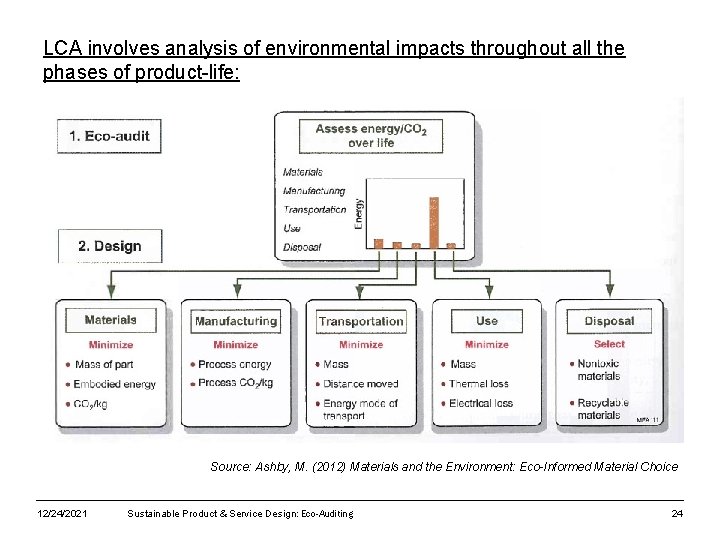
LCA involves analysis of environmental impacts throughout all the phases of product-life: Source: Ashby, M. (2012) Materials and the Environment: Eco-Informed Material Choice 12/24/2021 Sustainable Product & Service Design: Eco-Auditing 24
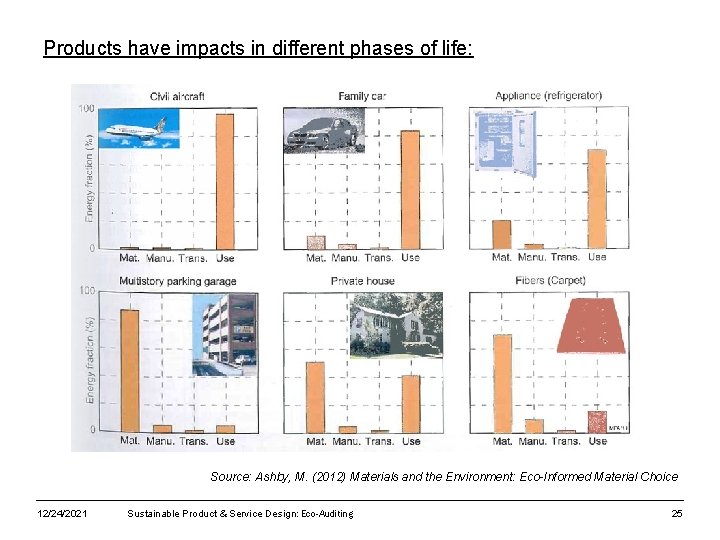
Products have impacts in different phases of life: Source: Ashby, M. (2012) Materials and the Environment: Eco-Informed Material Choice 12/24/2021 Sustainable Product & Service Design: Eco-Auditing 25
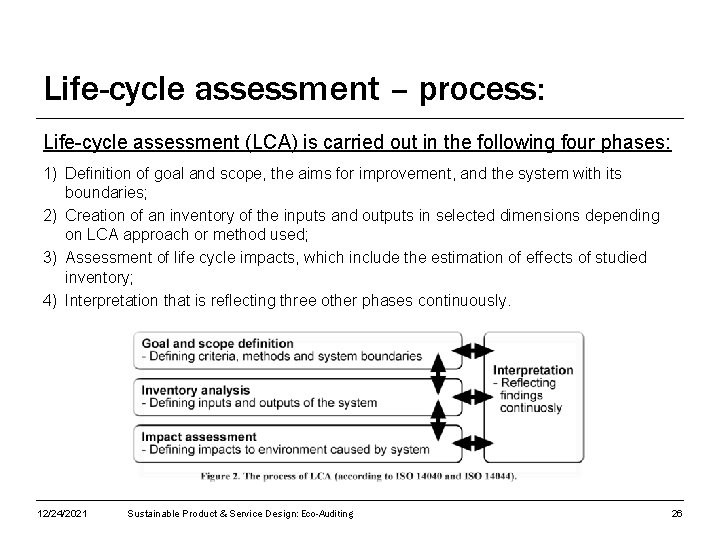
Life-cycle assessment – process: Life-cycle assessment (LCA) is carried out in the following four phases: 1) Definition of goal and scope, the aims for improvement, and the system with its boundaries; 2) Creation of an inventory of the inputs and outputs in selected dimensions depending on LCA approach or method used; 3) Assessment of life cycle impacts, which include the estimation of effects of studied inventory; 4) Interpretation that is reflecting three other phases continuously. 12/24/2021 Sustainable Product & Service Design: Eco-Auditing 26
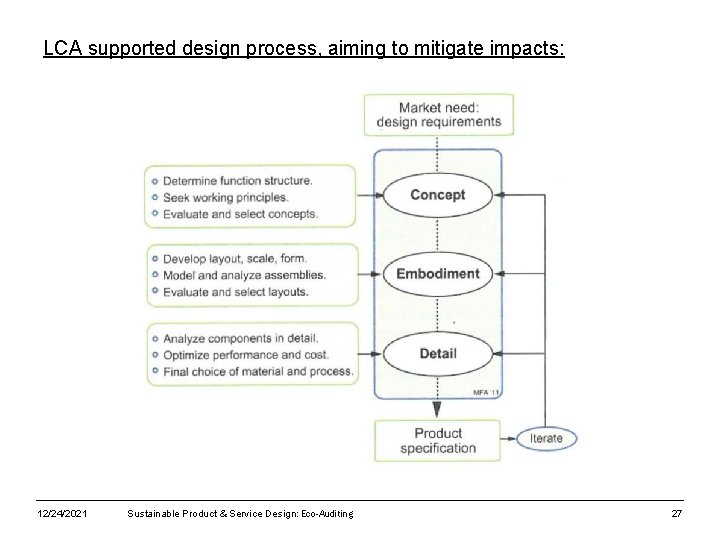
LCA supported design process, aiming to mitigate impacts: 12/24/2021 Sustainable Product & Service Design: Eco-Auditing 27
Ecodesign as a design strategy 12/24/2021 Sustainable Product & Service Design: Eco-Auditing 28
Simplified life-cycle assessment (SLCA) The methodologies used in LCA process can be divided in approaches utilizing quantitative, semi-quantitative or qualitative life-cycle assessment methods and data. (Wenzel, H. 1998) Simplified, or streamlined LCA (SLCA) is divided also in semiquantitative and qualitative strategies, including input-output tools and matrix approaches. Commonly, SLCA tools often emphasize general values over specific numbers from a specific assessment. Many of them can also combine quantitative and qualitative aspects 12/24/2021 Sustainable Product & Service Design: Eco-Auditing 29
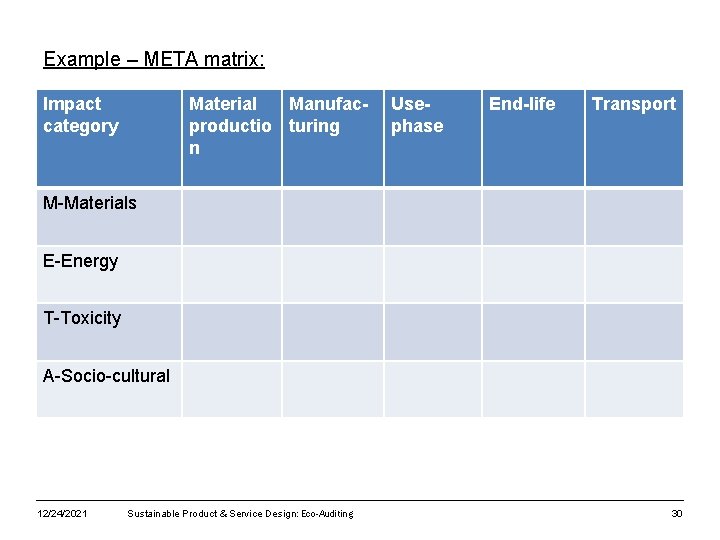
Example – META matrix: Impact category Material Manufacproductio turing n Usephase End-life Transport M-Materials E-Energy T-Toxicity A-Socio-cultural 12/24/2021 Sustainable Product & Service Design: Eco-Auditing 30
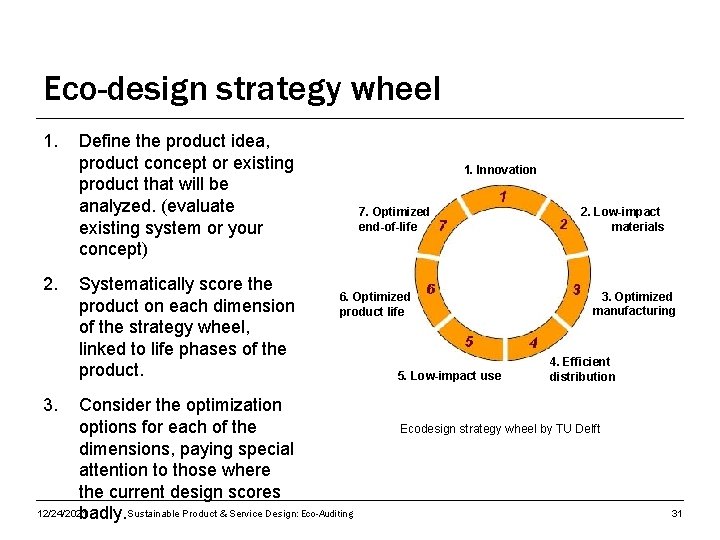
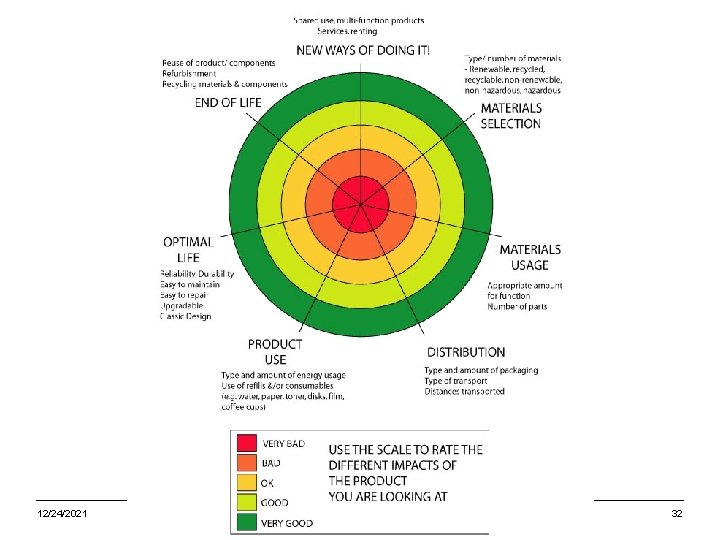
Eco-design strategy wheel 1. 2. Define the product idea, product concept or existing product that will be analyzed. (evaluate existing system or your concept) Systematically score the product on each dimension of the strategy wheel, linked to life phases of the product. 1. Innovation 7. Optimized end-of-life 6. Optimized product life 5. Low-impact use 2. Low-impact materials 3. Optimized manufacturing 4. Efficient distribution 3. Consider the optimization options for each of the dimensions, paying special attention to those where the current design scores 12/24/2021 badly. Sustainable Product & Service Design: Eco-Auditing Ecodesign strategy wheel by TU Delft 31
12/24/2021 Sustainable Product & Service Design: Eco-Auditing 32
Design for: 1. Innovation § Rethink how to provide the benefit § Serve needs provided by associated products § Anticipate technological change and build in flexibility § Provide product as service § Share among more users § Design to mimic nature § Use living organisms in product 12/24/2021 Sustainable Product & Service Design: Eco-Auditing 33
Design for: 2. Low-impact materials § Avoid materials that damage human health, ecological health, or deplete resources § Use minimal materials § Use renewable resources § Use waste by-products § Use thoroughly tested materials § Use recycled or reused materials 12/24/2021 Sustainable Product & Service Design: Eco-Auditing 34
Design for: 3. Optimized manufacturing § Design for ease of production quality control § Minimize manufacturing waste § Minimize energy in production § Minimize number of production methods and operations § Minimize number of components/materials 12/24/2021 Sustainable Product & Service Design: Eco-Auditing 35
Design for: 4. Efficient distribution § Reduce product and packaging waste § Use reusable or recyclable packaging § Use an efficient transport system § Use local production and assembly 12/24/2021 Sustainable Product & Service Design: Eco-Auditing 36
Design for: 5. Low-impact use § Minimize emissions/integrate cleaner or renewable energy sources § Reduce energy inefficiencies § Reduce water use inefficiencies § Reduce material use inefficiencies 12/24/2021 Sustainable Product & Service Design: Eco-Auditing 37
Design for: 6. Optimized product lifetime § Build in user’s desire to care for product long term § Design for take-back programmes § Build in durability § Design for maintenance and easy repair § Design for upgrades § Design for second life with different function § Create timeless look or fashion 12/24/2021 Sustainable Product & Service Design: Eco-Auditing 38
Design for: 7. Optimized end-of-life § Integrate methods for product collection § Provide for ease of disassembly § Provide for recycling or downcycling § Design reuse, or ‘next life of product’ § Provide for reuse of components § Provide ability to biodegrade § Provide for safe disposal 12/24/2021 Sustainable Product & Service Design: Eco-Auditing 39
Granta Edupack program 12/24/2021 Sustainable Product & Service Design: Eco-Auditing 40
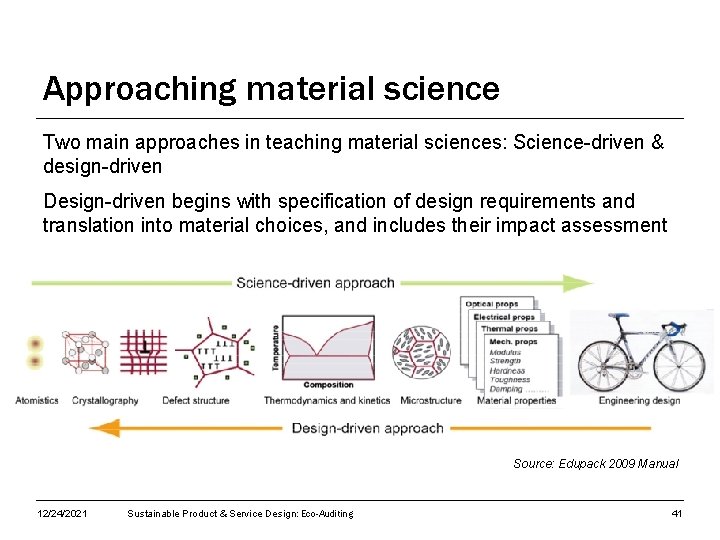
Approaching material science Two main approaches in teaching material sciences: Science-driven & design-driven Design-driven begins with specification of design requirements and translation into material choices, and includes their impact assessment Source: Edupack 2009 Manual 12/24/2021 Sustainable Product & Service Design: Eco-Auditing 41
Material science & design Design-driven approach has its main focus on material selection and impact assessment. Specification of design requirements and translation into material choices: • General properties (price, mass, density) • Physical properties (strength, insulation, etc. ) Assessing impacts of materials and processes: • Impacts of production (embodied energy, CO 2 footprint, etc. ) • Impacts of use & end-of-life (scenarios) • Social hotspots & impacts (demographic data) Source: Edupack 2009 Manual 12/24/2021 Sustainable Product & Service Design: Eco-Auditing 42
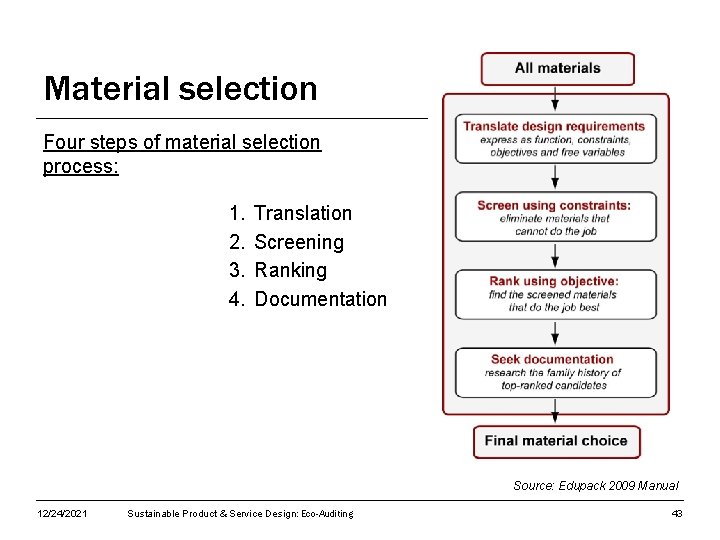
Material selection Four steps of material selection process: 1. 2. 3. 4. Translation Screening Ranking Documentation Source: Edupack 2009 Manual 12/24/2021 Sustainable Product & Service Design: Eco-Auditing 43
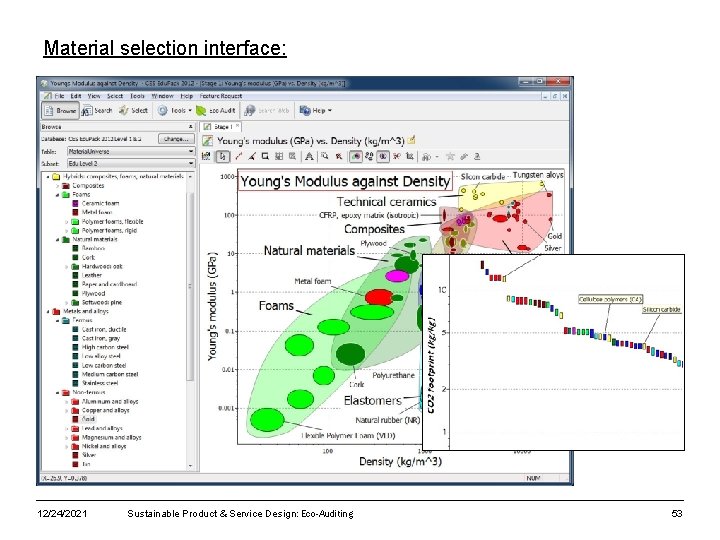
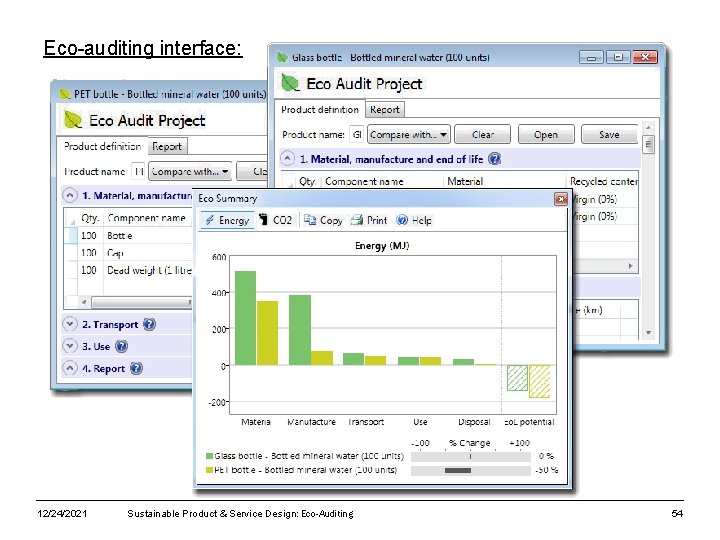
Granta Edupack program Granta’s Edupack Tool (previously CES Edupack, Cambridge Engineering Selector) is a program with database that have information tables on legislation & regulations, materials, processes, nations and even many producers. It can be used to easily find information and compare different materials and to assist in material selection. It can be also used to assess products’ impacts on both environmental and to some extent on societal dimensions (or system parts like service elements). On Aalto computers! 12/24/2021 Sustainable Product & Service Design: Eco-Auditing 44
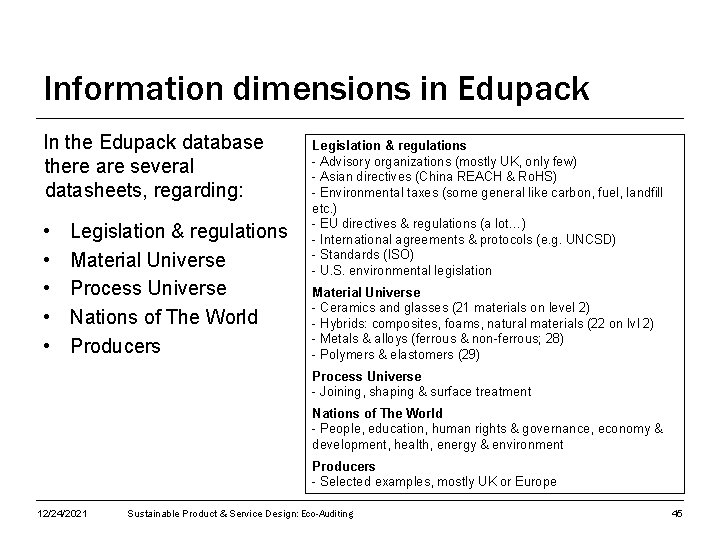
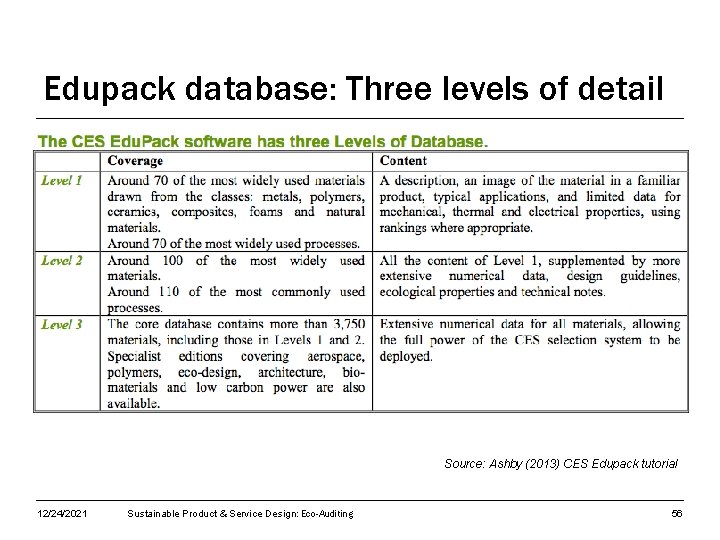
Information dimensions in Edupack In the Edupack database there are several datasheets, regarding: • • • Legislation & regulations Material Universe Process Universe Nations of The World Producers Legislation & regulations - Advisory organizations (mostly UK, only few) - Asian directives (China REACH & Ro. HS) - Environmental taxes (some general like carbon, fuel, landfill etc. ) - EU directives & regulations (a lot…) - International agreements & protocols (e. g. UNCSD) - Standards (ISO) - U. S. environmental legislation Material Universe - Ceramics and glasses (21 materials on level 2) - Hybrids: composites, foams, natural materials (22 on lvl 2) - Metals & alloys (ferrous & non-ferrous; 28) - Polymers & elastomers (29) Process Universe - Joining, shaping & surface treatment Nations of The World - People, education, human rights & governance, economy & development, health, energy & environment Producers - Selected examples, mostly UK or Europe 12/24/2021 Sustainable Product & Service Design: Eco-Auditing 45
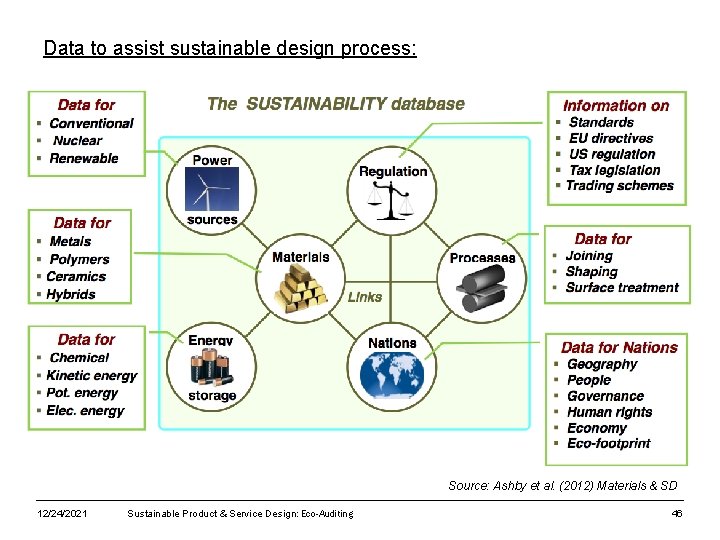
Data to assist sustainable design process: Source: Ashby et al. (2012) Materials & SD 12/24/2021 Sustainable Product & Service Design: Eco-Auditing 46
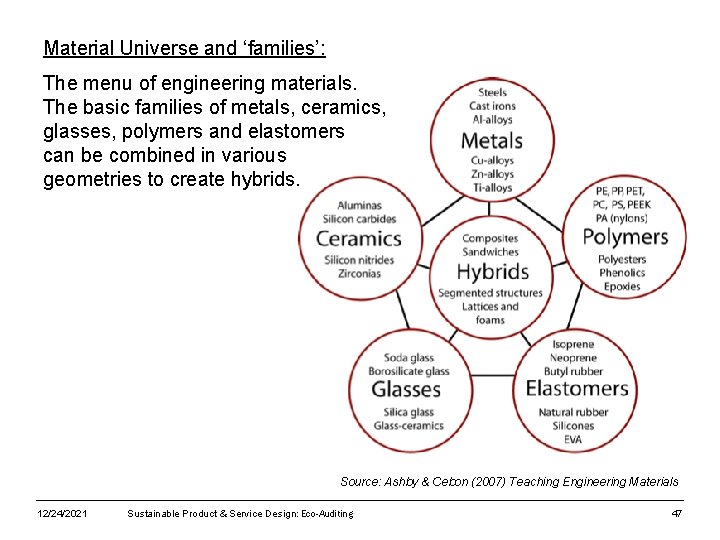
Material Universe and ‘families’: The menu of engineering materials. The basic families of metals, ceramics, glasses, polymers and elastomers can be combined in various geometries to create hybrids. Source: Ashby & Cebon (2007) Teaching Engineering Materials 12/24/2021 Sustainable Product & Service Design: Eco-Auditing 47
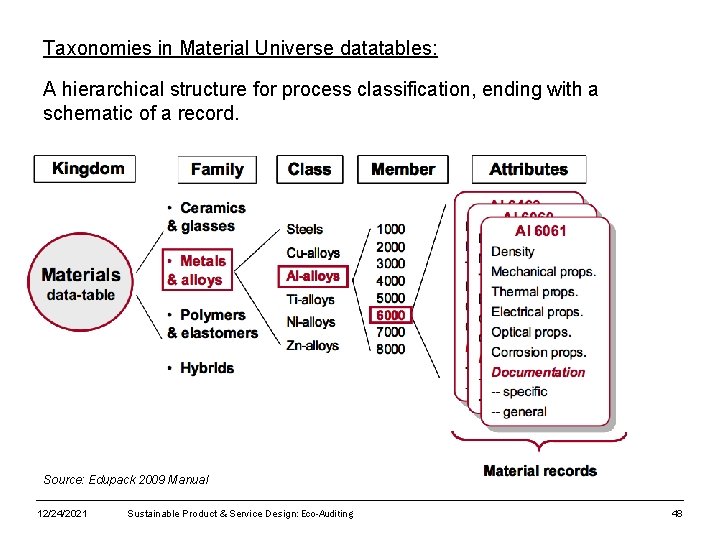
Taxonomies in Material Universe datatables: A hierarchical structure for process classification, ending with a schematic of a record. Source: Edupack 2009 Manual 12/24/2021 Sustainable Product & Service Design: Eco-Auditing 48
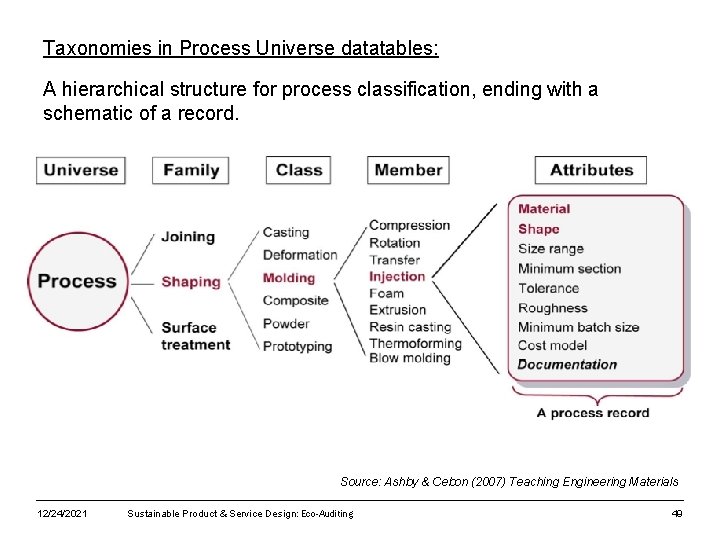
Taxonomies in Process Universe datatables: A hierarchical structure for process classification, ending with a schematic of a record. Source: Ashby & Cebon (2007) Teaching Engineering Materials 12/24/2021 Sustainable Product & Service Design: Eco-Auditing 49
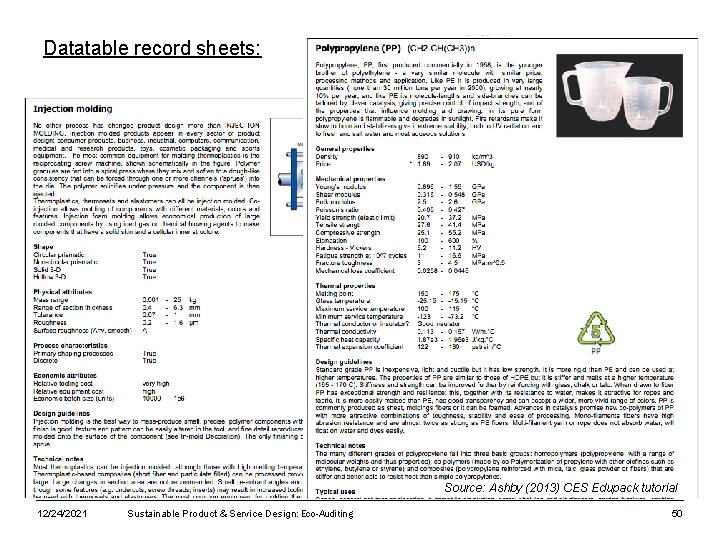
Datatable record sheets: Source: Ashby (2013) CES Edupack tutorial 12/24/2021 Sustainable Product & Service Design: Eco-Auditing 50
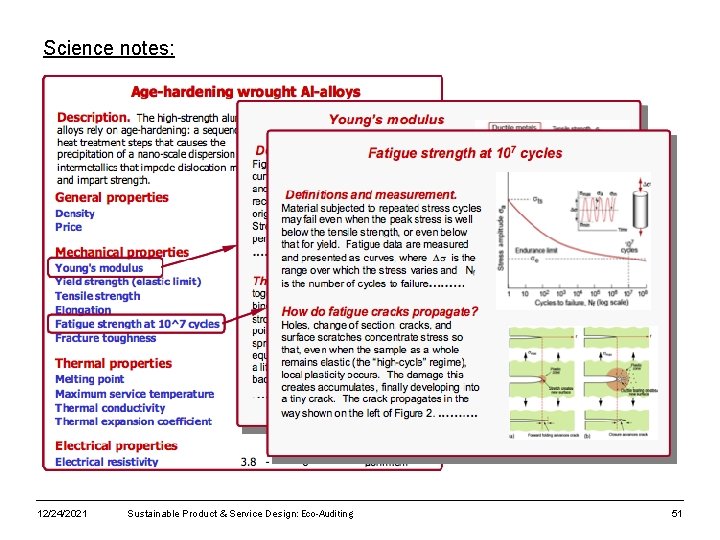
Science notes: 12/24/2021 Sustainable Product & Service Design: Eco-Auditing 51
Two main processes with Edupack Materials selection: - Materials comparison can be done by combining information from the several different tables considering material qualities and information related to them (eg. Nations of the world –table). Impacts assessment: - Products (or system elements) can be assessed with SLCA type of impact-assessment tool (indicating values from data tables) - Products’ assessment values can be compared with each other 12/24/2021 Sustainable Product & Service Design: Eco-Auditing 52
Material selection interface: 12/24/2021 Sustainable Product & Service Design: Eco-Auditing 53
Eco-auditing interface: 12/24/2021 Sustainable Product & Service Design: Eco-Auditing 54
Using Edupack: Exercises 12/24/2021 Sustainable Product & Service Design: Eco-Auditing 55
Edupack database: Three levels of detail Source: Ashby (2013) CES Edupack tutorial 12/24/2021 Sustainable Product & Service Design: Eco-Auditing 56
Each of the three levels can be interrogated by: • BROWSING Exploring the database and retrieving records via a hierarchical index. • SEARCHING Finding information via a full-text search of records. • SELECTION Using the powerful selection engine to find records that meet an array of design criteria. And several interrogations can be combined into a single project… Source: Ashby et al. (2012) Materials & SD 12/24/2021 Sustainable Product & Service Design: Eco-Auditing 57
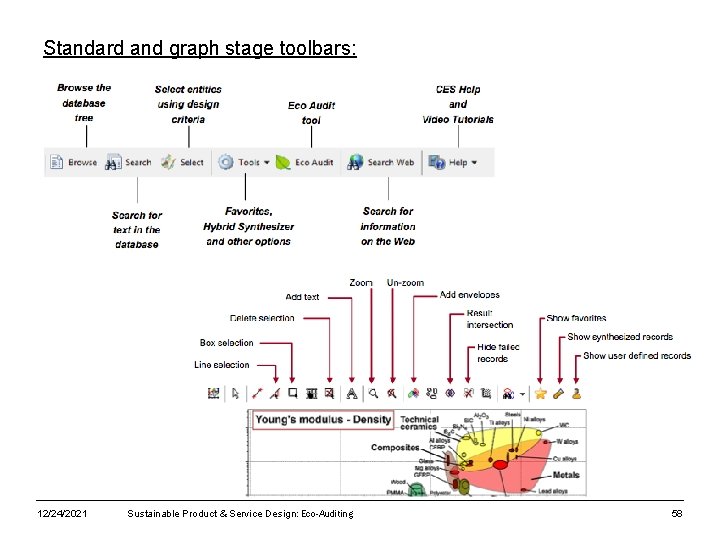
Standard and graph stage toolbars: 12/24/2021 Sustainable Product & Service Design: Eco-Auditing 58
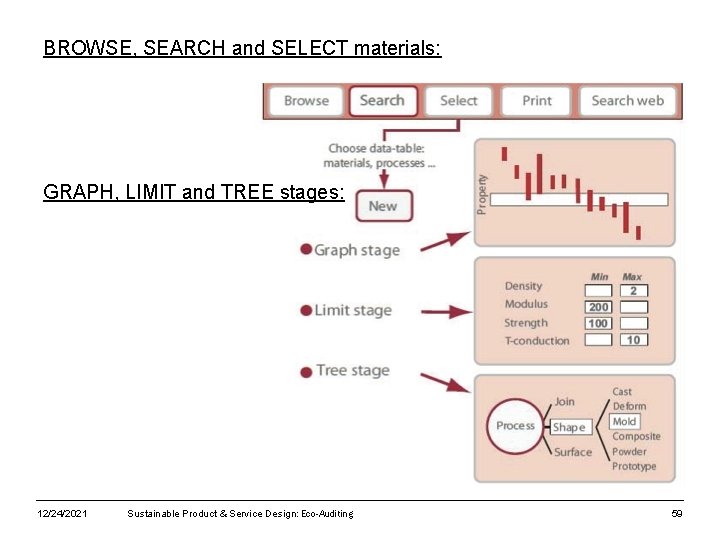
BROWSE, SEARCH and SELECT materials: GRAPH, LIMIT and TREE stages: 12/24/2021 Sustainable Product & Service Design: Eco-Auditing 59
Exercises #1 BROWSING and SEARCHING Using Edu. Pack Levels 1 & 2 12/24/2021 Sustainable Product & Service Design: Eco-Auditing 60
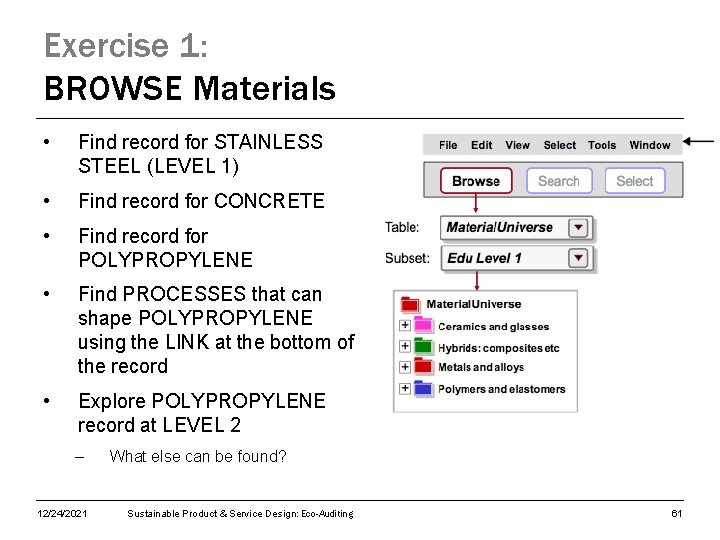
Exercise 1: BROWSE Materials • Find record for STAINLESS STEEL (LEVEL 1) • Find record for CONCRETE • Find record for POLYPROPYLENE • Find PROCESSES that can shape POLYPROPYLENE using the LINK at the bottom of the record • Explore POLYPROPYLENE record at LEVEL 2 – 12/24/2021 What else can be found? Sustainable Product & Service Design: Eco-Auditing 61
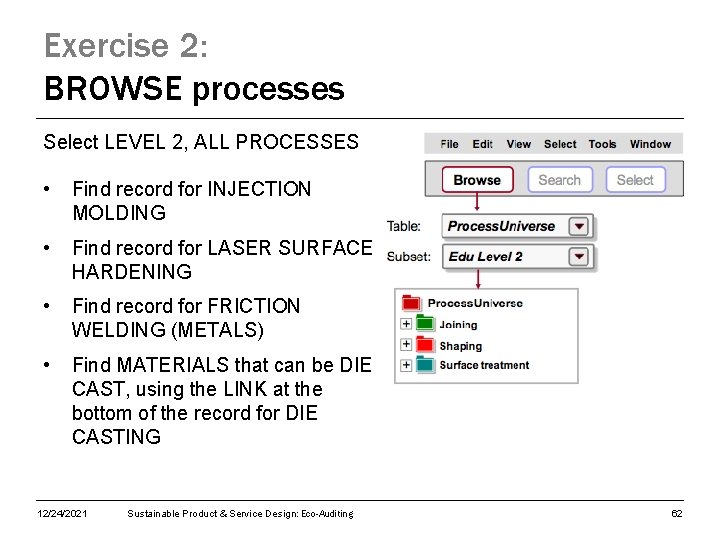
Exercise 2: BROWSE processes Select LEVEL 2, ALL PROCESSES • Find record for INJECTION MOLDING • Find record for LASER SURFACE HARDENING • Find record for FRICTION WELDING (METALS) • Find MATERIALS that can be DIE CAST, using the LINK at the bottom of the record for DIE CASTING 12/24/2021 Sustainable Product & Service Design: Eco-Auditing 62
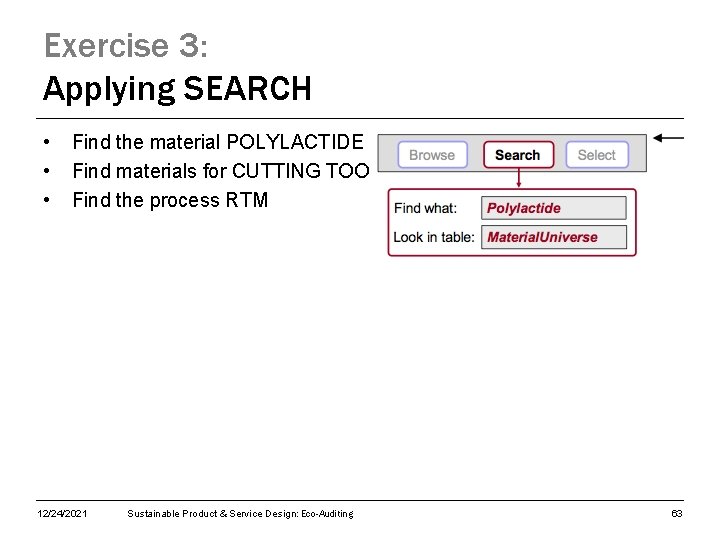
Exercise 3: Applying SEARCH • • • Find the material POLYLACTIDE Find materials for CUTTING TOOLS Find the process RTM 12/24/2021 Sustainable Product & Service Design: Eco-Auditing 63
Familiarizing… 12/24/2021 Sustainable Product & Service Design: Eco-Auditing 64
Exercises #2 PROPERTY CHARTS Using Edu. Pack Levels 1 & 2 12/24/2021 Sustainable Product & Service Design: Eco-Auditing 65
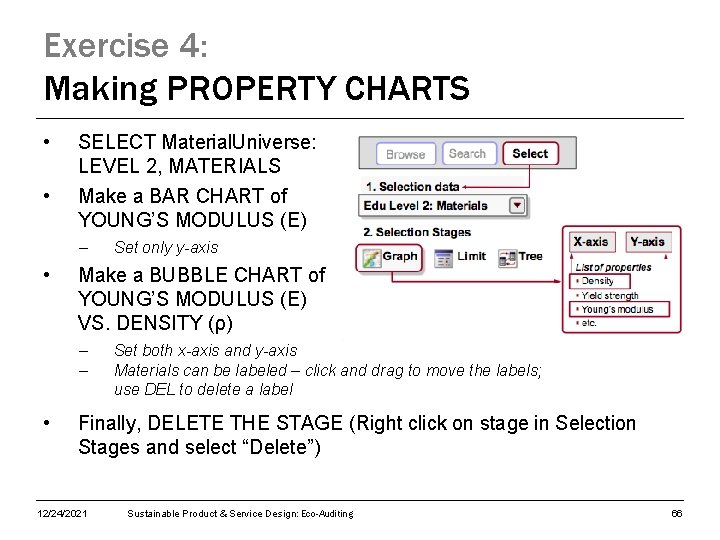
Exercise 4: Making PROPERTY CHARTS • SELECT Material. Universe: LEVEL 2, MATERIALS • Make a BAR CHART of YOUNG’S MODULUS (E) – • Make a BUBBLE CHART of YOUNG’S MODULUS (E) VS. DENSITY (ρ) – – • Set only y-axis Set both x-axis and y-axis Materials can be labeled – click and drag to move the labels; use DEL to delete a label Finally, DELETE THE STAGE (Right click on stage in Selection Stages and select “Delete”) 12/24/2021 Sustainable Product & Service Design: Eco-Auditing 66
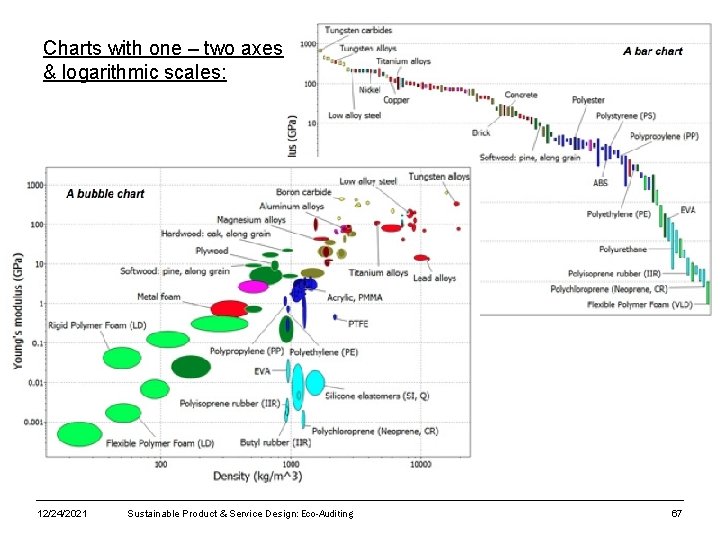
Charts with one – two axes & logarithmic scales: 12/24/2021 Sustainable Product & Service Design: Eco-Auditing 67
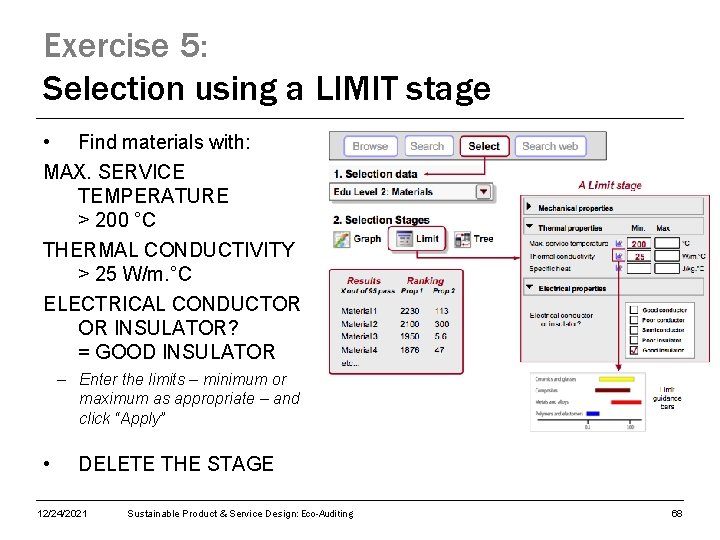
Exercise 5: Selection using a LIMIT stage • Find materials with: MAX. SERVICE TEMPERATURE > 200 °C THERMAL CONDUCTIVITY > 25 W/m. °C ELECTRICAL CONDUCTOR OR INSULATOR? = GOOD INSULATOR – Enter the limits – minimum or maximum as appropriate – and click “Apply” • DELETE THE STAGE 12/24/2021 Sustainable Product & Service Design: Eco-Auditing 68
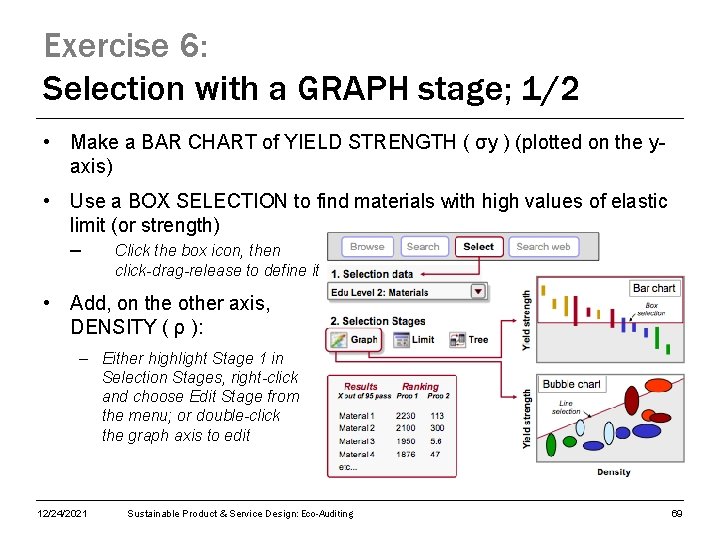
Exercise 6: Selection with a GRAPH stage; 1/2 • Make a BAR CHART of YIELD STRENGTH ( σy ) (plotted on the yaxis) • Use a BOX SELECTION to find materials with high values of elastic limit (or strength) – Click the box icon, then click-drag-release to define it • Add, on the other axis, DENSITY ( ρ ): – Either highlight Stage 1 in Selection Stages, right-click and choose Edit Stage from the menu; or double-click the graph axis to edit 12/24/2021 Sustainable Product & Service Design: Eco-Auditing 69
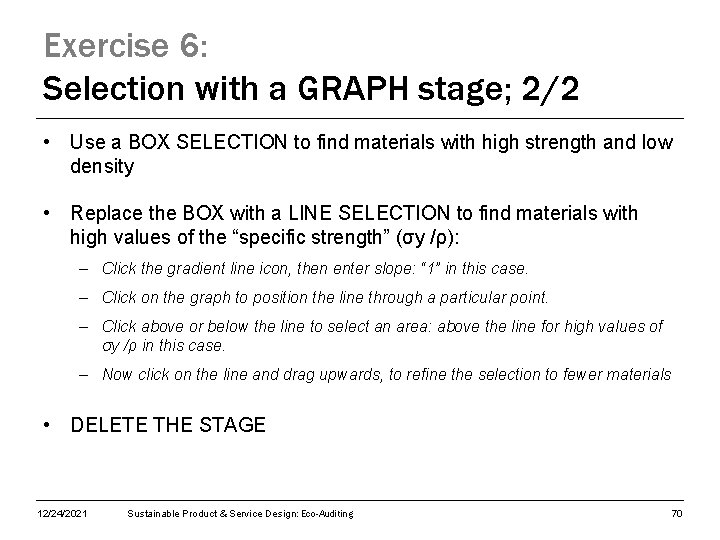
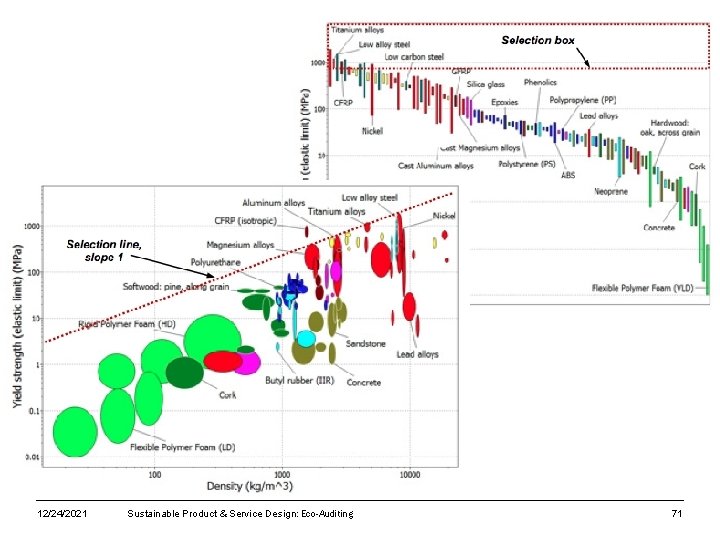
Exercise 6: Selection with a GRAPH stage; 2/2 • Use a BOX SELECTION to find materials with high strength and low density • Replace the BOX with a LINE SELECTION to find materials with high values of the “specific strength” (σy /ρ): – Click the gradient line icon, then enter slope: “ 1” in this case. – Click on the graph to position the line through a particular point. – Click above or below the line to select an area: above the line for high values of σy /ρ in this case. – Now click on the line and drag upwards, to refine the selection to fewer materials • DELETE THE STAGE 12/24/2021 Sustainable Product & Service Design: Eco-Auditing 70
12/24/2021 Sustainable Product & Service Design: Eco-Auditing 71
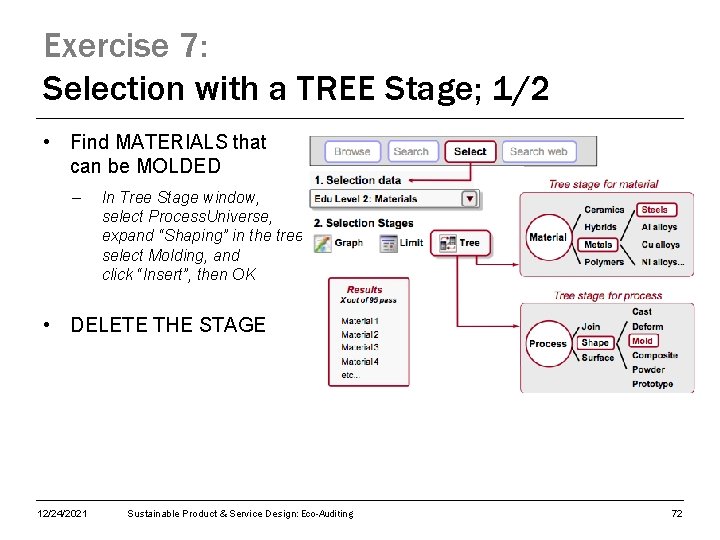
Exercise 7: Selection with a TREE Stage; 1/2 • Find MATERIALS that can be MOLDED – In Tree Stage window, select Process. Universe, expand “Shaping” in the tree, select Molding, and click “Insert”, then OK • DELETE THE STAGE 12/24/2021 Sustainable Product & Service Design: Eco-Auditing 72
Exercise 7: Selection with a TREE Stage; 2/2 • Find PROCESSES to join STEELS – First change Selection Data to select Processes: LEVEL 2, JOINING PROCESSES – Then, in Tree Stage window, select Material. Universe, expand “Metals and alloys” in the tree, select Ferrous, and click “Insert”, then OK • DELETE THE STAGE 12/24/2021 Sustainable Product & Service Design: Eco-Auditing 73
Exercises #3 GETTING ALL TOGETHER Using Edu. Pack Levels 1 & 2 12/24/2021 Sustainable Product & Service Design: Eco-Auditing 74
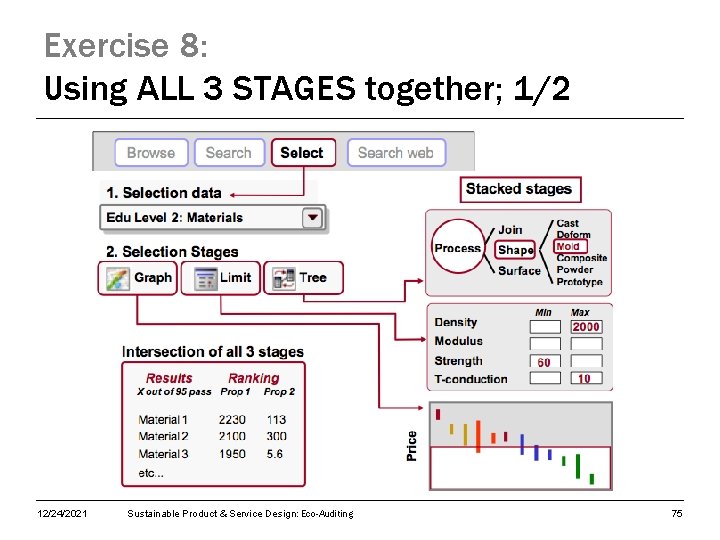
Exercise 8: Using ALL 3 STAGES together; 1/2 12/24/2021 Sustainable Product & Service Design: Eco-Auditing 75
Exercise 8: Using ALL 3 STAGES together; 2/2 • Find MATERIALS with the following properties: DENSITY < 2000 kg/m 3 STRENGTH (Elastic limit) > 60 Mpa THERMAL CONDUCTIVITY < 10 W/m. °C – Change Selection Data to select Materials: Select LEVEL 2, MATERIALS – 3 entries in a Limit Stage • Can be MOLDED (a Tree Stage: Process. Universe – Shaping – Molding) • Rank the results by PRICE (a Graph Stage: bar chart of Price) – On the final Graph Stage, all materials that fail one or more stages are grayedout; label the remaining materials, which pass all stages – The RESULTS window shows the materials that pass all the stages 12/24/2021 Sustainable Product & Service Design: Eco-Auditing 76
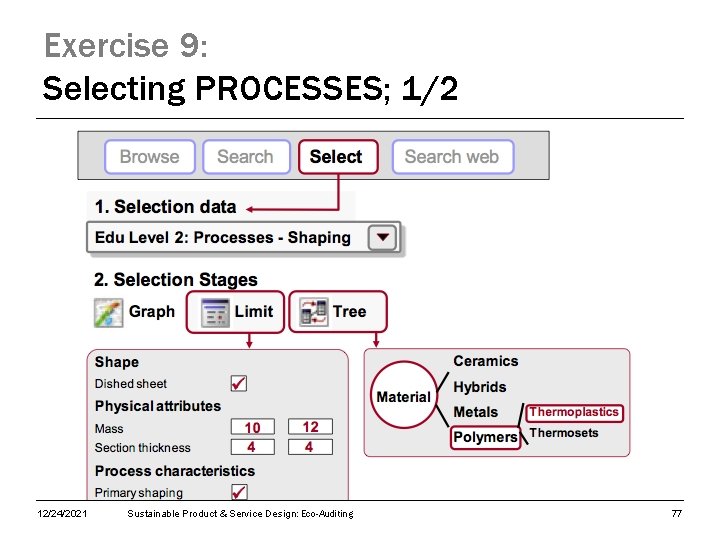
Exercise 9: Selecting PROCESSES; 1/2 12/24/2021 Sustainable Product & Service Design: Eco-Auditing 77
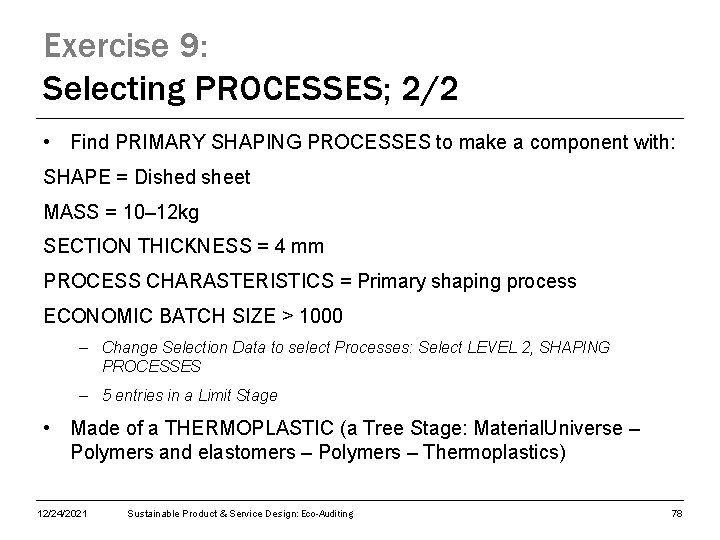
Exercise 9: Selecting PROCESSES; 2/2 • Find PRIMARY SHAPING PROCESSES to make a component with: SHAPE = Dished sheet MASS = 10– 12 kg SECTION THICKNESS = 4 mm PROCESS CHARASTERISTICS = Primary shaping process ECONOMIC BATCH SIZE > 1000 – Change Selection Data to select Processes: Select LEVEL 2, SHAPING PROCESSES – 5 entries in a Limit Stage • Made of a THERMOPLASTIC (a Tree Stage: Material. Universe – Polymers and elastomers – Polymers – Thermoplastics) 12/24/2021 Sustainable Product & Service Design: Eco-Auditing 78
Presenting project ideas 12/24/2021 Sustainable Product & Service Design: Eco-Auditing 79
Working with your project ideas… • Introduce your initial project idea to others • Upload idea as small text to My. Courses by next session… In your project idea text, reflect on: • Main objective, motivation, and assessment boundaries • Focus life phases, parts of product(-service) system, and stakeholders • Focus materials/impacts and potential alternatives for improvement 12/24/2021 Sustainable Product & Service Design: Eco-Auditing 80
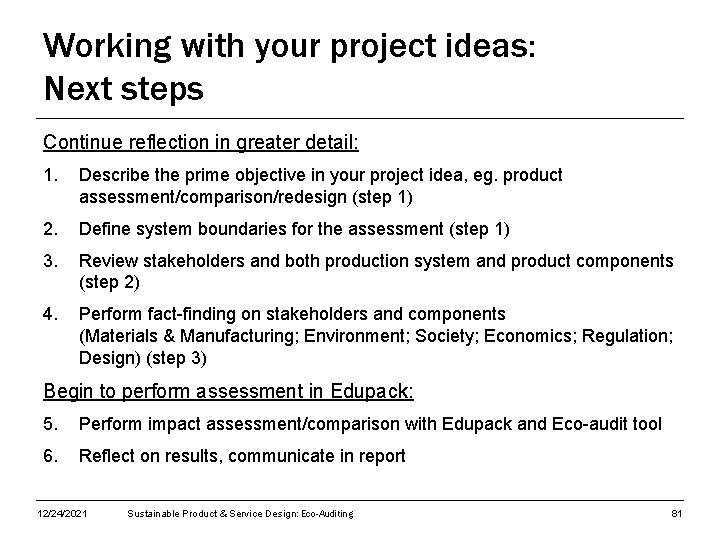
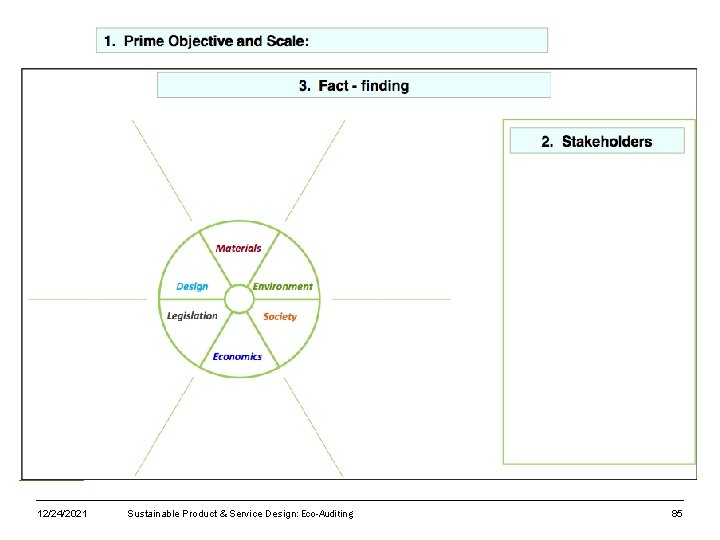
Working with your project ideas: Next steps Continue reflection in greater detail: 1. Describe the prime objective in your project idea, eg. product assessment/comparison/redesign (step 1) 2. Define system boundaries for the assessment (step 1) 3. Review stakeholders and both production system and product components (step 2) 4. Perform fact-finding on stakeholders and components (Materials & Manufacturing; Environment; Society; Economics; Regulation; Design) (step 3) Begin to perform assessment in Edupack: 5. Perform impact assessment/comparison with Edupack and Eco-audit tool 6. Reflect on results, communicate in report 12/24/2021 Sustainable Product & Service Design: Eco-Auditing 81
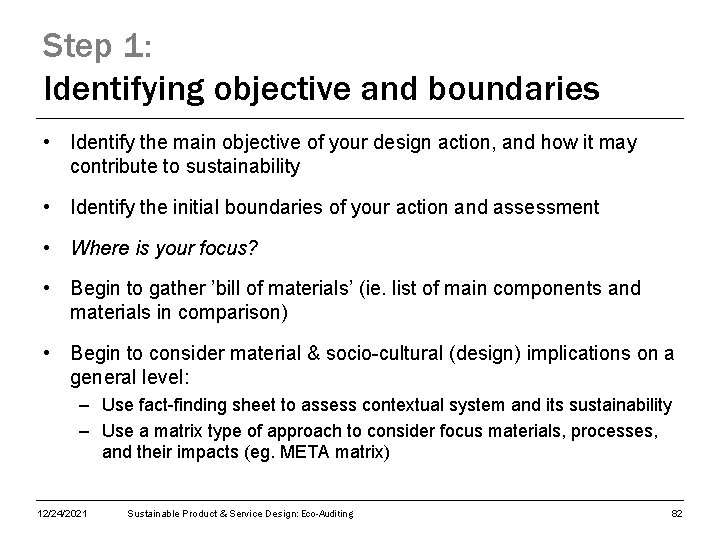
Step 1: Identifying objective and boundaries • Identify the main objective of your design action, and how it may contribute to sustainability • Identify the initial boundaries of your action and assessment • Where is your focus? • Begin to gather ’bill of materials’ (ie. list of main components and materials in comparison) • Begin to consider material & socio-cultural (design) implications on a general level: – Use fact-finding sheet to assess contextual system and its sustainability – Use a matrix type of approach to consider focus materials, processes, and their impacts (eg. META matrix) 12/24/2021 Sustainable Product & Service Design: Eco-Auditing 82
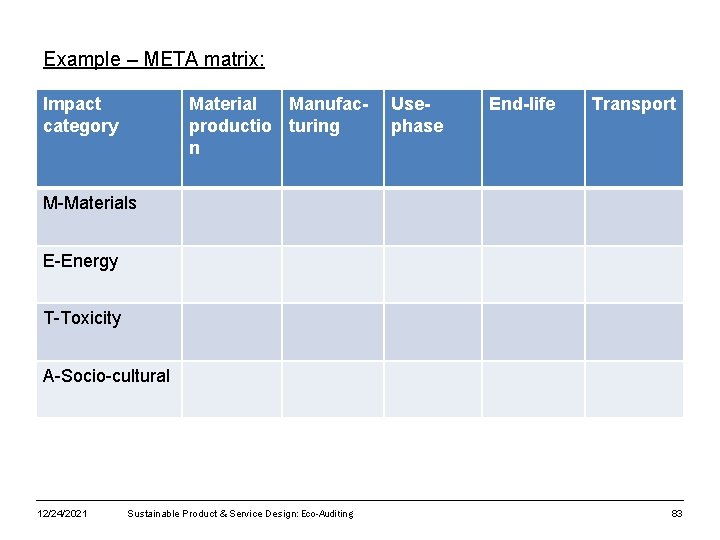
Example – META matrix: Impact category Material Manufacproductio turing n Usephase End-life Transport M-Materials E-Energy T-Toxicity A-Socio-cultural 12/24/2021 Sustainable Product & Service Design: Eco-Auditing 83
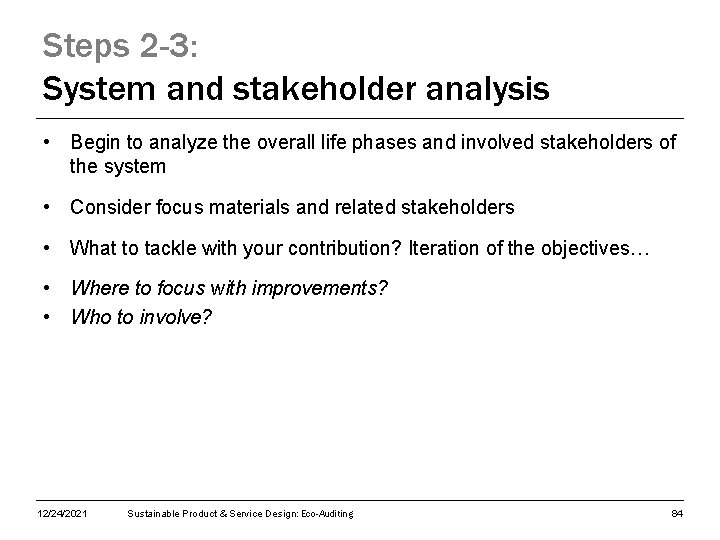
Steps 2 -3: System and stakeholder analysis • Begin to analyze the overall life phases and involved stakeholders of the system • Consider focus materials and related stakeholders • What to tackle with your contribution? Iteration of the objectives… • Where to focus with improvements? • Who to involve? 12/24/2021 Sustainable Product & Service Design: Eco-Auditing 84
12/24/2021 Sustainable Product & Service Design: Eco-Auditing 85
THANKS! Continues on Tuesday 19. 1. (See readings online…) 12/24/2021 Sustainable Product & Service Design: Eco-Auditing 86
- Slides: 86