
ECO R European Centre for Ontological Research Ontology
- Slides: 34
ECO R European Centre for Ontological Research Ontology for indexing electronic patient records. There is only one right way: Referent Tracking ! STIC-Santé seminar, Paris, Dec 8, 2005 Dr. W. Ceusters European Centre for Ontological Research Saarland University, Saarbrücken - Germany
ECO R Electronic Health Record European Centre for Ontological Research • ISO/TS 18308: 2003 – Electronic Health Record (EHR): • A repository of information regarding the health of a subject of care, in computer processable form. – EHR system: • the set of components that form the mechanism by which electronic health records are created, used, stored, and retrieved. It includes people, data, rules and procedures, processing and storage devices, and communication and support facilities. • More common meaning of EHR system: – only the “software being executed”
ECO R European Centre for Ontological Research The Medical Informatics dogma To structure or NOT to be • Fact: computers can only deal with a structured representation of reality: – structured data: • relational databases, spread sheets – structured information: • XML simulates context – structured knowledge: • rule-based knowledge systems • Conclusion: a need for structured data entry (? ? ? )
ECO Structured EHR data entry R European Centre for Ontological Research • Current technical solutions: – Data entry forms • provide the structure • various paradigms: – Rigid, pre-fixed – Adaptable to user-preferences, but fixed when used – Dynamically adapting to entered data in context – Terminologies, coding and classification systems: • Provide the language to be used; • Are claimed – To allow exchange of information preserving meaning – To be a good basis for record indexing to allow subsequent processing for statistics and epidemiology
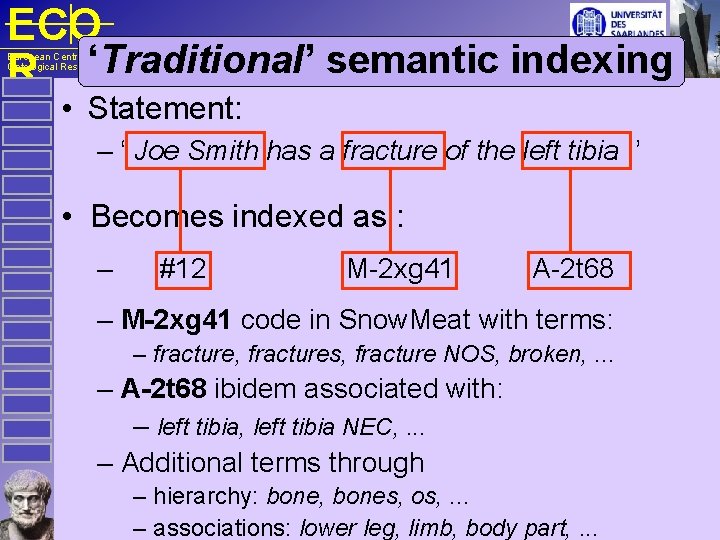
ECO R ‘Traditional’ semantic indexing European Centre for Ontological Research • Statement: – ‘ Joe Smith has a fracture of the left tibia ’ • Becomes indexed as : – #12 M-2 xg 41 A-2 t 68 – M-2 xg 41 code in Snow. Meat with terms: – fracture, fractures, fracture NOS, broken, . . . – A-2 t 68 ibidem associated with: – left tibia, left tibia NEC, . . . – Additional terms through – hierarchy: bone, bones, os, . . . – associations: lower leg, limb, body part, . . .
ECO R At least 2 major drawbacks European Centre for Ontological Research with traditional semantic indexing 1. Bad organisation and structure of ‘traditional’ terminologies and concept systems 2. Codes from such systems do not capture ‘what they are about’, ‘what was on the side of the patient’.
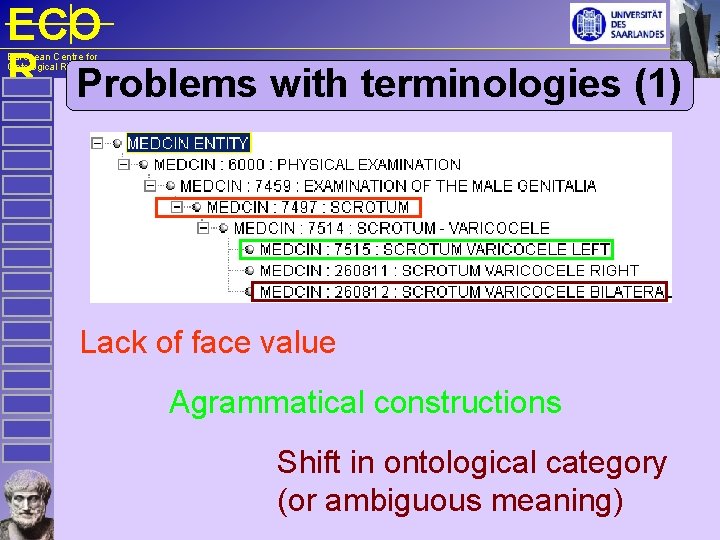
ECO R Problems with terminologies (1) European Centre for Ontological Research Lack of face value Agrammatical constructions Shift in ontological category (or ambiguous meaning)
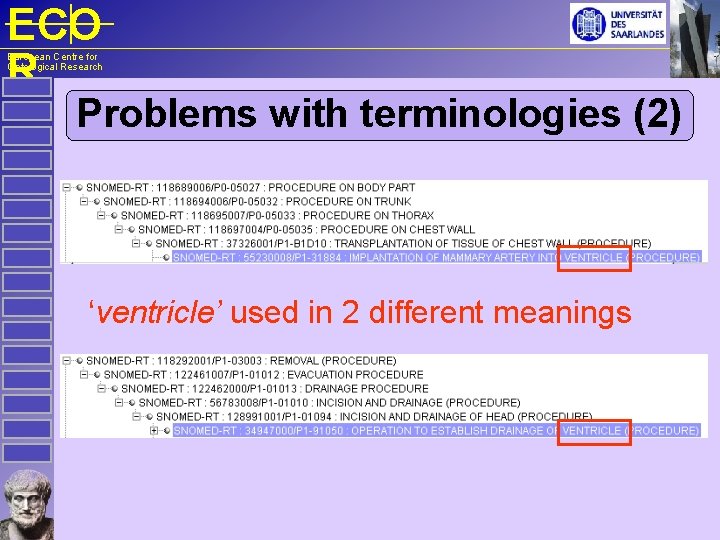
ECO R European Centre for Ontological Research Problems with terminologies (2) ‘ventricle’ used in 2 different meanings
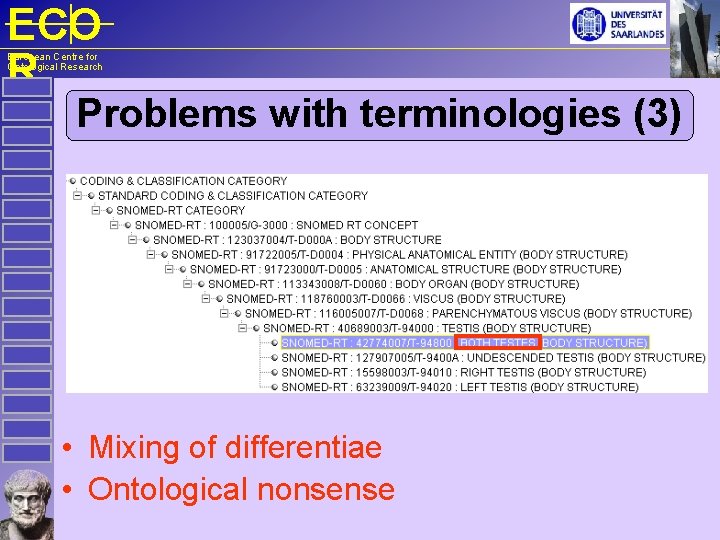
ECO R European Centre for Ontological Research Problems with terminologies (3) • Mixing of differentiae • Ontological nonsense
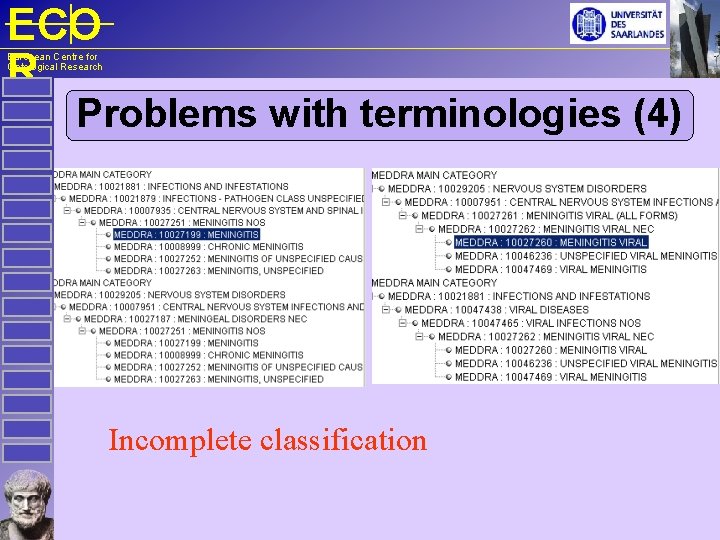
ECO R European Centre for Ontological Research Problems with terminologies (4) Incomplete classification
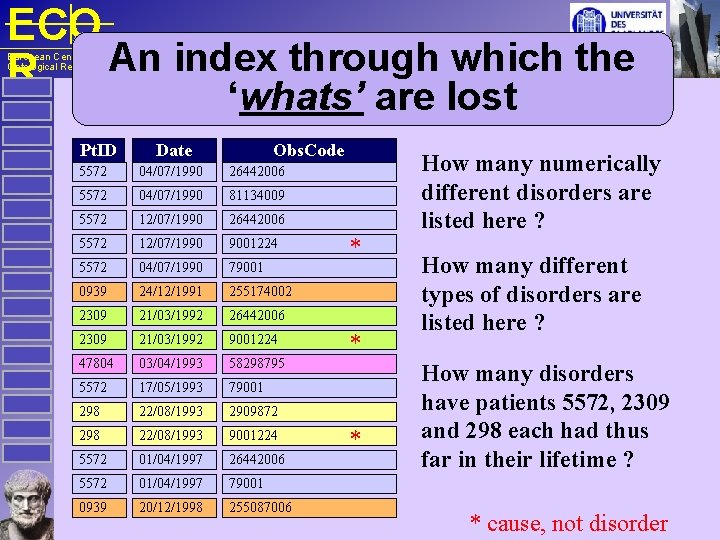
ECO An index through which the R European Centre for Ontological Research ‘whats’ are lost Pt. ID Date Obs. Code Narrative How many closed fracture of shaft numerically of femur different disorders are Fracture, closed, spiral closed fracture of shaft? of femur listed here 5572 04/07/1990 26442006 5572 04/07/1990 81134009 5572 12/07/1990 26442006 5572 12/07/1990 9001224 5572 04/07/1990 79001 0939 24/12/1991 255174002 2309 21/03/1992 26442006 2309 21/03/1992 9001224 47804 03/04/1993 58298795 5572 17/05/1993 79001 298 22/08/1993 2909872 298 22/08/1993 9001224 5572 01/04/1997 26442006 5572 01/04/1997 79001 Essential hypertension 0939 20/12/1998 255087006 malignant polyp of biliary tract * * Accident in public building (supermarket) How many different benign polypof of biliary tract types disorders are closed fracture of shaft of femur listed here ? Essential hypertension Accident in public building (supermarket) Other lesion on other specified region How many disorders have patients 5572, 2309 Closed fracture of radial head and in 298 thus Accident publiceach buildinghad (supermarket) closed of shaft lifetime of femur farfracture in their ? Essential hypertension * * cause, not disorder
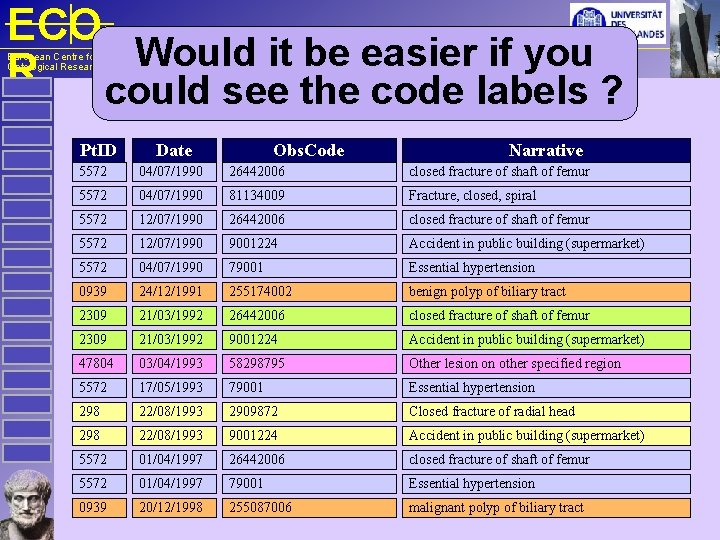
ECO Would it be easier if you R could see the code labels ? European Centre for Ontological Research Pt. ID Date Obs. Code Narrative 5572 04/07/1990 26442006 closed fracture of shaft of femur 5572 04/07/1990 81134009 Fracture, closed, spiral 5572 12/07/1990 26442006 closed fracture of shaft of femur 5572 12/07/1990 9001224 Accident in public building (supermarket) 5572 04/07/1990 79001 Essential hypertension 0939 24/12/1991 255174002 benign polyp of biliary tract 2309 21/03/1992 26442006 closed fracture of shaft of femur 2309 21/03/1992 9001224 Accident in public building (supermarket) 47804 03/04/1993 58298795 Other lesion on other specified region 5572 17/05/1993 79001 Essential hypertension 298 22/08/1993 2909872 Closed fracture of radial head 298 22/08/1993 9001224 Accident in public building (supermarket) 5572 01/04/1997 26442006 closed fracture of shaft of femur 5572 01/04/1997 79001 Essential hypertension 0939 20/12/1998 255087006 malignant polyp of biliary tract
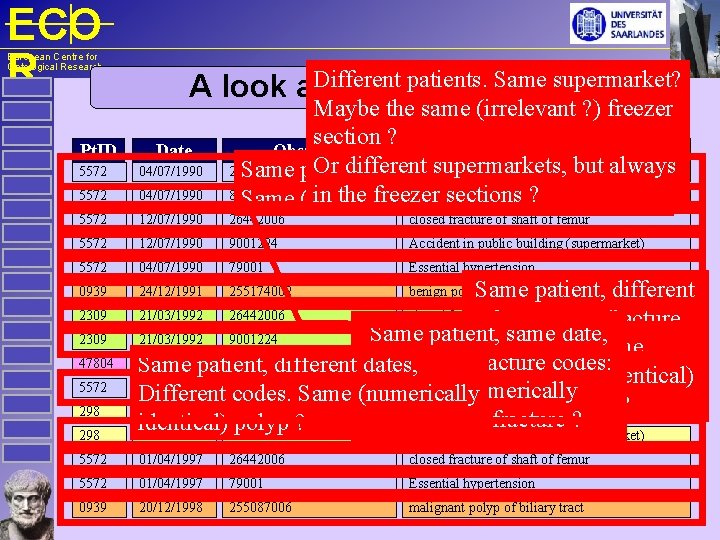
ECO R European Centre for Ontological Research Pt. ID patients. Same. . . supermarket? A look at. Different the problems Date Maybe the same (irrelevant ? ) freezer section ? Obs. Code Narrative Or different supermarkets, but always 26442006 closed fracture of shaft of femur Same patient, same hypertension code: 81134009 Fracture, closed, spiral in the freezer sections ? Same (numerically identical) hypertension ? 5572 04/07/1990 5572 12/07/1990 26442006 closed fracture of shaft of femur 5572 12/07/1990 9001224 Accident in public building (supermarket) 5572 04/07/1990 79001 Essential hypertension 24/12/1991 255174002 benign polyp of biliary tract 298 Same patient, different 21/03/1992 26442006 closed fracturedates, of shaft ofsame femur fracture Same patient, 21/03/1992 9001224 Accident in publicsame buildingdate, (supermarket) codes: same 03/04/1993 patient, 58298795 Other lesionfracture on other specified region 2 patients, different codes: Same different Differentdates, same fracture codes: (numerically identical) 17/05/1993 79001 Essential hypertension same (numerically Different codes. Same(numerically identical)headfracture ? ? 22/08/1993 2909872 Closed fracture of radialfracture identical) fracture ? identical) polyp ? 22/08/1993 9001224 Accident in public building (supermarket) 5572 01/04/1997 26442006 closed fracture of shaft of femur 5572 01/04/1997 79001 Essential hypertension 0939 20/12/1998 255087006 malignant polyp of biliary tract 0939 2309 47804 5572 298
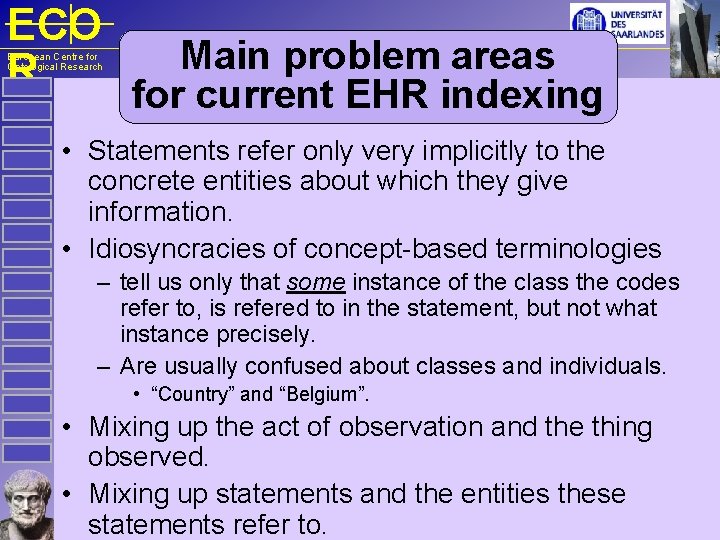
ECO R European Centre for Ontological Research Main problem areas for current EHR indexing • Statements refer only very implicitly to the concrete entities about which they give information. • Idiosyncracies of concept-based terminologies – tell us only that some instance of the class the codes refer to, is refered to in the statement, but not what instance precisely. – Are usually confused about classes and individuals. • “Country” and “Belgium”. • Mixing up the act of observation and the thing observed. • Mixing up statements and the entities these statements refer to.
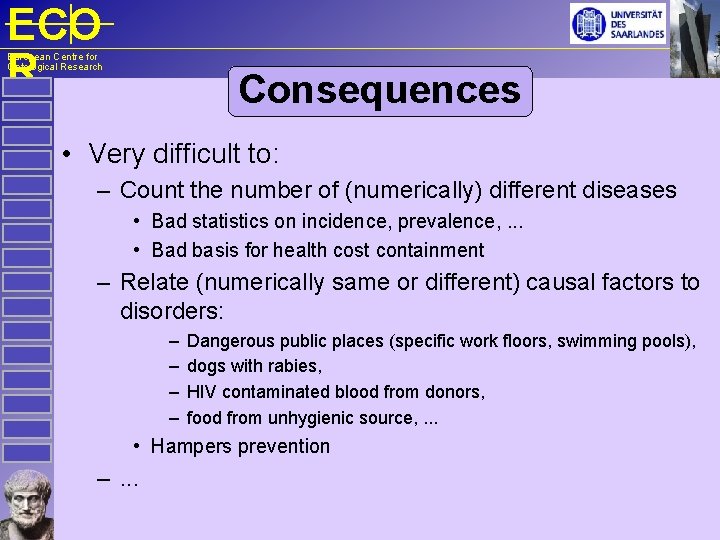
ECO R European Centre for Ontological Research Consequences • Very difficult to: – Count the number of (numerically) different diseases • Bad statistics on incidence, prevalence, . . . • Bad basis for health cost containment – Relate (numerically same or different) causal factors to disorders: – – Dangerous public places (specific work floors, swimming pools), dogs with rabies, HIV contaminated blood from donors, food from unhygienic source, . . . • Hampers prevention –. . .
ECO R European Centre for Ontological Research Proposed solution: Referent Tracking • Foundation: Realist ontology
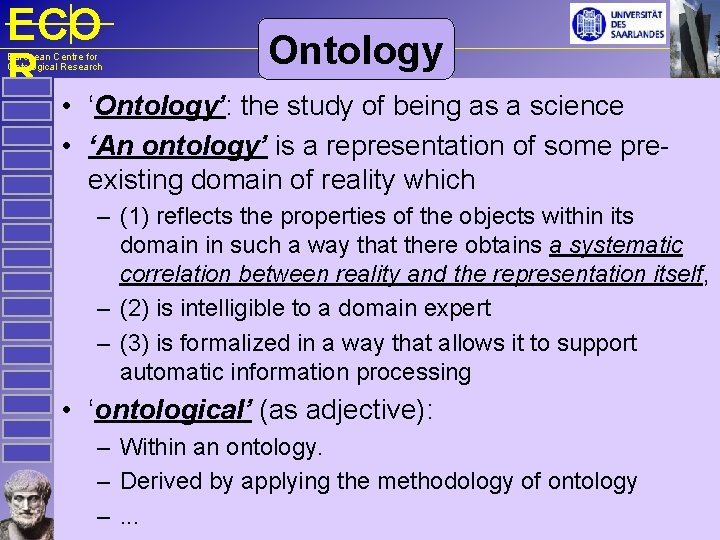
ECO R European Centre for Ontological Research Ontology • ‘Ontology’: the study of being as a science • ‘An ontology’ is a representation of some preexisting domain of reality which – (1) reflects the properties of the objects within its domain in such a way that there obtains a systematic correlation between reality and the representation itself, – (2) is intelligible to a domain expert – (3) is formalized in a way that allows it to support automatic information processing • ‘ontological’ (as adjective): – Within an ontology. – Derived by applying the methodology of ontology –. . .
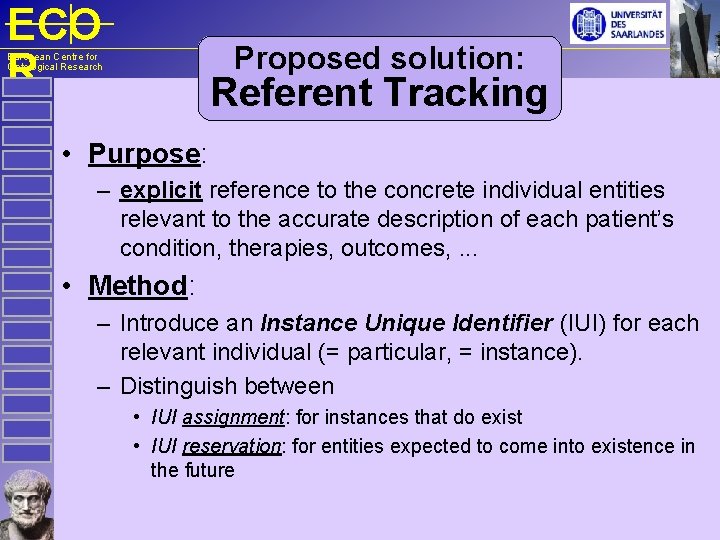
ECO R Proposed solution: European Centre for Ontological Research Referent Tracking • Purpose: – explicit reference to the concrete individual entities relevant to the accurate description of each patient’s condition, therapies, outcomes, . . . • Method: – Introduce an Instance Unique Identifier (IUI) for each relevant individual (= particular, = instance). – Distinguish between • IUI assignment: for instances that do exist • IUI reservation: for entities expected to come into existence in the future
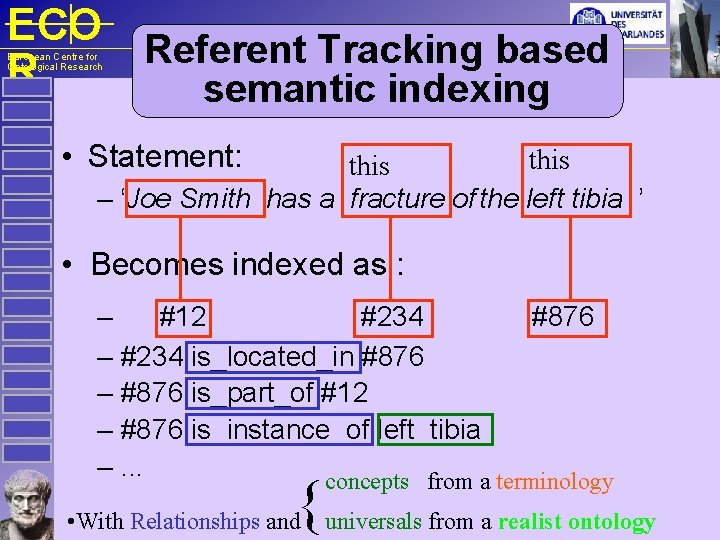
ECO Referent Tracking based R semantic indexing European Centre for Ontological Research • Statement: this – ‘Joe Smith has a fracture of the left tibia ’ • Becomes indexed as : – #12 #234 #876 – #234 is_located_in #876 – #876 is_part_of #12 – #876 is_instance_of left_tibia –. . . concepts from a terminology { • With Relationships and universals from a realist ontology
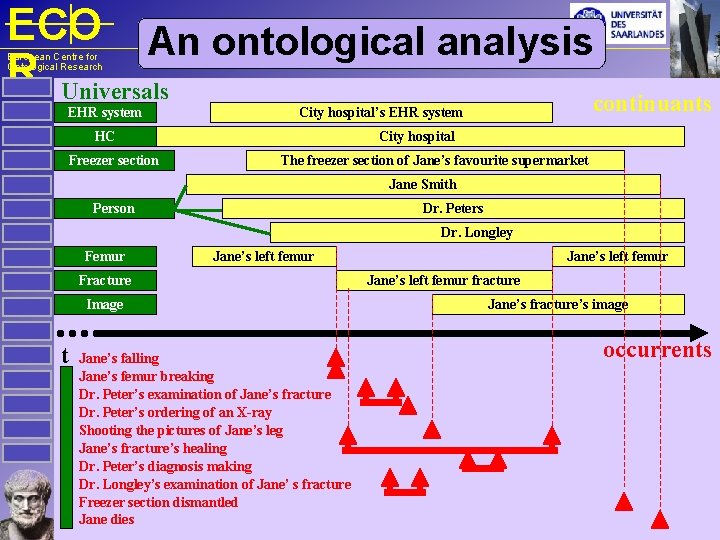
ECO An ontological analysis R Universals European Centre for Ontological Research EHR system HC Freezer section continuants City hospital’s EHR system City hospital The freezer section of Jane’s favourite supermarket Jane Smith Person Dr. Peters Dr. Longley Femur Jane’s left femur Fracture Image t Jane’s falling Jane’s femur breaking Dr. Peter’s examination of Jane’s fracture Dr. Peter’s ordering of an X-ray Shooting the pictures of Jane’s leg Jane’s fracture’s healing Dr. Peter’s diagnosis making Dr. Longley’s examination of Jane’ s fracture Freezer section dismantled Jane dies Jane’s left femur fracture Jane’s fracture’s image occurrents
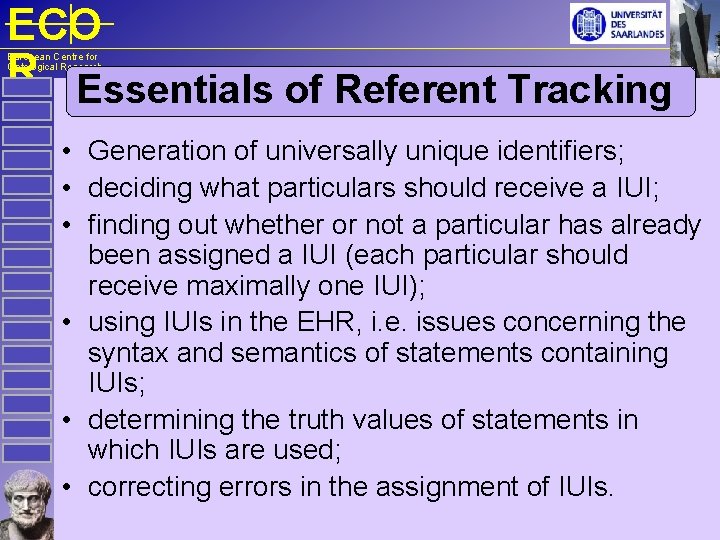
ECO R Essentials of Referent Tracking European Centre for Ontological Research • Generation of universally unique identifiers; • deciding what particulars should receive a IUI; • finding out whether or not a particular has already been assigned a IUI (each particular should receive maximally one IUI); • using IUIs in the EHR, i. e. issues concerning the syntax and semantics of statements containing IUIs; • determining the truth values of statements in which IUIs are used; • correcting errors in the assignment of IUIs.
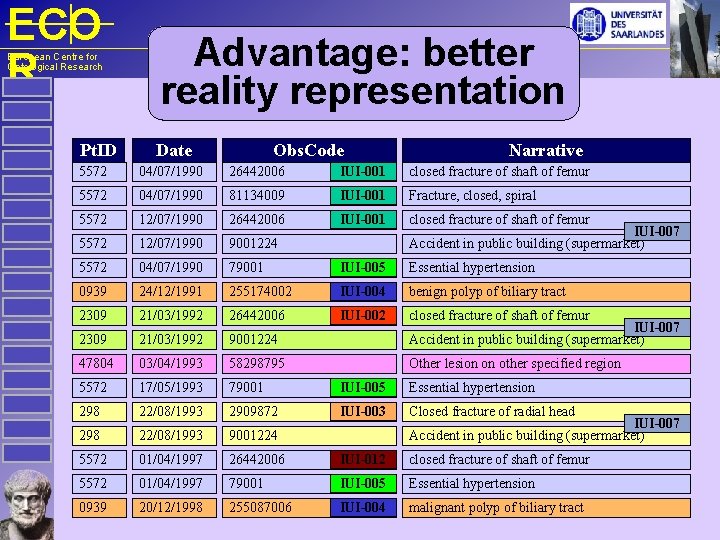
ECO R European Centre for Ontological Research Pt. ID Advantage: better reality representation Date Obs. Code Narrative 5572 04/07/1990 26442006 IUI-001 closed fracture of shaft of femur 5572 04/07/1990 81134009 IUI-001 Fracture, closed, spiral 5572 12/07/1990 26442006 IUI-001 closed fracture of shaft of femur 5572 12/07/1990 9001224 5572 04/07/1990 79001 IUI-005 Essential hypertension 0939 24/12/1991 255174002 IUI-004 benign polyp of biliary tract 2309 21/03/1992 26442006 IUI-002 closed fracture of shaft of femur 2309 21/03/1992 9001224 IUI-007 Accident in public building (supermarket) 47804 03/04/1993 58298795 Other lesion on other specified region 5572 17/05/1993 79001 IUI-005 Essential hypertension 298 22/08/1993 2909872 IUI-003 Closed fracture of radial head 298 22/08/1993 9001224 5572 01/04/1997 26442006 IUI-012 closed fracture of shaft of femur 5572 01/04/1997 79001 IUI-005 Essential hypertension 0939 20/12/1998 255087006 IUI-004 malignant polyp of biliary tract IUI-007 Accident in public building (supermarket)
ECO R European Centre for Ontological Research Steps in referent tracking based semantic indexing.
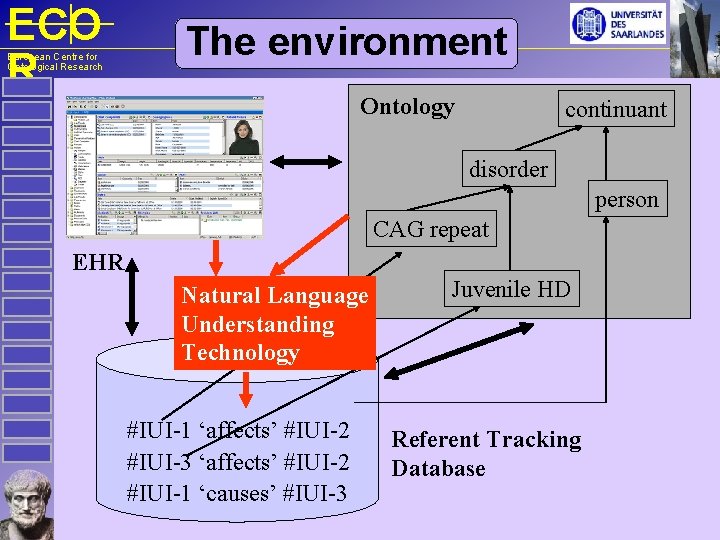
ECO R European Centre for Ontological Research The environment Ontology continuant disorder person CAG repeat EHR Natural Language Understanding Technology #IUI-1 ‘affects’ #IUI-2 #IUI-3 ‘affects’ #IUI-2 #IUI-1 ‘causes’ #IUI-3 Juvenile HD Referent Tracking Database
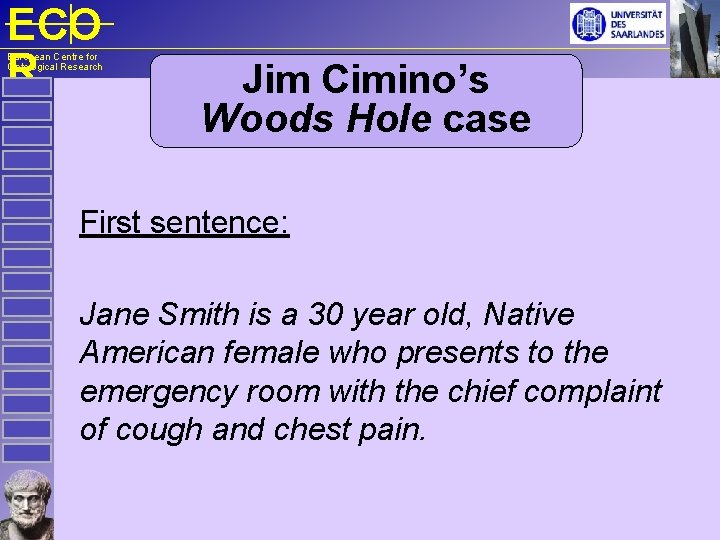
ECO R European Centre for Ontological Research Jim Cimino’s Woods Hole case First sentence: Jane Smith is a 30 year old, Native American female who presents to the emergency room with the chief complaint of cough and chest pain.
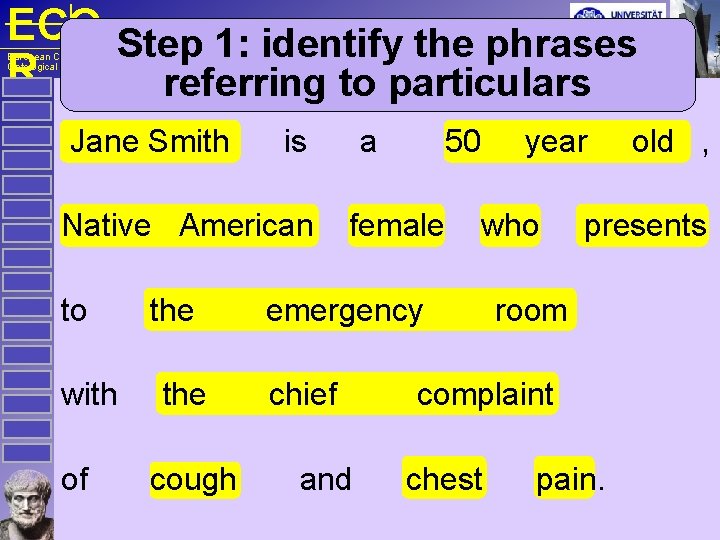
ECO Step 1: identify the phrases R referring to particulars European Centre for Ontological Research Jane Smith is Native American to with of the cough a 50 female year who emergency chief and presents room complaint chest old , pain.
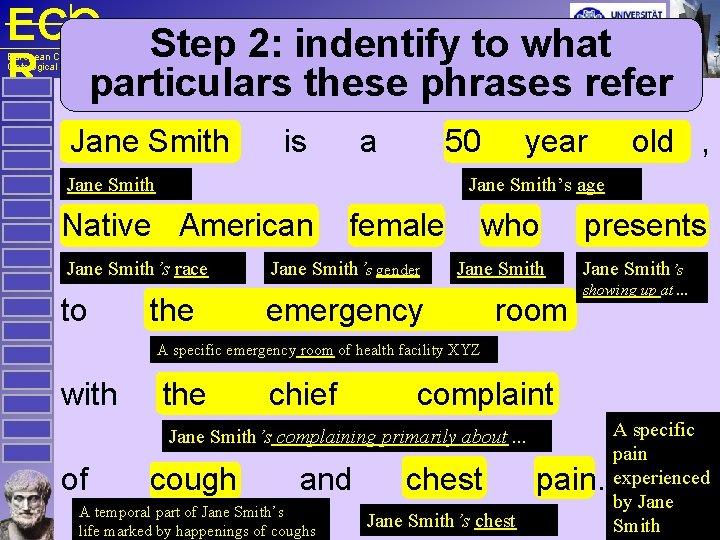
ECO Step 2: indentify to what R particulars these phrases refer European Centre for Ontological Research Jane Smith is a 50 Jane Smith old , Jane Smith’s age Native American Jane Smith’s race to year the female Jane Smith’s gender who Jane Smith emergency room presents Jane Smith’s showing up at. . . A specific emergency room of health facility XYZ with the chief complaint Jane Smith’s complaining primarily about. . . of cough and A temporal part of Jane Smith’s life marked by happenings of coughs chest Jane Smith’s chest pain. A specific pain experienced by Jane Smith
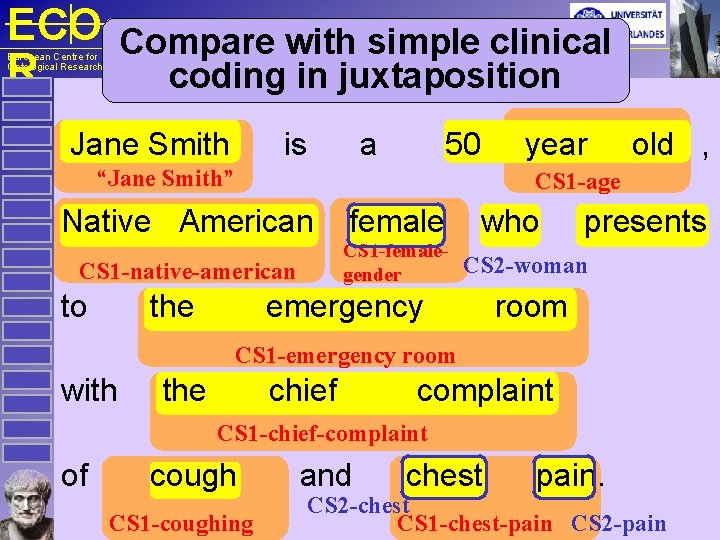
ECO Compare with simple clinical R coding in juxtaposition European Centre for Ontological Research Jane Smith is a 50 year “Jane Smith” CS 1 -age Native American female CS 1 -native-american CS 1 -femalegender to the old , who presents CS 2 -woman emergency room CS 1 -emergency room with the chief complaint CS 1 -chief-complaint of cough CS 1 -coughing and chest pain. CS 2 -chest CS 1 -chest-pain CS 2 -pain
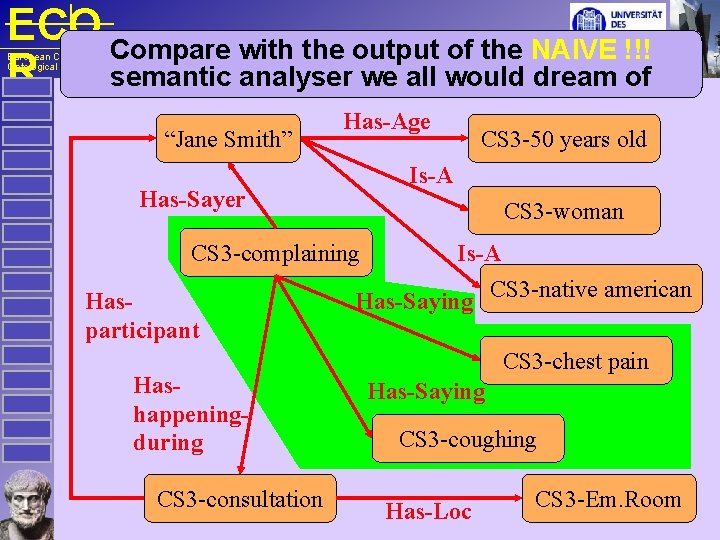
ECO Comparewiththe theoutputofofthe the. NAIVE perfect!!! R semantic analyser we all would dream of European Centre for Ontological Research “Jane Smith” Has-Age Is-A Has-Sayer CS 3 -woman CS 3 -complaining Hasparticipant Hashappeningduring CS 3 -consultation CS 3 -50 years old Is-A Has-Saying CS 3 -native american CS 3 -chest pain Has-Saying CS 3 -coughing Has-Loc CS 3 -Em. Room
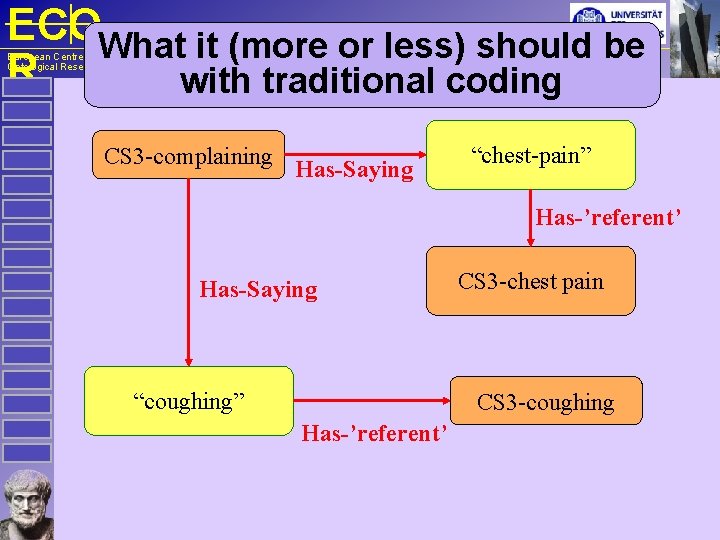
ECOWhat it (more or less) should be R with traditional coding European Centre for Ontological Research CS 3 -complaining Has-Saying “chest-pain” Has-’referent’ Has-Saying “coughing” CS 3 -chest pain CS 3 -coughing Has-’referent’
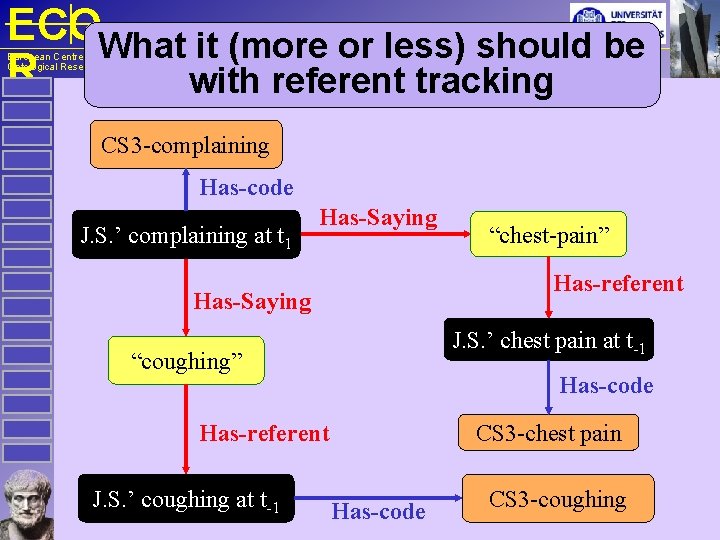
ECOWhat it (more or less) should be R with referent tracking European Centre for Ontological Research CS 3 -complaining Has-code J. S. ’ complaining at t 1 Has-Saying Has-referent Has-Saying J. S. ’ chest pain at t-1 “coughing” Has-code CS 3 -chest pain Has-referent J. S. ’ coughing at t-1 “chest-pain” Has-code CS 3 -coughing
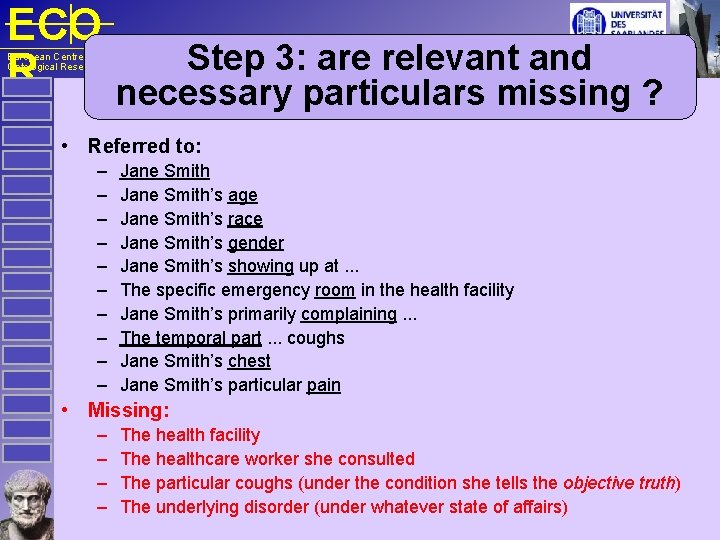
ECO Step 3: are relevant and R necessary particulars missing ? European Centre for Ontological Research • Referred to: – – – – – Jane Smith’s age Jane Smith’s race Jane Smith’s gender Jane Smith’s showing up at. . . The specific emergency room in the health facility Jane Smith’s primarily complaining. . . The temporal part. . . coughs Jane Smith’s chest Jane Smith’s particular pain • Missing: – – The health facility The healthcare worker she consulted The particular coughs (under the condition she tells the objective truth) The underlying disorder (under whatever state of affairs)
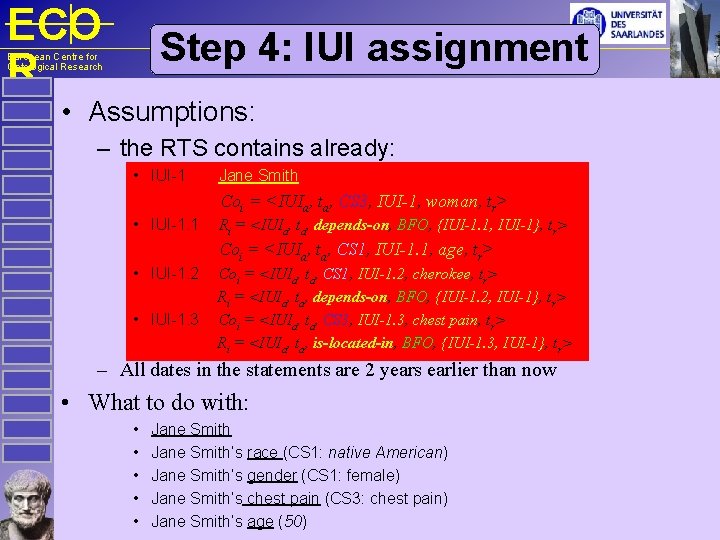
ECO R Step 4: IUI assignment European Centre for Ontological Research • Assumptions: – the RTS contains already: • IUI-1 Jane Smith Coi = <IUIa, ta, CS 3, IUI-1, woman, tr> • IUI-1. 1 Ri = <IUIa, ta, depends-on, BFO, {IUI-1. 1, IUI-1}, tr> Coi = <IUIa, ta, CS 1, IUI-1. 1, age, tr> • IUI-1. 2 • IUI-1. 3 Coi = <IUIa, ta, CS 1, IUI-1. 2, cherokee, tr> Ri = <IUIa, ta, depends-on, BFO, {IUI-1. 2, IUI-1}, tr> Coi = <IUIa, ta, CS 3, IUI-1. 3, chest pain, tr> Ri = <IUIa, ta, is-located-in, BFO, {IUI-1. 3, IUI-1}, tr> – All dates in the statements are 2 years earlier than now • What to do with: • • • Jane Smith’s race (CS 1: native American) Jane Smith’s gender (CS 1: female) Jane Smith’s chest pain (CS 3: chest pain) Jane Smith’s age (50)
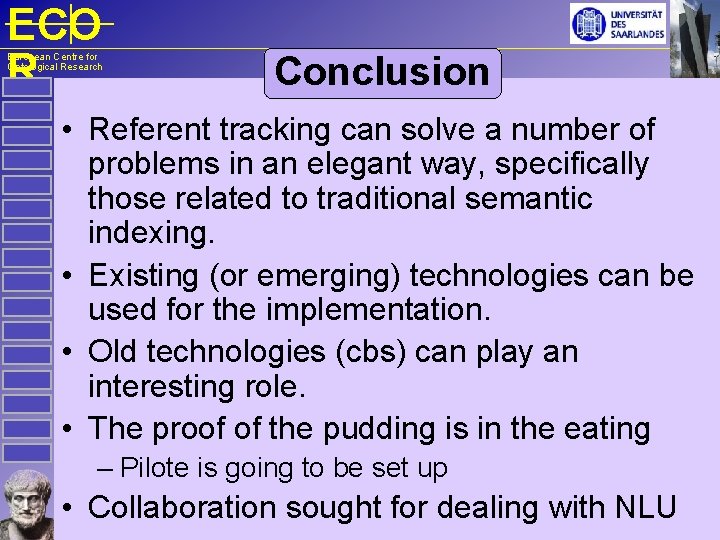
ECO R European Centre for Ontological Research Conclusion • Referent tracking can solve a number of problems in an elegant way, specifically those related to traditional semantic indexing. • Existing (or emerging) technologies can be used for the implementation. • Old technologies (cbs) can play an interesting role. • The proof of the pudding is in the eating – Pilote is going to be set up • Collaboration sought for dealing with NLU