
Eco Ambassador Grant Food Scaping a Tribal College
Eco. Ambassador Grant: Food Scaping a Tribal College Interns: Campus Kaytlyn Bergeron Na’ta’ne Miles (Pima-Maricopa) Paul Cline (Nooksack) Northwest Indian College Faculty: Ane Berrett, Director of Service Learning, Social Science Faculty Brian D. Compton, Ph. D. , Faculty, Native Environmental Science Program Sarang K. Khalsa, Food Forest Coordinator, WACC Americorps VISTA
Eco. Ambassador Objective Food Scaping a Tribal College Campus will address the issue of climate change and the impact on food sources of the Lummi Nation. By establishing a sustainable food sovereignty model of a nut and berry food forest on the NWIC campus, it will provide a space to educate and replicate gardens within the community. Collaboration with: EPA, AIHEC, Elders, ISL, high school/college students
NIFA Objective Telling the Story of the Land: Revitalization of Traditional Plant Knowledge and Harvest with a View Toward Sustainability The National Institute of Food and Agriculture (NIFA) supports research, education and Extension programs in the Land-Grant University System and other partner organizations
Relationship Research Project’s Relationship to USDA NIFA Goals Sustainable use of natural resource of USDA’s Research Education and Economics (REE) Action Plan Age-old traditional practices supporting sustainable interactions with the environment included the harvest of plants for use in the family, as trade items, and in other practices that helped enhance plant populations
Research Questions What was the pre-contact function of these ecosystems? How can current vegetation be used to determine the footprint of colonization? What is the feasibility of restoring the ecosystem to its precontact function? Which plant species have the greatest potential for reintroduction success? What is the potential for restoring cultural interaction within these habitats? Are small-scale pilot-level restoration efforts feasible and desirable?
Expected Outcomes Historical baseline of existing plant life to assist in establishing possible restoration Identification of the long-term experimental capacity for the chosen site Identification of invasive and other non-native species Current conditions as compared to pre-contact conditions Public awareness education Identification of the feasibility of plant/habitat restoration Identification of best management practices Initiation of a stewardship plan for site Identification of potential barriers to implementation of the stewardship plan and potential activities to overcome those barriers
Community Partners John Davis Project support; Head of Maintenance Department Faculty and students from all campuses Survey Jim Freed NIFA partner Bruce Hoestedeer Horticulturist/Permaculturist (meeting TBA)
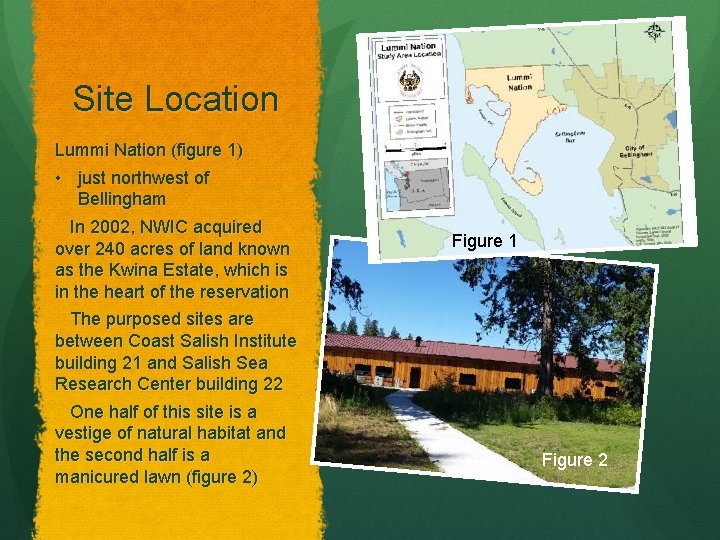
Site Location Lummi Nation (figure 1) • just northwest of Bellingham In 2002, NWIC acquired over 240 acres of land known as the Kwina Estate, which is in the heart of the reservation The purposed sites are between Coast Salish Institute building 21 and Salish Sea Research Center building 22 One half of this site is a vestige of natural habitat and the second half is a manicured lawn (figure 2) Figure 1 Figure 2

…In reference to a campus map
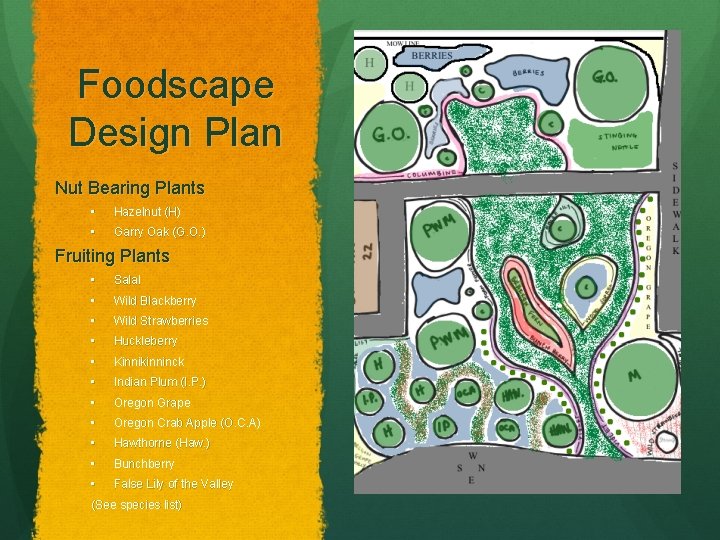
Foodscape Design Plan Nut Bearing Plants • Hazelnut (H) • Garry Oak (G. O. ) Fruiting Plants • Salal • Wild Blackberry • Wild Strawberries • Huckleberry • Kinnikinninck • Indian Plum (I. P. ) • Oregon Grape • Oregon Crab Apple (O. C. A) • Hawthorne (Haw. ) • Bunchberry • False Lily of the Valley (See species list)
Food Sovereignty “The authority of a state to govern itself” What does food sovereignty mean? Food sovereignty is when a Nation has control of their food supplies Define their own food and agriculture; to protect and regulate domestic agricultural production and trade in order to achieve sustainable development To be self reliant; to restrict the dumping of products in their markets To provide local fisheries-based communities the priority in managing the use of and the rights to aquatic resources
Local Food Sovereignty What does food sovereignty look like for the Lummi community? “The right of taking fish at usual and accustomed grounds and stations is further secured to said Indians in common with all citizens of the Territory, and of erecting temporary houses for the purpose of curing, together with the privilege of hunting and gathering roots and berries on open and unclaimed lands. Provided, however, That they shall not take shell-fish from any beds staked or cultivated by citizens. ”
So What is Next? Spring Quarter January Finalize plant species list Meetings with community partners, horticulturists, and NIFA partners February Begin plant phenology data collection March Visit Washington food gardens Finalize foodscape design Select plant providers and gather for groundbreaking
Conclusion Through support of the EPA, AHEIC, and NWIC with continuing support through NIFA the Lummi campus and community will benefit greatly from the nut and berry garden. This garden will provide a functioning, active example of food sovereignty. We intend to publicize our planning to duplicate throughout the community directly in people’s backyards. While practicing sustainably, ecologically friendly methods we intend to lessen the food print on campus and the Lummi community.
Work Cited Compton, Brian. "Telling the Story of the Land. " Brians Blog. Northwest Indian College. Web. Dec 1, 2014. Retrieved from http: //blogs. nwic. edu/briansblog/ Deloria, Vine, Jr. 1997. Indians of the Pacific Northwest from the coming of the white man to the present day. Garden City. Doubleday and Company Inc. Print. Grassroots International retrieved from http: //www. grassrootsonline. org/ publications/educational resources/download-food-thought-action-a-foodsovereignty-curriculum Governors Office of Indian Affairs. (n. d. ). Retrieved November 30, 2014, from http: / / www. goia. wa. gov/treaties/pointelliot. htm Oxford Dictionaries. 2014. Oxford University Press. Web. Dec 2, 2014. Retrieved from http: //www. oxforddictionaries. com/definition/english/sovereignty? search. Dict. Code=all United States Department of Agriculture. Dec 31, 2013. Web. 2 Dec. 2014. Retrieved from http: //www. usda. gov/wps/portal/usdahome? navid=researchscience
- Slides: 15