
Eco 2 Go Program at OSU Expansion Feasibility
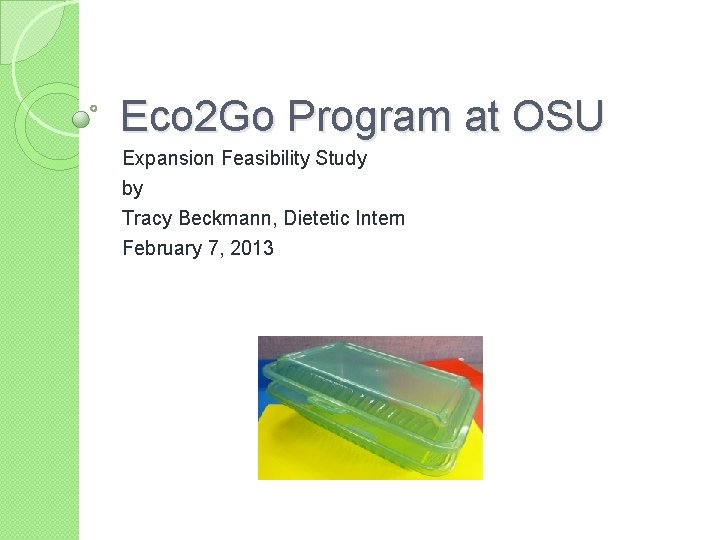
Eco 2 Go Program at OSU Expansion Feasibility Study by Tracy Beckmann, Dietetic Intern February 7, 2013
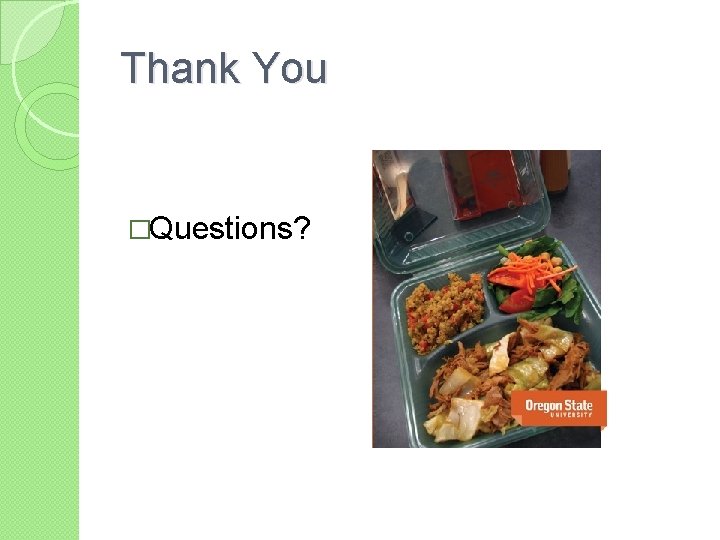
What is Eco 2 Go at OSU? �Reusable to-go container program �Program offers ◦ Sustainable dining option ◦ Increases student satisfaction ◦ Potential to reduce disposables cost
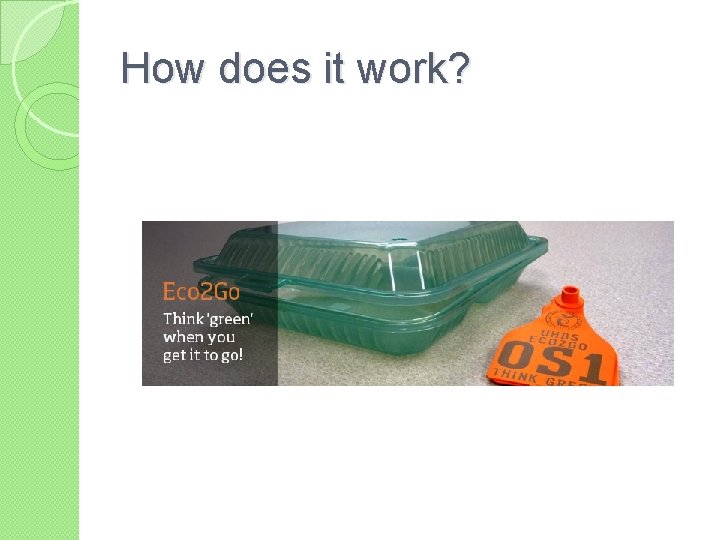
How does it work?
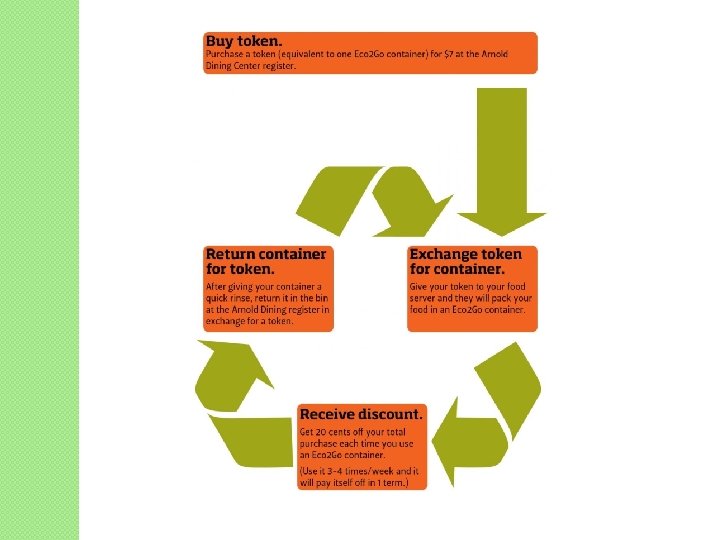
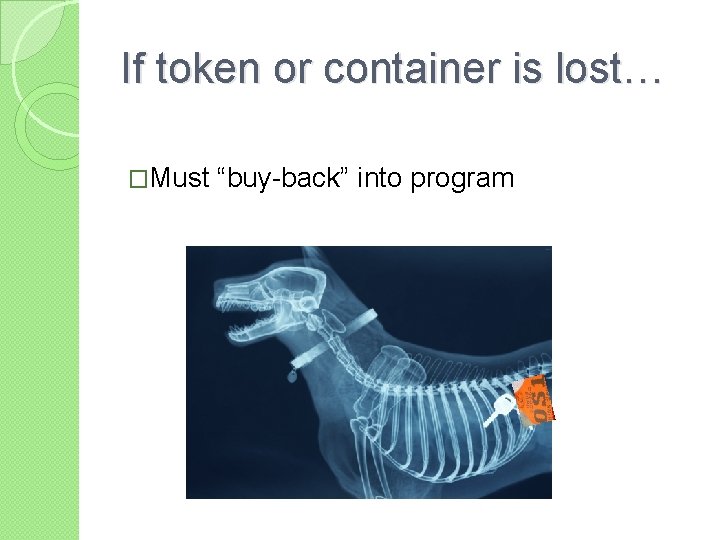
If token or container is lost… �Must “buy-back” into program
How is the program doing? �Launched in fall 2012, Southside (Arnold) � 46 student “buy-ins” �Student Satisfaction Survey
Southside dining hall �Site chosen due to central cashiers and continuous coverage �Marché style model is conducive to utilizing to-go containers �This set-up required minimal preparation to implement pilot program
Pilot program goals �sell 40 -50 containers within first 2 terms of program start �Increase student dining hall satisfaction �Decrease disposable “to-go” container expense �Determine pilot program sustainability
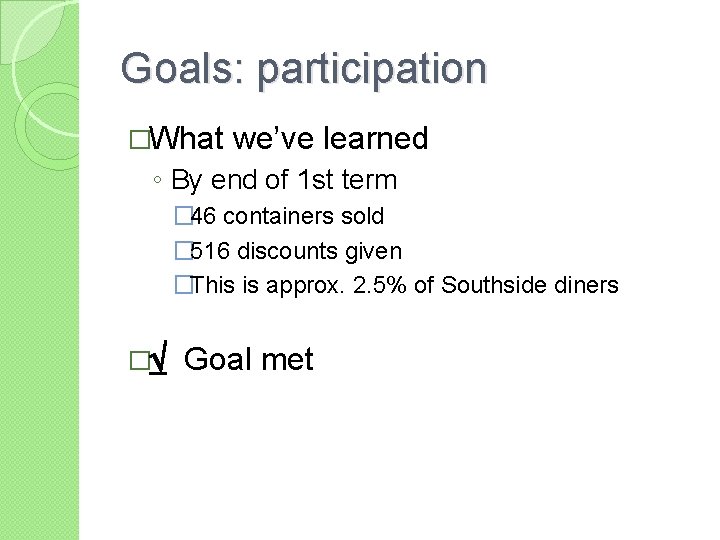
Goals: participation �What we’ve learned ◦ By end of 1 st term � 46 containers sold � 516 discounts given �This is approx. 2. 5% of Southside diners � Goal met
Goal: Student satisfaction �Student Satisfaction data collected January 28 -31, 2013 at Southside ◦ Survey focused on participants ◦ feedback from non-participants also tracked � 10 question survey, email list �Each participant given thank-you gift
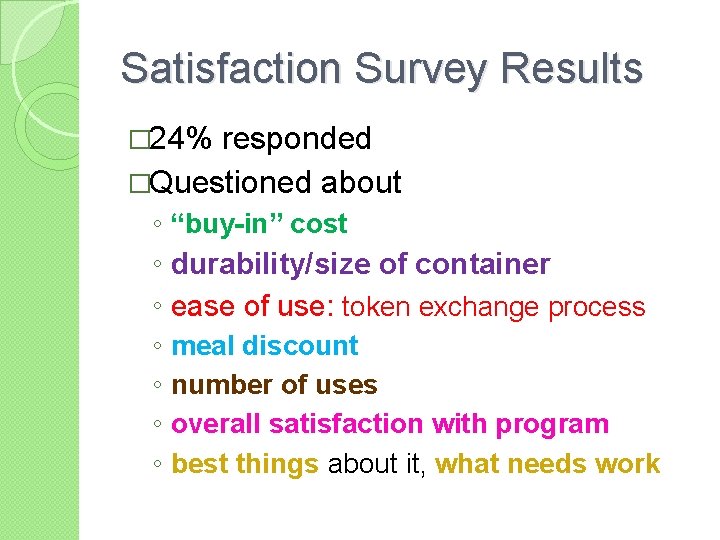
Satisfaction Survey Results � 24% responded �Questioned about ◦ “buy-in” cost ◦ durability/size of container ◦ ease of use: token exchange process ◦ ◦ meal discount number of uses overall satisfaction with program best things about it, what needs work
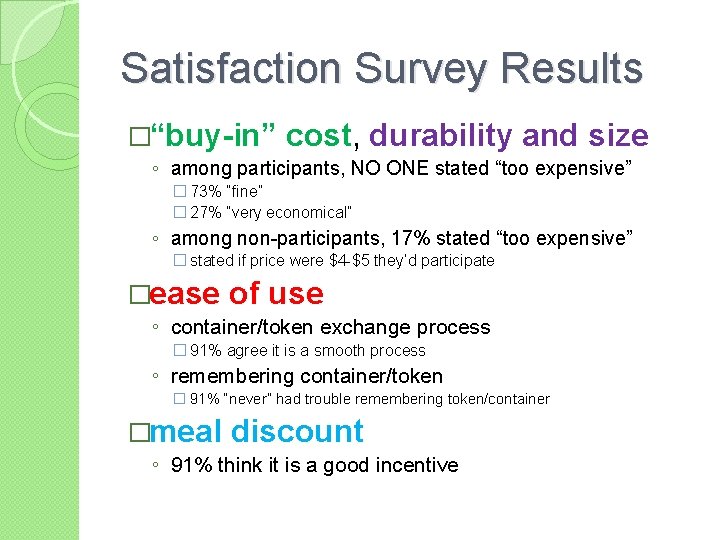
Satisfaction Survey Results �“buy-in” cost, durability and size ◦ among participants, NO ONE stated “too expensive” � 73% “fine” � 27% “very economical” ◦ among non-participants, 17% stated “too expensive” � stated if price were $4 -$5 they’d participate �ease of use ◦ container/token exchange process � 91% agree it is a smooth process ◦ remembering container/token � 91% “never” had trouble remembering token/container �meal discount ◦ 91% think it is a good incentive
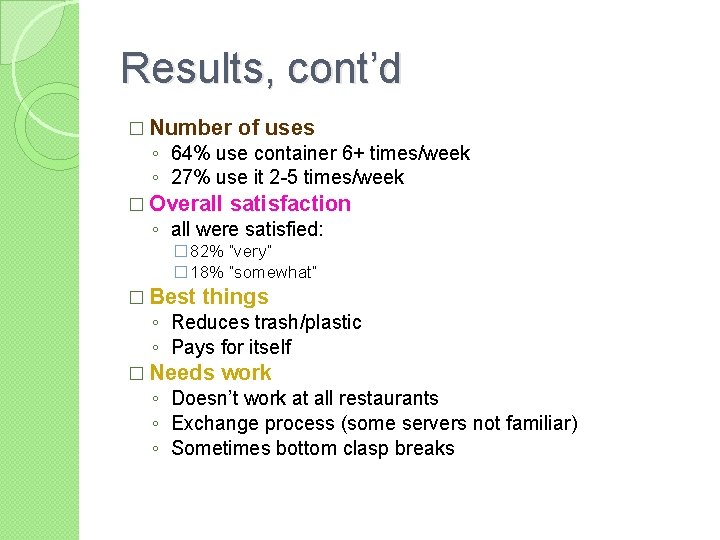
Results, cont’d � Number of uses ◦ 64% use container 6+ times/week ◦ 27% use it 2 -5 times/week � Overall satisfaction ◦ all were satisfied: � 82% “very” � 18% “somewhat” � Best things ◦ Reduces trash/plastic ◦ Pays for itself � Needs work ◦ Doesn’t work at all restaurants ◦ Exchange process (some servers not familiar) ◦ Sometimes bottom clasp breaks
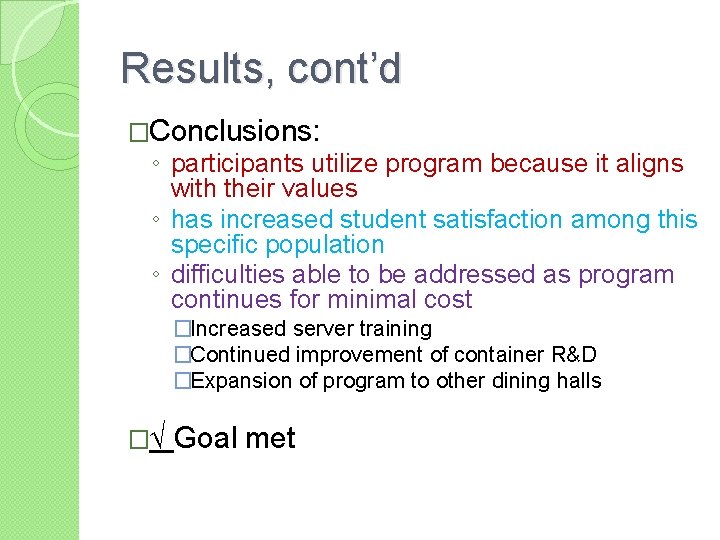
Results, cont’d �Conclusions: ◦ participants utilize program because it aligns with their values ◦ has increased student satisfaction among this specific population ◦ difficulties able to be addressed as program continues for minimal cost �Increased server training �Continued improvement of container R&D �Expansion of program to other dining halls � Goal met
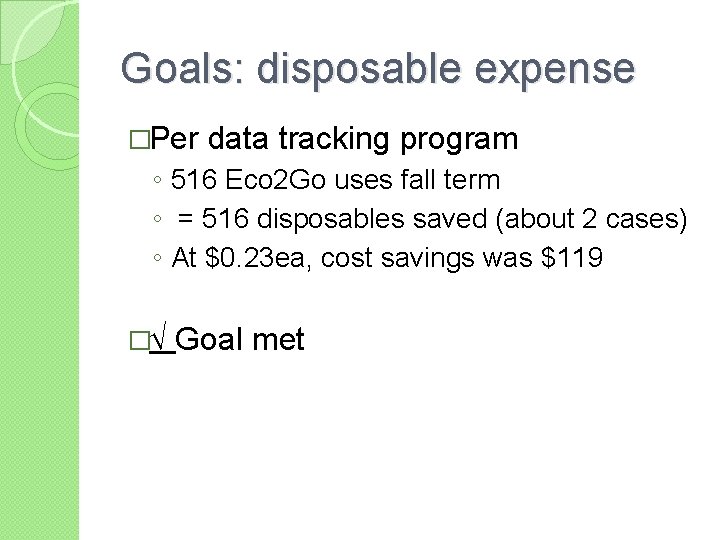
Goals: disposable expense �Per data tracking program ◦ 516 Eco 2 Go uses fall term ◦ = 516 disposables saved (about 2 cases) ◦ At $0. 23 ea, cost savings was $119 � Goal met
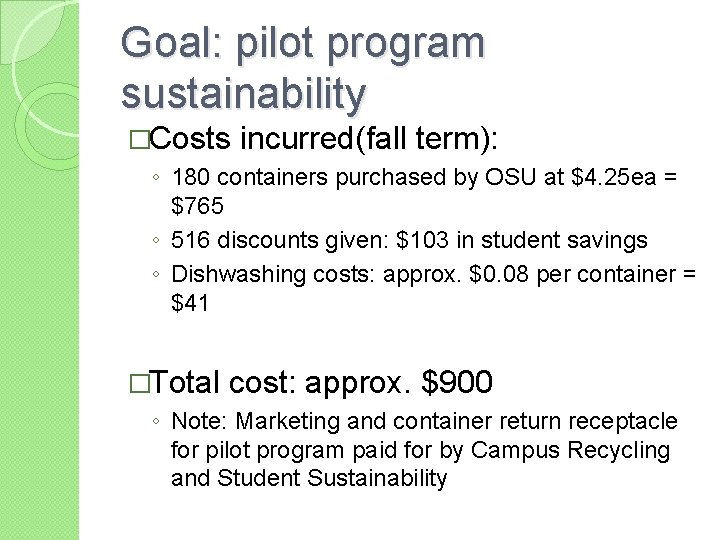
Goal: pilot program sustainability �Costs incurred(fall term): ◦ 180 containers purchased by OSU at $4. 25 ea = $765 ◦ 516 discounts given: $103 in student savings ◦ Dishwashing costs: approx. $0. 08 per container = $41 �Total cost: approx. $900 ◦ Note: Marketing and container return receptacle for pilot program paid for by Campus Recycling and Student Sustainability
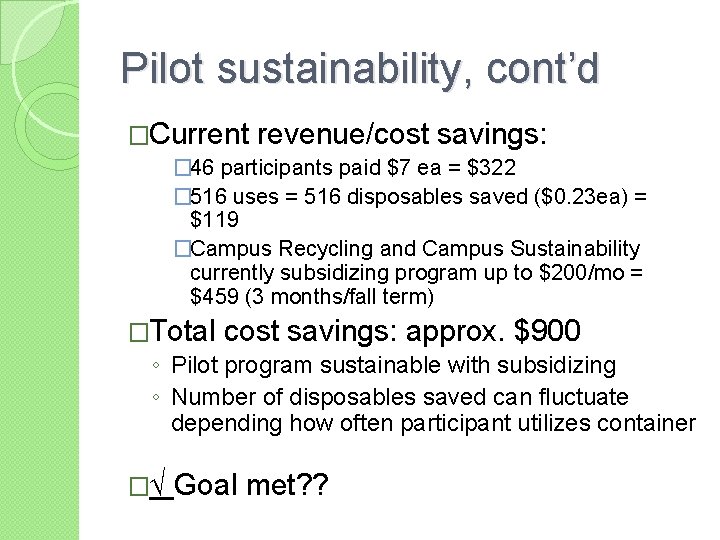
Pilot sustainability, cont’d �Current revenue/cost savings: � 46 participants paid $7 ea = $322 � 516 uses = 516 disposables saved ($0. 23 ea) = $119 �Campus Recycling and Campus Sustainability currently subsidizing program up to $200/mo = $459 (3 months/fall term) �Total cost savings: approx. $900 ◦ Pilot program sustainable with subsidizing ◦ Number of disposables saved can fluctuate depending how often participant utilizes container � Goal met? ?
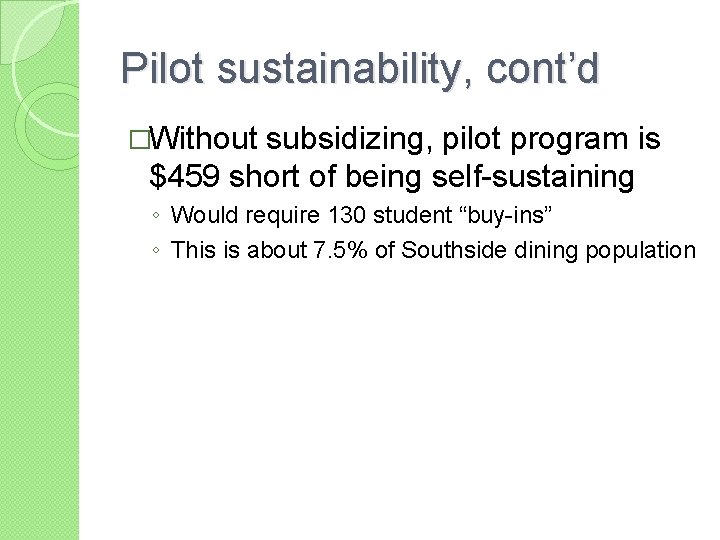
Pilot sustainability, cont’d �Without subsidizing, pilot program is $459 short of being self-sustaining ◦ Would require 130 student “buy-ins” ◦ This is about 7. 5% of Southside dining population
Ways to increase participation �Increase marketing of Eco 2 Go �De-incentivize plastic/compostable “togo” containers �Remove barriers to “buy-in” �Expand program to other dining halls
Marketing strategies �Goal: increase “buy-in” ◦ Continued partnership with Campus Recycling and Student Sustainability ◦ UHDS promotions: �tabling �social media �a few containers given as prizes/awards to awareness
Marketing strategies �Example of similar program: ◦ Reusable coffee cups �quite well-known �fairly mainstream �acceptable alternative to disposable cups
De-incentivise plastic � Disposables cost ◦ OSU cost is $0. 23 per container ◦ By offering disposables at no charge, we’re encouraging use ◦ Implement $0. 05 charge per disposable to encourage participation in program (consistent w/Corvallis-wide plastic bag fee) �This won’t cover cost, but will result in some students choosing Eco 2 Go or dining hall plates as alternatives � Personal observation at Southside ◦ In a 1 hour time period (lunch): � 157 diners � 82 used plates = 52% � 72 used plastic “to-go” containers = 46% �Over $16 lost to disposables �Several were thrown away in dining hall
Something to consider: �disposable “to-go” containers make up the largest component of our trash (per OSU Campus Operations)
Barriers to “buy-in” �Initial cost: � Offer reduced cost of container each term �$7 in fall �$6 in winter �$5 in spring �Requires cash � Allow purchase with Dining Plan (currently cannot use meal plan to purchase) �Expand program � Pilot program is limited in scope
Expansion of Eco 2 Go �Request made (unsolicited) by several non-participants during student survey �Logical next-step of program � Increased participation � May aid in cost effectiveness
Feasibility of expansion �Increased participation ◦ Students living in non-Southside res halls say container not cost-effective for them ◦ Add program to Mc. Nary and Marketplace West ◦ Southside participation: 46 participants = 2. 5% �Projected: �Mc. Nary: 2. 5% = add’l 50 participants �Marketplace West: 2. 5% = add’l 60 participants
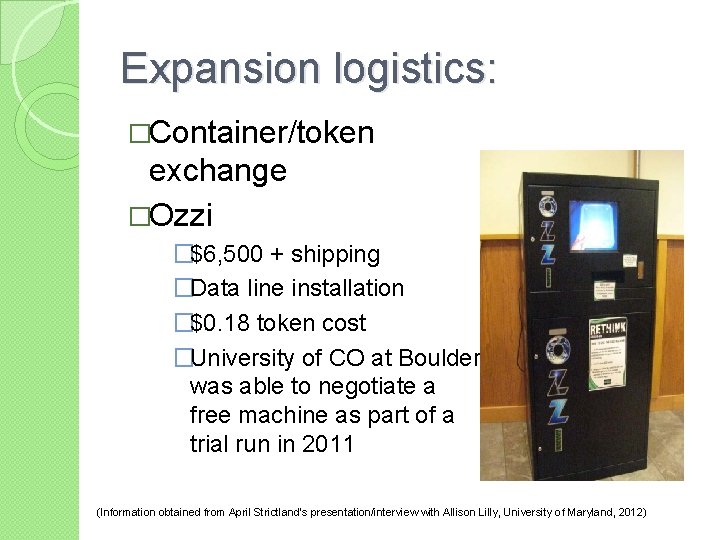
Expansion logistics: �Container/token exchange �Ozzi �$6, 500 + shipping �Data line installation �$0. 18 token cost �University of CO at Boulder was able to negotiate a free machine as part of a trial run in 2011 (Information obtained from April Strictland’s presentation/interview with Allison Lilly, University of Maryland, 2012)
Expansion logistics, cont’d: �Simpler/less expensive to utilize locations with central cashier: �Clubhouse Café �Boardwalk Cafe �Fairly continuous coverage �Complies with Public Health Codes ◦ Not accepting dirty dishes where food is prepared
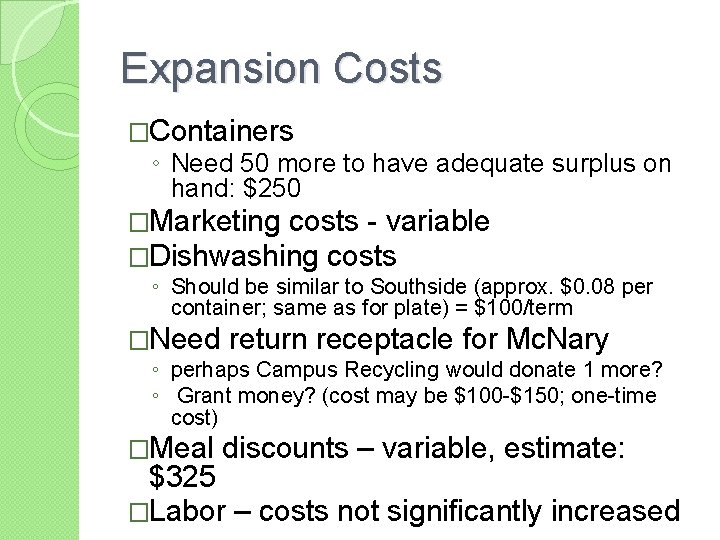
Expansion Costs �Containers ◦ Need 50 more to have adequate surplus on hand: $250 �Marketing costs - variable �Dishwashing costs ◦ Should be similar to Southside (approx. $0. 08 per container; same as for plate) = $100/term �Need return receptacle for Mc. Nary �Meal discounts – variable, estimate: ◦ perhaps Campus Recycling would donate 1 more? ◦ Grant money? (cost may be $100 -$150; one-time cost) $325 �Labor – costs not significantly increased
Cost of expansion, cont’d �Total cost: approx. $825
Potential help: �Applied for $5000 grant (Chris Anderson) ◦ To be applied towards future container purchases �Replace broken containers �Purchase containers more suitable for pizza, soup �Ensure ample container surplus �Allows OSU to reduce student purchase price �Perhaps help with other expansion costs?
Final thoughts �Offer ways to increase student dining satisfaction �Foster relationships with Campus Recycling and Student Sustainability �Increase opportunities to ◦ Teach sustainability ◦ Reduce waste ◦ Decrease operational costs �Thoughtful expansion of Eco 2 Go may help us reach these goals
Thank You �Questions?
References � Anderson, Chris; Catering Manager, Oregon State University, personal interview Feb. 4, 2013. Chris. Anderson@oregonstate. edu � Sanders, Tara; Registered Dietitian, Oregon State University, personal interviews Jan-Feb 2013. Tara. Sanders@oregonstate. edu � Strictland, April; Dietetic Intern 2011 -2012, Oregon State University. Reusable Takeout Containers Feasibility Study, March 1, 2012. � Student Satisfaction Survey, conducted at Southside (Arnold) Dining Hall Jan. 29 -31, 2013, informal research project
- Slides: 34