
ECMO and CRRT Matthew L Paden MD Assistant
- Slides: 26
ECMO and CRRT Matthew L. Paden, MD Assistant Professor of Pediatric Critical Care Director, Pediatric ECMO
Disclosures • Funded by NIH/FDA for CRRT/ECMO device development • Everything in ECMO is off label use • I’m a believer… Children’s Healthcare of Atlanta | Emory University 2
Objectives • Discuss usage cases for concomitant ECMO/CRRT • Description of recent common changes in ECMO configurations • Discuss technical aspects of concomitant ECMO/CRRT Children’s Healthcare of Atlanta | Emory University 3
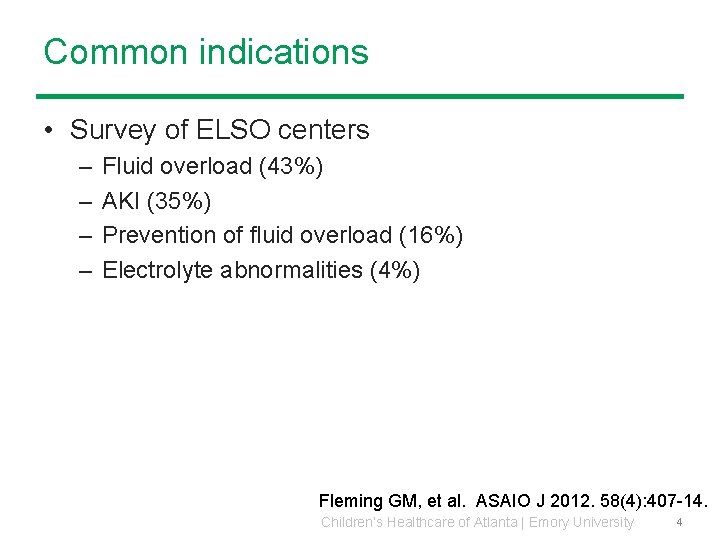
Common indications • Survey of ELSO centers – – Fluid overload (43%) AKI (35%) Prevention of fluid overload (16%) Electrolyte abnormalities (4%) Fleming GM, et al. ASAIO J 2012. 58(4): 407 -14. Children’s Healthcare of Atlanta | Emory University 4
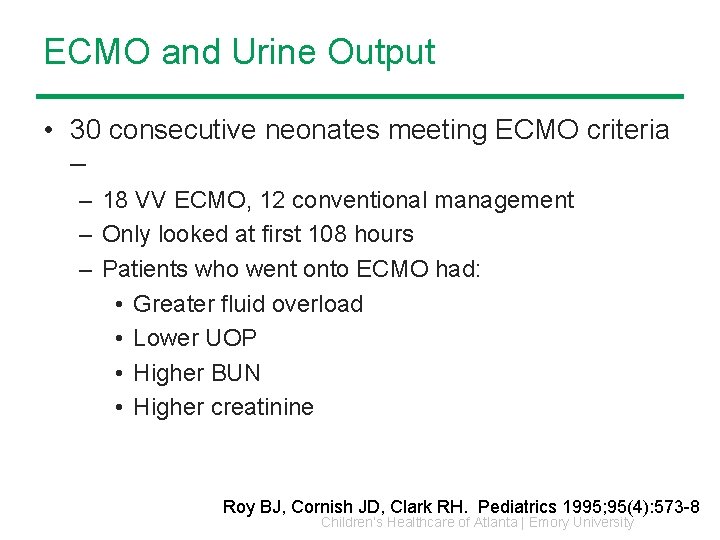
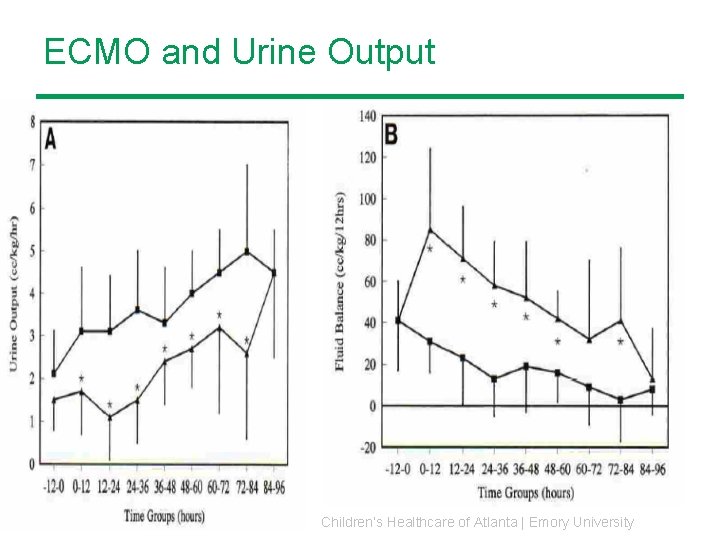
ECMO and Urine Output • 30 consecutive neonates meeting ECMO criteria – – 18 VV ECMO, 12 conventional management – Only looked at first 108 hours – Patients who went onto ECMO had: • Greater fluid overload • Lower UOP • Higher BUN • Higher creatinine Roy BJ, Cornish JD, Clark RH. Pediatrics 1995; 95(4): 573 -8 Children’s Healthcare of Atlanta | Emory University
ECMO and Urine Output Children’s Healthcare of Atlanta | Emory University
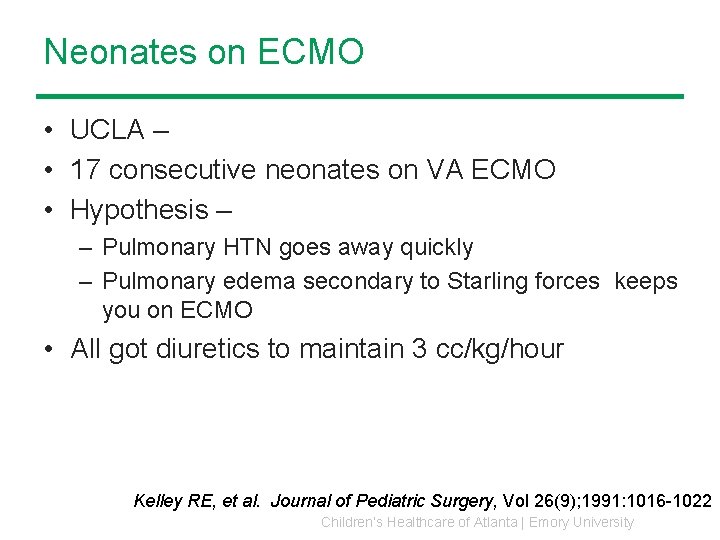
Neonates on ECMO • UCLA – • 17 consecutive neonates on VA ECMO • Hypothesis – – Pulmonary HTN goes away quickly – Pulmonary edema secondary to Starling forces keeps you on ECMO • All got diuretics to maintain 3 cc/kg/hour Kelley RE, et al. Journal of Pediatric Surgery, Vol 26(9); 1991: 1016 -1022 Children’s Healthcare of Atlanta | Emory University
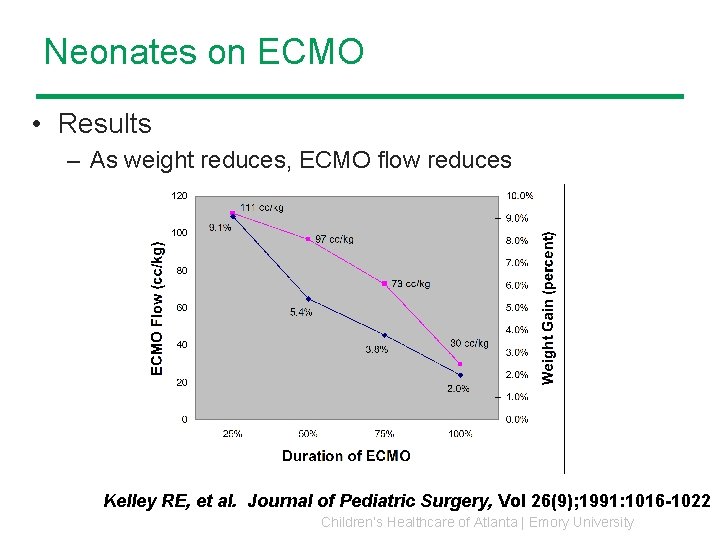
Neonates on ECMO • Results – As weight reduces, ECMO flow reduces Kelley RE, et al. Journal of Pediatric Surgery, Vol 26(9); 1991: 1016 -1022 Children’s Healthcare of Atlanta | Emory University
ELSO Guidelines • The goal of fluid management is to return the extracellular fluid volume to normal (dry weight) and maintain it there. • …spontaneous or pharmacologic diuresis should be instituted until patient is close to dry weight and edema has cleared. This will enhance recovery from heart or lung failure and decrease the time on ECLS. • As with all critically ill patients, full caloric and Children’s Healthcare of Atlanta | Emory University protein nutritional support is essential. 9
ELSO Guidelines • The hourly fluid balance goal should be set and maintained until normal extracellular fluid volume is reached (no systemic edema, within 5% of “dry” weight). Renal replacement therapy use to enhance fluid removal allowing adequate nutritional support is often performed. • Despite the literature surrounding fluid overload (>10%) as a risk factor for death, review of the ELSO registry also finds that use of renal replacement therapy is also a risk factor for poor outcome. • Even if acute renal failure occurs with ECLS, resolution in survivors occurs >90% of. University 10 Children’s Healthcarein of Atlanta | Emory
Preventing Fluid Overload • How many of you would start CRRT on an ECMO patient with a normal creatinine and no fluid overload? Children’s Healthcare of Atlanta | Emory University 11
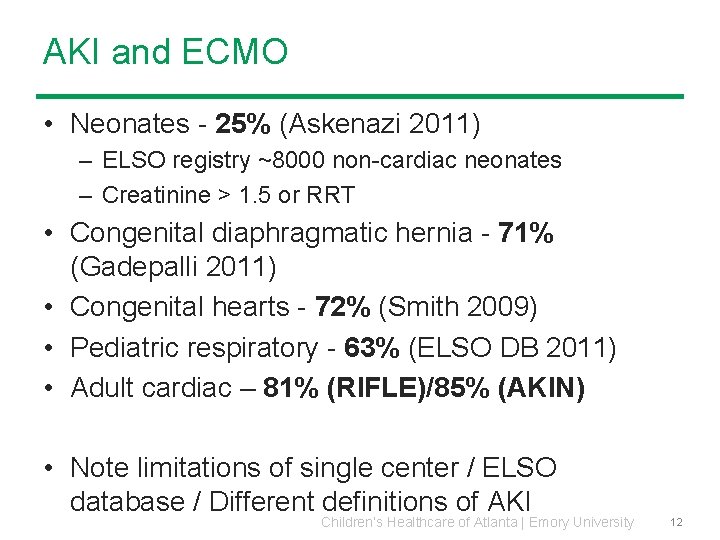
AKI and ECMO • Neonates - 25% (Askenazi 2011) – ELSO registry ~8000 non-cardiac neonates – Creatinine > 1. 5 or RRT • Congenital diaphragmatic hernia - 71% (Gadepalli 2011) • Congenital hearts - 72% (Smith 2009) • Pediatric respiratory - 63% (ELSO DB 2011) • Adult cardiac – 81% (RIFLE)/85% (AKIN) • Note limitations of single center / ELSO database / Different definitions of AKI Children’s Healthcare of Atlanta | Emory University 12
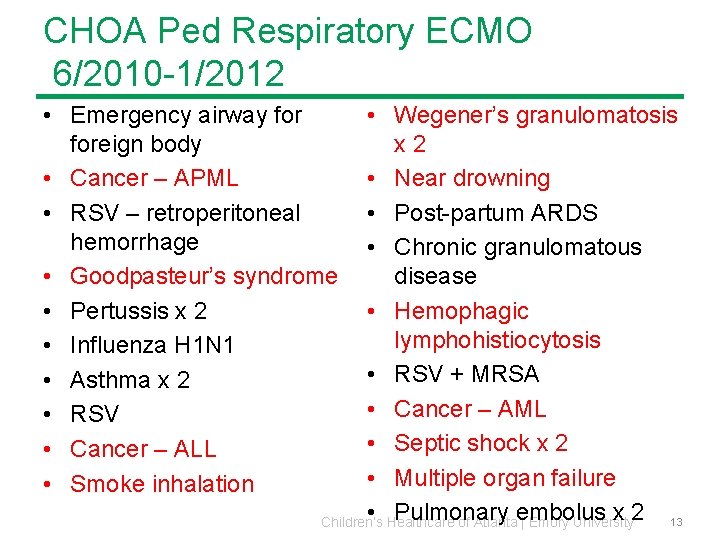
CHOA Ped Respiratory ECMO 6/2010 -1/2012 • Emergency airway foreign body • Cancer – APML • RSV – retroperitoneal hemorrhage • Goodpasteur’s syndrome • Pertussis x 2 • Influenza H 1 N 1 • Asthma x 2 • RSV • Cancer – ALL • Smoke inhalation • Wegener’s granulomatosis x 2 • Near drowning • Post-partum ARDS • Chronic granulomatous disease • Hemophagic lymphohistiocytosis • RSV + MRSA • Cancer – AML • Septic shock x 2 • Multiple organ failure • Healthcare Pulmonary x 2 13 Children’s of Atlantaembolus | Emory University
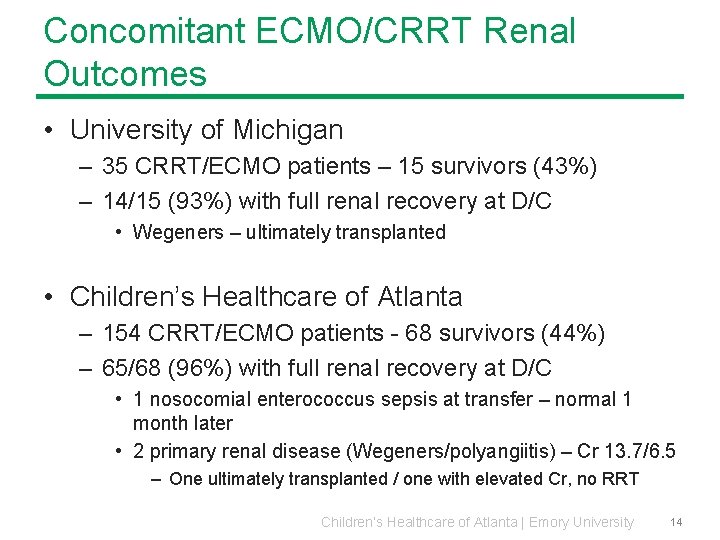
Concomitant ECMO/CRRT Renal Outcomes • University of Michigan – 35 CRRT/ECMO patients – 15 survivors (43%) – 14/15 (93%) with full renal recovery at D/C • Wegeners – ultimately transplanted • Children’s Healthcare of Atlanta – 154 CRRT/ECMO patients - 68 survivors (44%) – 65/68 (96%) with full renal recovery at D/C • 1 nosocomial enterococcus sepsis at transfer – normal 1 month later • 2 primary renal disease (Wegeners/polyangiitis) – Cr 13. 7/6. 5 – One ultimately transplanted / one with elevated Cr, no RRT Children’s Healthcare of Atlanta | Emory University 14
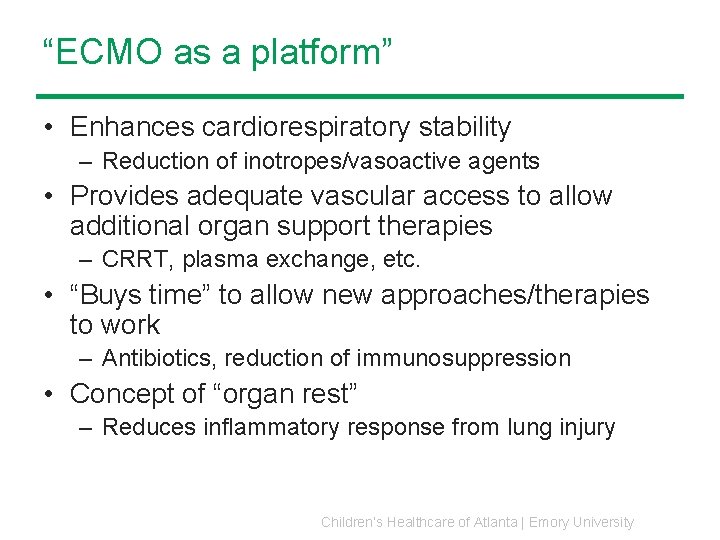
“ECMO as a platform” • Enhances cardiorespiratory stability – Reduction of inotropes/vasoactive agents • Provides adequate vascular access to allow additional organ support therapies – CRRT, plasma exchange, etc. • “Buys time” to allow new approaches/therapies to work – Antibiotics, reduction of immunosuppression • Concept of “organ rest” – Reduces inflammatory response from lung injury Children’s Healthcare of Atlanta | Emory University
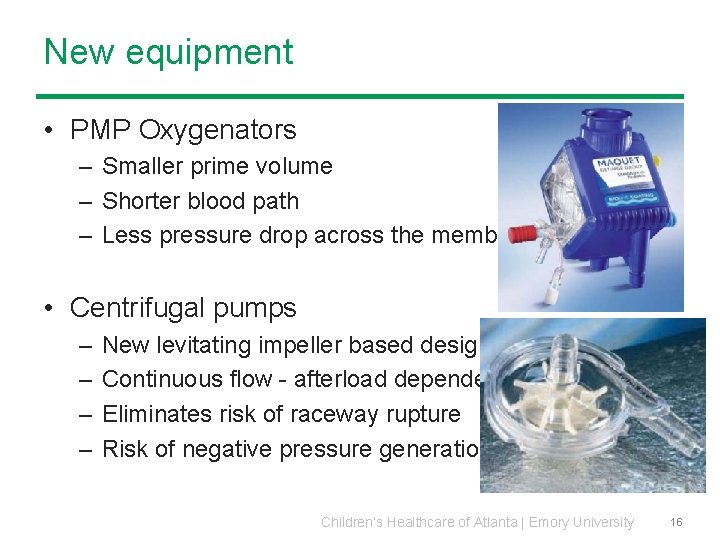
New equipment • PMP Oxygenators – Smaller prime volume – Shorter blood path – Less pressure drop across the membrane • Centrifugal pumps – – New levitating impeller based designs Continuous flow - afterload dependent Eliminates risk of raceway rupture Risk of negative pressure generation Children’s Healthcare of Atlanta | Emory University 16
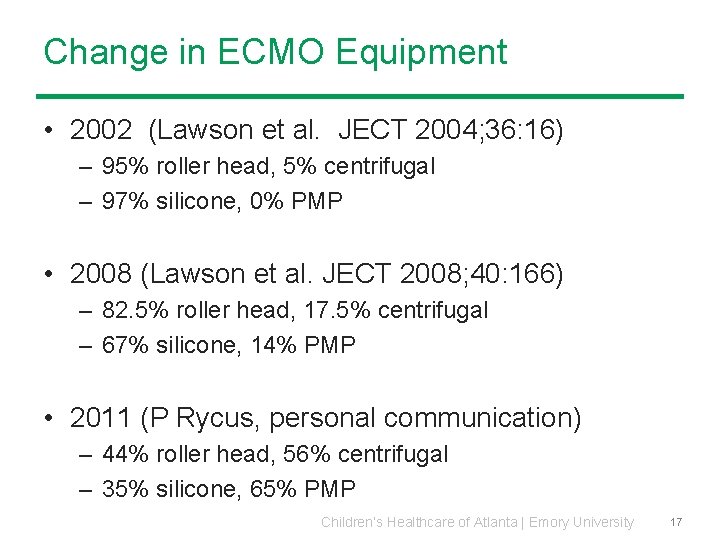
Change in ECMO Equipment • 2002 (Lawson et al. JECT 2004; 36: 16) – 95% roller head, 5% centrifugal – 97% silicone, 0% PMP • 2008 (Lawson et al. JECT 2008; 40: 166) – 82. 5% roller head, 17. 5% centrifugal – 67% silicone, 14% PMP • 2011 (P Rycus, personal communication) – 44% roller head, 56% centrifugal – 35% silicone, 65% PMP Children’s Healthcare of Atlanta | Emory University 17
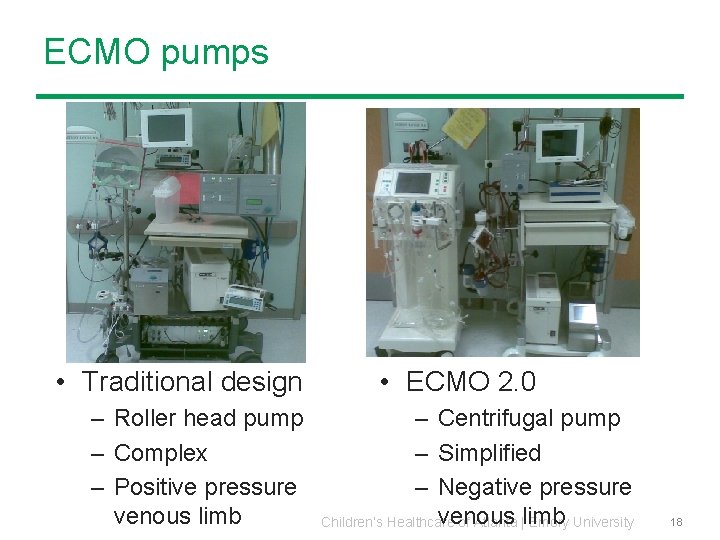
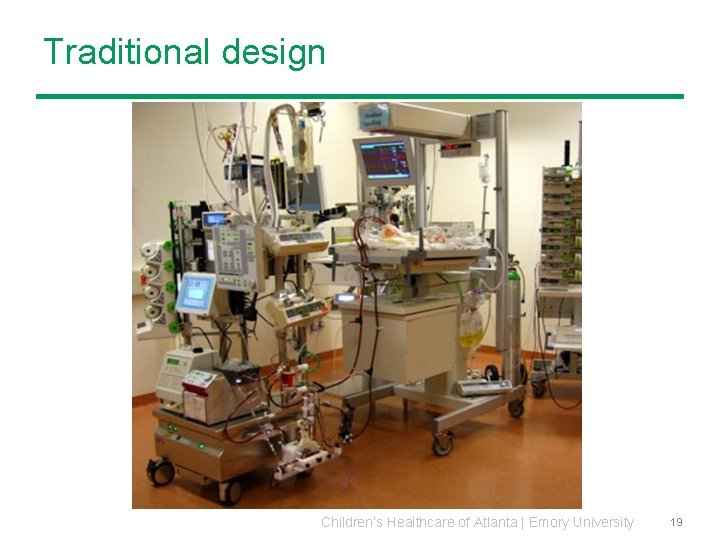
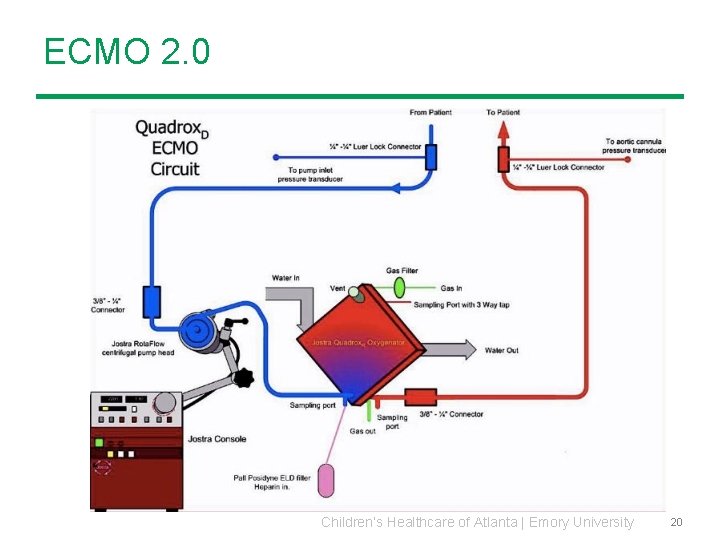
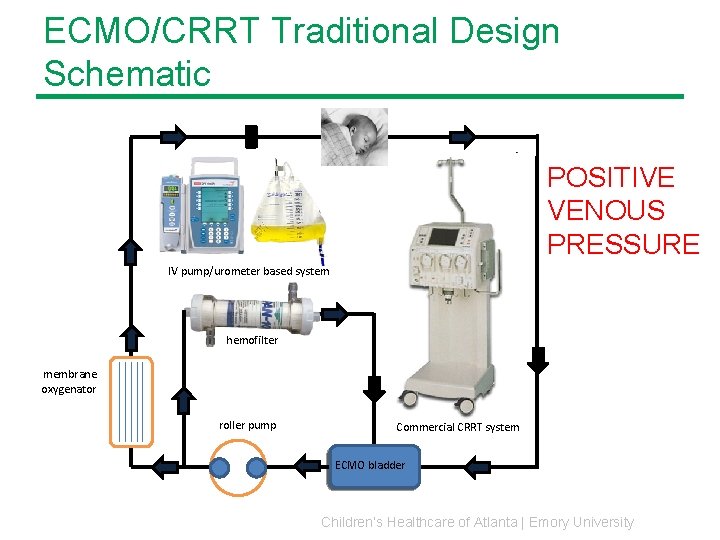
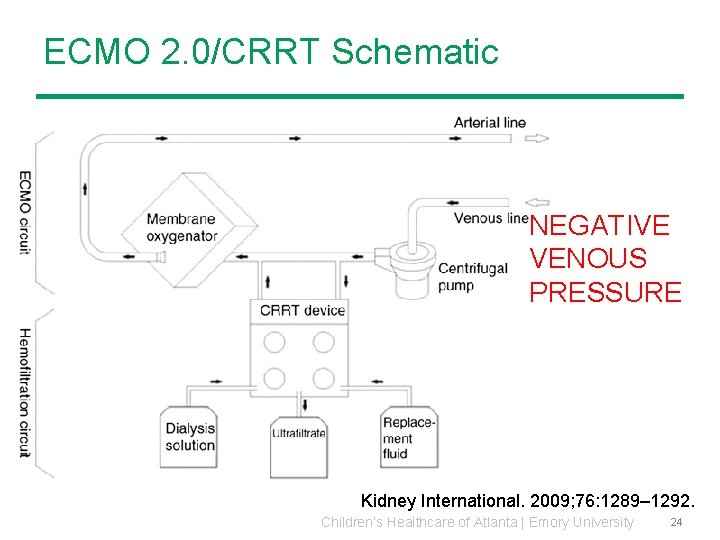
ECMO pumps • Traditional design – Roller head pump – Complex – Positive pressure venous limb • ECMO 2. 0 – Centrifugal pump – Simplified – Negative pressure venous Children’s Healthcare of Atlanta |limb Emory University 18
Traditional design Children’s Healthcare of Atlanta | Emory University 19
ECMO 2. 0 Children’s Healthcare of Atlanta | Emory University 20
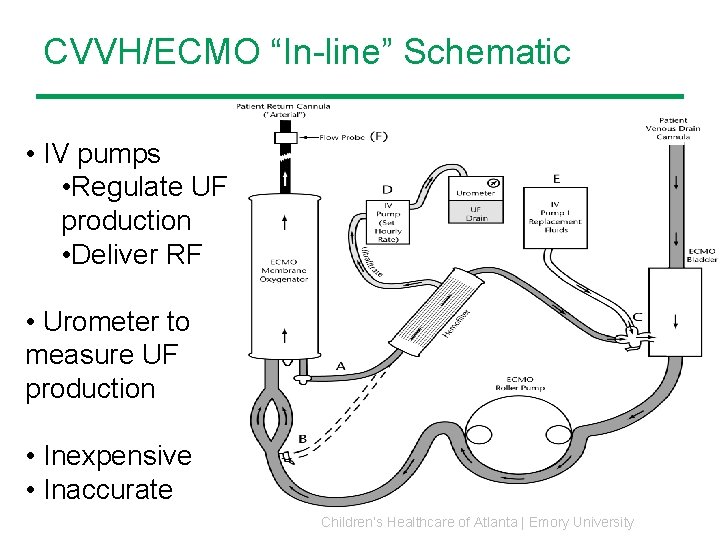
CVVH/ECMO “In-line” Schematic • IV pumps • Regulate UF production • Deliver RF • Urometer to measure UF production • Inexpensive • Inaccurate Children’s Healthcare of Atlanta | Emory University
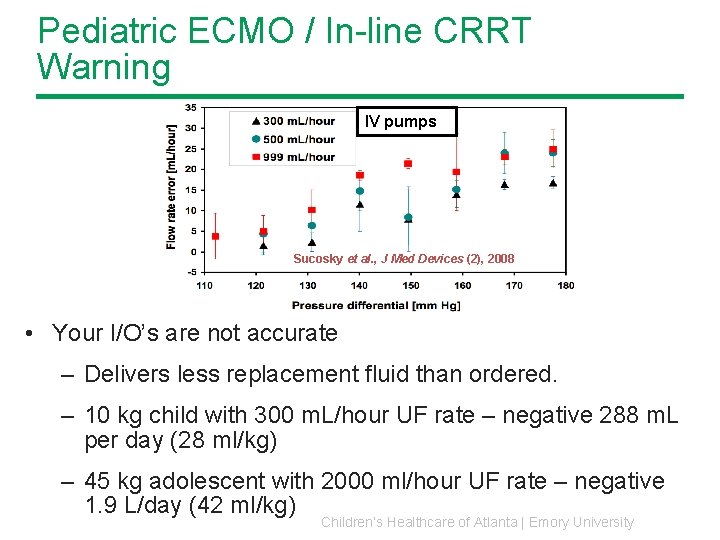
Pediatric ECMO / In-line CRRT Warning IV pumps Sucosky et al. , J Med Devices (2), 2008 • Your I/O’s are not accurate – Delivers less replacement fluid than ordered. – 10 kg child with 300 m. L/hour UF rate – negative 288 m. L per day (28 ml/kg) – 45 kg adolescent with 2000 ml/hour UF rate – negative 1. 9 L/day (42 ml/kg) Children’s Healthcare of Atlanta | Emory University
ECMO/CRRT Traditional Design Schematic POSITIVE VENOUS PRESSURE IV pump/urometer based system hemofilter membrane oxygenator roller pump Commercial CRRT system ECMO bladder Children’s Healthcare of Atlanta | Emory University
ECMO 2. 0/CRRT Schematic NEGATIVE VENOUS PRESSURE Kidney International. 2009; 76: 1289– 1292. Children’s Healthcare of Atlanta | Emory University 24
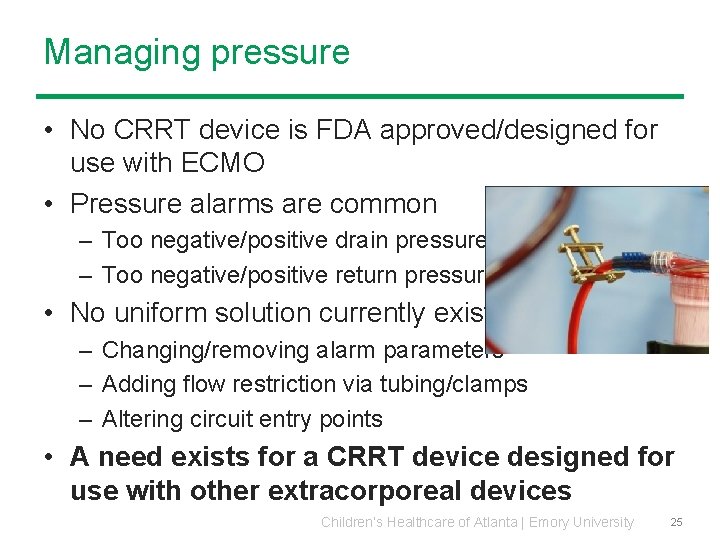
Managing pressure • No CRRT device is FDA approved/designed for use with ECMO • Pressure alarms are common – Too negative/positive drain pressures – Too negative/positive return pressures • No uniform solution currently exists – Changing/removing alarm parameters – Adding flow restriction via tubing/clamps – Altering circuit entry points • A need exists for a CRRT device designed for use with other extracorporeal devices Children’s Healthcare of Atlanta | Emory University 25
Children’s Healthcare of Atlanta | Emory University