
Echinoderms Review Starfish belong in the Animalia KINGDOM
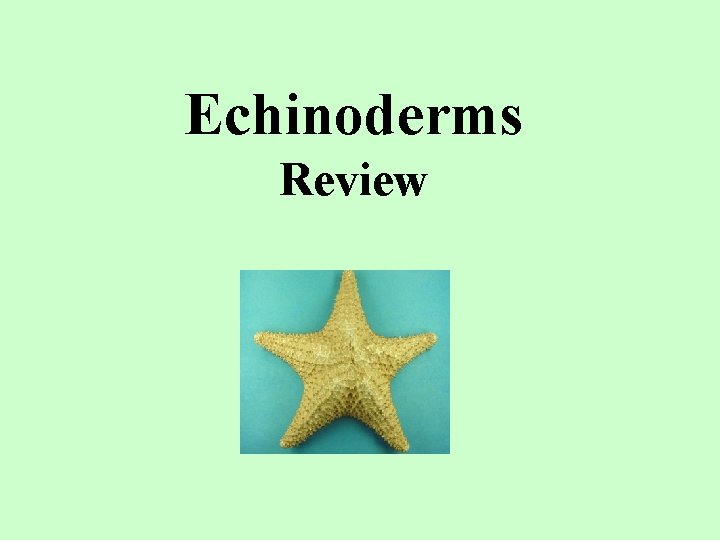
Echinoderms Review
Starfish belong in the Animalia KINGDOM ________ Echinodermata PHYLUM ________ CLASS __________ Asteroidea invertebrates Echinoderms are _________ vertebrates invertebrates
radial Adult echinoderms have _______ symmetry. no bilateral radial Deuterostomes _______ are organisms whose anus develops from the blastopore area in the embryo.
Since a starfish has NO INTESTINE, the nutrients are absorbed by the digestive glands ________
Echinoderms have an endoskeleton made of calcium carbonate plates ossicles called ________.
In Latin the name “echinoderm” means _________ Spiny skin Name one of the 3 characteristics your book lists that are found only in echinoderms. Endoskeleton made of OSSICLES Water vascular system Tube feet
Sea stars (starfish) belong to the Class _________ Asteroidea The mouth of a starfish is located on the _______ surface. oral
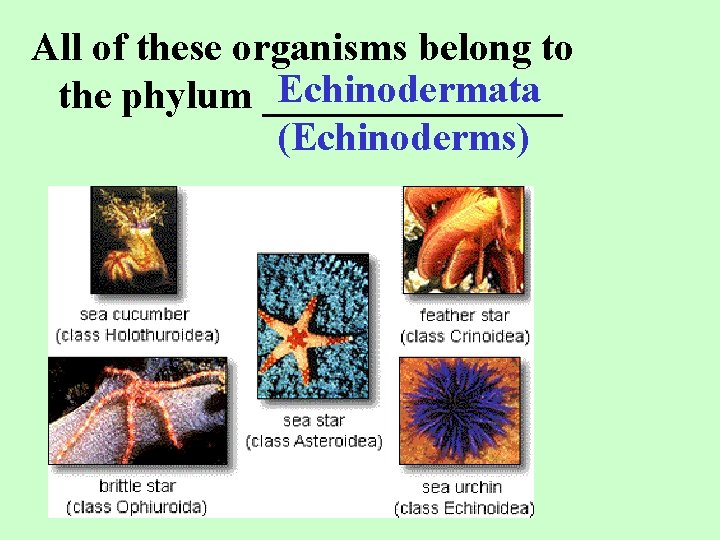
All of these organisms belong to Echinodermata the phylum ________ (Echinoderms)
Water enters the water vascular system through small pores in the madreporite _________.
open Starfish have _______circulation. The small movable suction cupped extensions of the water vascular system which aid in locomotion and feeding are called _______. tube feet
What is the function of the ampullae? Squeeze to control water entering and leaving the tube feet The seastar can turn its ______ cardiac stomach inside out through its mouth when it eats.
The stone canal, ring canal, and radial canal are all parts of the water vascular system. ________ Nutrients are absorbed in the digestive glands ________in a starfish.
Tell a function of the tube feet. Locomotion Hold onto & pry open clam shells Gas exchange/remove nitrogen waste
The network of water filled canals connected to the tube feet is called the _________ Water vascular system. carnivores Most starfish are ________. Carnivores herbivores omnivores
This organ absorbs nutrients in an earthworm and a clam but is missing in starfish intestine
The spines on the surface connect into the ______ inside. Ossicles of the endoskeleton
Type of reproduction seen in starfish Asexual Sexual They can do both! Symmetry seen in echinoderm larvae bilateral
T or F Most echinoderms are hermaphrodites. False, they have separate sexes. Fertilization in echinoderms is ________ external External internal
Seastars “breathe” by exchanging gases through their _______________. skin gills and skin on their tube feet Echinoderms are missing all of these organs except ______. digestive Circulatory excretory respiratory digestive
The ability of starfish to regrow lost arms is called regeneration ________.
The surface of a starfish opposite aboral from the mouth is the _______ Surface.
cardiac The __________ stomach is extruded out of the mouth during feeding
What is the function of the pedicillariae? Keep surface of starfish free of algae and small organisms that might damage or block it eyespots Starfish have _______ at the ends of each arm that can sense light and dark
The anus and madreporite are on the ______ surface of a starfish. aboral
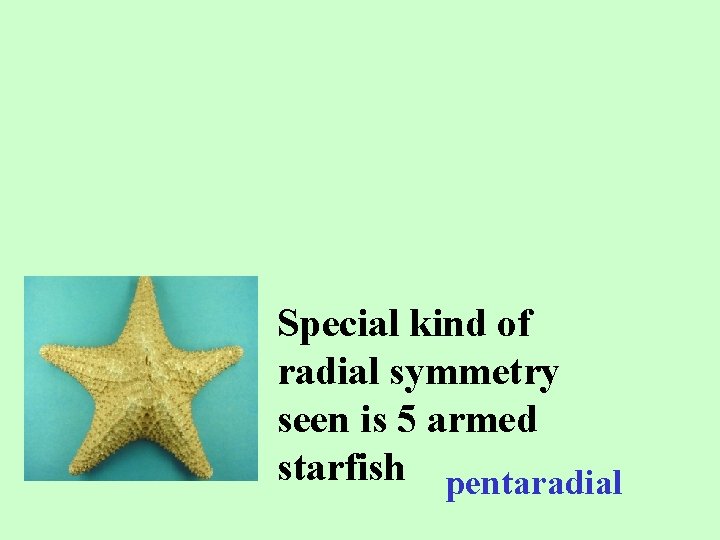
Special kind of radial symmetry seen is 5 armed starfish pentaradial
All echinoderms are MARINE. live in oceans That means they ______. have military-like camouflage live in the ocean march in lines like soldiers stay in one place
Tell the body system each part belongs to: vascular Madreporite Water ___________ nervous Nerve ring ___________ Water vascular Ring canal ___________ Ossicles ___________ Skeletal Reproductive Gonads ___________ Respiratory/excretory Skin gills ___________ Digestive Cardiac stomach __________
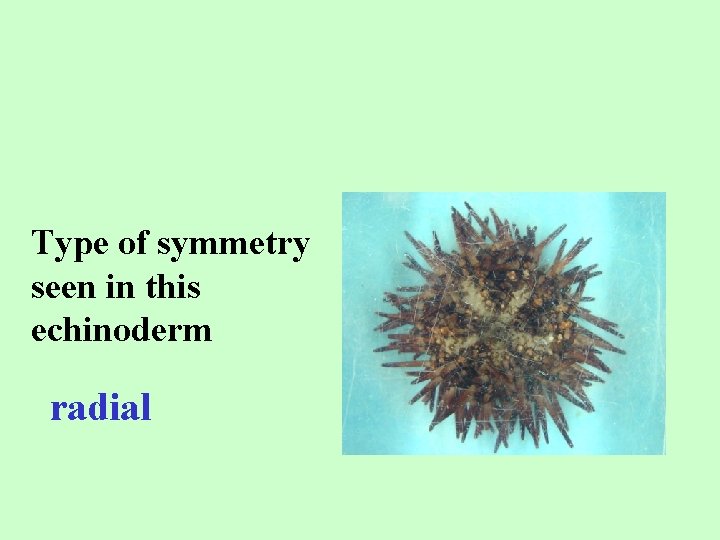
Type of symmetry seen in this echinoderm radial
Tube feet are found along the _________ groove. ambulacral When you cut into the starfish, the space you see around the internal coelom organs is the _______ Mantle cavity pseudocoelom pericardial cavity
The ventral surface is also called the oral surface. _______ TRUE or FALSE Starfish are hermaphrodites False. They have separate sexes
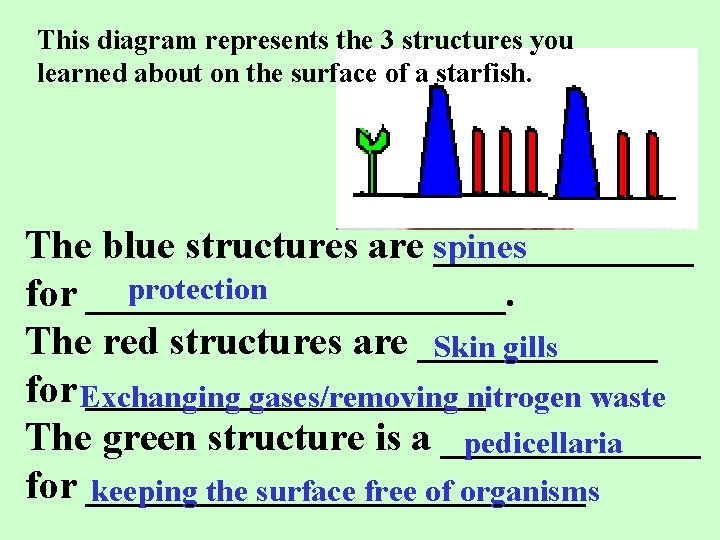
This diagram represents the 3 structures you learned about on the surface of a starfish. The blue structures are spines _______ protection for ___________. The red structures are ______ Skin gills for Exchanging __________ gases/removing nitrogen waste The green structure is a _______ pedicellaria for _____________ keeping the surface free of organisms
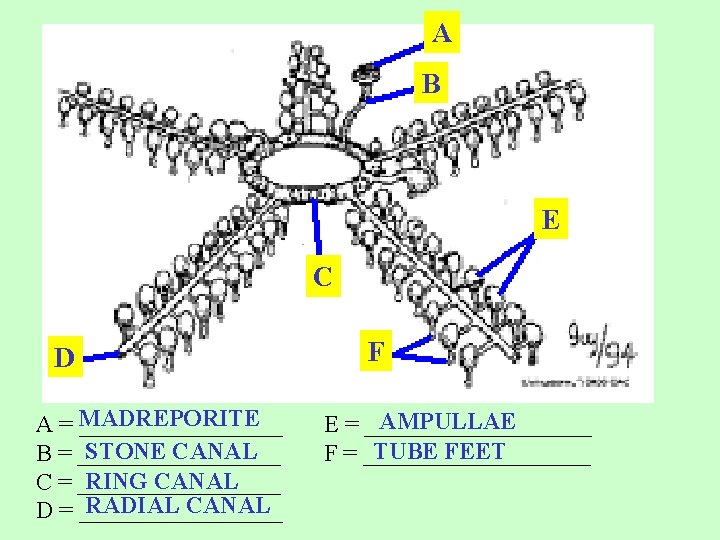
A B E C D A = MADREPORITE _________ STONE CANAL B = _________ RING CANAL C = _________ RADIAL CANAL D = _________ F AMPULLAE E = __________ TUBE FEET F = __________
What do the typhlosole in an earthworm, the ridges on the gills in a clam, and the skin gills of a starfish have in common? All are structures used to INCREASE SURFACE AREA Asteroidea comes from the Latin star word meaning ________
The only invertebrates that are NOT PROTOSTOMES are the _____________ echinoderms What is the plural of pedicellaria? pedicellariae
All echinoderms are MARINE. This means they ________ Live in salt water (oceans) How is reproduction in a starfish different from that of an earthworm? Earthworms= hermaphrodites Starfish= separate sexes; can use regeneration for asexual reproduction
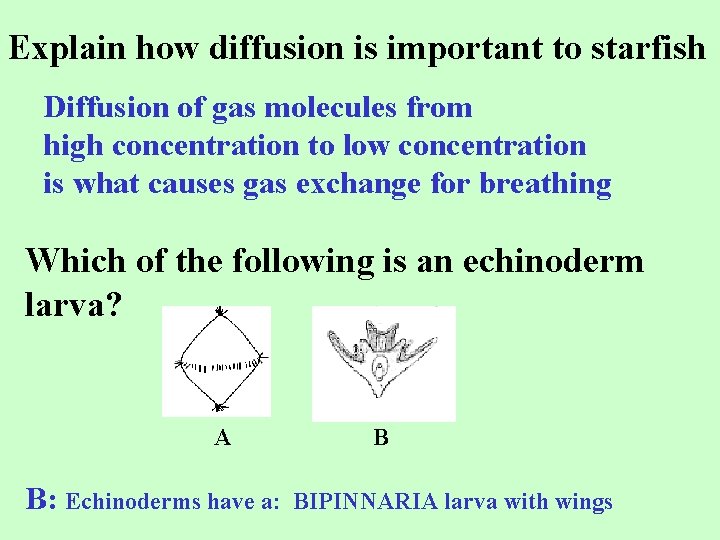
Explain how diffusion is important to starfish Diffusion of gas molecules from high concentration to low concentration is what causes gas exchange for breathing Which of the following is an echinoderm larva? A B: Echinoderms have a: B BIPINNARIA larva with wings
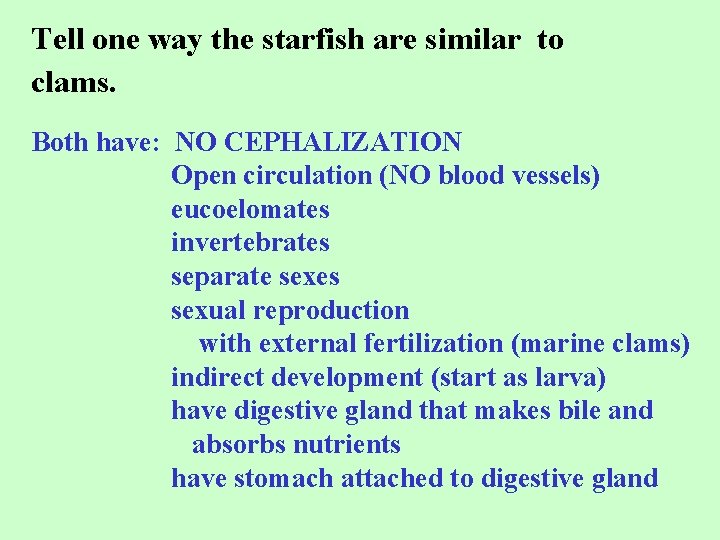
Tell one way the starfish are similar to clams. Both have: NO CEPHALIZATION Open circulation (NO blood vessels) eucoelomates invertebrates separate sexes sexual reproduction with external fertilization (marine clams) indirect development (start as larva) have digestive gland that makes bile and absorbs nutrients have stomach attached to digestive gland
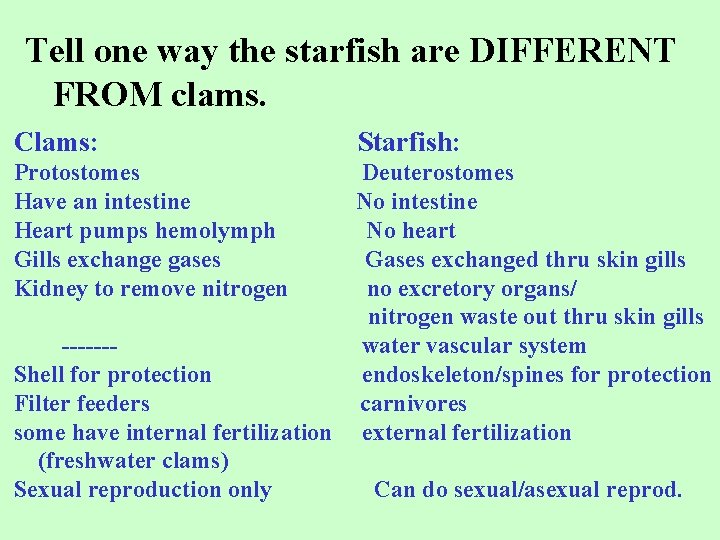
Tell one way the starfish are DIFFERENT FROM clams. Clams: Protostomes Have an intestine Heart pumps hemolymph Gills exchange gases Kidney to remove nitrogen Starfish: Deuterostomes No intestine No heart Gases exchanged thru skin gills no excretory organs/ nitrogen waste out thru skin gills ------water vascular system Shell for protection endoskeleton/spines for protection Filter feeders carnivores some have internal fertilization external fertilization (freshwater clams) Sexual reproduction only Can do sexual/asexual reprod.
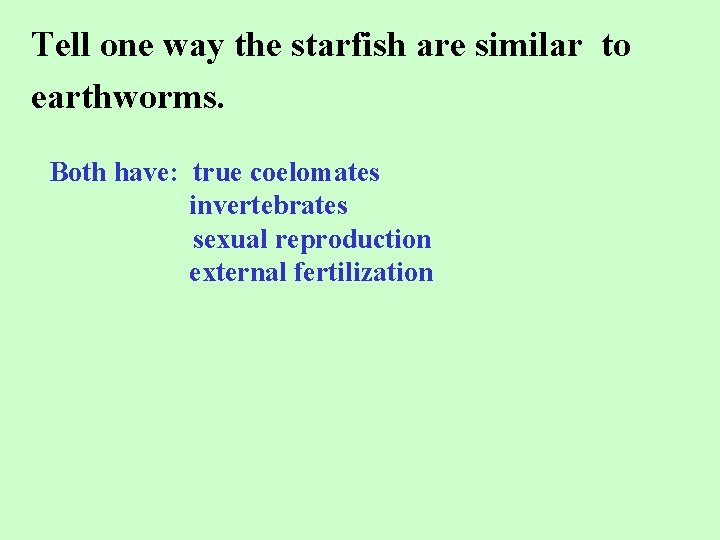
Tell one way the starfish are similar to earthworms. Both have: true coelomates invertebrates sexual reproduction external fertilization
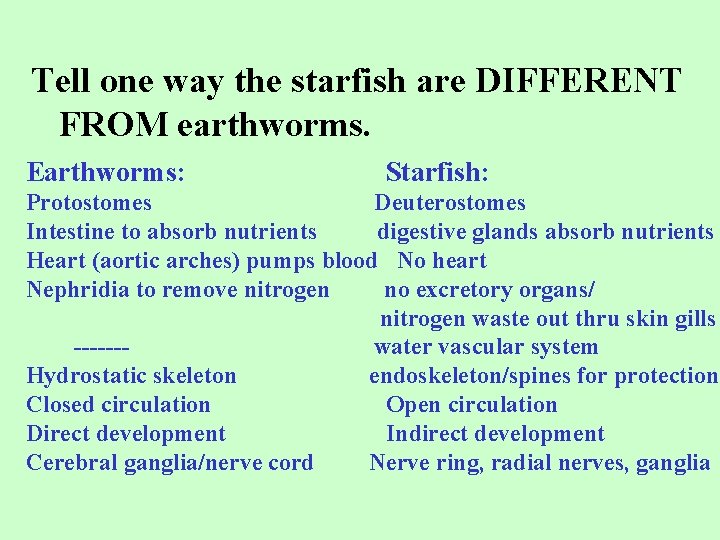
Tell one way the starfish are DIFFERENT FROM earthworms. Earthworms: Starfish: Protostomes Deuterostomes Intestine to absorb nutrients digestive glands absorb nutrients Heart (aortic arches) pumps blood No heart Nephridia to remove nitrogen no excretory organs/ nitrogen waste out thru skin gills ------water vascular system Hydrostatic skeleton endoskeleton/spines for protection Closed circulation Open circulation Direct development Indirect development Cerebral ganglia/nerve cord Nerve ring, radial nerves, ganglia
Why are echinoderms thought to have evolved from a bilaterally symmetrical ancestor? They have a bilaterally symmetrical larva Which 2 structures you learned about are contained within the ambulacral ridge? Radial nerve & radial canal
Name another echinoderm besides a starfish. Sea lily, feather star, brittle star, sea urchin, Basket star, sand dollar, sea cucumber indirect Starfish have _____development. They start out as a larva that looks different from the adult. direct indirect

Name one of the structures found on the surface of a starfish and tell its function. Spines- protection Pedicellaria-pinchers that keep surface clear of organisms Skin gills- exchange gases/remove nitrogen waste True OR False Sea stars can reproduce both sexually and asexually. TRUE They have separate sexes and can use regeneration.
A sea star’s nervous system does NOT include _______ a brain Nerve ring nerve net radial nerves cerebral ganglia Explain how a mollusk trochophore larva is different from an echinoderm bipinnaria larva. Trochophore larvae are egg shaped with a ring of cilia to help them swim; Bipinnaria have wings
- Slides: 44