
eCharting in Epidemiological Surveys The Way Forward Quantification
- Slides: 25
e-Charting in Epidemiological Surveys: The Way Forward Quantification of salivary Streptococci mutans, Lactobacilli and total bacteria in caries subjects Dr. Armelia Sari Widyarman & Dr. Anie Apriani Faculty of Dentistry, Jakarta, Indonesia IADR Asia Pacific Region Brisbane 28. 11. 2019
India Netherlands Philippines Indonesia
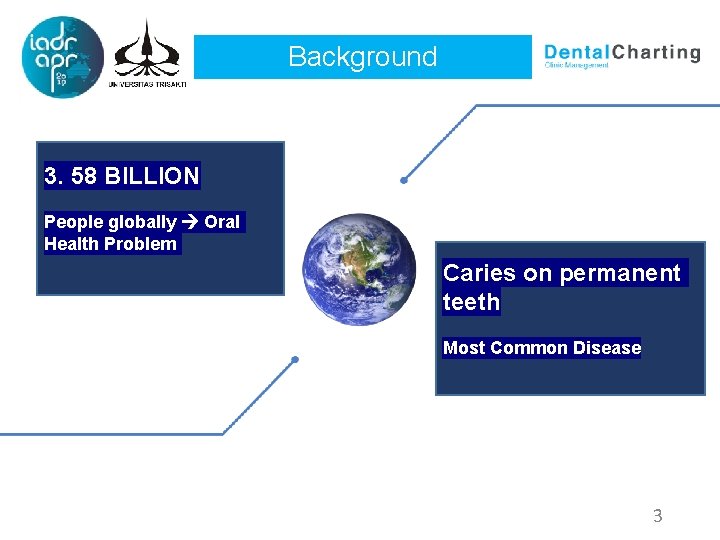
Background 3. 58 BILLION People globally Oral Health Problem Caries on permanent teeth Most Common Disease 3
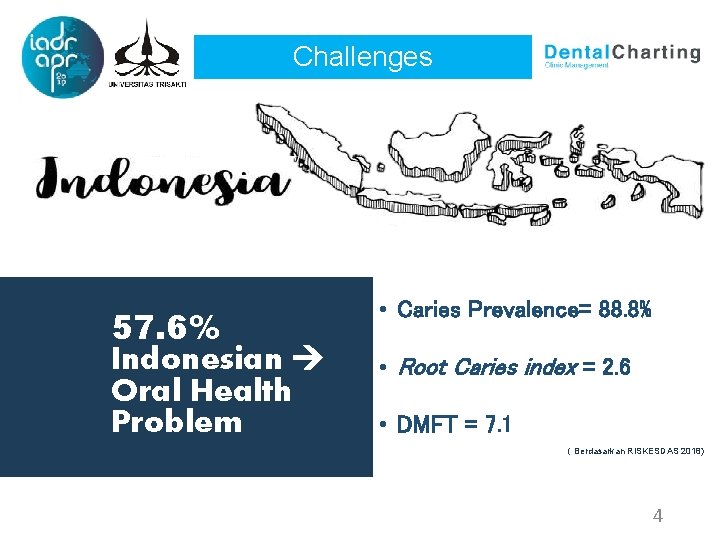
Challenges 57. 6% Indonesian Oral Health Problem • Caries Prevalence= 88. 8% • Root Caries index = 2. 6 • DMFT = 7. 1 ( Berdasarkan RISKESDAS 2018) 4
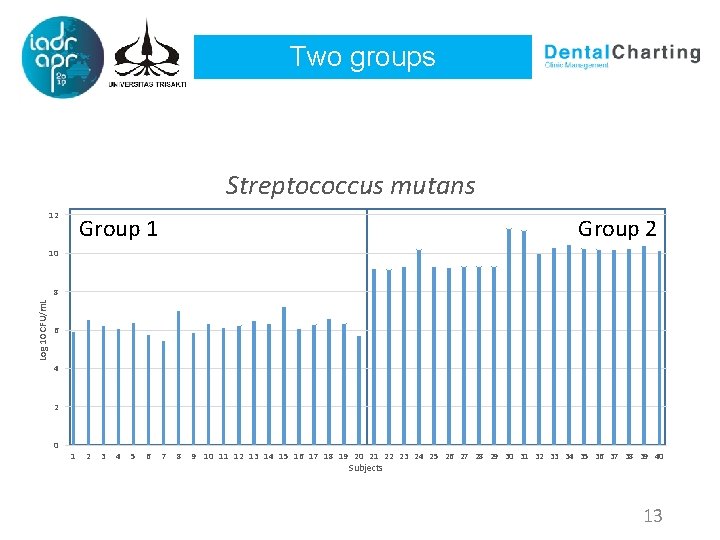
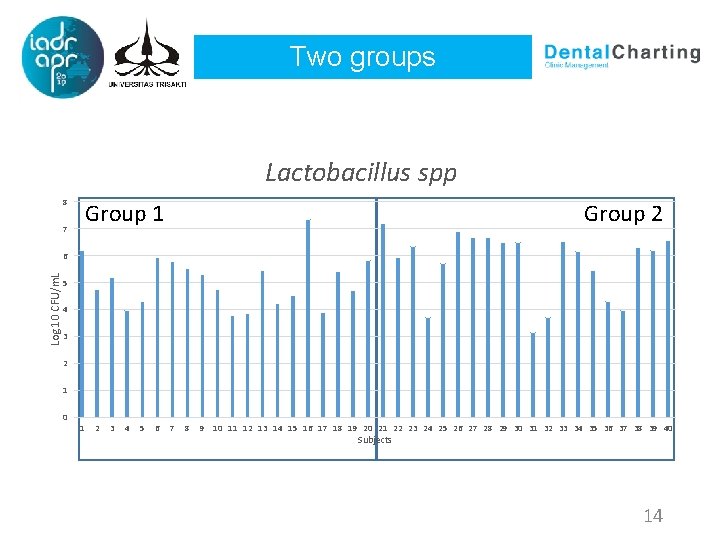
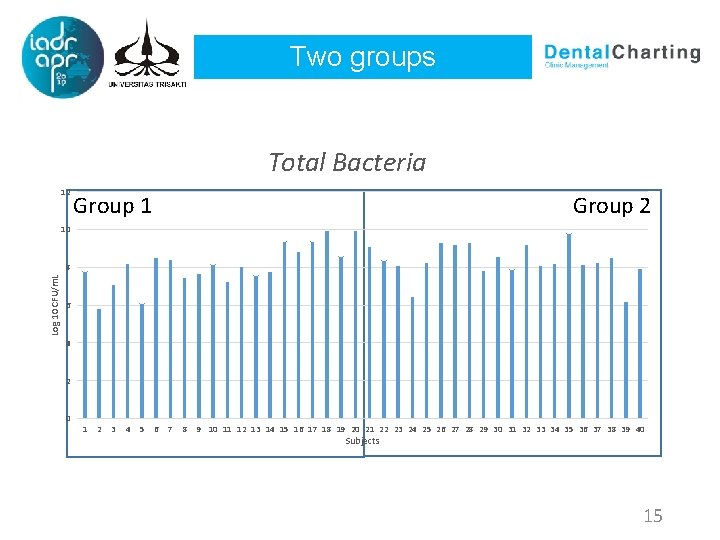
Objective In order to research the correlation between the oral microbiome of a subject and dental caries data has to be collected and compared over time. In this study we compared the number of Streptococcus mutans, Lactobacillus and total bacterial load in the saliva of patients with a high and low caries activity using q. PCR method. 5
Methods The sample population for this study comprised elementary students aged 8– 9 years old in Sukajadi, West Java, Indonesia Saliva samples were obtained from 40 children. The sample was divided into two groups, Group 1 (Subject 1 -20), subject with low caries activity (DMFT <4) and Group 2 (Subejct 21 -40), subject with high caries activity (DMFT > 4) This research was approved by the Ethics Committee of the Faculty of Dentistry, Trisakti University (EC number 228/S 2 Sp/KEPK/FKG/11/2018) 6
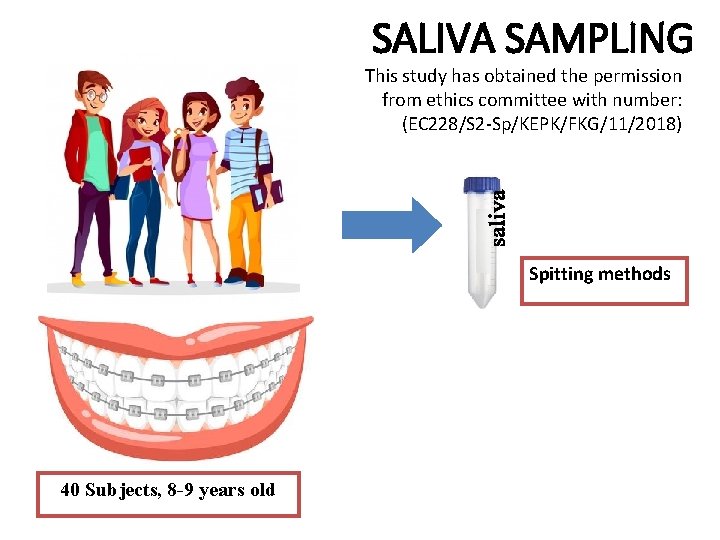
SALIVA SAMPLING This study has obtained the permission from ethics committee with number: (EC 228/S 2 -Sp/KEPK/FKG/11/2018) Spitting methods 40 Subjects, 8 -9 years old
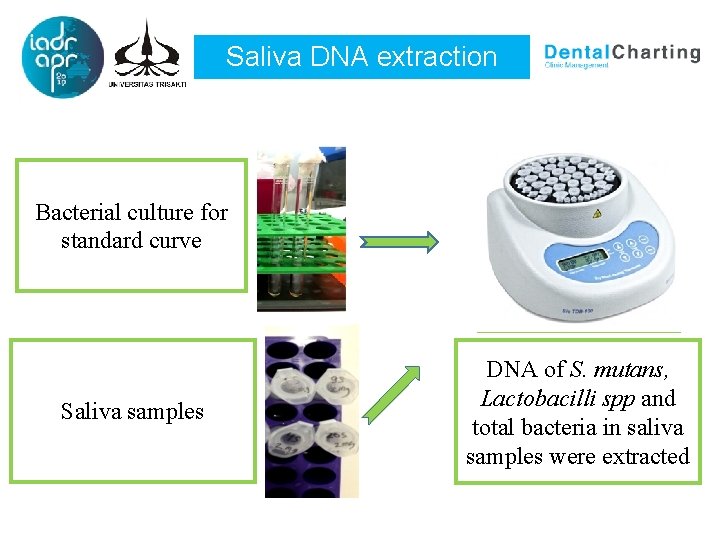
Saliva DNA extraction Bacterial culture for standard curve Saliva samples DNA of S. mutans, Lactobacilli spp and total bacteria in saliva samples were extracted
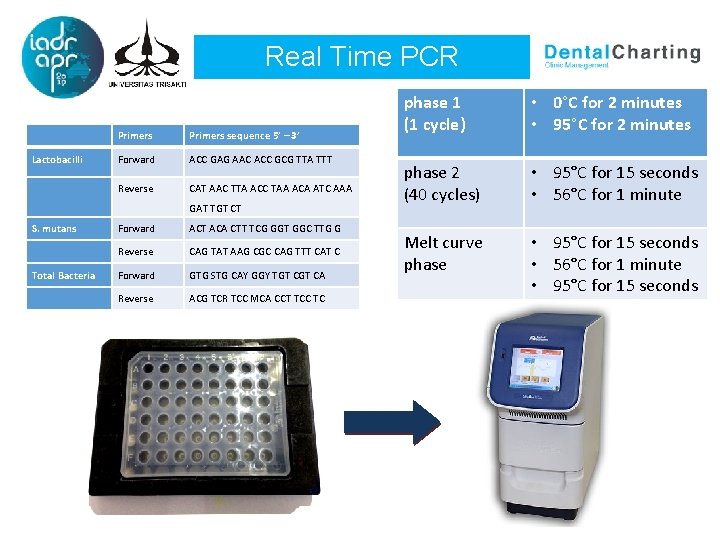
Real Time PCR Primers sequence 5’ – 3’ Lactobacilli Forward ACC GAG AAC ACC GCG TTA TTT Reverse CAT AAC TTA ACC TAA ACA ATC AAA GAT TGT CT S. mutans Forward ACT ACA CTT TCG GGT GGC TTG G Reverse CAG TAT AAG CGC CAG TTT CAT C Total Bacteria Forward GTG STG CAY GGY TGT CA Reverse ACG TCR TCC MCA CCT TCC TC phase 1 (1 cycle) • 0°C for 2 minutes • 95°C for 2 minutes phase 2 (40 cycles) • 95°C for 15 seconds • 56°C for 1 minute Melt curve phase • 95°C for 15 seconds • 56°C for 1 minute • 95°C for 15 seconds
RESULT 10
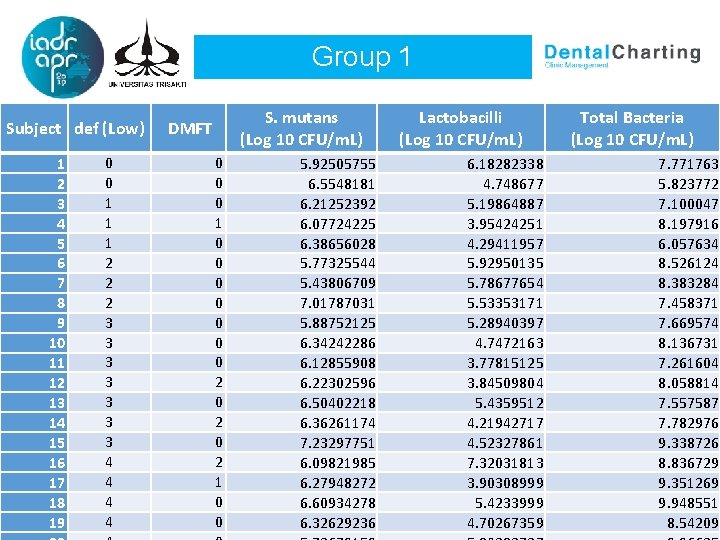
Group 1 Subject def (Low) 1 2 3 4 5 6 7 8 9 10 11 12 13 14 15 16 17 18 19 0 0 1 1 1 2 2 2 3 3 3 3 4 4 S. mutans (Log 10 CFU/m. L) DMFT 0 0 0 1 0 0 0 0 2 0 2 1 0 0 5. 92505755 6. 5548181 6. 21252392 6. 07724225 6. 38656028 5. 77325544 5. 43806709 7. 01787031 5. 88752125 6. 34242286 6. 12855908 6. 22302596 6. 50402218 6. 36261174 7. 23297751 6. 09821985 6. 27948272 6. 60934278 6. 32629236 Lactobacilli (Log 10 CFU/m. L) 6. 18282338 4. 748677 5. 19864887 3. 95424251 4. 29411957 5. 92950135 5. 78677654 5. 53353171 5. 28940397 4. 7472163 3. 77815125 3. 84509804 5. 4359512 4. 21942717 4. 52327861 7. 32031813 3. 90308999 5. 4233999 4. 70267359 Total Bacteria (Log 10 CFU/m. L) 7. 771763 5. 823772 7. 100047 8. 197916 6. 057634 8. 526124 8. 383284 7. 458371 7. 669574 8. 136731 7. 261604 8. 058814 7. 557587 7. 782976 9. 338726 8. 836729 9. 351269 9. 948551 11 8. 54209
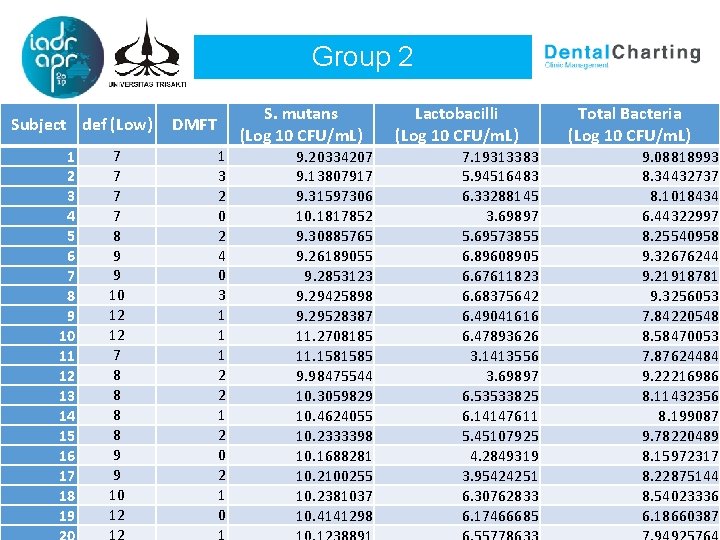
Group 2 Subject def (Low) DMFT 1 2 3 4 5 6 7 8 9 10 11 12 13 14 15 16 17 18 19 7 7 8 9 9 10 12 12 7 8 8 9 9 10 12 12 1 3 2 0 2 4 0 3 1 1 1 2 2 1 2 0 2 1 0 1 S. mutans (Log 10 CFU/m. L) 9. 20334207 9. 13807917 9. 31597306 10. 1817852 9. 30885765 9. 26189055 9. 2853123 9. 29425898 9. 29528387 11. 2708185 11. 1581585 9. 98475544 10. 3059829 10. 4624055 10. 2333398 10. 1688281 10. 2100255 10. 2381037 10. 4141298 Lactobacilli (Log 10 CFU/m. L) 7. 19313383 5. 94516483 6. 33288145 3. 69897 5. 69573855 6. 89608905 6. 67611823 6. 68375642 6. 49041616 6. 47893626 3. 1413556 3. 69897 6. 53533825 6. 14147611 5. 45107925 4. 2849319 3. 95424251 6. 30762833 6. 17466685 Total Bacteria (Log 10 CFU/m. L) 9. 08818993 8. 34432737 8. 1018434 6. 44322997 8. 25540958 9. 32676244 9. 21918781 9. 3256053 7. 84220548 8. 58470053 7. 87624484 9. 22216986 8. 11432356 8. 199087 9. 78220489 8. 15972317 8. 22875144 8. 54023336 6. 18660387 12
Two groups Streptococcus mutans 12 Group 1 Group 2 10 Log 10 CFU/m. L 8 6 4 2 0 1 2 3 4 5 6 7 8 9 10 11 12 13 14 15 16 17 18 19 20 21 22 23 24 25 26 27 28 29 30 31 32 33 34 35 36 37 38 39 40 Subjects 13
Two groups Lactobacillus spp 8 Group 1 7 Group 2 Log 10 CFU/m. L 6 5 4 3 2 1 0 1 2 3 4 5 6 7 8 9 10 11 12 13 14 15 16 17 18 19 20 21 22 23 24 25 26 27 28 29 30 31 32 33 34 35 36 37 38 39 40 Subjects 14
Two groups Total Bacteria 12 Group 1 Group 2 10 Log 10 CFU/m. L 8 6 4 2 0 1 2 3 4 5 6 7 8 9 10 11 12 13 14 15 16 17 18 19 20 21 22 23 24 25 26 27 28 29 30 31 32 33 34 35 36 37 38 39 40 Subjects 15
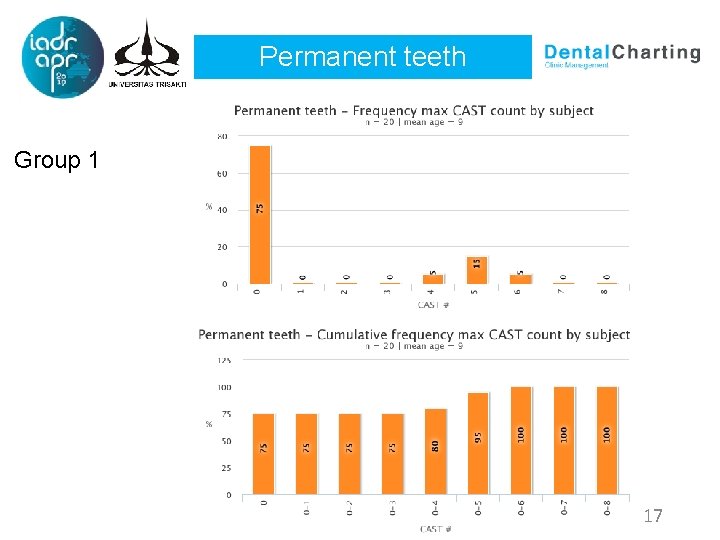
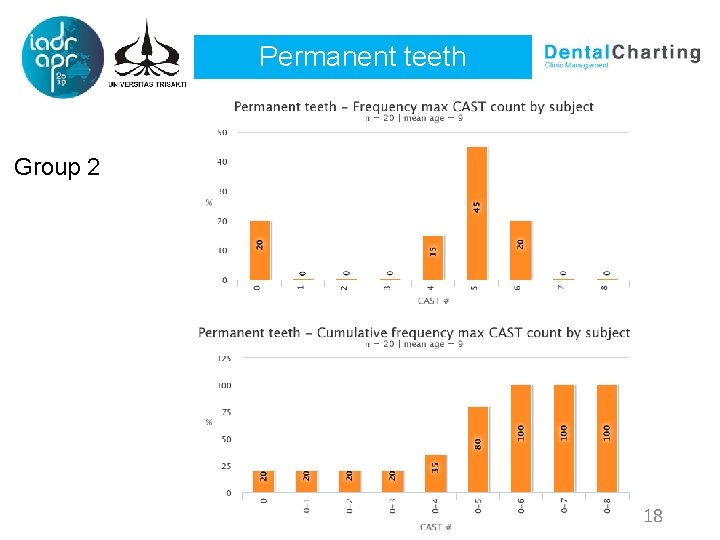
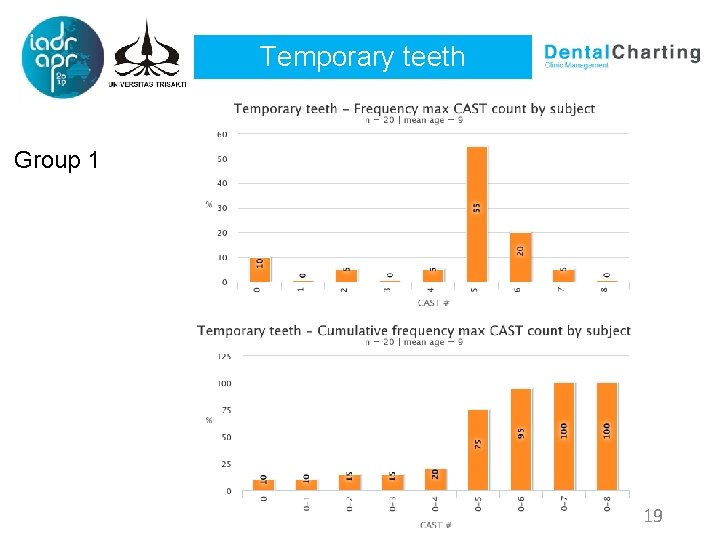
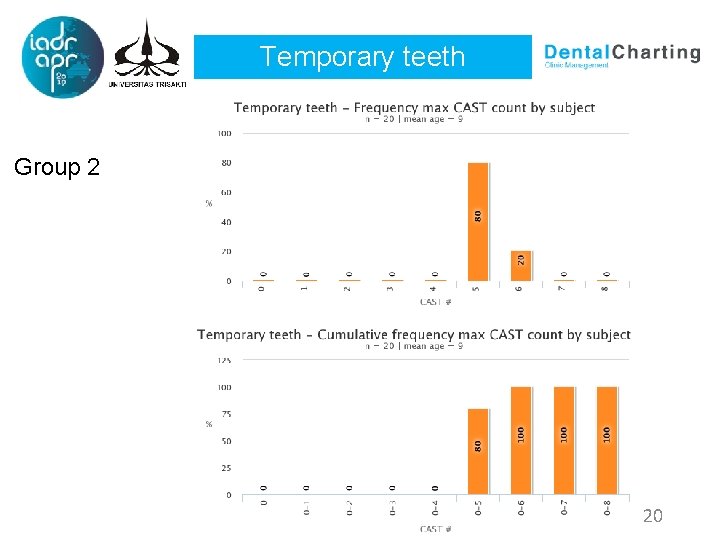
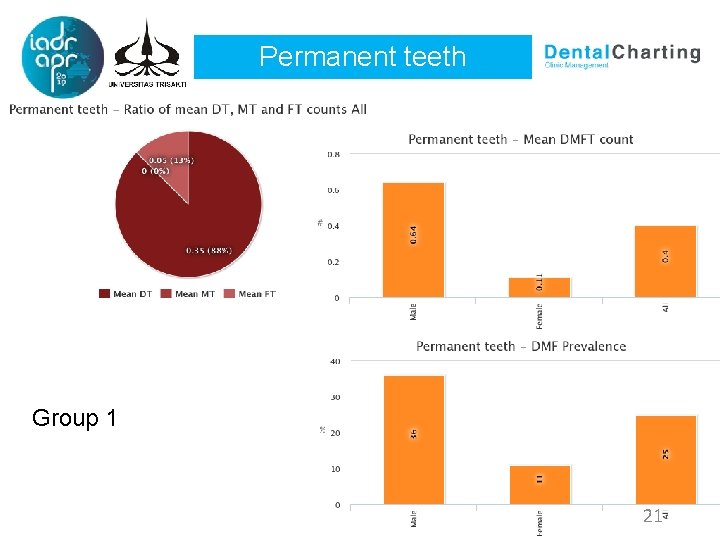
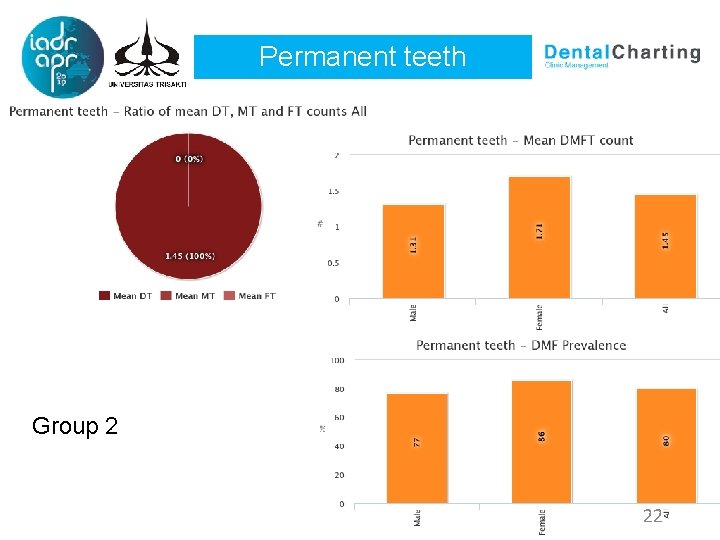
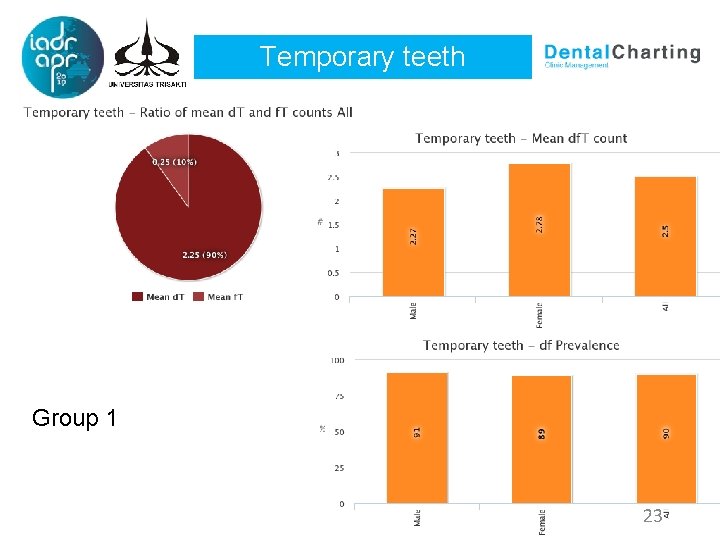
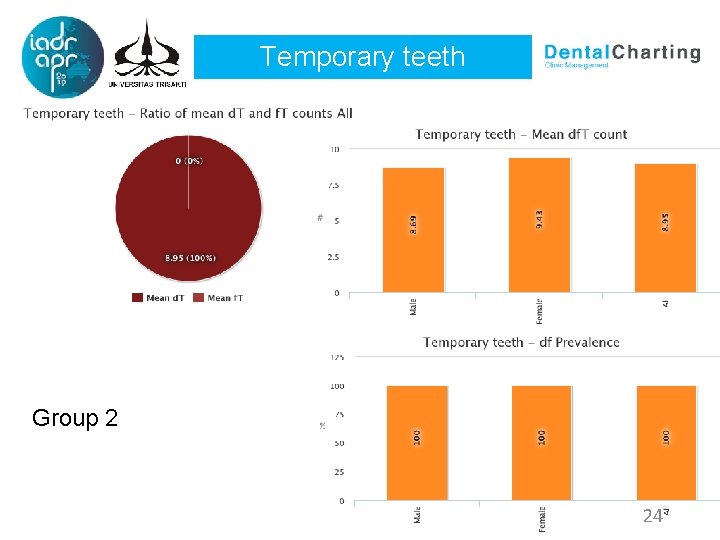
Discussion & Conclusion Organizing and keeping track of gathered data, patient by patient, during the e-Charting process, is facilitated by tying the collected data to the dental chart This familiar format is was made user-friendly, enabled by paperless e-Charting in the cloud In the process, the caries conditions DMFT and CAST are automatically counted from the dental chart and automatically converted into oral health indicators, illustrated on the following slides 16
Permanent teeth Group 1 17
Permanent teeth Group 2 18
Temporary teeth Group 1 19
Temporary teeth Group 2 20
Permanent teeth Group 1 21
Permanent teeth Group 2 22
Temporary teeth Group 1 23
Temporary teeth Group 2 24
Conclusion Automatically generated CAST and DMFT data showed that the two groups were significantly different in their caries status in both temporary and permanent dentitions. If so desired, in order to confirm correlation between the microbial counts and the caries status, calculation needs to performed with a statistical package. 25