
ECG interpretations Learning Modules ECG Basics How to
ECG interpretations
Learning Modules ¡ ECG Basics ¡ How to Analyze a Rhythm ¡ Normal Sinus Rhythm ¡ Heart Arrhythmias 2

Normal Impulse Conduction Sinoatrial node AV node Bundle of His Bundle Branches Purkinje fibers 3
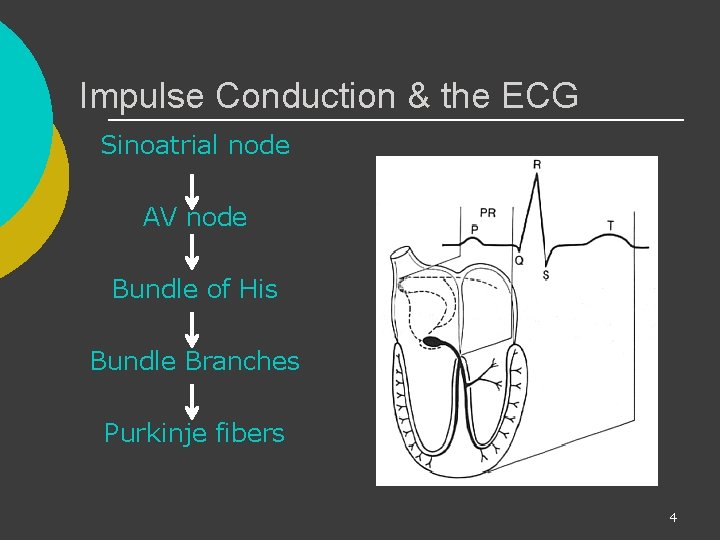
Impulse Conduction & the ECG Sinoatrial node AV node Bundle of His Bundle Branches Purkinje fibers 4
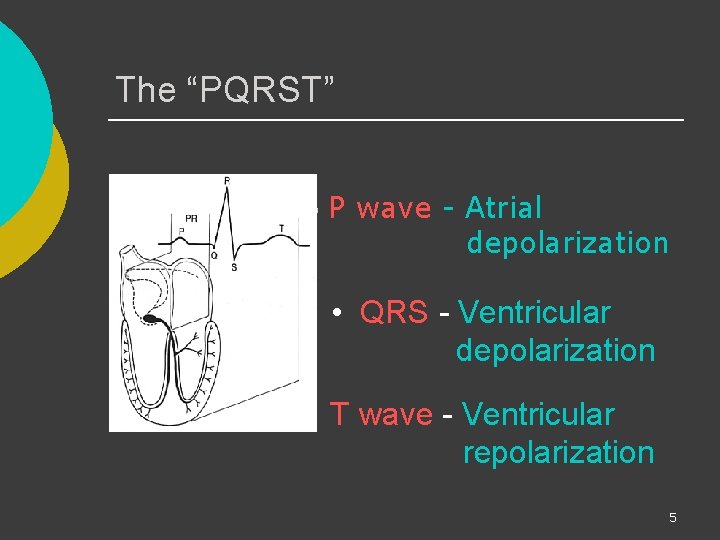
The “PQRST” ¡ P wave - Atrial depolarization • QRS - Ventricular depolarization • T wave - Ventricular repolarization 5
Pacemakers of the Heart ¡ ¡ ¡ SA Node - Dominant pacemaker with an intrinsic rate of 60 - 100 beats/ minute. AV Node - Back-up pacemaker with an intrinsic rate of 40 - 60 beats/minute. Ventricular cells - Back-up pacemaker with an intrinsic rate of 20 - 45 bpm. 6
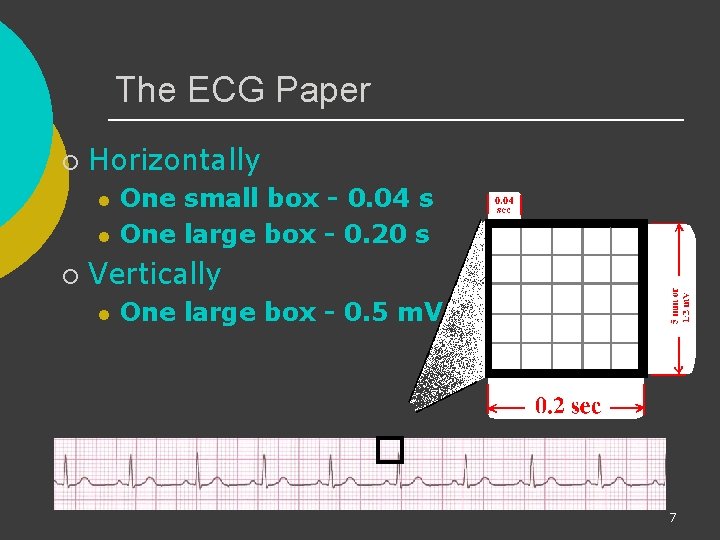
The ECG Paper ¡ Horizontally l l ¡ One small box - 0. 04 s One large box - 0. 20 s Vertically l One large box - 0. 5 m. V 7
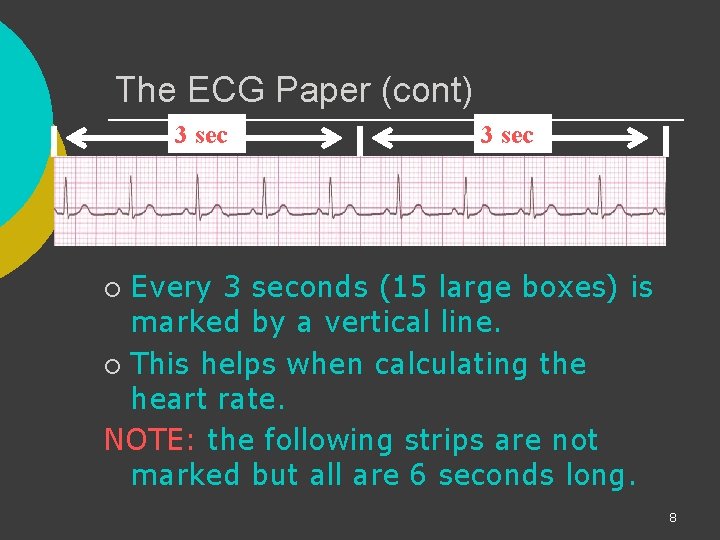
The ECG Paper (cont) 3 sec Every 3 seconds (15 large boxes) is marked by a vertical line. ¡ This helps when calculating the heart rate. NOTE: the following strips are not marked but all are 6 seconds long. ¡ 8
ECG Rhythm Interpretation Really Very Easy How to Analyze a Rhythm
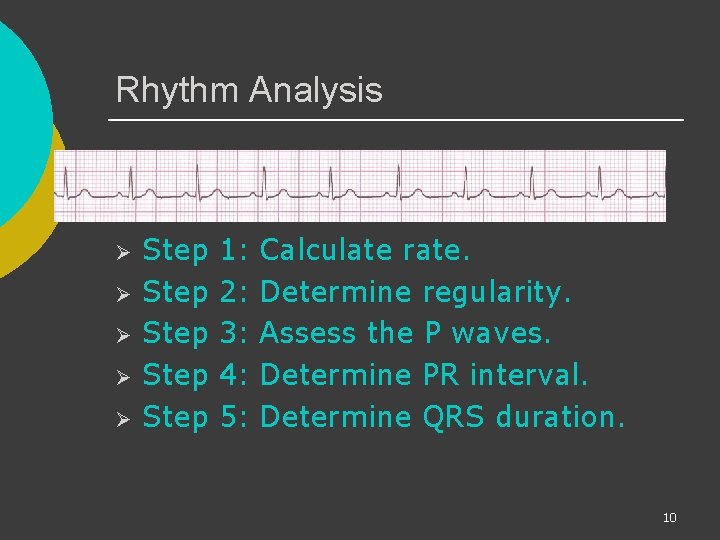
Rhythm Analysis Ø Ø Ø Step Step 1: Calculate rate. 2: Determine regularity. 3: Assess the P waves. 4: Determine PR interval. 5: Determine QRS duration. 10
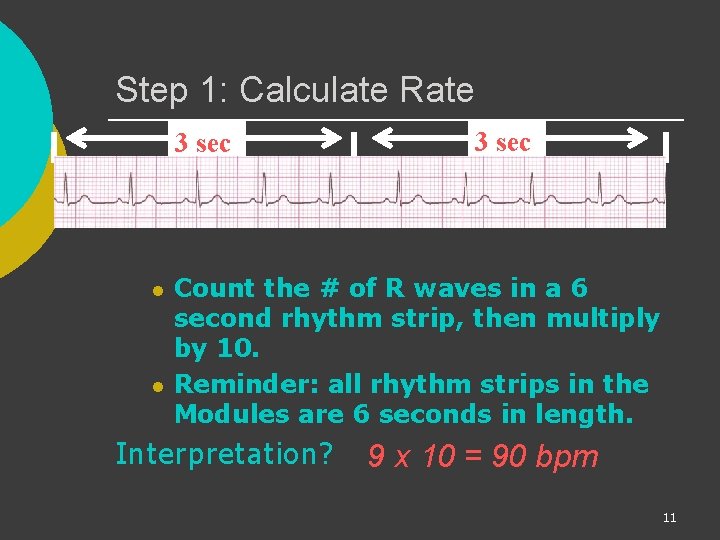
Step 1: Calculate Rate 3 sec l l 3 sec Count the # of R waves in a 6 second rhythm strip, then multiply by 10. Reminder: all rhythm strips in the Modules are 6 seconds in length. Interpretation? 9 x 10 = 90 bpm 11
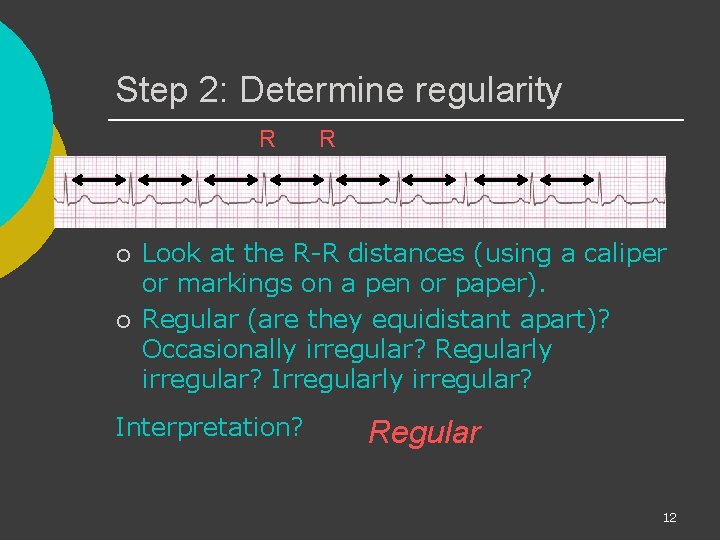
Step 2: Determine regularity R ¡ ¡ R Look at the R-R distances (using a caliper or markings on a pen or paper). Regular (are they equidistant apart)? Occasionally irregular? Regularly irregular? Irregularly irregular? Interpretation? Regular 12
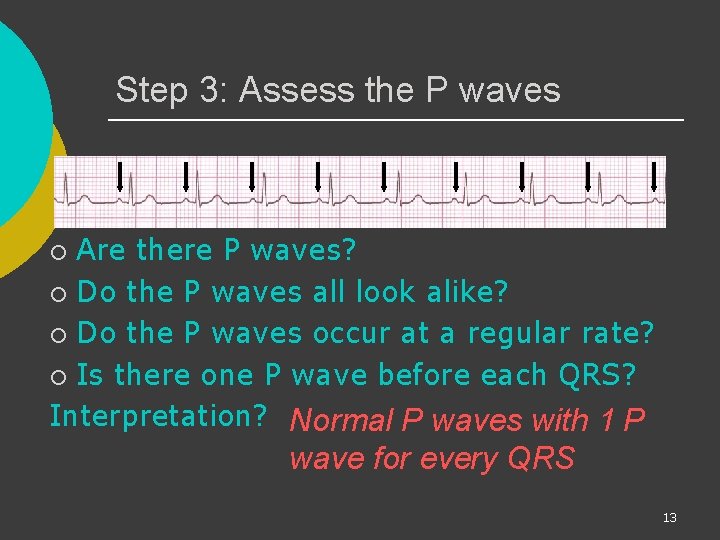
Step 3: Assess the P waves Are there P waves? ¡ Do the P waves all look alike? ¡ Do the P waves occur at a regular rate? ¡ Is there one P wave before each QRS? Interpretation? Normal P waves with 1 P ¡ wave for every QRS 13
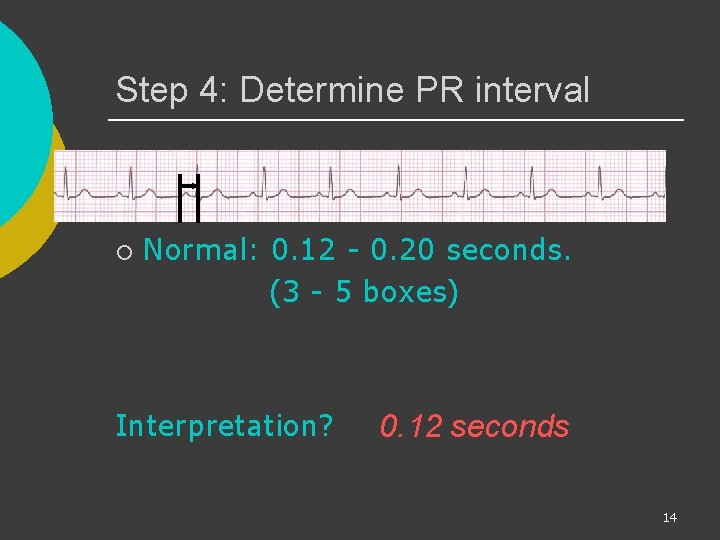
Step 4: Determine PR interval ¡ Normal: 0. 12 - 0. 20 seconds. (3 - 5 boxes) Interpretation? 0. 12 seconds 14
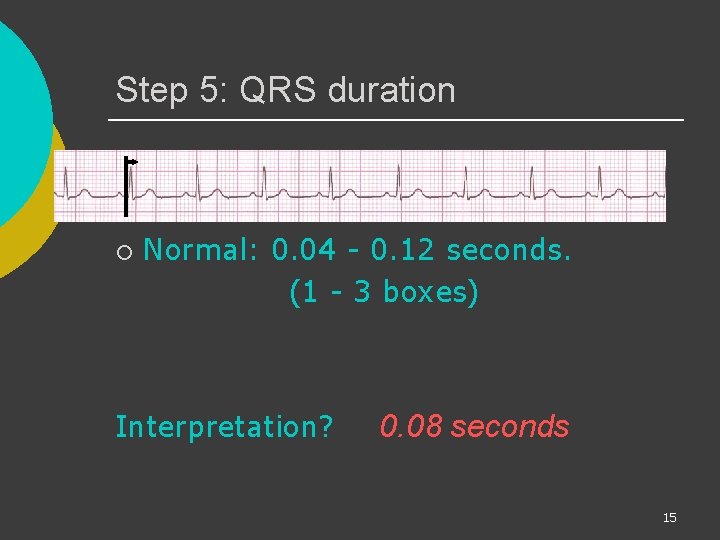
Step 5: QRS duration ¡ Normal: 0. 04 - 0. 12 seconds. (1 - 3 boxes) Interpretation? 0. 08 seconds 15
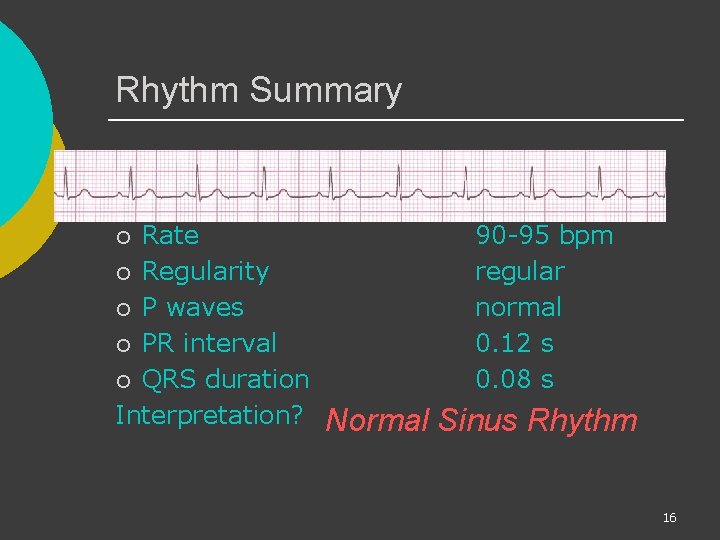
Rhythm Summary Rate ¡ Regularity ¡ P waves ¡ PR interval ¡ QRS duration Interpretation? ¡ 90 -95 bpm regular normal 0. 12 s 0. 08 s Normal Sinus Rhythm 16
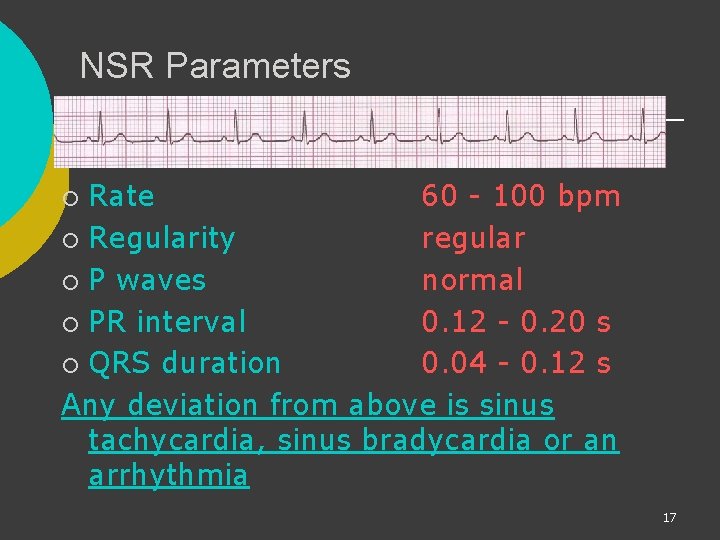
NSR Parameters Rate 60 - 100 bpm ¡ Regularity regular ¡ P waves normal ¡ PR interval 0. 12 - 0. 20 s ¡ QRS duration 0. 04 - 0. 12 s Any deviation from above is sinus tachycardia, sinus bradycardia or an arrhythmia ¡ 17
SA Node Problems The SA Node can: ¡ fire too slow Sinus Bradycardia ¡ fire too fast Sinus Tachycardia* 18
Arrhythmias ¡ Sinus Rhythms ¡ Premature Beats ¡ Ventricular Arrhythmias ¡ AV Junctional Blocks 19
Sinus Rhythms ¡ Sinus Bradycardia ¡ Sinus Tachycardia ¡ Sinus Arrest ¡ Normal Sinus Rhythm 20
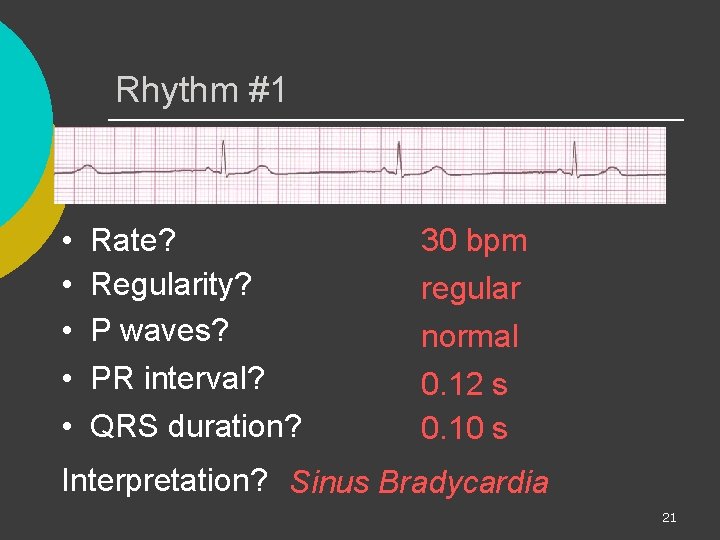
Rhythm #1 • • • Rate? Regularity? P waves? PR interval? QRS duration? 30 bpm regular normal 0. 12 s 0. 10 s Interpretation? Sinus Bradycardia 21
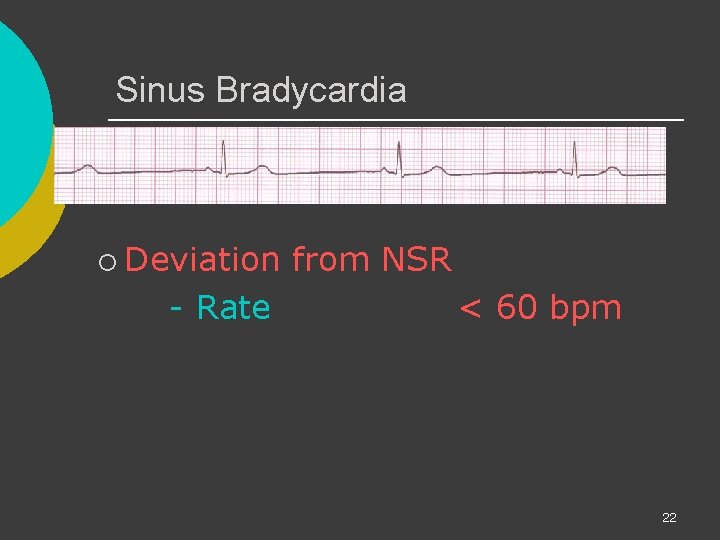
Sinus Bradycardia ¡ Deviation - Rate from NSR < 60 bpm 22
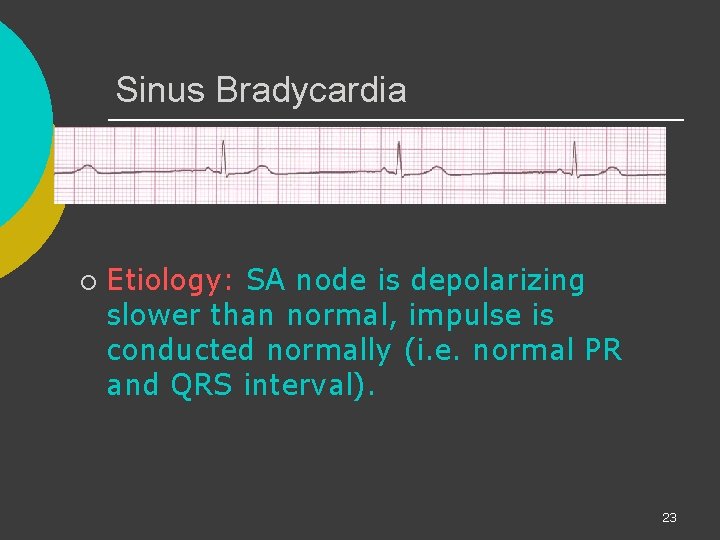
Sinus Bradycardia ¡ Etiology: SA node is depolarizing slower than normal, impulse is conducted normally (i. e. normal PR and QRS interval). 23
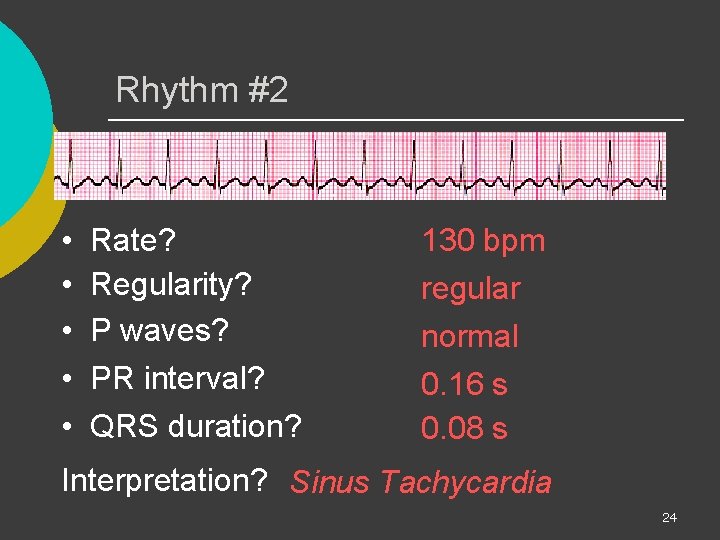
Rhythm #2 • • • Rate? Regularity? P waves? PR interval? QRS duration? 130 bpm regular normal 0. 16 s 0. 08 s Interpretation? Sinus Tachycardia 24
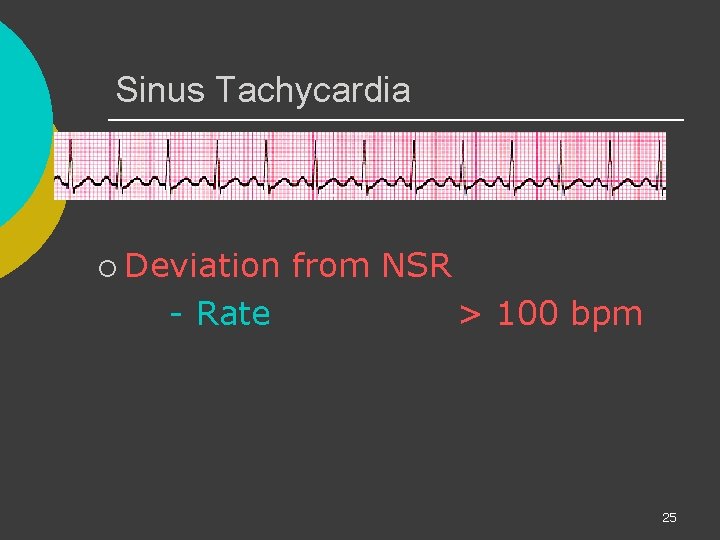
Sinus Tachycardia ¡ Deviation - Rate from NSR > 100 bpm 25
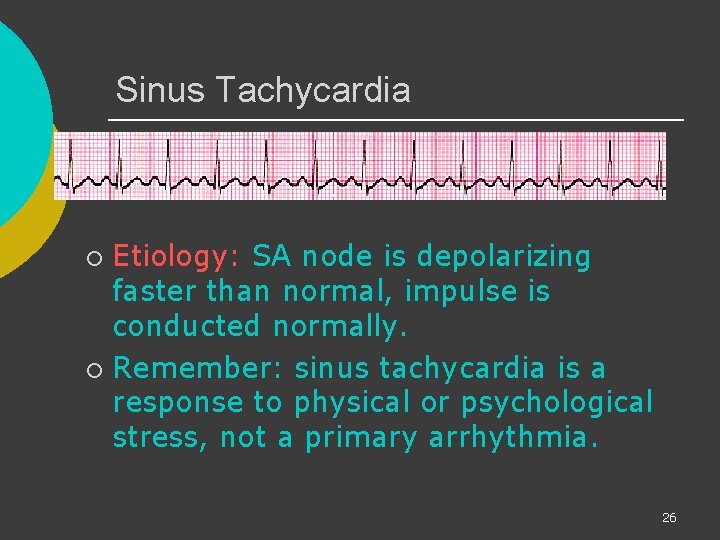
Sinus Tachycardia Etiology: SA node is depolarizing faster than normal, impulse is conducted normally. ¡ Remember: sinus tachycardia is a response to physical or psychological stress, not a primary arrhythmia. ¡ 26
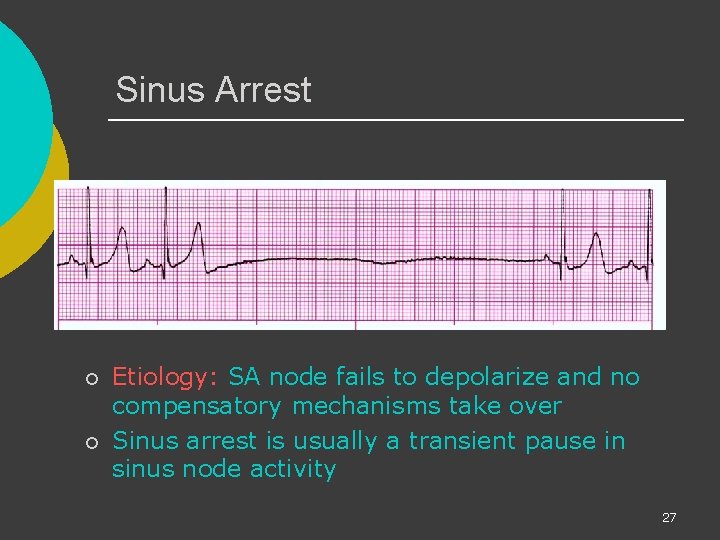
Sinus Arrest ¡ ¡ Etiology: SA node fails to depolarize and no compensatory mechanisms take over Sinus arrest is usually a transient pause in sinus node activity 27
Premature Beats ¡ Premature Atrial Contractions (PACs) ¡ Premature Ventricular Contractions (PVCs) 28
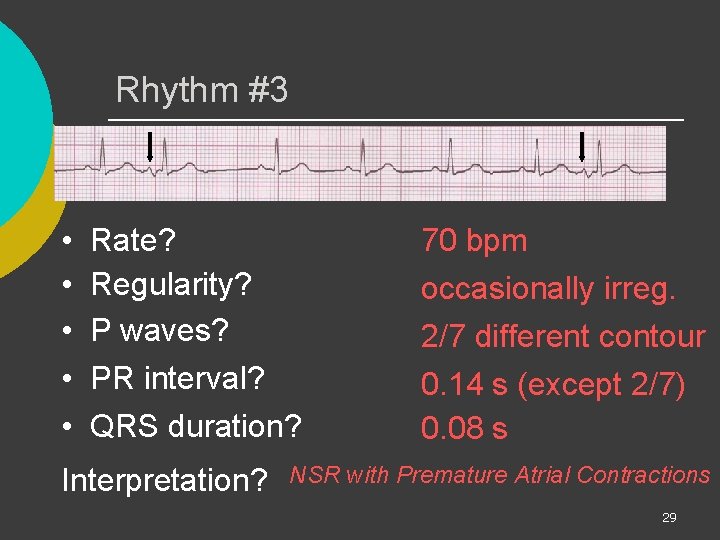
Rhythm #3 • • • Rate? Regularity? P waves? PR interval? QRS duration? Interpretation? 70 bpm occasionally irreg. 2/7 different contour 0. 14 s (except 2/7) 0. 08 s NSR with Premature Atrial Contractions 29
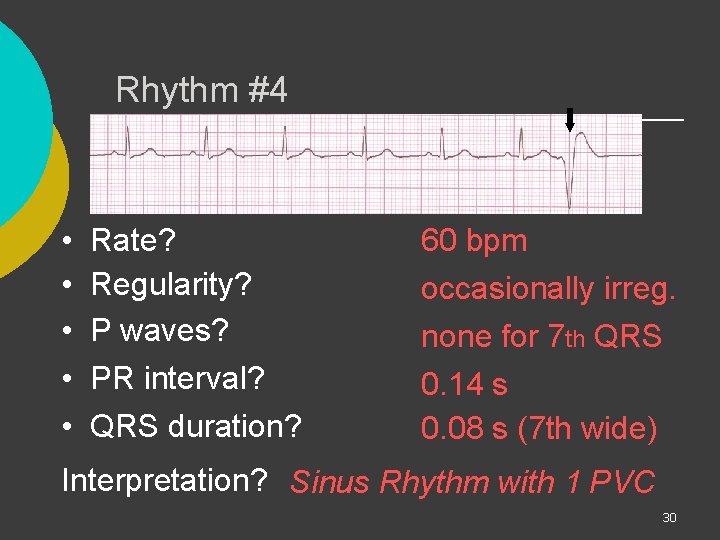
Rhythm #4 • • • Rate? Regularity? P waves? PR interval? QRS duration? 60 bpm occasionally irreg. none for 7 th QRS 0. 14 s 0. 08 s (7 th wide) Interpretation? Sinus Rhythm with 1 PVC 30
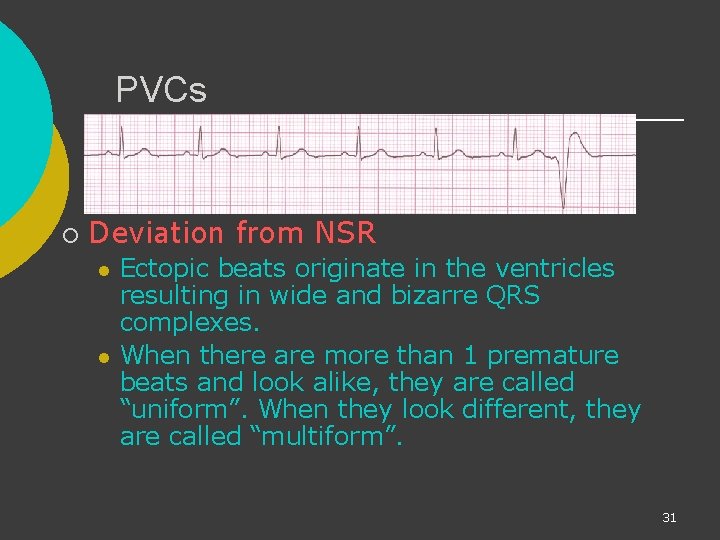
PVCs ¡ Deviation from NSR l l Ectopic beats originate in the ventricles resulting in wide and bizarre QRS complexes. When there are more than 1 premature beats and look alike, they are called “uniform”. When they look different, they are called “multiform”. 31
Supraventricular Arrhythmias ¡ Atrial Fibrillation ¡ Atrial Flutter 32
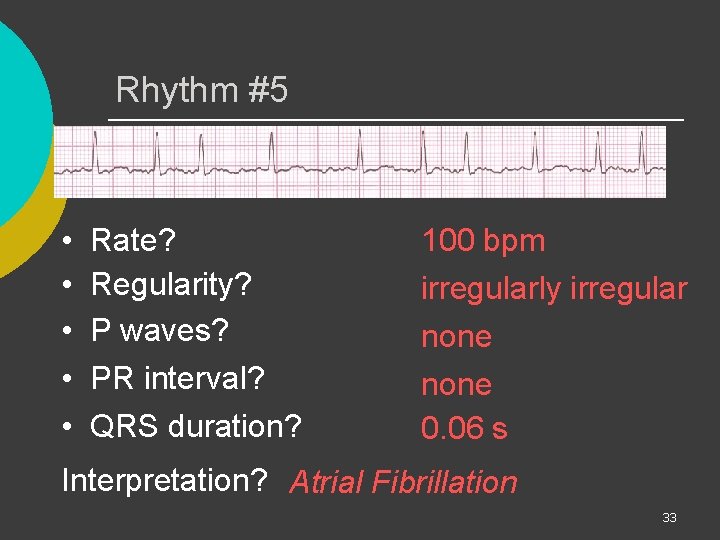
Rhythm #5 • • • Rate? Regularity? P waves? PR interval? QRS duration? 100 bpm irregularly irregular none 0. 06 s Interpretation? Atrial Fibrillation 33
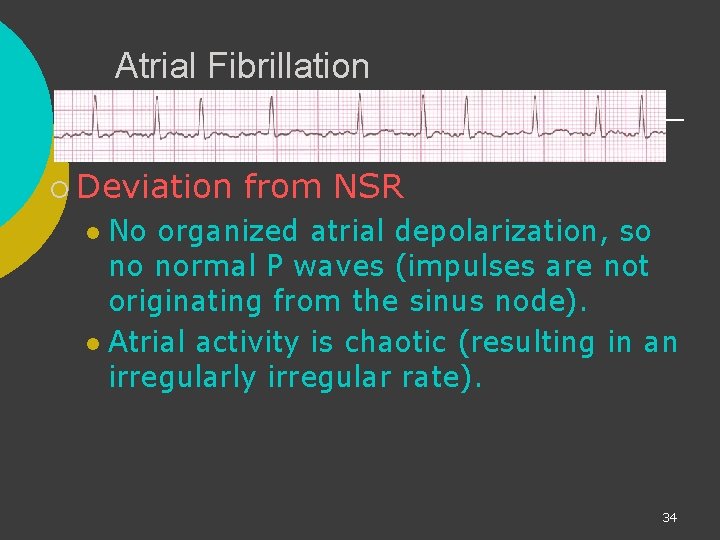
Atrial Fibrillation ¡ Deviation from NSR No organized atrial depolarization, so no normal P waves (impulses are not originating from the sinus node). l Atrial activity is chaotic (resulting in an irregularly irregular rate). l 34
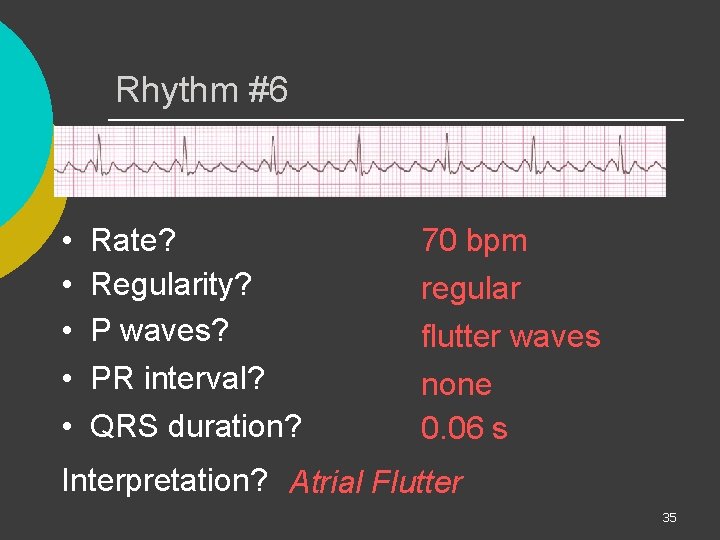
Rhythm #6 • • • Rate? Regularity? P waves? PR interval? QRS duration? 70 bpm regular flutter waves none 0. 06 s Interpretation? Atrial Flutter 35
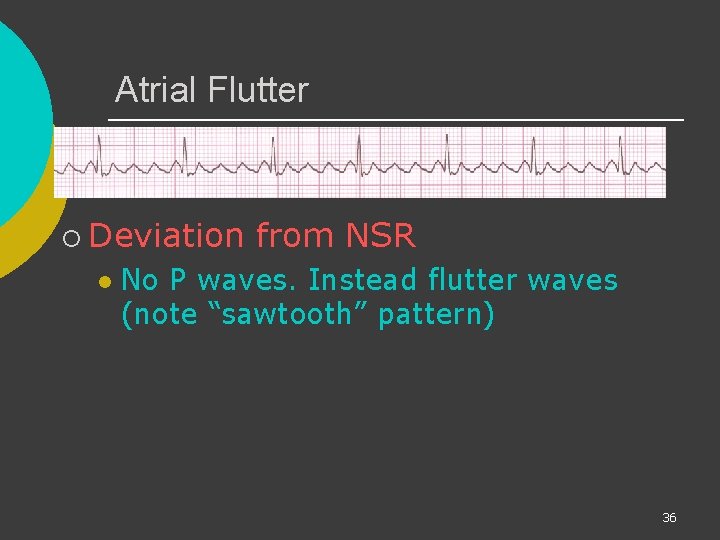
Atrial Flutter ¡ Deviation l from NSR No P waves. Instead flutter waves (note “sawtooth” pattern) 36
AV Nodal Blocks ¡ 1 st Degree AV Block ¡ 2 nd Degree AV Block, Type II ¡ 3 rd Degree AV Block 37
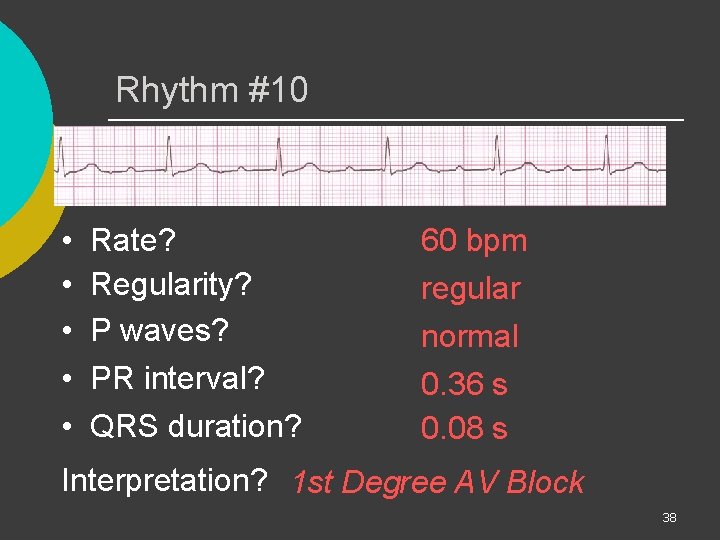
Rhythm #10 • • • Rate? Regularity? P waves? PR interval? QRS duration? 60 bpm regular normal 0. 36 s 0. 08 s Interpretation? 1 st Degree AV Block 38
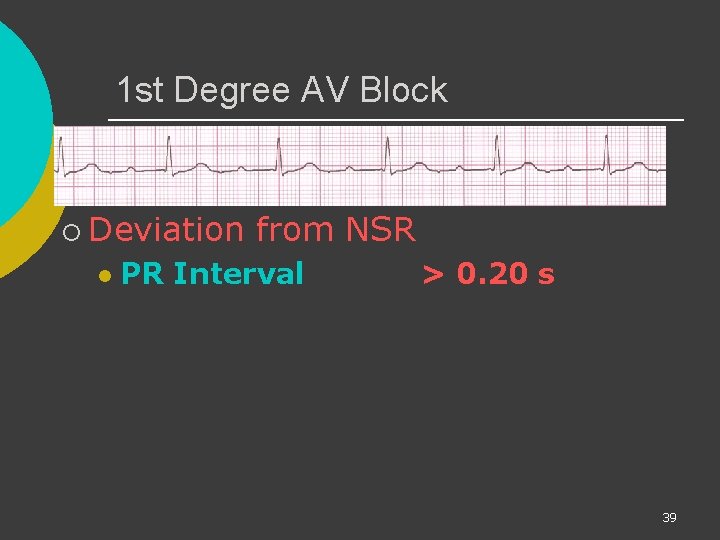
1 st Degree AV Block ¡ Deviation l from NSR PR Interval > 0. 20 s 39
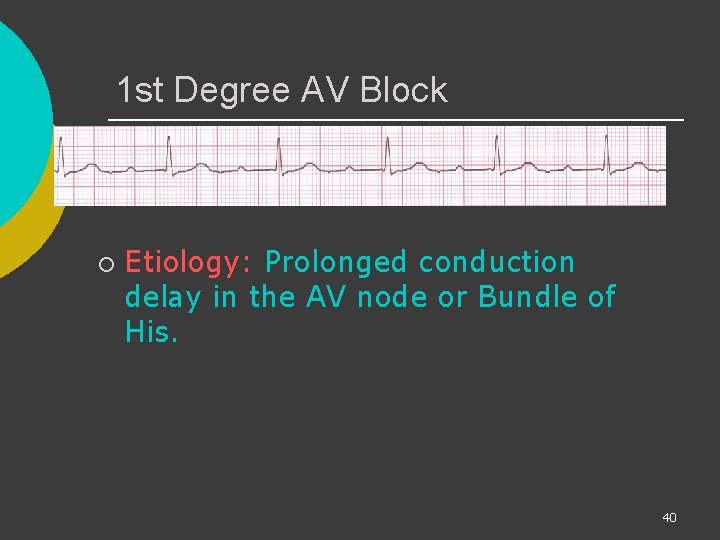
1 st Degree AV Block ¡ Etiology: Prolonged conduction delay in the AV node or Bundle of His. 40
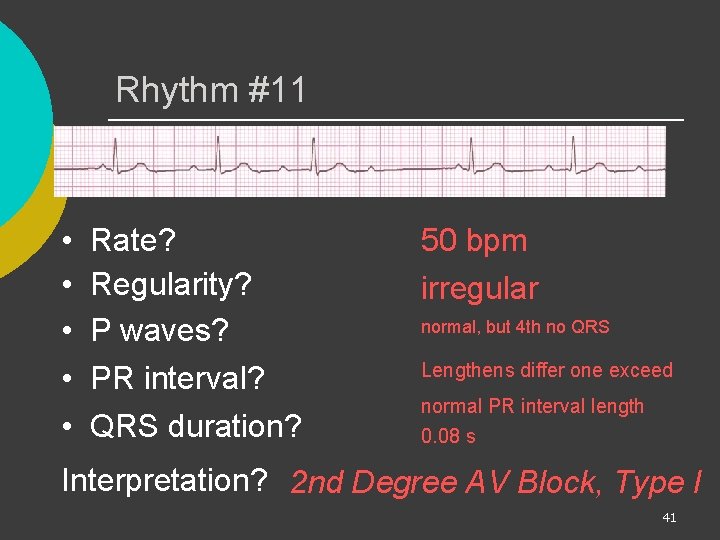
Rhythm #11 • • • Rate? Regularity? P waves? PR interval? QRS duration? 50 bpm irregular normal, but 4 th no QRS Lengthens differ one exceed normal PR interval length 0. 08 s Interpretation? 2 nd Degree AV Block, Type I 41
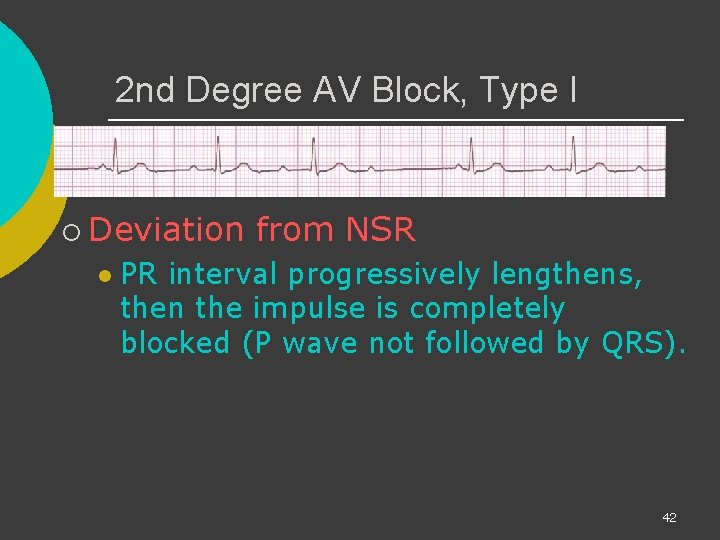
2 nd Degree AV Block, Type I ¡ Deviation l from NSR PR interval progressively lengthens, then the impulse is completely blocked (P wave not followed by QRS). 42
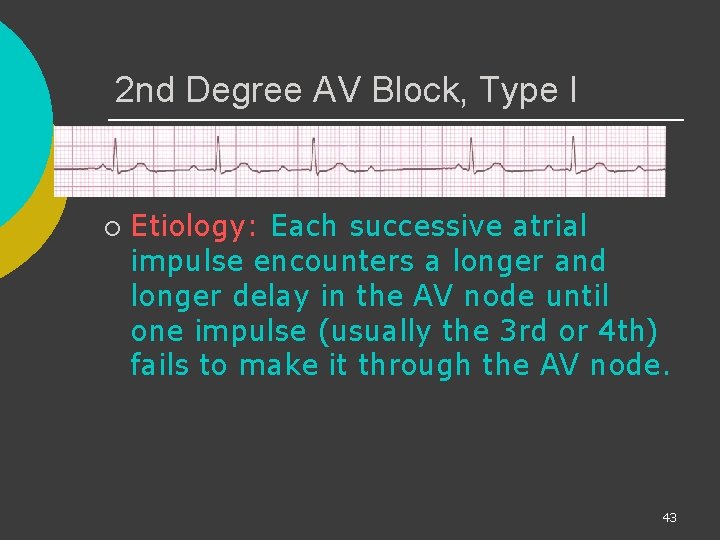
2 nd Degree AV Block, Type I ¡ Etiology: Each successive atrial impulse encounters a longer and longer delay in the AV node until one impulse (usually the 3 rd or 4 th) fails to make it through the AV node. 43
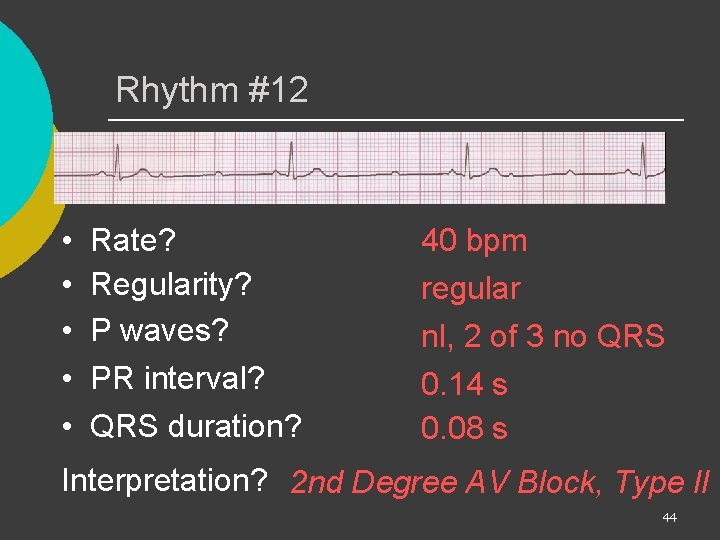
Rhythm #12 • • • Rate? Regularity? P waves? PR interval? QRS duration? 40 bpm regular nl, 2 of 3 no QRS 0. 14 s 0. 08 s Interpretation? 2 nd Degree AV Block, Type II 44
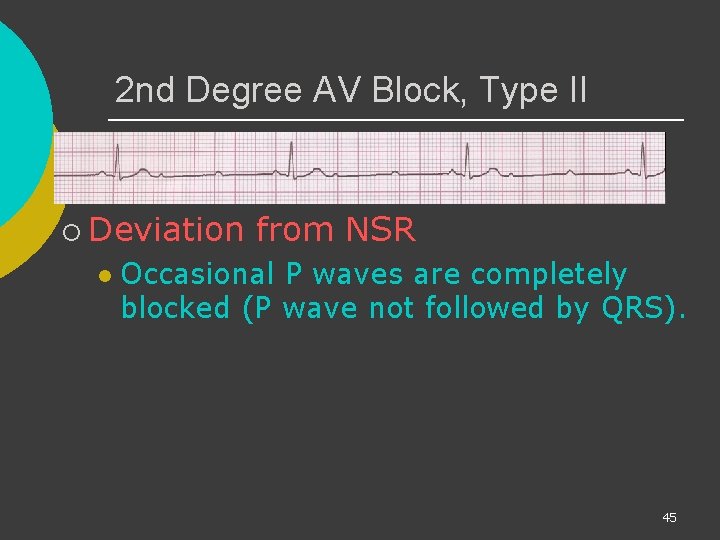
2 nd Degree AV Block, Type II ¡ Deviation l from NSR Occasional P waves are completely blocked (P wave not followed by QRS). 45
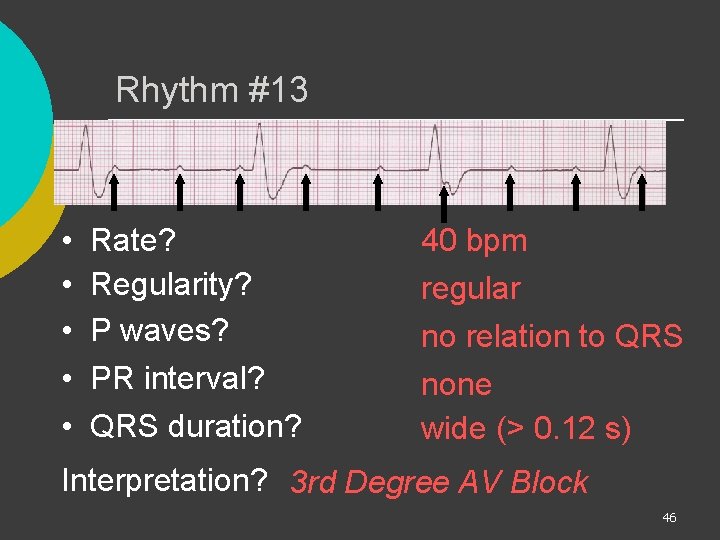
Rhythm #13 • • • Rate? Regularity? P waves? PR interval? QRS duration? 40 bpm regular no relation to QRS none wide (> 0. 12 s) Interpretation? 3 rd Degree AV Block 46
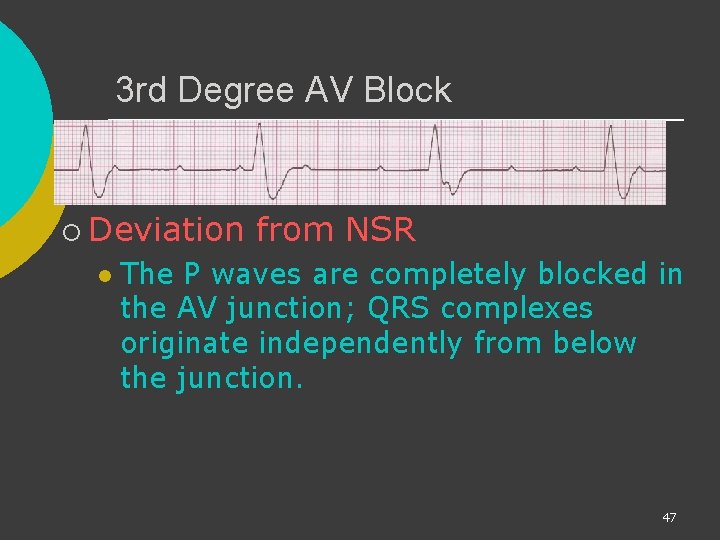
3 rd Degree AV Block ¡ Deviation l from NSR The P waves are completely blocked in the AV junction; QRS complexes originate independently from below the junction. 47
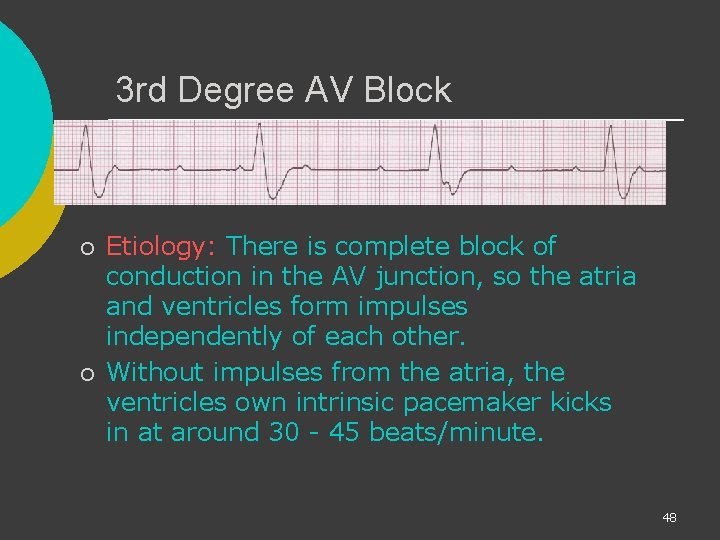
3 rd Degree AV Block ¡ ¡ Etiology: There is complete block of conduction in the AV junction, so the atria and ventricles form impulses independently of each other. Without impulses from the atria, the ventricles own intrinsic pacemaker kicks in at around 30 - 45 beats/minute. 48
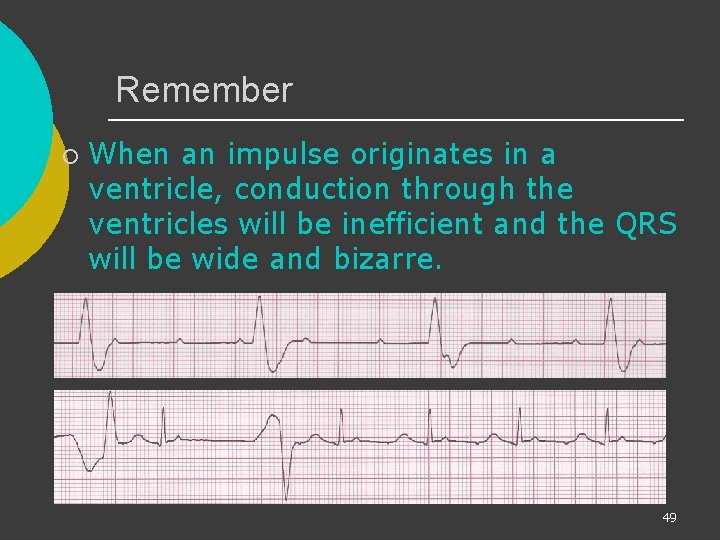
Remember ¡ When an impulse originates in a ventricle, conduction through the ventricles will be inefficient and the QRS will be wide and bizarre. 49
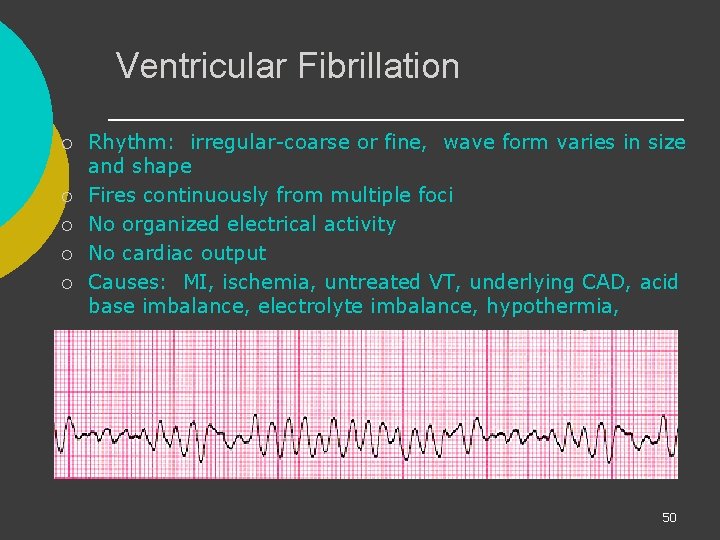
Ventricular Fibrillation ¡ ¡ ¡ Rhythm: irregular-coarse or fine, wave form varies in size and shape Fires continuously from multiple foci No organized electrical activity No cardiac output Causes: MI, ischemia, untreated VT, underlying CAD, acid base imbalance, electrolyte imbalance, hypothermia, 50
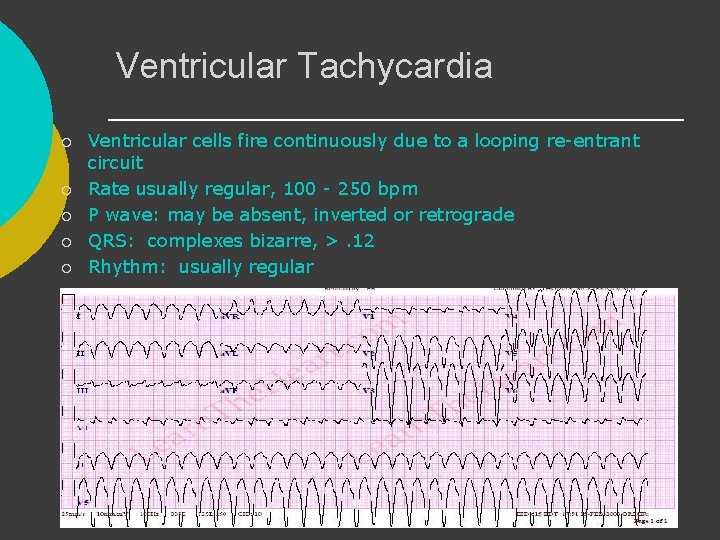
Ventricular Tachycardia ¡ ¡ ¡ Ventricular cells fire continuously due to a looping re-entrant circuit Rate usually regular, 100 - 250 bpm P wave: may be absent, inverted or retrograde QRS: complexes bizarre, >. 12 Rhythm: usually regular 51
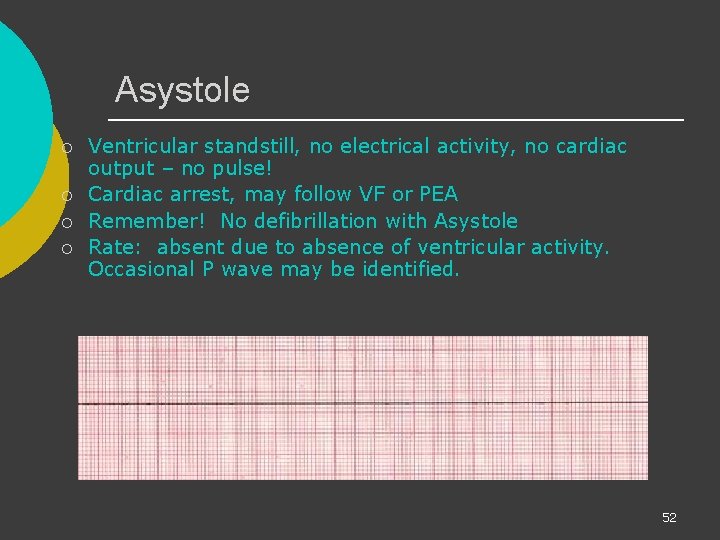
Asystole ¡ ¡ Ventricular standstill, no electrical activity, no cardiac output – no pulse! Cardiac arrest, may follow VF or PEA Remember! No defibrillation with Asystole Rate: absent due to absence of ventricular activity. Occasional P wave may be identified. 52
- Slides: 52