
ECG in Pacemaker Malfunction Sriram Rajagopal Southern Railway










- Slides: 87
ECG in Pacemaker Malfunction Sriram Rajagopal, Southern Railway Hospital, Perambur, Chennai
ECG in “Pacemaker Malfunction” (ECGs in Pacemaker Function Assessment) Sriram Rajagopal, Southern Railway Hospital, Perambur, Chennai
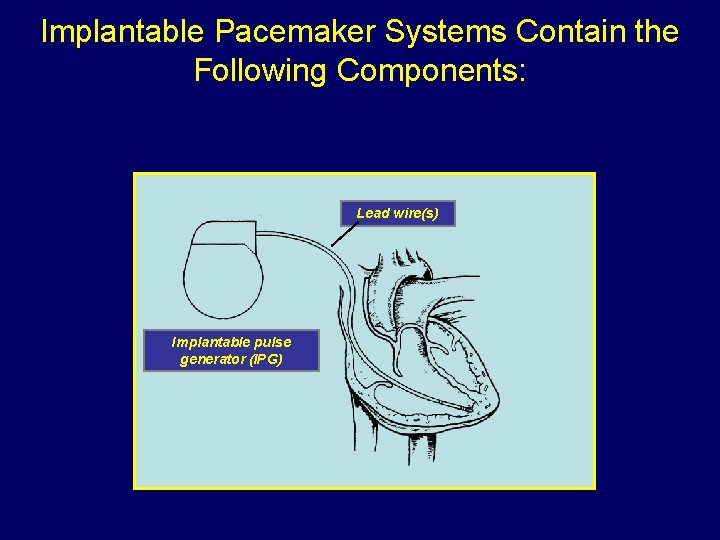
Implantable Pacemaker Systems Contain the Following Components: Lead wire(s) Implantable pulse generator (IPG)
Pseudomalfunctions are defined as: z Unusual z Unexpected z Eccentric ECG findings that appear to result from pacemaker malfunction but that represent normal pacemaker function
ECGs in Patients with Pacemakers Overview : • Basic principles of pacing • Background information required • Systematic approach • Examples with single chamber pacing • Examples with dual chamber pacing
ECGs in Patients with Pacemakers Overview : • Basic principles of pacing • Background information required • Systematic approach • Examples with single chamber pacing • Examples with dual chamber pacing
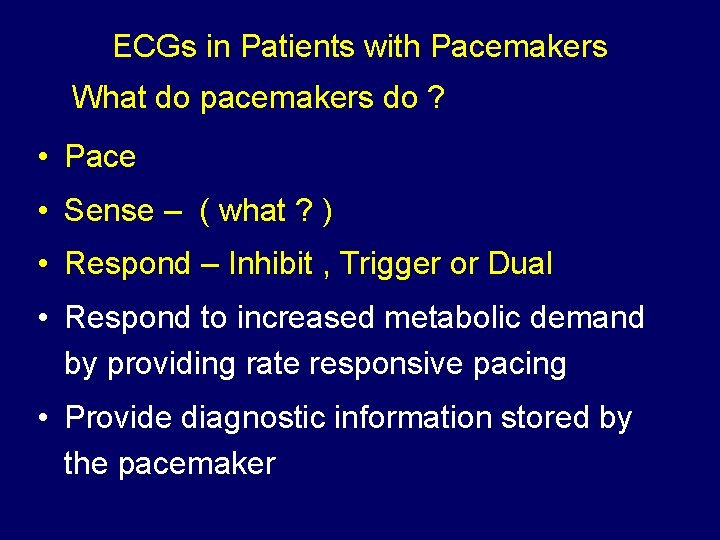
ECGs in Patients with Pacemakers What do pacemakers do ? • Pace • Sense – ( what ? ) • Respond – Inhibit , Trigger or Dual • Respond to increased metabolic demand by providing rate responsive pacing • Provide diagnostic information stored by the pacemaker
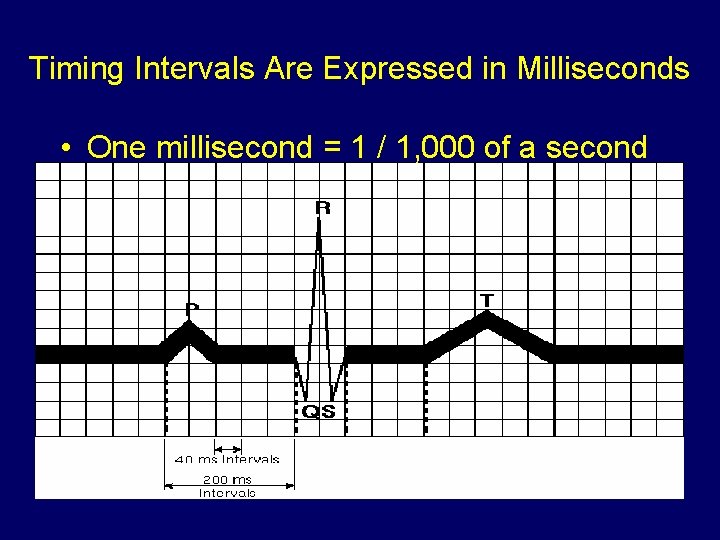
Timing Intervals Are Expressed in Milliseconds • One millisecond = 1 / 1, 000 of a second
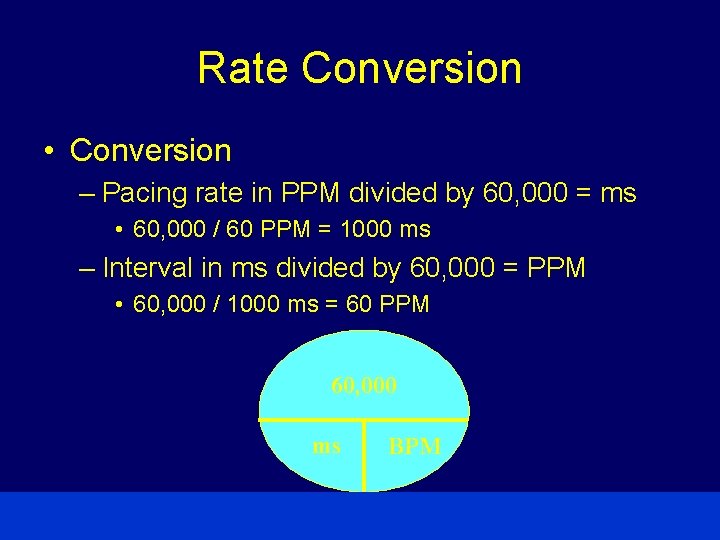
Rate Conversion • Conversion – Pacing rate in PPM divided by 60, 000 = ms • 60, 000 / 60 PPM = 1000 ms – Interval in ms divided by 60, 000 = PPM • 60, 000 / 1000 ms = 60 PPM 60, 000 ms BPM
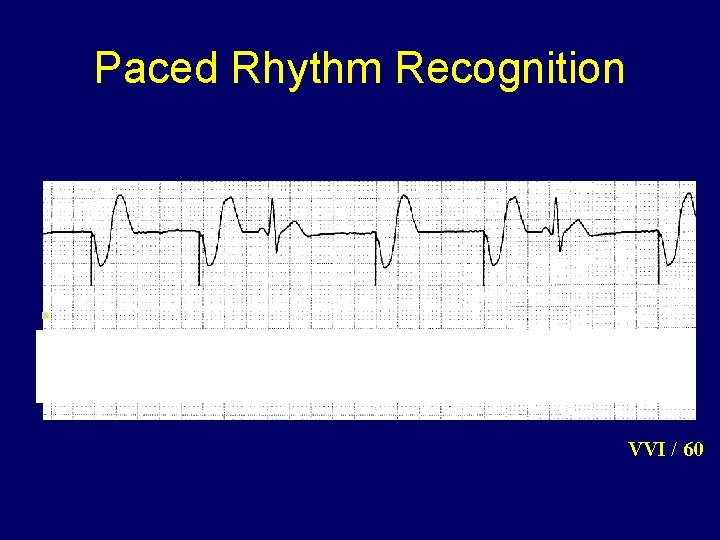
Paced Rhythm Recognition VVI / 60
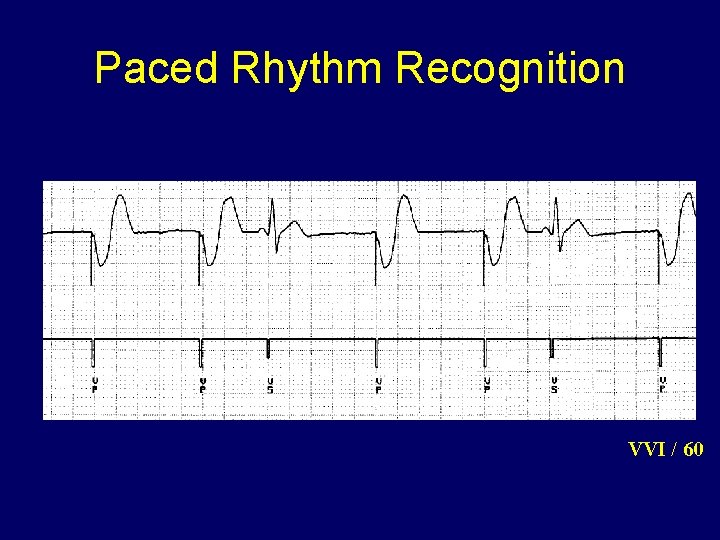
Paced Rhythm Recognition VVI / 60
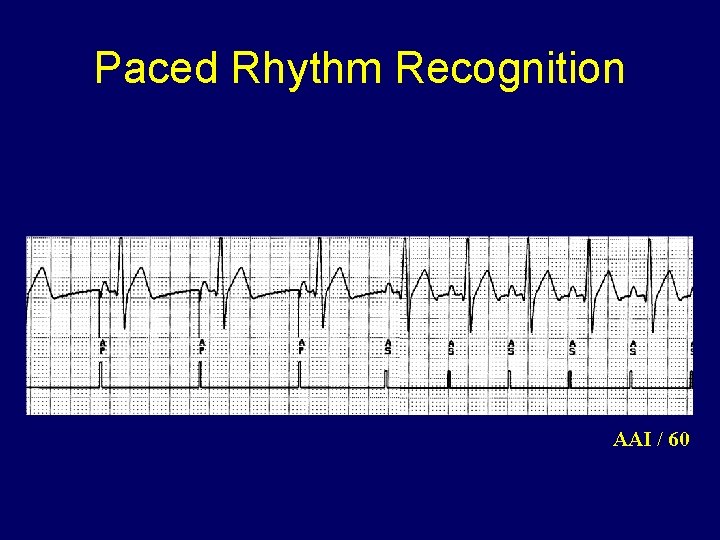
Paced Rhythm Recognition AAI / 60
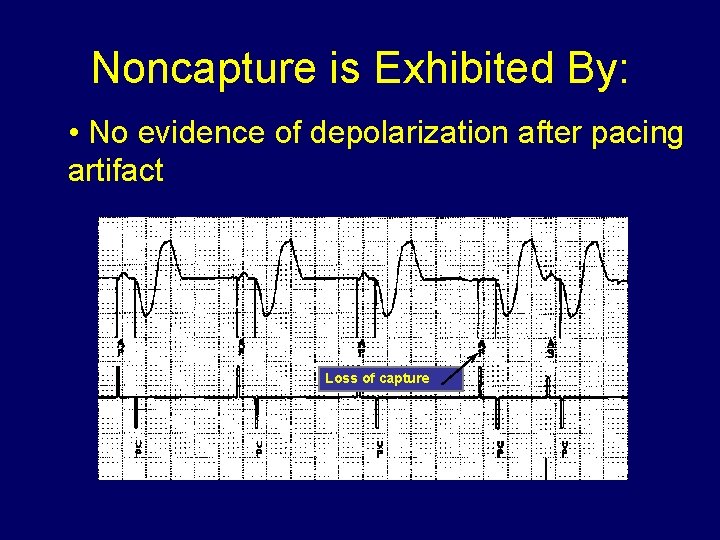
Noncapture is Exhibited By: • No evidence of depolarization after pacing artifact Loss of capture
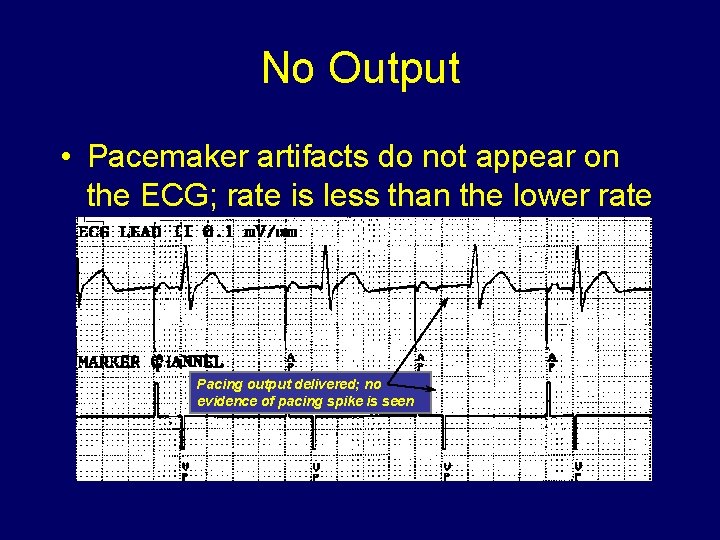
No Output • Pacemaker artifacts do not appear on the ECG; rate is less than the lower rate Pacing output delivered; no evidence of pacing spike is seen
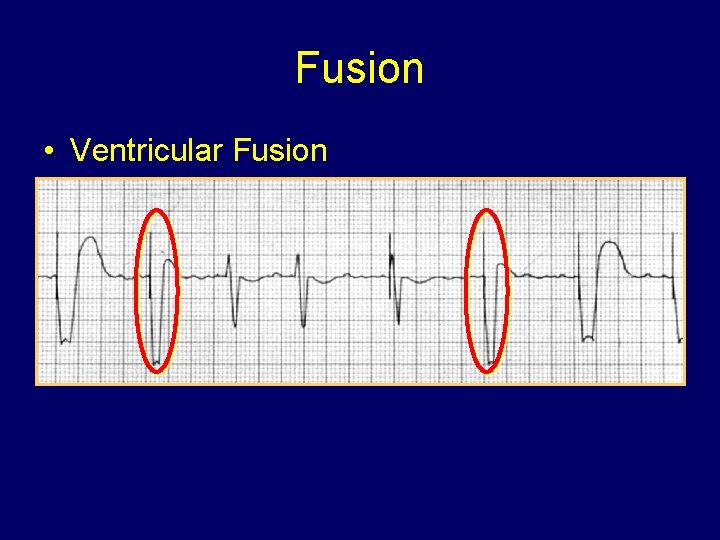
Fusion Beat • Definition: The combination of an intrinsic beat and a paced beat. • The morphology varies; in other words, a fusion beat doesn’t really look like a paced beat or an intrinsic beat. • The pacemaker and the patient contribute to depolarization in Fusion beats.
Fusion • Ventricular Fusion
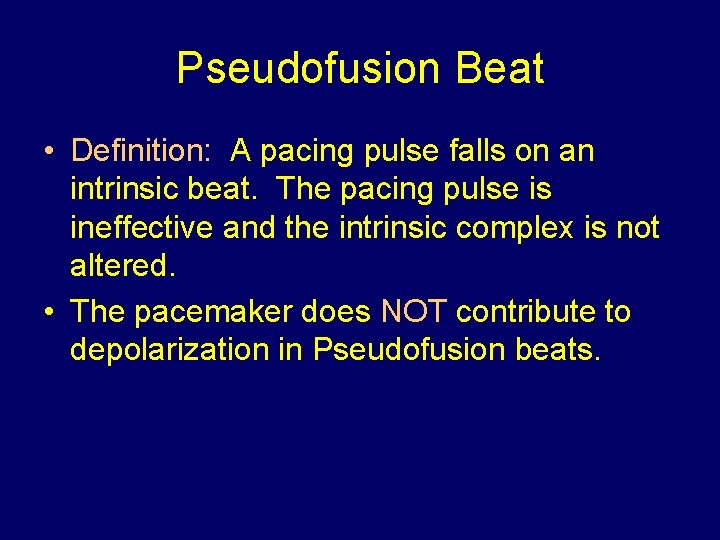
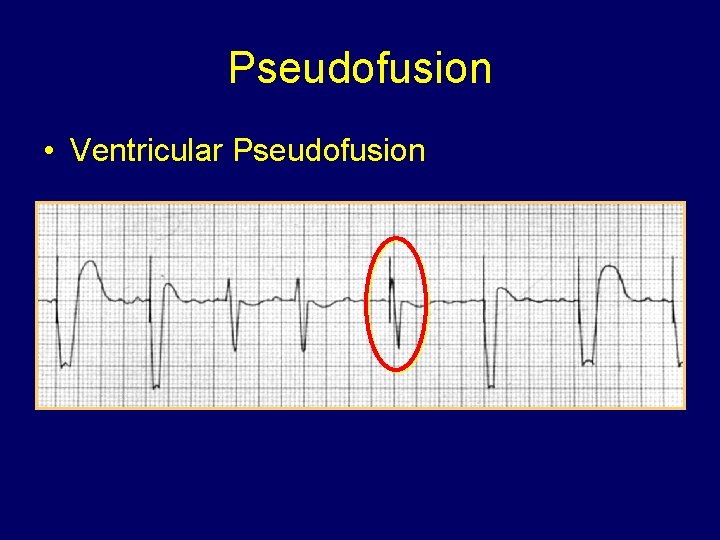
Pseudofusion Beat • Definition: A pacing pulse falls on an intrinsic beat. The pacing pulse is ineffective and the intrinsic complex is not altered. • The pacemaker does NOT contribute to depolarization in Pseudofusion beats.
Pseudofusion • Ventricular Pseudofusion
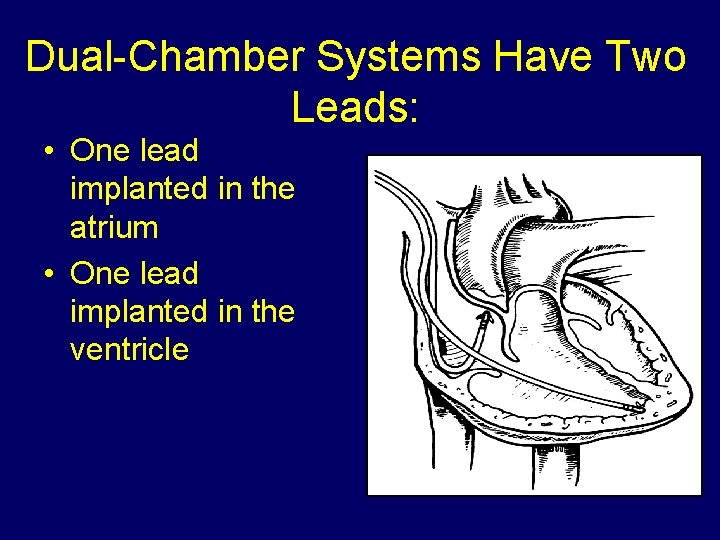
Dual-Chamber Systems Have Two Leads: • One lead implanted in the atrium • One lead implanted in the ventricle
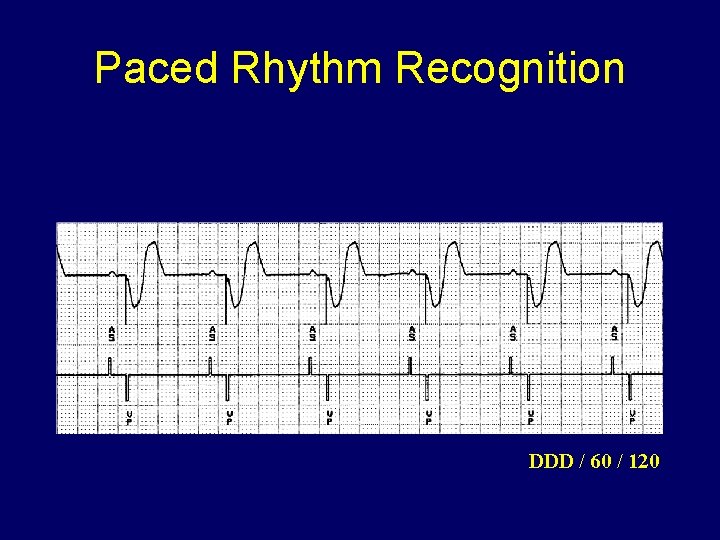
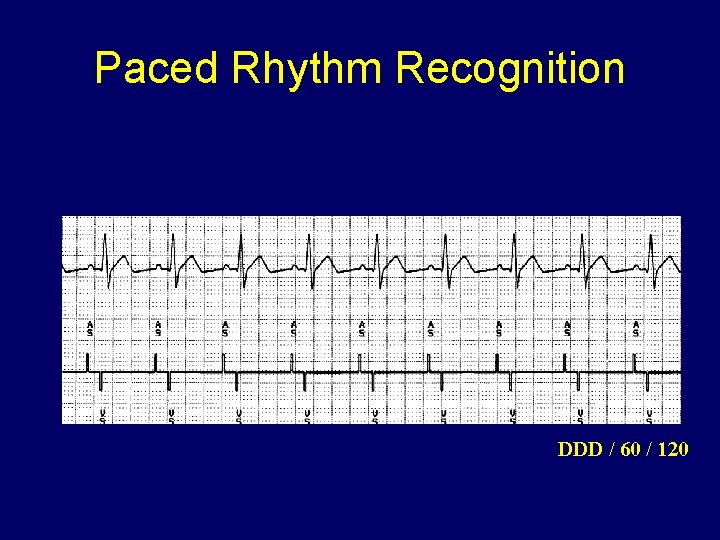
Paced Rhythm Recognition DDD / 60 / 120
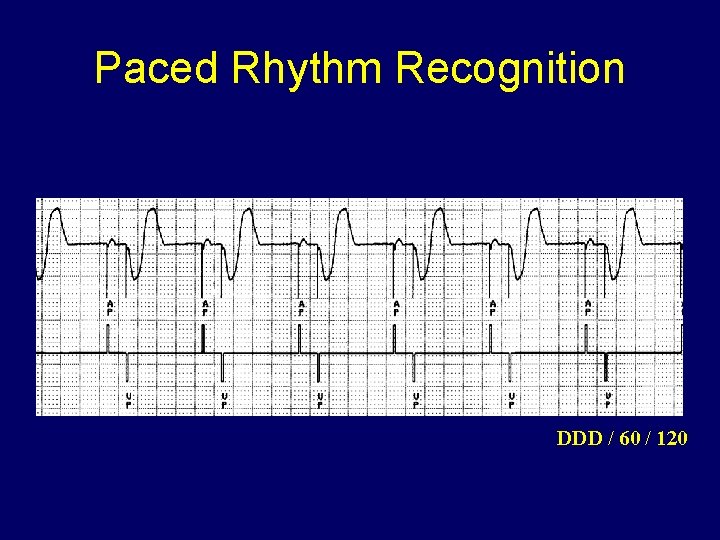
Paced Rhythm Recognition DDD / 60 / 120
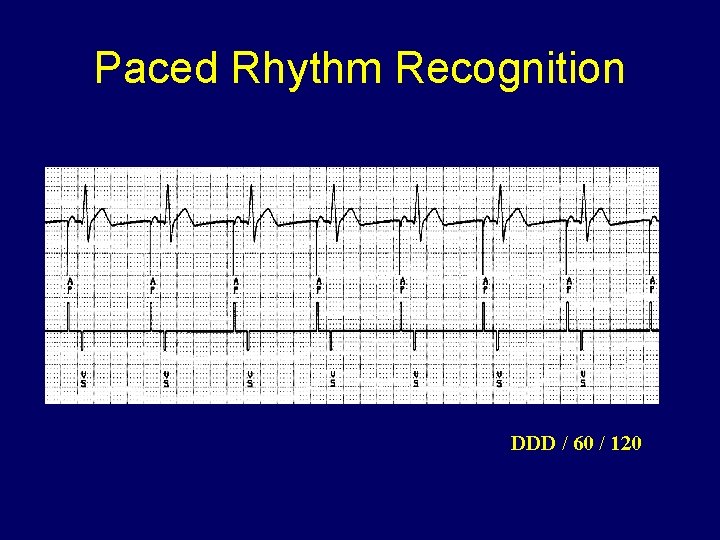
Paced Rhythm Recognition DDD / 60 / 120
Paced Rhythm Recognition DDD / 60 / 120
Sensing • Sensing is the ability of the pacemaker to “see” when a natural (intrinsic) depolarization is occurring – Pacemakers sense cardiac depolarization by measuring changes in electrical potential of myocardial cells between the anode and cathode
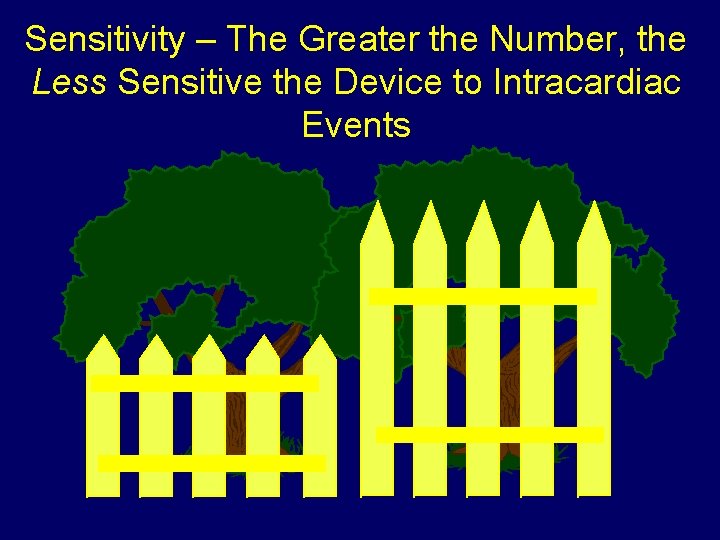
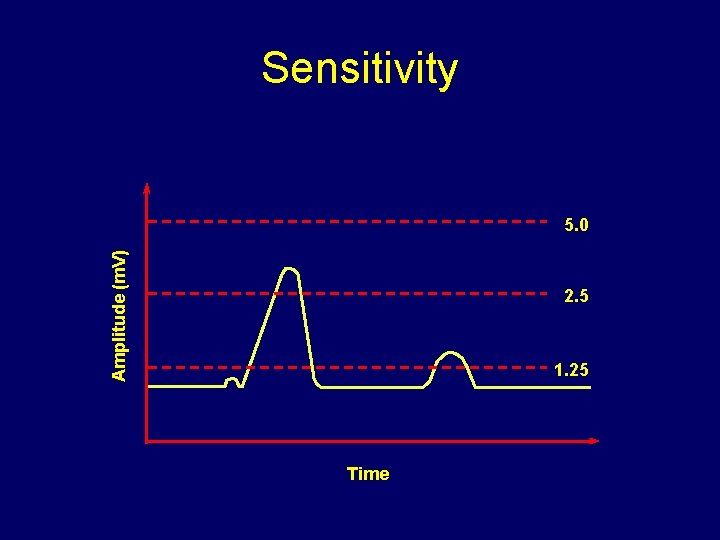
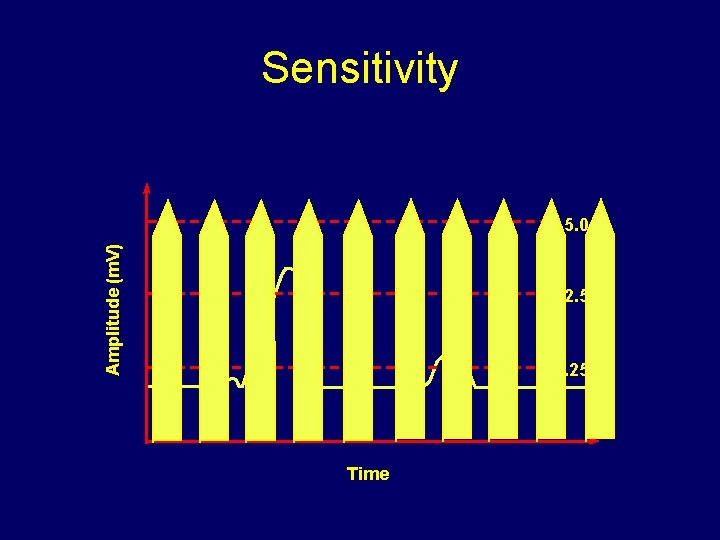
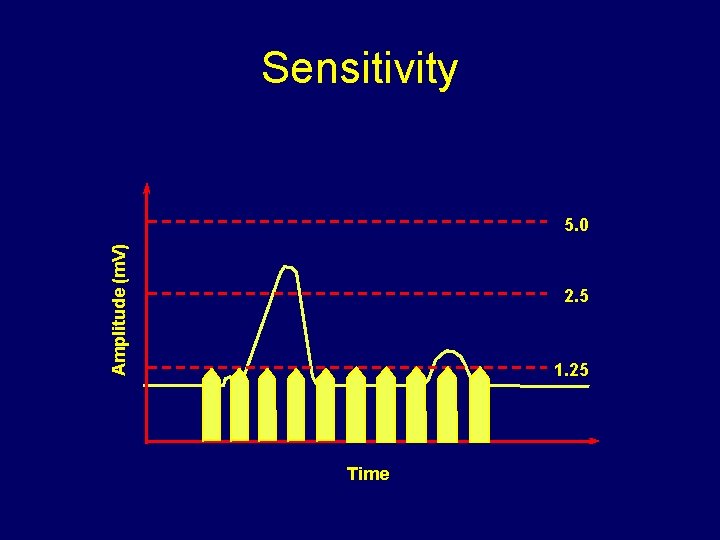
Sensitivity – The Greater the Number, the Less Sensitive the Device to Intracardiac Events
Sensitivity Amplitude (m. V) 5. 0 2. 5 1. 25 Time
Sensitivity Amplitude (m. V) 5. 0 2. 5 1. 25 Time
Sensitivity Amplitude (m. V) 5. 0 2. 5 1. 25 Time
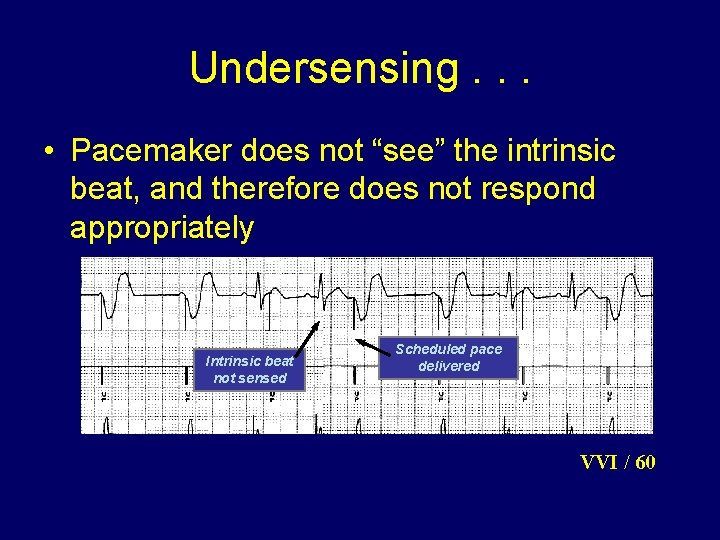
Undersensing. . . • Pacemaker does not “see” the intrinsic beat, and therefore does not respond appropriately Intrinsic beat not sensed Scheduled pace delivered VVI / 60
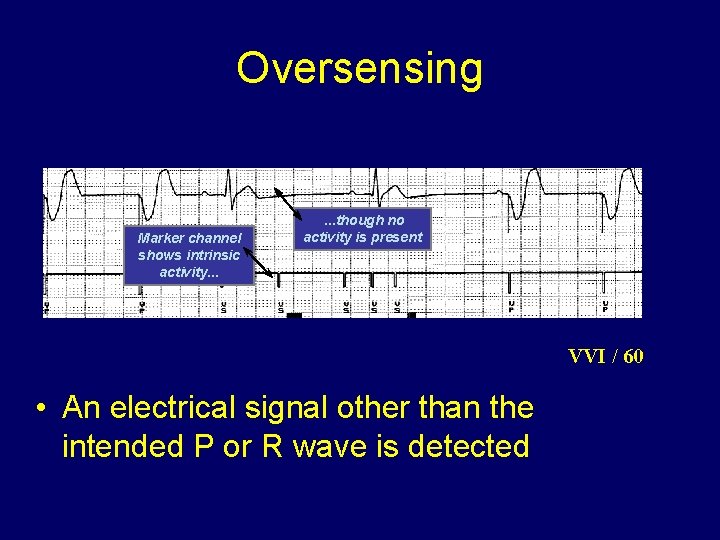
Oversensing Marker channel shows intrinsic activity. . . though no activity is present VVI / 60 • An electrical signal other than the intended P or R wave is detected
ECGs in Patients with Pacemakers Overview : • Basic principles of pacing • Background information required • Systematic approach • Examples with single chamber pacing • Examples with dual chamber pacing
ECGs in Patients with Pacemakers Basic Data : • Clinical details – age , indication for pacing, time since implant etc • Type of pacemaker • Programmed parameters • Magnet Behaviour • Special features
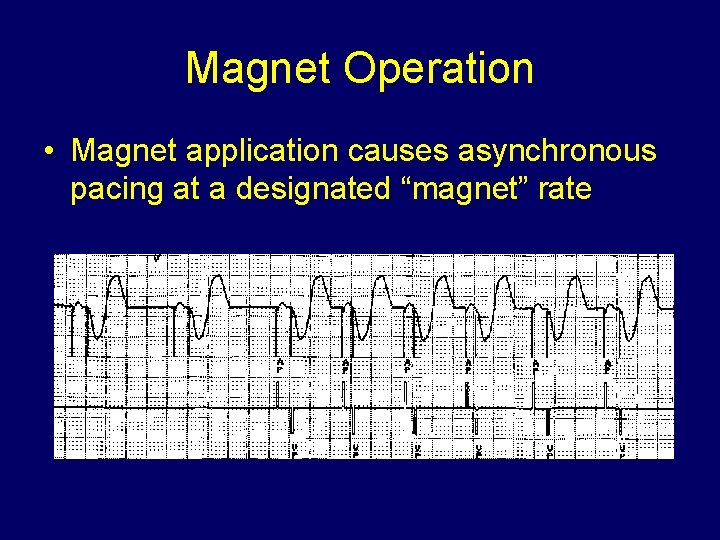
Magnet Operation • Magnet application causes asynchronous pacing at a designated “magnet” rate
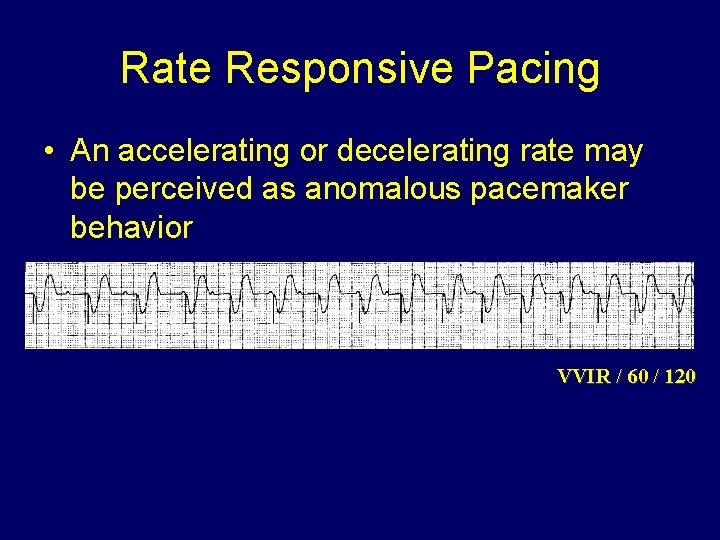
Rate Responsive Pacing • An accelerating or decelerating rate may be perceived as anomalous pacemaker behavior VVIR / 60 / 120
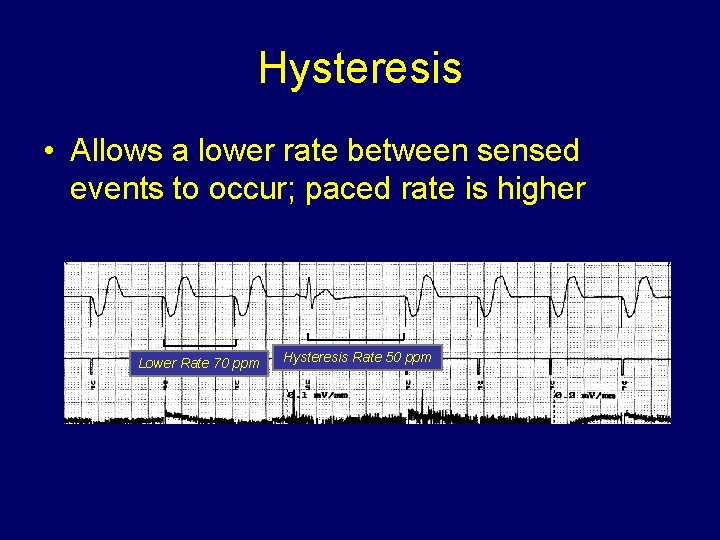
Hysteresis • Allows a lower rate between sensed events to occur; paced rate is higher Lower Rate 70 ppm Hysteresis Rate 50 ppm
ECGs in Patients with Pacemakers Overview : • Basic principles of pacing • Background information required • Systematic approach • Examples with single chamber pacing • Examples with dual chamber pacing
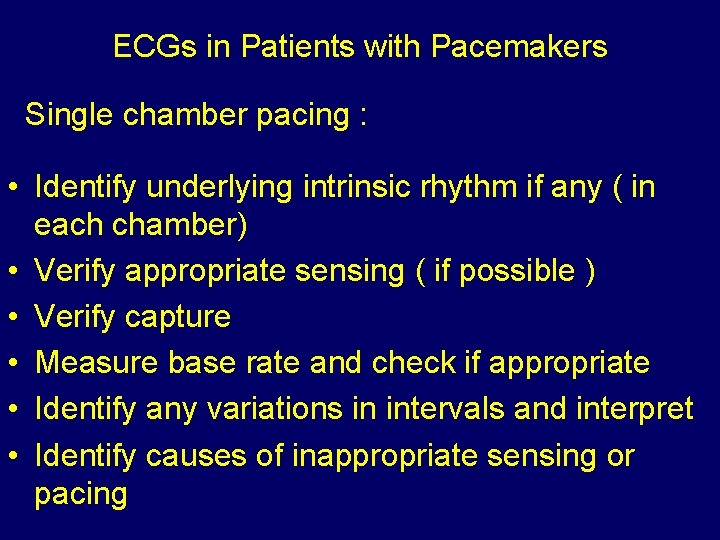
ECGs in Patients with Pacemakers Single chamber pacing : • Identify underlying intrinsic rhythm if any ( in each chamber) • Verify appropriate sensing ( if possible ) • Verify capture • Measure base rate and check if appropriate • Identify any variations in intervals and interpret • Identify causes of inappropriate sensing or pacing
ECGs in Patients with Pacemakers Overview : • Basic principles of pacing • Background information required • Systematic approach • Examples with single chamber pacing • Examples with dual chamber pacing
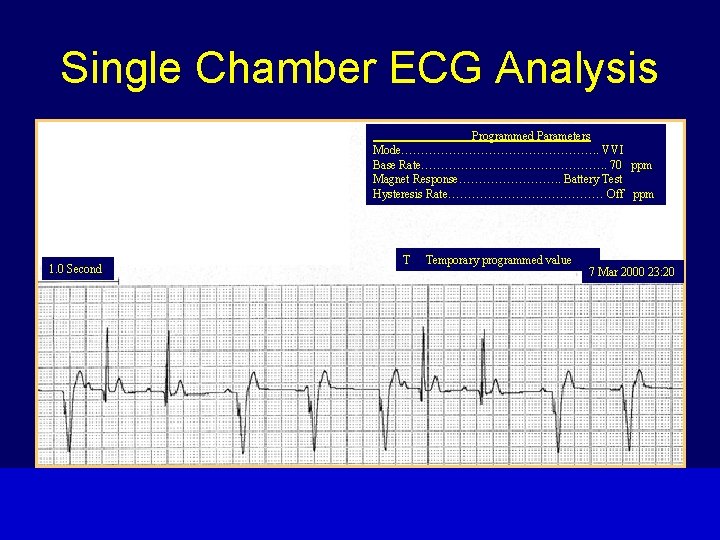
Single Chamber ECG Analysis Programmed Parameters Mode……………………. . VVI Base Rate……………………. . 70 ppm Magnet Response…………. . Battery Test Hysteresis Rate………………… Off ppm T 1. 0 Second 1 Temporary programmed value 7 Mar 2000 23: 20
ECG #1 • VVI • Normal Capture and Sensing 1
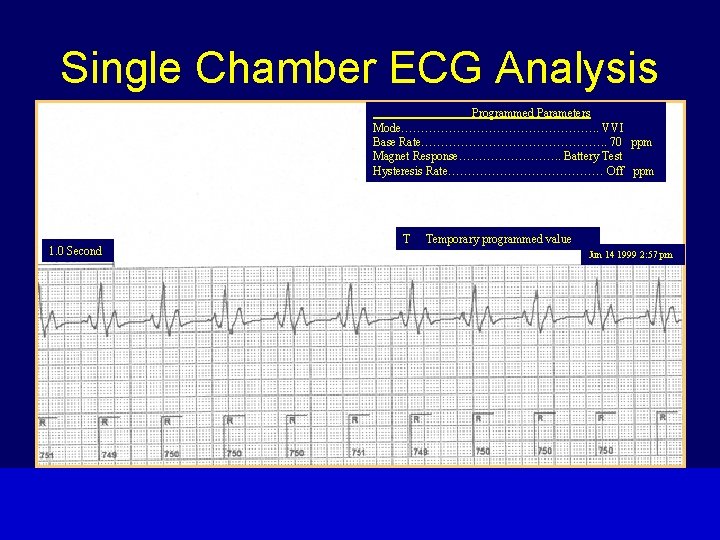
Single Chamber ECG Analysis Programmed Parameters Mode……………………. . VVI Base Rate……………………. . 70 ppm Magnet Response…………. . Battery Test Hysteresis Rate………………… Off ppm T 1. 0 Second Temporary programmed value Jun 14 1999 2: 57 pm 2
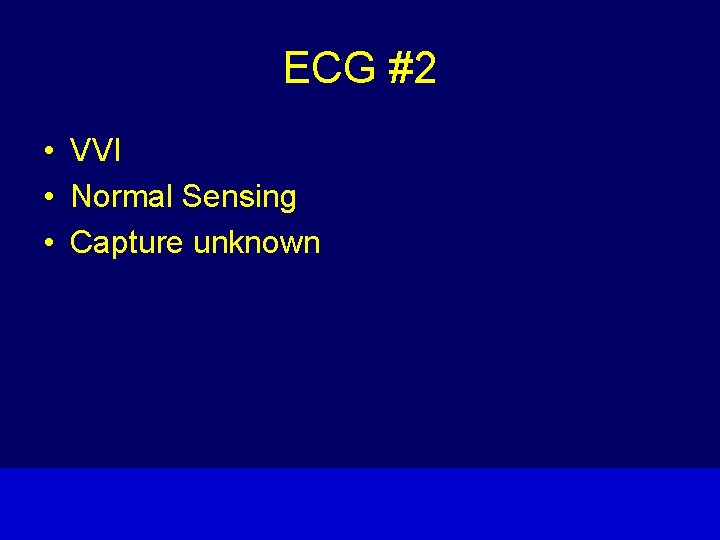
ECG #2 • VVI • Normal Sensing • Capture unknown 2
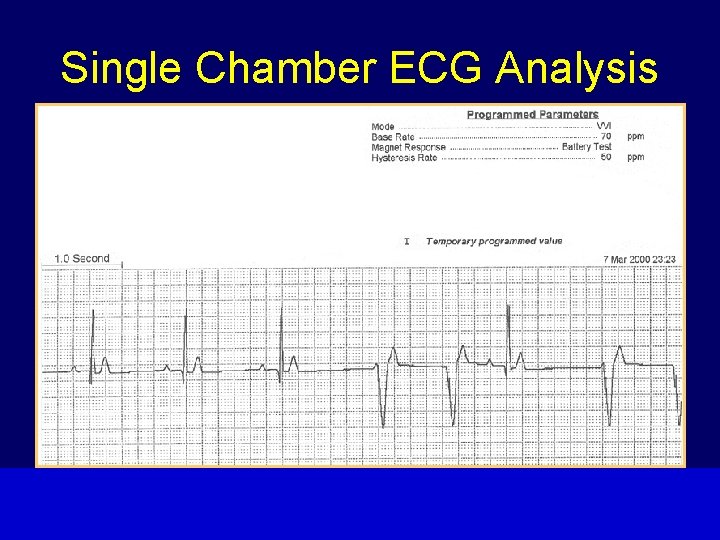
Single Chamber ECG Analysis 3
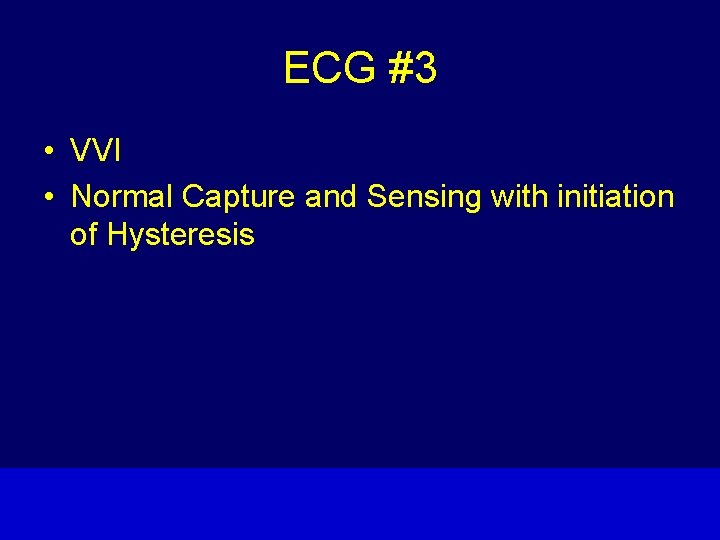
ECG #3 • VVI • Normal Capture and Sensing with initiation of Hysteresis 3
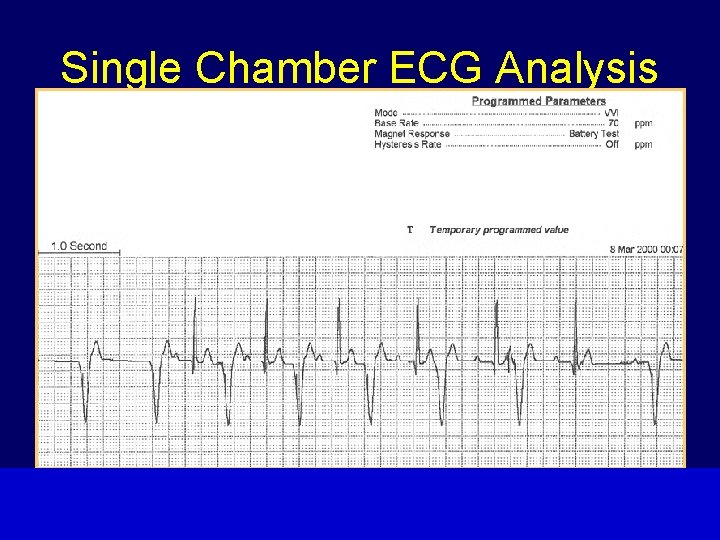
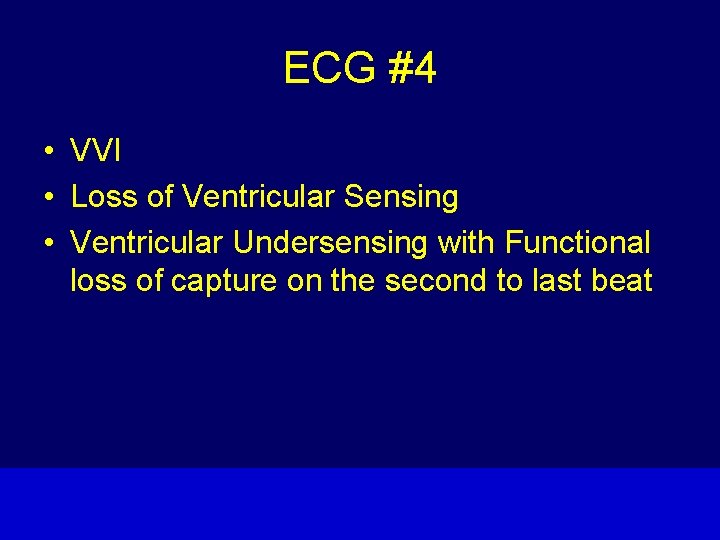
Single Chamber ECG Analysis 4
ECG #4 • VVI • Loss of Ventricular Sensing • Ventricular Undersensing with Functional loss of capture on the second to last beat 4
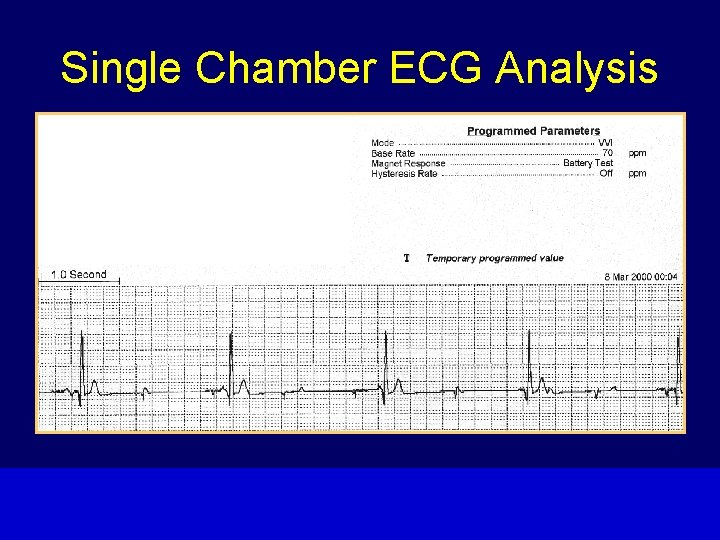
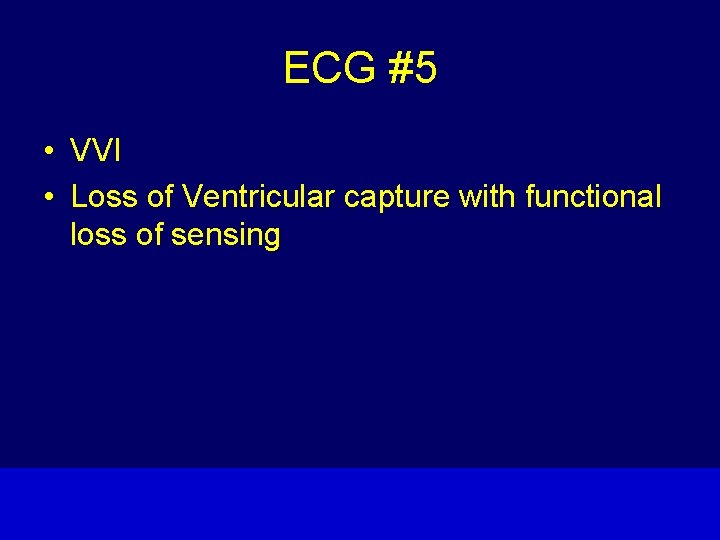
Single Chamber ECG Analysis 5
ECG #5 • VVI • Loss of Ventricular capture with functional loss of sensing 5
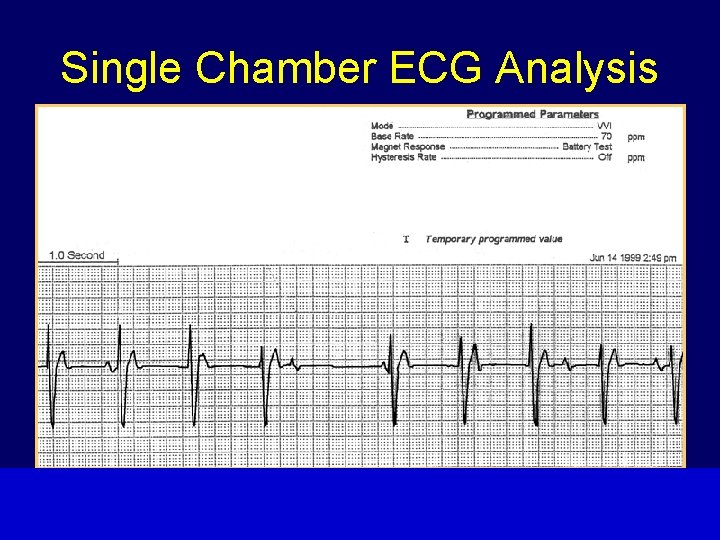
Single Chamber ECG Analysis 6
ECG #6 • VVI • Normal Capture • Ventricular Oversensing 6
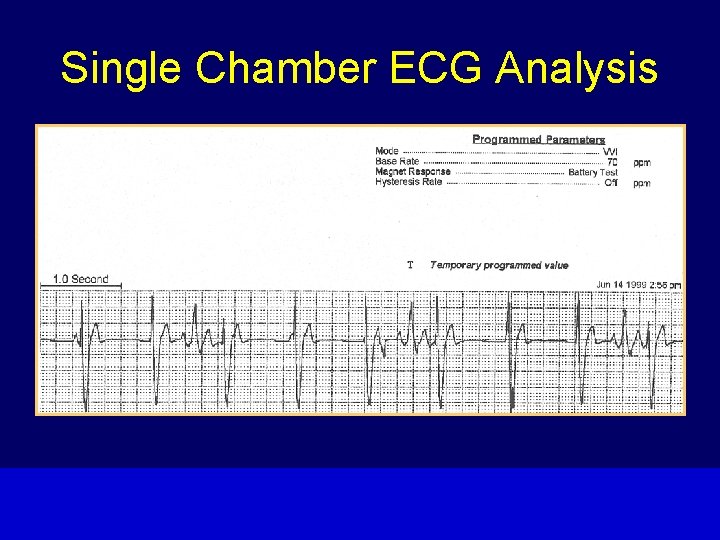
Single Chamber ECG Analysis 10
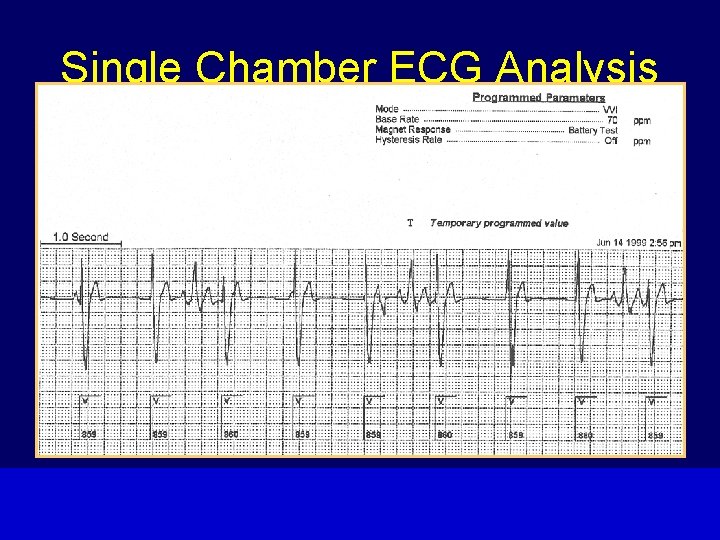
Single Chamber ECG Analysis 10
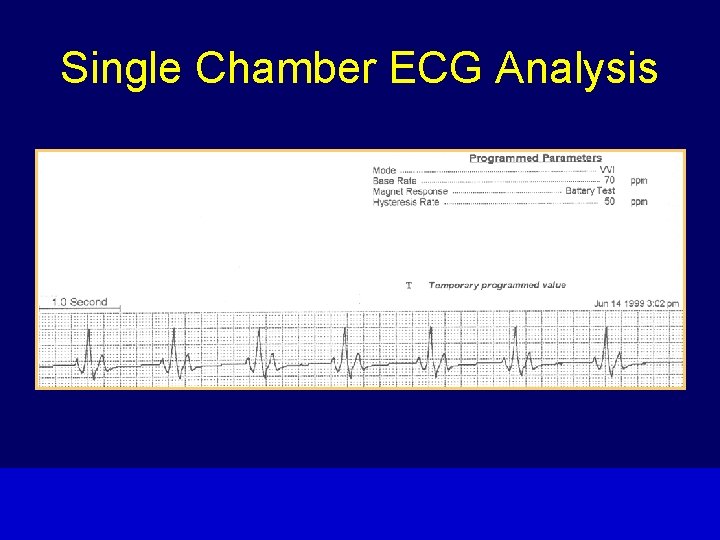
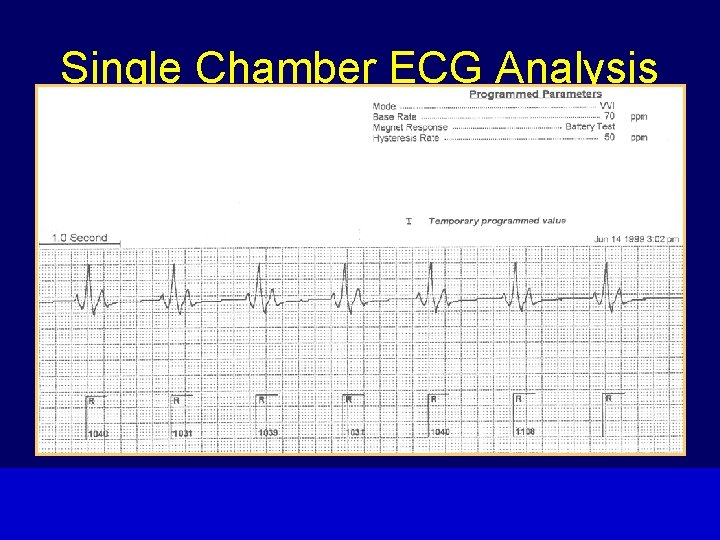
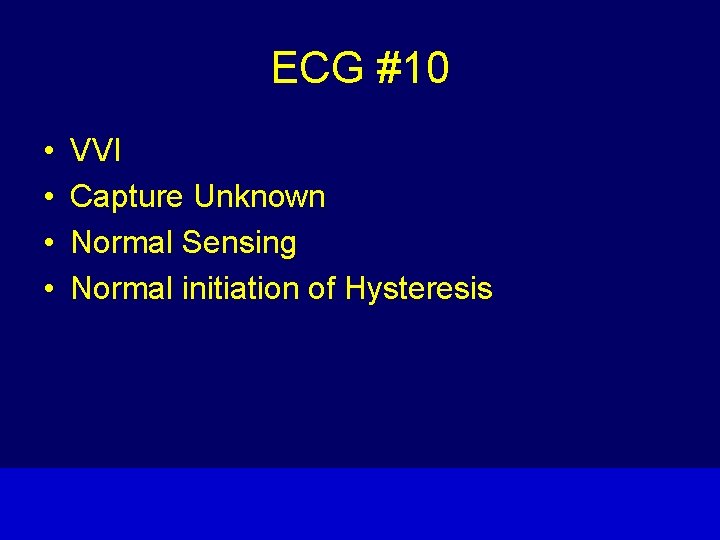
ECG #10 • • VVI Capture Unknown Normal Sensing Normal initiation of Hysteresis 10
Single Chamber ECG Analysis 12
Single Chamber ECG Analysis 12
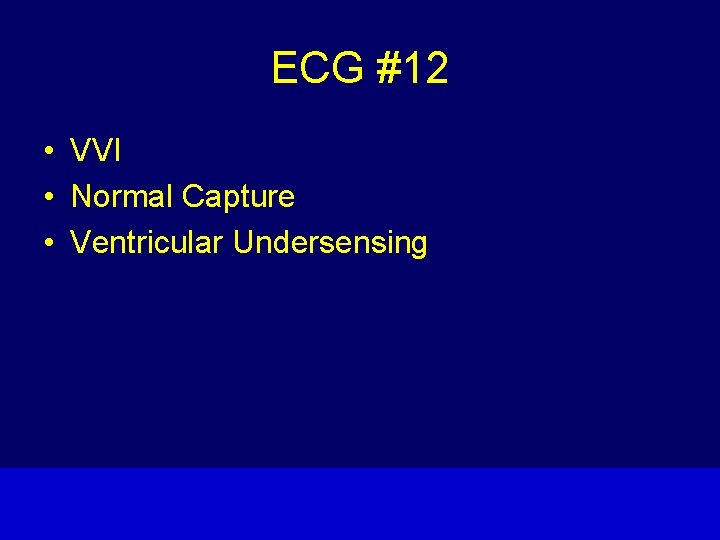
ECG #12 • VVI • Normal Capture • Ventricular Undersensing 12
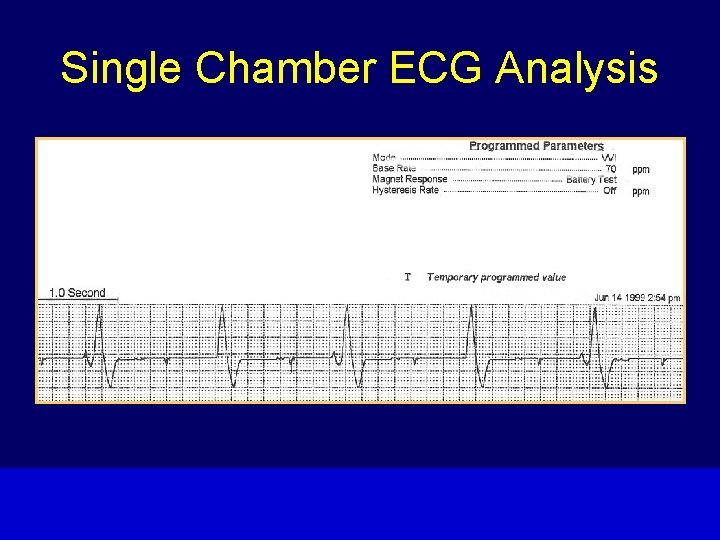
Single Chamber ECG Analysis 13
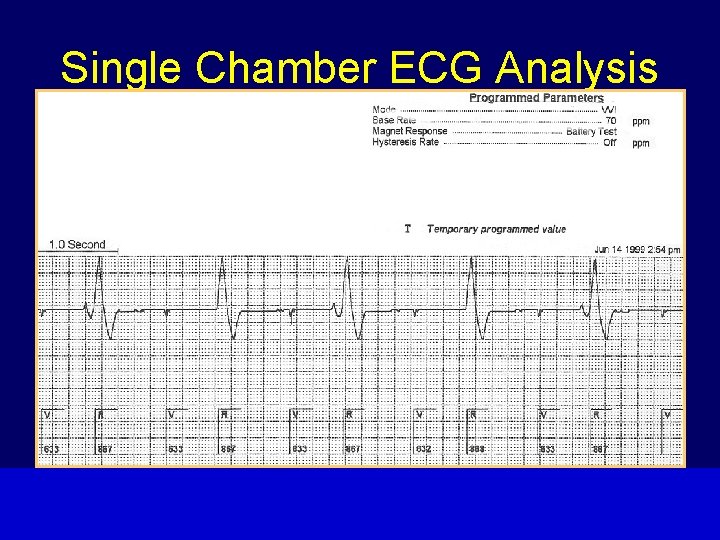
Single Chamber ECG Analysis 13
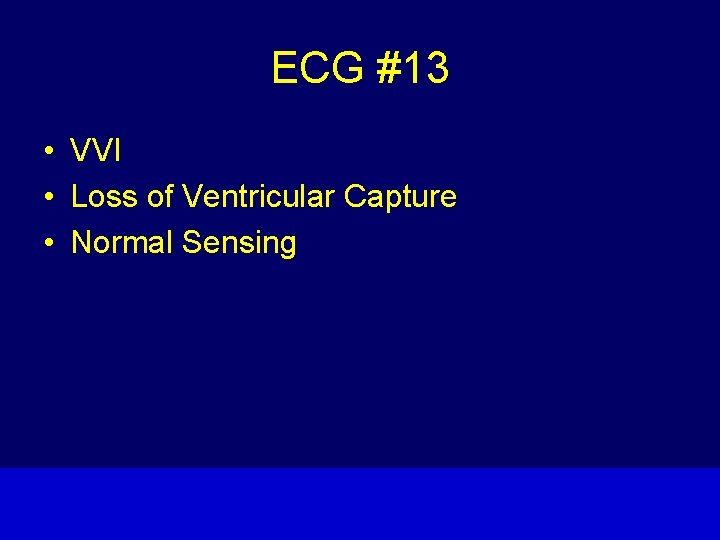
ECG #13 • VVI • Loss of Ventricular Capture • Normal Sensing 13
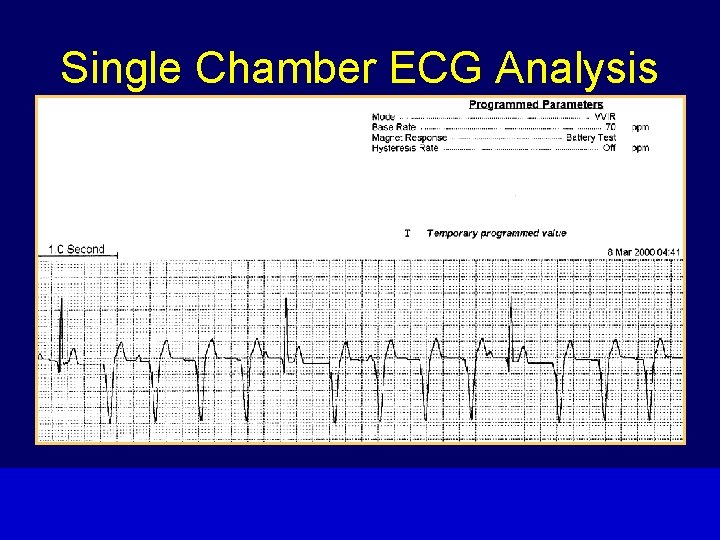
Single Chamber ECG Analysis 15
ECG #15 • VVIR • Normal Capture and Sensing under Sensor drive 15
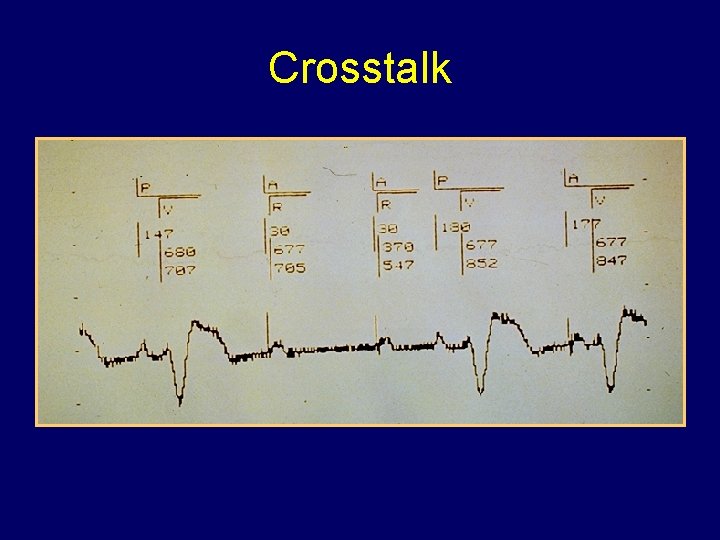
Crosstalk
ECGs in Patients with Pacemakers Overview : • Basic principles of pacing • Background information required • Systematic approach • Examples with single chamber pacing • Examples with dual chamber pacing
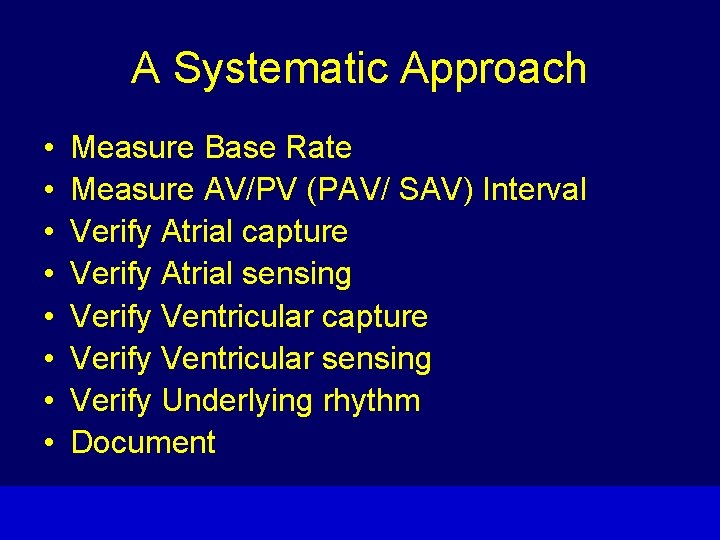
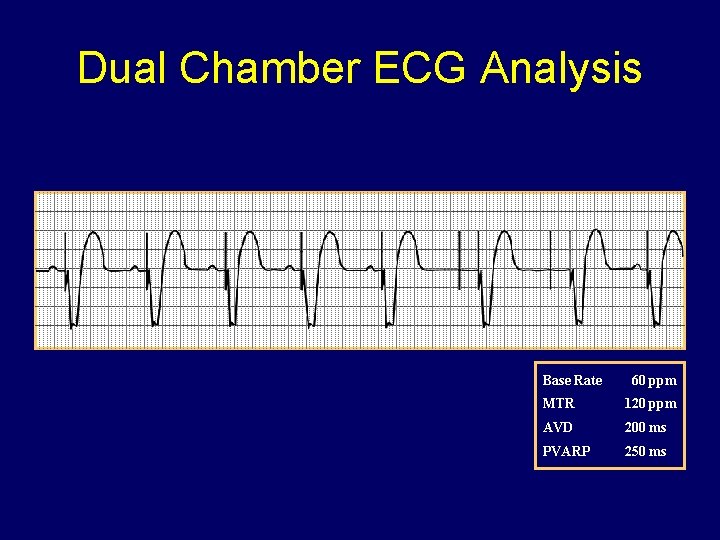
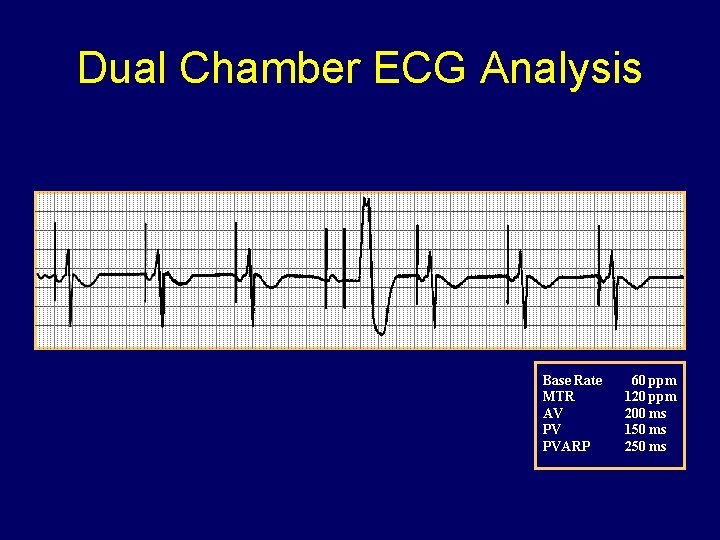
A Systematic Approach • • Measure Base Rate Measure AV/PV (PAV/ SAV) Interval Verify Atrial capture Verify Atrial sensing Verify Ventricular capture Verify Ventricular sensing Verify Underlying rhythm Document
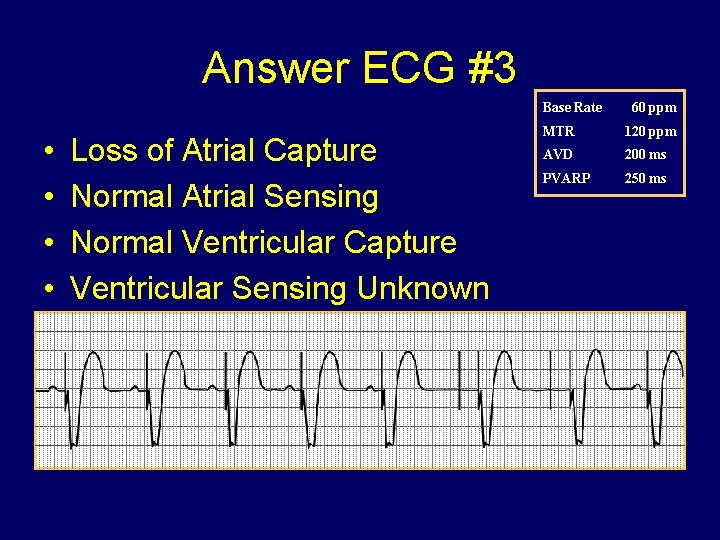
Dual Chamber ECG Analysis Base Rate ECG # 3 60 ppm MTR 120 ppm AVD 200 ms PVARP 250 ms
Answer ECG #3 Base Rate • • Loss of Atrial Capture Normal Atrial Sensing Normal Ventricular Capture Ventricular Sensing Unknown 60 ppm MTR 120 ppm AVD 200 ms PVARP 250 ms
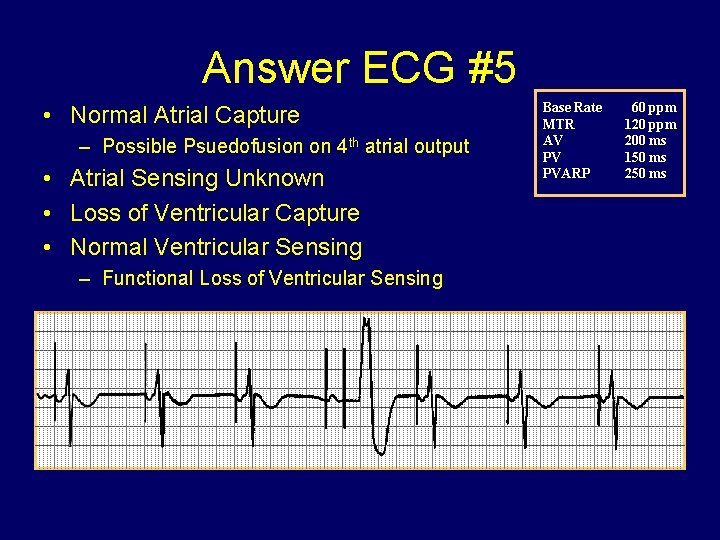
Dual Chamber ECG Analysis Base Rate MTR AV PV PVARP ECG # 5 60 ppm 120 ppm 200 ms 150 ms 250 ms
Answer ECG #5 • Normal Atrial Capture – Possible Psuedofusion on 4 th atrial output • Atrial Sensing Unknown • Loss of Ventricular Capture • Normal Ventricular Sensing – Functional Loss of Ventricular Sensing Base Rate MTR AV PV PVARP 60 ppm 120 ppm 200 ms 150 ms 250 ms
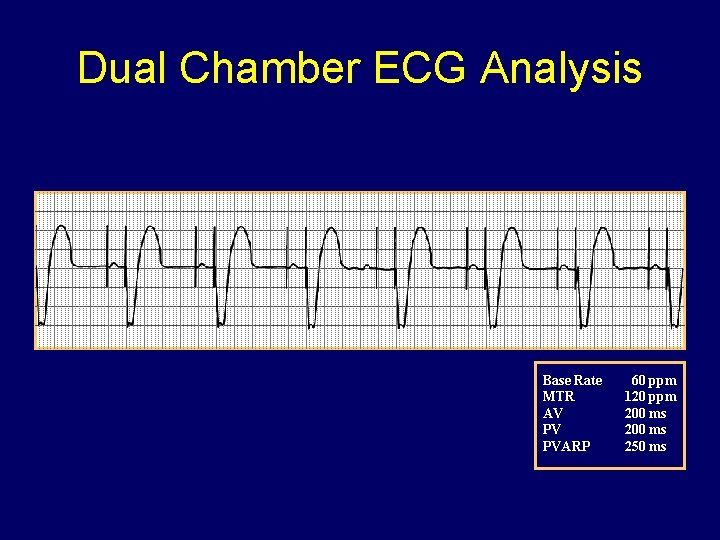
Dual Chamber ECG Analysis Base Rate MTR AV PV PVARP ECG # 10 60 ppm 120 ppm 200 ms 250 ms
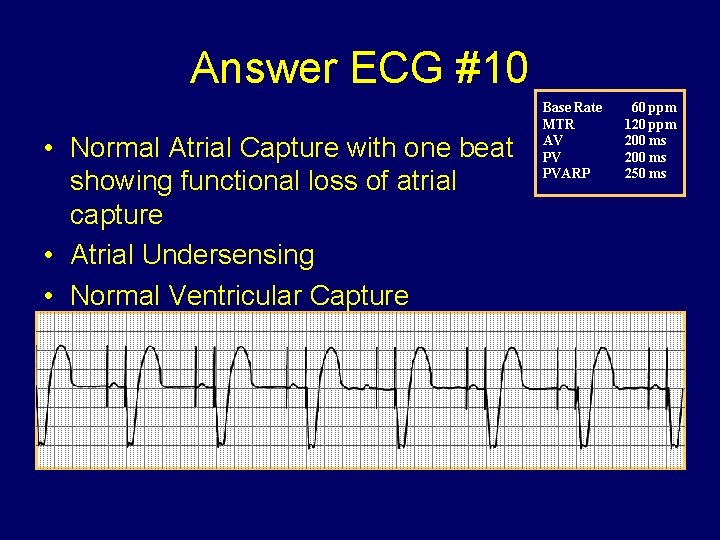
Answer ECG #10 • Normal Atrial Capture with one beat showing functional loss of atrial capture • Atrial Undersensing • Normal Ventricular Capture • Ventricular Sensing Unknown Base Rate MTR AV PV PVARP 60 ppm 120 ppm 200 ms 250 ms
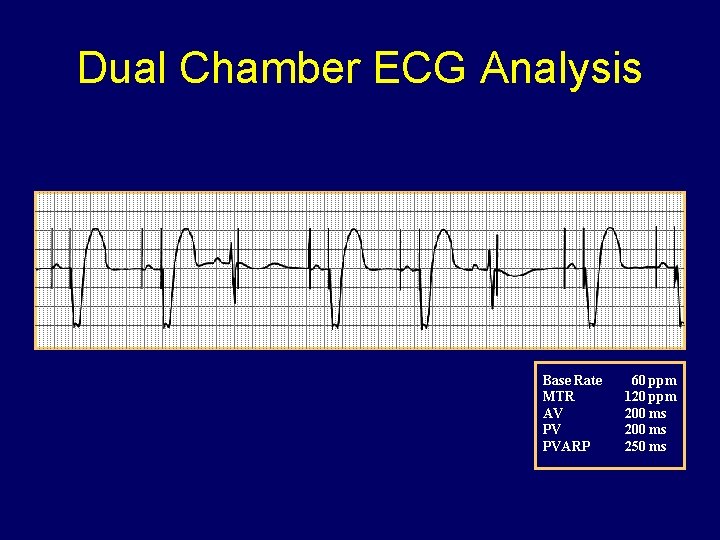
Dual Chamber ECG Analysis Base Rate MTR AV PV PVARP ECG # 12 60 ppm 120 ppm 200 ms 250 ms
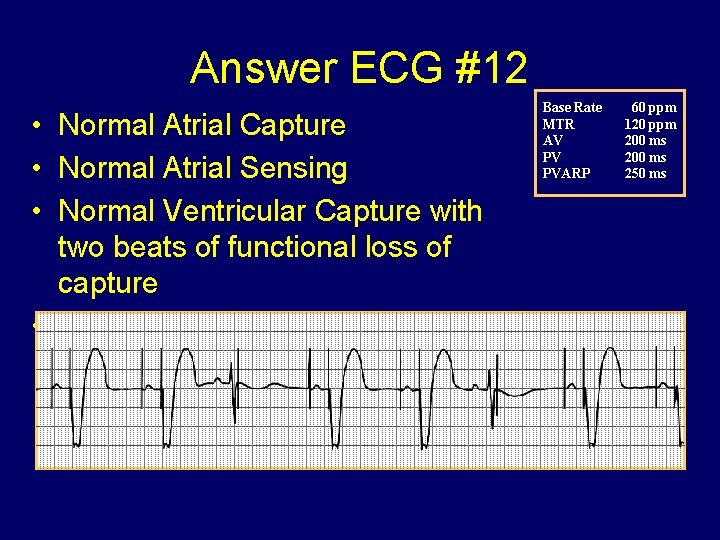
Answer ECG #12 • Normal Atrial Capture • Normal Atrial Sensing • Normal Ventricular Capture with two beats of functional loss of capture • Ventricular Undersensing Base Rate MTR AV PV PVARP 60 ppm 120 ppm 200 ms 250 ms
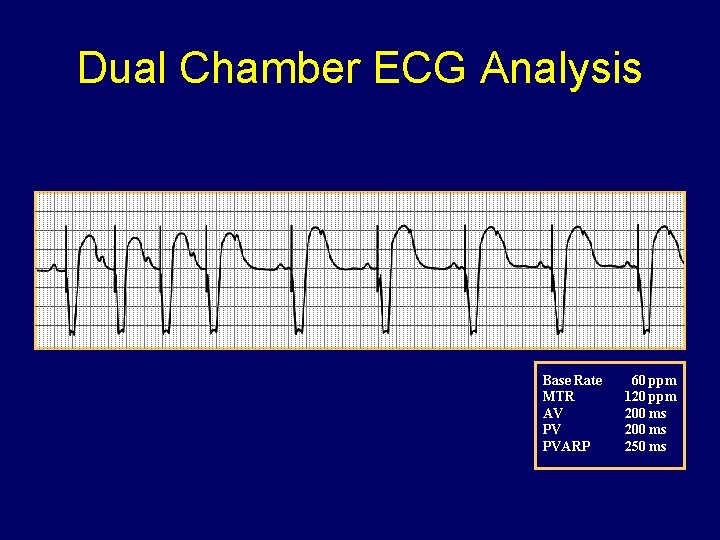
Dual Chamber ECG Analysis Base Rate MTR AV PV PVARP ECG # 20 60 ppm 120 ppm 200 ms 250 ms
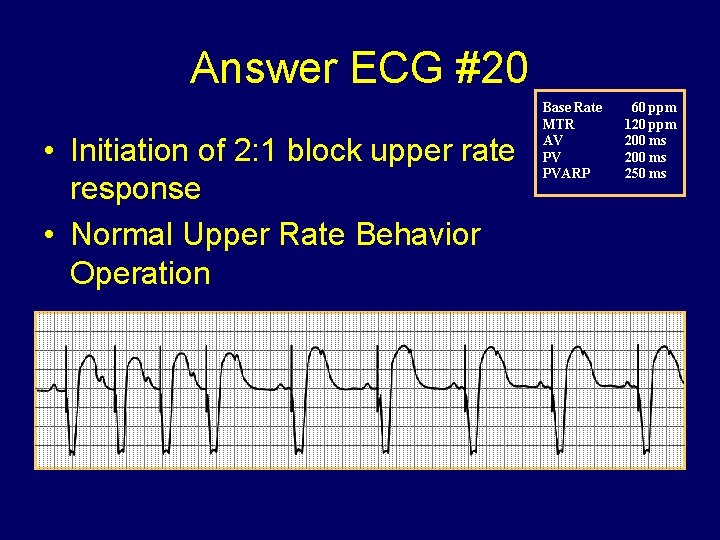
Answer ECG #20 • Initiation of 2: 1 block upper rate response • Normal Upper Rate Behavior Operation Base Rate MTR AV PV PVARP 60 ppm 120 ppm 200 ms 250 ms
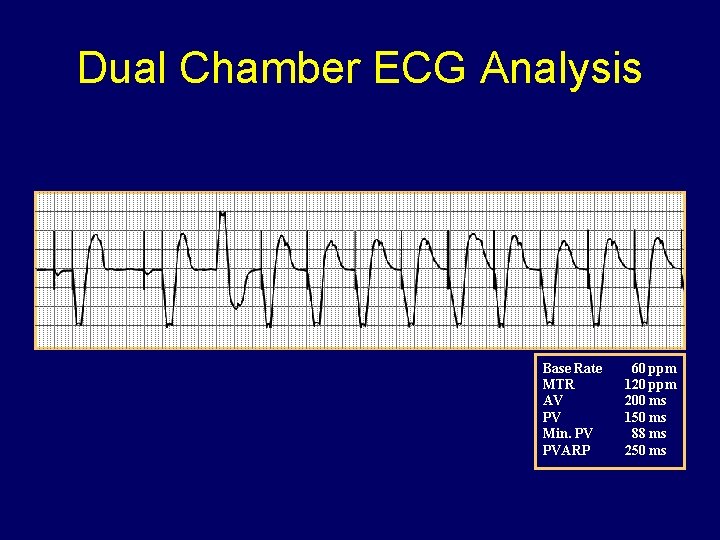
Dual Chamber ECG Analysis Base Rate MTR AV PV Min. PV PVARP ECG # 24 60 ppm 120 ppm 200 ms 150 ms 88 ms 250 ms
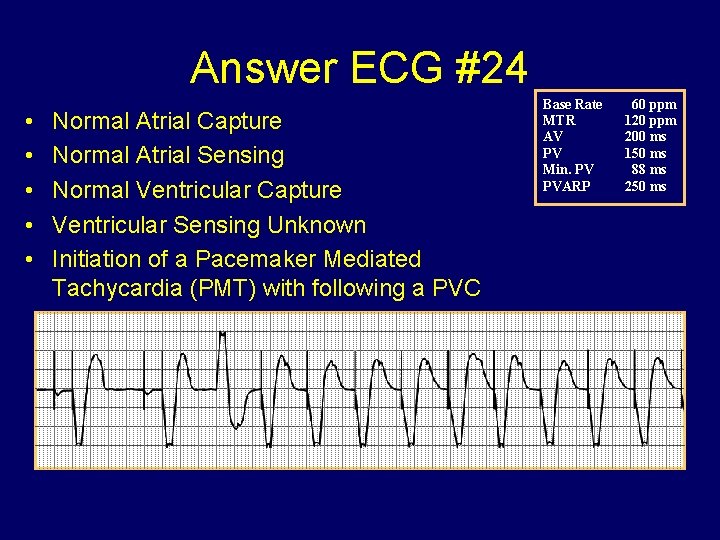
Answer ECG #24 • • • Normal Atrial Capture Normal Atrial Sensing Normal Ventricular Capture Ventricular Sensing Unknown Initiation of a Pacemaker Mediated Tachycardia (PMT) with following a PVC Base Rate MTR AV PV Min. PV PVARP 60 ppm 120 ppm 200 ms 150 ms 88 ms 250 ms
ECGs in Patients with Pacemakers Conclusions : • Familiarity with basics of pacemaker function • Knowledge of clinical background and details of pacing system • Programmed parameters – essential • Familiarity with special features • Systematic approach
Thank you for your kind attention !
ECGs in Patients with Pacemakers
ECGs in Patients with Pacemakers
ECGs in Patients with Pacemakers
ECGs in Patients with Pacemakers
ECGs in Patients with Pacemakers
ECGs in Patients with Pacemakers
ECGs in Patients with Pacemakers
ECGs in Patients with Pacemakers
ECGs in Patients with Pacemakers