
ECG IN 100 STEPS By Dr S Aswini
ECG IN 100 STEPS By Dr. S. Aswini Kumar MD

WHAT IS ECG ? 1. ECG - Electro-cardio- gram 2. ECG - Graphical recording of electrical activity of human heart 3. ECG - Does not always have a direct correlation with mechanical activity of heart
ECG READING 4. ECG reading - not a Bali-kera-mala 5. ECG reading - simple arithmetic 6. ECG reading - requires logical sequence + x . . 1 2 3 4
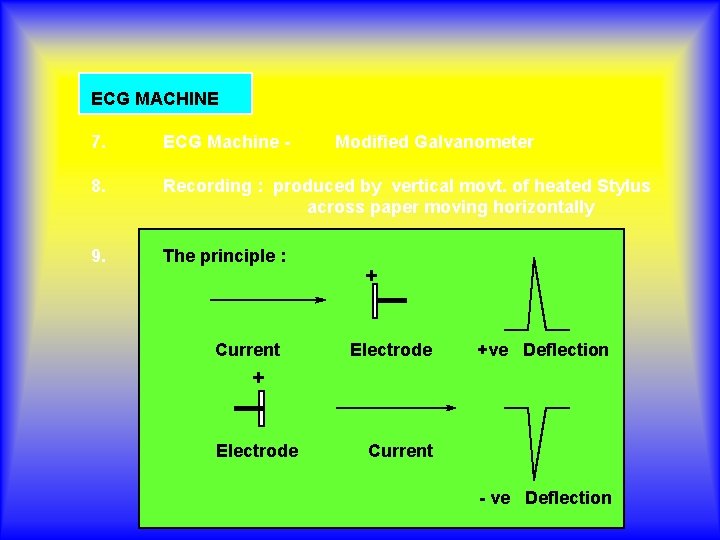
ECG MACHINE 7. ECG Machine - 8. Recording : produced by vertical movt. of heated Stylus across paper moving horizontally 9. The principle : Current Modified Galvanometer + Electrode +ve Deflection + Electrode Current - ve Deflection
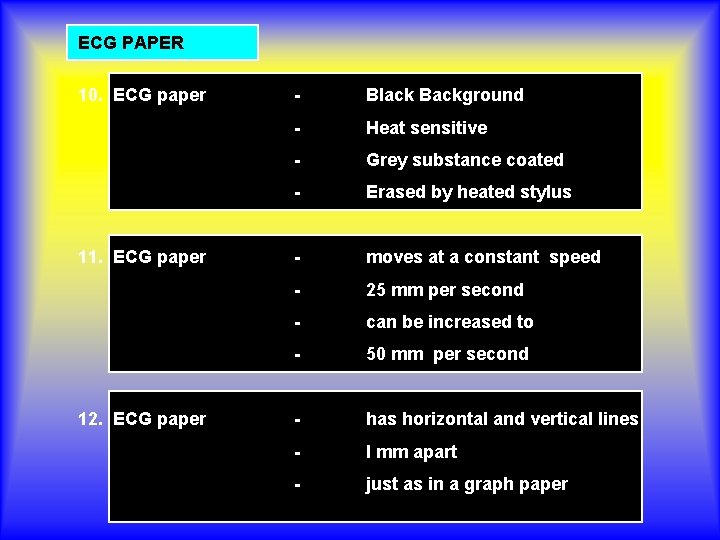
ECG PAPER 10. ECG paper 11. ECG paper 12. ECG paper - Black Background - Heat sensitive - Grey substance coated - Erased by heated stylus - moves at a constant speed - 25 mm per second - can be increased to - 50 mm per second - has horizontal and vertical lines - I mm apart - just as in a graph paper
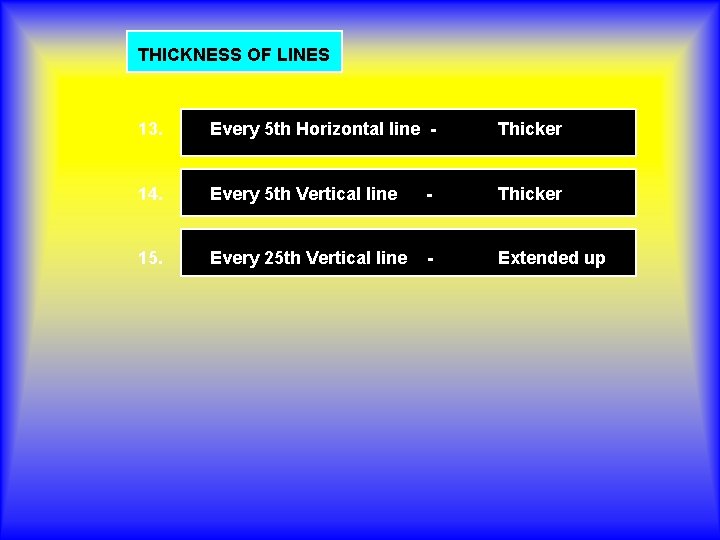
THICKNESS OF LINES 13. Every 5 th Horizontal line - Thicker 14. Every 5 th Vertical line - Thicker 15. Every 25 th Vertical line - Extended up
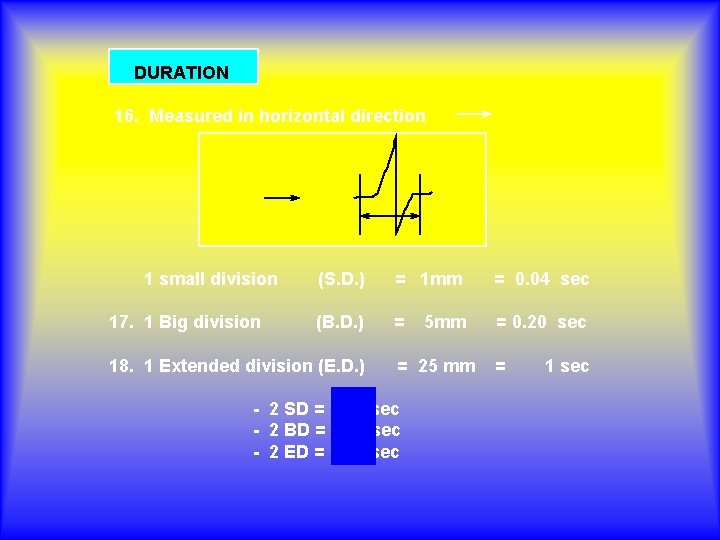
DURATION 16. Measured in horizontal direction 1 small division 17. 1 Big division (S. D. ) = 1 mm = 0. 04 sec (B. D. ) = = 0. 20 sec 18. 1 Extended division (E. D. ) 5 mm = 25 mm - 2 SD = 0. 08 sec - 2 BD = 0. 40 sec - 2 ED = 2. 00 sec = 1 sec
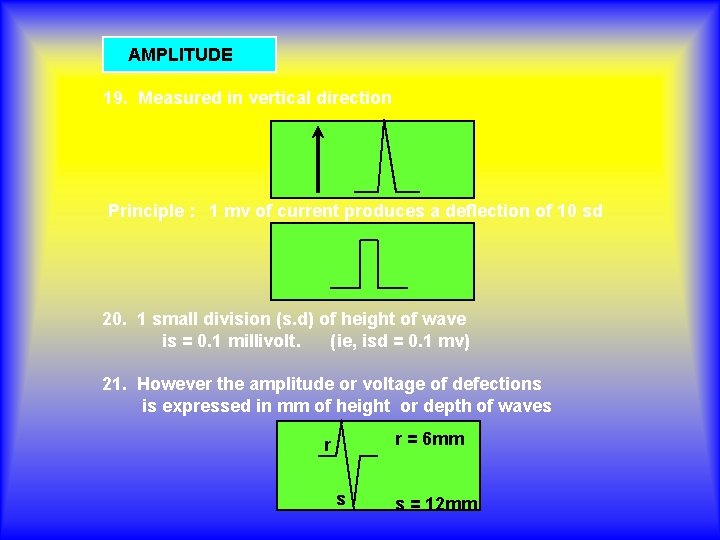
AMPLITUDE 19. Measured in vertical direction Principle : 1 mv of current produces a deflection of 10 sd 20. 1 small division (s. d) of height of wave is = 0. 1 millivolt. (ie, isd = 0. 1 mv) 21. However the amplitude or voltage of defections is expressed in mm of height or depth of waves r = 6 mm r s s = 12 mm
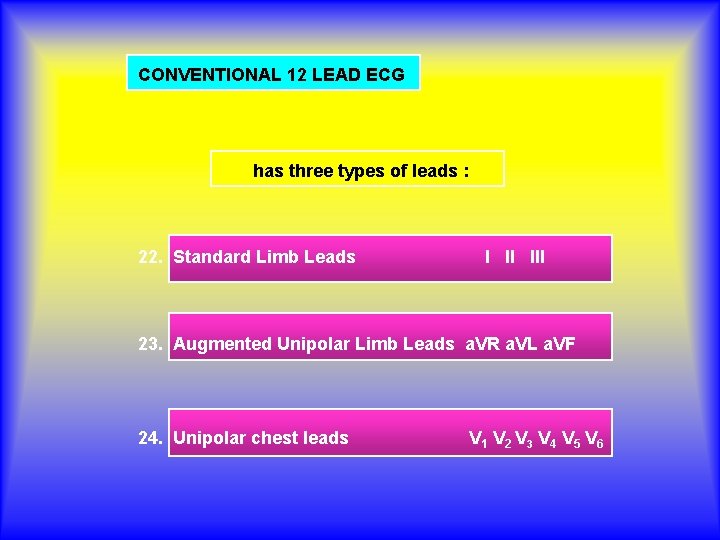
CONVENTIONAL 12 LEAD ECG has three types of leads : 22. Standard Limb Leads I II III 23. Augmented Unipolar Limb Leads a. VR a. VL a. VF 24. Unipolar chest leads V 1 V 2 V 3 V 4 V 5 V 6
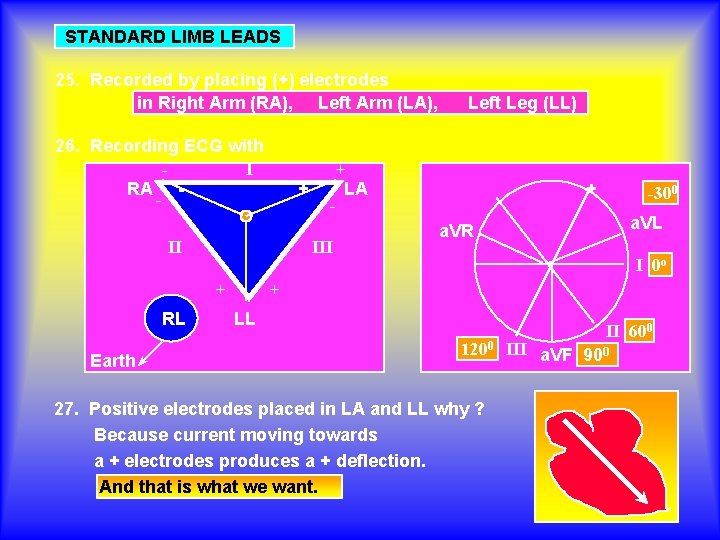
STANDARD LIMB LEADS 25. Recorded by placing (+) electrodes in Right Arm (RA), Left Arm (LA), 26. Recording ECG with I RA - + II III + RL Earth - Left Leg (LL) + LA + -300 a. VL a. VR I 0 o + LL II 600 1200 III a. VF 900 27. Positive electrodes placed in LA and LL why ? Because current moving towards a + electrodes produces a + deflection. And that is what we want.
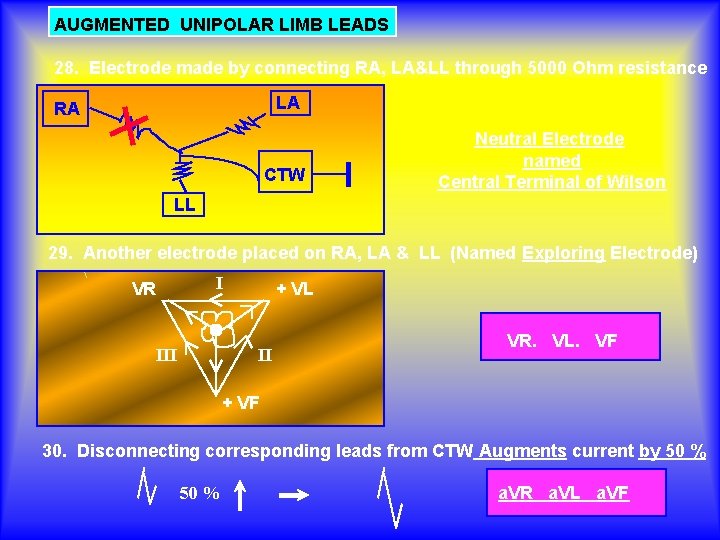
AUGMENTED UNIPOLAR LIMB LEADS 28. Electrode made by connecting RA, LA&LL through 5000 Ohm resistance LA RA CTW Neutral Electrode named Central Terminal of Wilson LL 29. Another electrode placed on RA, LA & LL (Named Exploring Electrode) VR I III + VL II VR. VL. VF + VF 30. Disconnecting corresponding leads from CTW Augments current by 50 % a. VR a. VL a. VF
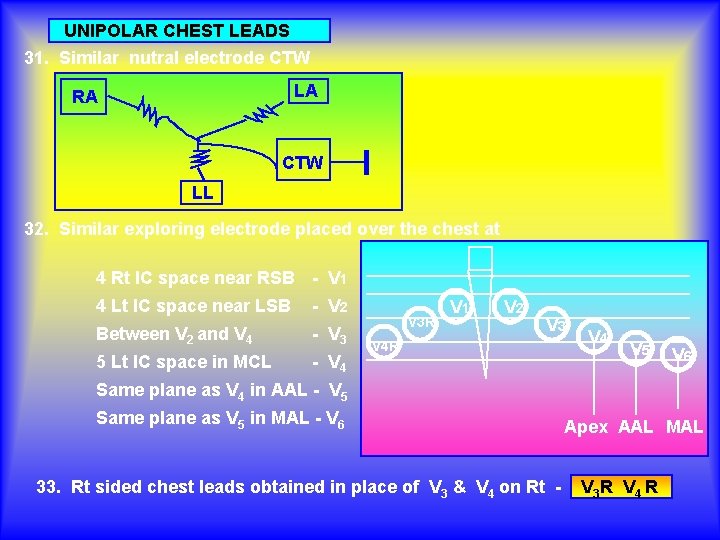
UNIPOLAR CHEST LEADS 31. Similar nutral electrode CTW LA RA CTW LL 32. Similar exploring electrode placed over the chest at 4 Rt IC space near RSB - V 1 4 Lt IC space near LSB - V 2 Between V 2 and V 4 - V 3 5 Lt IC space in MCL - V 4 V 3 R V 1 V 2 V 3 V 4 R V 4 V 5 V 6 Same plane as V 4 in AAL - V 5 Same plane as V 5 in MAL - V 6 33. Rt sided chest leads obtained in place of V 3 & V 4 on Rt - Apex AAL MAL V 3 R V 4 R
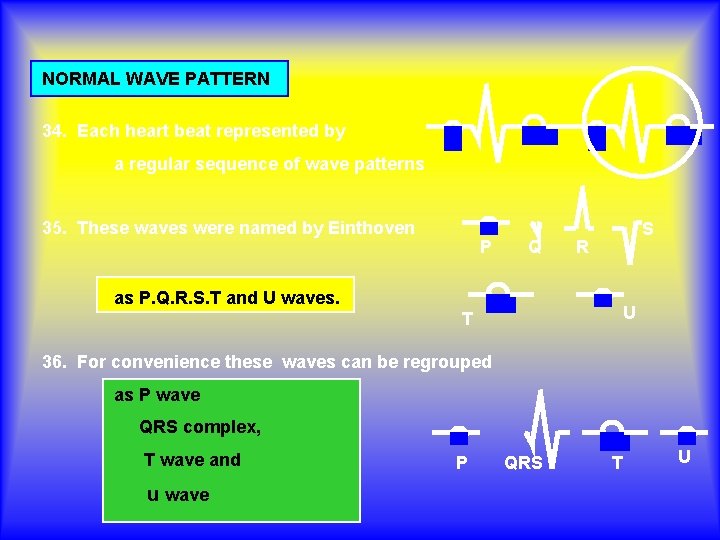
NORMAL WAVE PATTERN 34. Each heart beat represented by a regular sequence of wave patterns 35. These waves were named by Einthoven P Q S R as P. Q. R. S. T and U waves. U T 36. For convenience these waves can be regrouped as P wave QRS complex, T wave and u wave P QRS T U
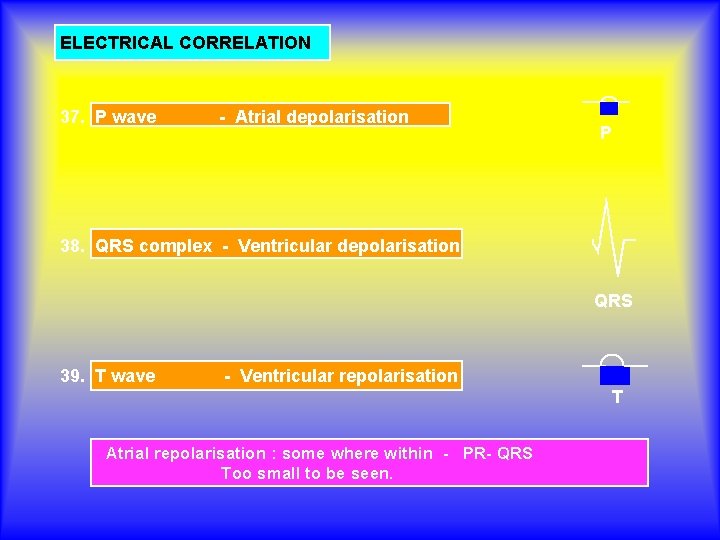
ELECTRICAL CORRELATION 37. P wave - Atrial depolarisation P 38. QRS complex - Ventricular depolarisation QRS 39. T wave - Ventricular repolarisation T Atrial repolarisation : some where within - PR- QRS Too small to be seen.
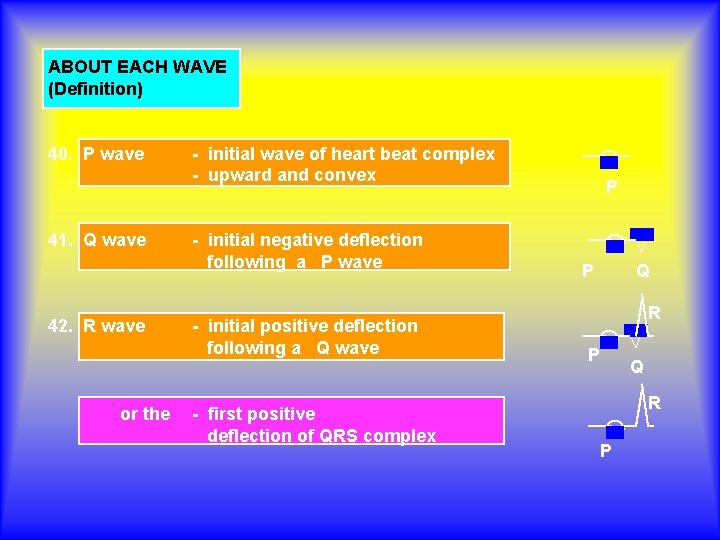
ABOUT EACH WAVE (Definition) 40. P wave 41. Q wave 42. R wave or the - initial wave of heart beat complex - upward and convex - initial negative deflection following a P wave - initial positive deflection following a Q wave - first positive deflection of QRS complex P P Q R P

ABOUT EACH WAVE (Definition) (Contd. ) R 43. S wave - negative deflection following R wave S OR OR - second negative deflection QRS 44. T wave - upward convex wave following QRS QS R T 45. U wave - Small upward convex wave following T wave Not always seen. T U
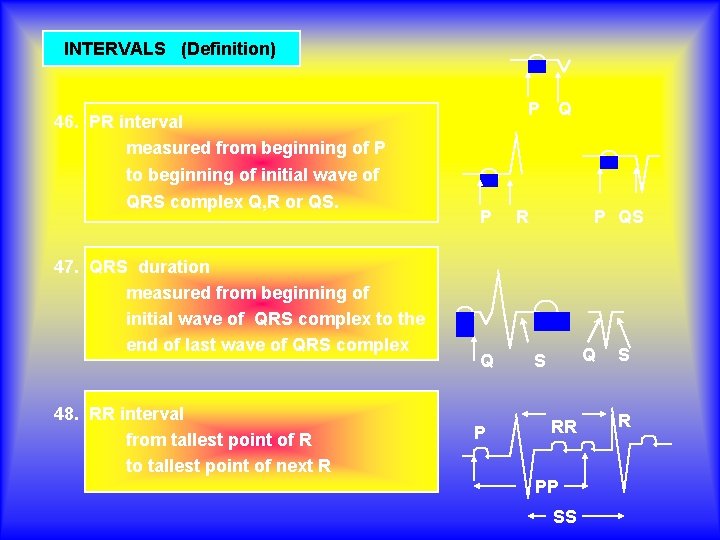
INTERVALS (Definition) P 46. PR interval measured from beginning of P to beginning of initial wave of QRS complex Q, R or QS. 47. QRS duration measured from beginning of initial wave of QRS complex to the end of last wave of QRS complex 48. RR interval from tallest point of R to tallest point of next R P QS Q S RR PP SS S R
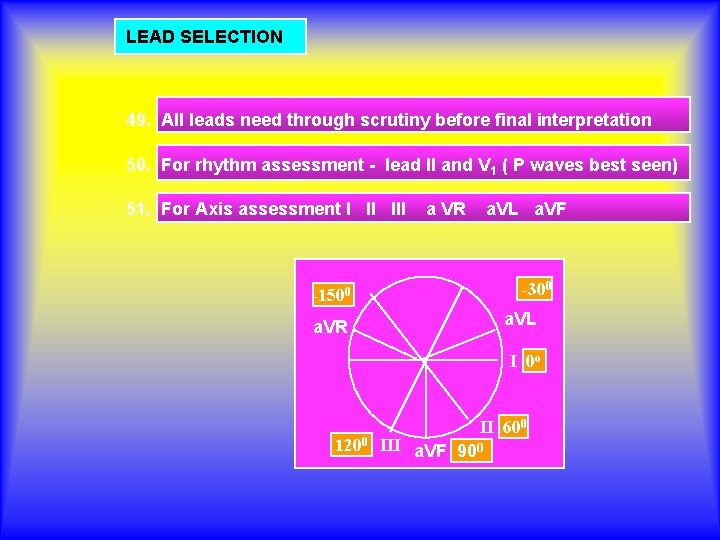
LEAD SELECTION 49. All leads need through scrutiny before final interpretation 50. For rhythm assessment - lead II and V 1 ( P waves best seen) 51. For Axis assessment I II III a VR a. VL a. VF -300 -1500 a. VL a. VR I 0 o II 600 1200 III a. VF 900

NOW START READING ECG IN 12 MAJOR STEPS I. STANDARDISATION 52. Standardisation : standard lead - } standard against which other leads are read 53. Normal Standardisation 1 mv current - produces deflection of 10 sd. . Std: 1 mv = 10 sd. 54. Half standard ECG Reduce deflections to 1/2. . . Std: 1 mv = 5 sd. . To calculate voltage X 2 Always look for the label 1/2 V 1 1/2 V 2 etc.
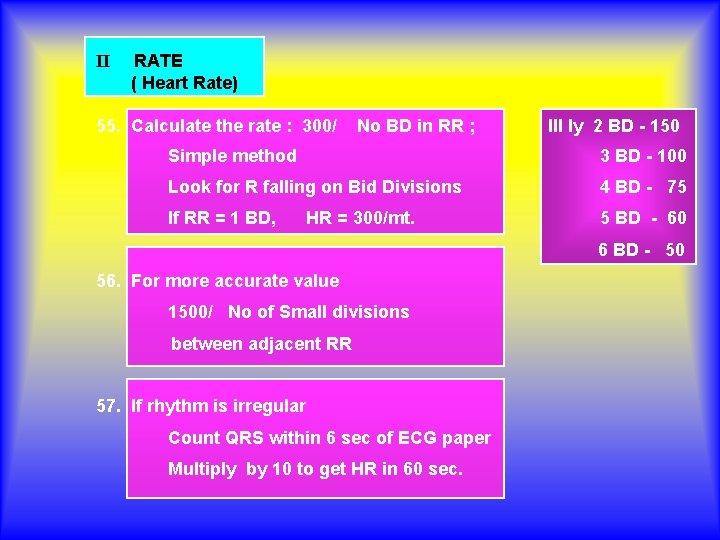
II RATE ( Heart Rate) 55. Calculate the rate : 300/ No BD in RR ; III ly 2 BD - 150 Simple method 3 BD - 100 Look for R falling on Bid Divisions 4 BD - 75 If RR = 1 BD, 5 BD - 60 HR = 300/mt. 6 BD - 50 56. For more accurate value 1500/ No of Small divisions between adjacent RR 57. If rhythm is irregular Count QRS within 6 sec of ECG paper Multiply by 10 to get HR in 60 sec.
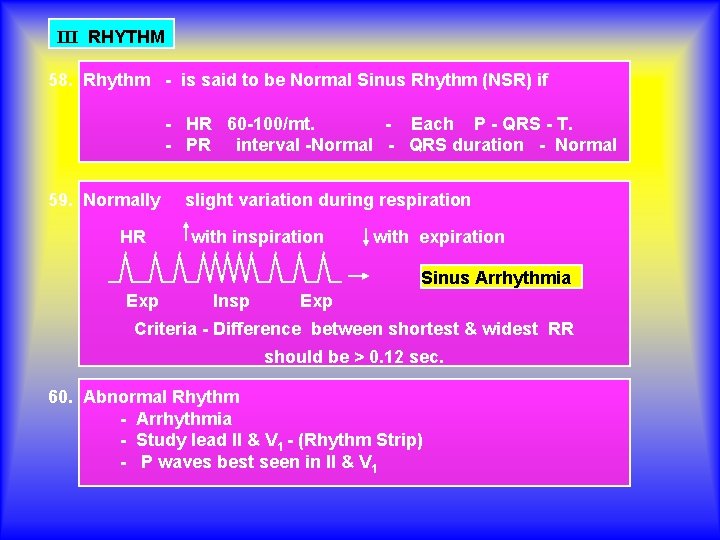
III RHYTHM 58. Rhythm - is said to be Normal Sinus Rhythm (NSR) if - HR 60 -100/mt. - Each P - QRS - T. - PR interval -Normal - QRS duration - Normal 59. Normally HR slight variation during respiration with inspiration with expiration Sinus Arrhythmia Exp Insp Exp Criteria - Difference between shortest & widest RR should be > 0. 12 sec. 60. Abnormal Rhythm - Arrhythmia - Study lead II & V 1 - (Rhythm Strip) - P waves best seen in II & V 1
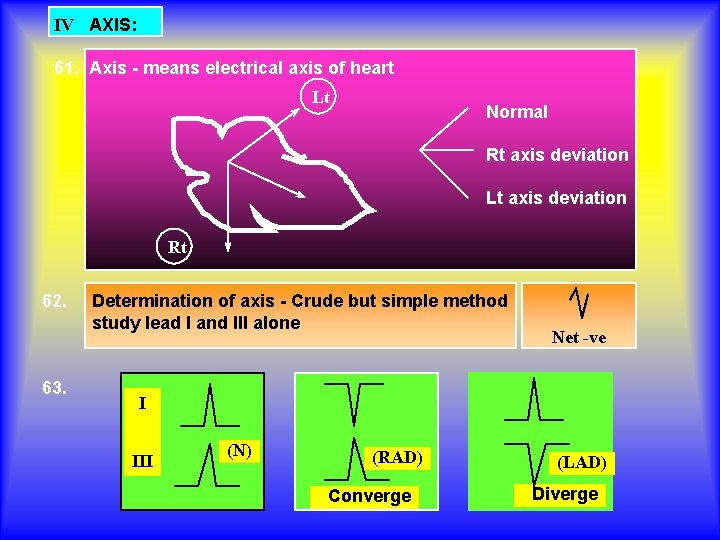
IV AXIS: 61. Axis - means electrical axis of heart Lt Normal Rt axis deviation Lt axis deviation Rt 62. 63. Determination of axis - Crude but simple method study lead I and III alone Net -ve I III (N) (RAD) Converge (LAD) Diverge
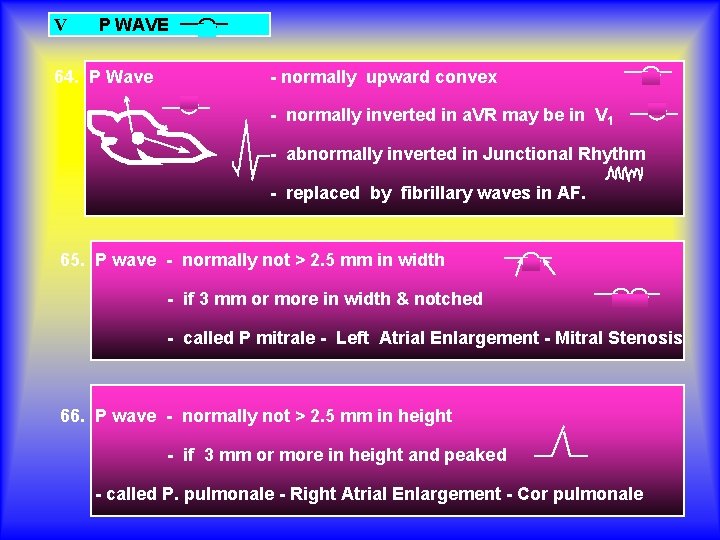
V P WAVE 64. P Wave - normally upward convex - normally inverted in a. VR may be in V 1 - abnormally inverted in Junctional Rhythm - replaced by fibrillary waves in AF. 65. P wave - normally not > 2. 5 mm in width - if 3 mm or more in width & notched - called P mitrale - Left Atrial Enlargement - Mitral Stenosis 66. P wave - normally not > 2. 5 mm in height - if 3 mm or more in height and peaked - called P. pulmonale - Right Atrial Enlargement - Cor pulmonale

VI PR INTERVAL (PQ) 67. PR Interval - Measure from Beginning of P wave to P Beginning of QRS complex Q Normal Range 0. 12 - 0. 20 sec ie 3 -5 sd. 68. PR Interval - Prolonged - More than 0. 20 sec. - I 0 Heart Block as in - Rheumatic Carditis. P Q 69. PR Interval - Shorter - less than 0. 12 seconds - Wolff Parkinson White Syndrome - Junctional Rhythm P Q
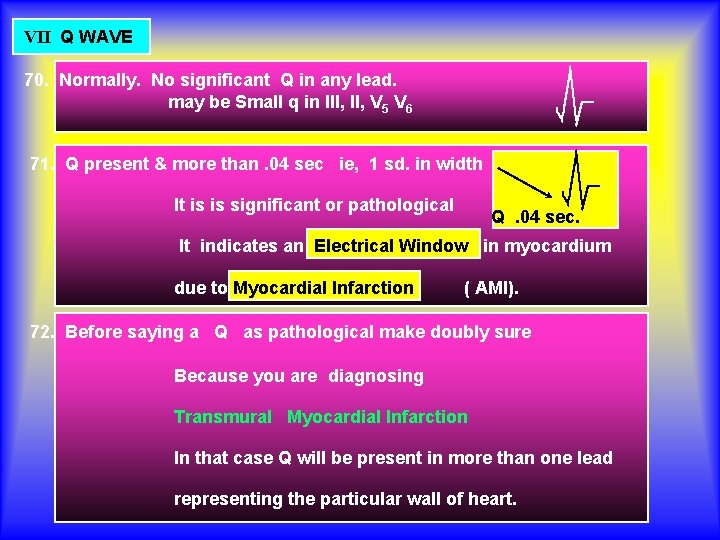
VII Q WAVE 70. Normally. No significant Q in any lead. may be Small q in III, V 5 V 6 71. Q present & more than. 04 sec ie, 1 sd. in width It is is significant or pathological Q. 04 sec. It indicates an Electrical Window in myocardium due to Myocardial Infarction ( AMI). 72. Before saying a Q as pathological make doubly sure Because you are diagnosing Transmural Myocardial Infarction In that case Q will be present in more than one lead representing the particular wall of heart.
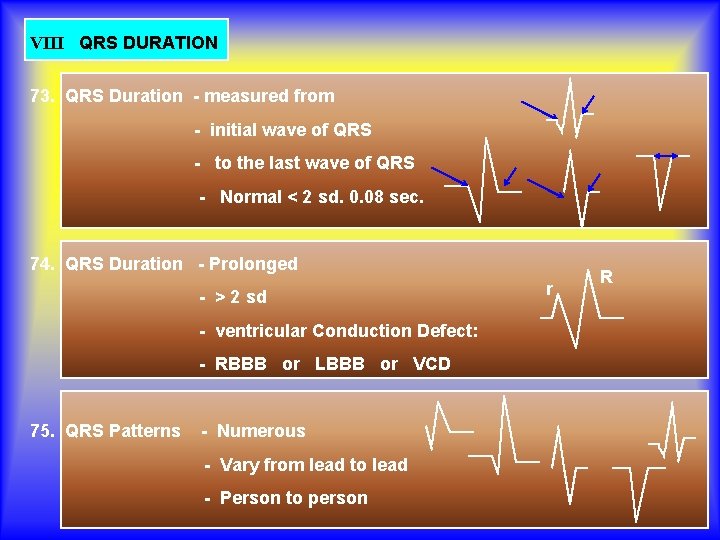
VIII QRS DURATION 73. QRS Duration - measured from - initial wave of QRS - to the last wave of QRS - Normal < 2 sd. 0. 08 sec. 74. QRS Duration - Prolonged - > 2 sd - ventricular Conduction Defect: - RBBB or LBBB or VCD 75. QRS Patterns - Numerous - Vary from lead to lead - Person to person r R
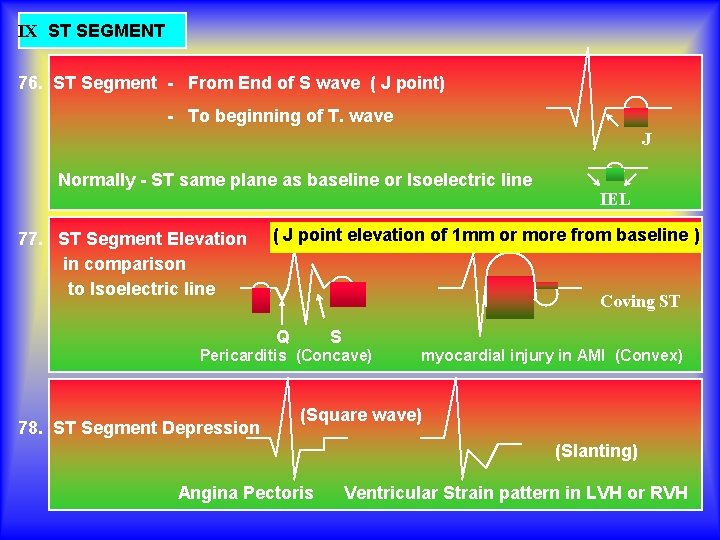
IX ST SEGMENT 76. ST Segment - From End of S wave ( J point) - To beginning of T. wave J Normally - ST same plane as baseline or Isoelectric line 77. ST Segment Elevation in comparison to Isoelectric line ( J point elevation of 1 mm or more from baseline ) Coving ST Q S Pericarditis (Concave) 78. ST Segment Depression IEL myocardial injury in AMI (Convex) (Square wave) (Slanting) Angina Pectoris Ventricular Strain pattern in LVH or RVH
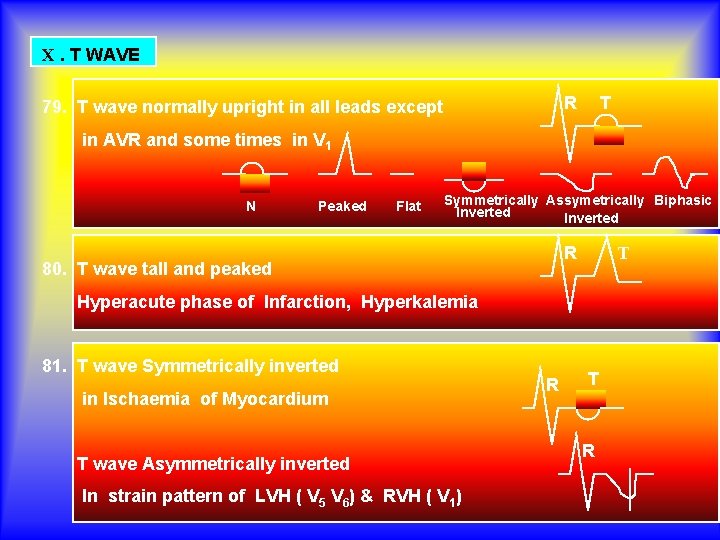
X. T WAVE R 79. T wave normally upright in all leads except T in AVR and some times in V 1 N Peaked Flat Symmetrically Assymetrically Biphasic Inverted R 80. T wave tall and peaked T Hyperacute phase of Infarction, Hyperkalemia 81. T wave Symmetrically inverted in Ischaemia of Myocardium T wave Asymmetrically inverted In strain pattern of LVH ( V 5 V 6) & RVH ( V 1) R T R

XI R/S IN V 1 82. Amplitude of R in V 1 ie R/S ratio in V 1 Amplitude of S in V 1 Normally R in V 1 is smaller than S in V 1 Therefore R/s Ratio in V 1 is 83. If R/S ratio in V 1 is > 1 <1 r 6 s 13 ie R is > S in V 1 Voltage Criteria for Right ventricular Hypertrophy ( RVH) Other Criteria for RVH: QR pattern in V 1, ST dep. & T inv in V 1, Persistent Deep S in V 5 or V 6 84. Other conditions where R> S in V 1 True Posterior Wall Infarction Right Bundle Branch Block. r R’ s
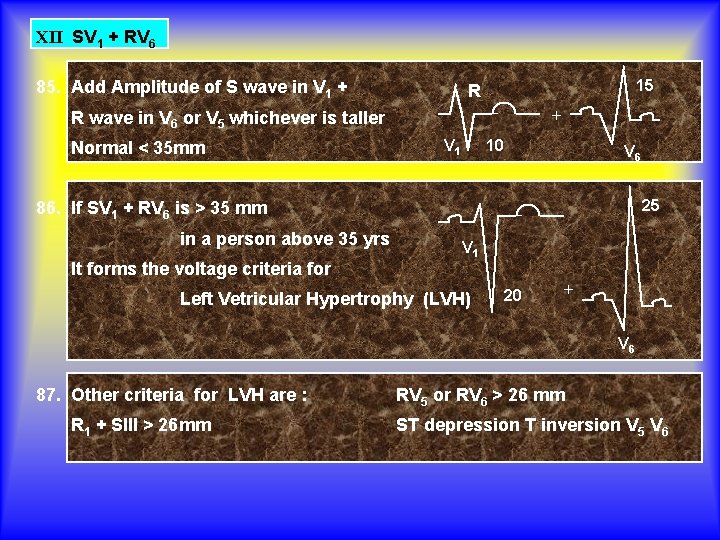
XII SV 1 + RV 6 85. Add Amplitude of S wave in V 1 + 15 R + R wave in V 6 or V 5 whichever is taller Normal < 35 mm V 1 10 V 6 25 86. If SV 1 + RV 6 is > 35 mm in a person above 35 yrs It forms the voltage criteria for V 1 Left Vetricular Hypertrophy (LVH) 20 + V 6 87. Other criteria for LVH are : R 1 + SIII > 26 mm RV 5 or RV 6 > 26 mm ST depression T inversion V 5 V 6
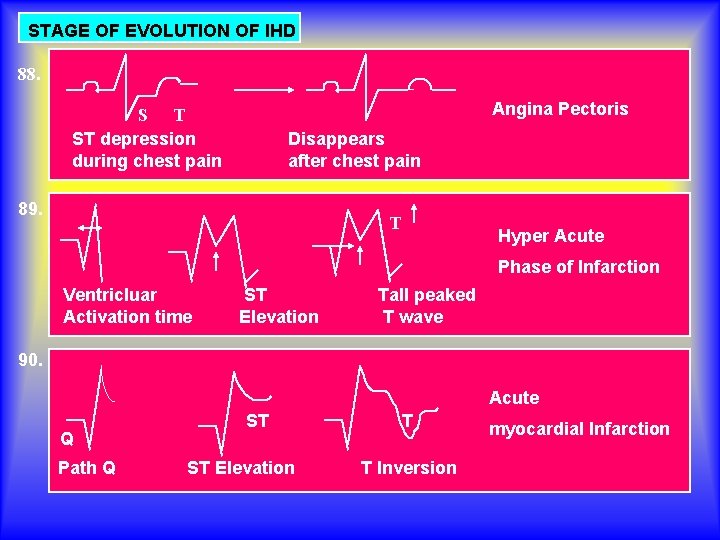
STAGE OF EVOLUTION OF IHD 88. Angina Pectoris S T ST depression during chest pain Disappears after chest pain 89. T Hyper Acute Phase of Infarction Ventricluar Activation time ST Elevation Tall peaked T wave 90. Acute Q Path Q ST ST Elevation T T Inversion myocardial Infarction
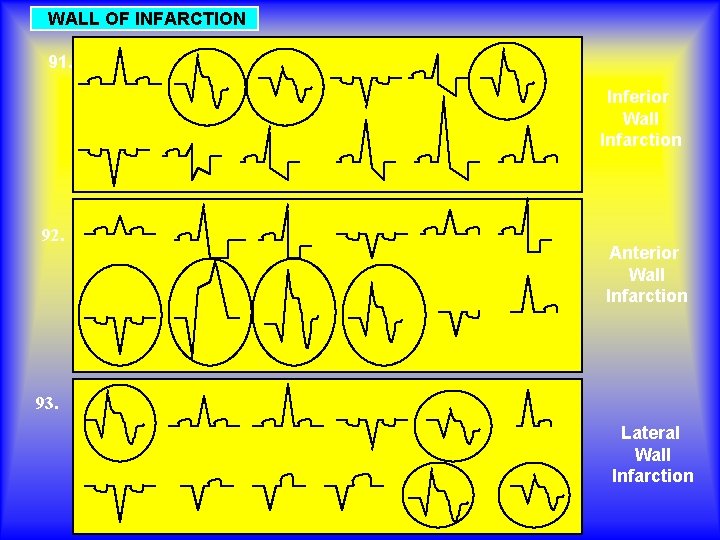
WALL OF INFARCTION 91. Inferior Wall Infarction 92. Anterior Wall Infarction 93. Lateral Wall Infarction
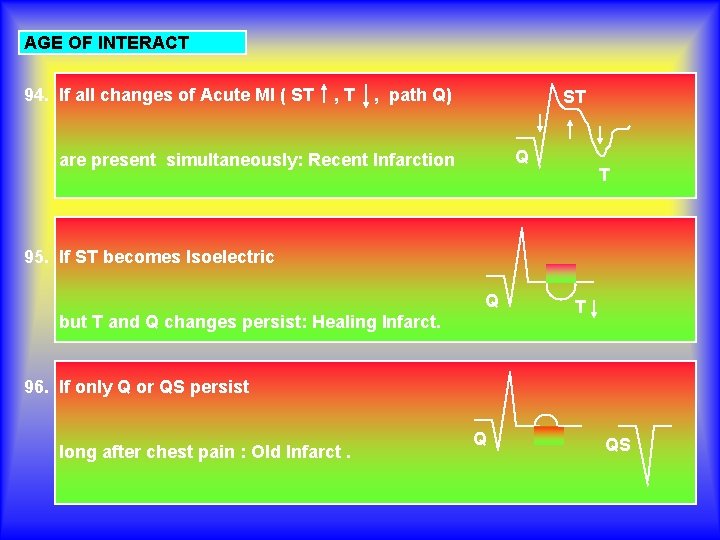
AGE OF INTERACT 94. If all changes of Acute MI ( ST , path Q) ST Q are present simultaneously: Recent Infarction T 95. If ST becomes Isoelectric Q but T and Q changes persist: Healing Infarct. T 96. If only Q or QS persist long after chest pain : Old Infarct. Q QS
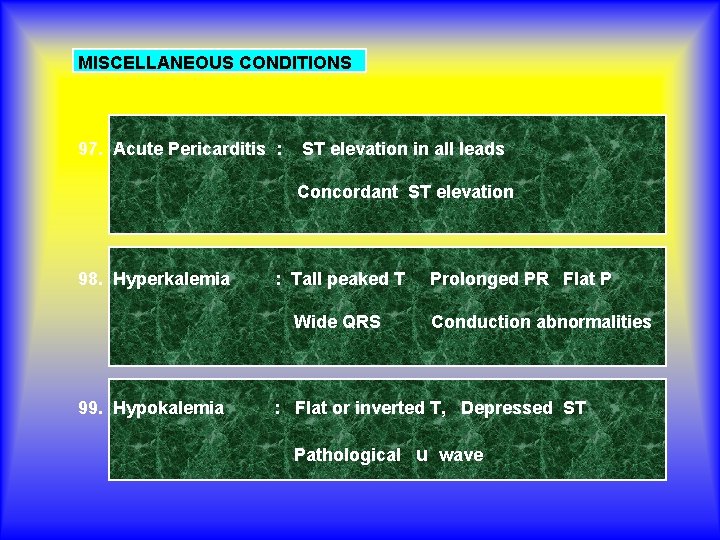
MISCELLANEOUS CONDITIONS 97. Acute Pericarditis : ST elevation in all leads Concordant ST elevation 98. Hyperkalemia : Tall peaked T Wide QRS 99. Hypokalemia Prolonged PR Flat P Conduction abnormalities : Flat or inverted T, Depressed ST Pathological u wave
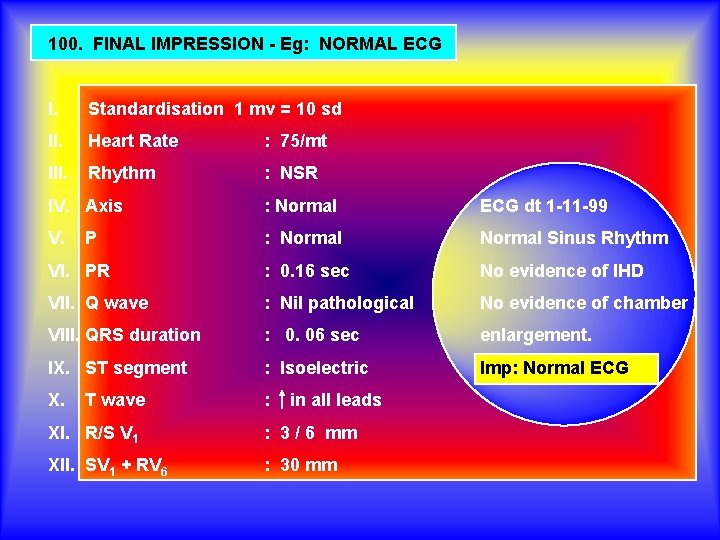
100. FINAL IMPRESSION - Eg: NORMAL ECG I. Standardisation 1 mv = 10 sd II. Heart Rate : 75/mt III. Rhythm : NSR IV. Axis : Normal ECG dt 1 -11 -99 V. : Normal Sinus Rhythm VI. PR : 0. 16 sec No evidence of IHD VII. Q wave : Nil pathological No evidence of chamber VIII. QRS duration : 0. 06 sec enlargement. IX. ST segment : Isoelectric Imp: Normal ECG X. : P T wave in all leads XI. R/S V 1 : 3 / 6 mm XII. SV 1 + RV 6 : 30 mm
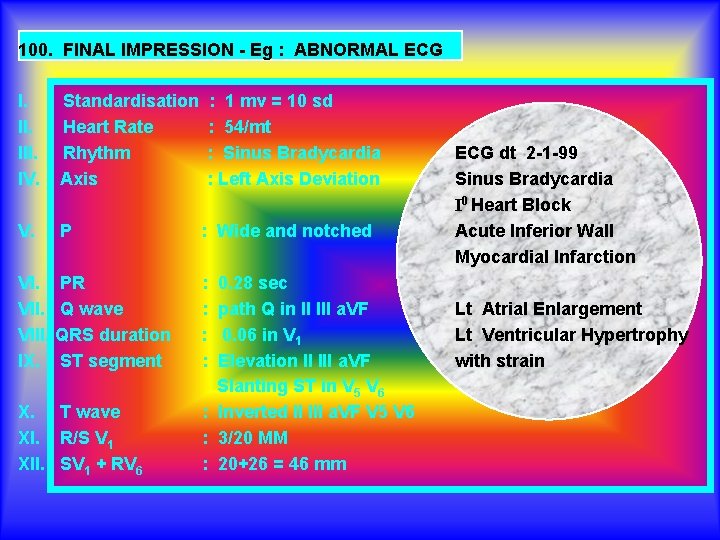
100. FINAL IMPRESSION - Eg : ABNORMAL ECG I. III. IV. Standardisation Heart Rate Rhythm Axis : 1 mv = 10 sd : 54/mt : Sinus Bradycardia : Left Axis Deviation V. P : Wide and notched VI. PR VII. Q wave VIII. QRS duration IX. ST segment X. T wave XI. R/S V 1 XII. SV 1 + RV 6 : : 0. 28 sec path Q in II III a. VF 0. 06 in V 1 Elevation II III a. VF Slanting ST in V 5 V 6 : Inverted II III a. VF V 5 V 6 : 3/20 MM : 20+26 = 46 mm ECG dt 2 -1 -99 Sinus Bradycardia I 0 Heart Block Acute Inferior Wall Myocardial Infarction Lt Atrial Enlargement Lt Ventricular Hypertrophy with strain
- Slides: 36