
ECG Fundamentals of Electrocardiography The conduction system is

- Slides: 47
ECG
Fundamentals of Electrocardiography The conduction system is the mechanism by which the heart contracts. Contraction is controlled by specialized cells within the heart that generate and distribute electrical impulses
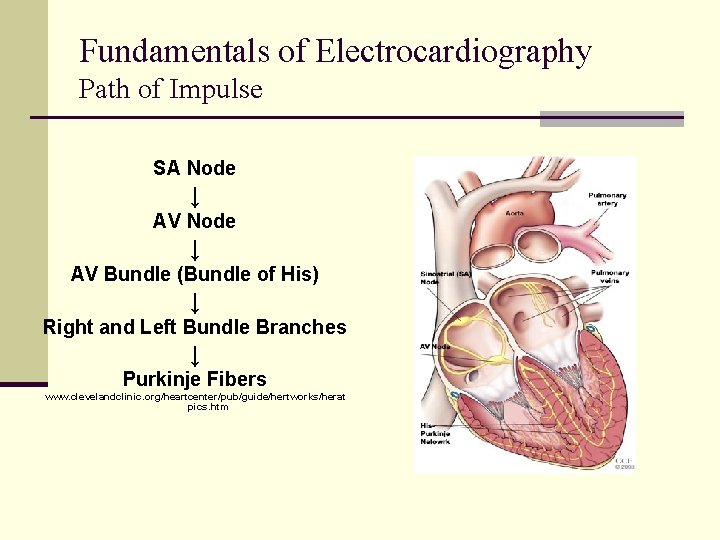
Fundamentals of Electrocardiography Path of Impulse SA Node ↓ AV Bundle (Bundle of His) ↓ Right and Left Bundle Branches ↓ Purkinje Fibers www. clevelandclinic. org/heartcenter/pub/guide/hertworks/herat pics. htm
Fundamentals of Electrocardiography Path of Impulse The pulse begins in the sinoatrial (SA) node. The cells within the SA node spontaneously depolarize to trigger contraction. The contraction begins in the upper atria and spreads toward the atrioventricular (AV) valves. This helps move blood from the atria to the ventricles.
Fundamentals of Electrocardiography Path of Impulse The pulse travels to the AV node which is located within the interatrial septum. It than proceeds to the AV bundle (Bundle of His). The bundle of His then divides into the left and right bundle branches. Each branch travels down the septum. At the apex, the branches called purkinje fibers transverse the ventricles back toward the base of the heart.
Fundamentals of Electrocardiography n Depolarization causes contraction of heart n Repolarization causes relaxation of heart n Contraction state of heart is systole n Relaxation state of heart is diastole
Fundamentals of Electrocardiography Purpose of ECG n Identify cardiac rate n Identify any abnormalities in rhythm n Identify presence of abnormal transmission impulses through conduction system of heart
Fundamentals of Electrocardiography Indications for ECG n Chest pain n Rhythm disturbances n Routine physical n Pre-Op evaluation
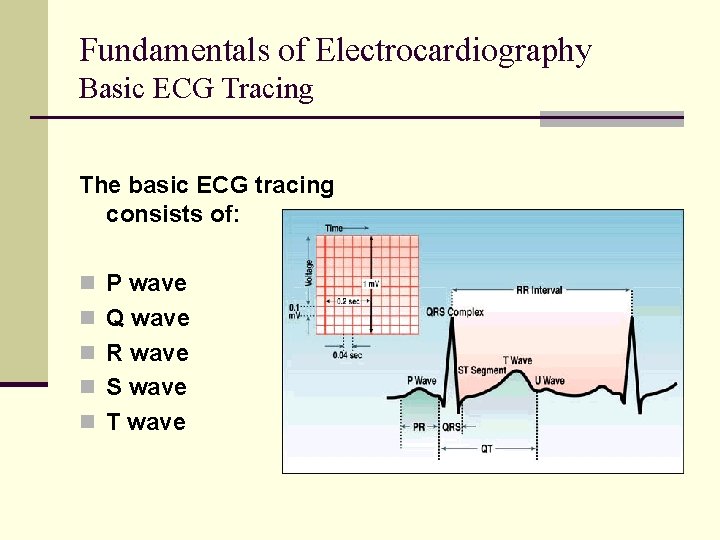
Fundamentals of Electrocardiography Basic ECG Tracing The basic ECG tracing consists of: n P wave n Q wave n R wave n S wave n T wave
Fundamentals of Electrocardiography Basic ECG Tracing P wave: (normal <. 2 sec or 5 boxes) n First deflection from baseline n Is a positive deflection (upward) n Corresponds to atrial depolarization Q wave: n Small negative (downward) deflection preceding the R wave
Fundamentals of Electrocardiography Basic ECG Tracing R wave: n Large positive deflection preceding the S wave: n Small negative deflection
Fundamentals of Electrocardiography Basic ECG Tracing QRS Complex: n All 3 Q, R, and S waves together(normally < 3 boxes) n Corresponds with ventricular depolarization, resulting in ventricle contraction n If Q wave is absent, then QRS complex is measured from the beginning of the first positive deflection after the PR interval
Fundamentals of Electrocardiography Basic ECG Tracing T wave: n Follows QRS complex n Positive deflection n Corresponds to ventricular repolarization and relaxation
Fundamentals of Electrocardiography Basic ECG Tracing ST Segment n Interval time from end of ventricular depolarization to beginning of ventricular repolarization n Should normally be at baseline n Heart’s resting period between ventricular depolarization and repolarization
Fundamentals of Electrocardiography Basic ECG Tracing PR Interval n Measured from beginning of P wave to beginning of QRS Complex (normal <. 2 sec or 5 boxes) n Is the time between atrial depolarization and beginning of ventricular depolarization n The impulse travels from the SA node to the ventricle
Fundamentals of Electrocardiography Basic ECG Tracing QT Interval n Period between onset of QRS complex and end of T wave n It represents the entire time of ventricular depolarization and repolarization
Fundamentals of Electrocardiography Standard 12 -Lead ECG n Consists of 6 chest leads and 6 limb leads n Only ten electrodes are utilized to obtain a 12 - Lead ECG
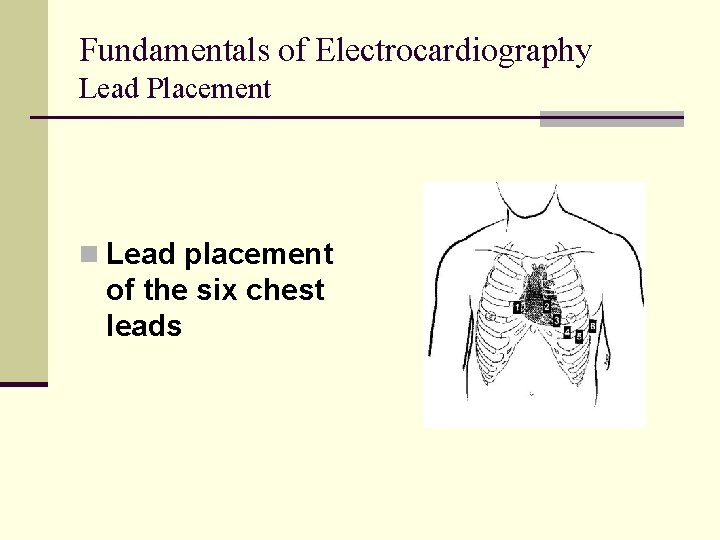
Fundamentals of Electrocardiography Lead Placement Limb Leads n Right arm n Right leg n Left arm n Left Leg Chest Leads n V 1: just to the right of the sternum n V 2: just to the left of the sternum n V 3: placed next to & below V 2 n V 4: placed next to & below V 3 n V 5: laterally and over to the left side of the heart n V 6: laterally next to V 5
Fundamentals of Electrocardiography Basic ECG Tracing-Limb Leads n Lead I: Right arm and Left arm n Lead II: Right arm and Left leg n Lead III: Left arm and Left leg n AVR: midway between left arm and left leg to right arm n AVL: midway between right arm and left leg to left arm n AVF: midpoint between right and left arms to left leg
Fundamentals of Electrocardiography Basic ECG Tracing n Right leg lead is the ground lead n V 1, V 2 and AVR are the right heart leads n V 3 and V 4 are the septal leads (transition between right and left sides of heart) n V 5, V 6, I and AVL are the lateral leads (left side of the heart) n II, III, and AVF are the inferior heart leads
Fundamentals of Electrocardiography Lead Placement n Lead placement of the six chest leads
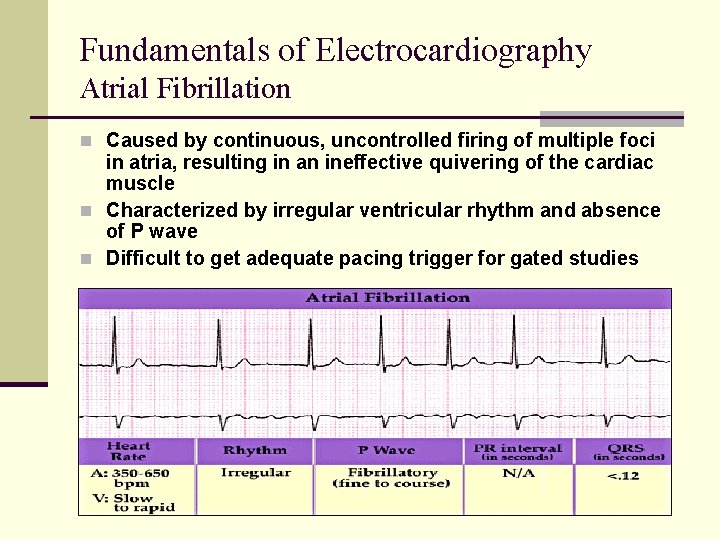
Fundamentals of Electrocardiography Heart Rates & Rhythm n Sinus rhythm: 60 -100 bpm and rhythm originates in SA node (Normal rhythm is when there is equal distance between the R-R intervals) n Sinus tachycardia: SA node paces the heart faster than 100 bpm n Sinus bradycardia: SA node paces the heart slower than 60 bpm n Flutter: 250 -350 bpm n Fibrillation: >350 bpm
Fundamentals of Electrocardiography Rate Determination n On ECG paper, count the number of R waves in any 6 sec. interval. Multiply that number by 10 to calculate HR n 300, 150, 100, 75, 60, 50 method
Fundamentals of Electrocardiography Causes of Arrhythmias n Fast or slow HR n Skipped beats n Heart disease n Smoking n Caffeine n Alcohol n Medications n Stress
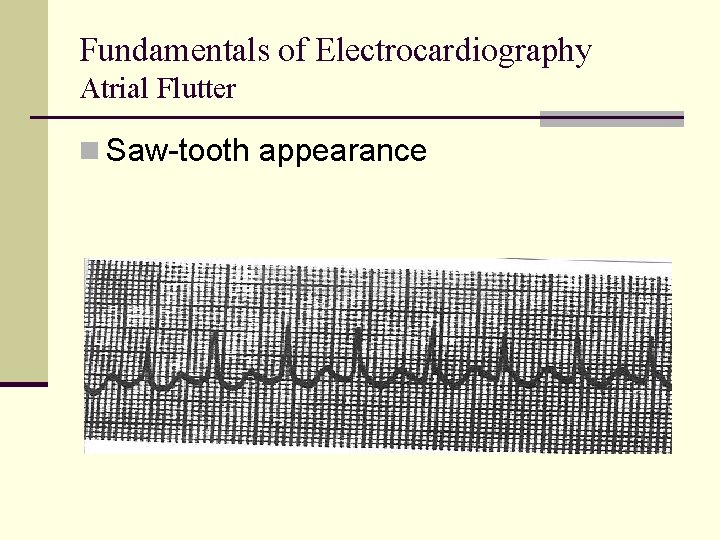
Fundamentals of Electrocardiography Atrial Flutter n Saw-tooth appearance
Fundamentals of Electrocardiography Atrial Fibrillation n Caused by continuous, uncontrolled firing of multiple foci in atria, resulting in an ineffective quivering of the cardiac muscle n Characterized by irregular ventricular rhythm and absence of P wave n Difficult to get adequate pacing trigger for gated studies
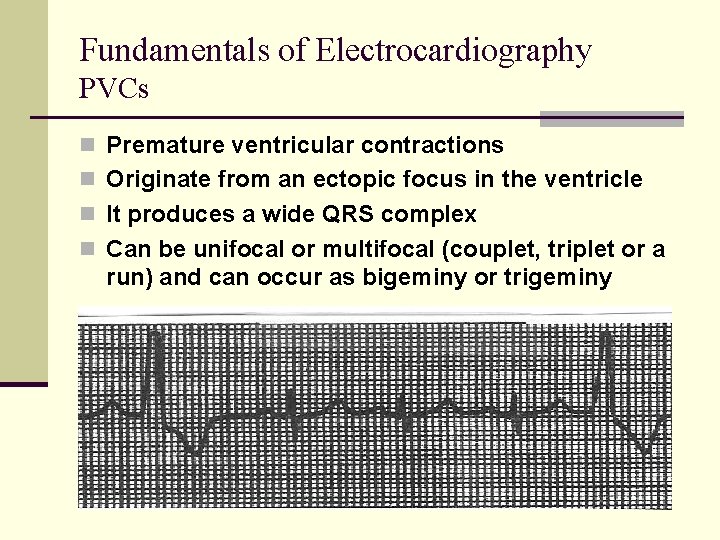
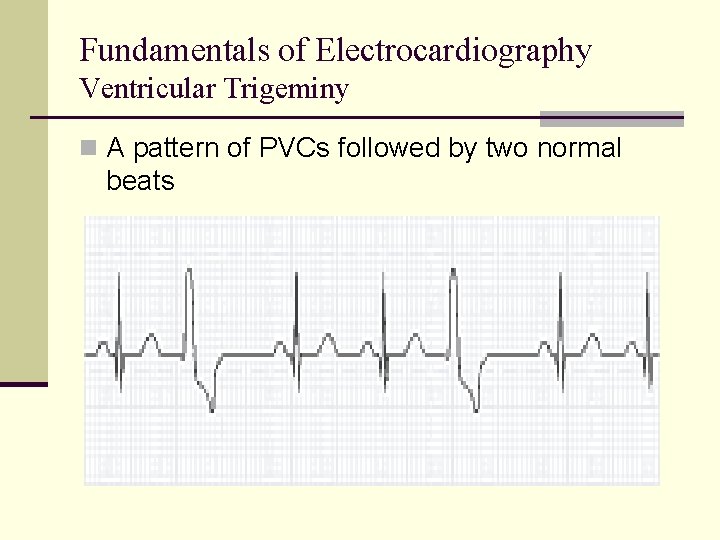
Fundamentals of Electrocardiography PVCs n Premature ventricular contractions n Originate from an ectopic focus in the ventricle n It produces a wide QRS complex n Can be unifocal or multifocal (couplet, triplet or a run) and can occur as bigeminy or trigeminy
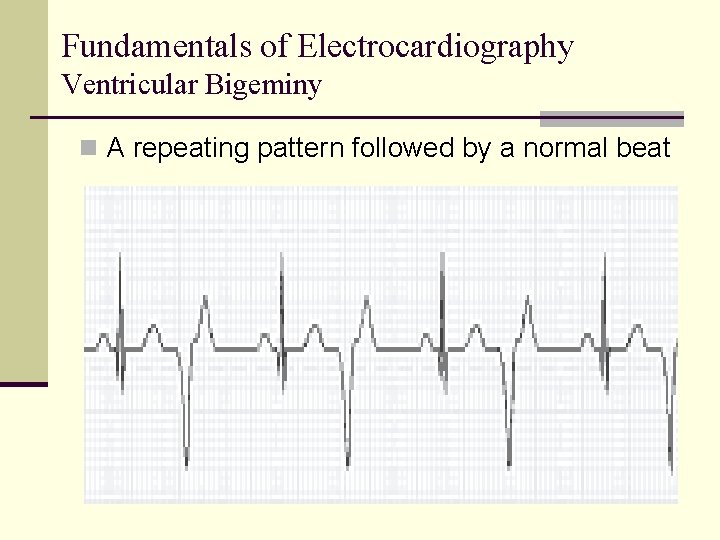
Fundamentals of Electrocardiography Ventricular Bigeminy n A repeating pattern followed by a normal beat
Fundamentals of Electrocardiography Ventricular Trigeminy n A pattern of PVCs followed by two normal beats
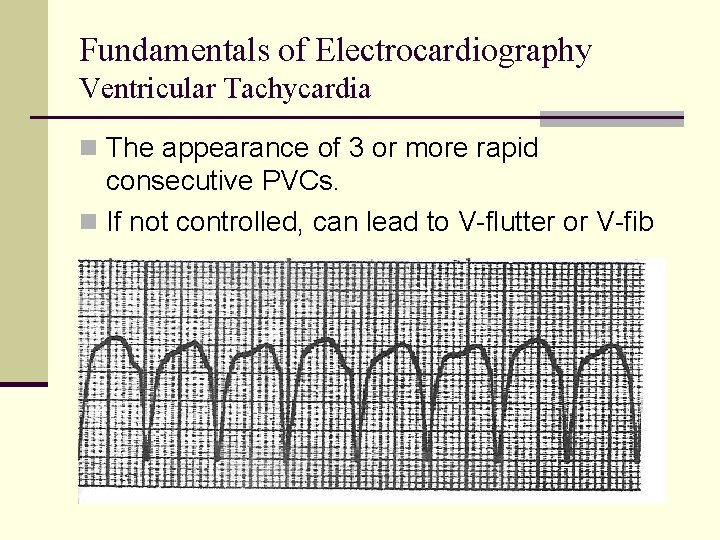
Fundamentals of Electrocardiography Ventricular Tachycardia n The appearance of 3 or more rapid consecutive PVCs. n If not controlled, can lead to V-flutter or V-fib
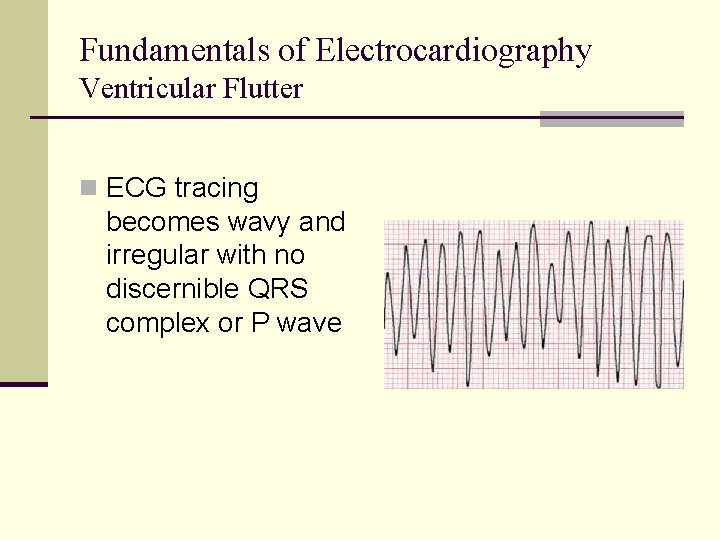
Fundamentals of Electrocardiography Ventricular Flutter n ECG tracing becomes wavy and irregular with no discernible QRS complex or P wave
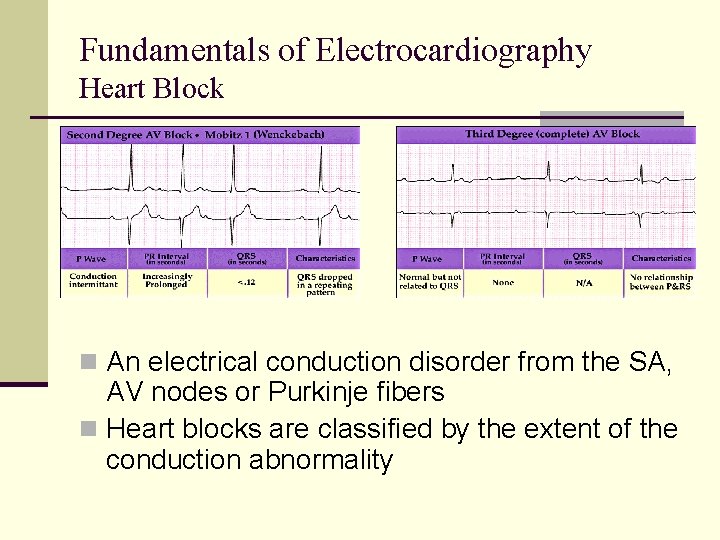
Fundamentals of Electrocardiography Heart Block n An electrical conduction disorder from the SA, AV nodes or Purkinje fibers n Heart blocks are classified by the extent of the conduction abnormality
Fundamentals of Electrocardiography Heart Block First-Degree n Electrical impulse is conducted more slowly than normal Second-Degree n The electrical impulse may or may not be conducted Third-Degree n The electrical impulse is totally blocked
Fundamentals of Electrocardiography Heart Blocks n Sinus block n Atrioventricular block n Bundle branch block (BBB)
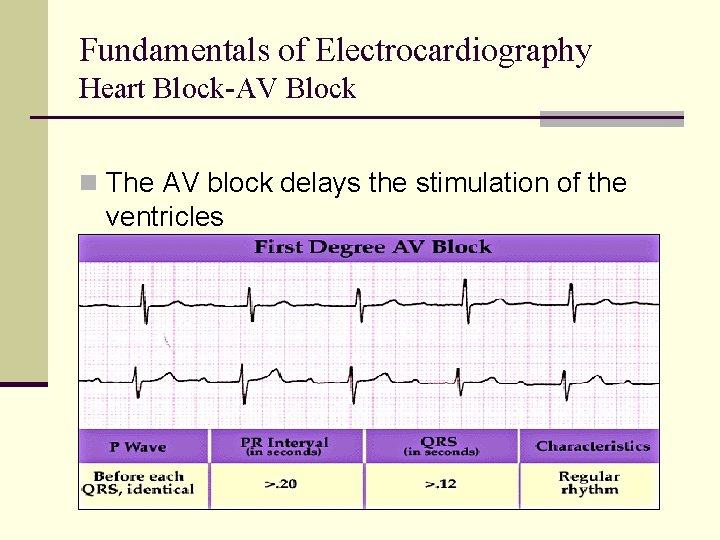
Fundamentals of Electrocardiography Heart Block-AV Block n The AV block delays the stimulation of the ventricles
Fundamentals of Electrocardiography Heart Block-AV Blocks First-Degree n PR interval is prolonged beyond 0. 2 second because of a delay in conduction through the AV node Second-Degree n PR interval becomes gradually longer and QRS complex fails to occur Third-Degree n None of the atrial impulses are conducted to the ventricles and the ventricles pace independently
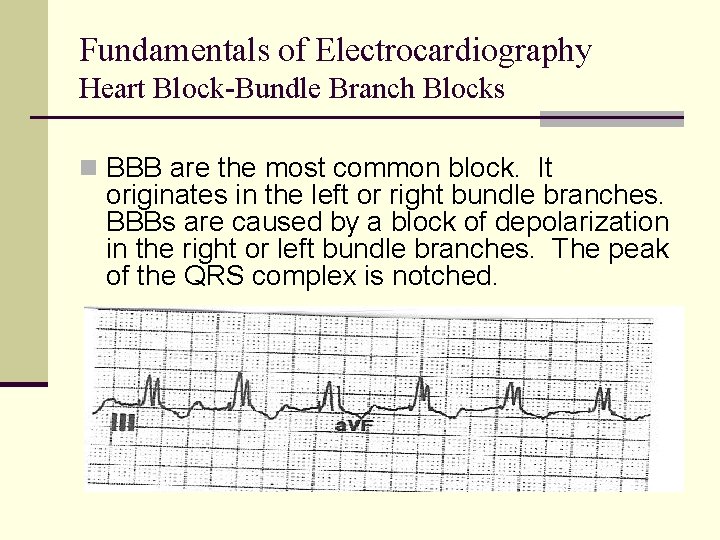
Fundamentals of Electrocardiography Heart Block-Bundle Branch Blocks n BBB are the most common block. It originates in the left or right bundle branches. BBBs are caused by a block of depolarization in the right or left bundle branches. The peak of the QRS complex is notched.
Bundle Branch Blocks n Right bundle branch blocks appear in leads V 1 and V 2 n Left bundle branch blocks appear in leads V 5 and V 6
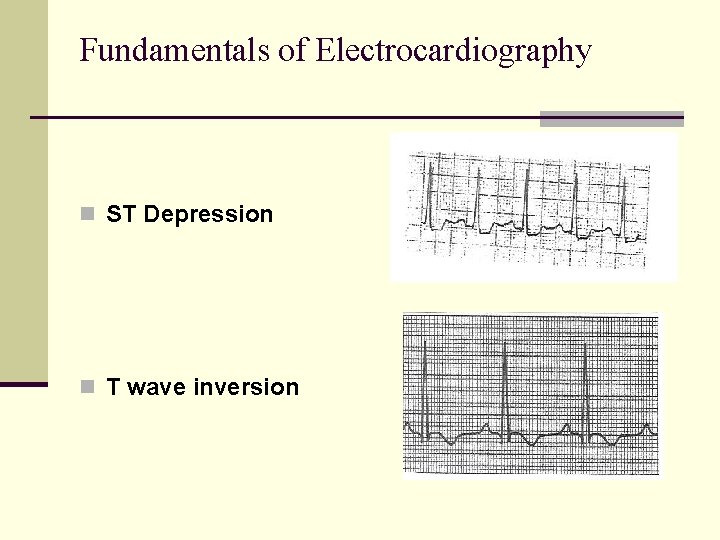
Fundamentals of Electrocardiography Ischemia/Infarction n ST segment depression may be seen in subendocardial infarction, in patients on Digitalis and in transient exercise-induced ischemia. n T wave inversion represents ischemia. Its appearance may be anything from moderately flattened to significantly inverted.
Fundamentals of Electrocardiography n ST Depression n T wave inversion
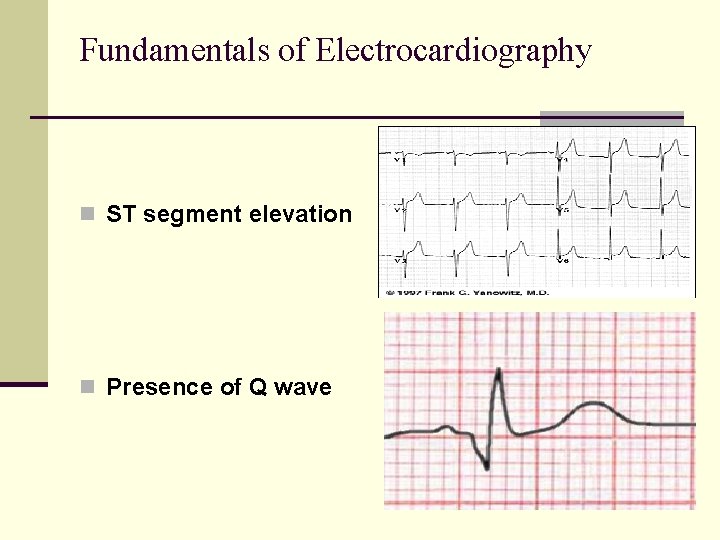
Fundamentals of Electrocardiography Ischemia/Infarction n ST segment elevation represents acute ischemia resulting in injury. Degree of elevation denotes severity of ischemic injury. n Presence of Q wave denotes myocardial infarction. Q wave is not usually visualized. The anatomical location of the infarction is determined by the presence of a Q wave on a given lead.
Fundamentals of Electrocardiography n ST segment elevation n Presence of Q wave
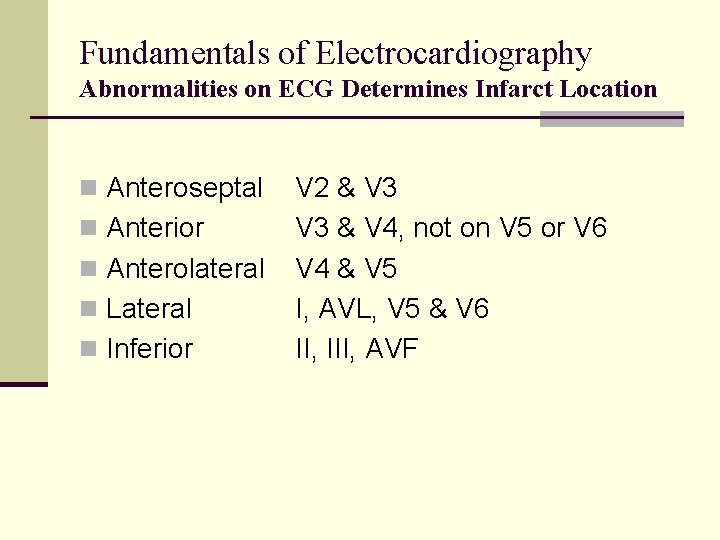
Fundamentals of Electrocardiography Abnormalities on ECG Determines Infarct Location n Anteroseptal n Anterior n Anterolateral n Lateral n Inferior V 2 & V 3 & V 4, not on V 5 or V 6 V 4 & V 5 I, AVL, V 5 & V 6 II, III, AVF
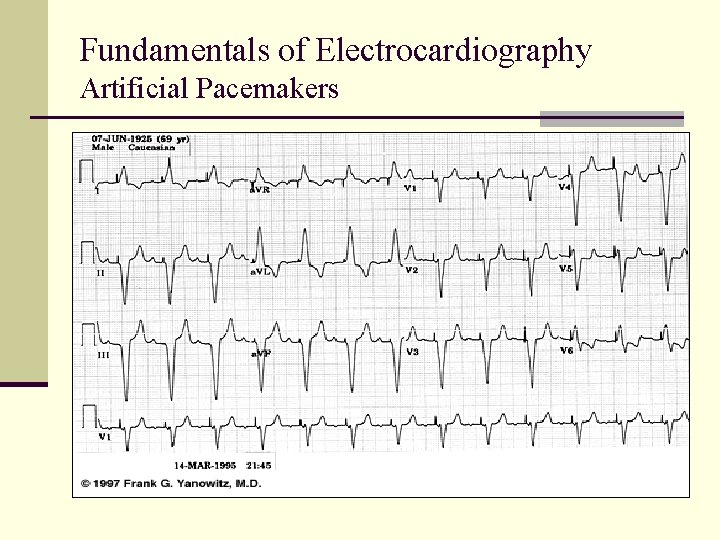
Fundamentals of Electrocardiography Artificial Pacemakers n An electric device used to stimulate the heart to beat when the electrical conduction system is unable to function properly. Can be used for atrial, ventricular or dual-chamber pacing. It causes a narrow line (the pacemaker spike) in the ECG tracing.
Fundamentals of Electrocardiography Artificial Pacemakers
References n Crawford, MS, CNMT, Elpida S. , and Syed Sajid Husain, MD, MAS. Nuclear Cardiac Imaging, Terminology and Technical Aspects. Reston: Society of Nuclear Medicine, 2003. n Taylor, MD, Andrew, David Schuster, MD, and Naomi Alazraki, MD. A Clinician’s Guide to Nuclear Medicine. Reston: Society of Nuclear Medicine, 2000. n Introduction to Nuclear Cardiology (Third Edition). Du Pont Pharma ( a professional education service), 1993.
References n University of Utah School of Medicine website, www. medstat. med. utah. edu/kw/ecg