
ECEN 667 Power System Stability Lecture 11 Governors
ECEN 667 Power System Stability Lecture 11: Governors Prof. Tom Overbye Dept. of Electrical and Computer Engineering Texas A&M University overbye@tamu. edu
Announcements • Read Chapter 4 • Homework 3 is due today • Exam 1 is Thursday October 10 during class; closed book, closed notes. One 8. 5 by 11 inch note sheet and calculators allowed. 1

Governor Models 2
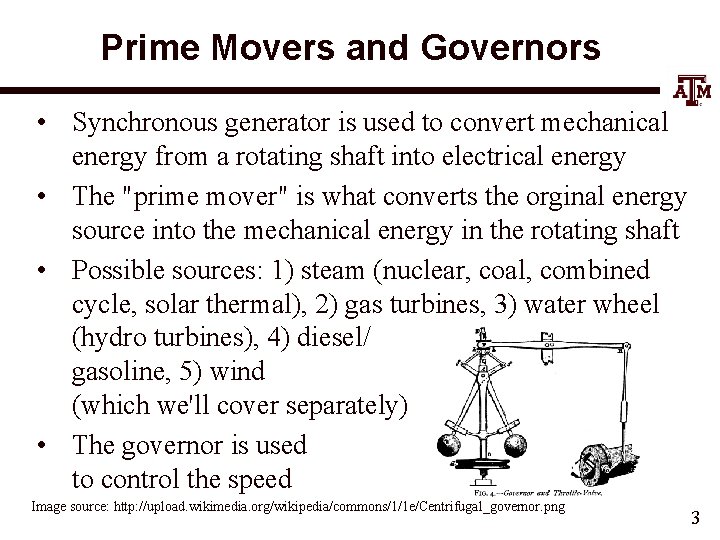
Prime Movers and Governors • Synchronous generator is used to convert mechanical energy from a rotating shaft into electrical energy • The "prime mover" is what converts the orginal energy source into the mechanical energy in the rotating shaft • Possible sources: 1) steam (nuclear, coal, combined cycle, solar thermal), 2) gas turbines, 3) water wheel (hydro turbines), 4) diesel/ gasoline, 5) wind (which we'll cover separately) • The governor is used to control the speed Image source: http: //upload. wikimedia. org/wikipedia/commons/1/1 e/Centrifugal_governor. png 3
Prime Movers and Governors • In transient stability collectively the prime mover and the governor are called the "governor" • As has been previously discussed, models need to be appropriate for the application • In transient stability the response of the system for seconds to perhaps minutes is considered • Long-term dynamics, such as those of the boiler and automatic generation control (AG), are usually not considered • These dynamics would need to be considered in longer simulations (e. g. dispatcher training simulator (DTS) 4
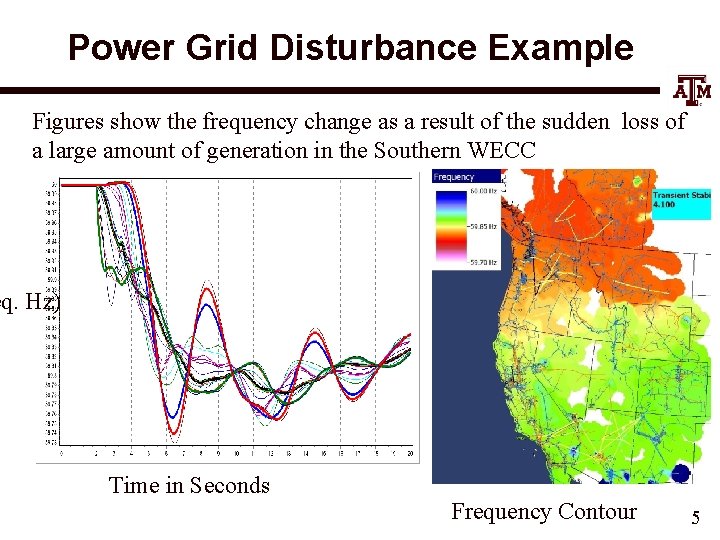
Power Grid Disturbance Example Figures show the frequency change as a result of the sudden loss of a large amount of generation in the Southern WECC eq. Hz) Time in Seconds Frequency Contour 5
Frequency Response for Generation Loss • In response to a rapid loss of generation, in the initial seconds the system frequency will decrease as energy stored in the rotating masses is transformed into electric energy – Some generation, such as solar PV has no inertia, and for most new wind turbines the inertia is not seen by the system • Within seconds governors respond, increasing the power output of controllable generation – – Many conventional units are operated so they only respond to over frequency situations Solar PV and wind are usually operated in North America at maximum power so they have no reserves to contribute 6
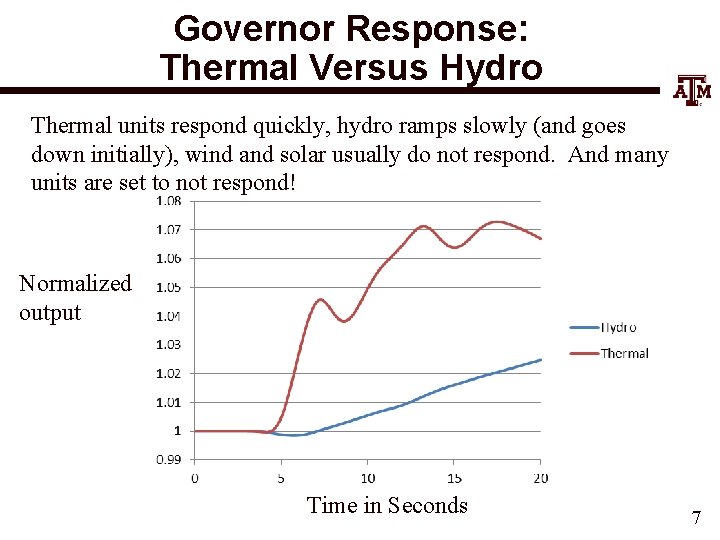
Governor Response: Thermal Versus Hydro Thermal units respond quickly, hydro ramps slowly (and goes down initially), wind and solar usually do not respond. And many units are set to not respond! Normalized output Time in Seconds 7
Some Good References • Kundur, Power System Stability and Control, 1994 • Wood, Wollenberg and Sheble, Power Generation, Operation and Control, third edition, 2013 • IEEE PES, "Dynamic Models for Turbine-Governors in Power System Studies, " Jan 2013 • "Dynamic Models for Fossil Fueled Steam Units in Power System Studies, " IEEE Trans. Power Syst. , May 1991, pp. 753 -761 • "Hydraulic Turbine and Turbine Control Models for System Dynamic Studies, " IEEE Trans. Power Syst. , Feb 1992, pp. 167 -179 8
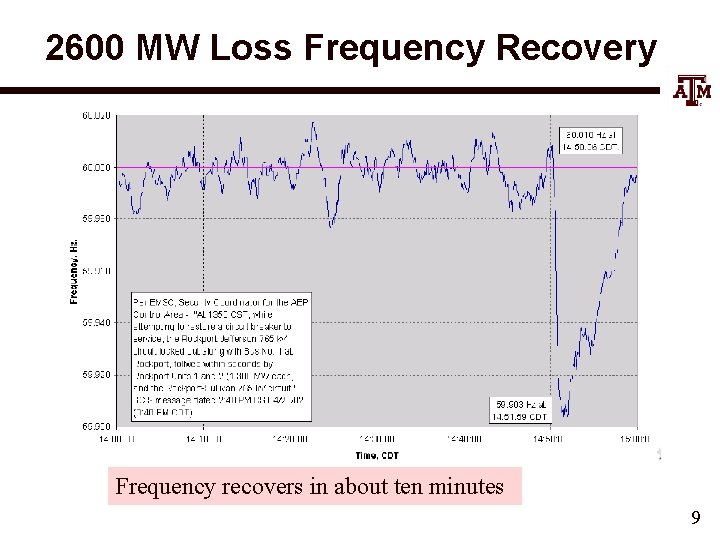
2600 MW Loss Frequency Recovery Frequency recovers in about ten minutes 9

Frequency Response Definition • FERC defines in RM 13 -11: “Frequency response is a measure of an Interconnection’s ability to stabilize frequency immediately following the sudden loss of generation or load, and is a critical component of the reliable operation of the Bulk-Power System, particularly during disturbances and recoveries. ” • Design Event for WECC is N-2 (Palo Verde Outage) not to result in UFLS (59. 5 Hz in WECC) Source: wecc. biz/Reliability/Frequency%20 Response%20 Analysis%20 -%20 Dmitry%20 Kosterev. pdf 10
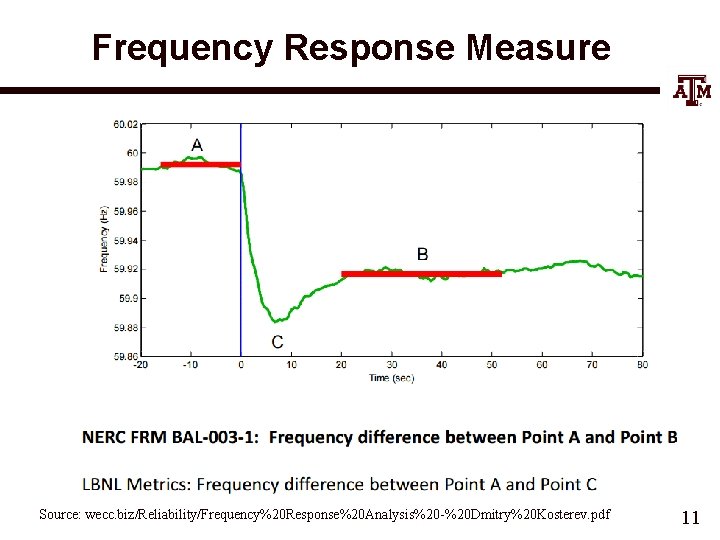
Frequency Response Measure Source: wecc. biz/Reliability/Frequency%20 Response%20 Analysis%20 -%20 Dmitry%20 Kosterev. pdf 11
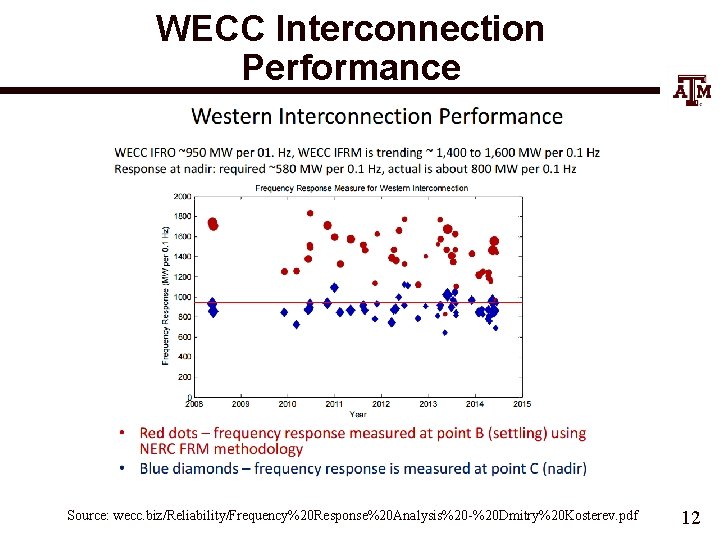
WECC Interconnection Performance Source: wecc. biz/Reliability/Frequency%20 Response%20 Analysis%20 -%20 Dmitry%20 Kosterev. pdf 12
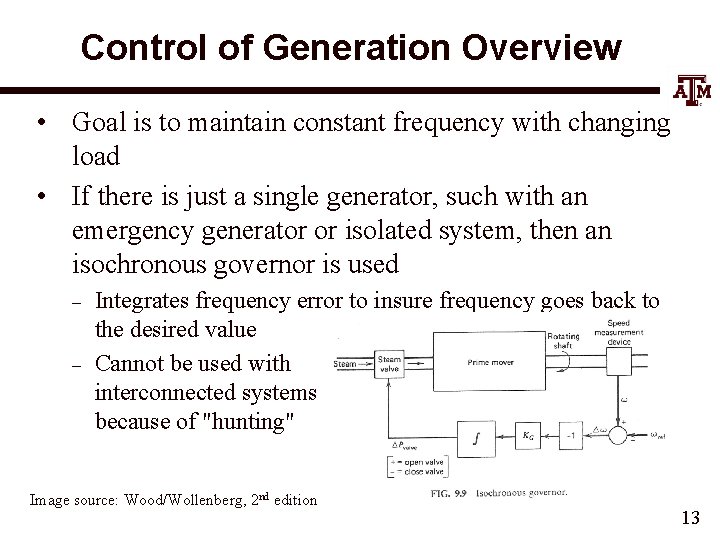
Control of Generation Overview • Goal is to maintain constant frequency with changing load • If there is just a single generator, such with an emergency generator or isolated system, then an isochronous governor is used – – Integrates frequency error to insure frequency goes back to the desired value Cannot be used with interconnected systems because of "hunting" Image source: Wood/Wollenberg, 2 nd edition 13
Generator “Hunting” • Control system “hunting” is oscillation around an equilibrium point • Trying to interconnect multiple isochronous generators will cause hunting because the frequency setpoints of the two generators are never exactly equal • • One will be accumulating a frequency error trying to speed up the system, whereas the other will be trying to slow it down The generators will NOT share the power load proportionally 14
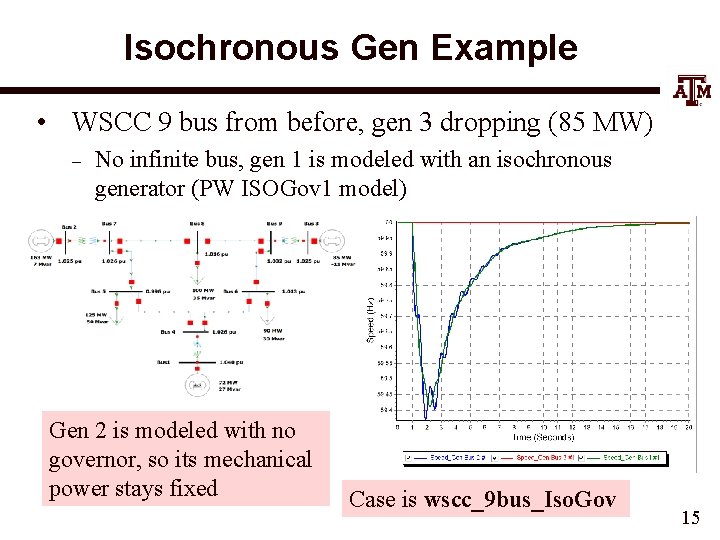
Isochronous Gen Example • WSCC 9 bus from before, gen 3 dropping (85 MW) – No infinite bus, gen 1 is modeled with an isochronous generator (PW ISOGov 1 model) Gen 2 is modeled with no governor, so its mechanical power stays fixed Case is wscc_9 bus_Iso. Gov 15
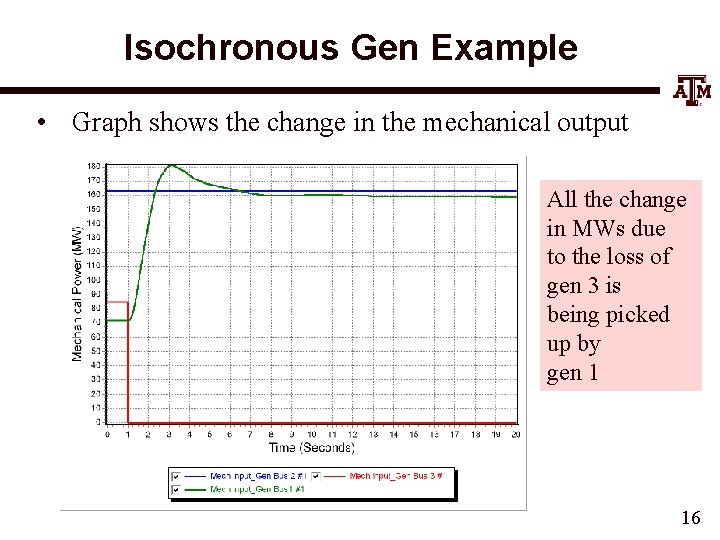
Isochronous Gen Example • Graph shows the change in the mechanical output All the change in MWs due to the loss of gen 3 is being picked up by gen 1 16
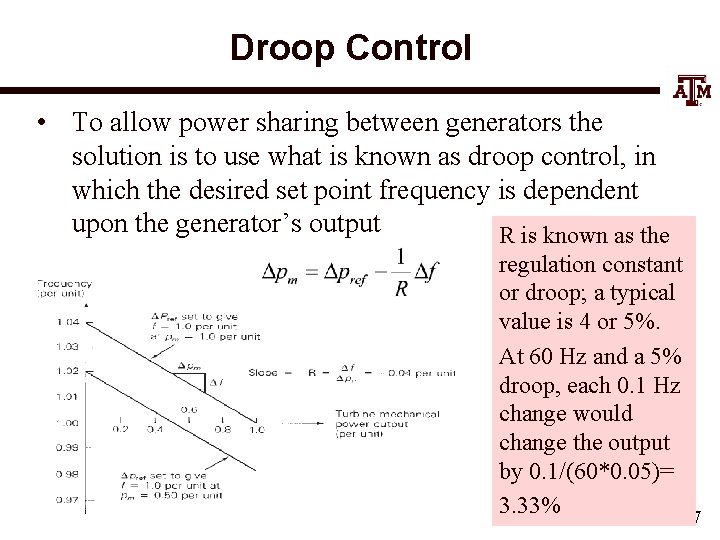
Droop Control • To allow power sharing between generators the solution is to use what is known as droop control, in which the desired set point frequency is dependent upon the generator’s output R is known as the regulation constant or droop; a typical value is 4 or 5%. At 60 Hz and a 5% droop, each 0. 1 Hz change would change the output by 0. 1/(60*0. 05)= 3. 33% 17
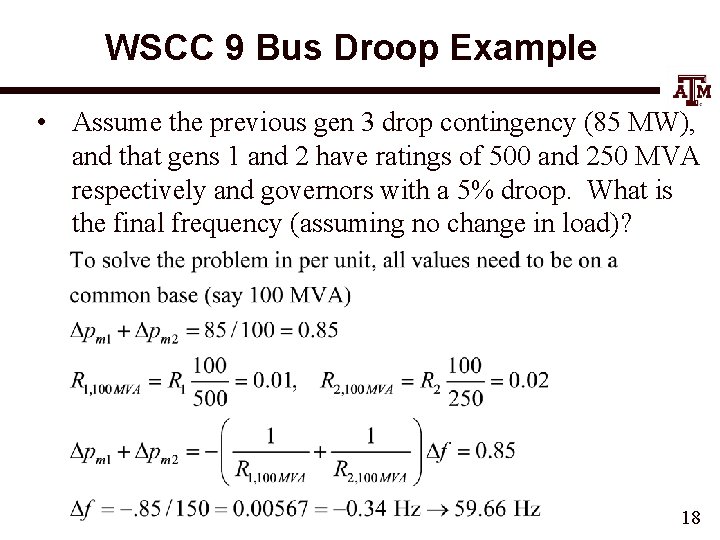
WSCC 9 Bus Droop Example • Assume the previous gen 3 drop contingency (85 MW), and that gens 1 and 2 have ratings of 500 and 250 MVA respectively and governors with a 5% droop. What is the final frequency (assuming no change in load)? 18
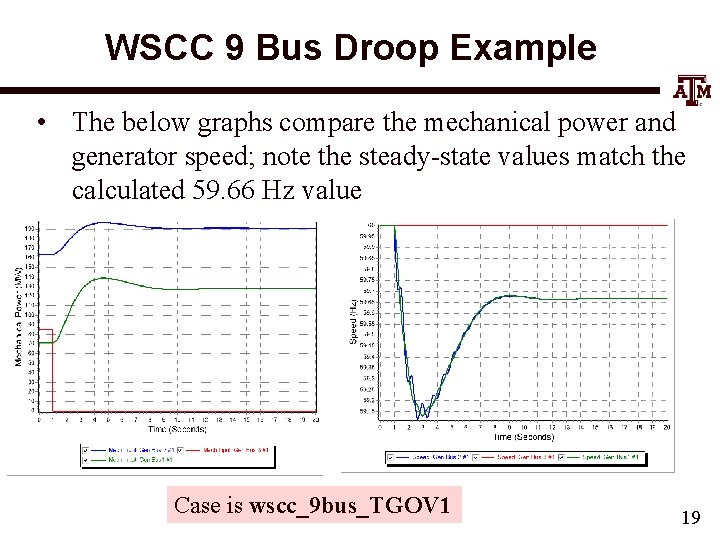
WSCC 9 Bus Droop Example • The below graphs compare the mechanical power and generator speed; note the steady-state values match the calculated 59. 66 Hz value Case is wscc_9 bus_TGOV 1 19
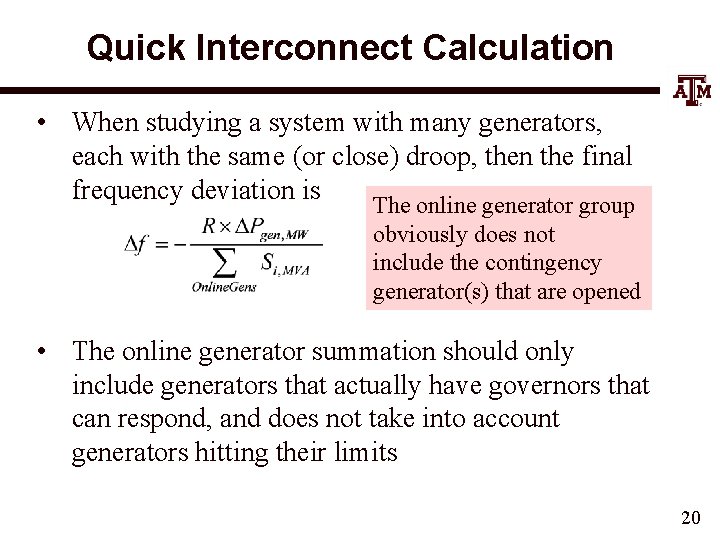
Quick Interconnect Calculation • When studying a system with many generators, each with the same (or close) droop, then the final frequency deviation is The online generator group obviously does not include the contingency generator(s) that are opened • The online generator summation should only include generators that actually have governors that can respond, and does not take into account generators hitting their limits 20
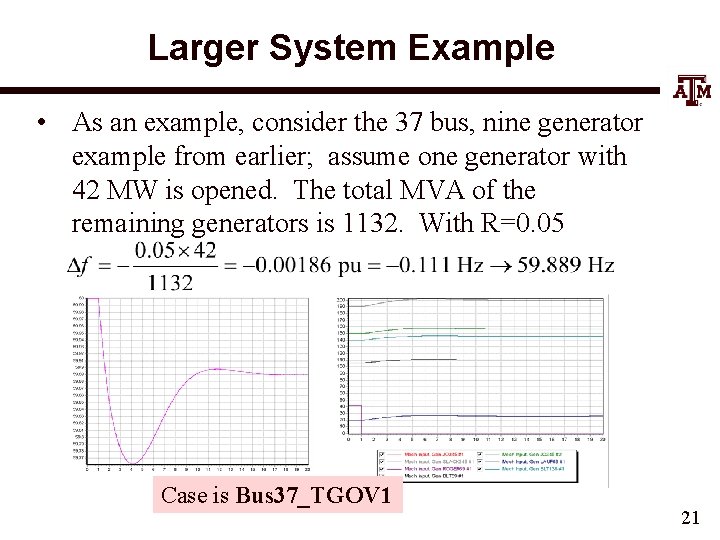
Larger System Example • As an example, consider the 37 bus, nine generator example from earlier; assume one generator with 42 MW is opened. The total MVA of the remaining generators is 1132. With R=0. 05 Case is Bus 37_TGOV 1 21
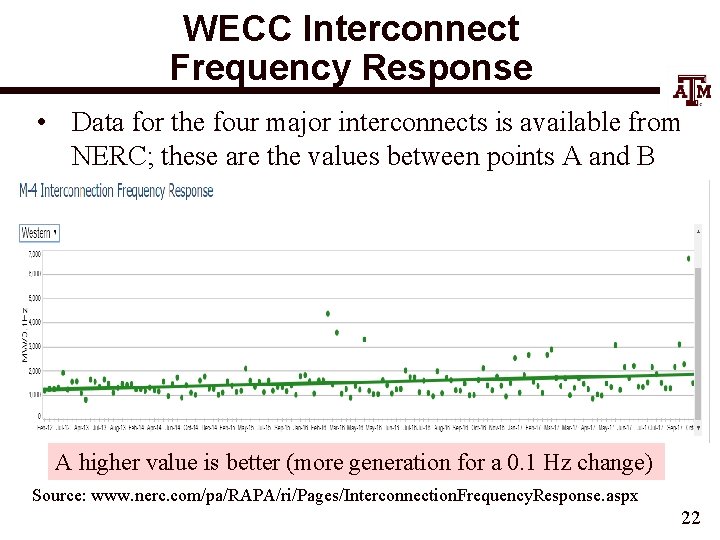
WECC Interconnect Frequency Response • Data for the four major interconnects is available from NERC; these are the values between points A and B A higher value is better (more generation for a 0. 1 Hz change) Source: www. nerc. com/pa/RAPA/ri/Pages/Interconnection. Frequency. Response. aspx 22
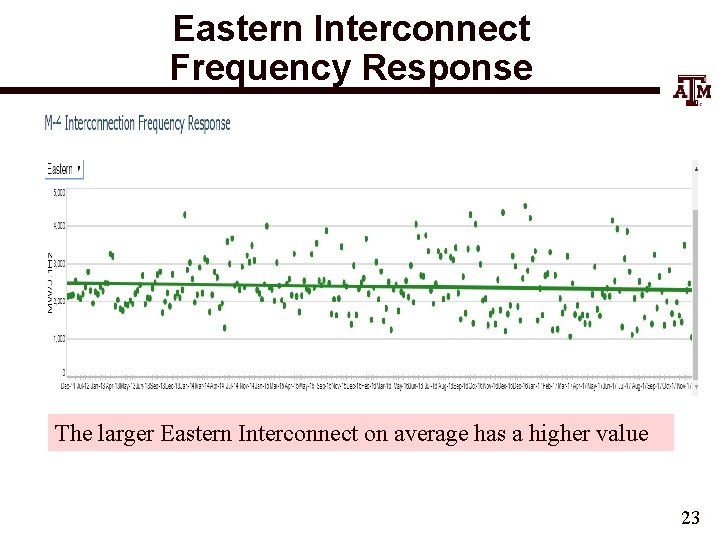
Eastern Interconnect Frequency Response The larger Eastern Interconnect on average has a higher value 23
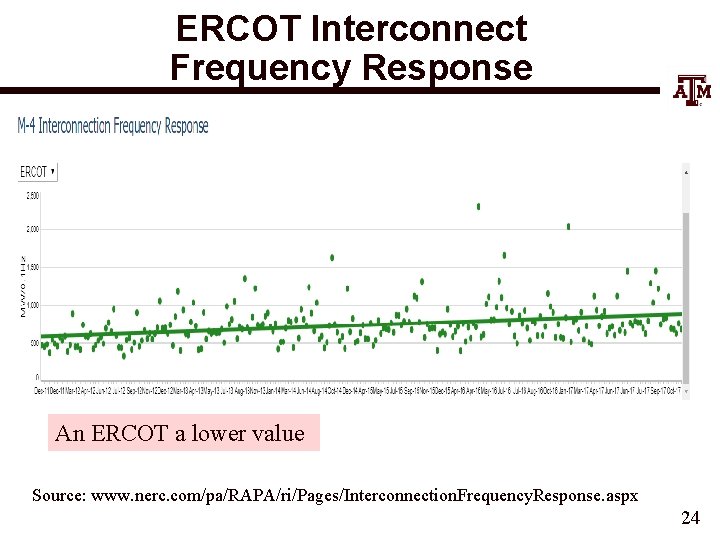
ERCOT Interconnect Frequency Response An ERCOT a lower value Source: www. nerc. com/pa/RAPA/ri/Pages/Interconnection. Frequency. Response. aspx 24
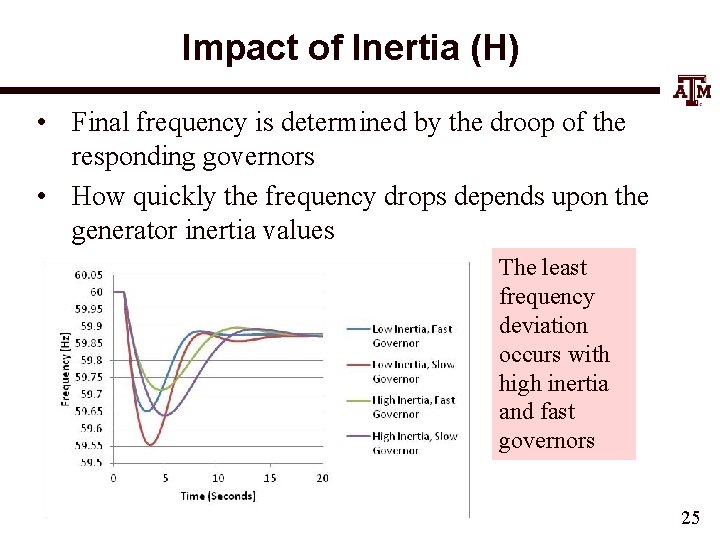
Impact of Inertia (H) • Final frequency is determined by the droop of the responding governors • How quickly the frequency drops depends upon the generator inertia values The least frequency deviation occurs with high inertia and fast governors 25
Restoring Frequency to 60 (or 50) Hz • In an interconnected power system the governors to not automatically restore the frequency to 60 Hz • Rather done via the ACE (area control area calculation). Previously we defined ACE as the difference between the actual real power exports from an area and the scheduled exports. But it has an additional term ACE = Pactual - Psched – 10 b(freqact - freqsched) • b is the balancing authority frequency bias in MW/0. 1 Hz with a negative sign. It is about 0. 8% of peak load/generation This slower ACE response is usually not modeled in transient stability 26
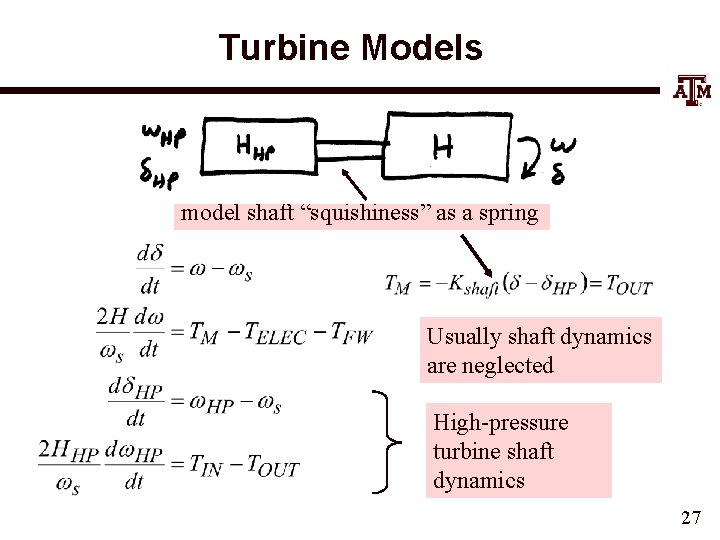
Turbine Models model shaft “squishiness” as a spring Usually shaft dynamics are neglected High-pressure turbine shaft dynamics 27
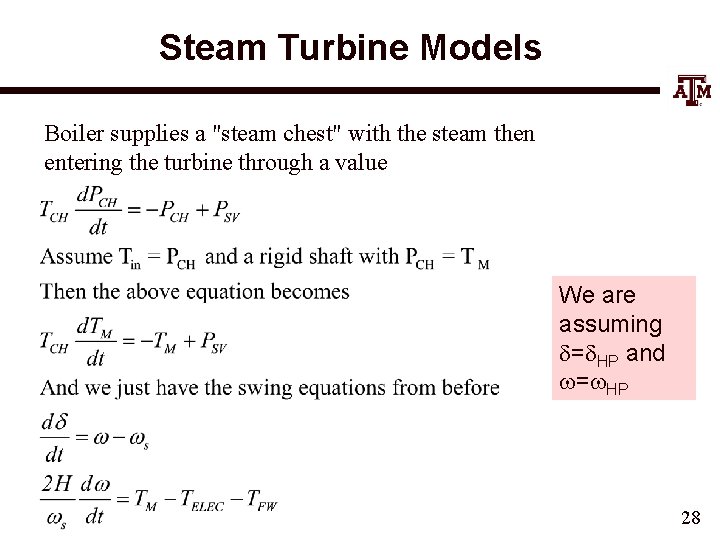
Steam Turbine Models Boiler supplies a "steam chest" with the steam then entering the turbine through a value We are assuming d=d. HP and w=w. HP 28
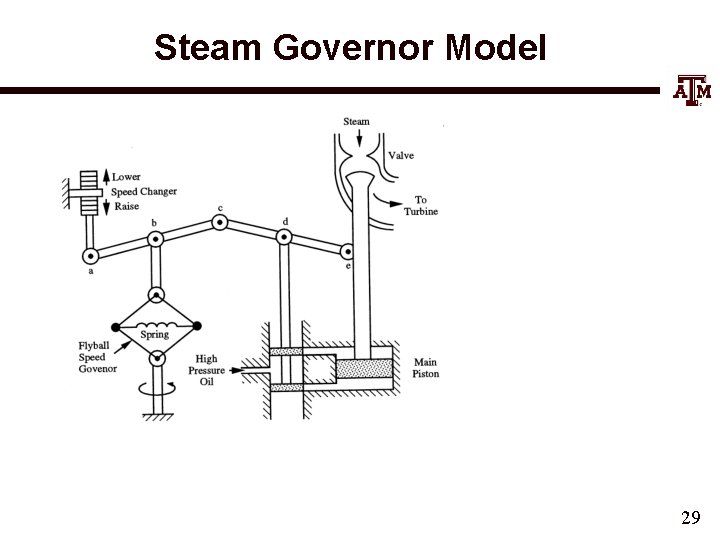
Steam Governor Model 29
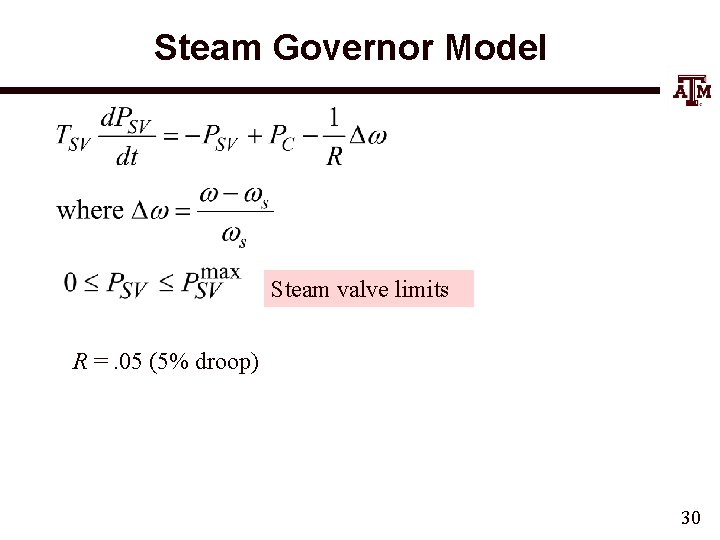
Steam Governor Model Steam valve limits R =. 05 (5% droop) 30
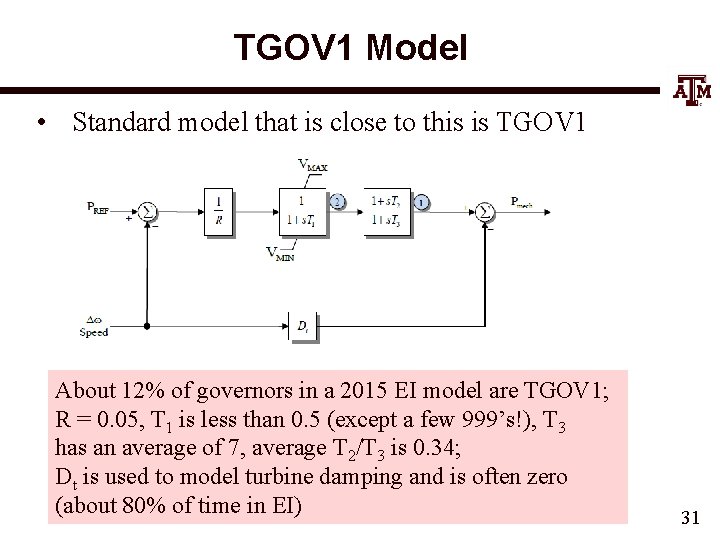
TGOV 1 Model • Standard model that is close to this is TGOV 1 About 12% of governors in a 2015 EI model are TGOV 1; R = 0. 05, T 1 is less than 0. 5 (except a few 999’s!), T 3 has an average of 7, average T 2/T 3 is 0. 34; Dt is used to model turbine damping and is often zero (about 80% of time in EI) 31
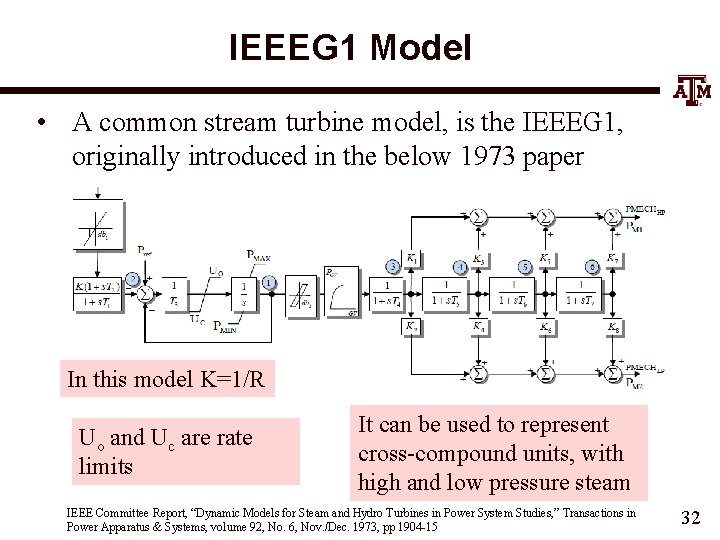
IEEEG 1 Model • A common stream turbine model, is the IEEEG 1, originally introduced in the below 1973 paper In this model K=1/R Uo and Uc are rate limits It can be used to represent cross-compound units, with high and low pressure steam IEEE Committee Report, “Dynamic Models for Steam and Hydro Turbines in Power System Studies, ” Transactions in Power Apparatus & Systems, volume 92, No. 6, Nov. /Dec. 1973, pp 1904 -15 32
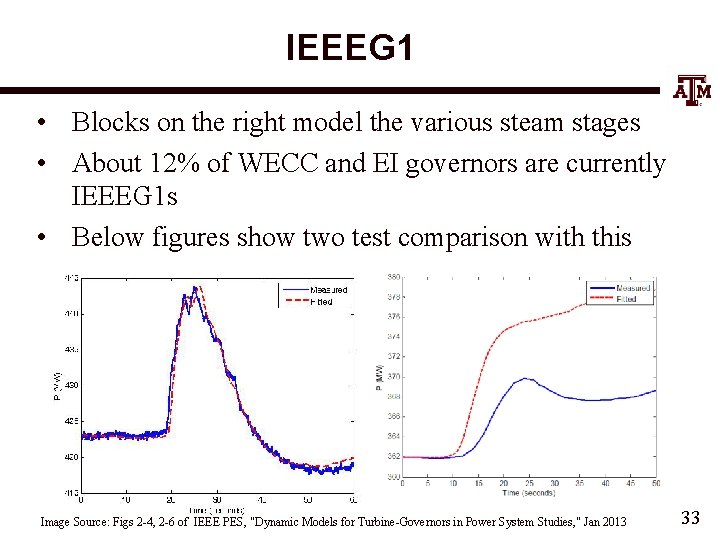
IEEEG 1 • Blocks on the right model the various steam stages • About 12% of WECC and EI governors are currently IEEEG 1 s • Below figures show two test comparison with this model Image Source: Figs 2 -4, 2 -6 of IEEE PES, "Dynamic Models for Turbine-Governors in Power System Studies, " Jan 2013 33
- Slides: 34