
ECECS 584 Hybrid Automaton Modeling Framework Executions Reach
ECE/CS 584: Hybrid Automaton Modeling Framework Executions, Reach set, Invariance Lecture 03 Sayan Mitra

Announcements • Project proposals due in a week – 2 pages with goals, description & milestones • Allerton Conference special session on Verification of CPS – October 4 th, 1: 30 pm at Allerton House – Free!
Plan for Today • Examples of hybrid models • Executions, reach sets, invariants
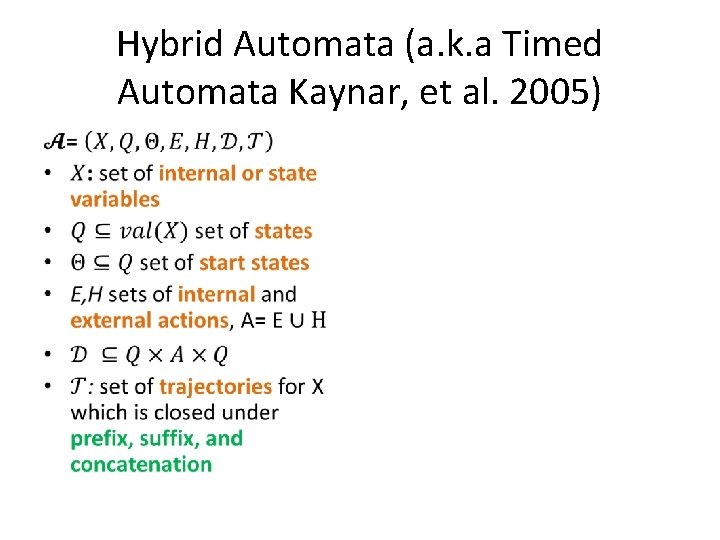
Hybrid Automata (a. k. a Timed Automata Kaynar, et al. 2005) •
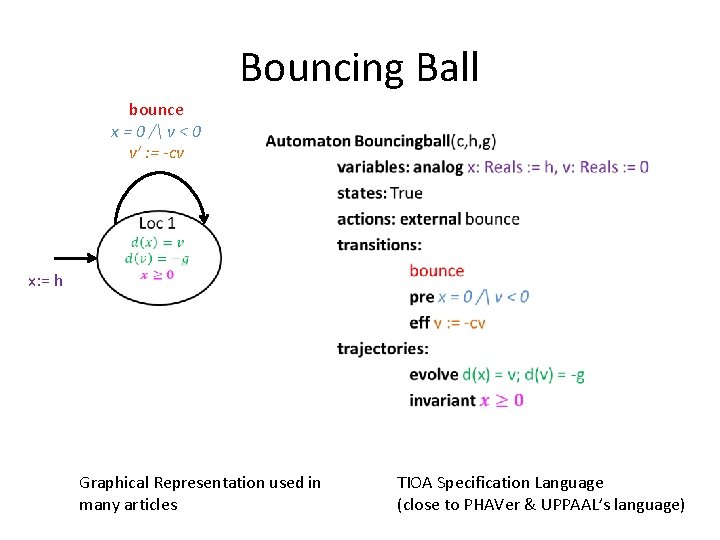
Bouncing Ball bounce x = 0 / v < 0 v’ : = -cv • x: = h Graphical Representation used in many articles TIOA Specification Language (close to PHAVer & UPPAAL’s language)
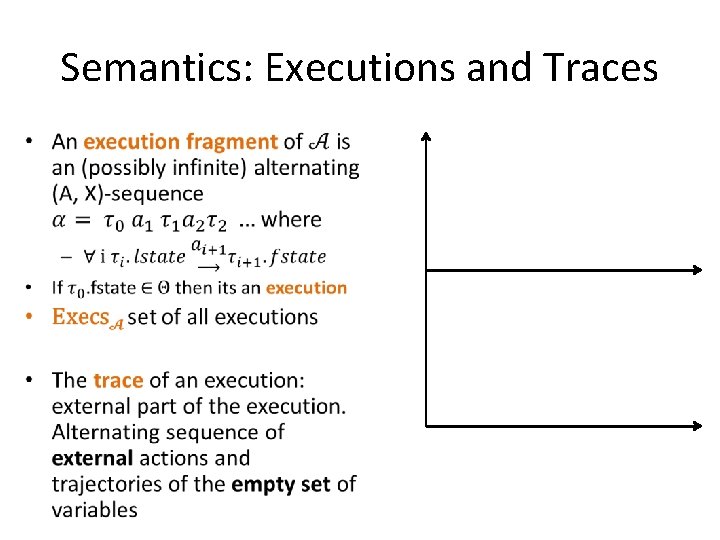
Semantics: Executions and Traces •
Special kinds of executions • Infinite: Infinite sequence of transitions and trajectories • Closed: Finite with final trajectory with closed domain • Admissable: Infinite duration – May or may not be infinite • Zeno: Infinite but not admissable – Infinite number of transitions in finite time
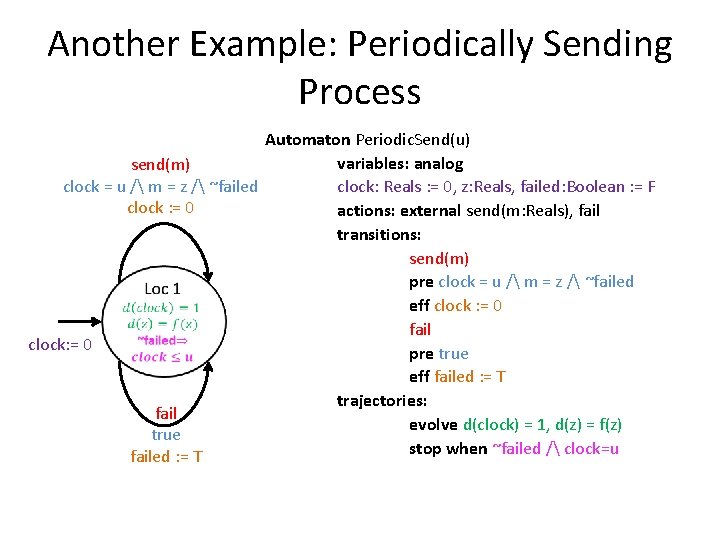
Another Example: Periodically Sending Process Automaton Periodic. Send(u) variables: analog send(m) clock = u / m = z / ~failed clock: Reals : = 0, z: Reals, failed: Boolean : = F clock : = 0 actions: external send(m: Reals), fail transitions: send(m) pre clock = u / m = z / ~failed eff clock : = 0 fail clock: = 0 pre true eff failed : = T trajectories: fail evolve d(clock) = 1, d(z) = f(z) true stop when ~failed / clock=u failed : = T

Modeling a Simple Failure Detector System • Periodic send • Channel • Timeout
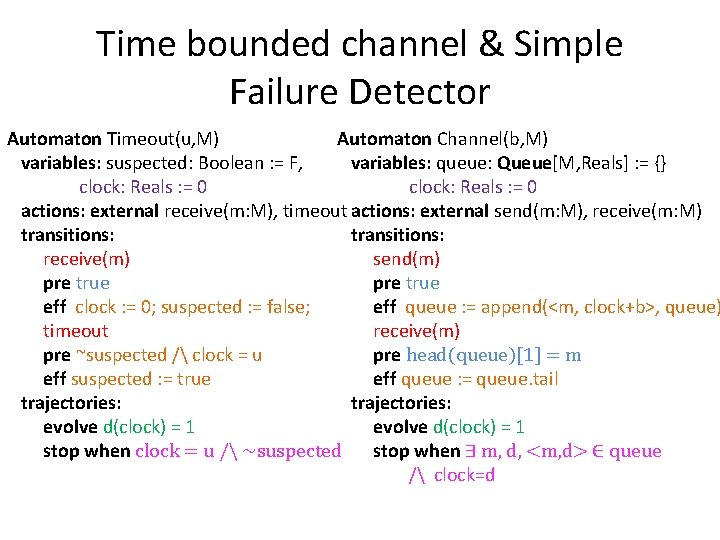
Time bounded channel & Simple Failure Detector Automaton Timeout(u, M) Automaton Channel(b, M) variables: suspected: Boolean : = F, variables: queue: Queue[M, Reals] : = {} clock: Reals : = 0 actions: external receive(m: M), timeout actions: external send(m: M), receive(m: M) transitions: receive(m) send(m) pre true eff clock : = 0; suspected : = false; eff queue : = append(<m, clock+b>, queue) timeout receive(m) pre head(queue)[1] = m pre ~suspected / clock = u eff suspected : = true eff queue : = queue. tail trajectories: evolve d(clock) = 1 stop when clock = u / ~suspected stop when ∃ m, d, <m, d> ∈ queue / clock=d
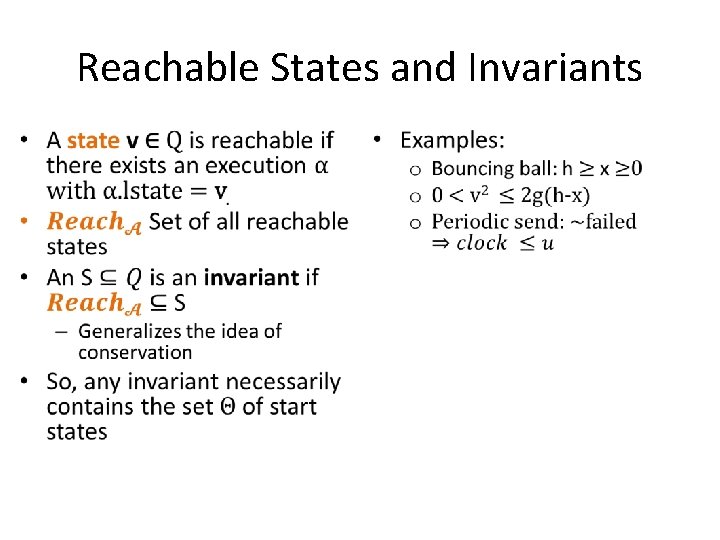
Reachable States and Invariants • •
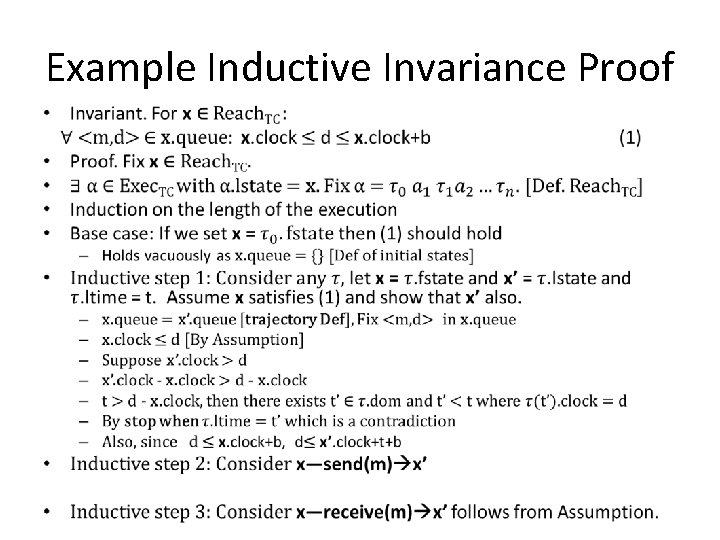
Example Inductive Invariance Proof •
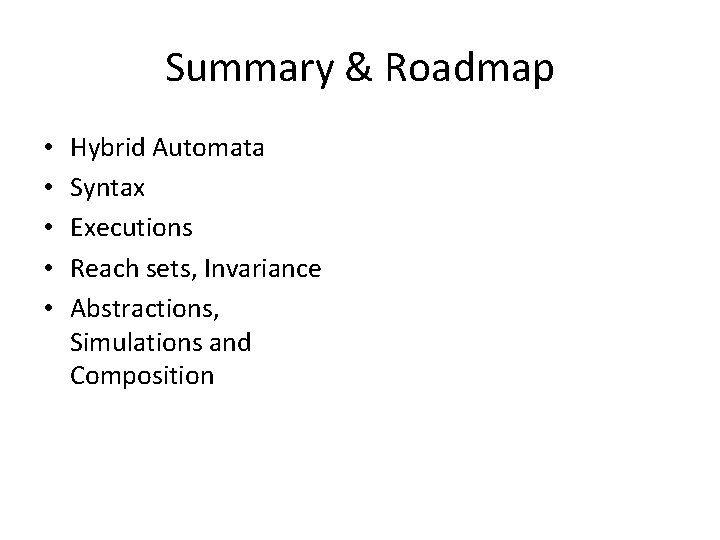
Summary & Roadmap • • • Hybrid Automata Syntax Executions Reach sets, Invariance Abstractions, Simulations and Composition
- Slides: 14