
ECE Engineering Model The Basis for Electromagnetic and
ECE Engineering Model The Basis for Electromagnetic and Mechanical Applications Horst Eckardt, AIAS Version 4. 2, 16. 1. 2014 1
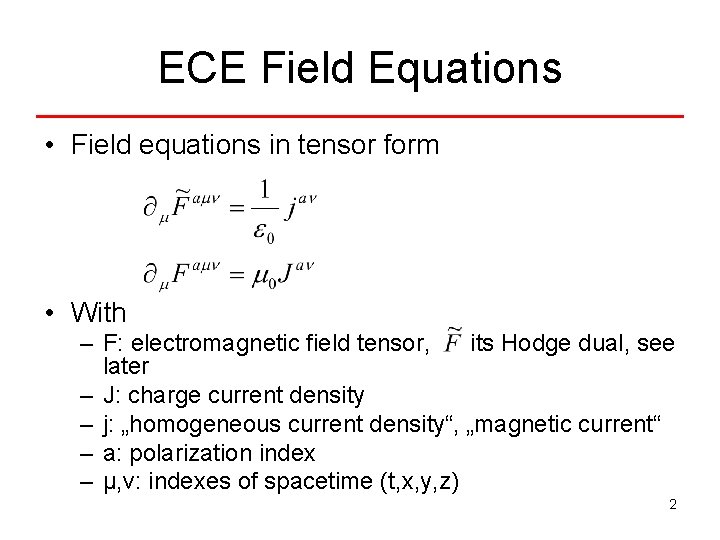
ECE Field Equations • Field equations in tensor form • With – F: electromagnetic field tensor, its Hodge dual, see later – J: charge current density – j: „homogeneous current density“, „magnetic current“ – a: polarization index – μ, ν: indexes of spacetime (t, x, y, z) 2
Properties of Field Equations • J is not necessarily external current, is defined by spacetime properties completely • j only occurs if electromagnetism is influenced by gravitation, or magnetic monopoles exist, otherwise =0 • Polarization index „a“ can be omitted if tangent space is defined equal to space of base manifold (assumed from now on) 3
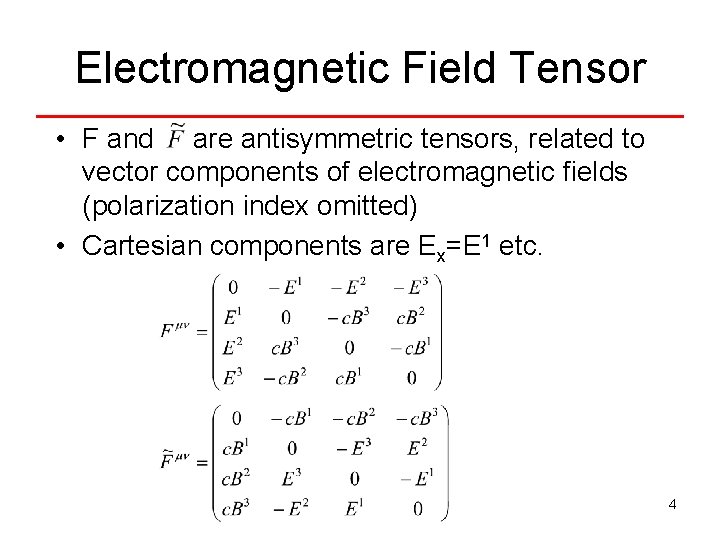
Electromagnetic Field Tensor • F and are antisymmetric tensors, related to vector components of electromagnetic fields (polarization index omitted) • Cartesian components are Ex=E 1 etc. 4

Potential with polarization directions • Potential matrix: • Polarization vectors: 5

ECE Field Equations – Vector Form „Material“ Equations Dielectric Displacement Magnetic Induction 6
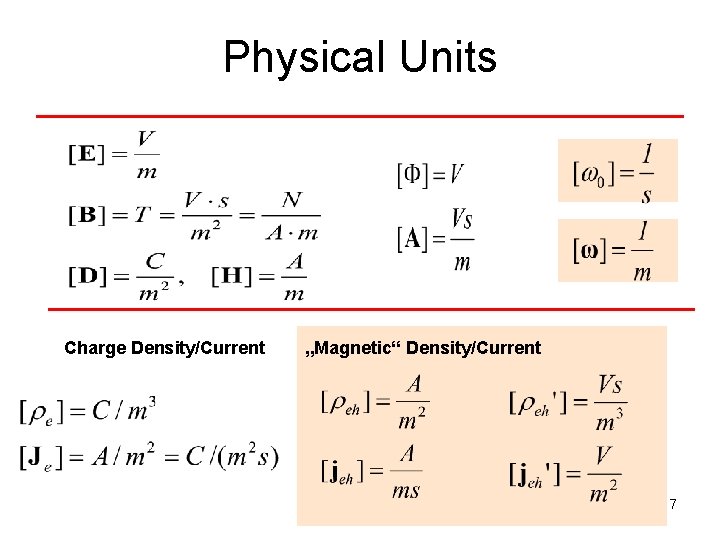
Physical Units Charge Density/Current „Magnetic“ Density/Current 7
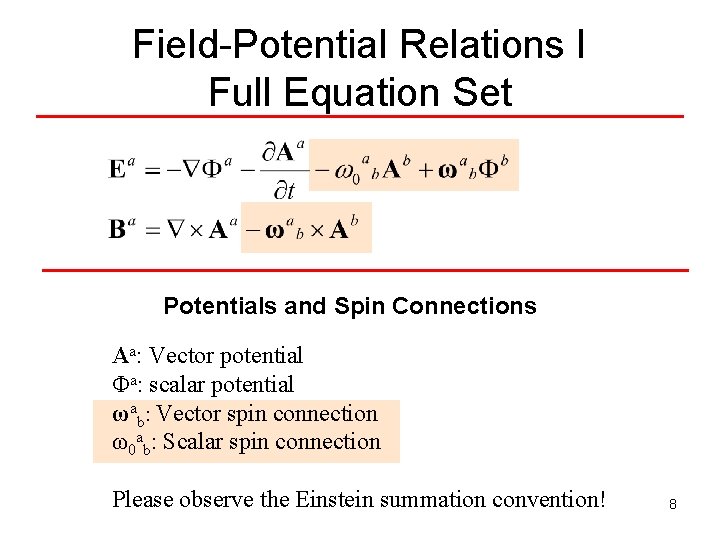
Field-Potential Relations I Full Equation Set Potentials and Spin Connections Aa: Vector potential Φa: scalar potential ωab: Vector spin connection ω0 ab: Scalar spin connection Please observe the Einstein summation convention! 8
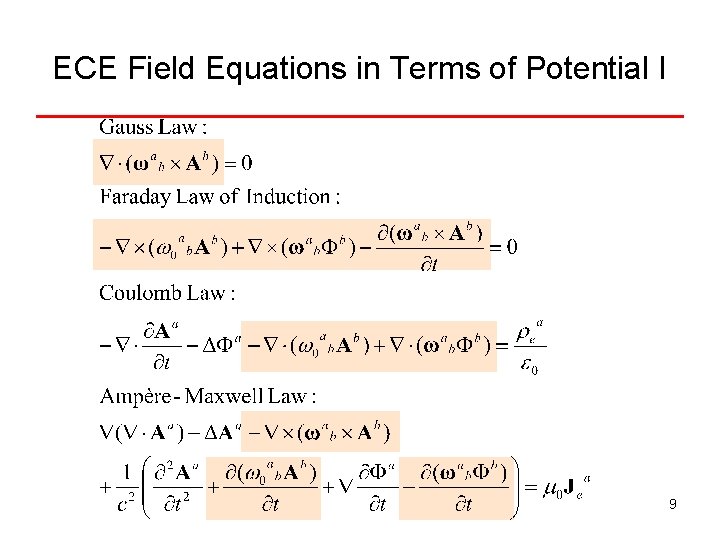
ECE Field Equations in Terms of Potential I 9
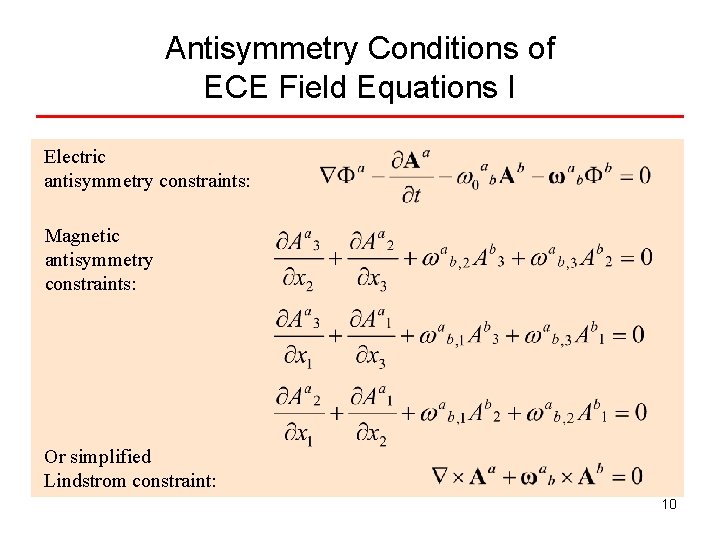
Antisymmetry Conditions of ECE Field Equations I Electric antisymmetry constraints: Magnetic antisymmetry constraints: Or simplified Lindstrom constraint: 10
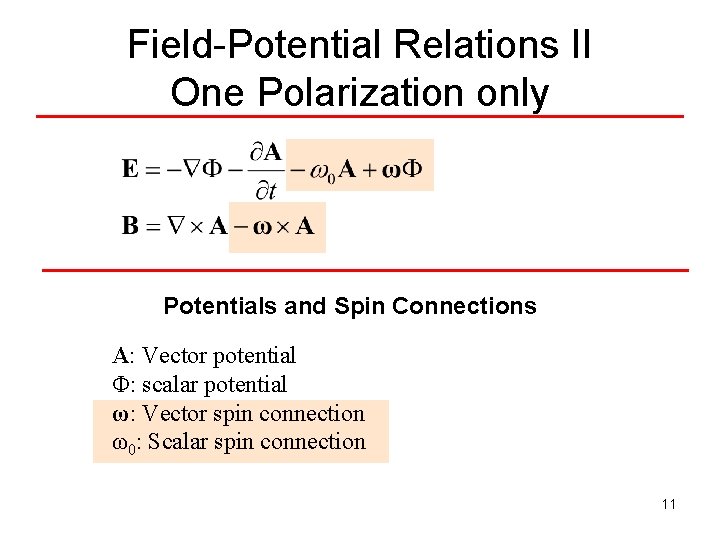
Field-Potential Relations II One Polarization only Potentials and Spin Connections A: Vector potential Φ: scalar potential ω: Vector spin connection ω0: Scalar spin connection 11
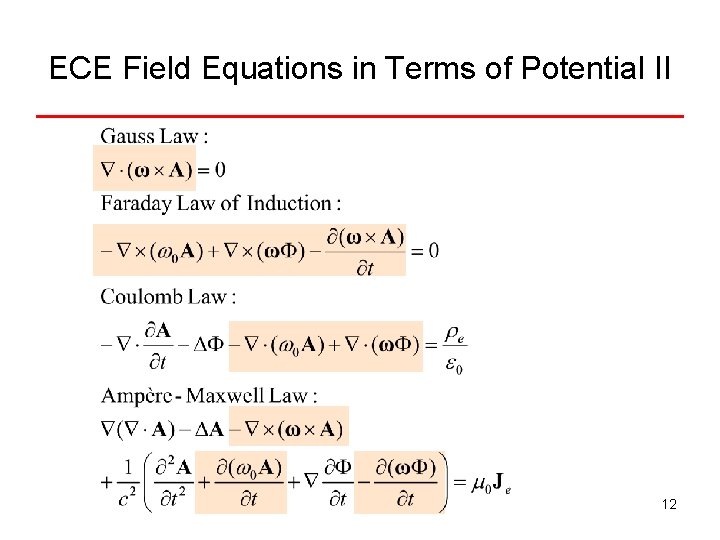
ECE Field Equations in Terms of Potential II 12
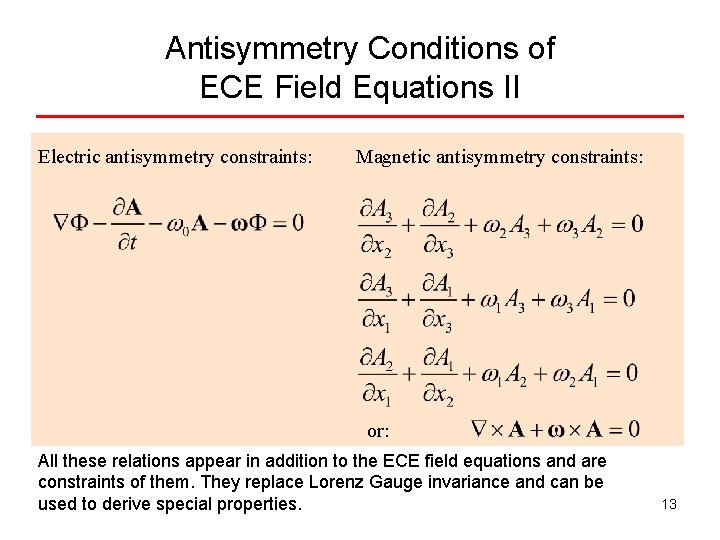
Antisymmetry Conditions of ECE Field Equations II Electric antisymmetry constraints: Magnetic antisymmetry constraints: or: All these relations appear in addition to the ECE field equations and are constraints of them. They replace Lorenz Gauge invariance and can be used to derive special properties. 13
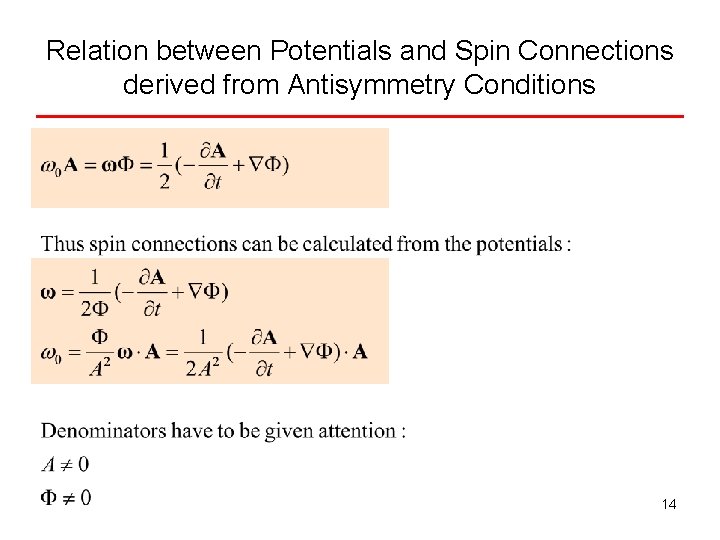
Relation between Potentials and Spin Connections derived from Antisymmetry Conditions 14
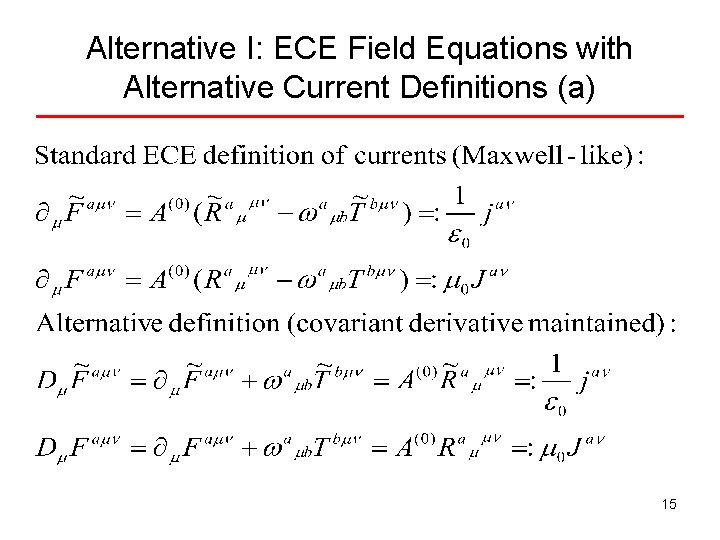
Alternative I: ECE Field Equations with Alternative Current Definitions (a) 15
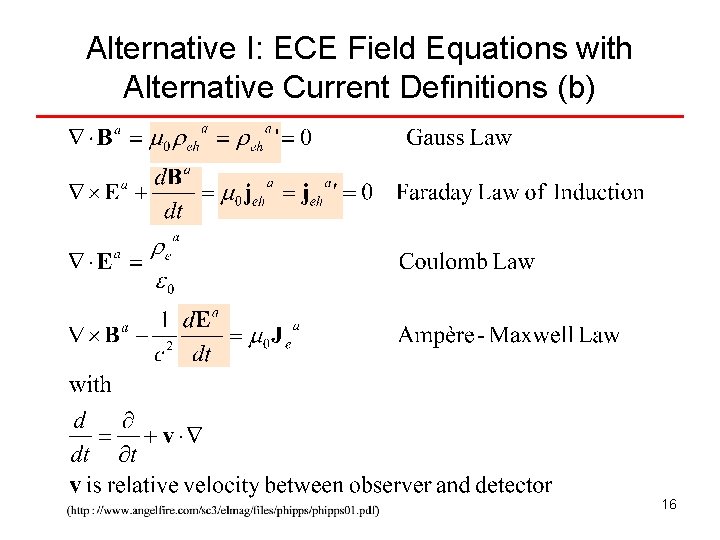
Alternative I: ECE Field Equations with Alternative Current Definitions (b) 16
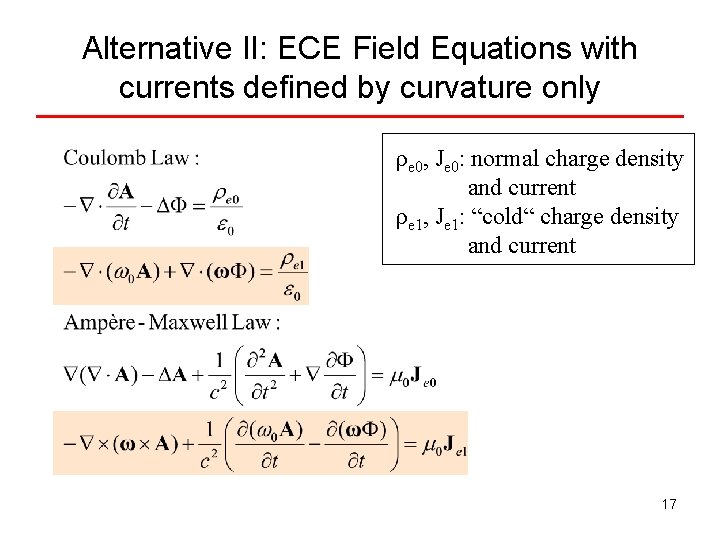
Alternative II: ECE Field Equations with currents defined by curvature only ρe 0, Je 0: normal charge density and current ρe 1, Je 1: “cold“ charge density and current 17
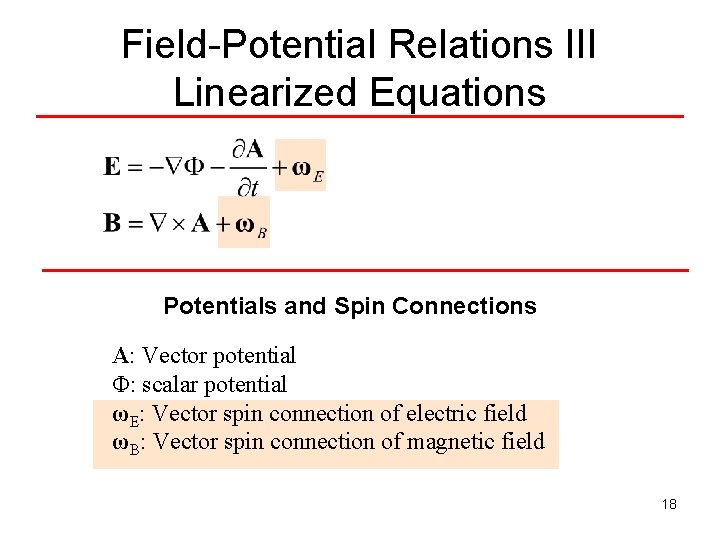
Field-Potential Relations III Linearized Equations Potentials and Spin Connections A: Vector potential Φ: scalar potential ωE: Vector spin connection of electric field ωB: Vector spin connection of magnetic field 18
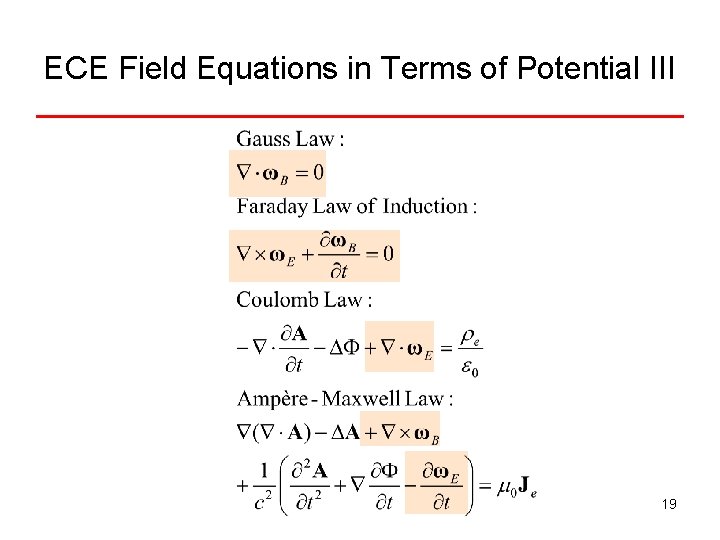
ECE Field Equations in Terms of Potential III 19
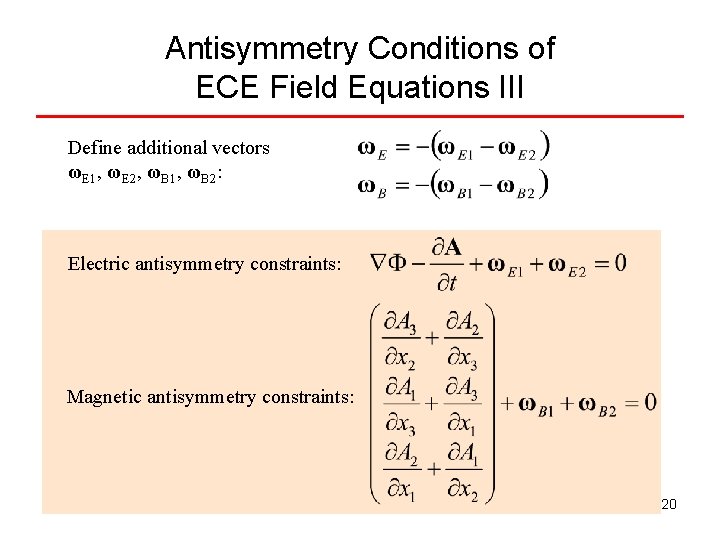
Antisymmetry Conditions of ECE Field Equations III Define additional vectors ωE 1, ωE 2, ωB 1, ωB 2: Electric antisymmetry constraints: Magnetic antisymmetry constraints: 20
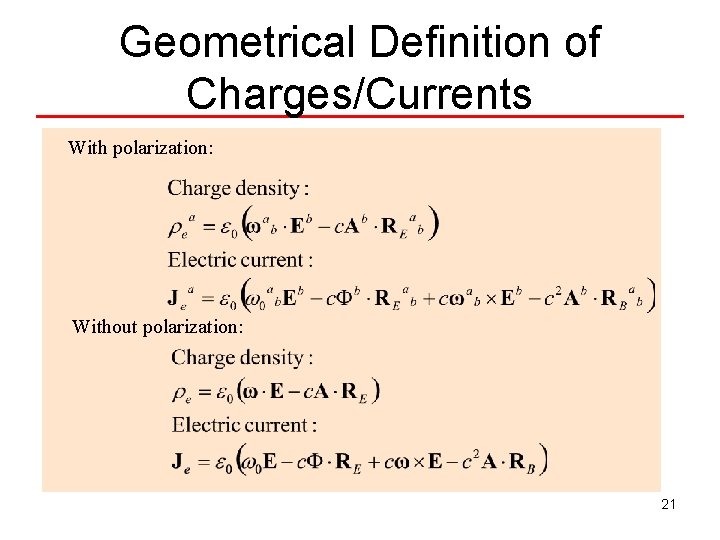
Geometrical Definition of Charges/Currents With polarization: Without polarization: 21
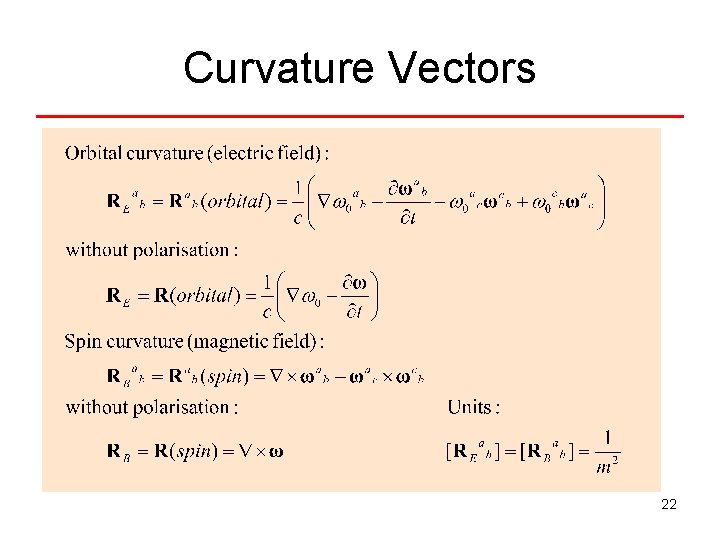
Curvature Vectors 22
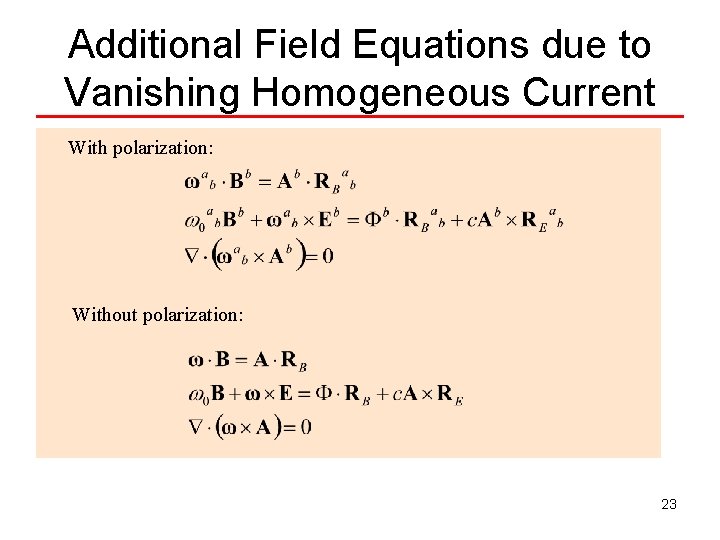
Additional Field Equations due to Vanishing Homogeneous Current With polarization: Without polarization: 23
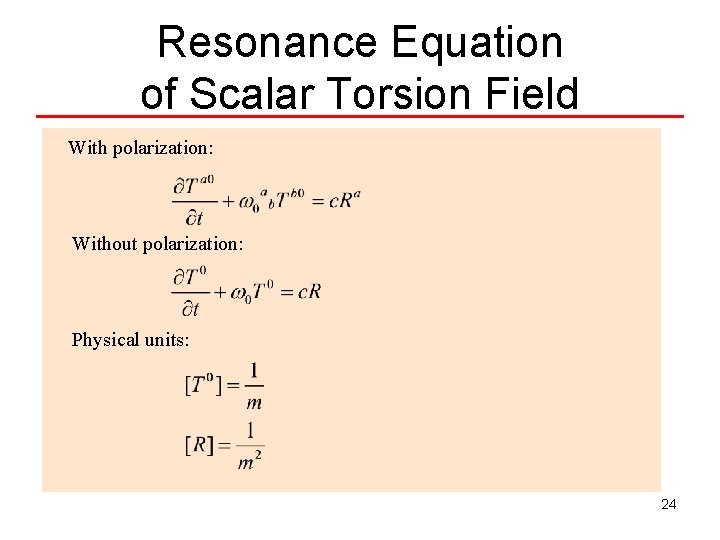
Resonance Equation of Scalar Torsion Field With polarization: Without polarization: Physical units: 24
Properties of ECE Equations • The ECE equations in potential representation define a well-defined equation system (8 equations with 8 unknows), can be reduced by antisymmetry conditions and additional constraints • There is much more structure in ECE than in standard theory (Maxwell-Heaviside) • There is no gauge freedom in ECE theory • In potential representation, the Gauss and Faraday law do not make sense in standard theory (see red fields) • Resonance structures (self-enforcing oscillations) are possible in Coulomb and Ampère-Maxwell law 25
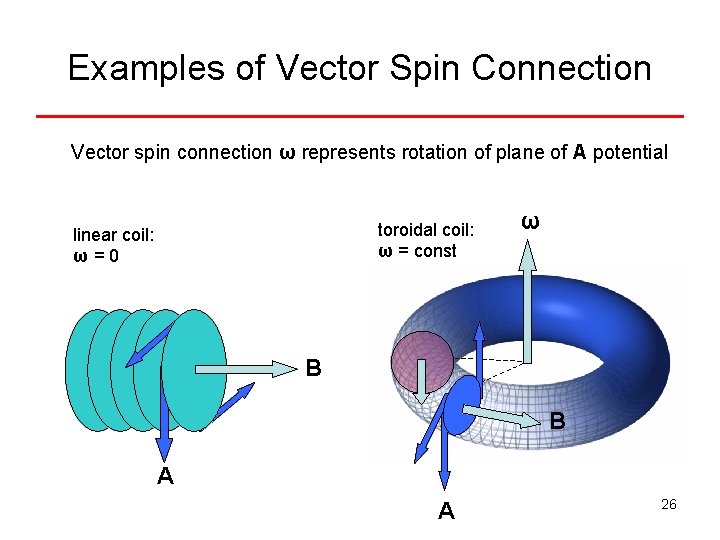
Examples of Vector Spin Connection Vector spin connection ω represents rotation of plane of A potential toroidal coil: ω = const linear coil: ω=0 ω B B A A 26
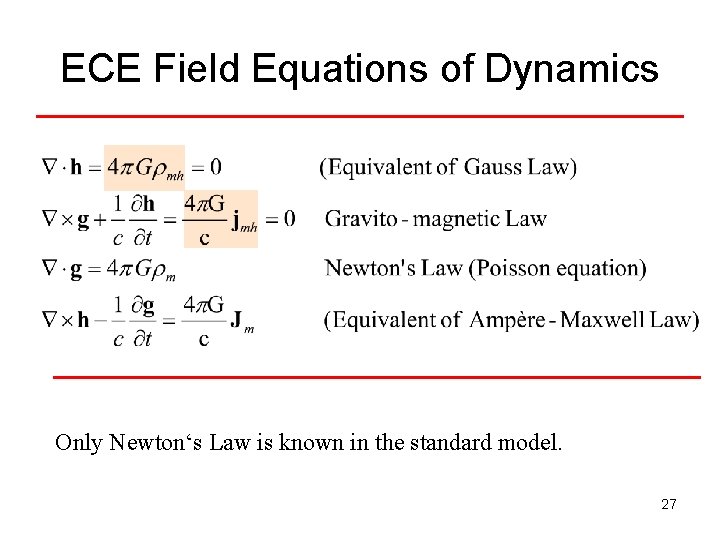
ECE Field Equations of Dynamics Only Newton‘s Law is known in the standard model. 27
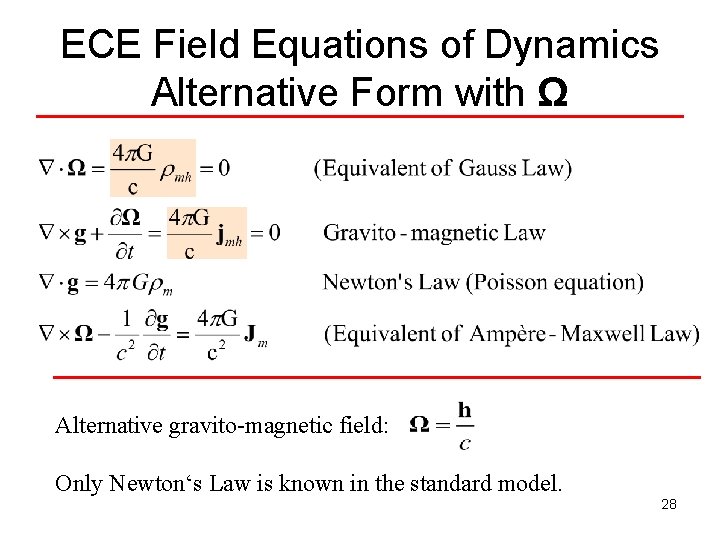
ECE Field Equations of Dynamics Alternative Form with Ω Alternative gravito-magnetic field: Only Newton‘s Law is known in the standard model. 28
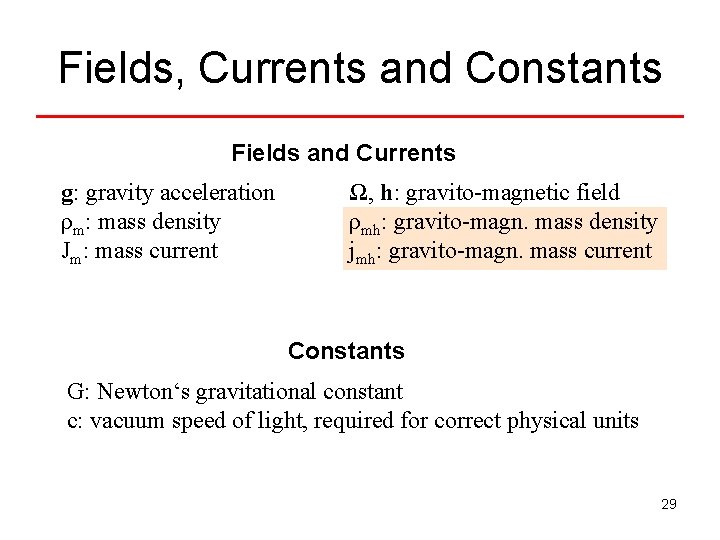
Fields, Currents and Constants Fields and Currents g: gravity acceleration ρm: mass density Jm: mass current Ω, h: gravito-magnetic field ρmh: gravito-magn. mass density jmh: gravito-magn. mass current Constants G: Newton‘s gravitational constant c: vacuum speed of light, required for correct physical units 29
![Force Equations Physical quantities and units F [N] M [Nm] T [1/m] g, h](http://slidetodoc.com/presentation_image_h2/97007e94538179b776f3c5a9a3bb1a9e/image-30.jpg "Force Equations Physical quantities and units F [N] M [Nm] T [1/m] g, h")
Force Equations Physical quantities and units F [N] M [Nm] T [1/m] g, h [m/s 2] m [kg] v [m/s] E 0=mc 2 [J] Θ [1/s] L [Nms] Force Torque Torsion Acceleration Mass velocity Rest energy Rotation axis vector Angular momentum 30
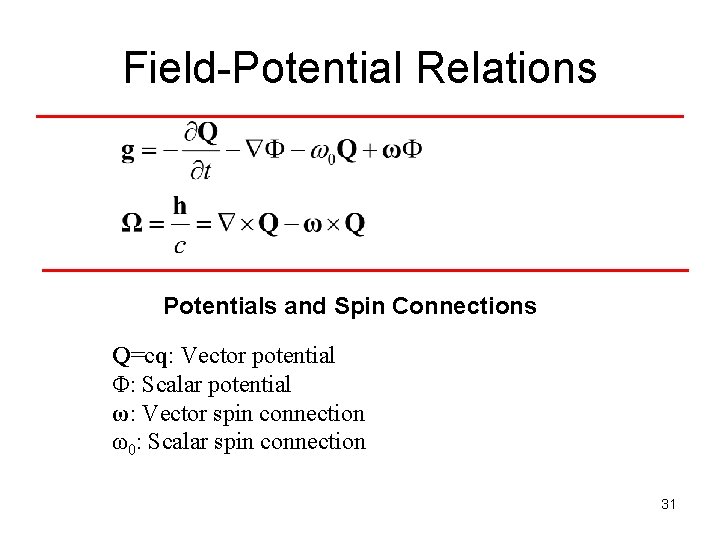
Field-Potential Relations Potentials and Spin Connections Q=cq: Vector potential Φ: Scalar potential ω: Vector spin connection ω0: Scalar spin connection 31
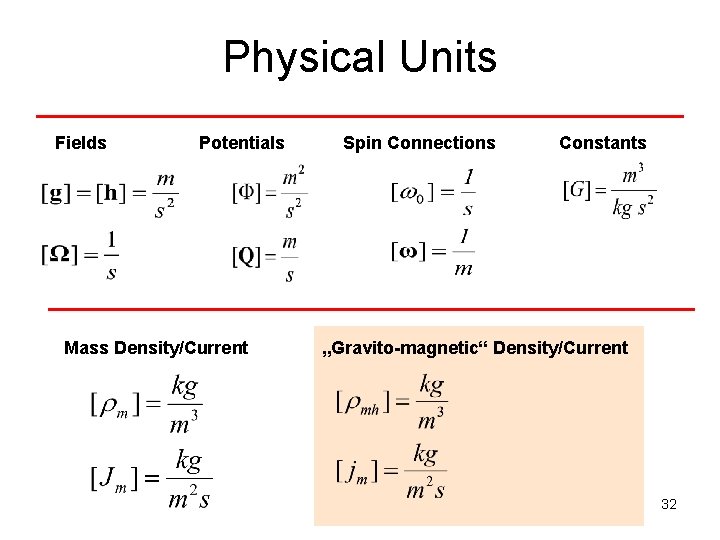
Physical Units Fields Potentials Mass Density/Current Spin Connections Constants „Gravito-magnetic“ Density/Current 32
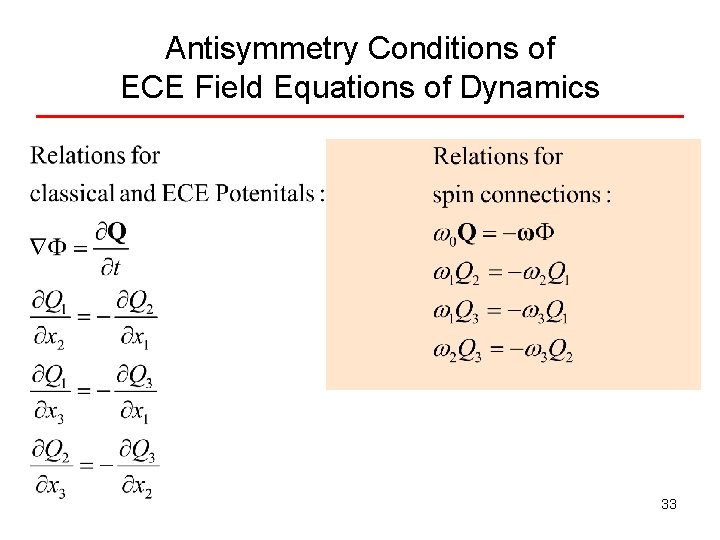
Antisymmetry Conditions of ECE Field Equations of Dynamics 33
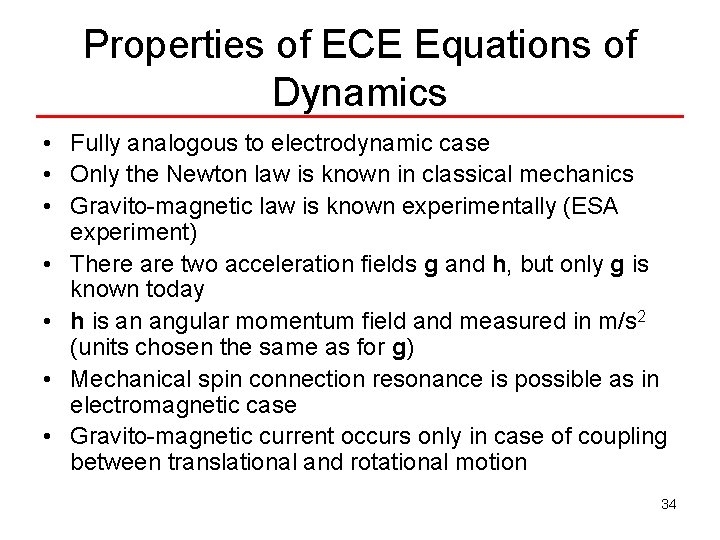
Properties of ECE Equations of Dynamics • Fully analogous to electrodynamic case • Only the Newton law is known in classical mechanics • Gravito-magnetic law is known experimentally (ESA experiment) • There are two acceleration fields g and h, but only g is known today • h is an angular momentum field and measured in m/s 2 (units chosen the same as for g) • Mechanical spin connection resonance is possible as in electromagnetic case • Gravito-magnetic current occurs only in case of coupling between translational and rotational motion 34
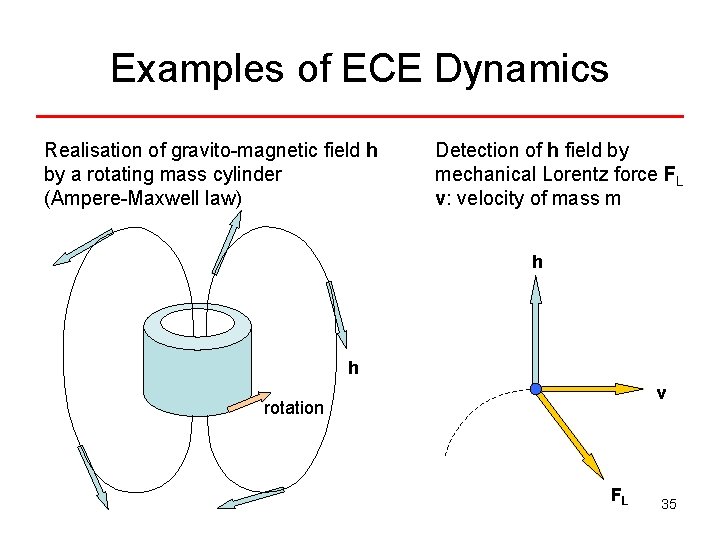
Examples of ECE Dynamics Realisation of gravito-magnetic field h by a rotating mass cylinder (Ampere-Maxwell law) Detection of h field by mechanical Lorentz force FL v: velocity of mass m h h v rotation FL 35
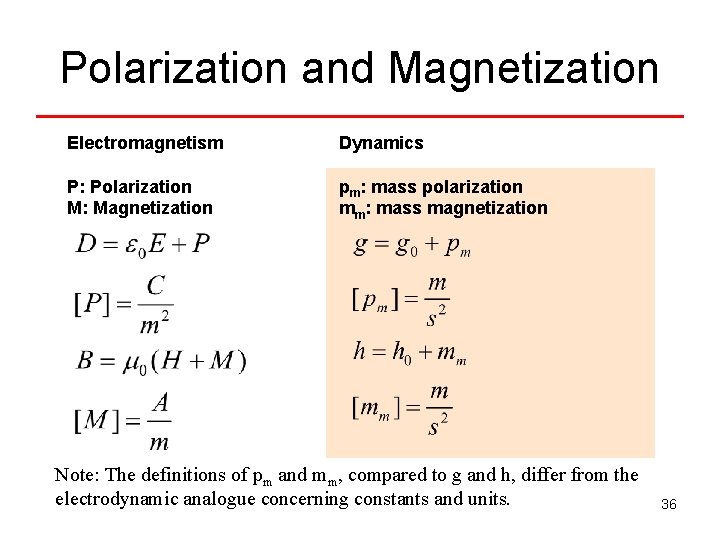
Polarization and Magnetization Electromagnetism Dynamics P: Polarization M: Magnetization pm: mass polarization mm: mass magnetization Note: The definitions of pm and mm, compared to g and h, differ from the electrodynamic analogue concerning constants and units. 36
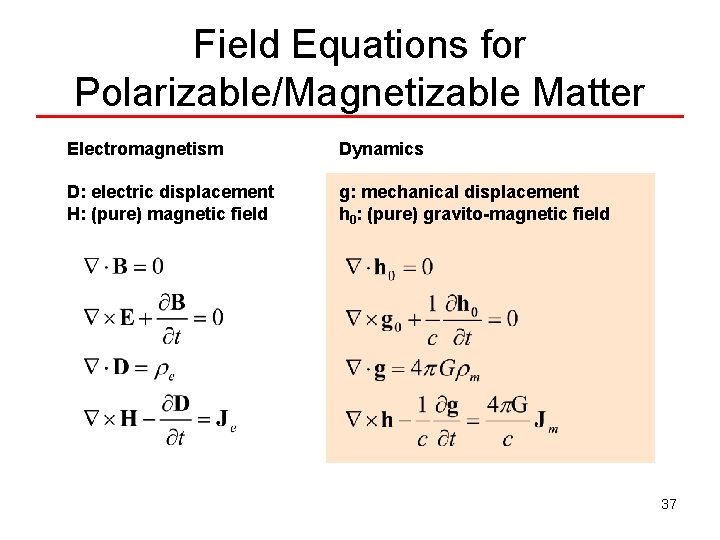
Field Equations for Polarizable/Magnetizable Matter Electromagnetism Dynamics D: electric displacement H: (pure) magnetic field g: mechanical displacement h 0: (pure) gravito-magnetic field 37
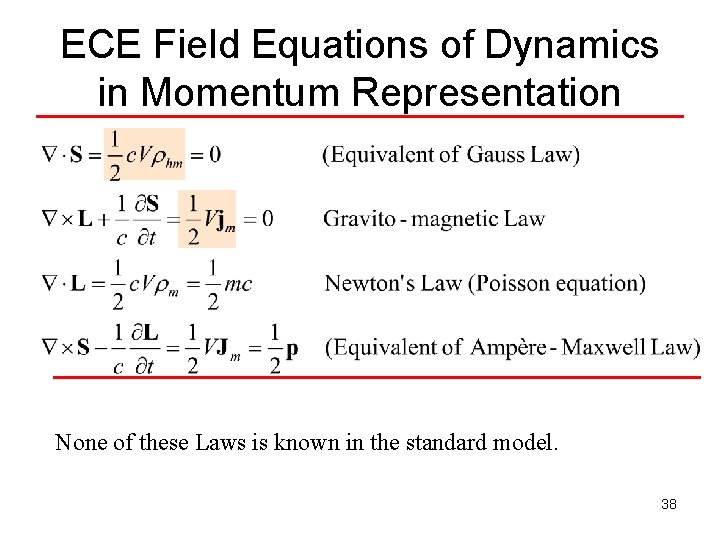
ECE Field Equations of Dynamics in Momentum Representation None of these Laws is known in the standard model. 38
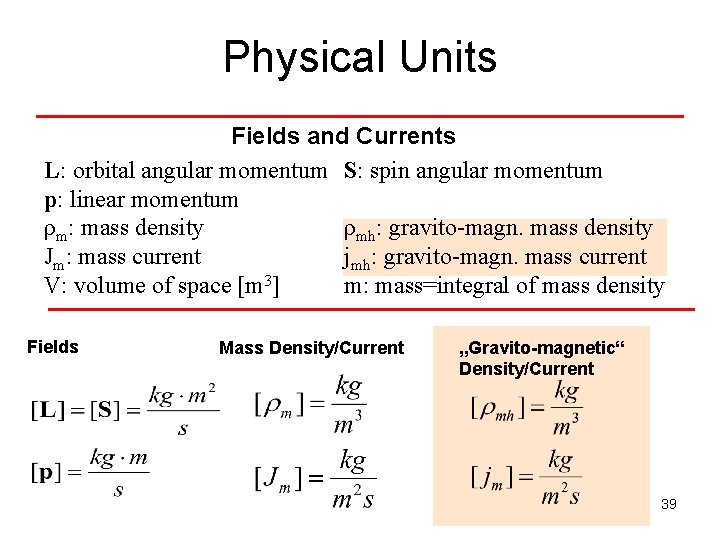
Physical Units Fields and Currents L: orbital angular momentum S: spin angular momentum p: linear momentum ρm: mass density ρmh: gravito-magn. mass density Jm: mass current jmh: gravito-magn. mass current V: volume of space [m 3] m: mass=integral of mass density Fields Mass Density/Current „Gravito-magnetic“ Density/Current 39
- Slides: 39