
ECE 671 Lecture 19 Available Bit Rate Streaming

ECE 671 – Lecture 19 Available Bit Rate Streaming © 2018 Tilman Wolf & Mike Zink
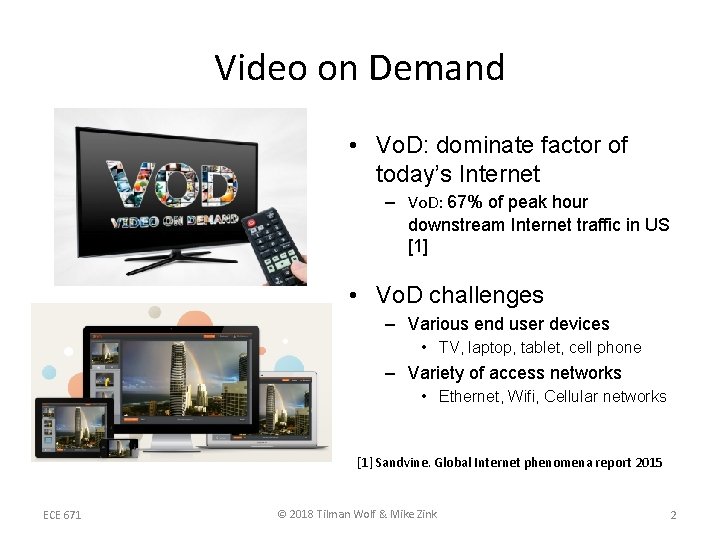
Video on Demand • Vo. D: dominate factor of today’s Internet – Vo. D: 67% of peak hour downstream Internet traffic in US [1] • Vo. D challenges – Various end user devices • TV, laptop, tablet, cell phone – Variety of access networks • Ethernet, Wifi, Cellular networks [1] Sandvine. Global Internet phenomena report 2015 ECE 671 © 2018 Tilman Wolf & Mike Zink 2
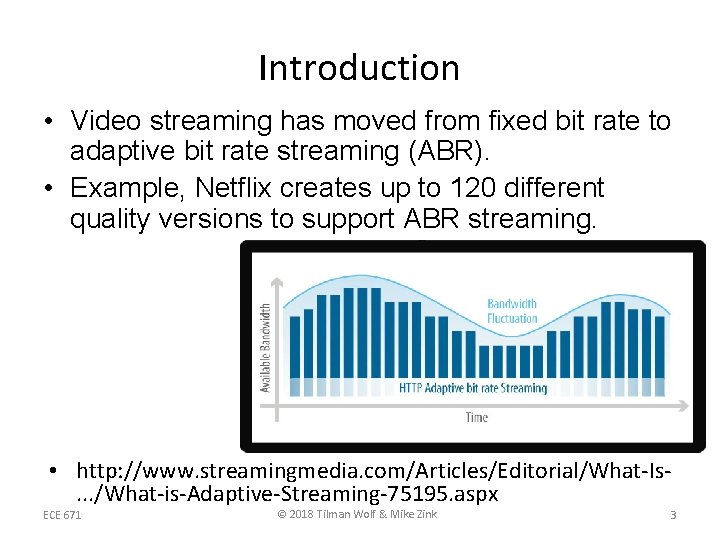
Introduction • Video streaming has moved from fixed bit rate to adaptive bit rate streaming (ABR). • Example, Netflix creates up to 120 different quality versions to support ABR streaming. • http: //www. streamingmedia. com/Articles/Editorial/What-Is. . . /What-is-Adaptive-Streaming-75195. aspx ECE 671 © 2018 Tilman Wolf & Mike Zink 3

Adaptive Streaming Solutions • • Microsoft Smooth. Stream Apple HTTP Live Streaming (HLS) Adobe HTTP Dynamic Streaming (HDS) MPEG – Dynamic Adaptive Streaming over HTTP (DASH) ECE 671 © 2018 Tilman Wolf & Mike Zink 4
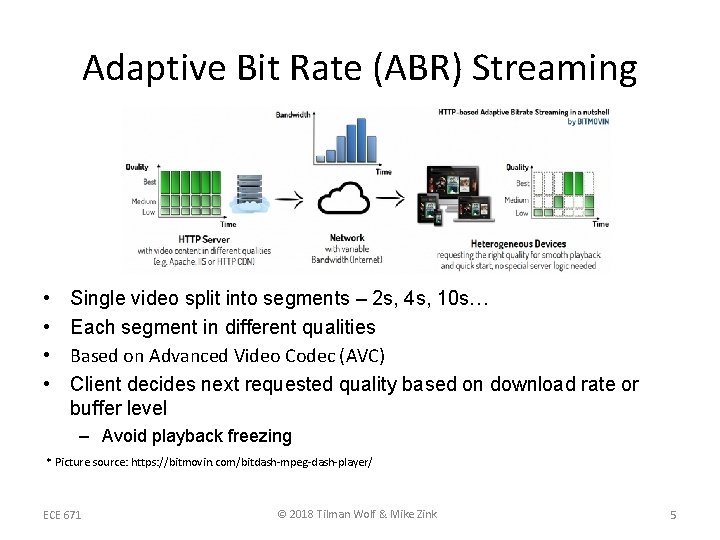
Adaptive Bit Rate (ABR) Streaming • • Single video split into segments – 2 s, 4 s, 10 s… Each segment in different qualities Based on Advanced Video Codec (AVC) Client decides next requested quality based on download rate or buffer level – Avoid playback freezing * Picture source: https: //bitmovin. com/bitdash-mpeg-dash-player/ ECE 671 © 2018 Tilman Wolf & Mike Zink 5
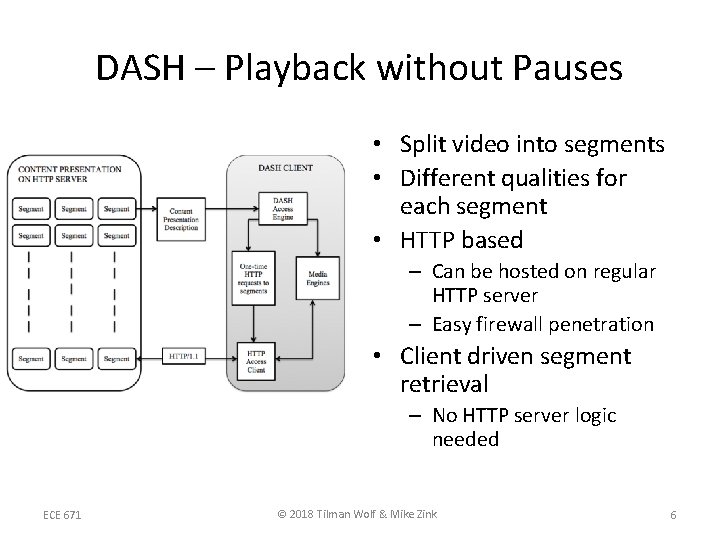
DASH – Playback without Pauses • Split video into segments • Different qualities for each segment • HTTP based – Can be hosted on regular HTTP server – Easy firewall penetration • Client driven segment retrieval – No HTTP server logic needed ECE 671 © 2018 Tilman Wolf & Mike Zink 6
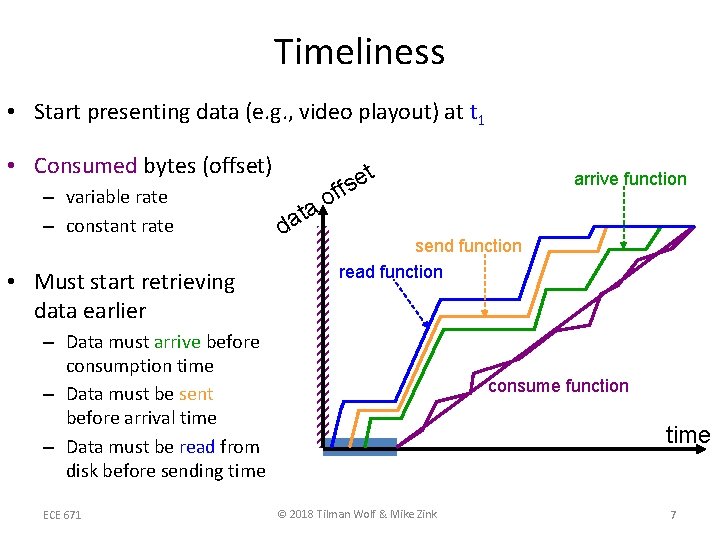
Timeliness • Start presenting data (e. g. , video playout) at t 1 • Consumed bytes (offset) – variable rate – constant rate • Must start retrieving data earlier ta a d t e s off send function read function – Data must arrive before consumption time – Data must be sent before arrival time – Data must be read from disk before sending time ECE 671 arrive function consume function time © 2018 Tilman Wolf & Mike Zink 7
Quality Adaptation Issues • Identify existing issues with current rate estimation approaches • Improve Qo. E – Prevent re-buffering – Reduce quality changes – Keep average quality as high as possible • No server modifications work with any web server • Evaluate new approach in testbed and real-world scenario ECE 671 © 2018 Tilman Wolf & Mike Zink 8
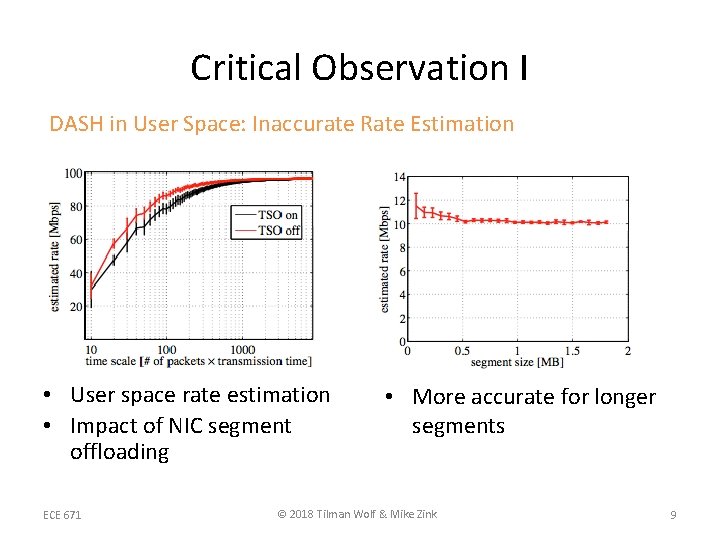
Critical Observation I DASH in User Space: Inaccurate Rate Estimation • User space rate estimation • Impact of NIC segment offloading ECE 671 • More accurate for longer segments © 2018 Tilman Wolf & Mike Zink 9
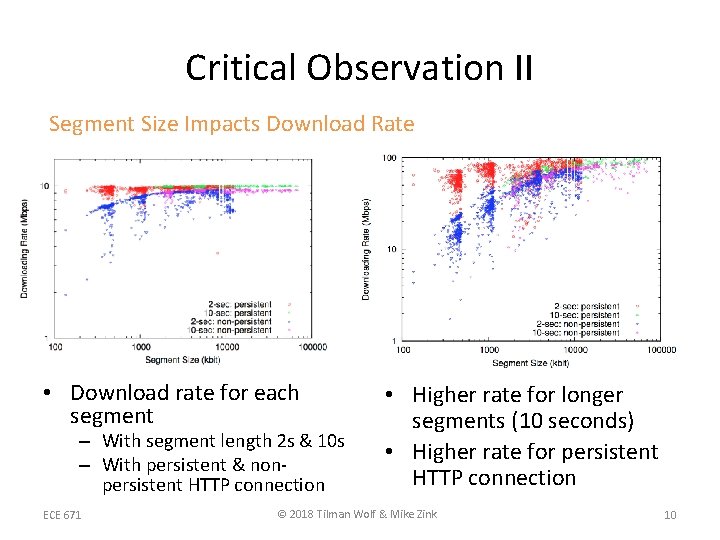
Critical Observation II Segment Size Impacts Download Rate • Download rate for each segment – With segment length 2 s & 10 s – With persistent & nonpersistent HTTP connection ECE 671 • Higher rate for longer segments (10 seconds) • Higher rate for persistent HTTP connection © 2018 Tilman Wolf & Mike Zink 10
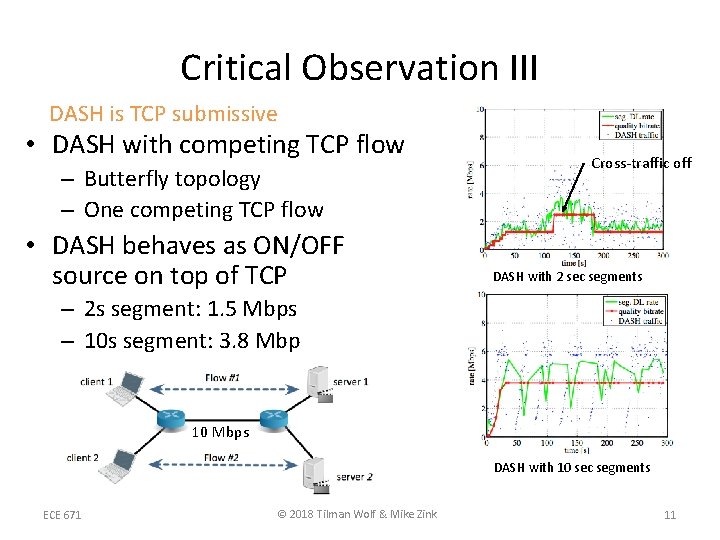
Critical Observation III DASH is TCP submissive • DASH with competing TCP flow – Butterfly topology – One competing TCP flow • DASH behaves as ON/OFF source on top of TCP Cross-traffic off DASH with 2 sec segments – 2 s segment: 1. 5 Mbps – 10 s segment: 3. 8 Mbp 10 Mbps DASH with 10 sec segments ECE 671 © 2018 Tilman Wolf & Mike Zink 11
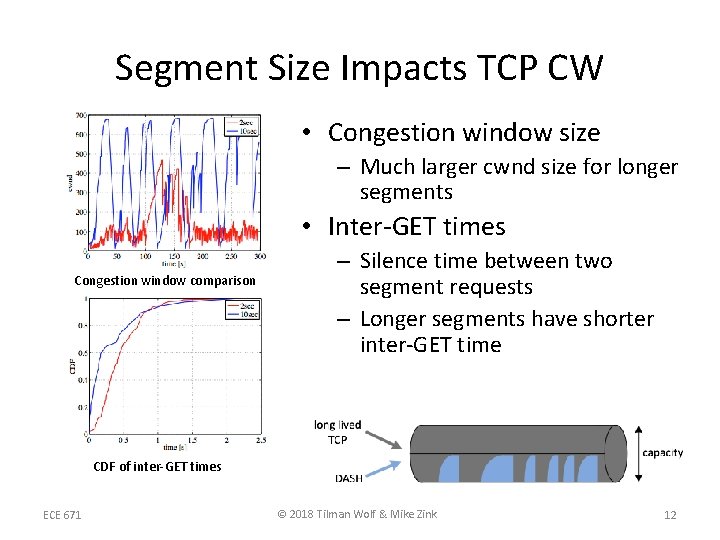
Segment Size Impacts TCP CW • Congestion window size – Much larger cwnd size for longer segments • Inter-GET times Congestion window comparison – Silence time between two segment requests – Longer segments have shorter inter-GET time CDF of inter-GET times ECE 671 © 2018 Tilman Wolf & Mike Zink 12
- Slides: 12