
ECE 638 Principles of Digital Color Imaging Systems
- Slides: 21
ECE 638: Principles of Digital Color Imaging Systems Lecture 13: Uniform Color Spaces
Synopsis l l l Nonlinearity of the HVS – Weber’s Law Color Order systems Mac. Adam ellipses Requirements for a uniform color space 1976 CIE L*u*v* uniform color space 1976 CIE L*a*b* uniform color space
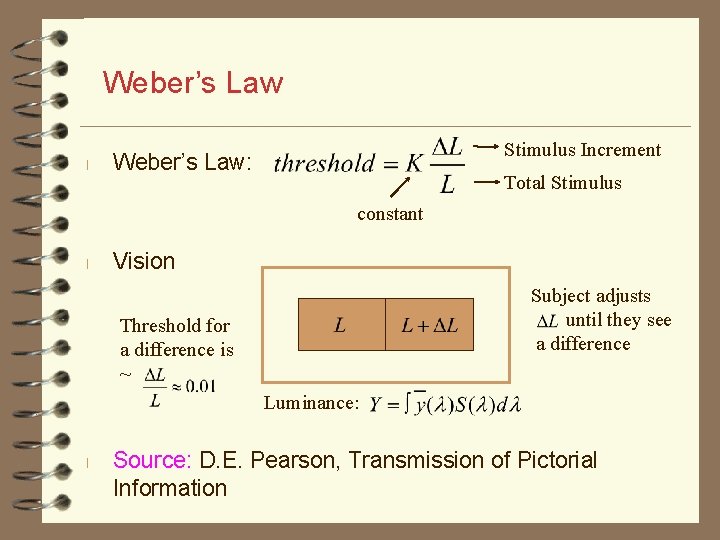
Weber’s Law l Stimulus Increment Weber’s Law: Total Stimulus constant l Vision Subject adjusts until they see a difference Threshold for a difference is ~ Luminance: l Source: D. E. Pearson, Transmission of Pictorial Information
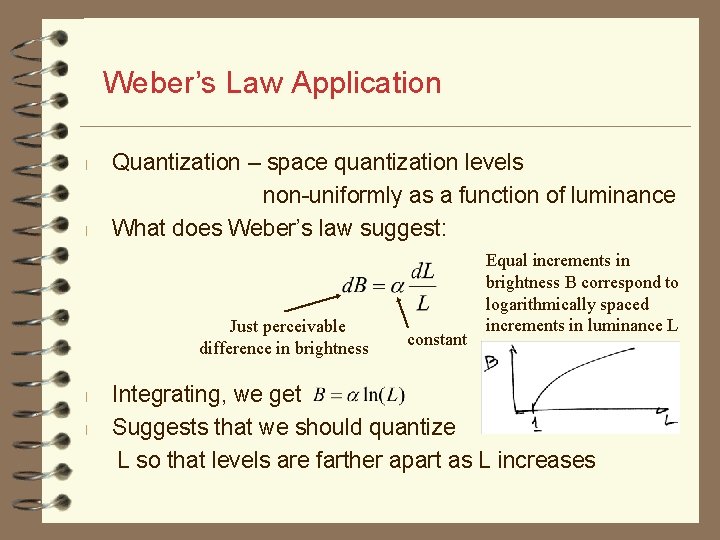
Weber’s Law Application l l Quantization – space quantization levels non-uniformly as a function of luminance What does Weber’s law suggest: Just perceivable difference in brightness l l constant Equal increments in brightness B correspond to logarithmically spaced increments in luminance L Integrating, we get Suggests that we should quantize L so that levels are farther apart as L increases
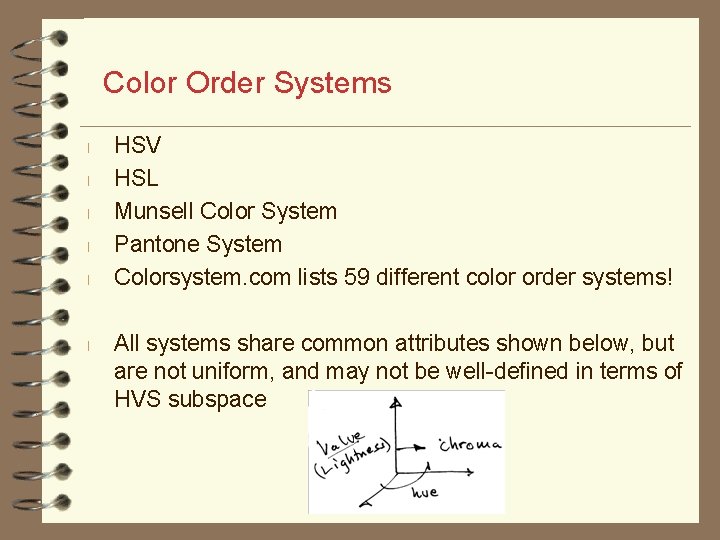
Color Order Systems l l l HSV HSL Munsell Color System Pantone System Colorsystem. com lists 59 different color order systems! All systems share common attributes shown below, but are not uniform, and may not be well-defined in terms of HVS subspace
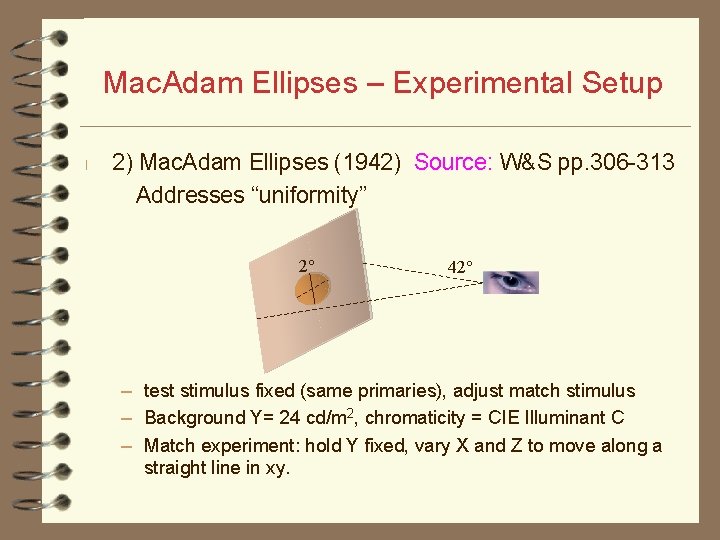
Mac. Adam Ellipses – Experimental Setup l 2) Mac. Adam Ellipses (1942) Source: W&S pp. 306 -313 Addresses “uniformity” 2° 42° – test stimulus fixed (same primaries), adjust match stimulus – Background Y= 24 cd/m 2, chromaticity = CIE Illuminant C – Match experiment: hold Y fixed, vary X and Z to move along a straight line in xy.
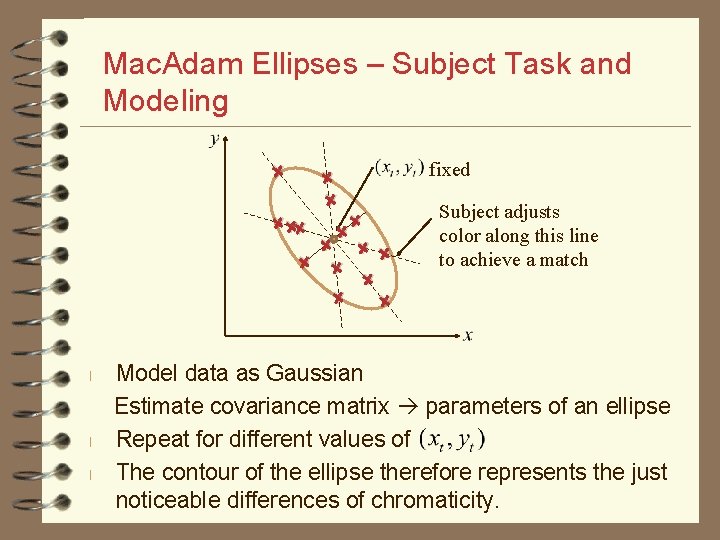
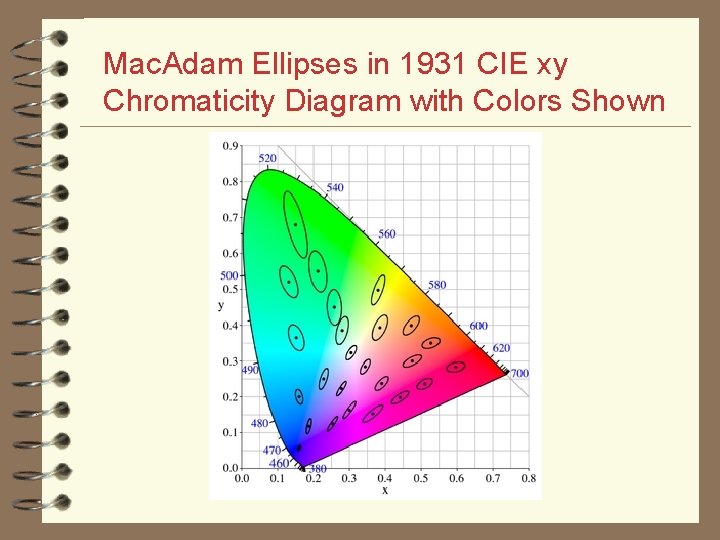
Mac. Adam Ellipses – Subject Task and Modeling fixed Subject adjusts color along this line to achieve a match l l l Model data as Gaussian Estimate covariance matrix parameters of an ellipse Repeat for different values of The contour of the ellipse therefore represents the just noticeable differences of chromaticity.
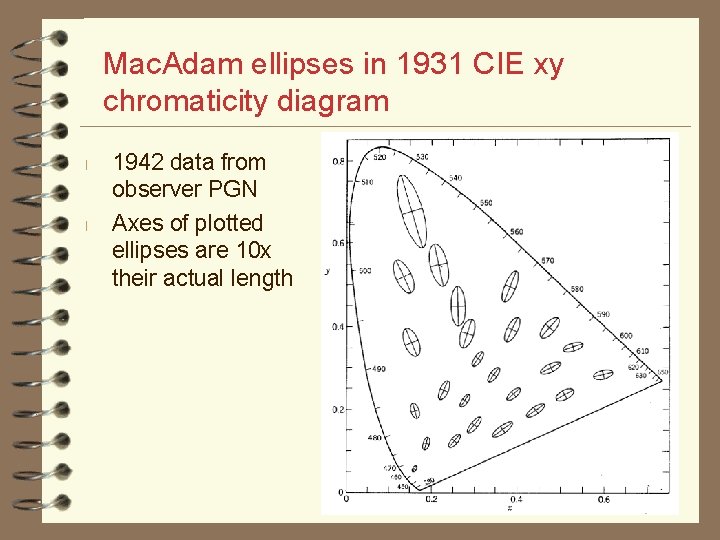
Mac. Adam ellipses in 1931 CIE xy chromaticity diagram l l 1942 data from observer PGN Axes of plotted ellipses are 10 x their actual length
Mac. Adam Ellipses in 1931 CIE xy Chromaticity Diagram with Colors Shown
Desired Properties for a Uniform Color Space l l 1) Uniformity Mac. Adam ellipses should be circular with constant radius through out the color space. 2) Axes should correspond to perceptually relevant parameters (Perceptually relevant parameters should be easily identifiable). 3) There should be a well-defined transformation from a color space that spans the HVS subspace to the uniform color space. 4) The transformation should be invertible.
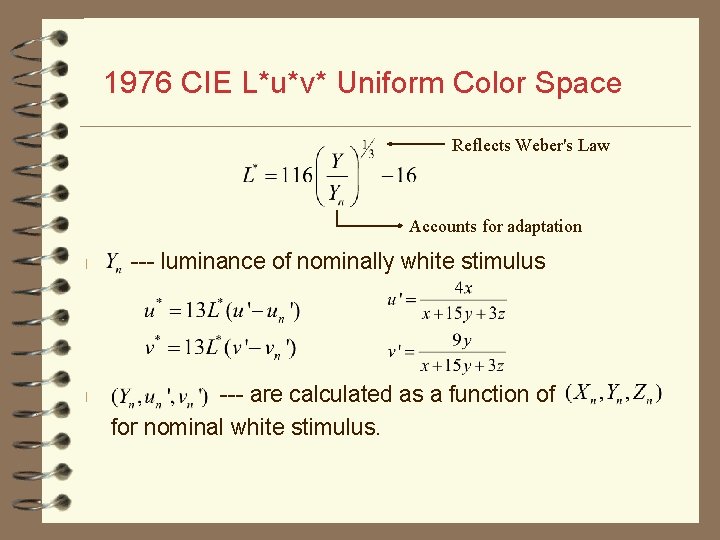
1976 CIE L*u*v* Uniform Color Space Reflects Weber's Law Accounts for adaptation l l --- luminance of nominally white stimulus --- are calculated as a function of for nominal white stimulus.
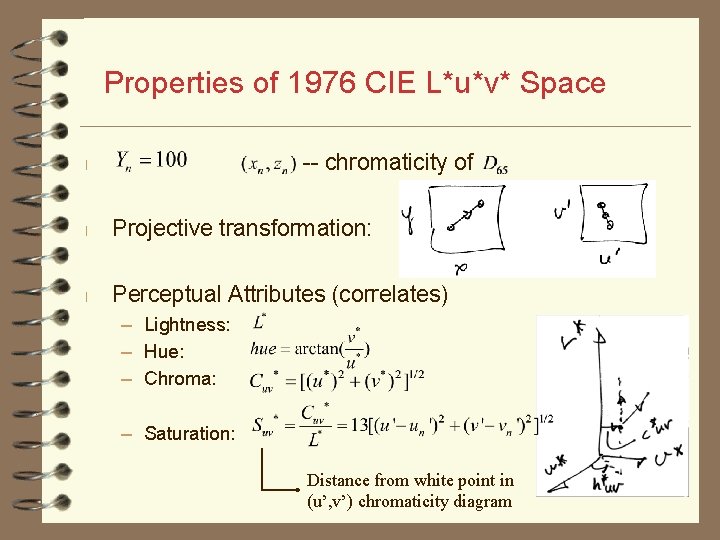
Properties of 1976 CIE L*u*v* Space -- chromaticity of l l Projective transformation: l Perceptual Attributes (correlates) – Lightness: – Hue: – Chroma: – Saturation: Distance from white point in (u’, v’) chromaticity diagram
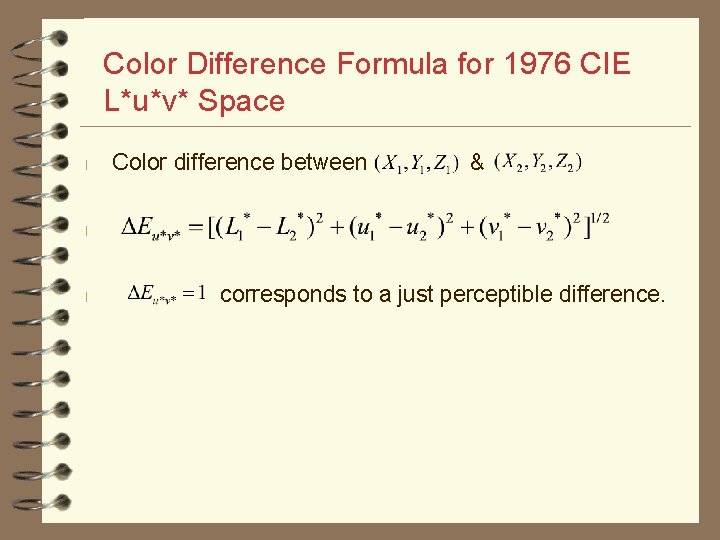
Color Difference Formula for 1976 CIE L*u*v* Space l Color difference between & l l corresponds to a just perceptible difference.
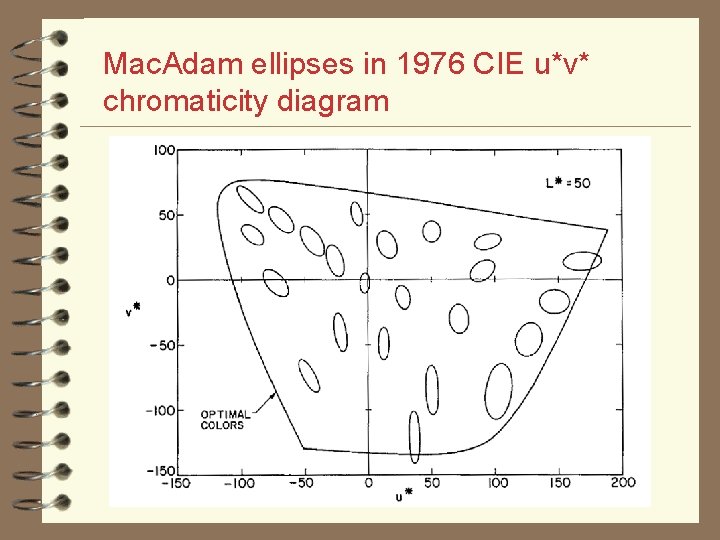
Mac. Adam ellipses in 1976 CIE u*v* chromaticity diagram l text
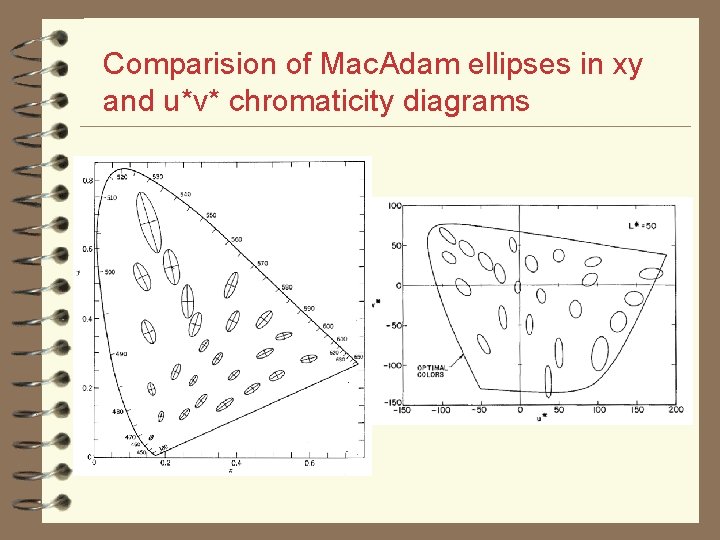
Comparision of Mac. Adam ellipses in xy and u*v* chromaticity diagrams l text
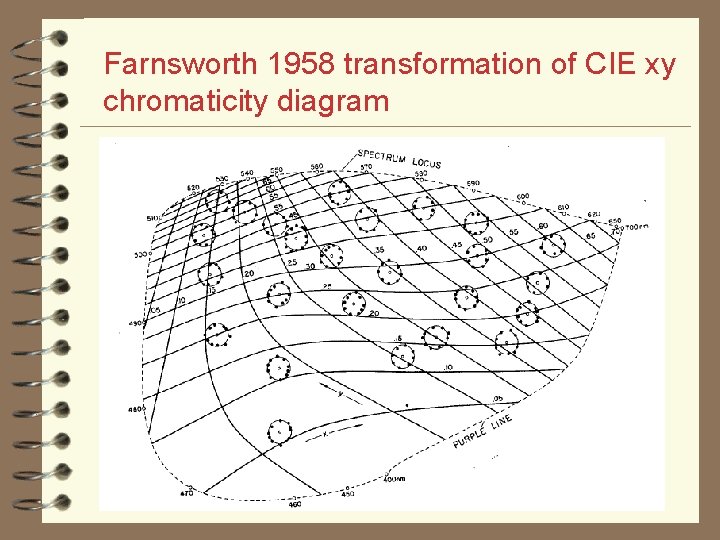
Farnsworth 1958 transformation of CIE xy chromaticity diagram l text
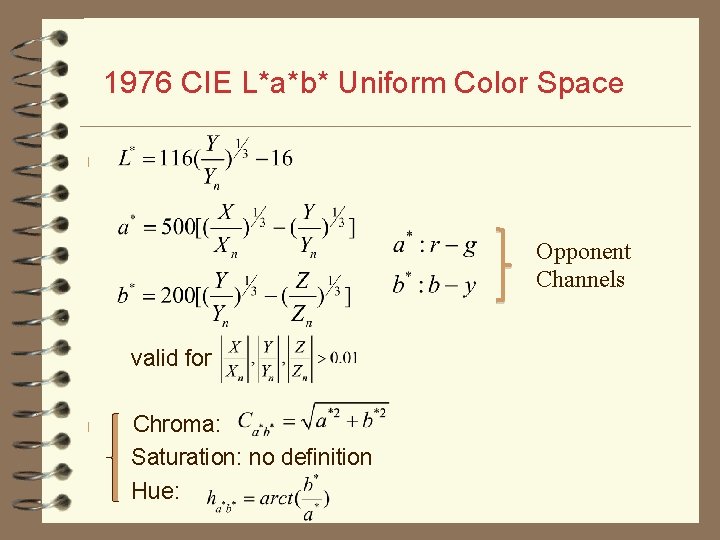
1976 CIE L*a*b* Uniform Color Space l Opponent Channels valid for l Chroma: Saturation: no definition Hue:
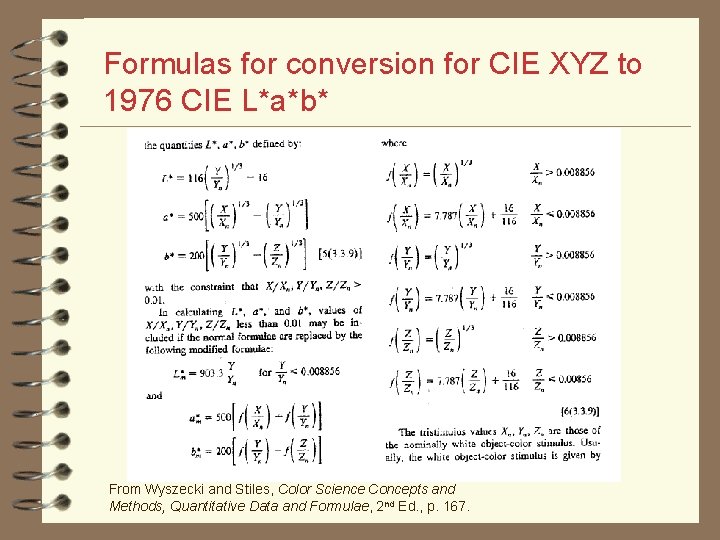
Formulas for conversion for CIE XYZ to 1976 CIE L*a*b* From Wyszecki and Stiles, Color Science Concepts and Methods, Quantitative Data and Formulae, 2 nd Ed. , p. 167.
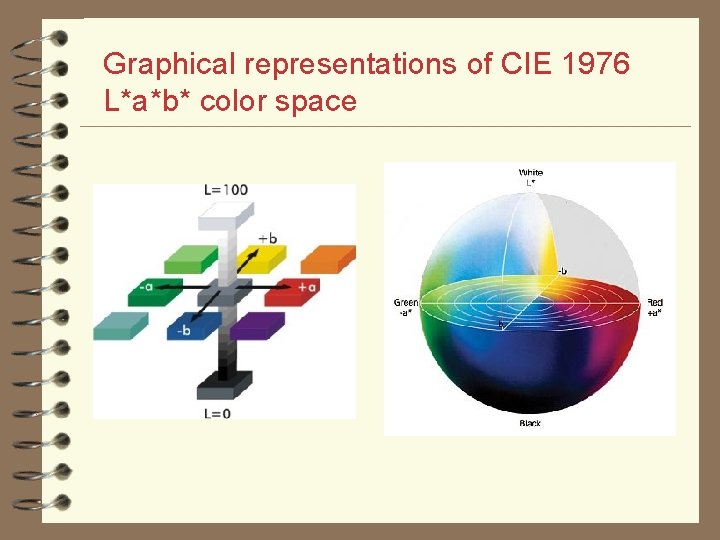
Graphical representations of CIE 1976 L*a*b* color space l text
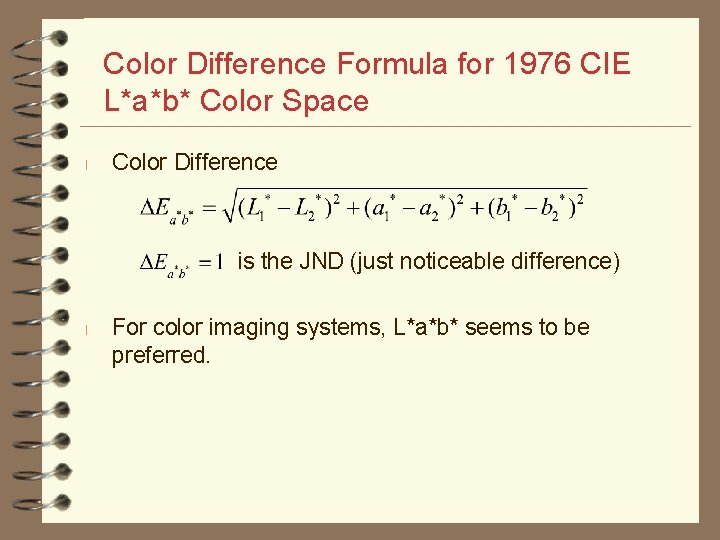
Color Difference Formula for 1976 CIE L*a*b* Color Space l Color Difference is the JND (just noticeable difference) l For color imaging systems, L*a*b* seems to be preferred.
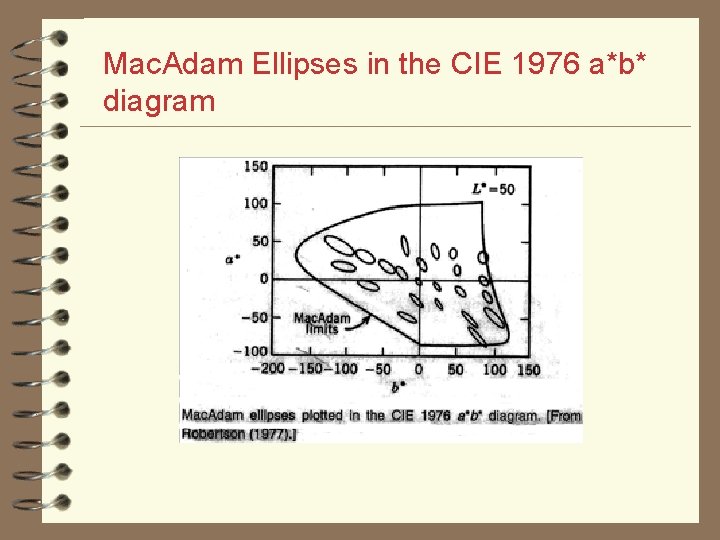
Mac. Adam Ellipses in the CIE 1976 a*b* diagram