
ECE 5984 Introduction to Machine Learning Topics Finish
- Slides: 42
ECE 5984: Introduction to Machine Learning Topics: – (Finish) Model selection – Error decomposition – Bias-Variance Tradeoff – Classification: Naïve Bayes Readings: Barber 17. 1, 17. 2, 10. 1 -10. 3 Dhruv Batra Virginia Tech
Administrativia • HW 2 – Due: Friday 03/06, 11: 55 pm – Implement linear regression, Naïve Bayes, Logistic Regression • Need a couple of catch-up lectures – How about 4 -6 pm? (C) Dhruv Batra 2
Administrativia • Mid-term – When: March 18, class timing – Where: In class – Format: Pen-and-paper. – Open-book, open-notes, closed-internet. • No sharing. – What to expect: mix of • Multiple Choice or True/False questions • “Prove this statement” • “What would happen for this dataset? ” – Material • Everything from beginning to class to (including) SVMs (C) Dhruv Batra 3
Recap of last time (C) Dhruv Batra 4
Regression (C) Dhruv Batra 5
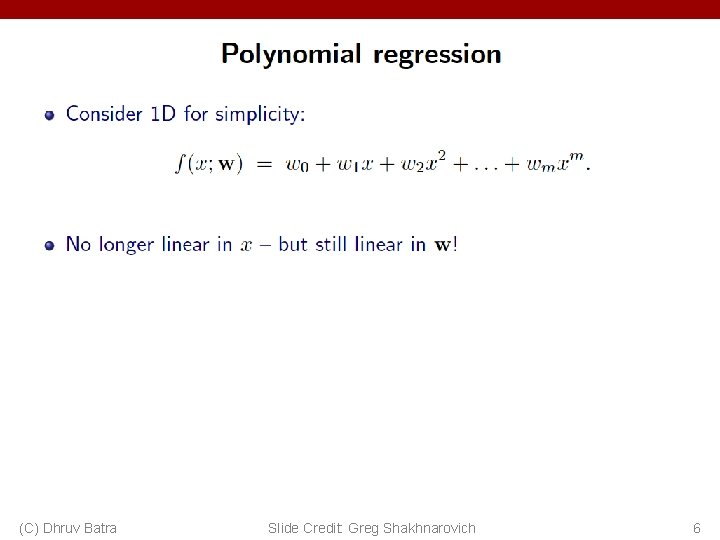
(C) Dhruv Batra Slide Credit: Greg Shakhnarovich 6
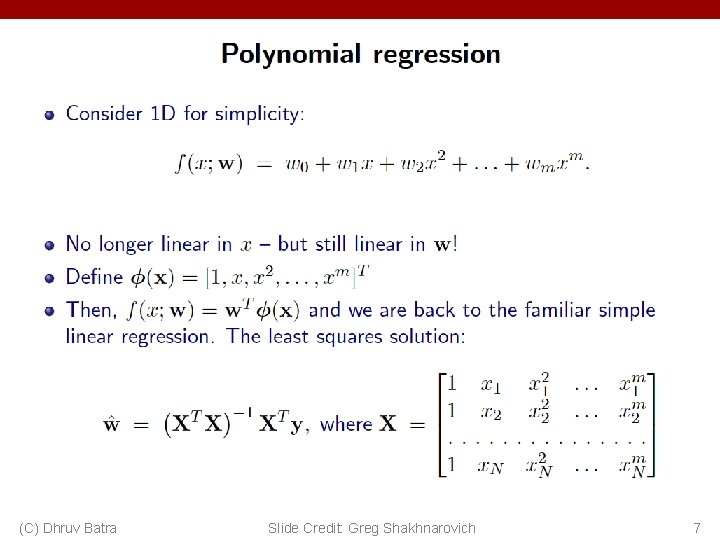
(C) Dhruv Batra Slide Credit: Greg Shakhnarovich 7
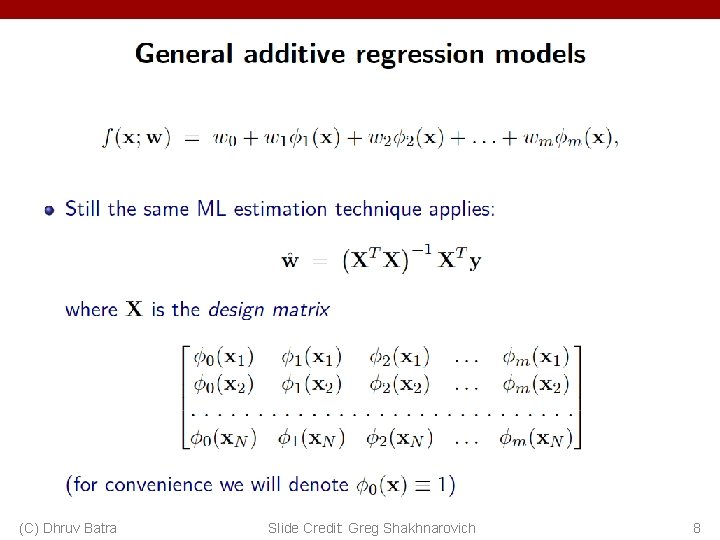
(C) Dhruv Batra Slide Credit: Greg Shakhnarovich 8
What you need to know • Linear Regression – – – (C) Dhruv Batra Model Least Squares Objective Connections to Max Likelihood with Gaussian Conditional Robust regression with Laplacian Likelihood Ridge Regression with priors Polynomial and General Additive Regression 9
Plan for Today • (Finish) Model Selection – Overfitting vs Underfitting – Bias-Variance trade-off • aka Modeling error vs Estimation error tradeoff • Naïve Bayes (C) Dhruv Batra 10
New Topic: Model Selection and Error Decomposition (C) Dhruv Batra 11
Example for Regression • Demo – http: //www. princeton. edu/~rkatzwer/Polynomial. Regression/ • How do we pick the hypothesis class? (C) Dhruv Batra 12
Model Selection • How do we pick the right model class? • Similar questions – How do I pick magic hyper-parameters? – How do I do feature selection? (C) Dhruv Batra 13
Errors • Expected Loss/Error • Training Loss/Error • Validation Loss/Error • Test Loss/Error • Reporting Training Error (instead of Test) is CHEATING • Optimizing parameters on Test Error is CHEATING (C) Dhruv Batra 14
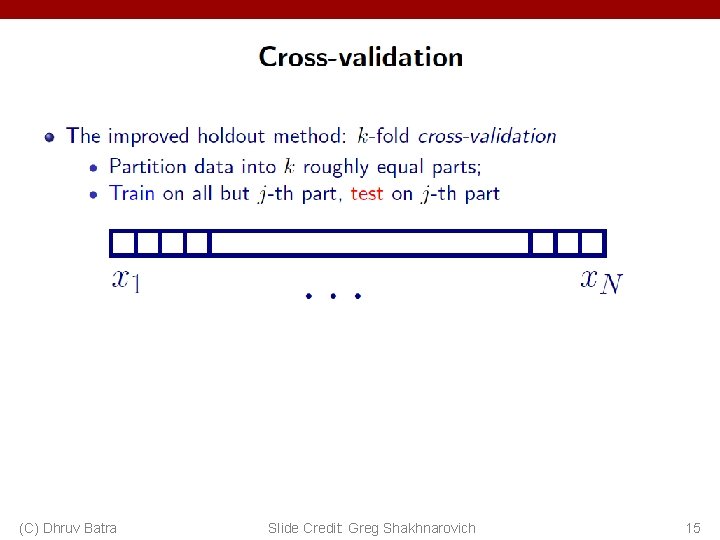
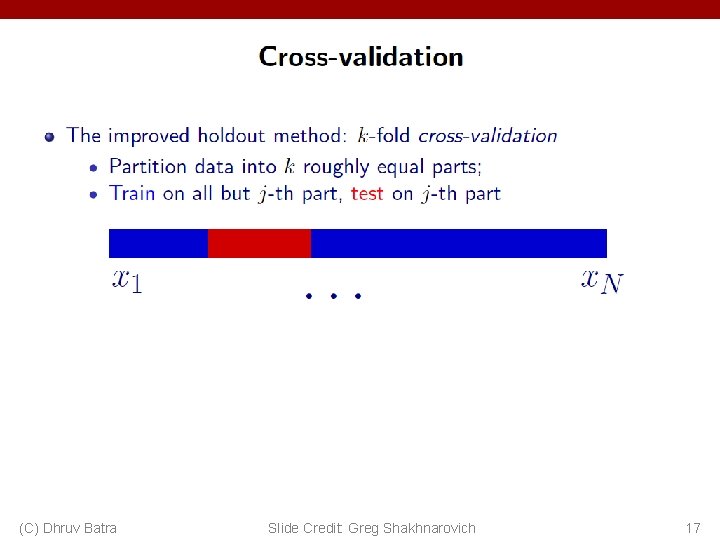
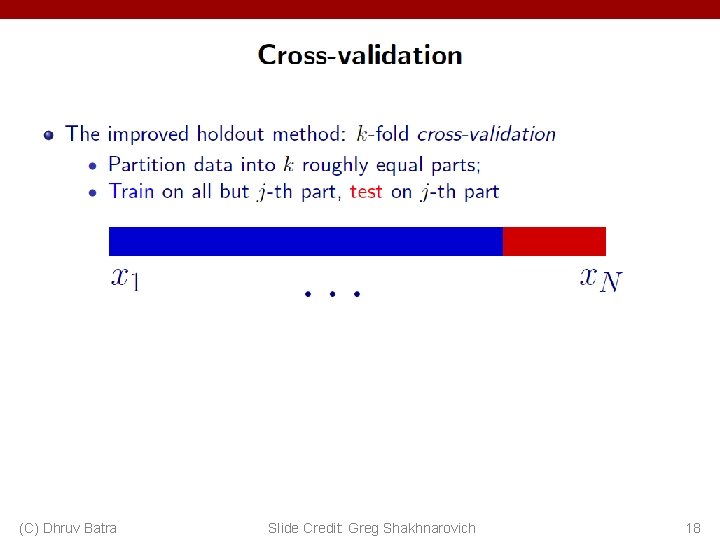
(C) Dhruv Batra Slide Credit: Greg Shakhnarovich 15
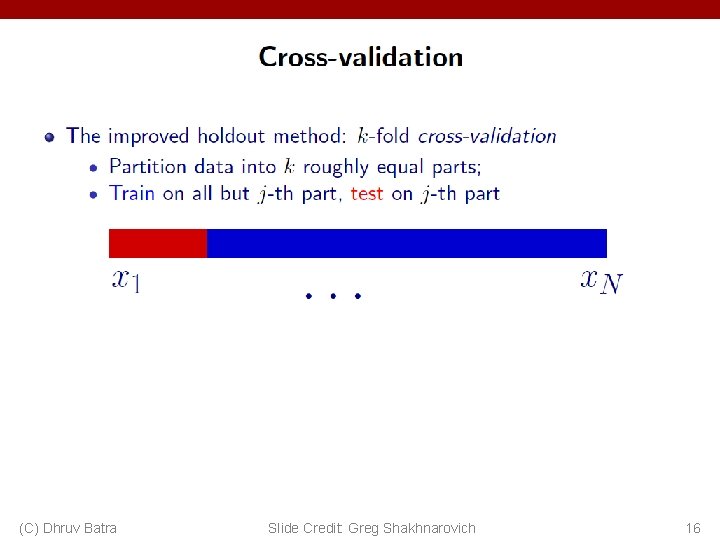
(C) Dhruv Batra Slide Credit: Greg Shakhnarovich 16
(C) Dhruv Batra Slide Credit: Greg Shakhnarovich 17
(C) Dhruv Batra Slide Credit: Greg Shakhnarovich 18
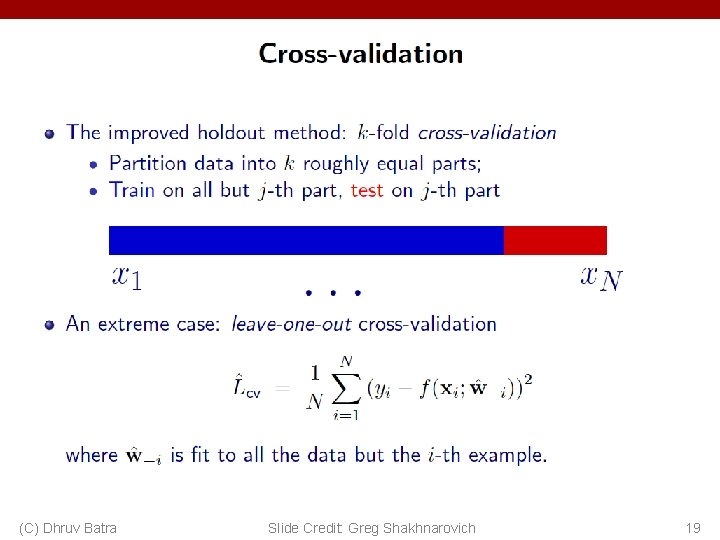
(C) Dhruv Batra Slide Credit: Greg Shakhnarovich 19
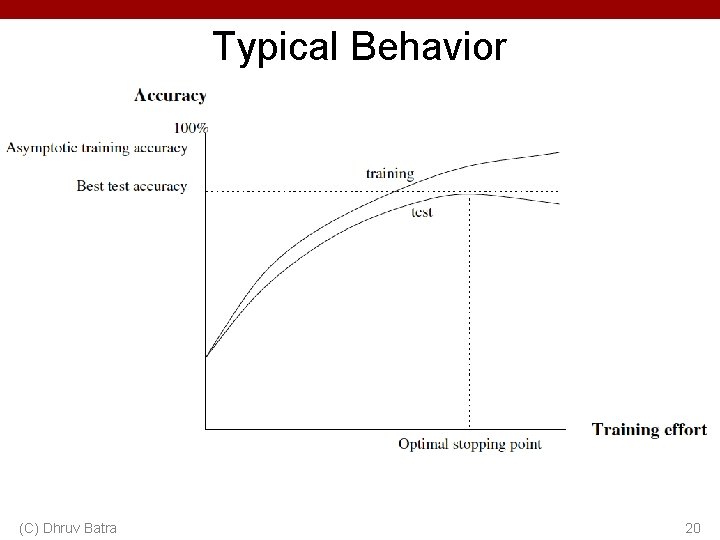
Typical Behavior • a (C) Dhruv Batra 20
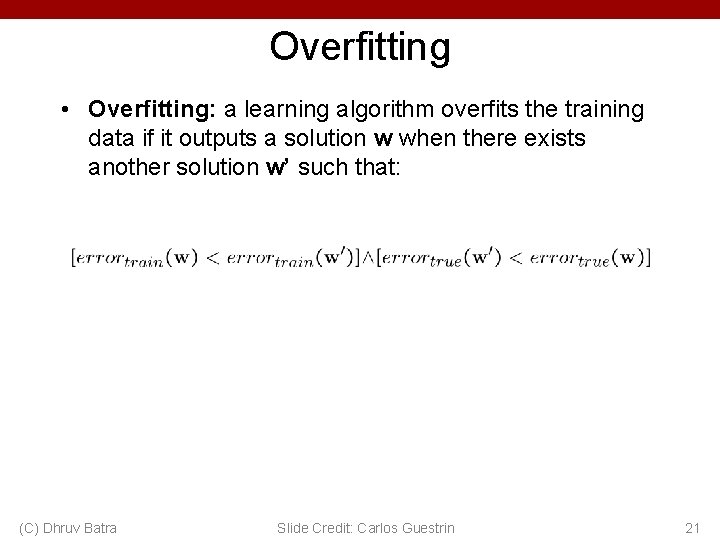
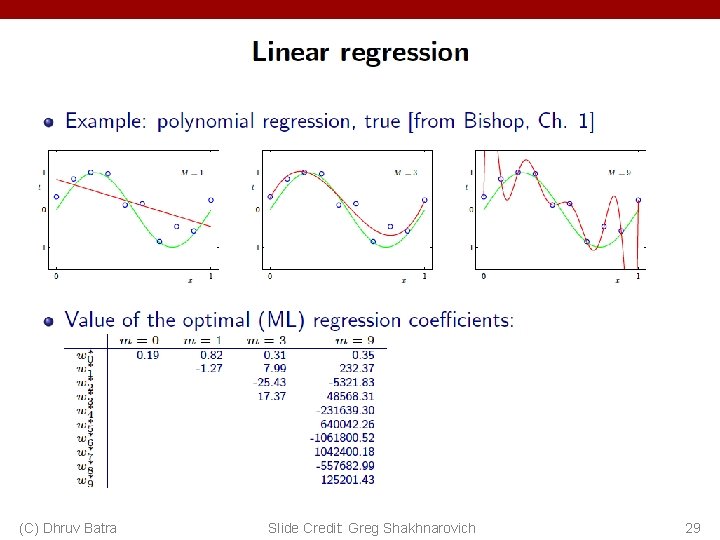
Overfitting • Overfitting: a learning algorithm overfits the training data if it outputs a solution w when there exists another solution w’ such that: (C) Dhruv Batra Slide Credit: Carlos Guestrin 21
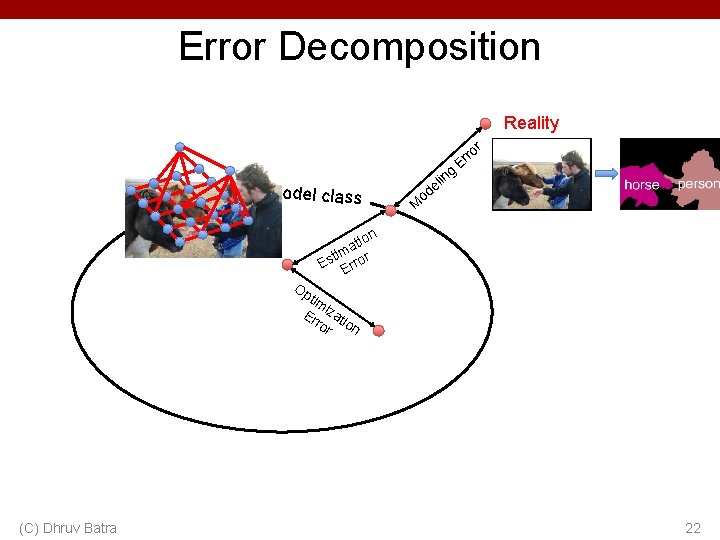
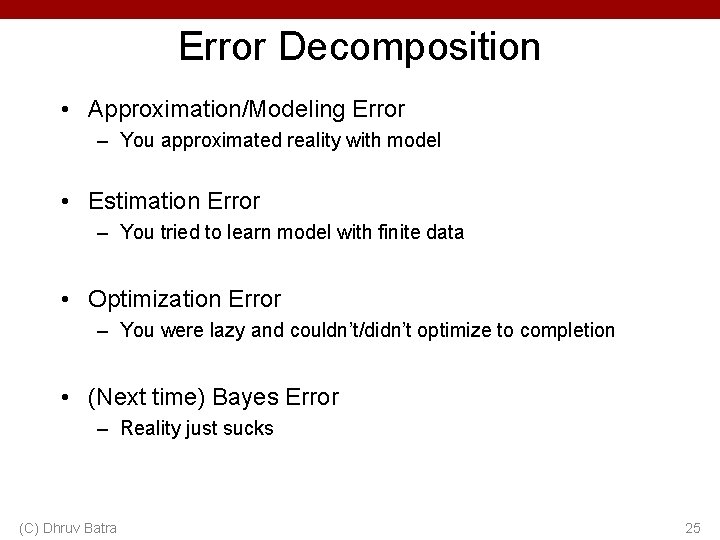
Error Decomposition Reality r model class g lin e od ro Er M n tio a tim r Es Erro Op tim Er izat ro ion r (C) Dhruv Batra 22
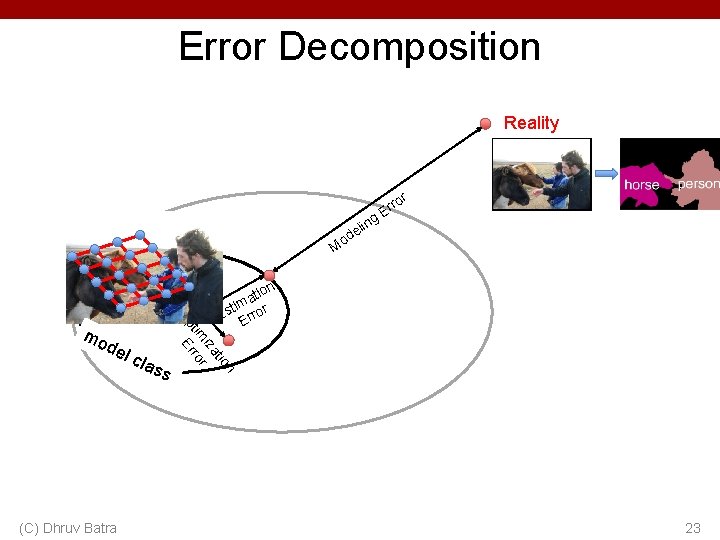
Error Decomposition Reality r ng eli d o ro Er M l cl (C) Dhruv Batra ass n tio iza im or pt Err O mo de n tio a tim Es Error 23
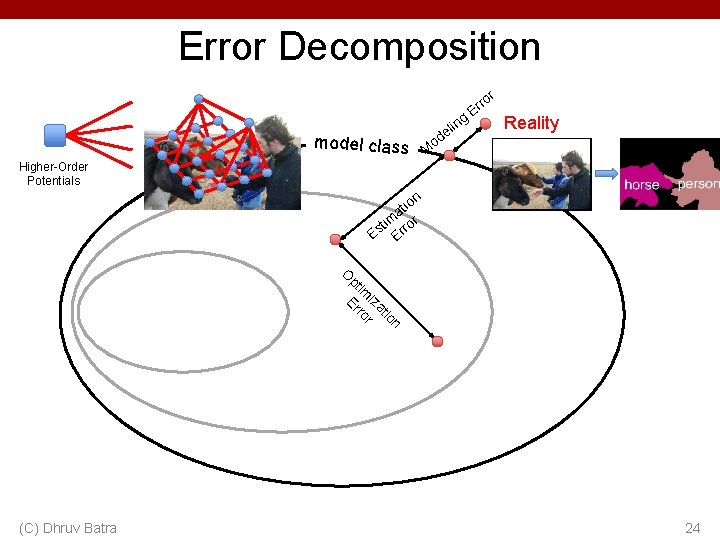
Error Decomposition r model class ng li de ro Er Reality o M Higher-Order Potentials n io t a im ror t Es Er O pt im Er iza ro tio r n (C) Dhruv Batra 24
Error Decomposition • Approximation/Modeling Error – You approximated reality with model • Estimation Error – You tried to learn model with finite data • Optimization Error – You were lazy and couldn’t/didn’t optimize to completion • (Next time) Bayes Error – Reality just sucks (C) Dhruv Batra 25
Bias-Variance Tradeoff • Bias: difference between what you expect to learn and truth – Measures how well you expect to represent true solution – Decreases with more complex model • Variance: difference between what you expect to learn and what you learn from a particular dataset – Measures how sensitive learner is to specific dataset – Increases with more complex model (C) Dhruv Batra Slide Credit: Carlos Guestrin 26
Bias-Variance Tradeoff • Matlab demo (C) Dhruv Batra 27
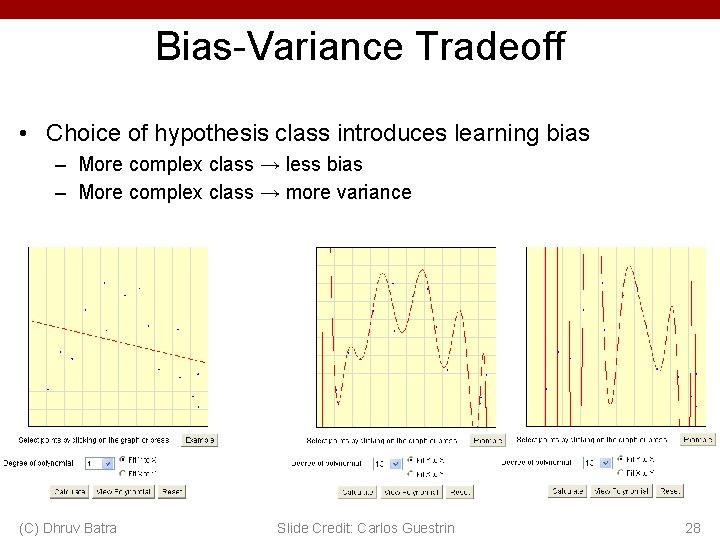
Bias-Variance Tradeoff • Choice of hypothesis class introduces learning bias – More complex class → less bias – More complex class → more variance (C) Dhruv Batra Slide Credit: Carlos Guestrin 28
(C) Dhruv Batra Slide Credit: Greg Shakhnarovich 29
Learning Curves • Error vs size of dataset • On board – High-bias curves – High-variance curves (C) Dhruv Batra 30
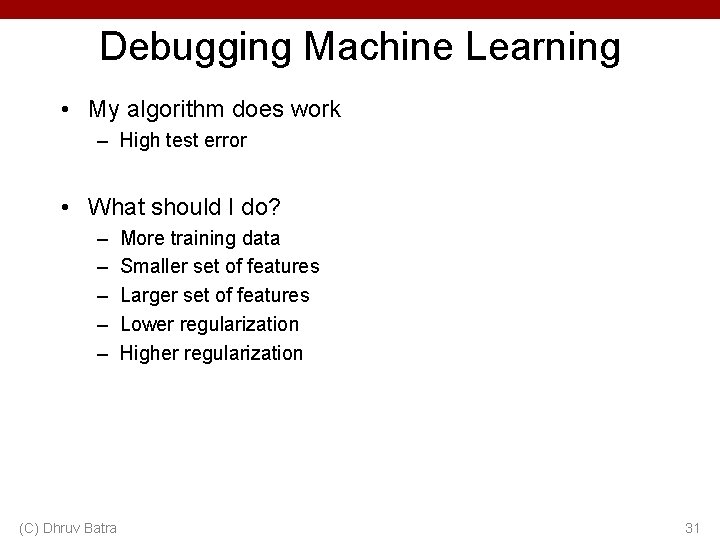
Debugging Machine Learning • My algorithm does work – High test error • What should I do? – – – (C) Dhruv Batra More training data Smaller set of features Larger set of features Lower regularization Higher regularization 31
What you need to know • Generalization Error Decomposition – Approximation, estimation, optimization, bayes error – For squared losses, bias-variance tradeoff • Errors – Difference between train & test error & expected error – Cross-validation (and cross-val error) – NEVER learn on test data • Overfitting vs Underfitting (C) Dhruv Batra 32
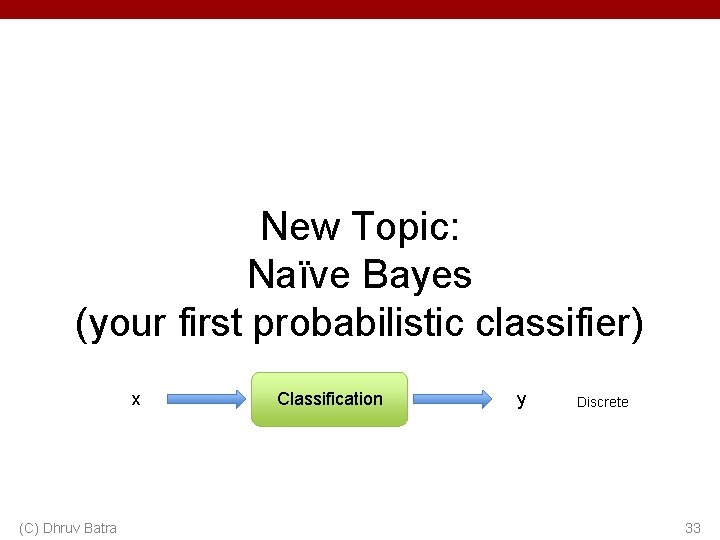
New Topic: Naïve Bayes (your first probabilistic classifier) x (C) Dhruv Batra Classification y Discrete 33
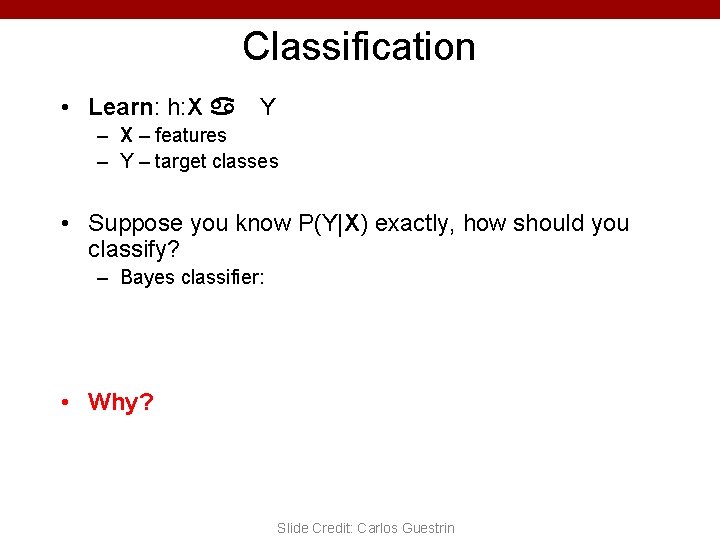
Classification • Learn: h: X Y – X – features – Y – target classes • Suppose you know P(Y|X) exactly, how should you classify? – Bayes classifier: • Why? Slide Credit: Carlos Guestrin
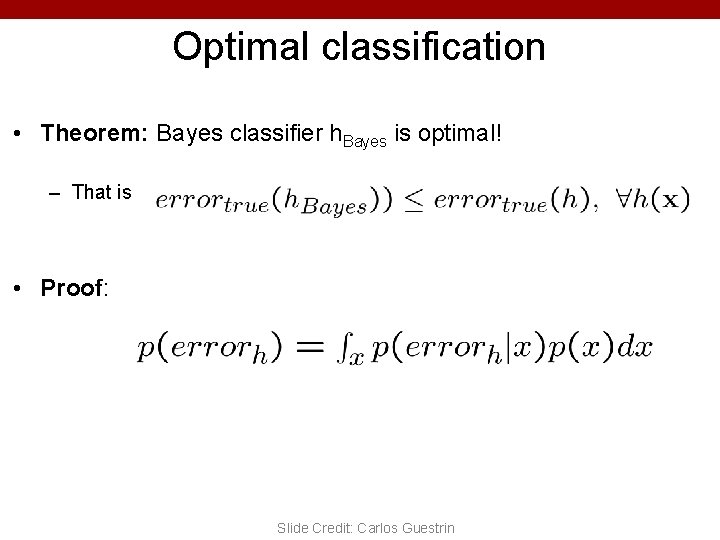
Optimal classification • Theorem: Bayes classifier h. Bayes is optimal! – That is • Proof: Slide Credit: Carlos Guestrin
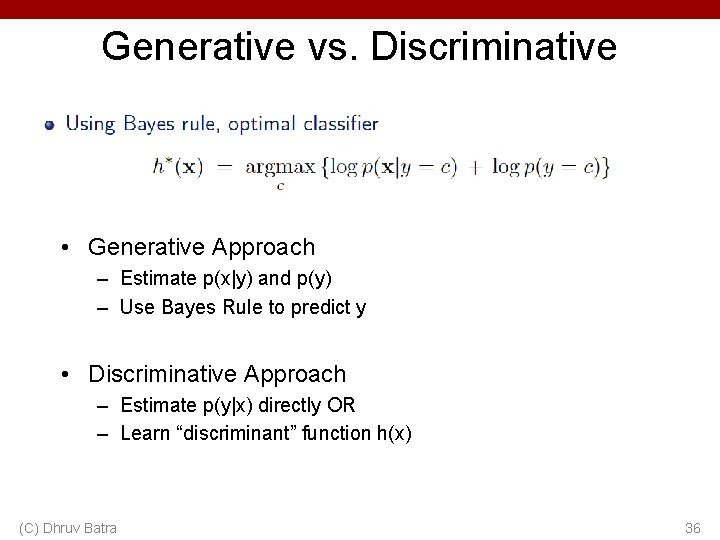
Generative vs. Discriminative • Generative Approach – Estimate p(x|y) and p(y) – Use Bayes Rule to predict y • Discriminative Approach – Estimate p(y|x) directly OR – Learn “discriminant” function h(x) (C) Dhruv Batra 36
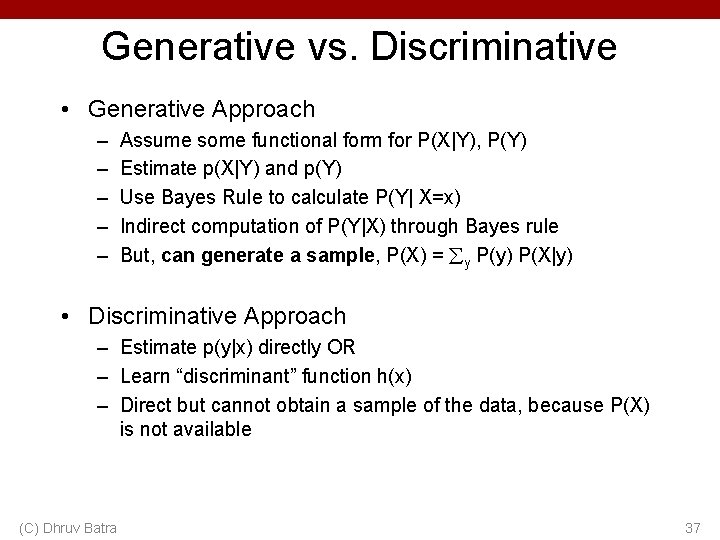
Generative vs. Discriminative • Generative Approach – – – Assume some functional form for P(X|Y), P(Y) Estimate p(X|Y) and p(Y) Use Bayes Rule to calculate P(Y| X=x) Indirect computation of P(Y|X) through Bayes rule But, can generate a sample, P(X) = y P(y) P(X|y) • Discriminative Approach – Estimate p(y|x) directly OR – Learn “discriminant” function h(x) – Direct but cannot obtain a sample of the data, because P(X) is not available (C) Dhruv Batra 37
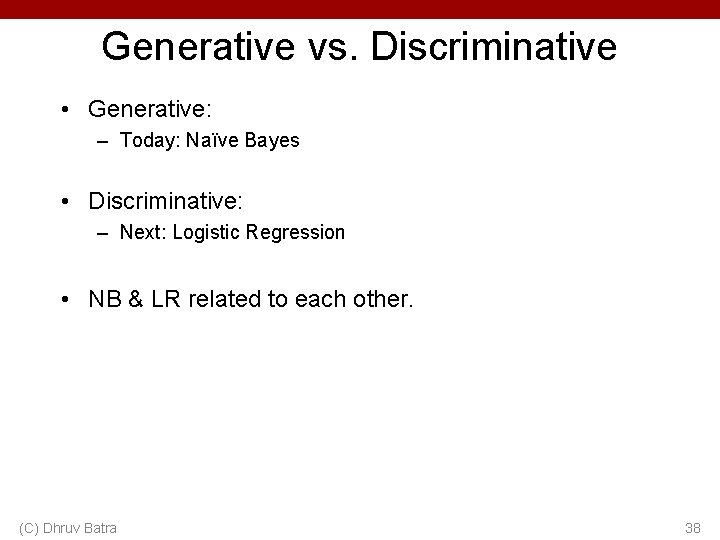
Generative vs. Discriminative • Generative: – Today: Naïve Bayes • Discriminative: – Next: Logistic Regression • NB & LR related to each other. (C) Dhruv Batra 38
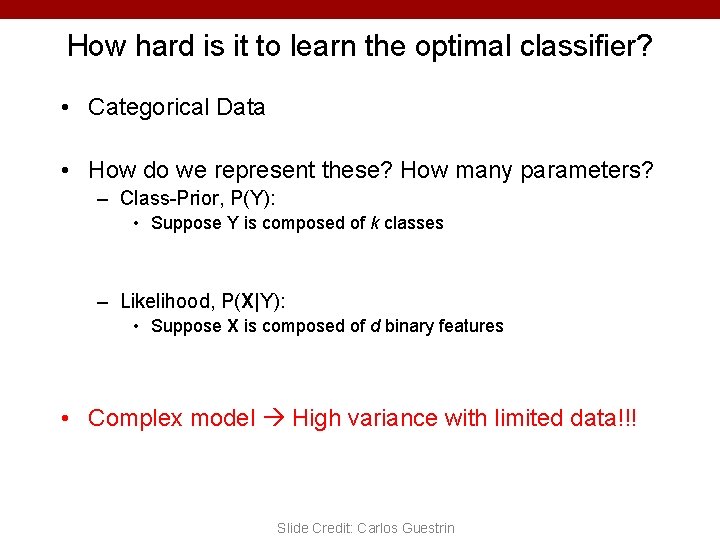
How hard is it to learn the optimal classifier? • Categorical Data • How do we represent these? How many parameters? – Class-Prior, P(Y): • Suppose Y is composed of k classes – Likelihood, P(X|Y): • Suppose X is composed of d binary features • Complex model High variance with limited data!!! Slide Credit: Carlos Guestrin
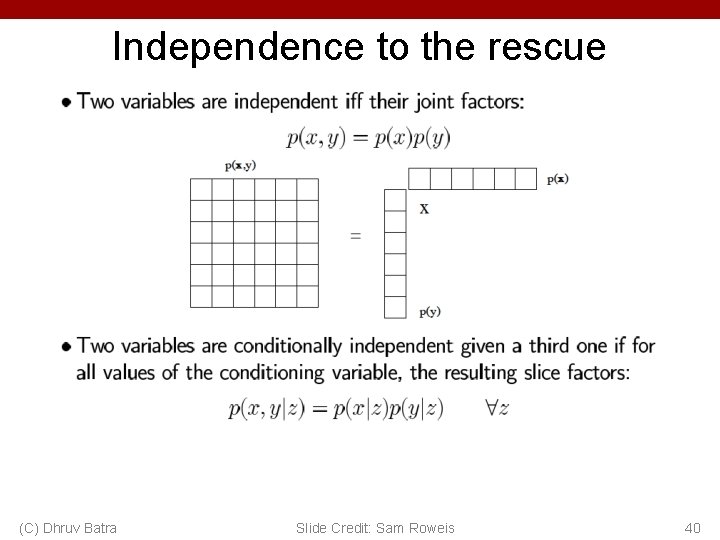
Independence to the rescue (C) Dhruv Batra Slide Credit: Sam Roweis 40
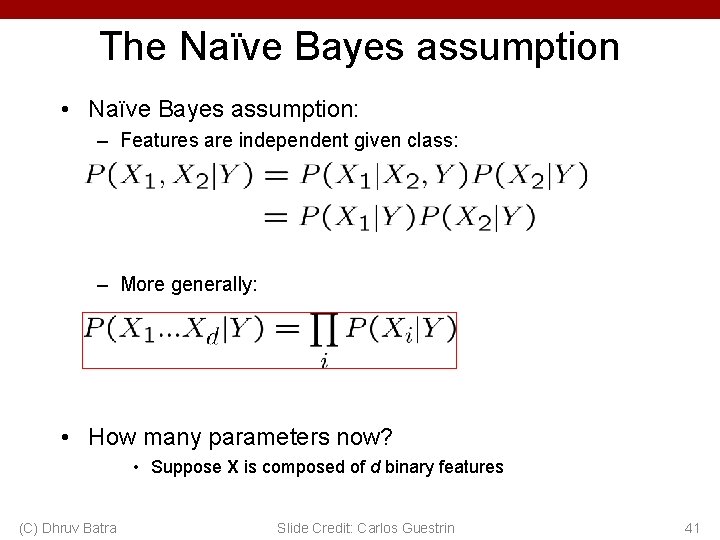
The Naïve Bayes assumption • Naïve Bayes assumption: – Features are independent given class: – More generally: • How many parameters now? • Suppose X is composed of d binary features (C) Dhruv Batra Slide Credit: Carlos Guestrin 41
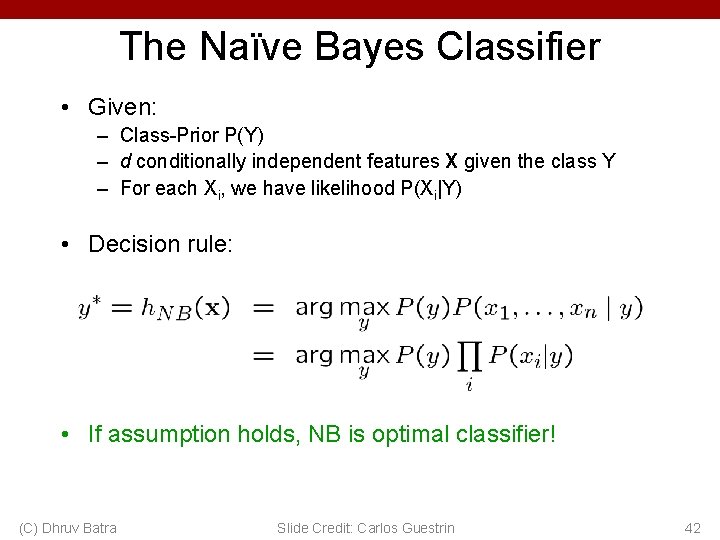
The Naïve Bayes Classifier • Given: – Class-Prior P(Y) – d conditionally independent features X given the class Y – For each Xi, we have likelihood P(Xi|Y) • Decision rule: • If assumption holds, NB is optimal classifier! (C) Dhruv Batra Slide Credit: Carlos Guestrin 42