
ECE 576 POWER SYSTEM DYNAMICS AND STABILITY Lecture

ECE 576 POWER SYSTEM DYNAMICS AND STABILITY Lecture 30 Modal Analysis Professor M. A. Pai Department of Electrical and Computer Engineering © 2000 University of Illinois Board of Trustees, All Rights Reserved

Modal Analysis - Comments l l Modal analysis or analysis of small signal stability through eigenvalue analysis is at the core of all current software. In Modal Analysis one looks at: – – l Eigenvalues Eigenvectors (left or right) Participation factors Mode shape Power System Stabilizer (PSS) design in a multimachine context is done using modal analysis method. Lecture 30 – Page 1
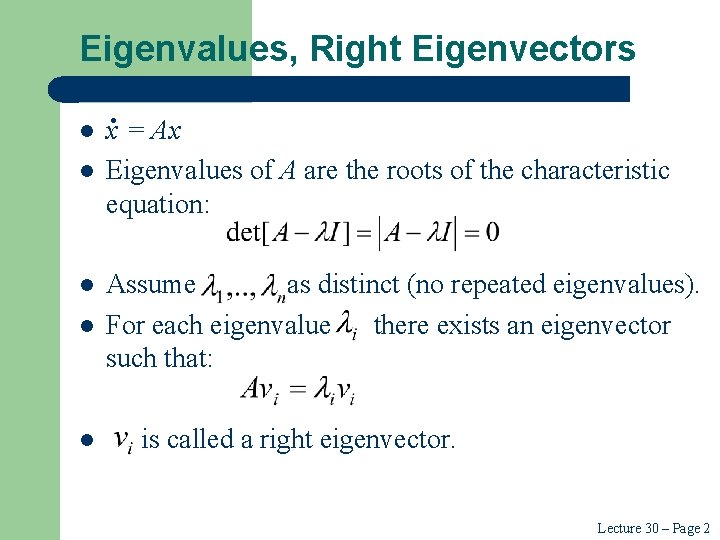
Eigenvalues, Right Eigenvectors l . x = Ax l Eigenvalues of A are the roots of the characteristic equation: l Assume as distinct (no repeated eigenvalues). For each eigenvalue there exists an eigenvector such that: l l is called a right eigenvector. Lecture 30 – Page 2
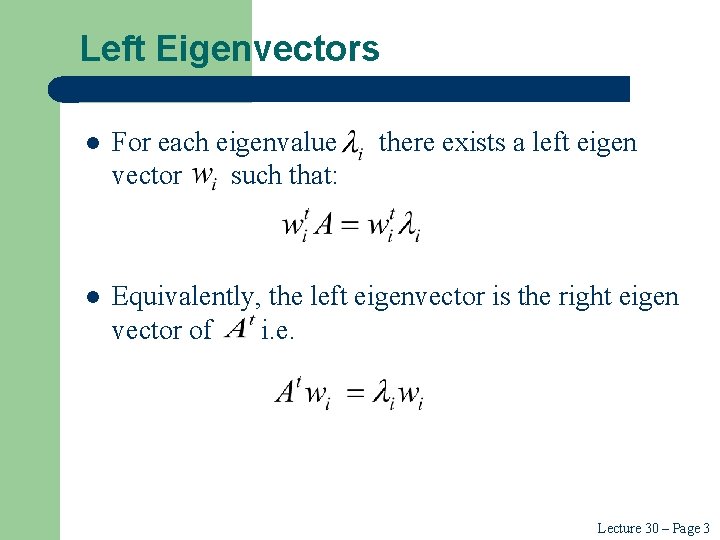
Left Eigenvectors l For each eigenvalue vector such that: there exists a left eigen l Equivalently, the left eigenvector is the right eigen vector of i. e. Lecture 30 – Page 3
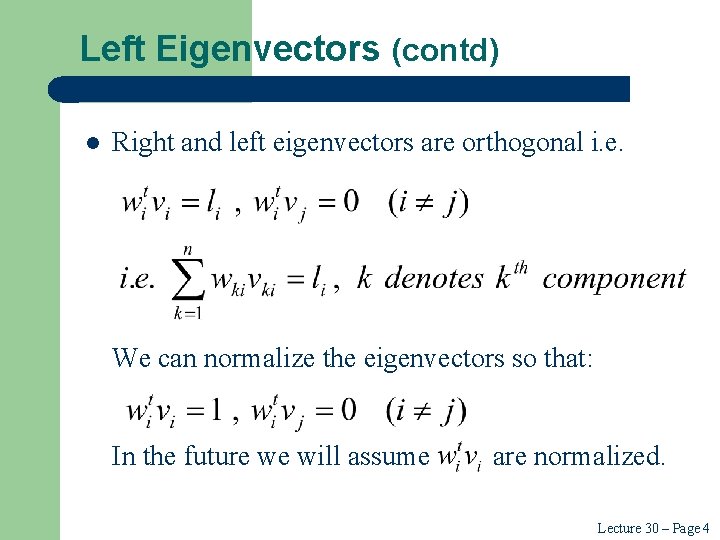
Left Eigenvectors (contd) l Right and left eigenvectors are orthogonal i. e. We can normalize the eigenvectors so that: In the future we will assume are normalized. Lecture 30 – Page 4
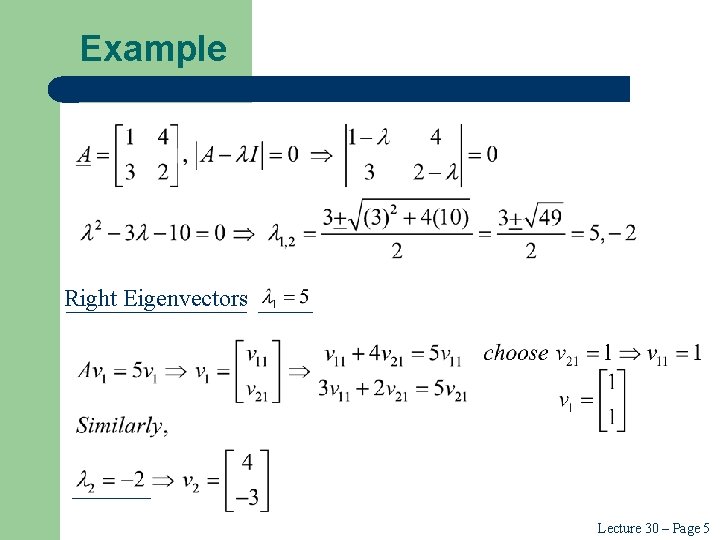
Example Right Eigenvectors Lecture 30 – Page 5
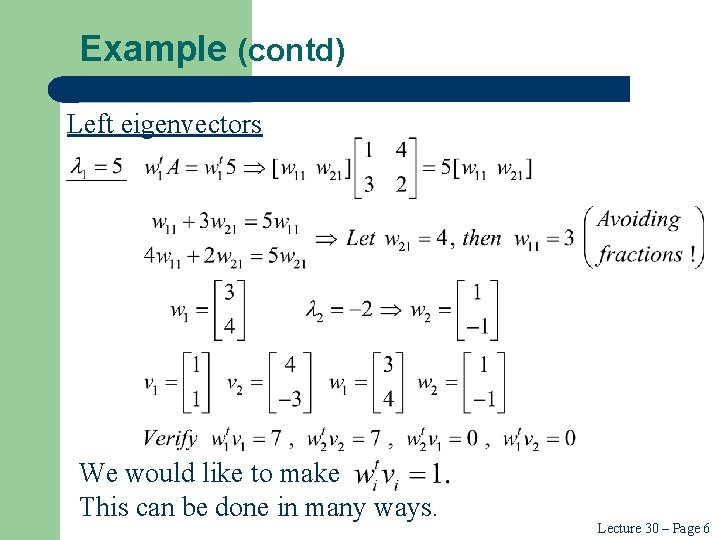
Example (contd) Left eigenvectors We would like to make This can be done in many ways. Lecture 30 – Page 6
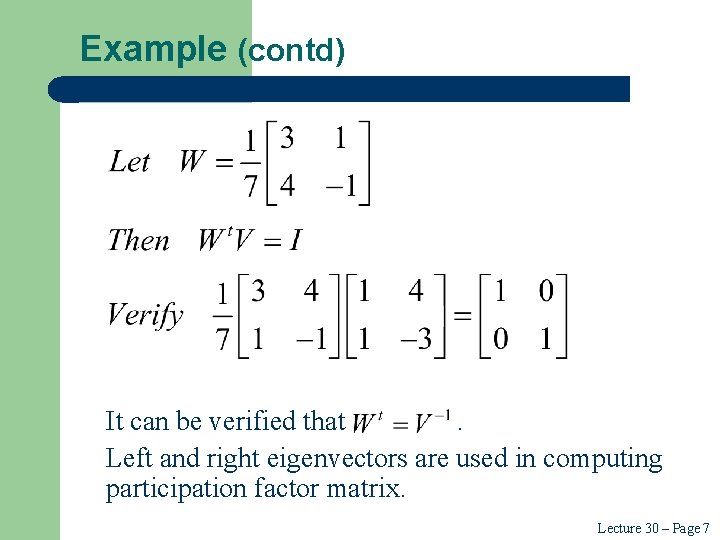
Example (contd) It can be verified that. Left and right eigenvectors are used in computing participation factor matrix. Lecture 30 – Page 7
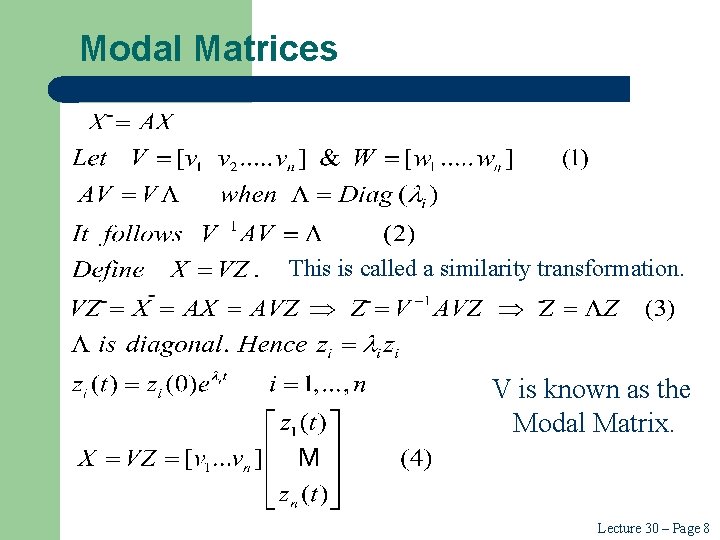
Modal Matrices This is called a similarity transformation. V is known as the Modal Matrix. Lecture 30 – Page 8
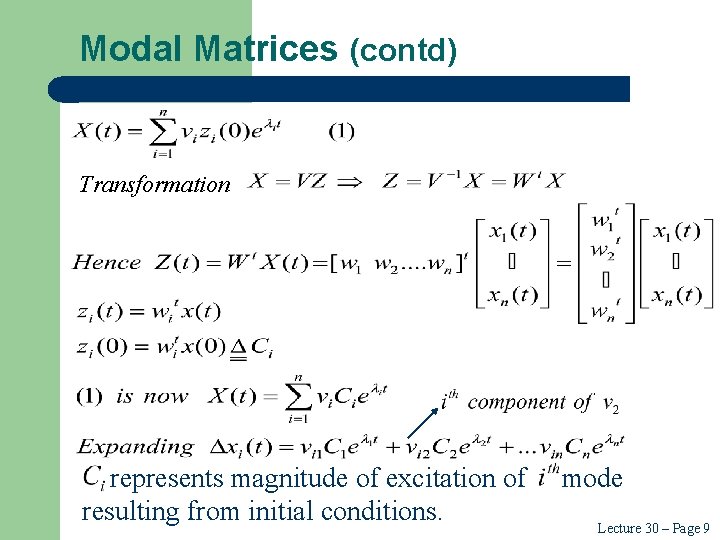
Modal Matrices (contd) Transformation represents magnitude of excitation of resulting from initial conditions. mode Lecture 30 – Page 9
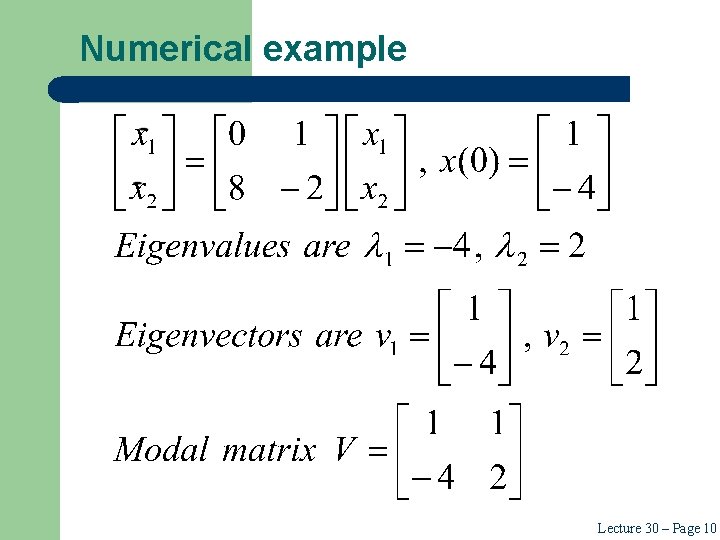
Numerical example Lecture 30 – Page 10
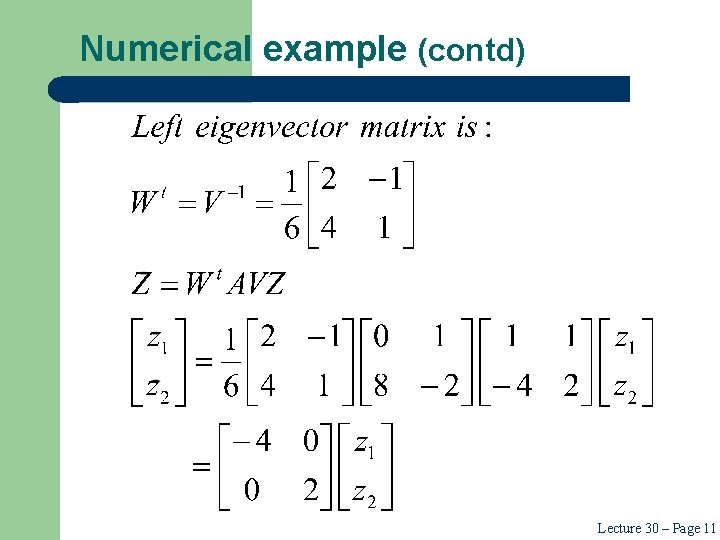
Numerical example (contd) Lecture 30 – Page 11
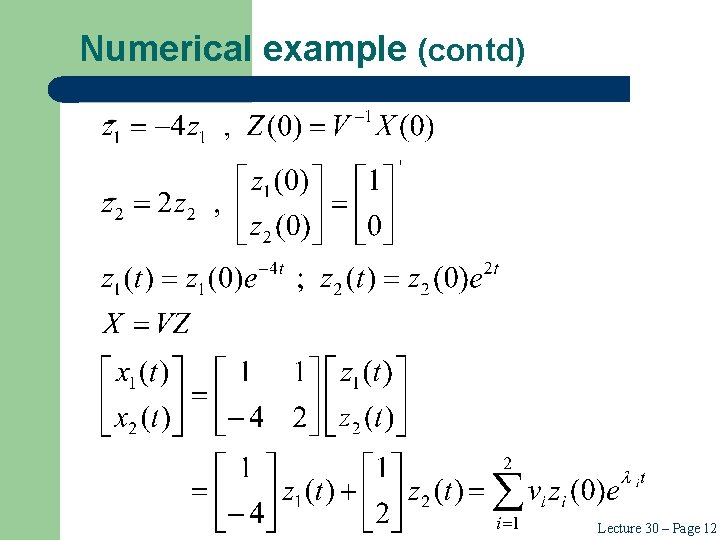
Numerical example (contd) Lecture 30 – Page 12
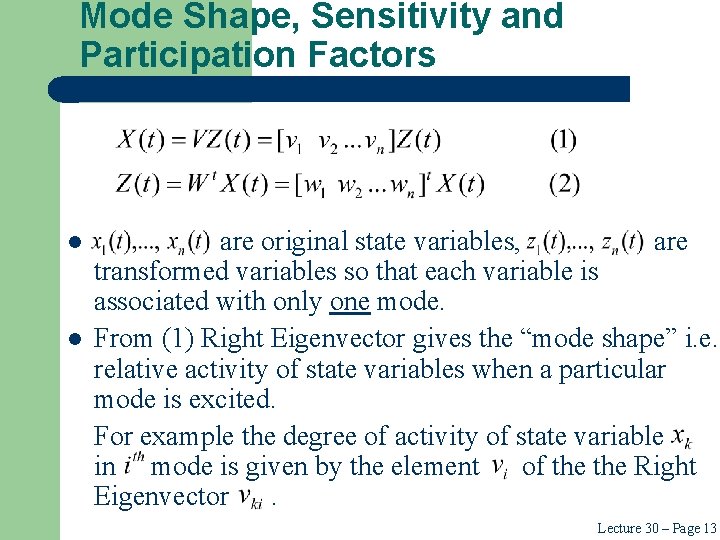
Mode Shape, Sensitivity and Participation Factors l l are original state variables, are transformed variables so that each variable is associated with only one mode. From (1) Right Eigenvector gives the “mode shape” i. e. relative activity of state variables when a particular mode is excited. For example the degree of activity of state variable in mode is given by the element of the Right Eigenvector. Lecture 30 – Page 13
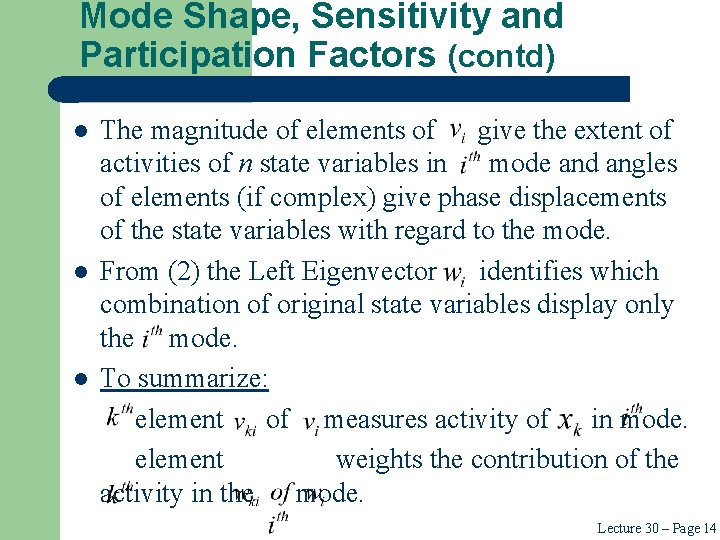
Mode Shape, Sensitivity and Participation Factors (contd) l l l The magnitude of elements of give the extent of activities of n state variables in mode and angles of elements (if complex) give phase displacements of the state variables with regard to the mode. From (2) the Left Eigenvector identifies which combination of original state variables display only the mode. To summarize: element of measures activity of in mode. element weights the contribution of the activity in the mode. Lecture 30 – Page 14
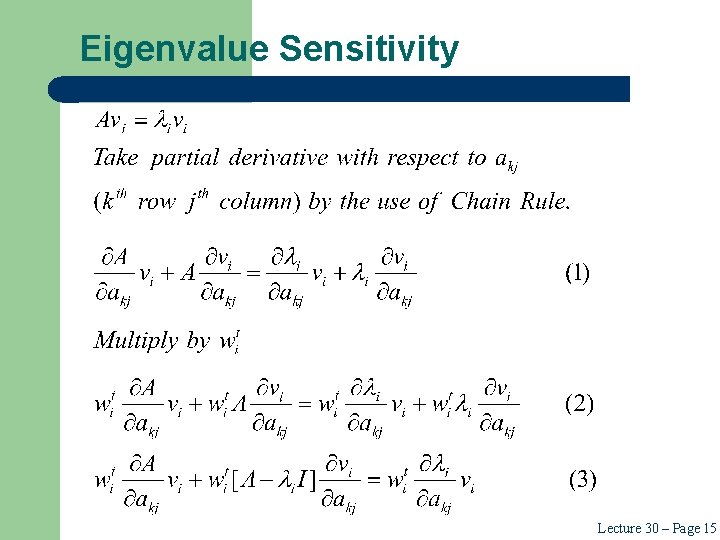
Eigenvalue Sensitivity Lecture 30 – Page 15
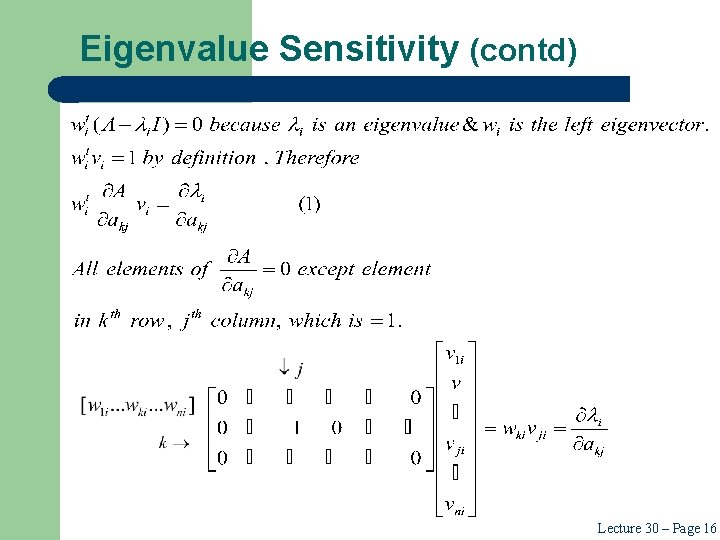
Eigenvalue Sensitivity (contd) Lecture 30 – Page 16
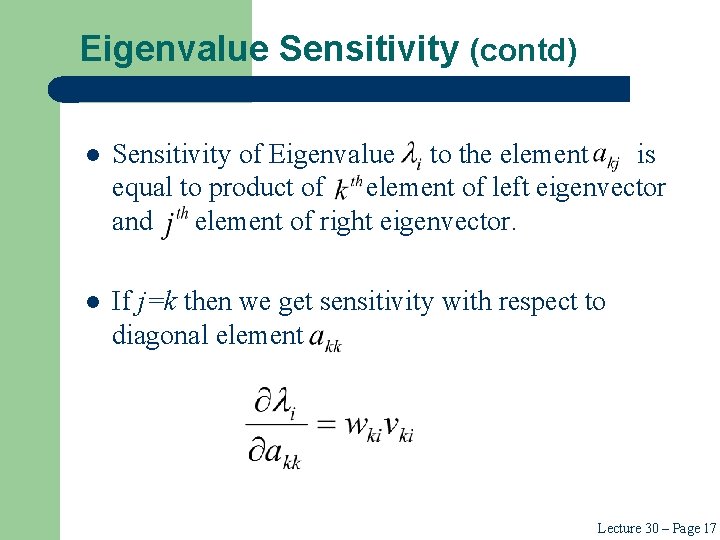
Eigenvalue Sensitivity (contd) l Sensitivity of Eigenvalue to the element is equal to product of element of left eigenvector and element of right eigenvector. l If j=k then we get sensitivity with respect to diagonal element Lecture 30 – Page 17
- Slides: 18