
ECE 546 Lecture 04 Resistance Capacitance Inductance Spring

![Circuit Element K [K]=[L]-1 • Better locality property • Leads to sparser matrix •](https://slidetodoc.com/presentation_image_h/7d83e8e90be38869bc83f162d2669634/image-35.jpg "Circuit Element K [K]=[L]-1 • Better locality property • Leads to sparser matrix •")
- Slides: 72
ECE 546 Lecture 04 Resistance, Capacitance, Inductance Spring 2018 Jose E. Schutt-Aine Electrical & Computer Engineering University of Illinois jschutt@emlab. uiuc. edu ECE 546 – Jose Schutt-Aine 1
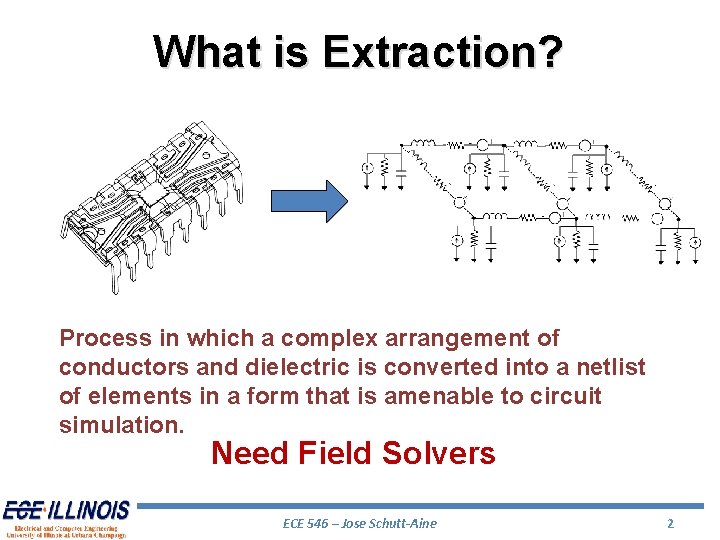
What is Extraction? Process in which a complex arrangement of conductors and dielectric is converted into a netlist of elements in a form that is amenable to circuit simulation. Need Field Solvers ECE 546 – Jose Schutt-Aine 2
Electromagnetic Modeling Tools We need electromagnetic modeling tools to analyze: Transmission line propagation Reflections from discontinuities Crosstalk between interconnects Simultaneous switching noise So we can provide: Improved design of interconnects Robust design guidelines Faster, more cost effective design cycles ECE 546 – Jose Schutt-Aine 3
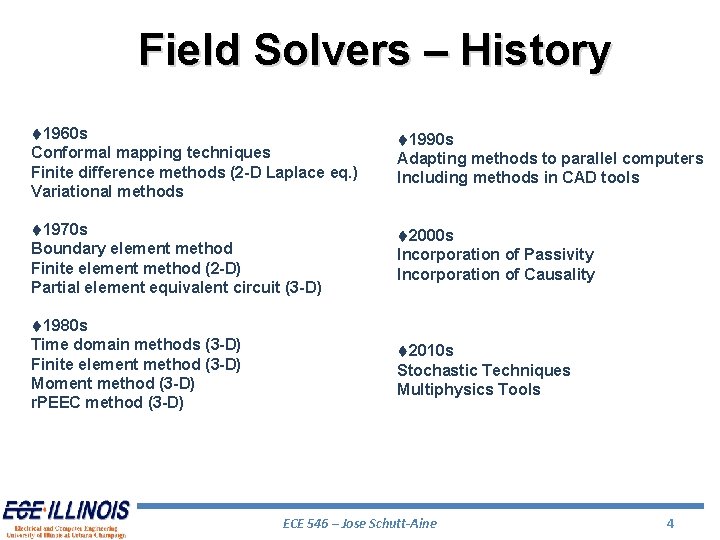
Field Solvers – History 1960 s Conformal mapping techniques Finite difference methods (2 -D Laplace eq. ) Variational methods 1990 s Adapting methods to parallel computers Including methods in CAD tools 1970 s Boundary element method Finite element method (2 -D) Partial element equivalent circuit (3 -D) 2000 s Incorporation of Passivity Incorporation of Causality 1980 s Time domain methods (3 -D) Finite element method (3 -D) Moment method (3 -D) r. PEEC method (3 -D) 2010 s Stochastic Techniques Multiphysics Tools ECE 546 – Jose Schutt-Aine 4
Categories of Field Solvers • Method of Moments (MOM) • Application to 2 -D Interconnects • Closed-Form Green’s Function • Full-Wave and FDTD • Parallel FDTD • Applications ECE 546 – Jose Schutt-Aine 5
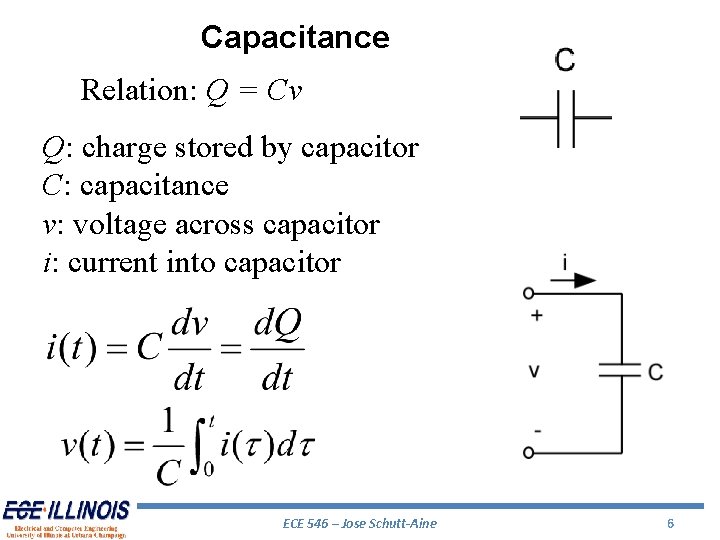
Capacitance Relation: Q = Cv Q: charge stored by capacitor C: capacitance v: voltage across capacitor i: current into capacitor ECE 546 – Jose Schutt-Aine 6
Capacitance A : area eo : permittivity For more complex capacitance geometries, need to use numerical methods ECE 546 – Jose Schutt-Aine 7
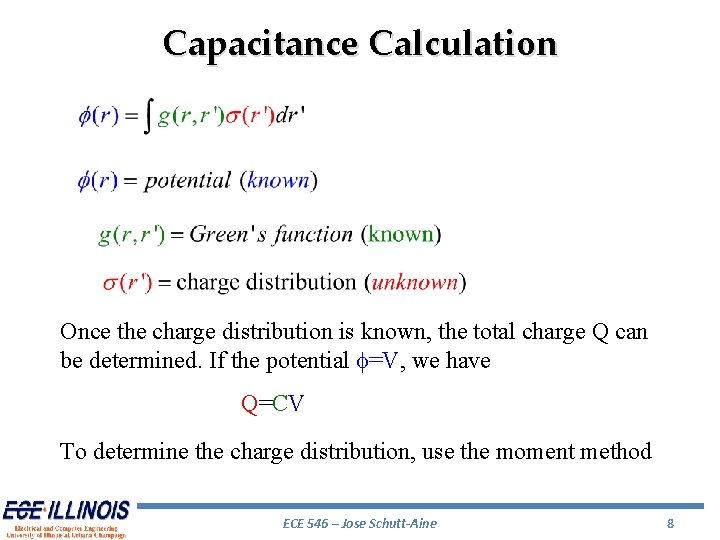
Capacitance Calculation Once the charge distribution is known, the total charge Q can be determined. If the potential f=V, we have Q=CV To determine the charge distribution, use the moment method ECE 546 – Jose Schutt-Aine 8
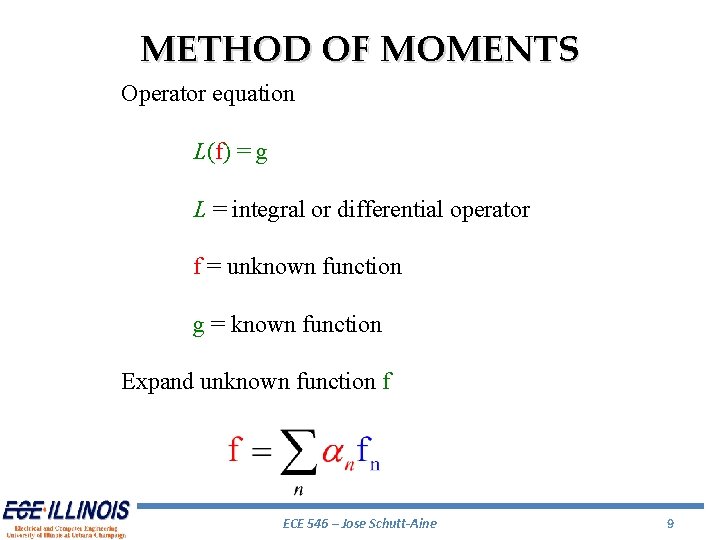
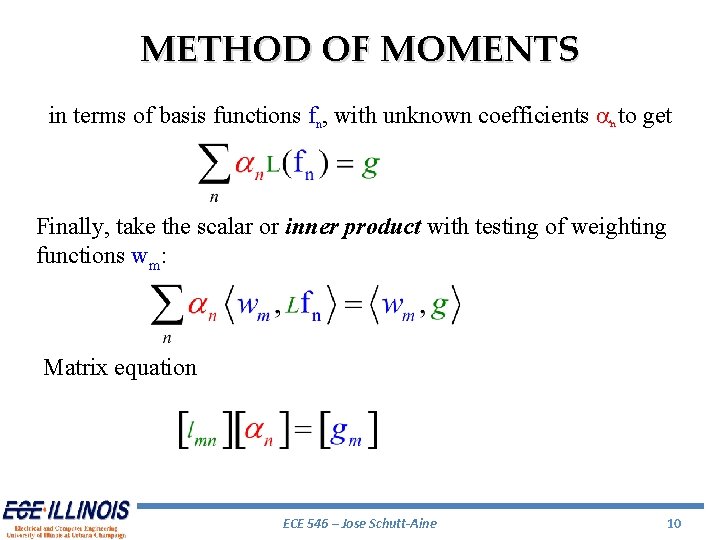
METHOD OF MOMENTS Operator equation L(f) = g L = integral or differential operator f = unknown function g = known function Expand unknown function f ECE 546 – Jose Schutt-Aine 9
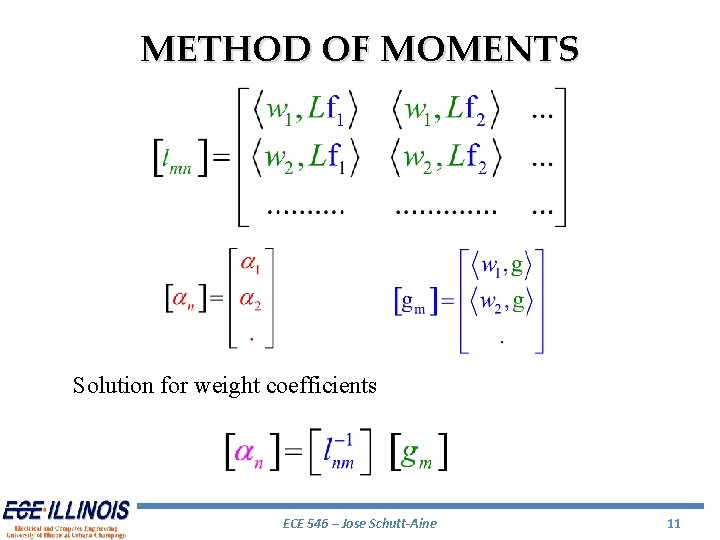
METHOD OF MOMENTS in terms of basis functions fn, with unknown coefficients a to get n Finally, take the scalar or inner product with testing of weighting functions wm: Matrix equation ECE 546 – Jose Schutt-Aine 10
METHOD OF MOMENTS Solution for weight coefficients ECE 546 – Jose Schutt-Aine 11
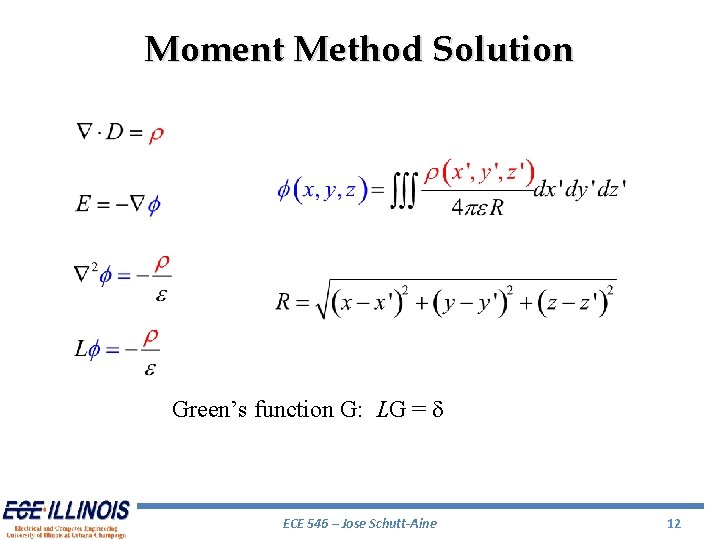
Moment Method Solution Green’s function G: LG = d ECE 546 – Jose Schutt-Aine 12
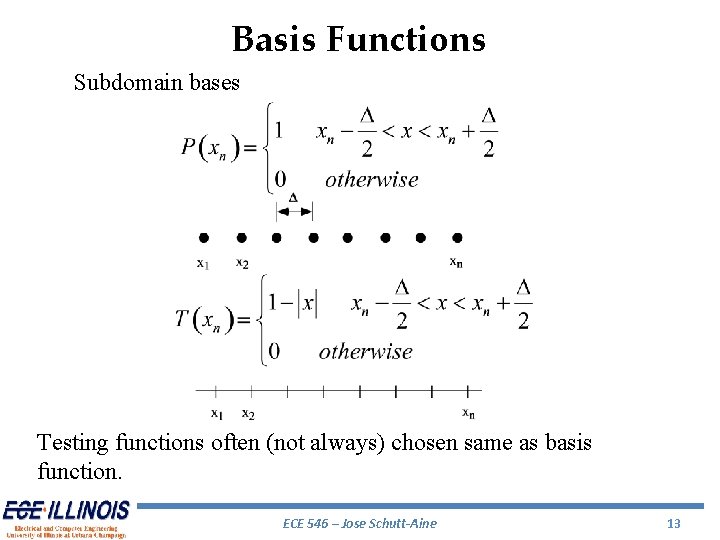
Basis Functions Subdomain bases Testing functions often (not always) chosen same as basis function. ECE 546 – Jose Schutt-Aine 13
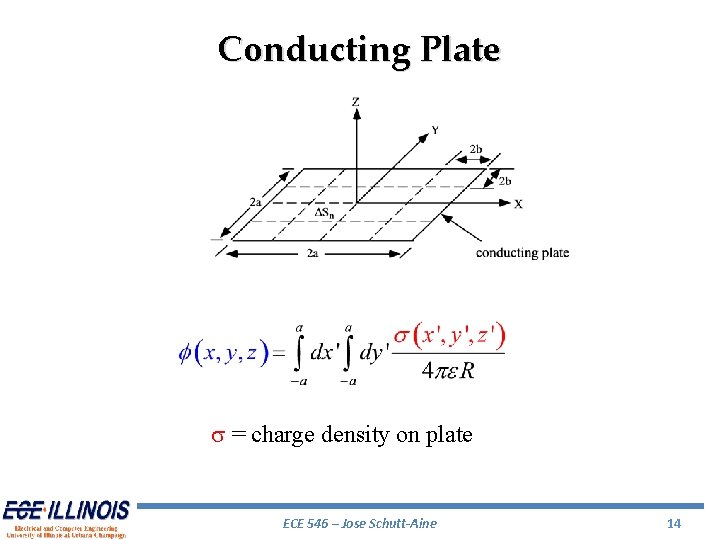
Conducting Plate s = charge density on plate ECE 546 – Jose Schutt-Aine 14
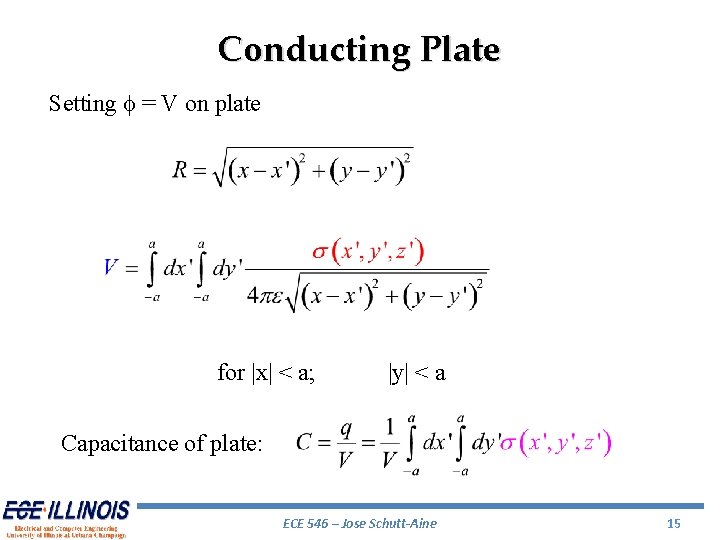
Conducting Plate Setting f = V on plate for |x| < a; |y| < a Capacitance of plate: ECE 546 – Jose Schutt-Aine 15
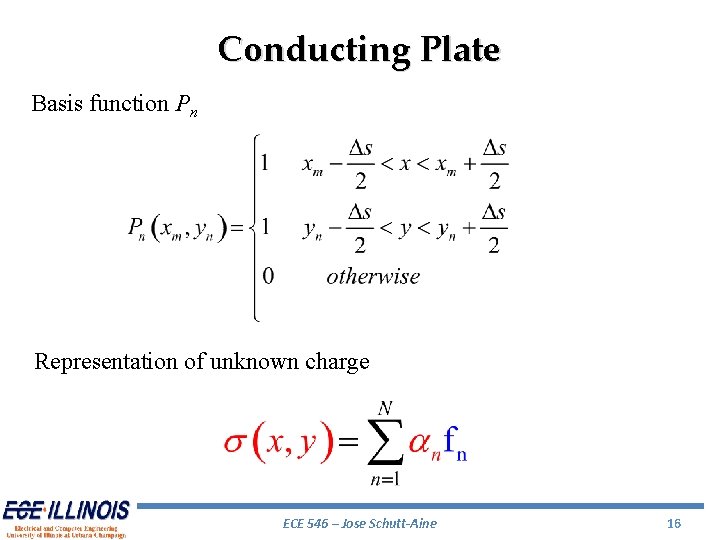
Conducting Plate Basis function Pn Representation of unknown charge ECE 546 – Jose Schutt-Aine 16
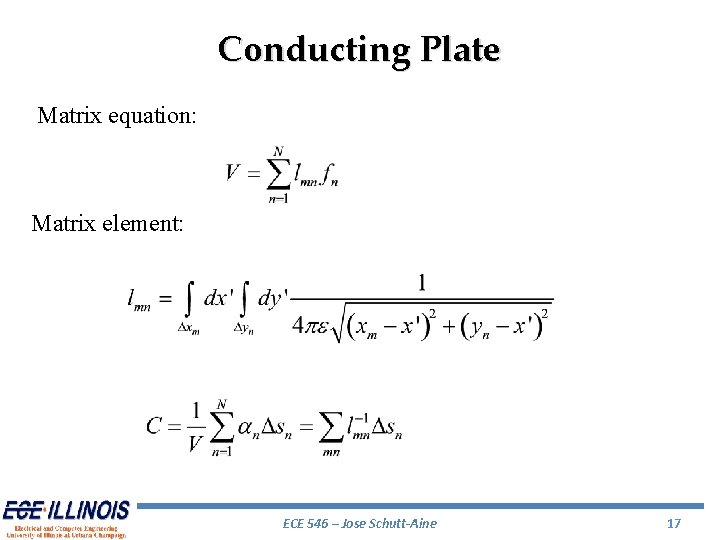
Conducting Plate Matrix equation: Matrix element: ECE 546 – Jose Schutt-Aine 17
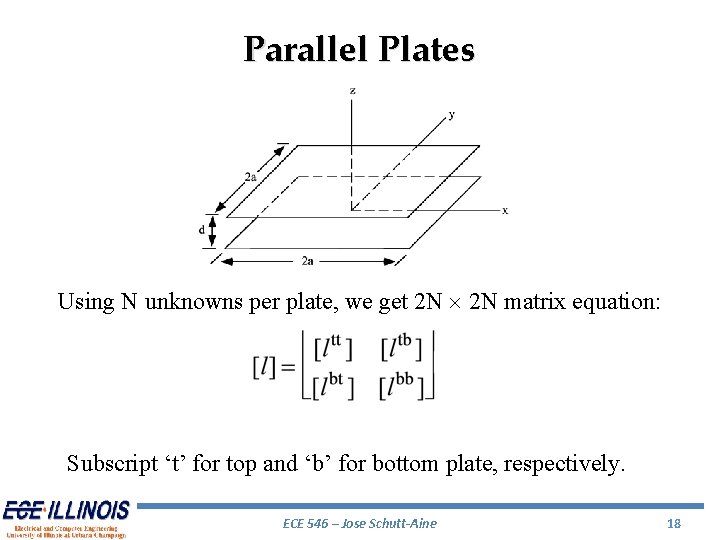
Parallel Plates Using N unknowns per plate, we get 2 N matrix equation: Subscript ‘t’ for top and ‘b’ for bottom plate, respectively. ECE 546 – Jose Schutt-Aine 18
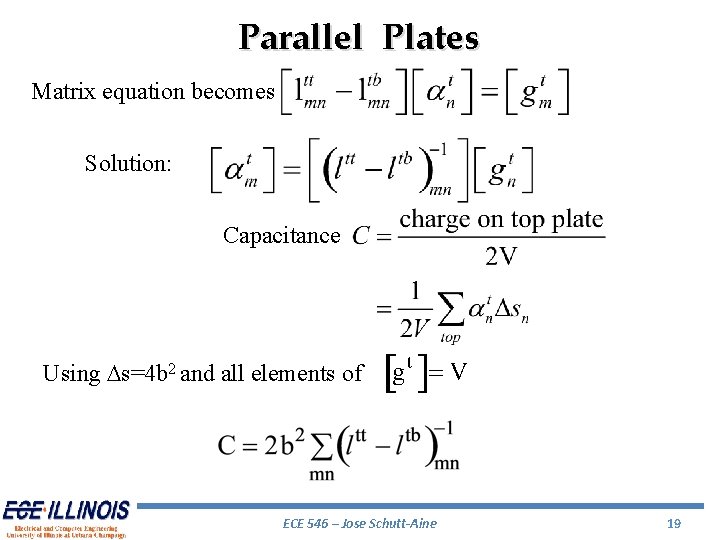
Parallel Plates Matrix equation becomes Solution: Capacitance Using Ds=4 b 2 and all elements of ECE 546 – Jose Schutt-Aine 19
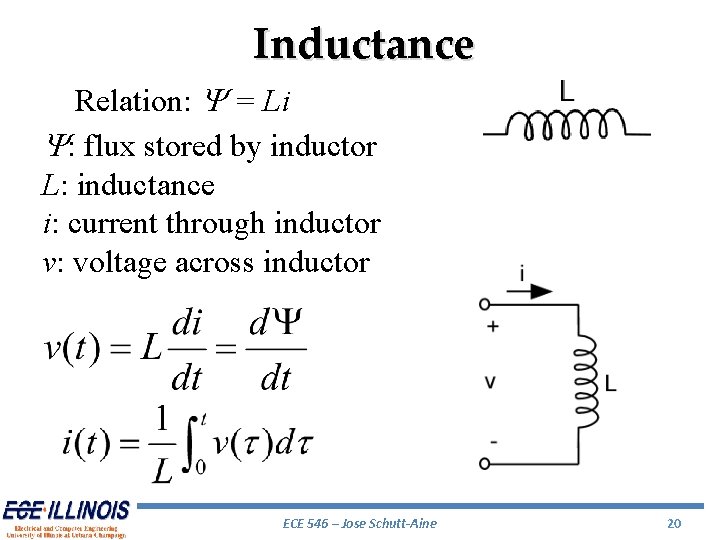
Inductance Relation: Y = Li Y: flux stored by inductor L: inductance i: current through inductor v: voltage across inductor ECE 546 – Jose Schutt-Aine 20
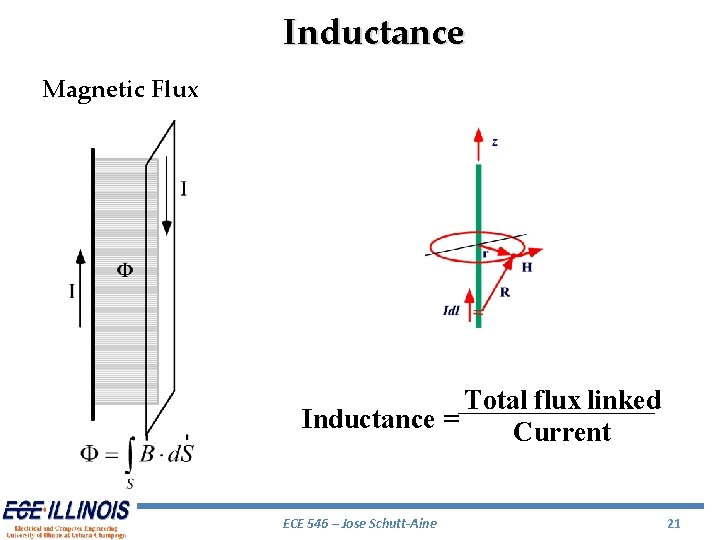
Inductance Magnetic Flux Total flux linked Inductance = Current ECE 546 – Jose Schutt-Aine 21
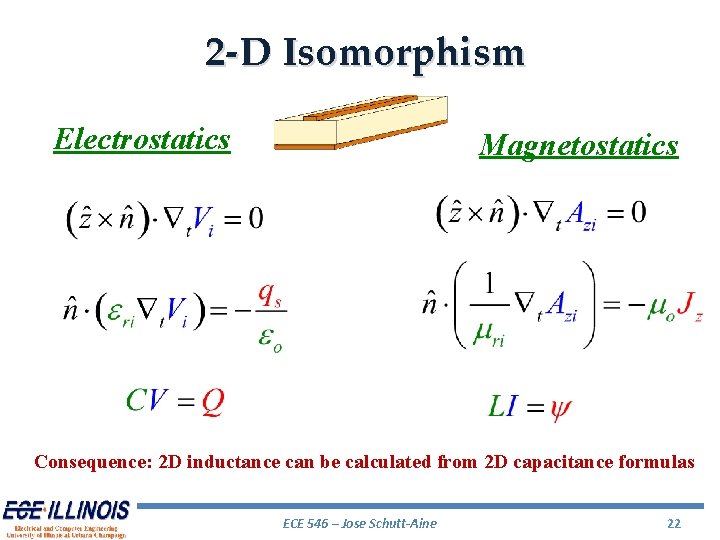
2 -D Isomorphism Electrostatics Magnetostatics Consequence: 2 D inductance can be calculated from 2 D capacitance formulas ECE 546 – Jose Schutt-Aine 22
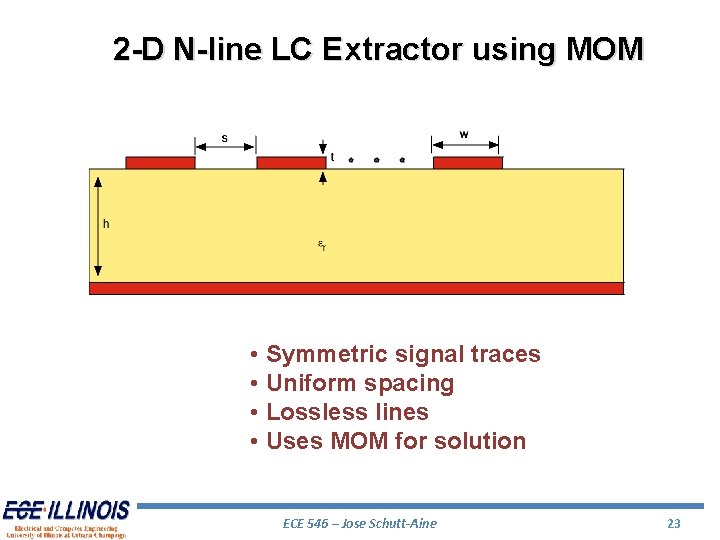
2 -D N-line LC Extractor using MOM • Symmetric signal traces • Uniform spacing • Lossless lines • Uses MOM for solution ECE 546 – Jose Schutt-Aine 23
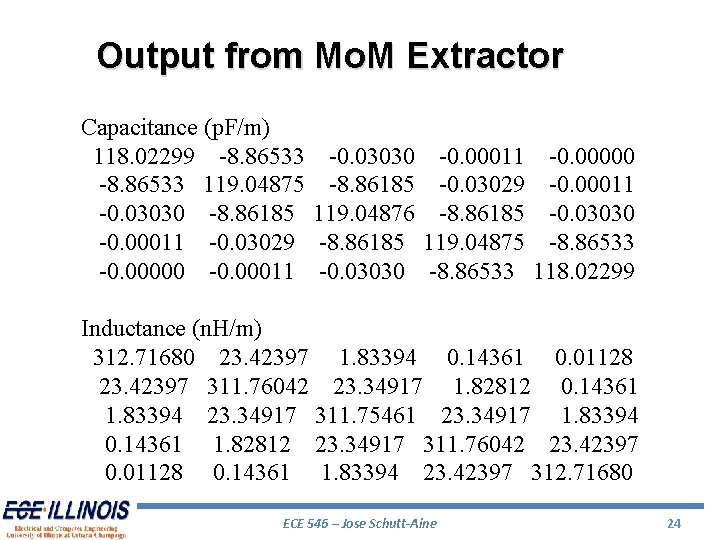
Output from Mo. M Extractor Capacitance (p. F/m) 118. 02299 -8. 86533 -0. 03030 -0. 00011 -0. 00000 -8. 86533 119. 04875 -8. 86185 -0. 03029 -0. 00011 -0. 03030 -8. 86185 119. 04876 -8. 86185 -0. 03030 -0. 00011 -0. 03029 -8. 86185 119. 04875 -8. 86533 -0. 00000 -0. 00011 -0. 03030 -8. 86533 118. 02299 Inductance (n. H/m) 312. 71680 23. 42397 1. 83394 0. 14361 0. 01128 23. 42397 311. 76042 23. 34917 1. 82812 0. 14361 1. 83394 23. 34917 311. 75461 23. 34917 1. 83394 0. 14361 1. 82812 23. 34917 311. 76042 23. 42397 0. 01128 0. 14361 1. 83394 23. 42397 312. 71680 ECE 546 – Jose Schutt-Aine 24
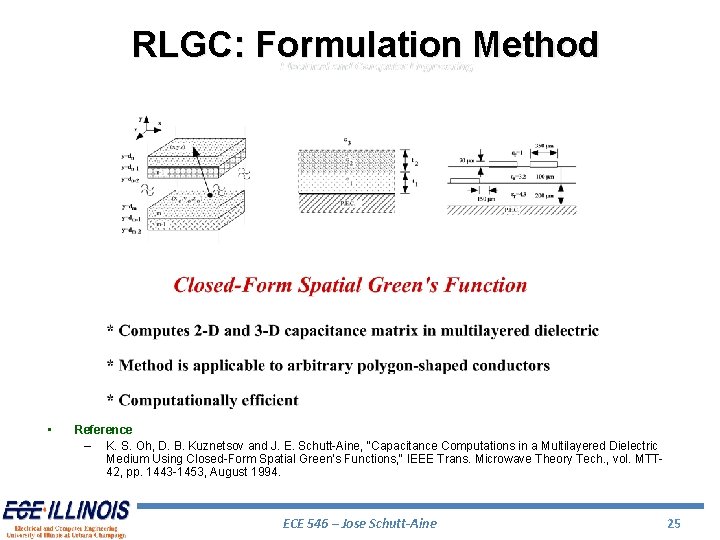
RLGC: Formulation Method • Reference – K. S. Oh, D. B. Kuznetsov and J. E. Schutt-Aine, "Capacitance Computations in a Multilayered Dielectric Medium Using Closed-Form Spatial Green's Functions, " IEEE Trans. Microwave Theory Tech. , vol. MTT 42, pp. 1443 -1453, August 1994. ECE 546 – Jose Schutt-Aine 25
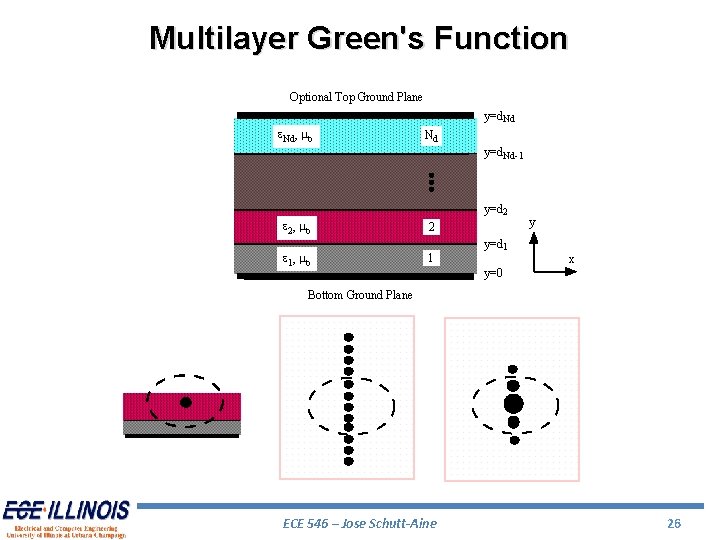
Multilayer Green's Function Optional Top Ground Plane y=d. Nd e. Nd, mo Nd y=d. Nd-1 y=d 2 e 2, mo e 1, mo 2 1 y=d 1 y x y=0 Bottom Ground Plane ECE 546 – Jose Schutt-Aine 26
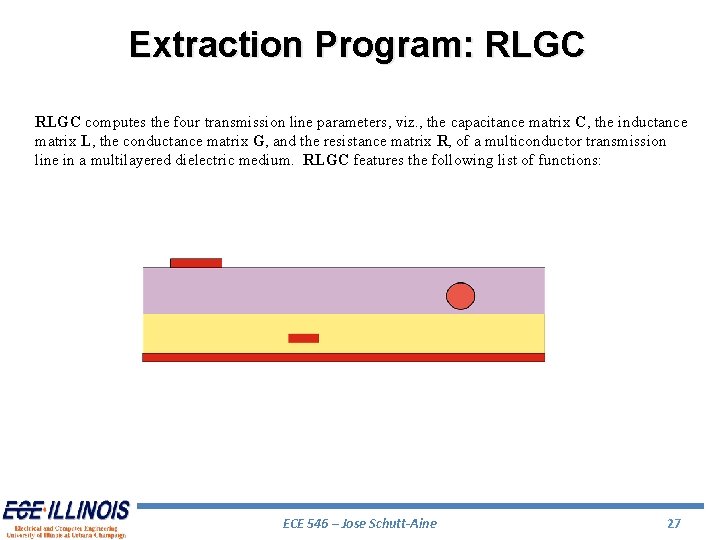
Extraction Program: RLGC computes the four transmission line parameters, viz. , the capacitance matrix C, the inductance matrix L, the conductance matrix G, and the resistance matrix R, of a multiconductor transmission line in a multilayered dielectric medium. RLGC features the following list of functions: ECE 546 – Jose Schutt-Aine 27
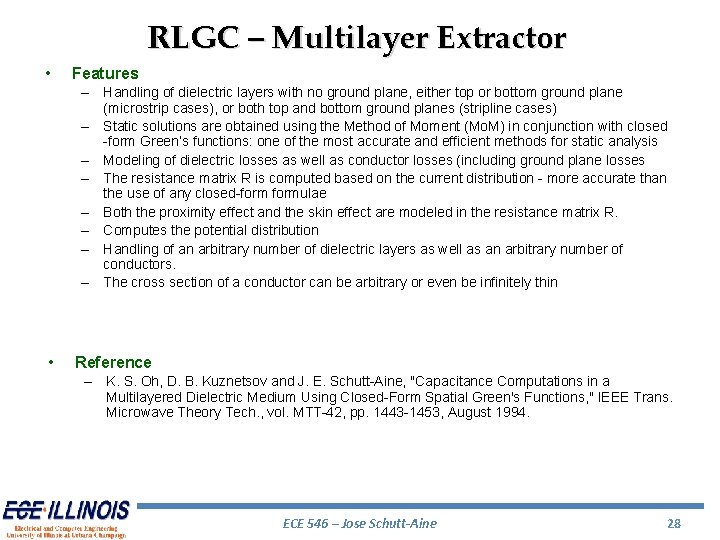
RLGC – Multilayer Extractor • Features – Handling of dielectric layers with no ground plane, either top or bottom ground plane (microstrip cases), or both top and bottom ground planes (stripline cases) – Static solutions are obtained using the Method of Moment (Mo. M) in conjunction with closed -form Green’s functions: one of the most accurate and efficient methods for static analysis – Modeling of dielectric losses as well as conductor losses (including ground plane losses – The resistance matrix R is computed based on the current distribution - more accurate than the use of any closed-formulae – Both the proximity effect and the skin effect are modeled in the resistance matrix R. – Computes the potential distribution – Handling of an arbitrary number of dielectric layers as well as an arbitrary number of conductors. – The cross section of a conductor can be arbitrary or even be infinitely thin • Reference – K. S. Oh, D. B. Kuznetsov and J. E. Schutt-Aine, "Capacitance Computations in a Multilayered Dielectric Medium Using Closed-Form Spatial Green's Functions, " IEEE Trans. Microwave Theory Tech. , vol. MTT-42, pp. 1443 -1453, August 1994. ECE 546 – Jose Schutt-Aine 28
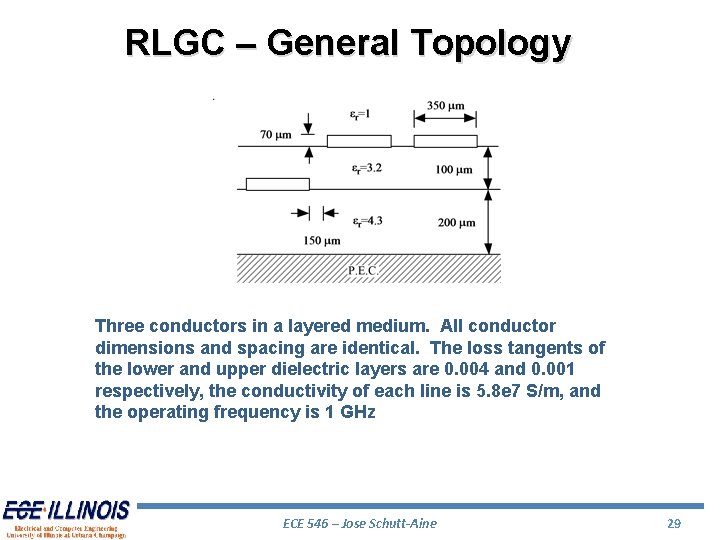
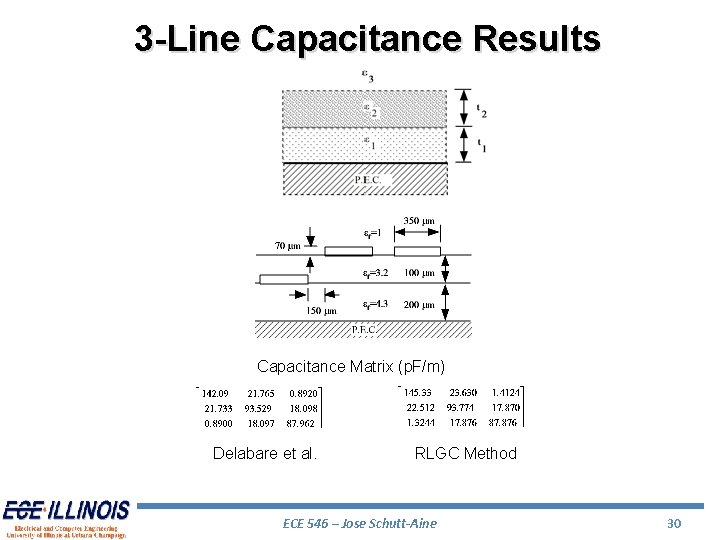
RLGC – General Topology Three conductors in a layered medium. All conductor dimensions and spacing are identical. The loss tangents of the lower and upper dielectric layers are 0. 004 and 0. 001 respectively, the conductivity of each line is 5. 8 e 7 S/m, and the operating frequency is 1 GHz ECE 546 – Jose Schutt-Aine 29
3 -Line Capacitance Results Capacitance Matrix (p. F/m) Delabare et al. RLGC Method ECE 546 – Jose Schutt-Aine 30
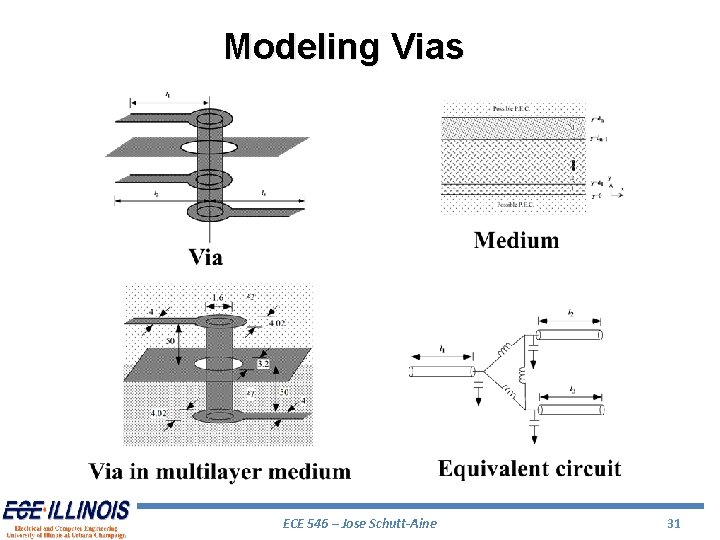
Modeling Vias ECE 546 – Jose Schutt-Aine 31
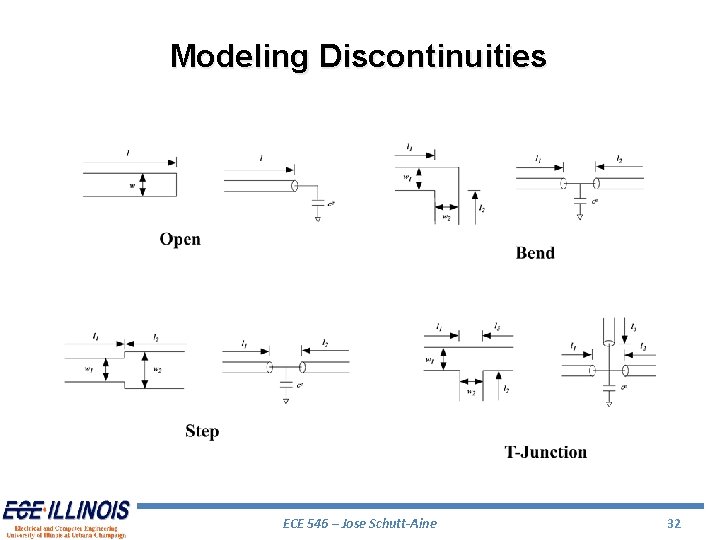
Modeling Discontinuities ECE 546 – Jose Schutt-Aine 32
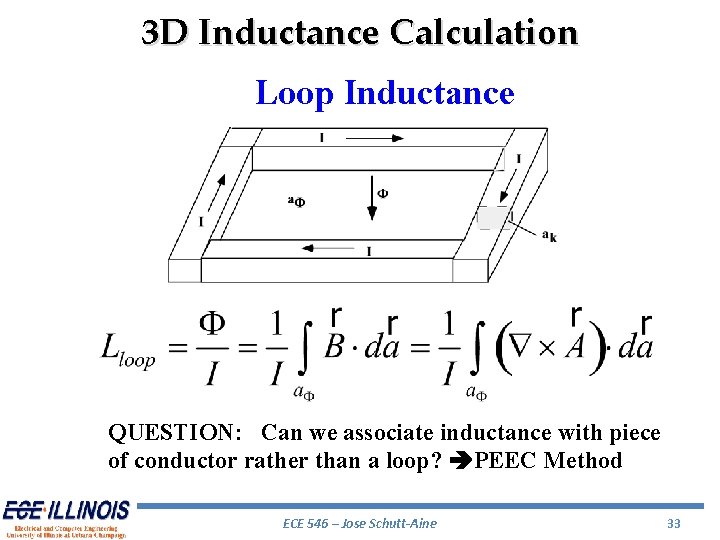
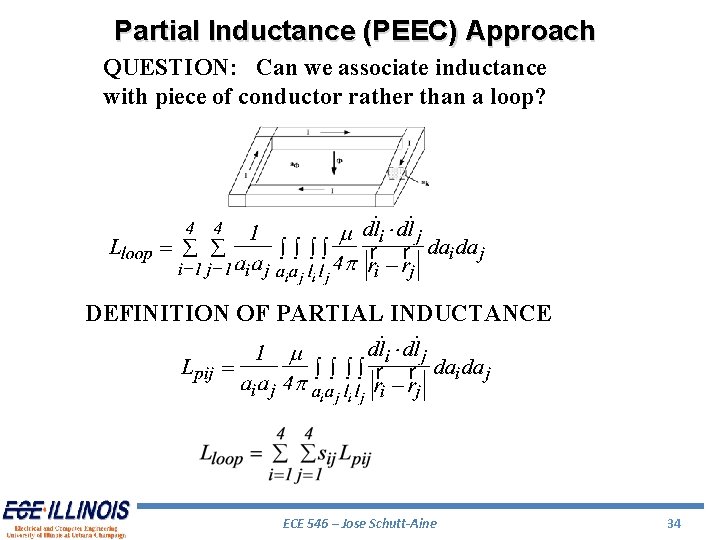
3 D Inductance Calculation Loop Inductance QUESTION: Can we associate inductance with piece of conductor rather than a loop? PEEC Method ECE 546 – Jose Schutt-Aine 33
Partial Inductance (PEEC) Approach QUESTION: Can we associate inductance with piece of conductor rather than a loop? DEFINITION OF PARTIAL INDUCTANCE ECE 546 – Jose Schutt-Aine 34
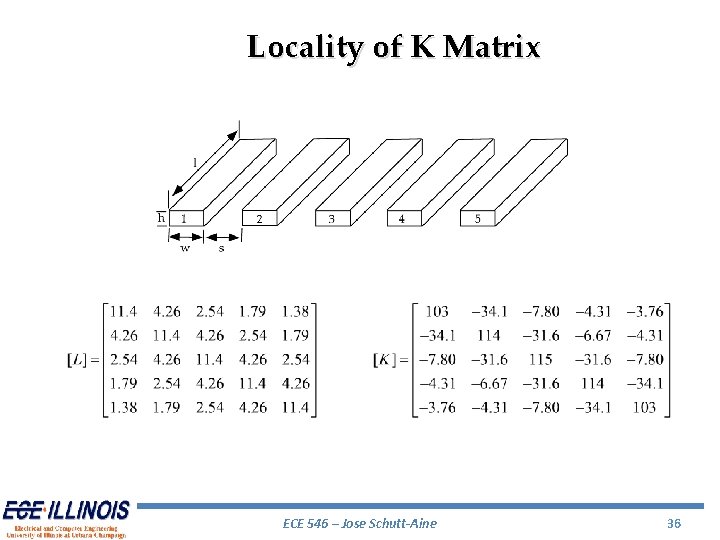
Circuit Element K [K]=[L]-1 • Better locality property • Leads to sparser matrix • Diagonally dominant • Allows truncation of far off-diagonal elements • Better suited for on-chip inductance analysis ECE 546 – Jose Schutt-Aine 35
Locality of K Matrix ECE 546 – Jose Schutt-Aine 36
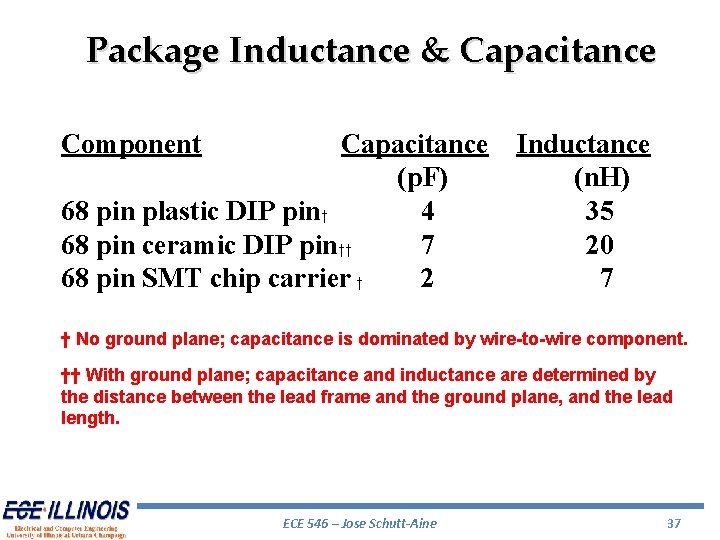
Package Inductance & Capacitance Component Capacitance Inductance (p. F) (n. H) 68 pin plastic DIP pin† 4 35 68 pin ceramic DIP pin†† 7 20 68 pin SMT chip carrier † 2 7 † No ground plane; capacitance is dominated by wire-to-wire component. †† With ground plane; capacitance and inductance are determined by the distance between the lead frame and the ground plane, and the lead length. ECE 546 – Jose Schutt-Aine 37
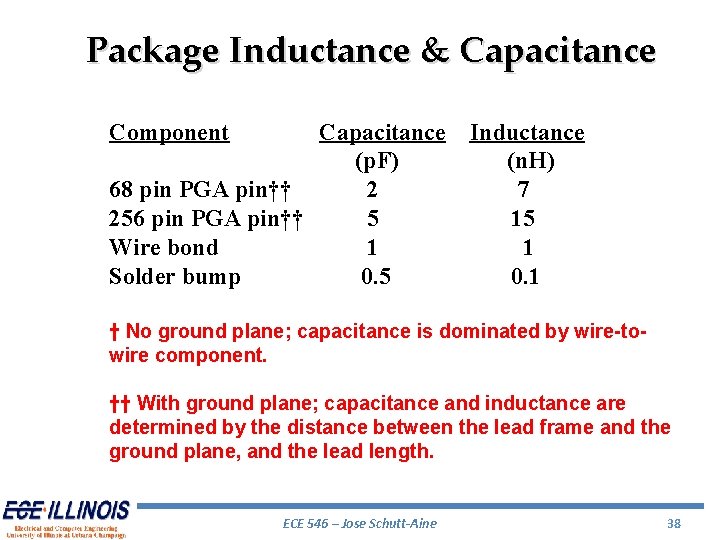
Package Inductance & Capacitance Component Capacitance Inductance (p. F) (n. H) 68 pin PGA pin†† 2 7 256 pin PGA pin†† 5 15 Wire bond 1 Solder bump 0. 5 0. 1 † No ground plane; capacitance is dominated by wire-towire component. †† With ground plane; capacitance and inductance are determined by the distance between the lead frame and the ground plane, and the lead length. ECE 546 – Jose Schutt-Aine 38
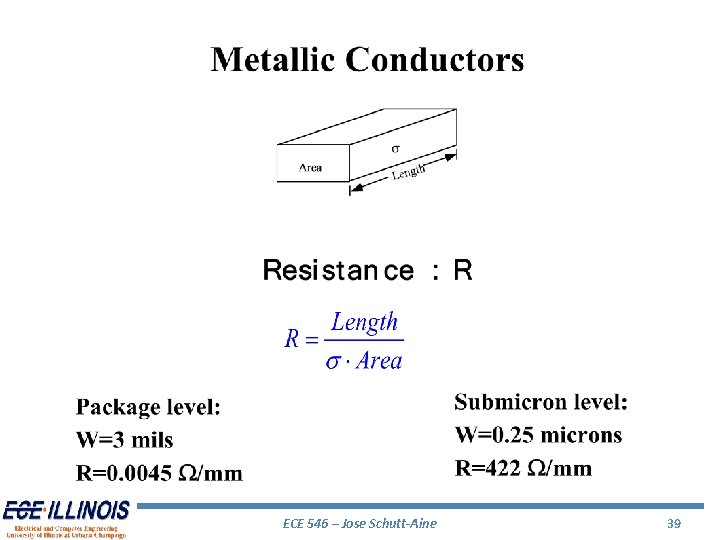
ECE 546 – Jose Schutt-Aine 39
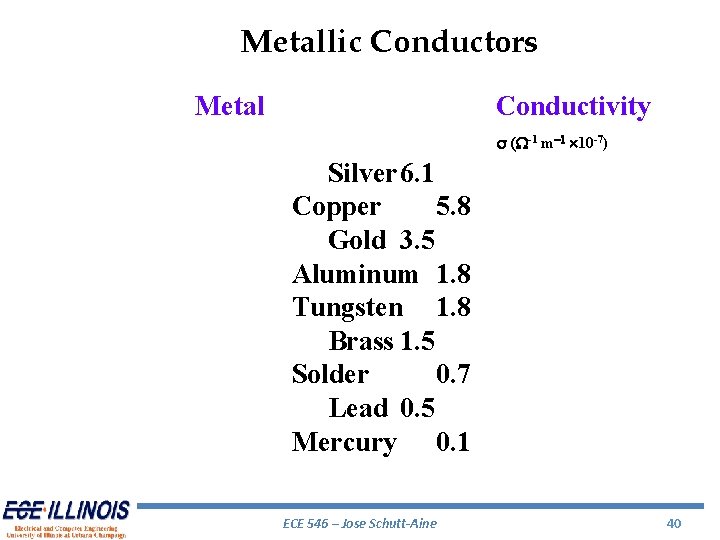
Metallic Conductors Metal Conductivity s (W m 10 ) Silver 6. 1 Copper 5. 8 Gold 3. 5 Aluminum 1. 8 Tungsten 1. 8 Brass 1. 5 Solder 0. 7 Lead 0. 5 Mercury 0. 1 -1 ECE 546 – Jose Schutt-Aine -1 -7 40
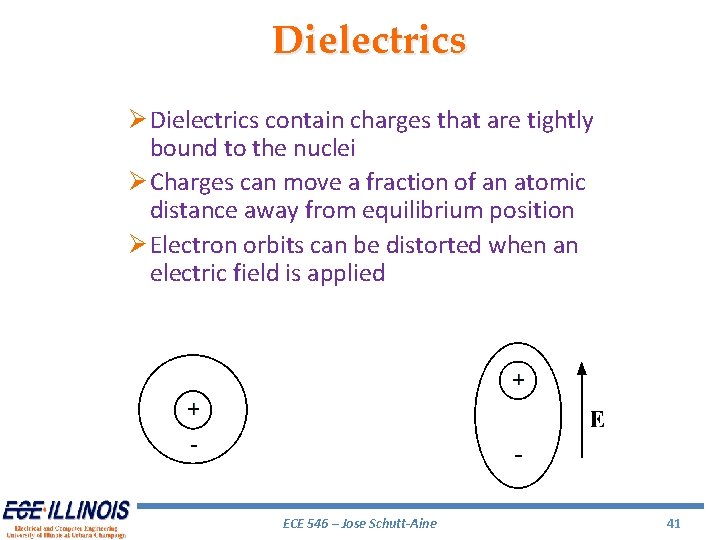
Dielectrics Ø Dielectrics contain charges that are tightly bound to the nuclei Ø Charges can move a fraction of an atomic distance away from equilibrium position Ø Electron orbits can be distorted when an electric field is applied ECE 546 – Jose Schutt-Aine 41
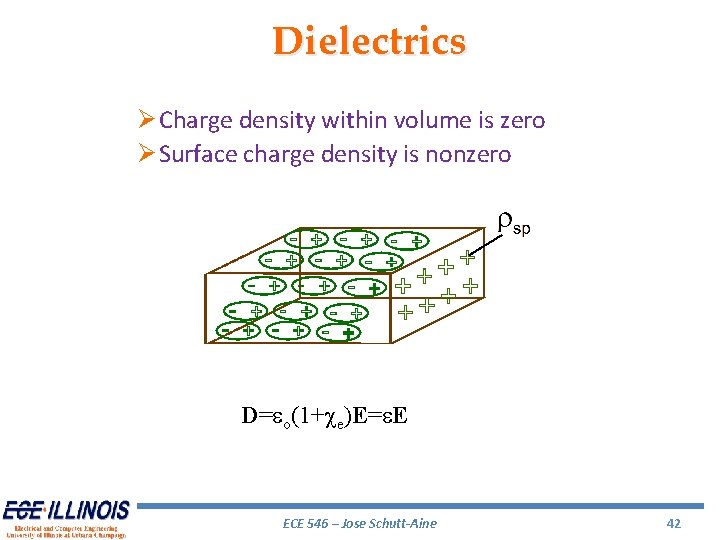
Dielectrics Ø Charge density within volume is zero Ø Surface charge density is nonzero D=eo(1+ e)E=e. E ECE 546 – Jose Schutt-Aine 42
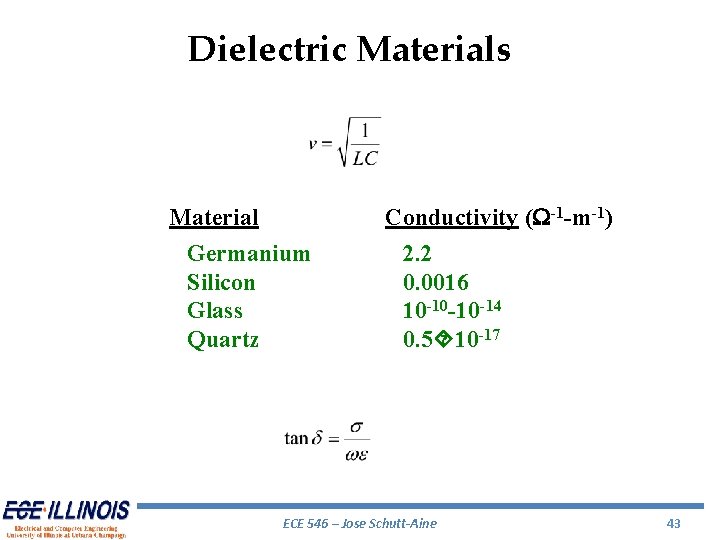
Dielectric Materials Material Germanium Silicon Glass Quartz Conductivity (W-1 -m-1) 2. 2 0. 0016 10 -10 -10 -14 0. 5 10 -17 ECE 546 – Jose Schutt-Aine 43
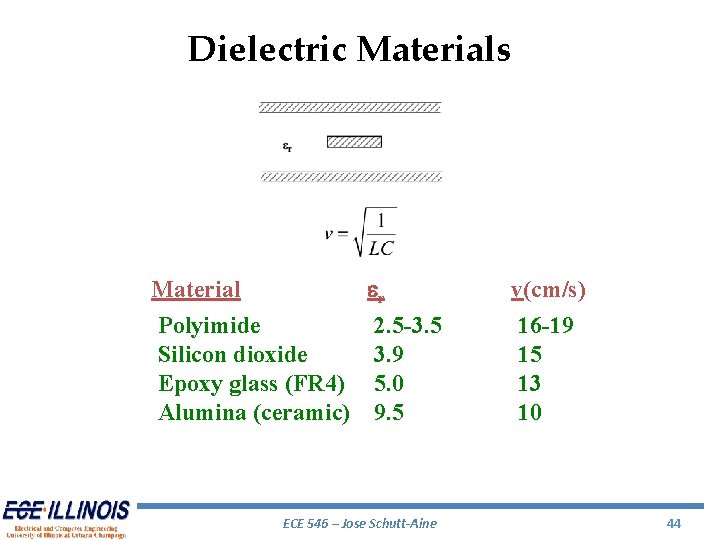
Dielectric Materials Material er v(cm/s) Polyimide Silicon dioxide Epoxy glass (FR 4) Alumina (ceramic) 2. 5 -3. 5 3. 9 5. 0 9. 5 16 -19 15 13 10 ECE 546 – Jose Schutt-Aine 44
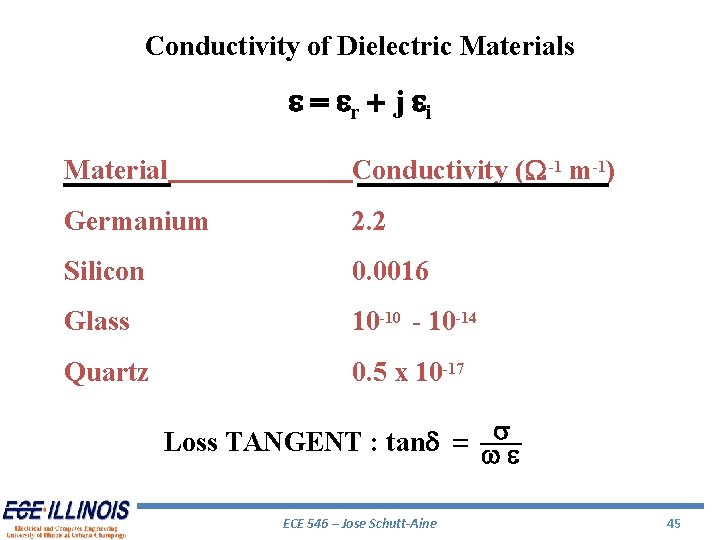
Conductivity of Dielectric Materials e = e r + j ei Material Conductivity (W -1 m-1) Germanium 2. 2 Silicon 0. 0016 Glass 10 -10 - 10 -14 Quartz 0. 5 x 10 -17 Loss TANGENT : tand = wse ECE 546 – Jose Schutt-Aine 45
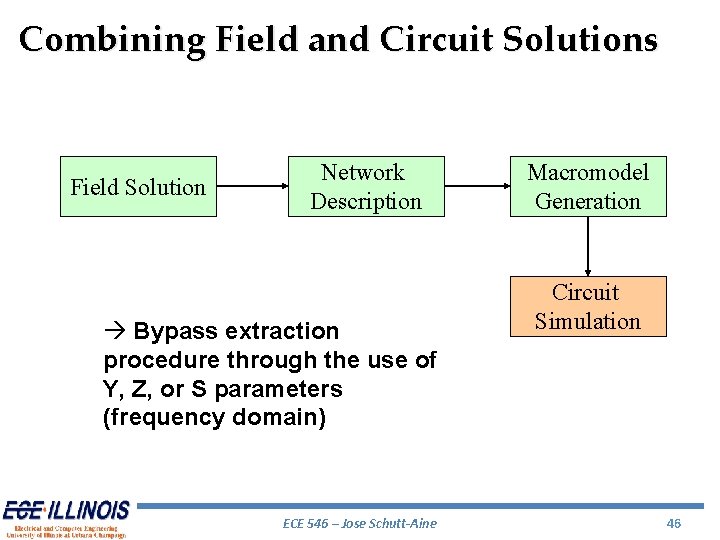
Combining Field and Circuit Solutions Field Solution Network Description à Bypass extraction procedure through the use of Y, Z, or S parameters (frequency domain) ECE 546 – Jose Schutt-Aine Macromodel Generation Circuit Simulation 46
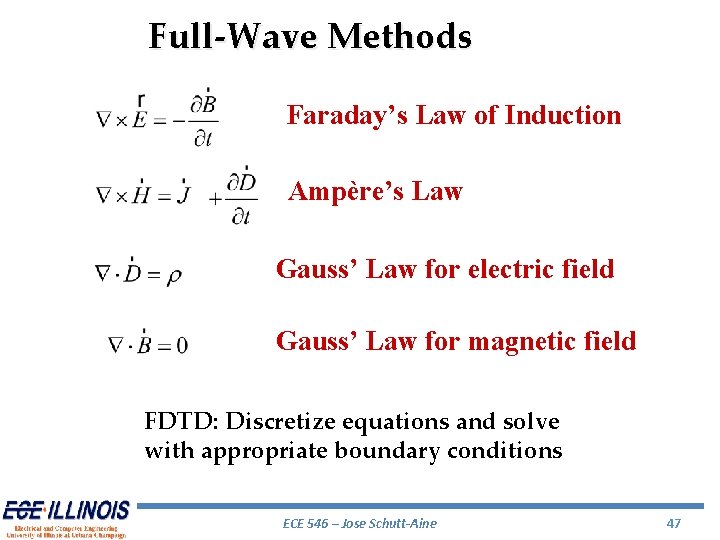
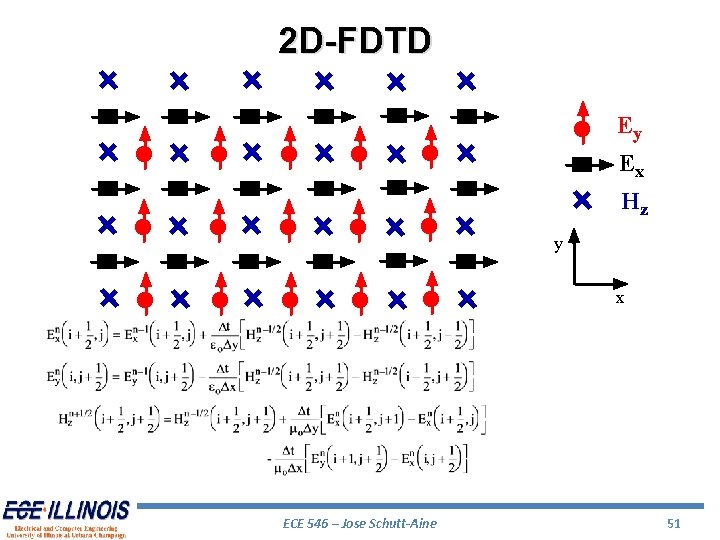
Full-Wave Methods Faraday’s Law of Induction Ampère’s Law Gauss’ Law for electric field Gauss’ Law for magnetic field FDTD: Discretize equations and solve with appropriate boundary conditions ECE 546 – Jose Schutt-Aine 47
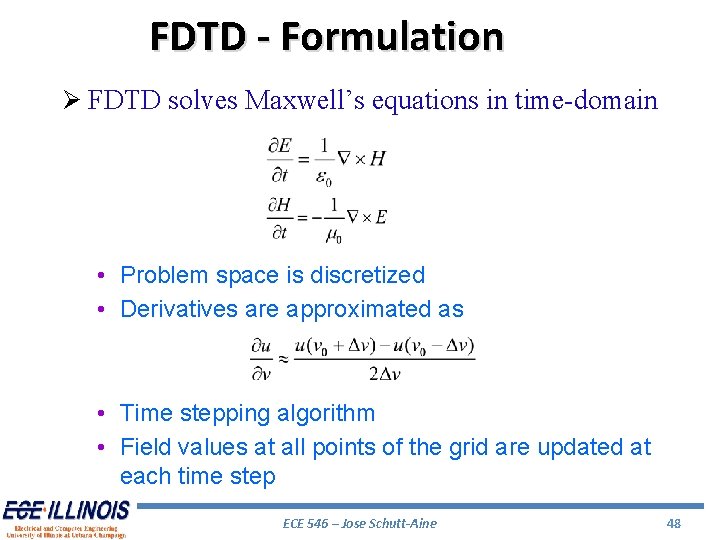
FDTD - Formulation Ø FDTD solves Maxwell’s equations in time-domain • Problem space is discretized • Derivatives are approximated as • Time stepping algorithm • Field values at all points of the grid are updated at each time step ECE 546 – Jose Schutt-Aine 48
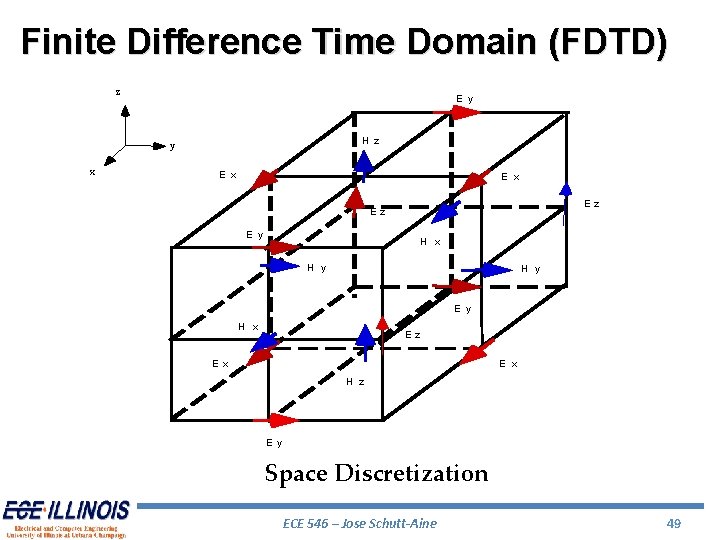
Finite Difference Time Domain (FDTD) z E y H z y x E x Ez Ez E y H x H y E y H x Ez E x H z E y Space Discretization ECE 546 – Jose Schutt-Aine 49
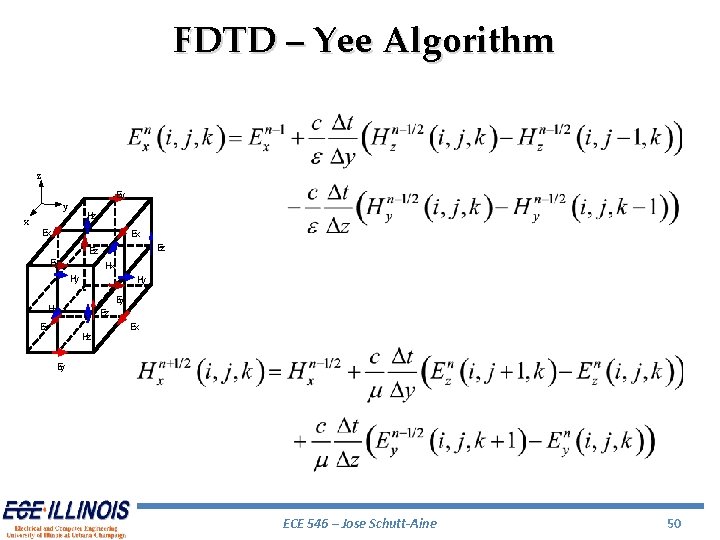
FDTD – Yee Algorithm z Ey y Hz x Ex Ex Ez Ez Ey Hx Hy Hy Ey Hx Ex Ez Hz Ex Ey ECE 546 – Jose Schutt-Aine 50
2 D-FDTD Ey Ex Hz y x ECE 546 – Jose Schutt-Aine 51
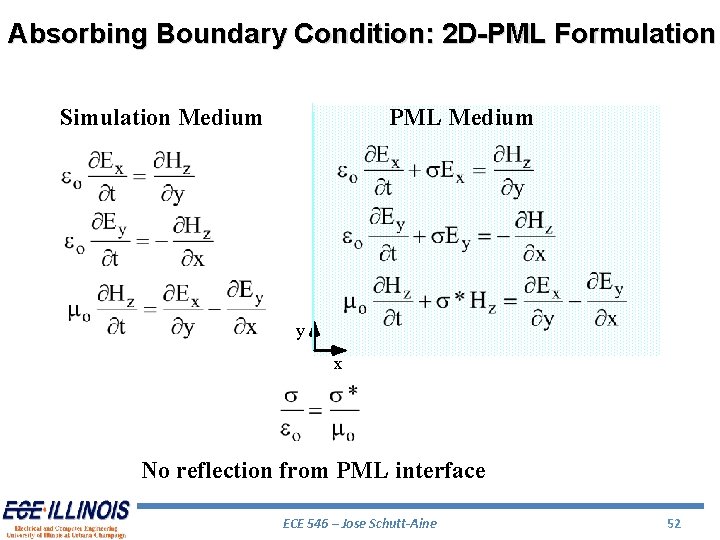
Absorbing Boundary Condition: 2 D-PML Formulation Simulation Medium PML Medium y x No reflection from PML interface ECE 546 – Jose Schutt-Aine 52
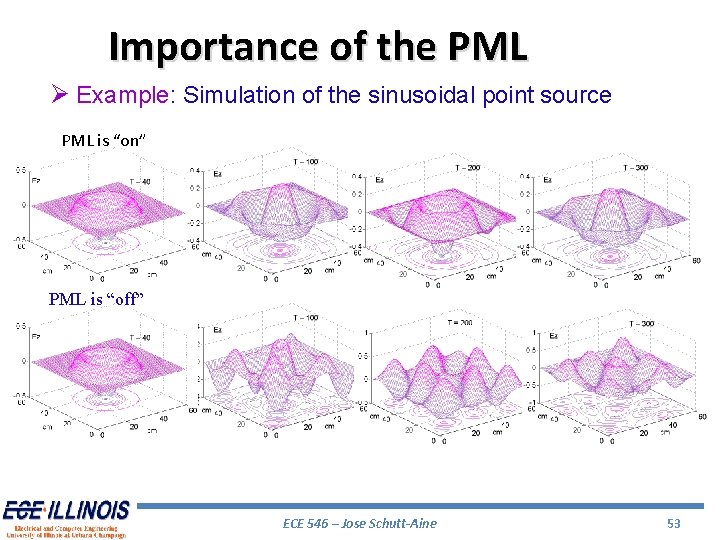
Importance of the PML Ø Example: Simulation of the sinusoidal point source PML is “on” PML is “off” ECE 546 – Jose Schutt-Aine 53
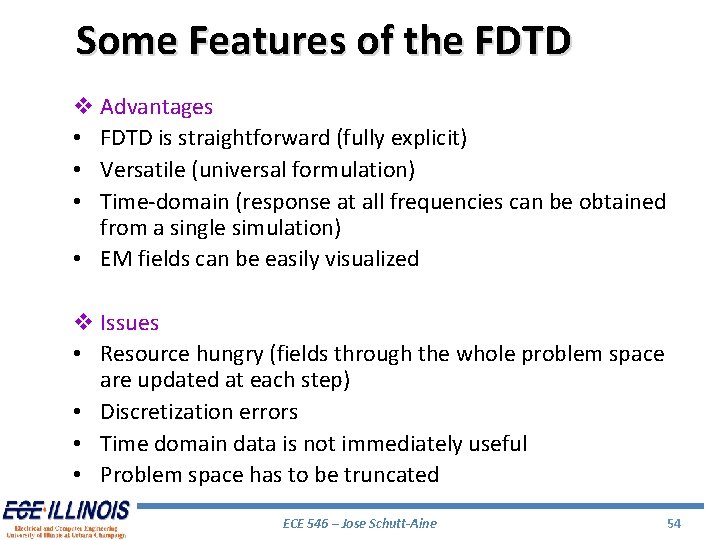
Some Features of the FDTD v Advantages • FDTD is straightforward (fully explicit) • Versatile (universal formulation) • Time-domain (response at all frequencies can be obtained from a single simulation) • EM fields can be easily visualized v Issues • Resource hungry (fields through the whole problem space are updated at each step) • Discretization errors • Time domain data is not immediately useful • Problem space has to be truncated ECE 546 – Jose Schutt-Aine 54
Pros of The FDTD Method • FDTD directly solves Maxwell’s equations providing all information about the EM field at each of the space sells at every time-step • Being a time-domain technique, FDTD directly calculates the impulse response of an electromagnetic system. Therefore? A single FDTD simulation can provide either ultrawideband temporal waveforms or the sinusoidal steady-state response at any frequency within the excitation spectrum • FDTD uses no linear algebra • Being a time-domain technique, FDTD directly calculates the nonlinear response of an electromagnetic system ECE 546 – Jose Schutt-Aine 55
Cons of The FDTD Method • Computationally expensive, requires large random access memory. At each time step values of the fields at each point in space are updated using values from the previous step • FDTD works well with regular uniform meshes but the use of regular uniform meshes leads to staircasing. Implementation of nonuniform meshes, on the other hand, requires special mesh-generation software and can lead to additional computer operations and instabilities • Requires truncation of the problem space in a way that does not create reflection errors ECE 546 – Jose Schutt-Aine 56
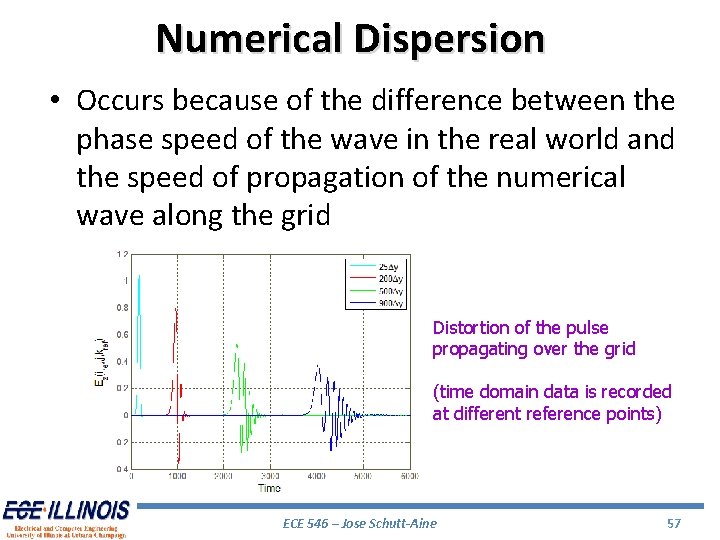
Numerical Dispersion • Occurs because of the difference between the phase speed of the wave in the real world and the speed of propagation of the numerical wave along the grid Distortion of the pulse propagating over the grid (time domain data is recorded at different reference points) ECE 546 – Jose Schutt-Aine 57
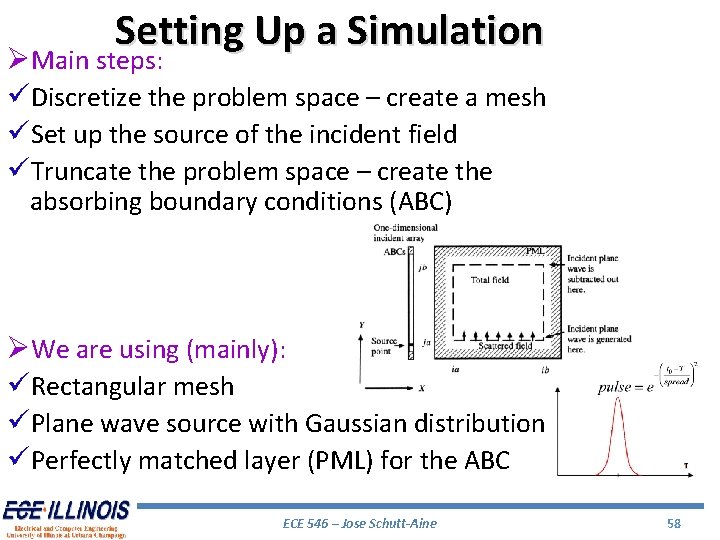
Setting Up a Simulation ØMain steps: üDiscretize the problem space – create a mesh üSet up the source of the incident field üTruncate the problem space – create the absorbing boundary conditions (ABC) ØWe are using (mainly): üRectangular mesh üPlane wave source with Gaussian distribution üPerfectly matched layer (PML) for the ABC ECE 546 – Jose Schutt-Aine 58
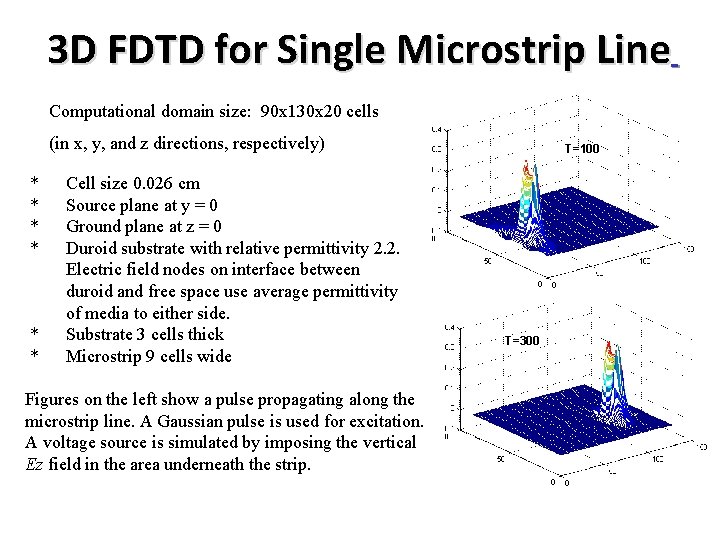
3 D FDTD for Single Microstrip Line Computational domain size: 90 x 130 x 20 cells (in x, y, and z directions, respectively) * Cell size 0. 026 cm * Source plane at y = 0 * Ground plane at z = 0 * Duroid substrate with relative permittivity 2. 2. Electric field nodes on interface between duroid and free space use average permittivity of media to either side. * Substrate 3 cells thick * Microstrip 9 cells wide Figures on the left show a pulse propagating along the microstrip line. A Gaussian pulse is used for excitation. A voltage source is simulated by imposing the vertical Ez field in the area underneath the strip. T=100 T=300
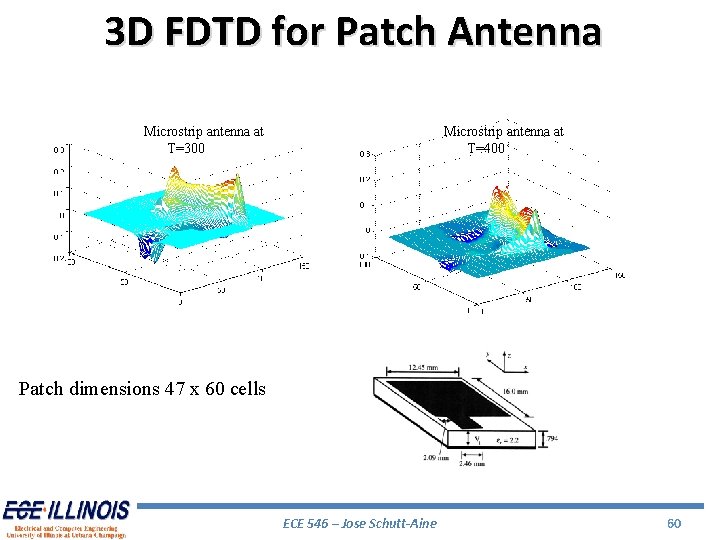
3 D FDTD for Patch Antenna Microstrip antenna at T=300 Microstrip antenna at T=400 Patch dimensions 47 x 60 cells ECE 546 – Jose Schutt-Aine 60
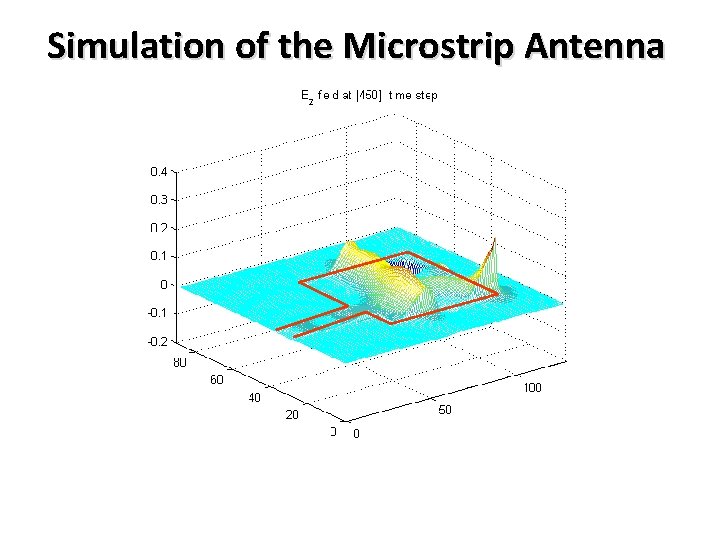
Simulation of the Microstrip Antenna
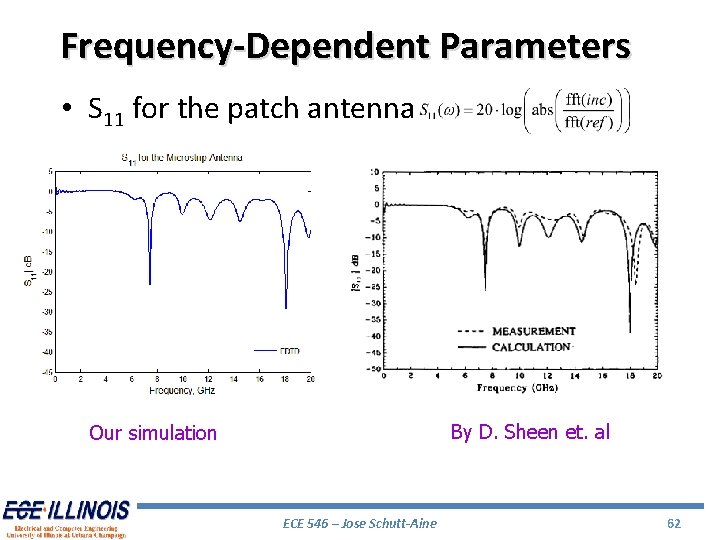
Frequency-Dependent Parameters • S 11 for the patch antenna By D. Sheen et. al Our simulation ECE 546 – Jose Schutt-Aine 62
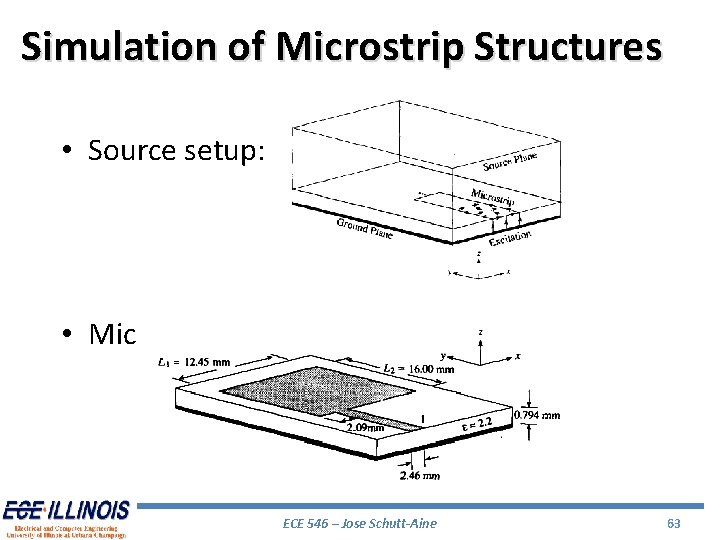
Simulation of Microstrip Structures • Source setup: • Microstrip Patch Antenna ECE 546 – Jose Schutt-Aine 63
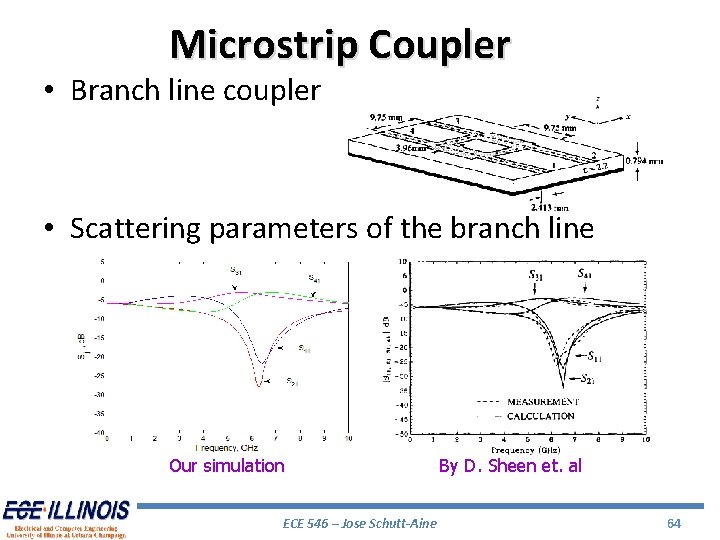
Microstrip Coupler • Branch line coupler • Scattering parameters of the branch line coupler Our simulation ECE 546 – Jose Schutt-Aine By D. Sheen et. al 64
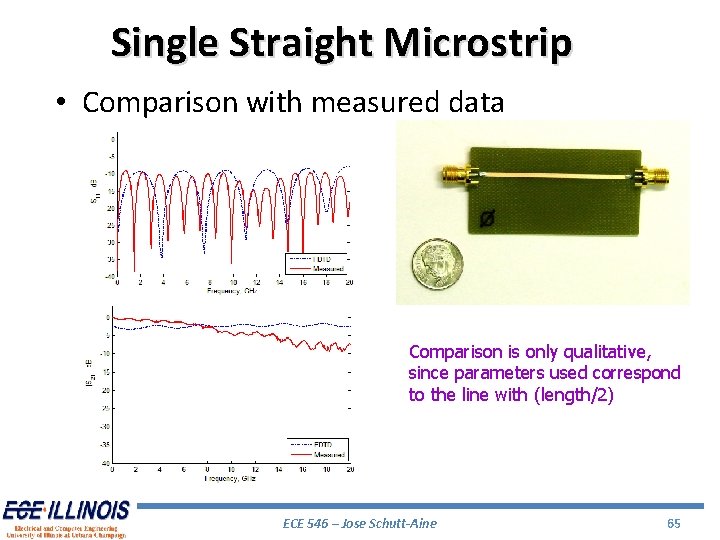
Single Straight Microstrip • Comparison with measured data Comparison is only qualitative, since parameters used correspond to the line with (length/2) ECE 546 – Jose Schutt-Aine 65
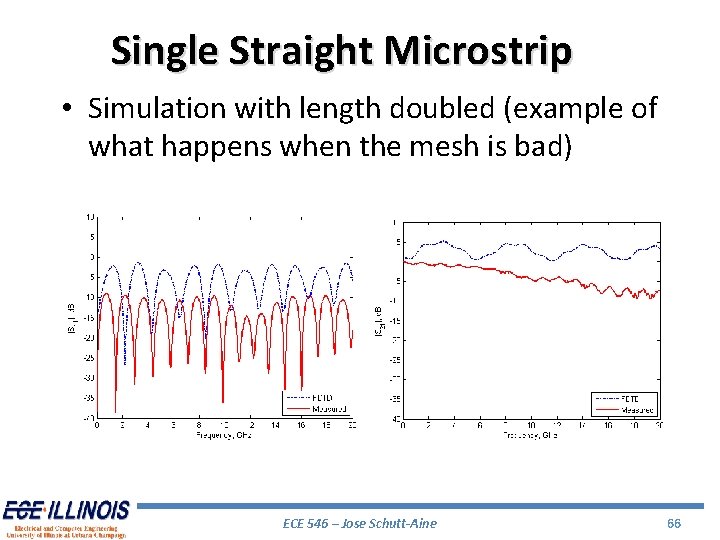
Single Straight Microstrip • Simulation with length doubled (example of what happens when the mesh is bad) ECE 546 – Jose Schutt-Aine 66
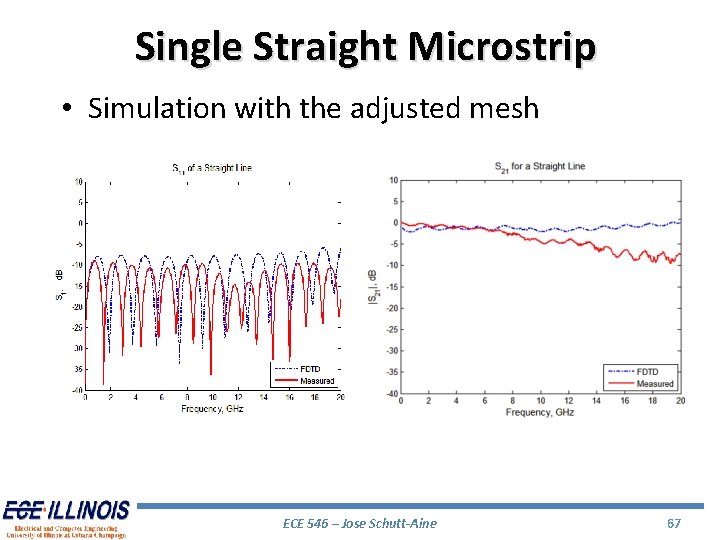
Single Straight Microstrip • Simulation with the adjusted mesh ECE 546 – Jose Schutt-Aine 67
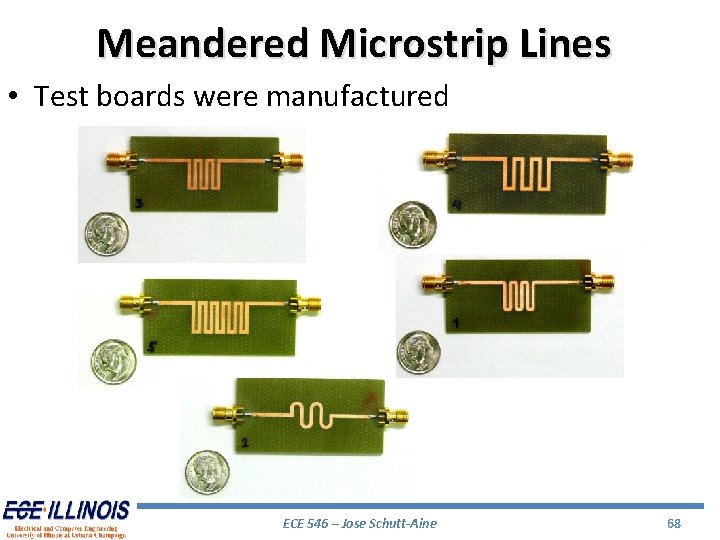
Meandered Microstrip Lines • Test boards were manufactured ECE 546 – Jose Schutt-Aine 68
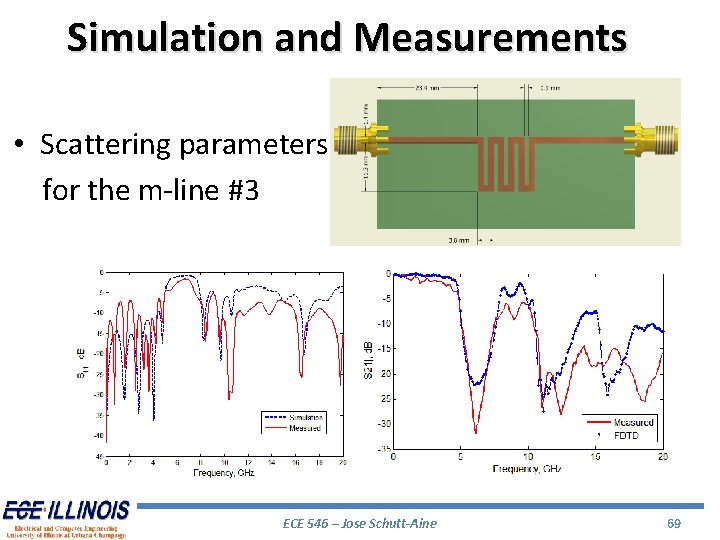
Simulation and Measurements • Scattering parameters for the m-line #3 ECE 546 – Jose Schutt-Aine 69
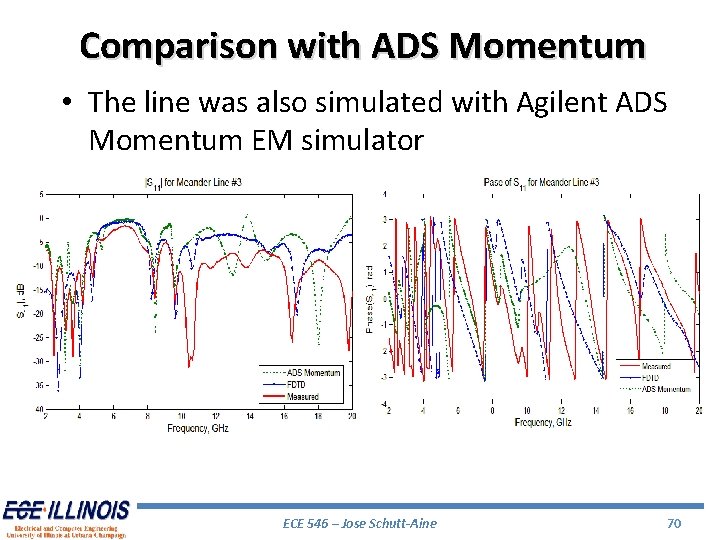
Comparison with ADS Momentum • The line was also simulated with Agilent ADS Momentum EM simulator ECE 546 – Jose Schutt-Aine 70
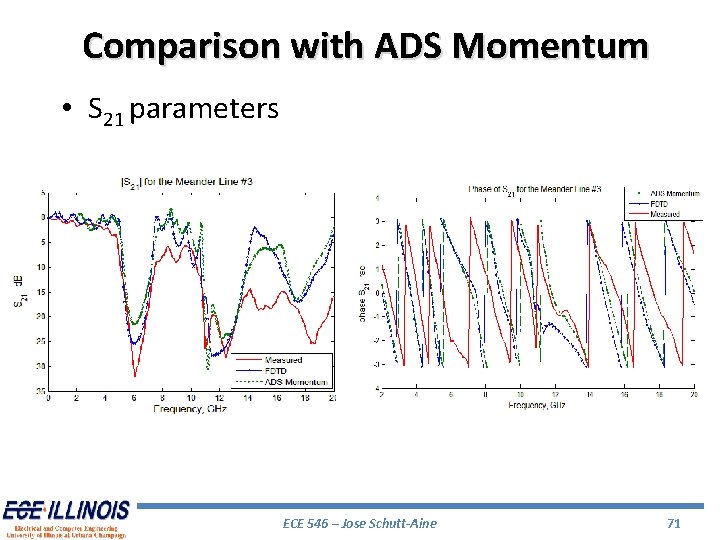
Comparison with ADS Momentum • S 21 parameters ECE 546 – Jose Schutt-Aine 71
References • A. Taflove, S. C. Hagness, Computational Electrodinamics: The Finite – Difference Time-Domain Method. 3 -d edition. Artech House Publishers, 2005. • D. Sullivan, Electromagnetic simulation using the FDTD method, IEEE Press series on RF and microwave technology, 2000. • D. M. Sheen, S. M. Ali, M. D. Abouzahra, J. A. Kong, “Application of the Three-Dimensional Finite-Difference Time-Domain Method to the Analysis of Planar Microstrip Circuits”, IEEE Trans. Microwave Theory Tech. , vol. 38, no 7, July 1990. ECE 546 – Jose Schutt-Aine 72