
ECE 544 Protocol Design Project 2016 Siddharth Rupavatharam

- Slides: 11
ECE 544 Protocol Design Project 2016 Siddharth Rupavatharam Bhargav Gokalgandhi
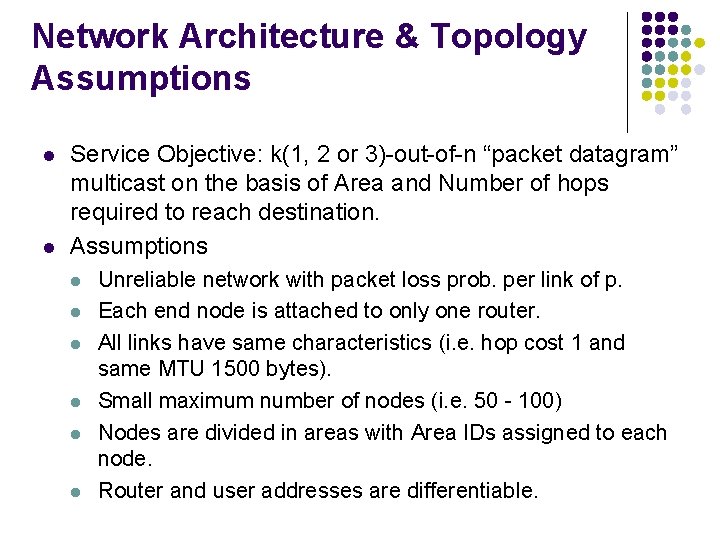
Network Architecture & Topology Assumptions l l Service Objective: k(1, 2 or 3)-out-of-n “packet datagram” multicast on the basis of Area and Number of hops required to reach destination. Assumptions l l l Unreliable network with packet loss prob. per link of p. Each end node is attached to only one router. All links have same characteristics (i. e. hop cost 1 and same MTU 1500 bytes). Small maximum number of nodes (i. e. 50 - 100) Nodes are divided in areas with Area IDs assigned to each node. Router and user addresses are differentiable.
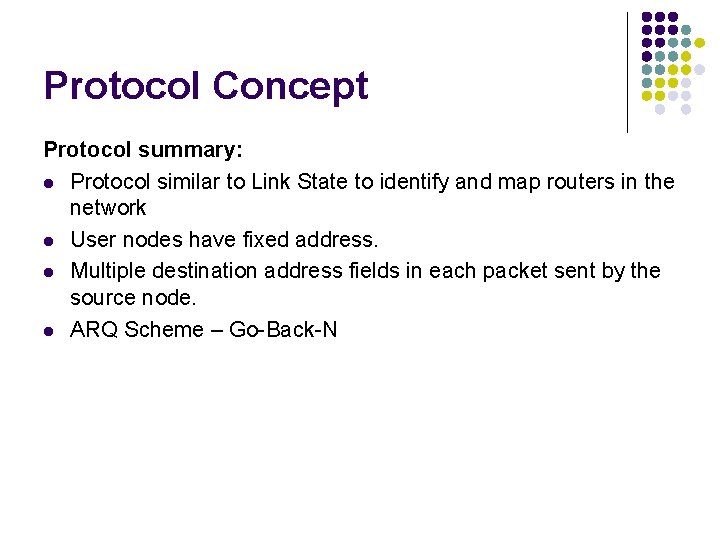
Protocol Concept Protocol summary: l Protocol similar to Link State to identify and map routers in the network l User nodes have fixed address. l Multiple destination address fields in each packet sent by the source node. l ARQ Scheme – Go-Back-N
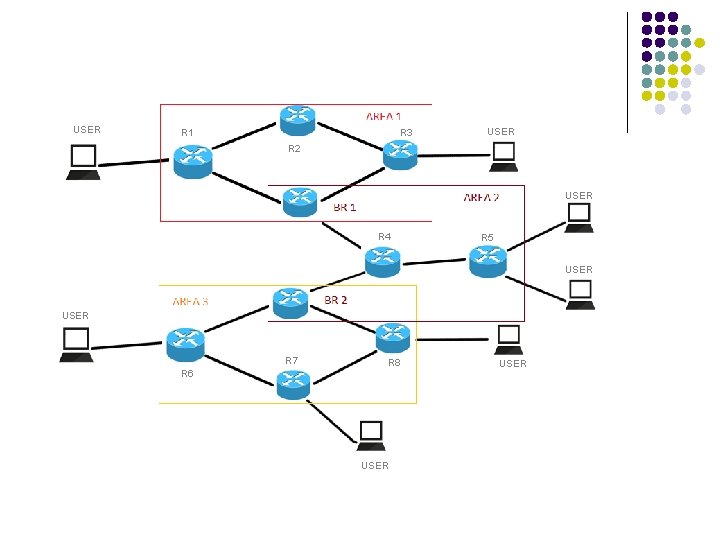
USER R 1 R 3 USER R 2 USER R 4 R 5 USER R 7 R 8 R 6 USER
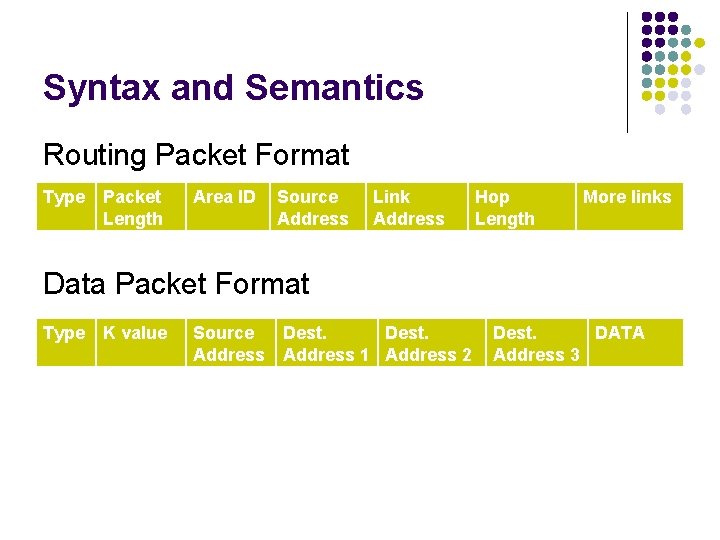
Syntax and Semantics Routing Packet Format Type Packet Length Area ID Source Address Link Address Hop Length More links Data Packet Format Type K value Source Address Dest. Address 1 Address 2 Dest. DATA Address 3
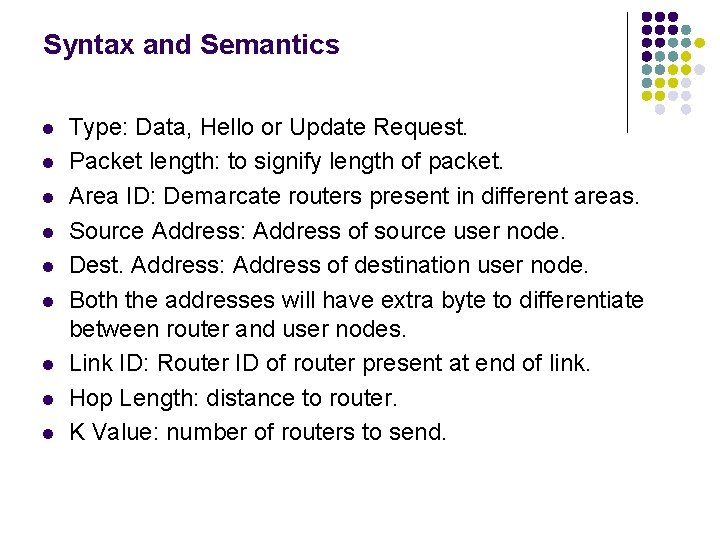
Syntax and Semantics l l l l l Type: Data, Hello or Update Request. Packet length: to signify length of packet. Area ID: Demarcate routers present in different areas. Source Address: Address of source user node. Dest. Address: Address of destination user node. Both the addresses will have extra byte to differentiate between router and user nodes. Link ID: Router ID of router present at end of link. Hop Length: distance to router. K Value: number of routers to send.
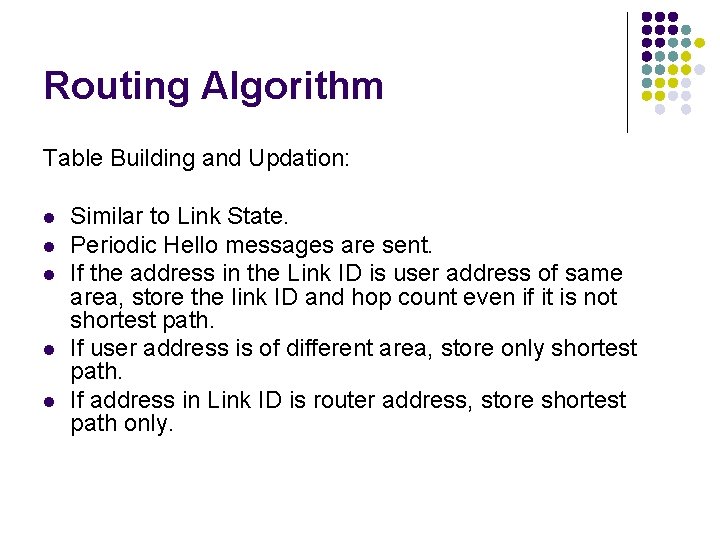
Routing Algorithm Table Building and Updation: l l l Similar to Link State. Periodic Hello messages are sent. If the address in the Link ID is user address of same area, store the link ID and hop count even if it is not shortest path. If user address is of different area, store only shortest path. If address in Link ID is router address, store shortest path only.
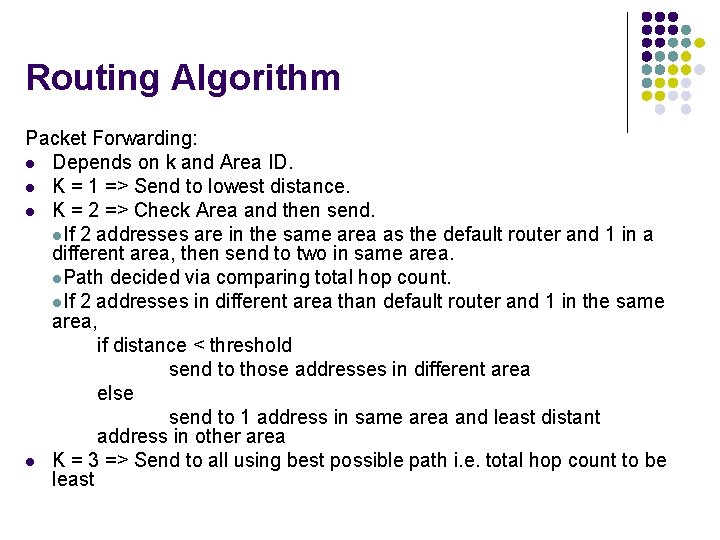
Routing Algorithm Packet Forwarding: l Depends on k and Area ID. l K = 1 => Send to lowest distance. l K = 2 => Check Area and then send. l. If 2 addresses are in the same area as the default router and 1 in a different area, then send to two in same area. l. Path decided via comparing total hop count. l. If 2 addresses in different area than default router and 1 in the same area, if distance < threshold send to those addresses in different area else send to 1 address in same area and least distant address in other area l K = 3 => Send to all using best possible path i. e. total hop count to be least
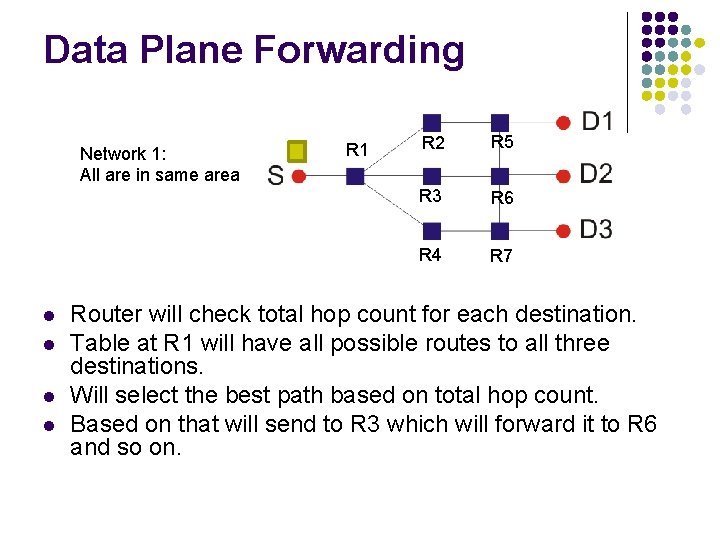
Data Plane Forwarding Network 1: All are in same area l l R 1 R 2 R 5 R 3 R 6 R 4 R 7 Router will check total hop count for each destination. Table at R 1 will have all possible routes to all three destinations. Will select the best path based on total hop count. Based on that will send to R 3 which will forward it to R 6 and so on.
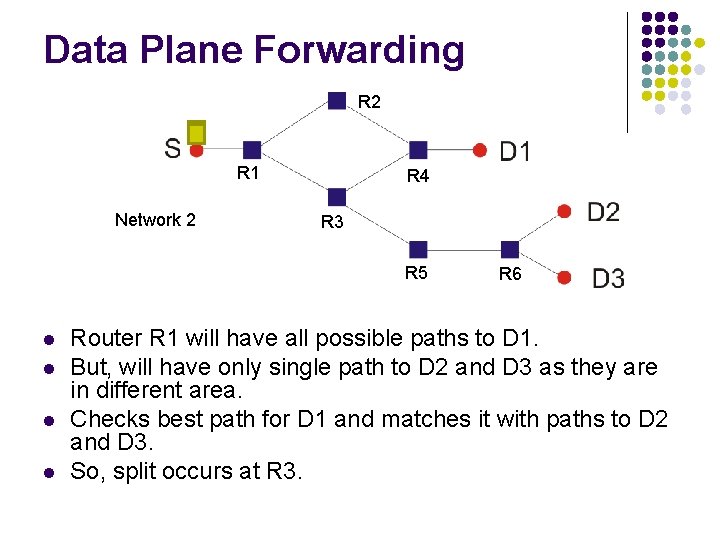
Data Plane Forwarding R 2 R 1 Network 2 R 4 R 3 R 5 l l R 6 Router R 1 will have all possible paths to D 1. But, will have only single path to D 2 and D 3 as they are in different area. Checks best path for D 1 and matches it with paths to D 2 and D 3. So, split occurs at R 3.
Summary Key protocol design features (recap) l l Uses Area ID and Number of Hops(Distance) for decision of number of destinations to send. Checks and compares next total hop count to split packet. Performance (For the above two examples) l l l Overhead increases as bytes are added for area ID and address differentiation. For large networks, memory requirements will NOT increase exponentially because of differentiation in area. Router processing time increases. Implementation complexity l l l Header length for each packet increases. Extra storage requirements for entries within area. Router computational complexity is high.