
ECE 544 Communication NetworksII Spring 2015 Transport Protocols
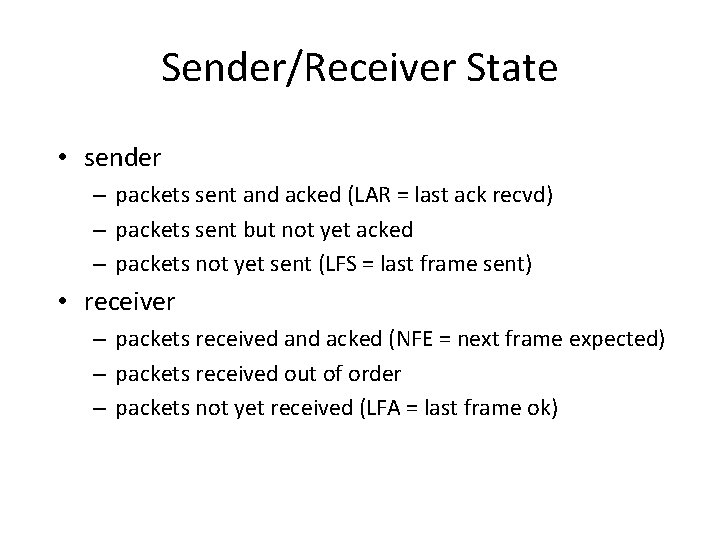
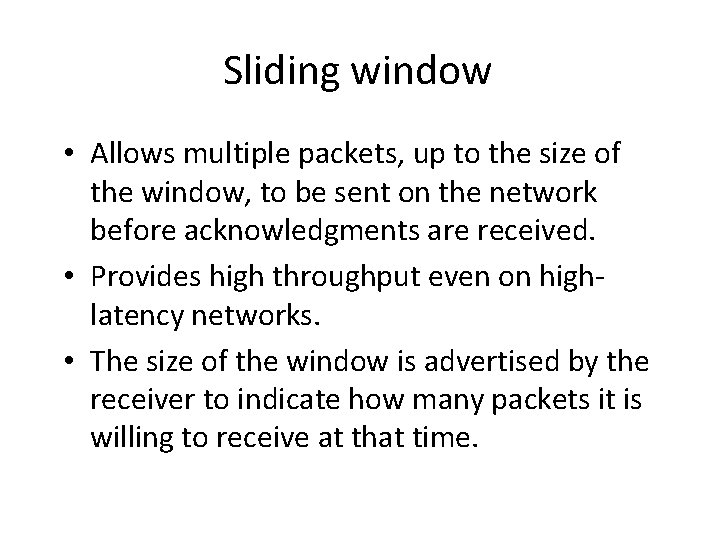
- Slides: 101
ECE 544: Communication Networks-II Spring 2015 Transport Protocols Includes teaching materials from, L. Peterson, David Wetherall and Tom Anderson (Univ. of Washington), Gregg, Brendan. Systems Performance: Enterprise and the Cloud
Today’s Lecture • • Introduction to transport protocols UDP TCP RTP
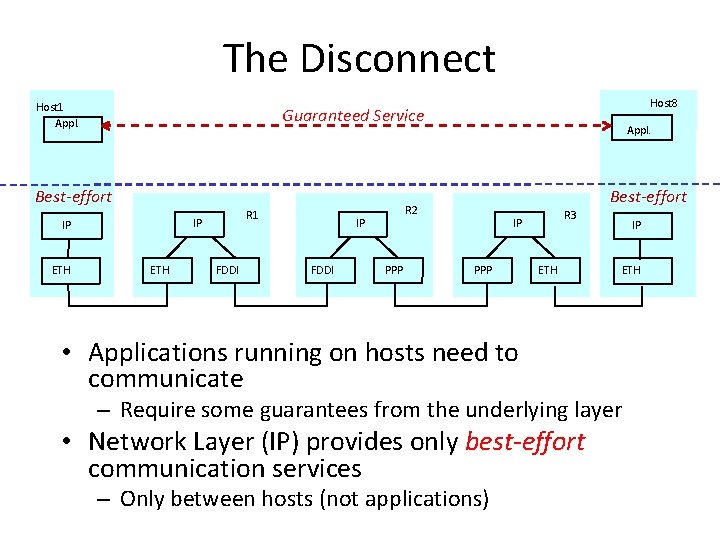
The Disconnect Host 1 Appl. Guaranteed Service Best-effort R 1 IP IP ETH Host 8 ETH FDDI Best-effort R 2 IP FDDI Appl. PPP R 3 IP PPP ETH • Applications running on hosts need to communicate IP ETH – Require some guarantees from the underlying layer • Network Layer (IP) provides only best-effort communication services – Only between hosts (not applications)
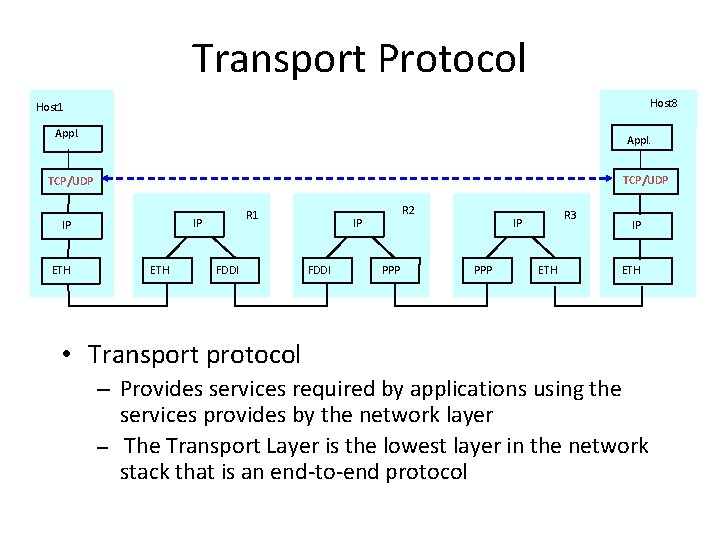
Transport Protocol Host 8 Host 1 Appl. TCP/UDP IP ETH R 1 IP ETH FDDI R 2 IP FDDI PPP R 3 IP PPP ETH IP ETH • Transport protocol – Provides services required by applications using the services provides by the network layer – The Transport Layer is the lowest layer in the network stack that is an end-to-end protocol
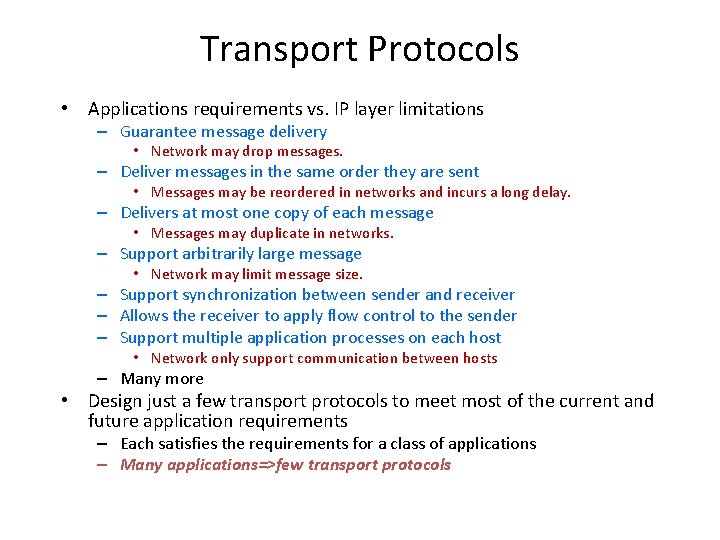
Transport Protocols • Applications requirements vs. IP layer limitations – Guarantee message delivery • Network may drop messages. – Deliver messages in the same order they are sent • Messages may be reordered in networks and incurs a long delay. – Delivers at most one copy of each message • Messages may duplicate in networks. – Support arbitrarily large message • Network may limit message size. – Support synchronization between sender and receiver – Allows the receiver to apply flow control to the sender – Support multiple application processes on each host • Network only support communication between hosts – Many more • Design just a few transport protocols to meet most of the current and future application requirements – Each satisfies the requirements for a class of applications – Many applications=>few transport protocols
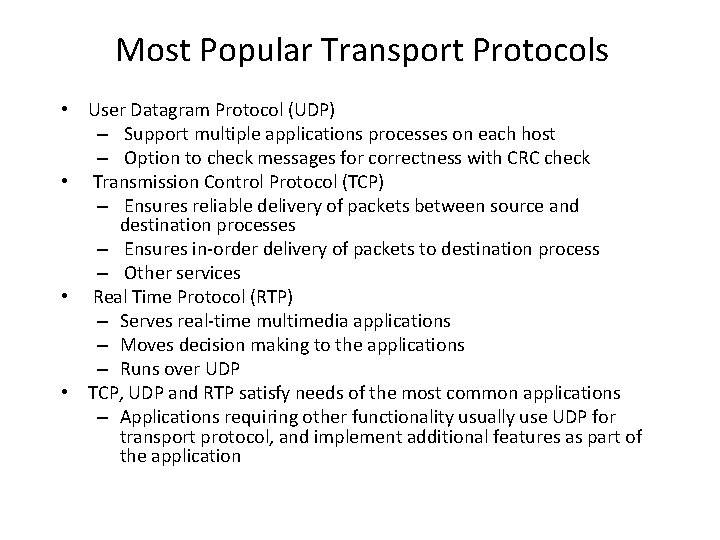
Most Popular Transport Protocols • User Datagram Protocol (UDP) – Support multiple applications processes on each host – Option to check messages for correctness with CRC check • Transmission Control Protocol (TCP) – Ensures reliable delivery of packets between source and destination processes – Ensures in-order delivery of packets to destination process – Other services • Real Time Protocol (RTP) – Serves real-time multimedia applications – Moves decision making to the applications – Runs over UDP • TCP, UDP and RTP satisfy needs of the most common applications – Applications requiring other functionality usually use UDP for transport protocol, and implement additional features as part of the application
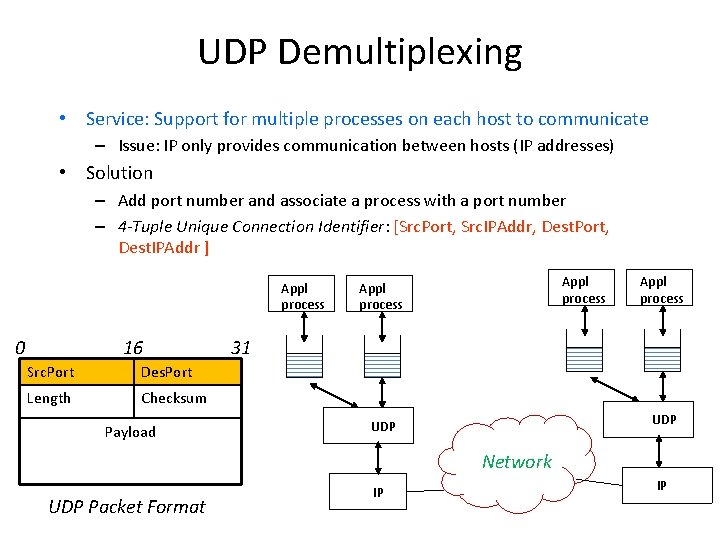
UDP Demultiplexing • Service: Support for multiple processes on each host to communicate – Issue: IP only provides communication between hosts (IP addresses) • Solution – Add port number and associate a process with a port number – 4 -Tuple Unique Connection Identifier: [Src. Port, Src. IPAddr, Dest. Port, Dest. IPAddr ] Appl process 0 16 Src. Port Des. Port Length Checksum Payload Appl process 31 UDP Network UDP Packet Format IP IP
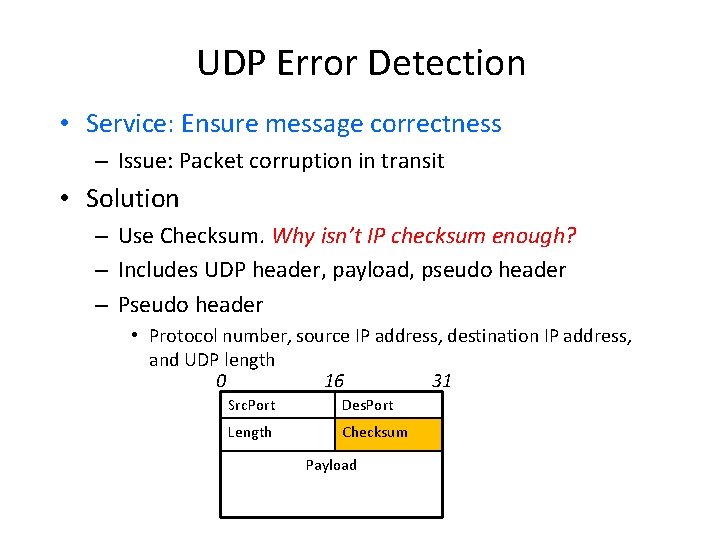
UDP Error Detection • Service: Ensure message correctness – Issue: Packet corruption in transit • Solution – Use Checksum. Why isn’t IP checksum enough? – Includes UDP header, payload, pseudo header – Pseudo header • Protocol number, source IP address, destination IP address, and UDP length 0 16 31 Src. Port Des. Port Length Checksum Payload
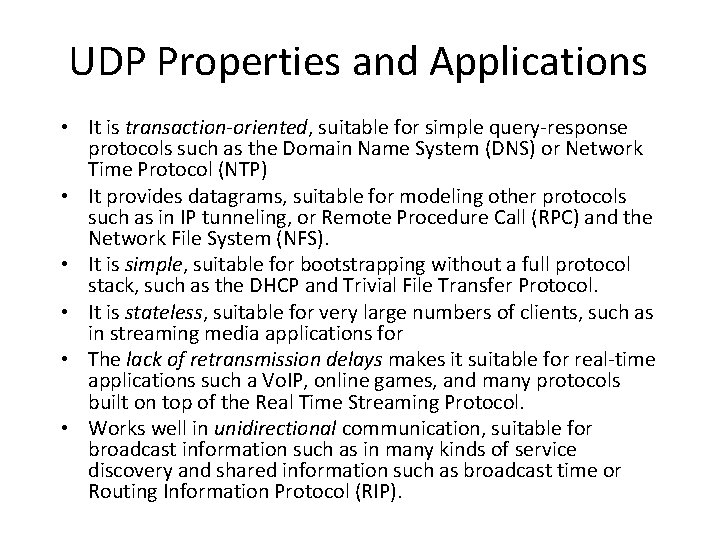
UDP Properties and Applications • It is transaction-oriented, suitable for simple query-response protocols such as the Domain Name System (DNS) or Network Time Protocol (NTP) • It provides datagrams, suitable for modeling other protocols such as in IP tunneling, or Remote Procedure Call (RPC) and the Network File System (NFS). • It is simple, suitable for bootstrapping without a full protocol stack, such as the DHCP and Trivial File Transfer Protocol. • It is stateless, suitable for very large numbers of clients, such as in streaming media applications for • The lack of retransmission delays makes it suitable for real-time applications such a Vo. IP, online games, and many protocols built on top of the Real Time Streaming Protocol. • Works well in unidirectional communication, suitable for broadcast information such as in many kinds of service discovery and shared information such as broadcast time or Routing Information Protocol (RIP).
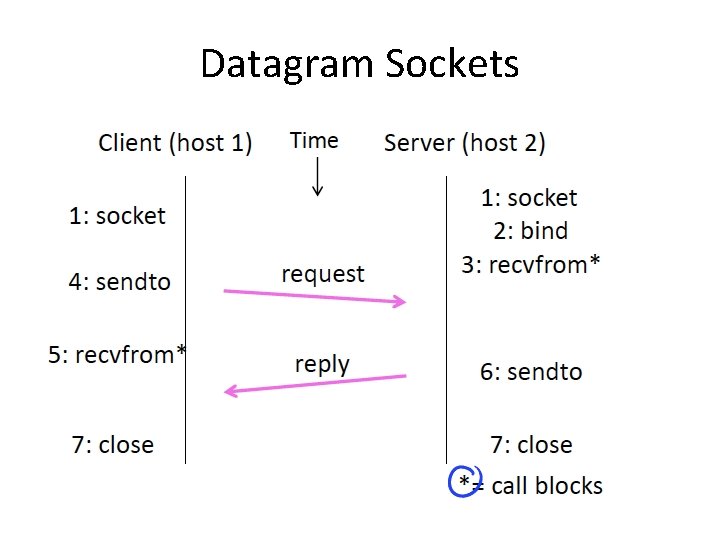
Datagram Sockets
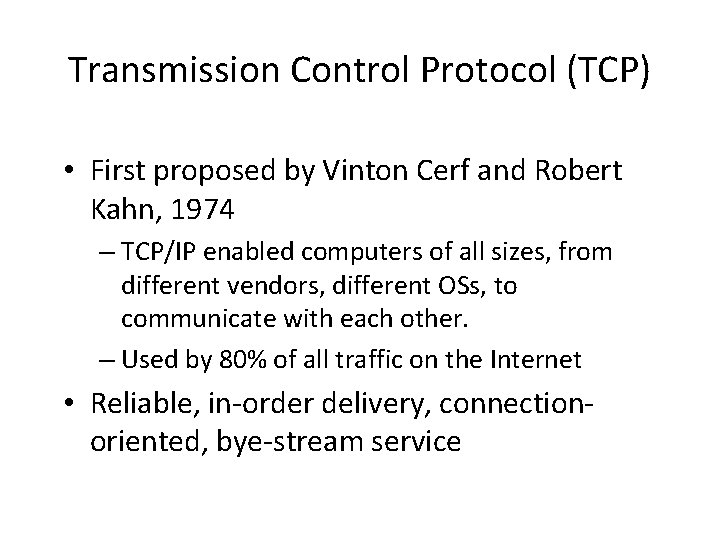
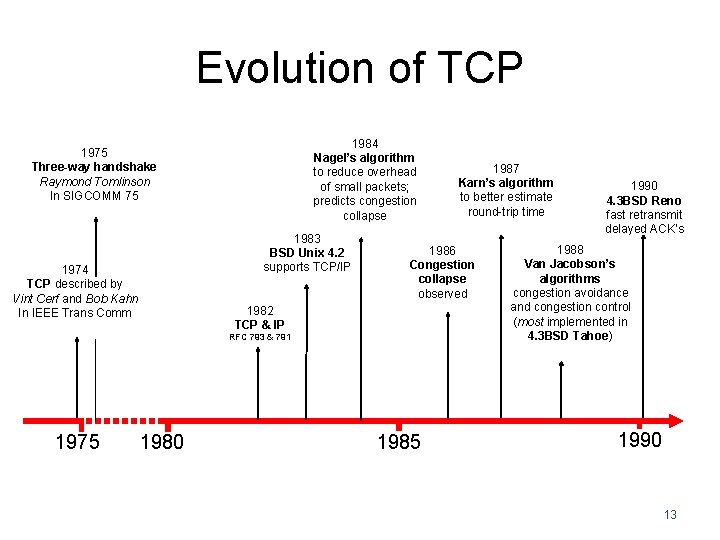
Transmission Control Protocol (TCP) • First proposed by Vinton Cerf and Robert Kahn, 1974 – TCP/IP enabled computers of all sizes, from different vendors, different OSs, to communicate with each other. – Used by 80% of all traffic on the Internet • Reliable, in-order delivery, connectionoriented, bye-stream service
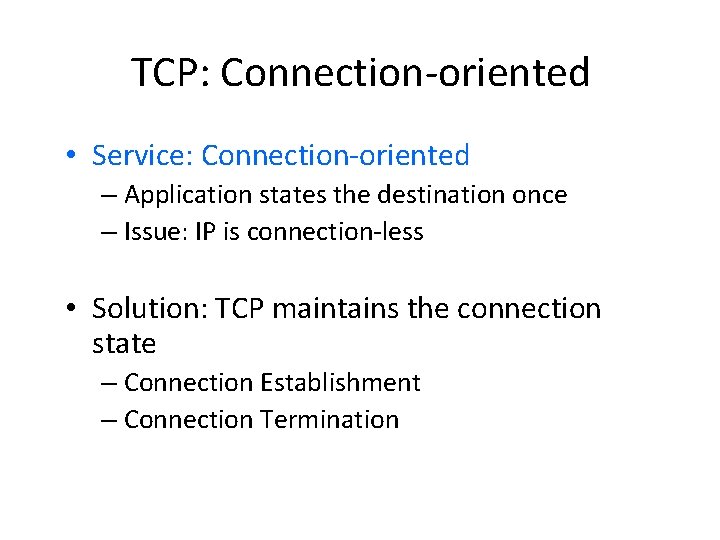
TCP: Connection-oriented • Service: Connection-oriented – Application states the destination once – Issue: IP is connection-less • Solution: TCP maintains the connection state – Connection Establishment – Connection Termination
Evolution of TCP 1984 Nagel’s algorithm to reduce overhead of small packets; predicts congestion collapse 1975 Three-way handshake Raymond Tomlinson In SIGCOMM 75 1983 BSD Unix 4. 2 supports TCP/IP 1974 TCP described by Vint Cerf and Bob Kahn In IEEE Trans Comm 1986 Congestion collapse observed 1982 TCP & IP RFC 793 & 791 1975 1980 1987 Karn’s algorithm to better estimate round-trip time 1985 1990 4. 3 BSD Reno fast retransmit delayed ACK’s 1988 Van Jacobson’s algorithms congestion avoidance and congestion control (most implemented in 4. 3 BSD Tahoe) 1990 13
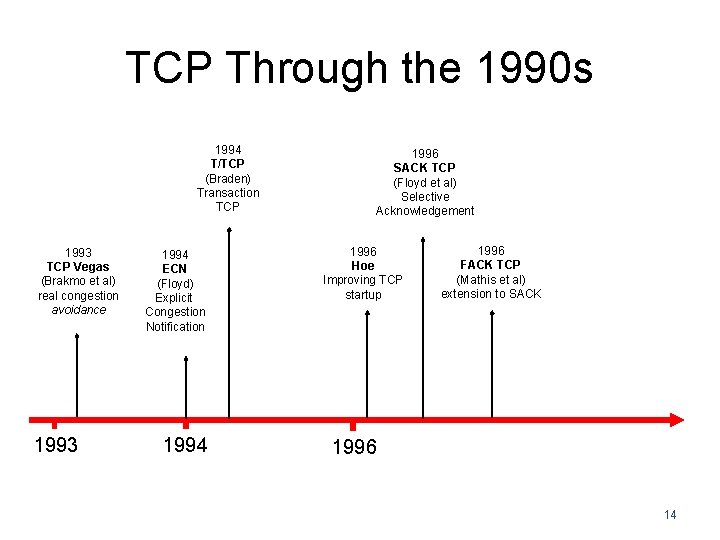
TCP Through the 1990 s 1994 T/TCP (Braden) Transaction TCP 1993 TCP Vegas (Brakmo et al) real congestion avoidance 1993 1994 ECN (Floyd) Explicit Congestion Notification 1994 1996 SACK TCP (Floyd et al) Selective Acknowledgement 1996 Hoe Improving TCP startup 1996 FACK TCP (Mathis et al) extension to SACK 1996 14
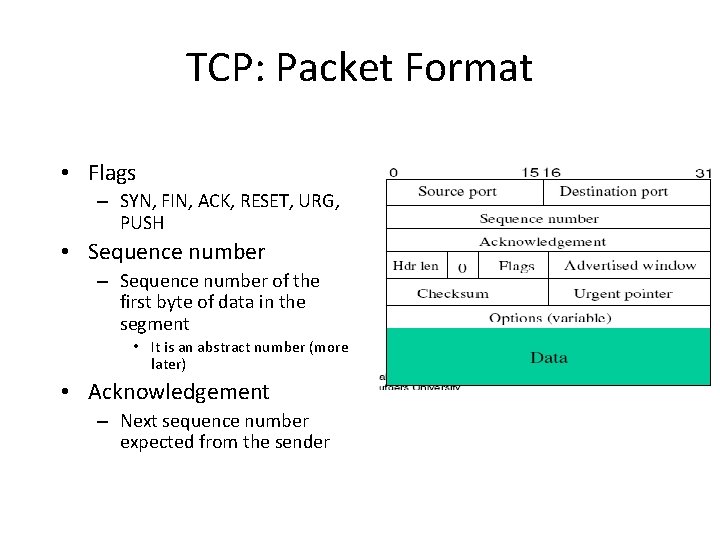
TCP: Packet Format • Flags – SYN, FIN, ACK, RESET, URG, PUSH • Sequence number – Sequence number of the first byte of data in the segment • It is an abstract number (more later) • Acknowledgement – Next sequence number expected from the sender
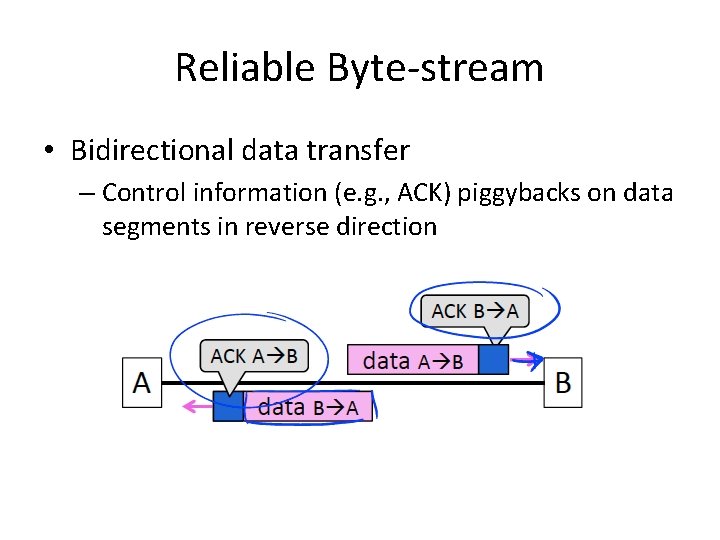
Reliable Byte-stream • Bidirectional data transfer – Control information (e. g. , ACK) piggybacks on data segments in reverse direction
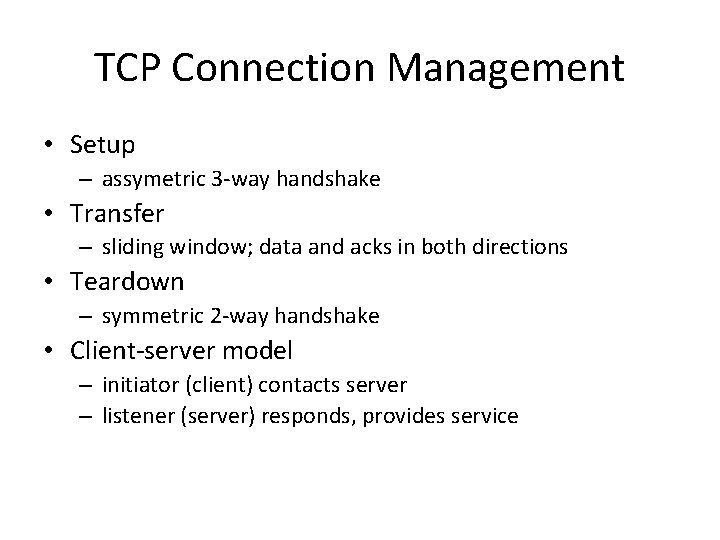
TCP Connection Management • Setup – assymetric 3 -way handshake • Transfer – sliding window; data and acks in both directions • Teardown – symmetric 2 -way handshake • Client-server model – initiator (client) contacts server – listener (server) responds, provides service
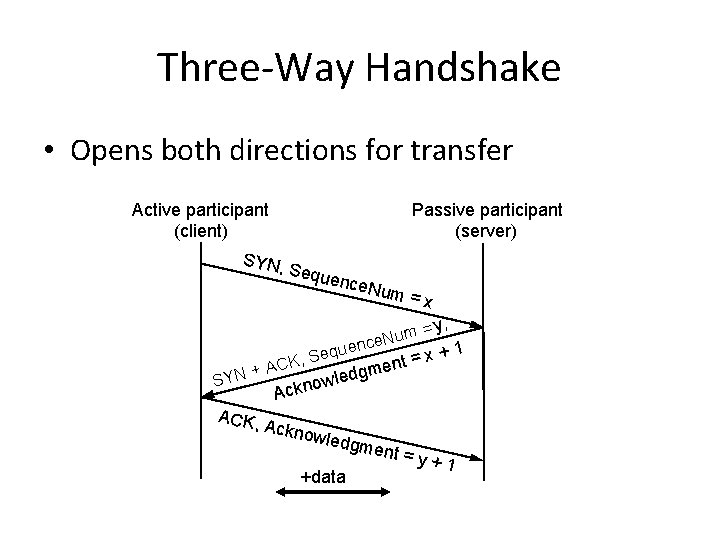
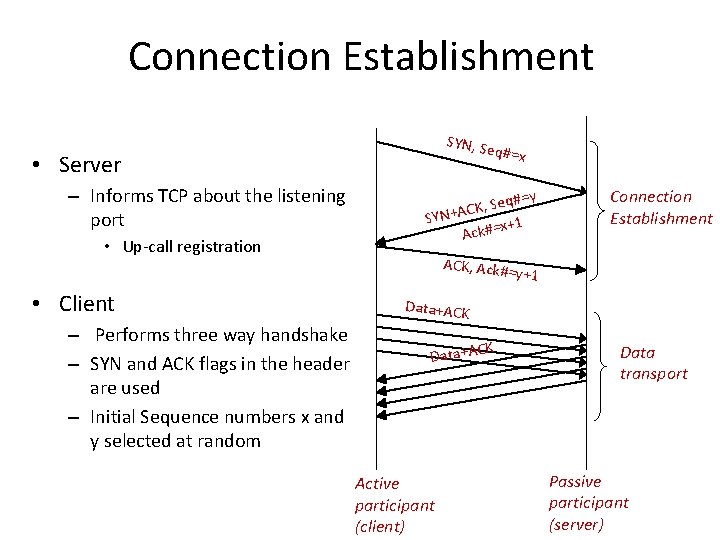
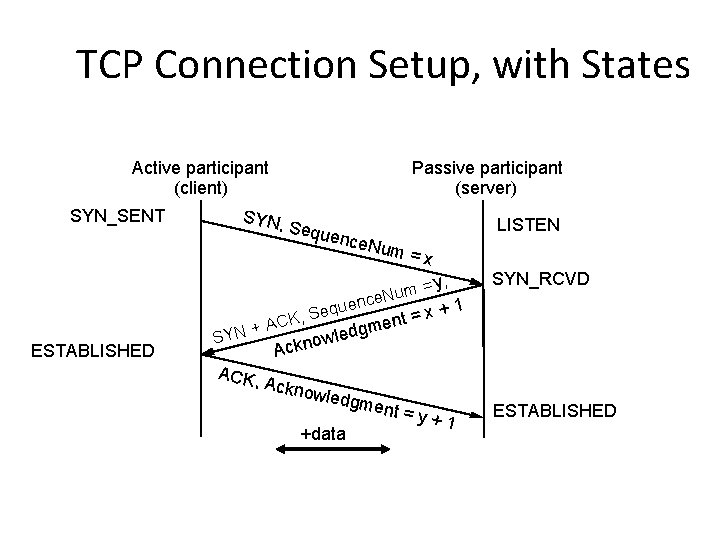
Three-Way Handshake • Opens both directions for transfer Active participant (client) Passive participant (server) SYN, Sequ ence. N um = x K, AC + N Y S ACK, = y, m u nce. N e u q x+1 Se t= en m g d e wl o Ackno wledg ment +data =y+1
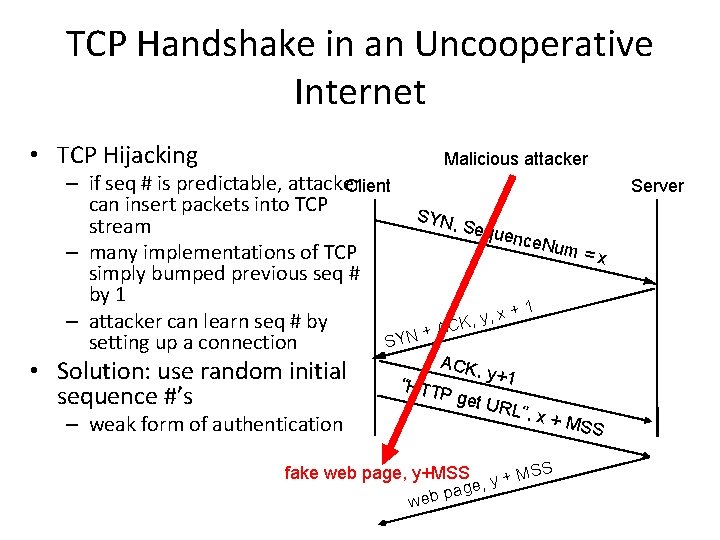
Do we need 3 -way handshake? • Allows both sides to – allocate state for buffer size, state variables, … – calculate estimated RTT, estimated MTU, etc. • Helps prevent – Duplicates across incarnations – Intentional hijacking • random nonces => weak form of authentication • Short-circuit? – Persistent connections in HTTP (keep connection open) – Transactional TCP (save seq #, reuse on reopen) – But congestion control effects dominate
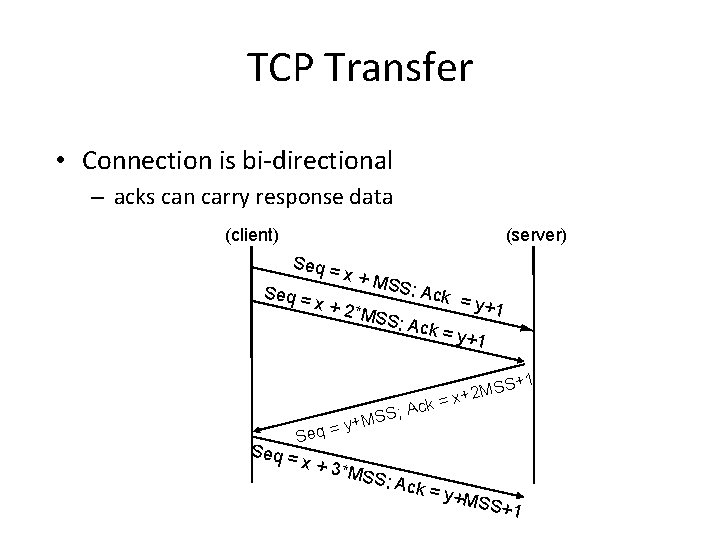
TCP Transfer • Connection is bi-directional – acks can carry response data (client) (server) Seq = x+M SS; A ck = y+1 MSS; Ack = y+1 x + 2* +1 Seq = S; A S M y+ x + 3* MSS; ck Ack = MSS 2 + x = y+MS S+1
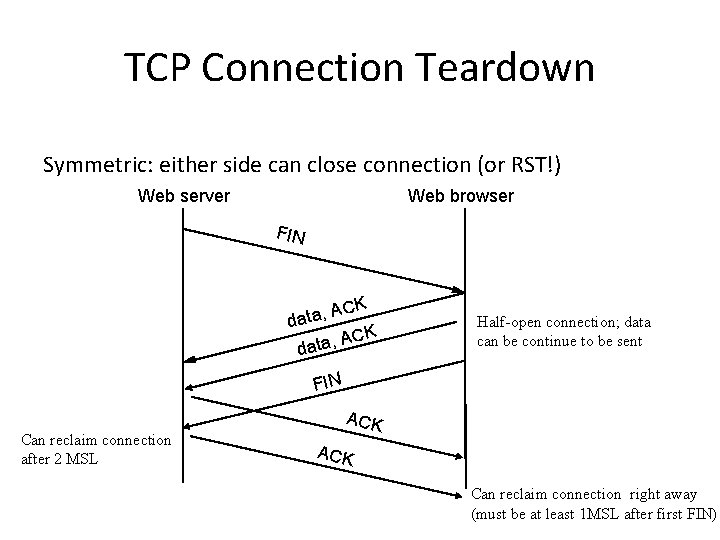
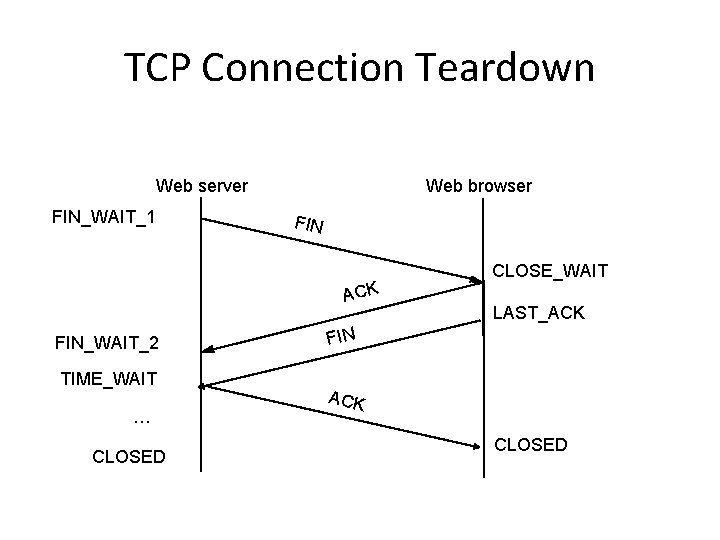
TCP Connection Teardown Symmetric: either side can close connection (or RST!) Web server Web browser FIN CK A , a t da Half-open connection; data can be continue to be sent FIN Can reclaim connection after 2 MSL ACK Can reclaim connection right away (must be at least 1 MSL after first FIN)
Connection Establishment • Both sender and receiver must be ready before we start the transfer of data – Need to agree on a set of parameters – e. g. , the Maximum Segment Size (MSS) • This is (in-band) signaling – It sets up state at the endpoints
Connection Establishment SYN, Se q#=x • Server – Informs TCP about the listening port • Up-call registration eq#=y S , K C SYN+A x+1 Ack#= Connection Establishment ACK, Ack#= y+1 • Client – Performs three way handshake – SYN and ACK flags in the header are used – Initial Sequence numbers x and y selected at random Data+ACK K Data+AC Active participant (client) Data transport Passive participant (server)
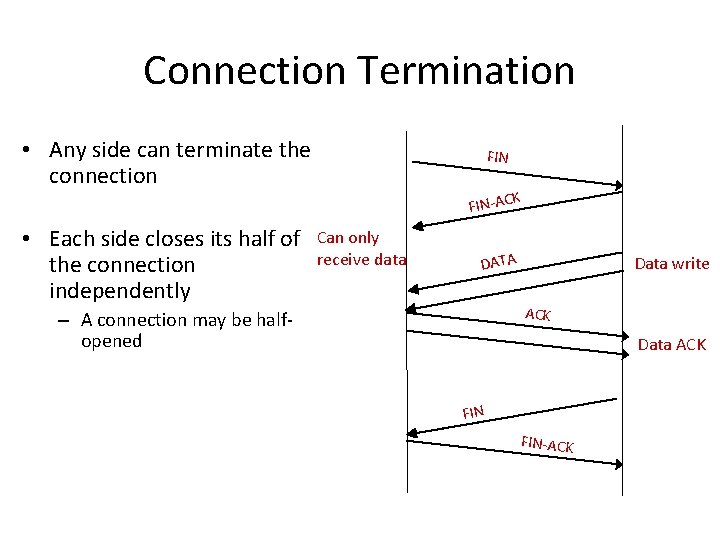
Connection Termination • Any side can terminate the connection FIN K FIN-AC • Each side closes its half of the connection independently Can only receive data DATA Data write ACK – A connection may be halfopened Data ACK FIN-ACK
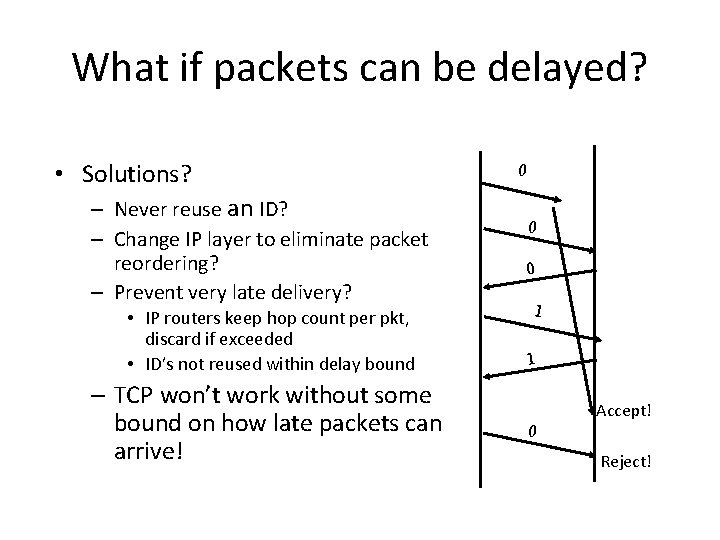
What if packets can be delayed? • Solutions? – Never reuse an ID? – Change IP layer to eliminate packet reordering? – Prevent very late delivery? • IP routers keep hop count per pkt, discard if exceeded • ID’s not reused within delay bound – TCP won’t work without some bound on how late packets can arrive! 0 0 0 1 1 0 Accept! Reject!
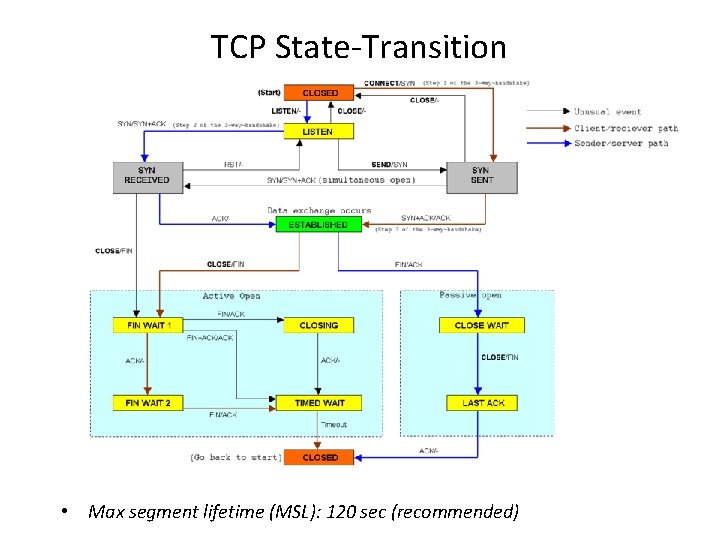
TCP Connection Setup, with States Active participant (client) SYN, SYN_SENT ESTABLISHED Passive participant (server) Sequ ence. N um = S ACK, x = y, m u nce. N e u q e x+1 K, S AC YN + LISTEN SYN_RCVD t= en m g d nowle Ackno wledg ment +data =y+1 ESTABLISHED
TCP Connection Teardown Web server FIN_WAIT_1 Web browser FIN ACK FIN_WAIT_2 TIME_WAIT … CLOSED CLOSE_WAIT LAST_ACK FIN ACK CLOSED
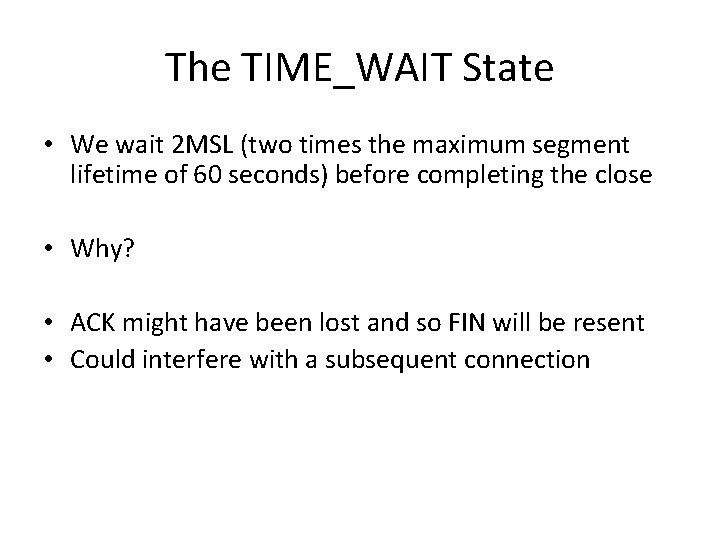
The TIME_WAIT State • We wait 2 MSL (two times the maximum segment lifetime of 60 seconds) before completing the close • Why? • ACK might have been lost and so FIN will be resent • Could interfere with a subsequent connection
TCP Handshake in an Uncooperative Internet • TCP Hijacking Malicious attacker – if seq # is predictable, attacker Client can insert packets into TCP SYN, Sequ stream ence. N um = – many implementations of TCP x simply bumped previous seq # by 1 x+1 , y , – attacker can learn seq # by ACK + N SY setting up a connection • Solution: use random initial sequence #’s ACK, y “HTT P – weak form of authentication +1 get U fake web page, y+MSS RL”, x + SS w y+M , e g eb pa MSS Server
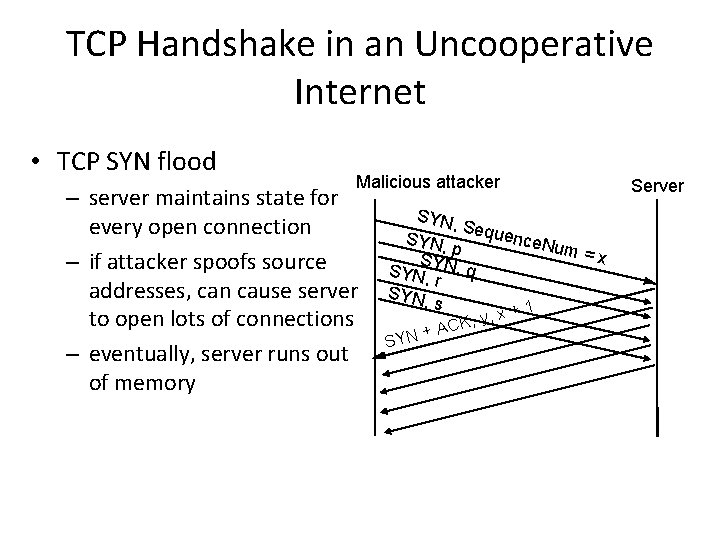
TCP Handshake in an Uncooperative Internet • TCP SYN flood Malicious attacker – server maintains state for every open connection – if attacker spoofs source addresses, can cause server to open lots of connections – eventually, server runs out of memory SYN, Sequ ence. N SYN, um = p x SYN, q SYN, r SYN, s +1 SYN + , x y , K AC Server
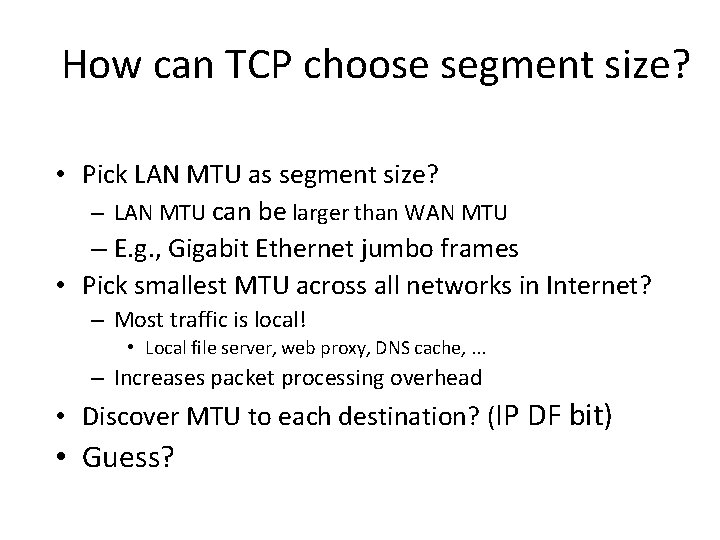
How can TCP choose segment size? • Pick LAN MTU as segment size? – LAN MTU can be larger than WAN MTU – E. g. , Gigabit Ethernet jumbo frames • Pick smallest MTU across all networks in Internet? – Most traffic is local! • Local file server, web proxy, DNS cache, . . . – Increases packet processing overhead • Discover MTU to each destination? (IP DF bit) • Guess?
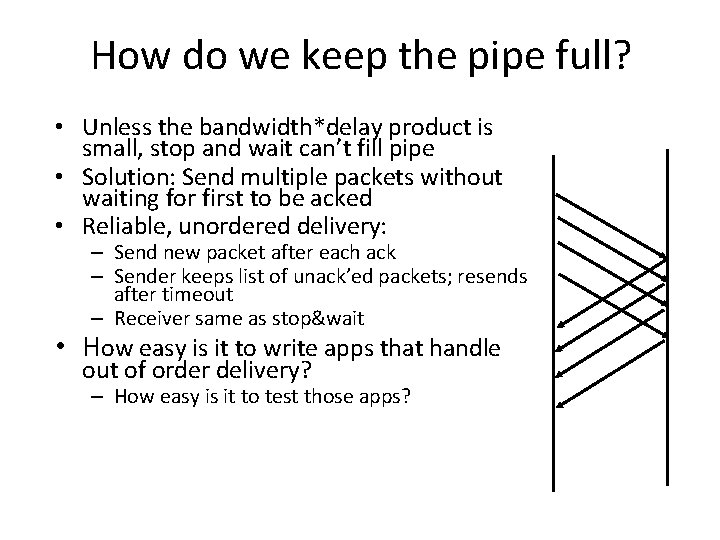
How do we keep the pipe full? • Unless the bandwidth*delay product is small, stop and wait can’t fill pipe • Solution: Send multiple packets without waiting for first to be acked • Reliable, unordered delivery: – Send new packet after each ack – Sender keeps list of unack’ed packets; resends after timeout – Receiver same as stop&wait • How easy is it to write apps that handle out of order delivery? – How easy is it to test those apps?
Sliding Window: Reliable, ordered delivery • Two constraints: – Receiver can’t deliver packet to application until all prior packets have arrived – Sender must prevent buffer overflow at receiver • Solution: sliding window – circular buffer at sender and receiver • packets in transit <= buffer size • advance when sender and receiver agree packets at beginning have been received – How big should the window be? • bandwidth * round trip delay
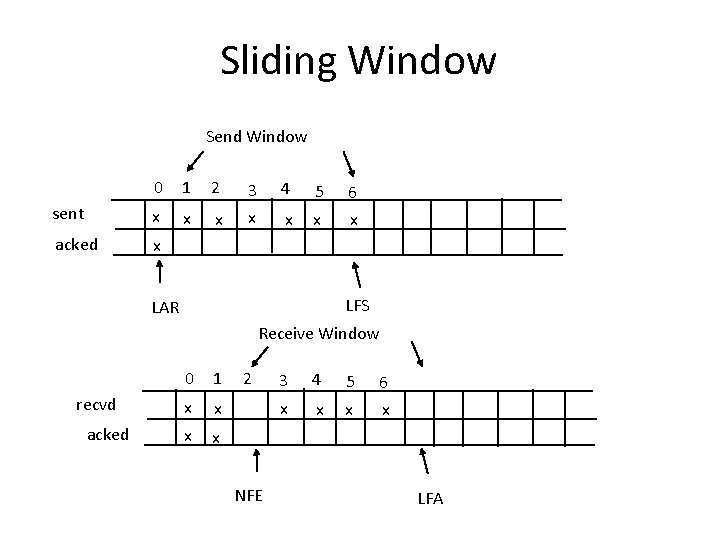
Sender/Receiver State • sender – packets sent and acked (LAR = last ack recvd) – packets sent but not yet acked – packets not yet sent (LFS = last frame sent) • receiver – packets received and acked (NFE = next frame expected) – packets received out of order – packets not yet received (LFA = last frame ok)
Sliding window • Allows multiple packets, up to the size of the window, to be sent on the network before acknowledgments are received. • Provides high throughput even on highlatency networks. • The size of the window is advertised by the receiver to indicate how many packets it is willing to receive at that time.
Sliding Window Send Window 0 1 2 3 4 5 sent x x x acked x 6 x LFS LAR Receive Window recvd acked 0 1 x x 2 NFE 3 4 5 x x x 6 x LFA
TCP State-Transition • Max segment lifetime (MSL): 120 sec (recommended)
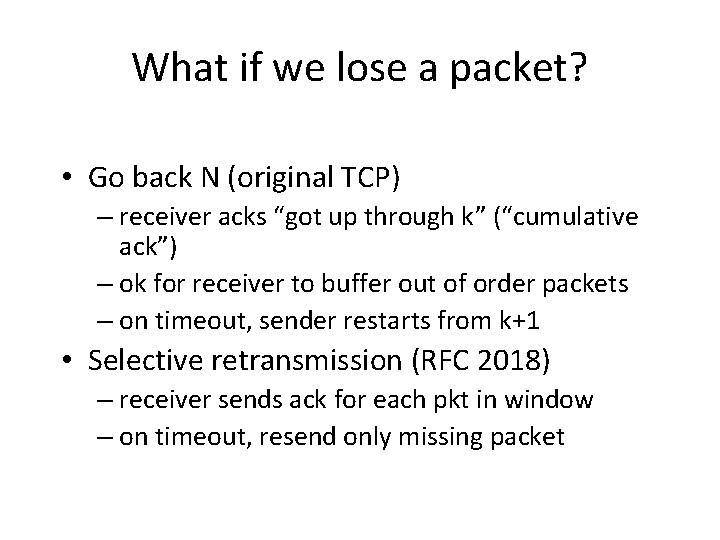
What if we lose a packet? • Go back N (original TCP) – receiver acks “got up through k” (“cumulative ack”) – ok for receiver to buffer out of order packets – on timeout, sender restarts from k+1 • Selective retransmission (RFC 2018) – receiver sends ack for each pkt in window – on timeout, resend only missing packet
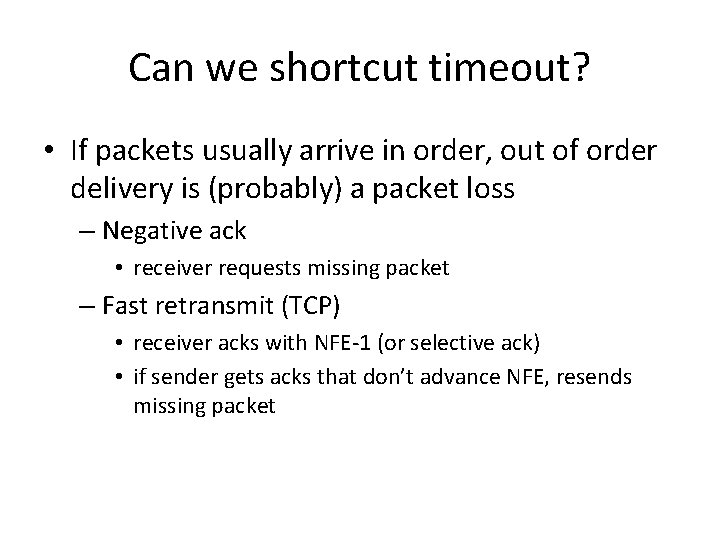
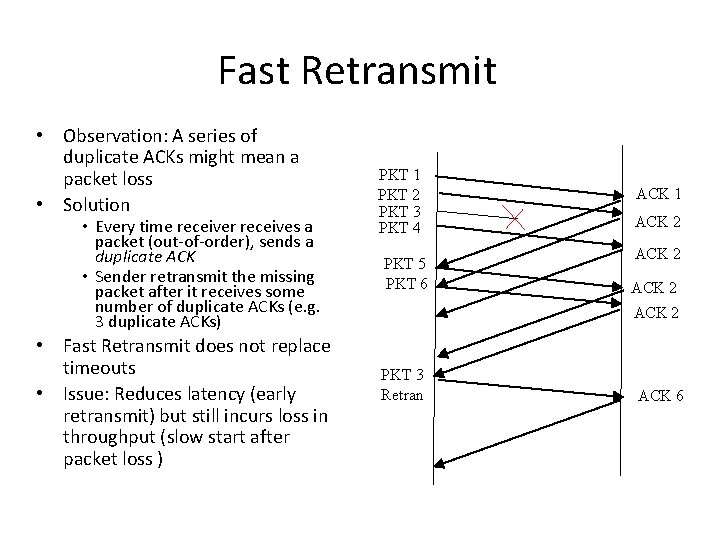
Can we shortcut timeout? • If packets usually arrive in order, out of order delivery is (probably) a packet loss – Negative ack • receiver requests missing packet – Fast retransmit (TCP) • receiver acks with NFE-1 (or selective ack) • if sender gets acks that don’t advance NFE, resends missing packet
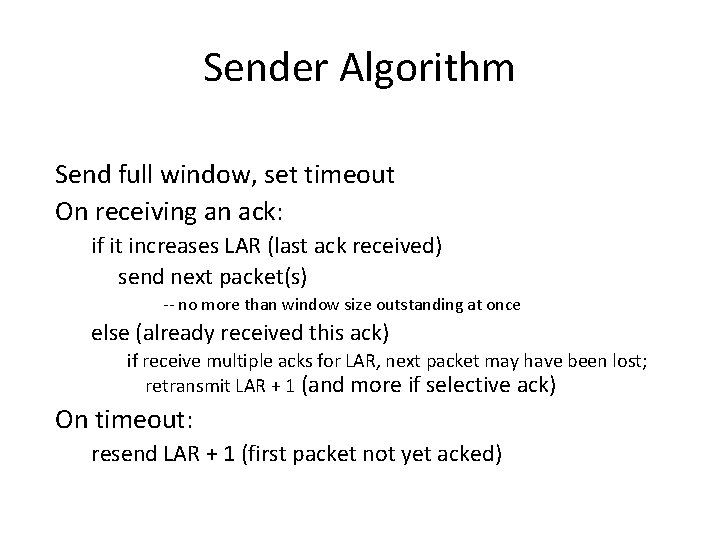
Sender Algorithm Send full window, set timeout On receiving an ack: if it increases LAR (last ack received) send next packet(s) -- no more than window size outstanding at once else (already received this ack) if receive multiple acks for LAR, next packet may have been lost; retransmit LAR + 1 (and more if selective ack) On timeout: resend LAR + 1 (first packet not yet acked)
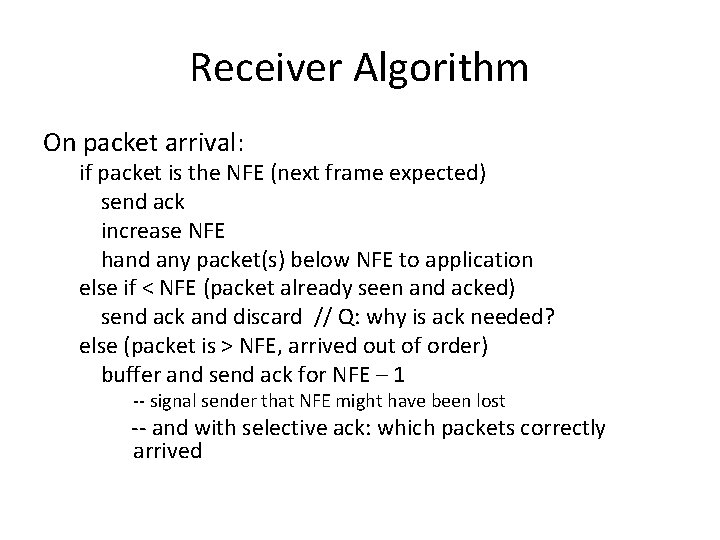
Receiver Algorithm On packet arrival: if packet is the NFE (next frame expected) send ack increase NFE hand any packet(s) below NFE to application else if < NFE (packet already seen and acked) send ack and discard // Q: why is ack needed? else (packet is > NFE, arrived out of order) buffer and send ack for NFE – 1 -- signal sender that NFE might have been lost -- and with selective ack: which packets correctly arrived
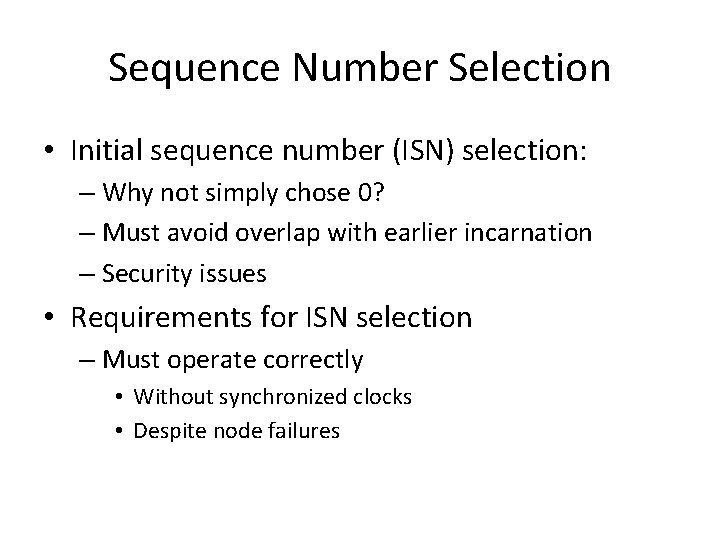
Sequence Number Selection • Initial sequence number (ISN) selection: – Why not simply chose 0? – Must avoid overlap with earlier incarnation – Security issues • Requirements for ISN selection – Must operate correctly • Without synchronized clocks • Despite node failures
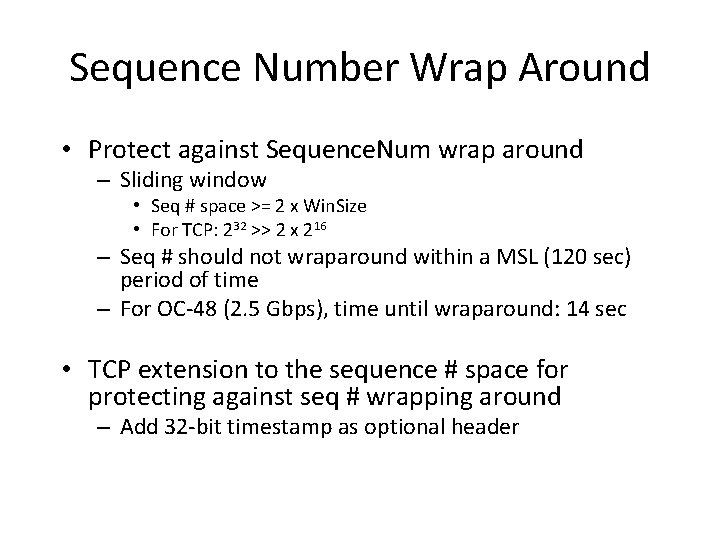
Sequence Number Wrap Around • Protect against Sequence. Num wrap around – Sliding window • Seq # space >= 2 x Win. Size • For TCP: 232 >> 2 x 216 – Seq # should not wraparound within a MSL (120 sec) period of time – For OC-48 (2. 5 Gbps), time until wraparound: 14 sec • TCP extension to the sequence # space for protecting against seq # wrapping around – Add 32 -bit timestamp as optional header
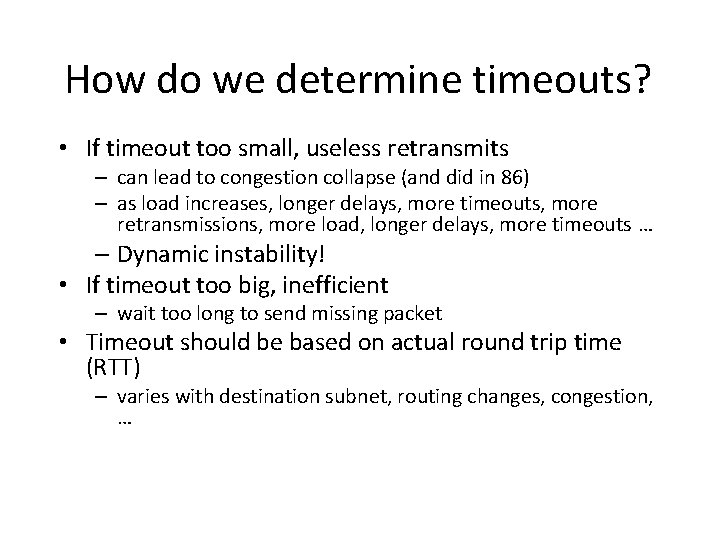
How do we determine timeouts? • If timeout too small, useless retransmits – can lead to congestion collapse (and did in 86) – as load increases, longer delays, more timeouts, more retransmissions, more load, longer delays, more timeouts … – Dynamic instability! • If timeout too big, inefficient – wait too long to send missing packet • Timeout should be based on actual round trip time (RTT) – varies with destination subnet, routing changes, congestion, …
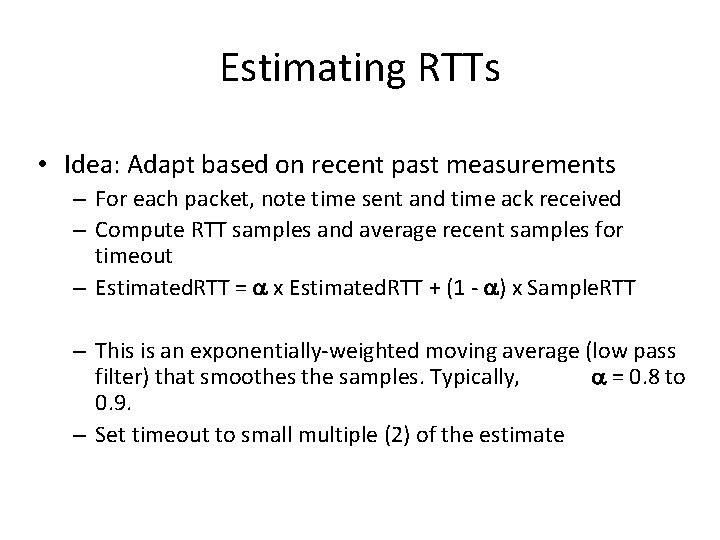
Estimating RTTs • Idea: Adapt based on recent past measurements – For each packet, note time sent and time ack received – Compute RTT samples and average recent samples for timeout – Estimated. RTT = x Estimated. RTT + (1 - ) x Sample. RTT – This is an exponentially-weighted moving average (low pass filter) that smoothes the samples. Typically, = 0. 8 to 0. 9. – Set timeout to small multiple (2) of the estimate
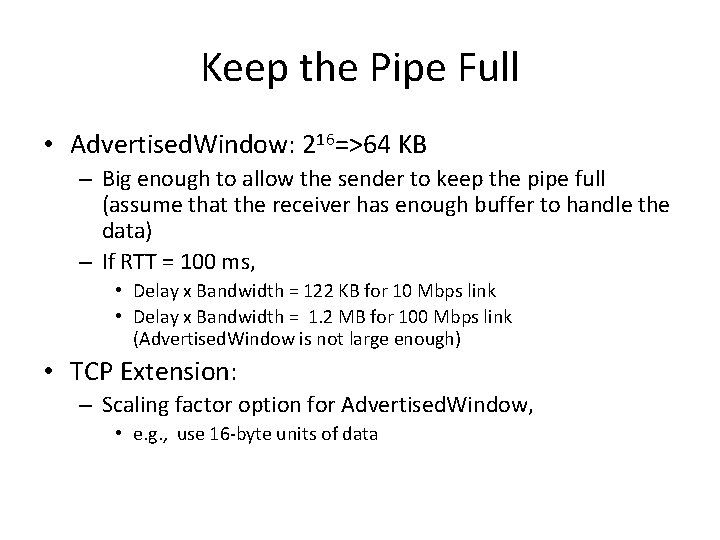
Keep the Pipe Full • Advertised. Window: 216=>64 KB – Big enough to allow the sender to keep the pipe full (assume that the receiver has enough buffer to handle the data) – If RTT = 100 ms, • Delay x Bandwidth = 122 KB for 10 Mbps link • Delay x Bandwidth = 1. 2 MB for 100 Mbps link (Advertised. Window is not large enough) • TCP Extension: – Scaling factor option for Advertised. Window, • e. g. , use 16 -byte units of data
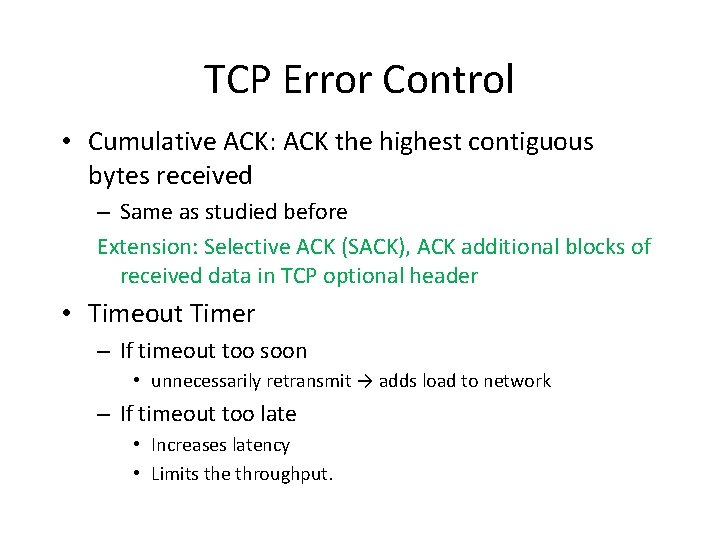
TCP Error Control • Cumulative ACK: ACK the highest contiguous bytes received – Same as studied before Extension: Selective ACK (SACK), ACK additional blocks of received data in TCP optional header • Timeout Timer – If timeout too soon • unnecessarily retransmit → adds load to network – If timeout too late • Increases latency • Limits the throughput.
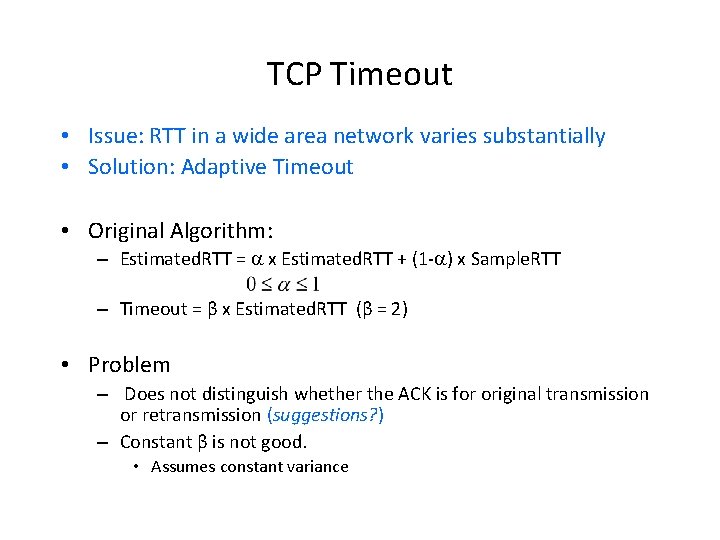
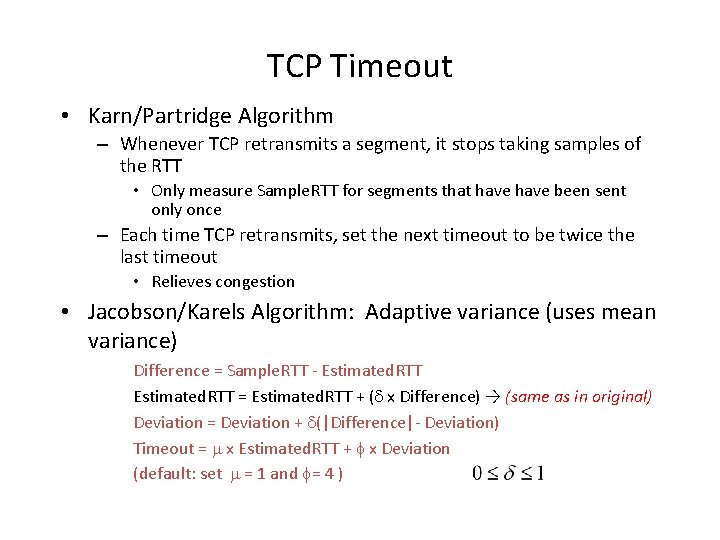
TCP Timeout • Issue: RTT in a wide area network varies substantially • Solution: Adaptive Timeout • Original Algorithm: – Estimated. RTT = a x Estimated. RTT + (1 -a) x Sample. RTT – Timeout = β x Estimated. RTT (β = 2) • Problem – Does not distinguish whether the ACK is for original transmission or retransmission (suggestions? ) – Constant β is not good. • Assumes constant variance
TCP Timeout • Karn/Partridge Algorithm – Whenever TCP retransmits a segment, it stops taking samples of the RTT • Only measure Sample. RTT for segments that have been sent only once – Each time TCP retransmits, set the next timeout to be twice the last timeout • Relieves congestion • Jacobson/Karels Algorithm: Adaptive variance (uses mean variance) Difference = Sample. RTT - Estimated. RTT = Estimated. RTT + (d x Difference) → (same as in original) Deviation = Deviation + d(|Difference|- Deviation) Timeout = m x Estimated. RTT + f x Deviation (default: set m = 1 and f= 4 )
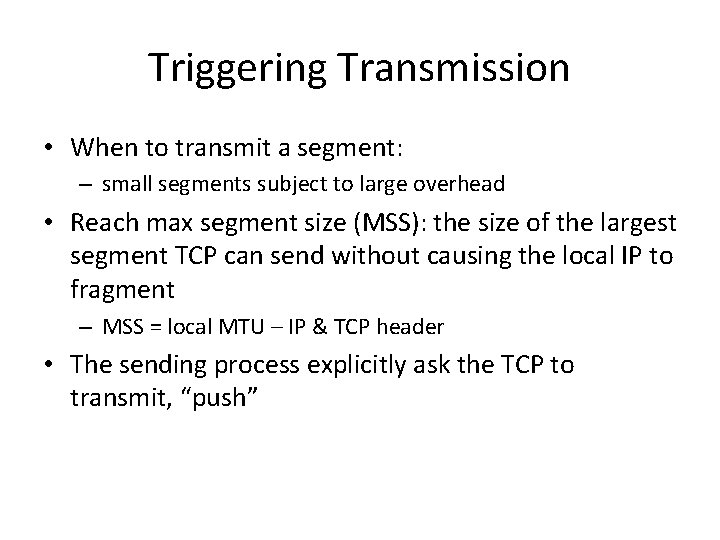
Triggering Transmission • When to transmit a segment: – small segments subject to large overhead • Reach max segment size (MSS): the size of the largest segment TCP can send without causing the local IP to fragment – MSS = local MTU – IP & TCP header • The sending process explicitly ask the TCP to transmit, “push”
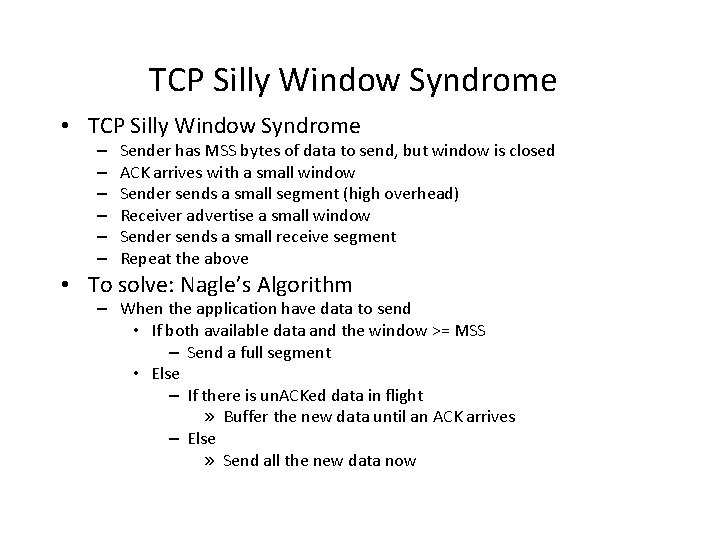
TCP Silly Window Syndrome • TCP Silly Window Syndrome – – – Sender has MSS bytes of data to send, but window is closed ACK arrives with a small window Sender sends a small segment (high overhead) Receiver advertise a small window Sender sends a small receive segment Repeat the above • To solve: Nagle’s Algorithm – When the application have data to send • If both available data and the window >= MSS – Send a full segment • Else – If there is un. ACKed data in flight » Buffer the new data until an ACK arrives – Else » Send all the new data now
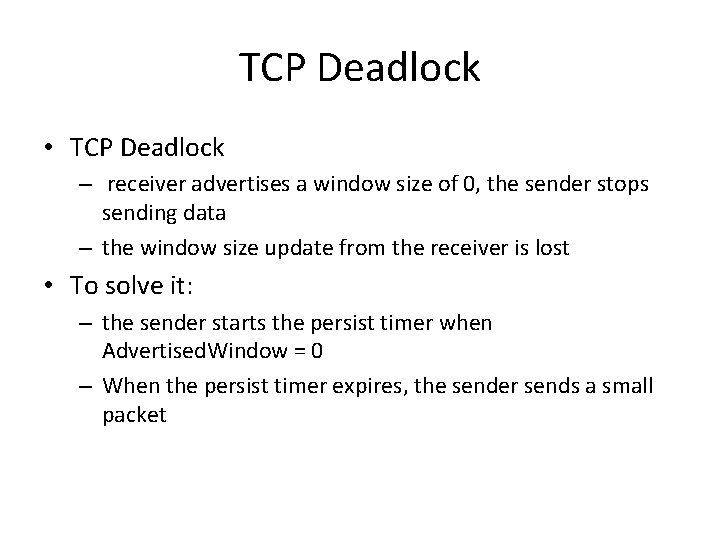
TCP Deadlock • TCP Deadlock – receiver advertises a window size of 0, the sender stops sending data – the window size update from the receiver is lost • To solve it: – the sender starts the persist timer when Advertised. Window = 0 – When the persist timer expires, the sender sends a small packet
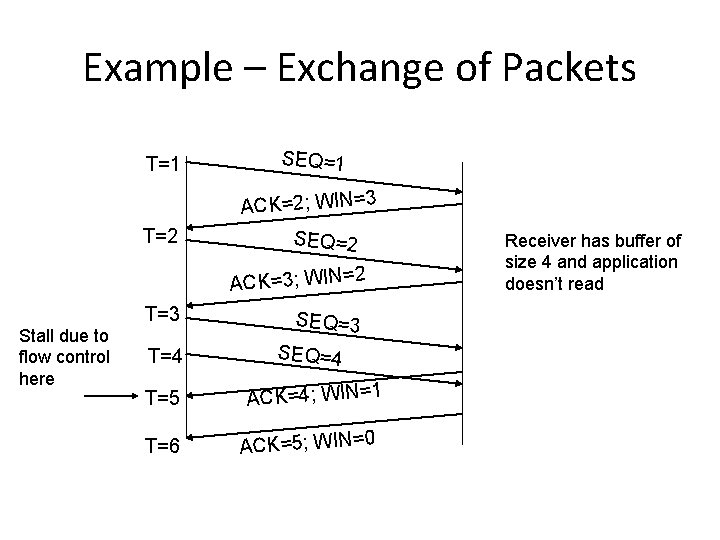
Example – Exchange of Packets T=1 SEQ=1 ACK=2; WIN=3 T=2 SEQ=2 ACK=3; WIN=2 T=3 Stall due to flow control here SEQ=3 T=4 SEQ=4 T=5 ACK=4; WIN=1 T=6 ACK=5; WIN=0 Receiver has buffer of size 4 and application doesn’t read
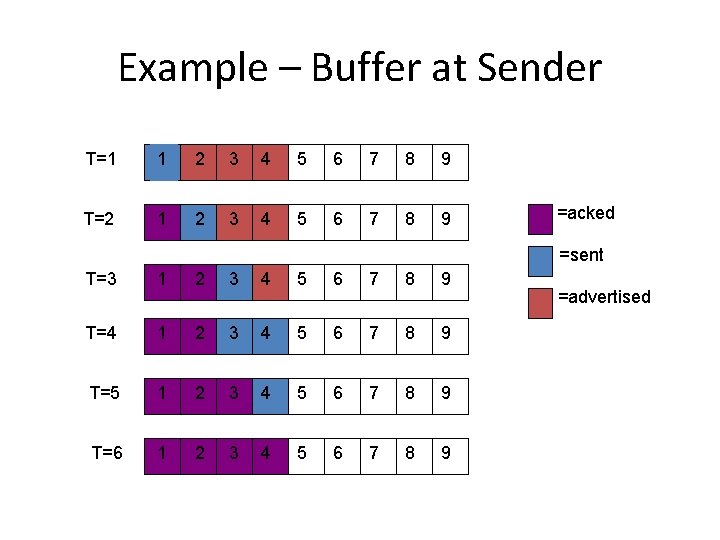
Example – Buffer at Sender T=1 1 2 3 4 5 6 7 8 9 T=2 1 2 3 4 5 6 7 8 9 =acked =sent T=3 1 2 3 4 5 6 7 8 9 T=4 1 2 3 4 5 6 7 8 9 T=5 1 2 3 4 5 6 7 8 9 T=6 1 2 3 4 5 6 7 8 9 =advertised
How does sender know when to resume sending? • If receive window = 0, sender stops – no data => no acks => no window updates • Sender periodically pings receiver with one byte packet – receiver acks with current window size • Why not have receiver ping sender?
Should sender be greedy? • Should sender transmit as soon as any space opens in receive window? – Silly window syndrome • receive window opens a few bytes • sender transmits little packet • receive window closes • Solution (Clark, 1982): sender doesn’t resume sending until window is half open
Should sender be greedy? • App writes a few bytes; send a packet? – – Don’t want to send a packet for every keystroke If buffered writes >= max segment size if app says “push” (ex: telnet, on carriage return) after timeout (ex: 0. 5 sec) • Nagle’s algorithm – Never send two partial segments; wait for first to be acked, before sending next – Self-adaptive: can send lots of tinygrams if network is being responsive • But (!) poor interaction with delayed acks (later)
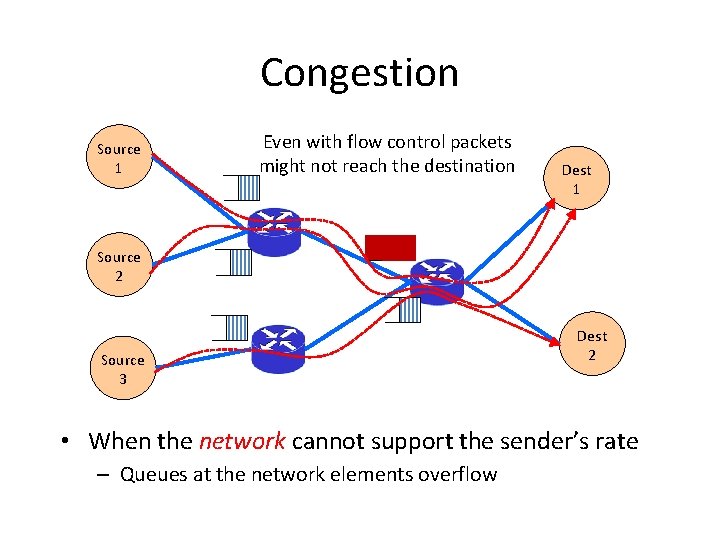
Congestion Source 1 Even with flow control packets might not reach the destination Dest 1 Source 2 Source 3 Dest 2 • When the network cannot support the sender’s rate – Queues at the network elements overflow
Congestion Control vs. Flow Control • Congestion Control – Mechanism to prevent sender from overrunning the capacity of the network • When network is the bottleneck • Flow Control – Mechanism to prevent sender from overrunning the capacity of the receiver • When receiver is the bottleneck
Misbehaving TCP Receivers • On server side, little incentive to cheat TCP – Mostly competing against other flows from same server • On client side, high incentive to induce server to send faster – How? 60
Congestion Control: Design Approach • Maintain another window at the sender called Congestion. Window (cwnd) – Congestion. Window is the max number of packets allowed in the network • Number of un. ACKed packets at the sender. • Key: How to calculate congestion window (cwnd) – Various approaches possible – TCP estimates it based on observed packet losses • Assumes packet loss as indication of congestion • Since we don’t know whether the network or the receiver is the bottleneck – Max. Window = MIN(Congestion. Window, Advertised. Window) – Effective. Win = Max. Window – (Last. Byte. Sent – Last. Byte. Acked)
Congestion Avoidance • Prevent sending too much data and causing saturation, which can cause packet drops and worse performance. • Slow-start: Part of TCP congestion control, this begins with a small congestion window and then increases it as acknowledgments (ACKs) are received within a certain time. When they are not, the congestion window is reduced.
Optimizations • Selective acknowledgments (SACKs): allow TCP to acknowledge discontinuous packets, reducing the number of retransmits required. • Fast retransmit: Instead of waiting on a timer, TCP can retransmit dropped packets based on the arrival of duplicate ACKs. These are a function of round-trip time and not the typically much slower timer.
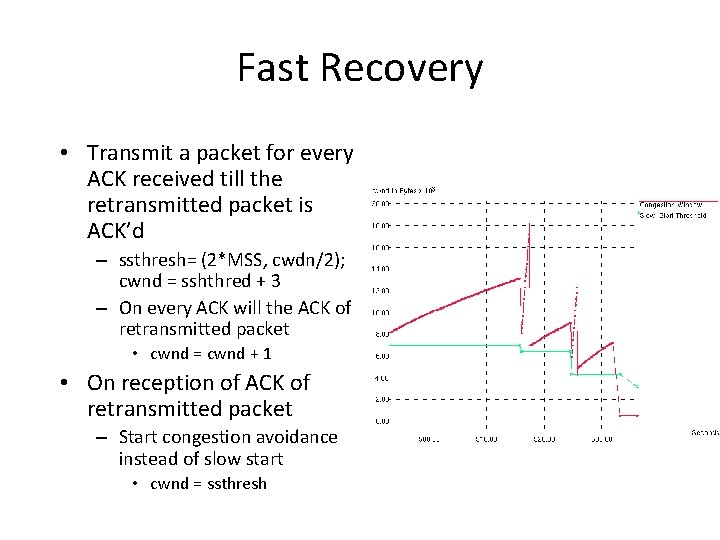
Optimizations • Fast recovery: This recovers TCP performance after detecting duplicate ACKs, by resetting the connection to perform slow-start. • In some cases these are implemented by use of extended TCP options added to the protocol header. • Important topics for TCP performance include three-way handshake, duplicate ACK detection, congestion control algorithms, Nagle, delayed ACKs, SACK, and FACK.
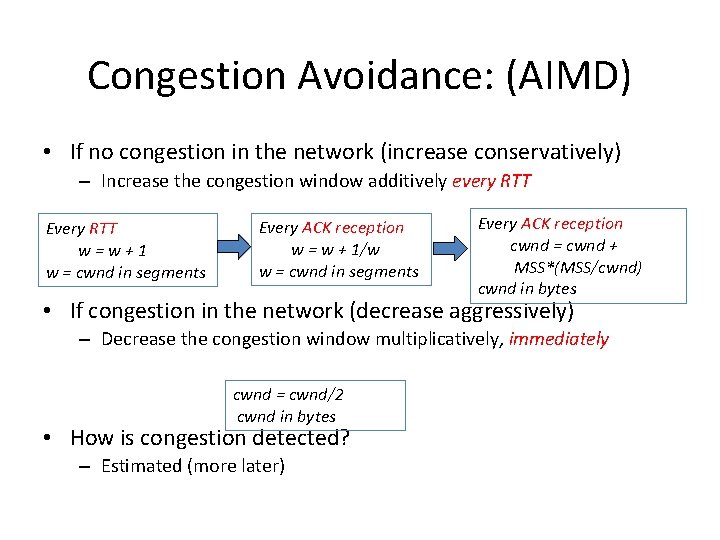
Congestion Avoidance: (AIMD) • If no congestion in the network (increase conservatively) – Increase the congestion window additively every RTT Every RTT w=w+1 w = cwnd in segments Every ACK reception w = w + 1/w w = cwnd in segments Every ACK reception cwnd = cwnd + MSS*(MSS/cwnd) cwnd in bytes • If congestion in the network (decrease aggressively) – Decrease the congestion window multiplicatively, immediately cwnd = cwnd/2 cwnd in bytes • How is congestion detected? – Estimated (more later)
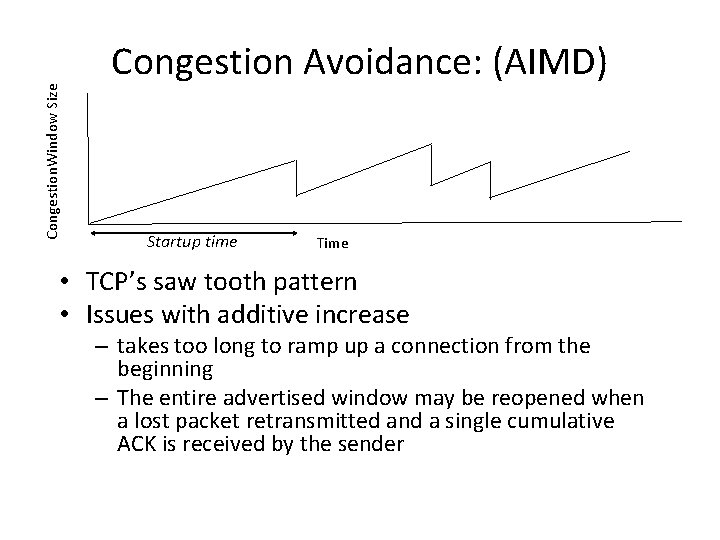
Congestion. Window Size Congestion Avoidance: (AIMD) Startup time Time • TCP’s saw tooth pattern • Issues with additive increase – takes too long to ramp up a connection from the beginning – The entire advertised window may be reopened when a lost packet retransmitted and a single cumulative ACK is received by the sender
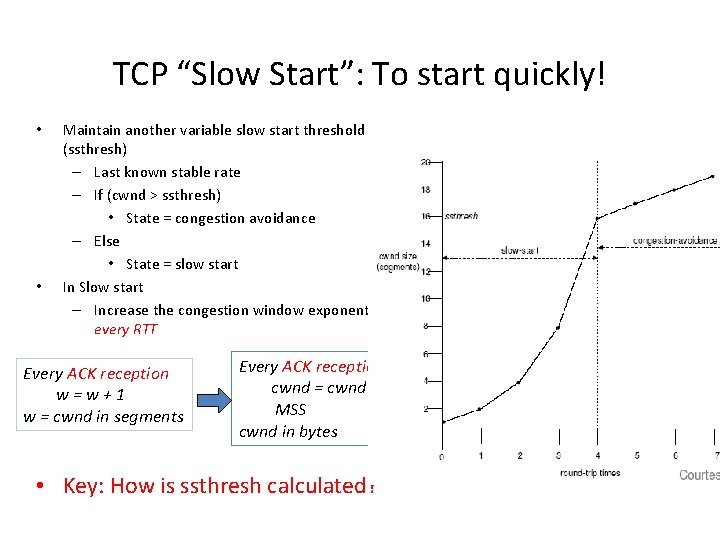
TCP “Slow Start”: To start quickly! • • Maintain another variable slow start threshold (ssthresh) – Last known stable rate – If (cwnd > ssthresh) • State = congestion avoidance – Else • State = slow start In Slow start – Increase the congestion window exponentially every RTT Every ACK reception w=w+1 w = cwnd in segments Every ACK reception cwnd = cwnd + MSS cwnd in bytes • Key: How is ssthresh calculated?
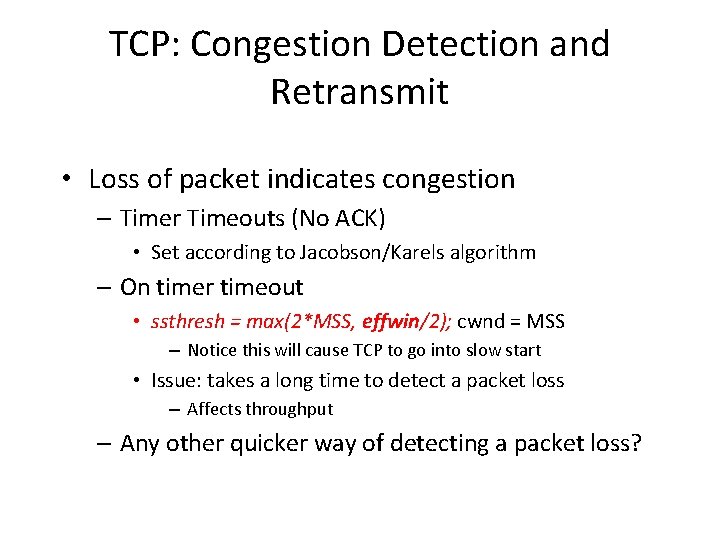
TCP: Congestion Detection and Retransmit • Loss of packet indicates congestion – Timer Timeouts (No ACK) • Set according to Jacobson/Karels algorithm – On timer timeout • ssthresh = max(2*MSS, effwin/2); cwnd = MSS – Notice this will cause TCP to go into slow start • Issue: takes a long time to detect a packet loss – Affects throughput – Any other quicker way of detecting a packet loss?
Fast Retransmit • Observation: A series of duplicate ACKs might mean a packet loss • Solution • Every time receiver receives a packet (out-of-order), sends a duplicate ACK • Sender retransmit the missing packet after it receives some number of duplicate ACKs (e. g. 3 duplicate ACKs) • Fast Retransmit does not replace timeouts • Issue: Reduces latency (early retransmit) but still incurs loss in throughput (slow start after packet loss ) PKT 1 PKT 2 PKT 3 PKT 4 PKT 5 PKT 6 ACK 1 ACK 2 PKT 3 Retran ACK 6
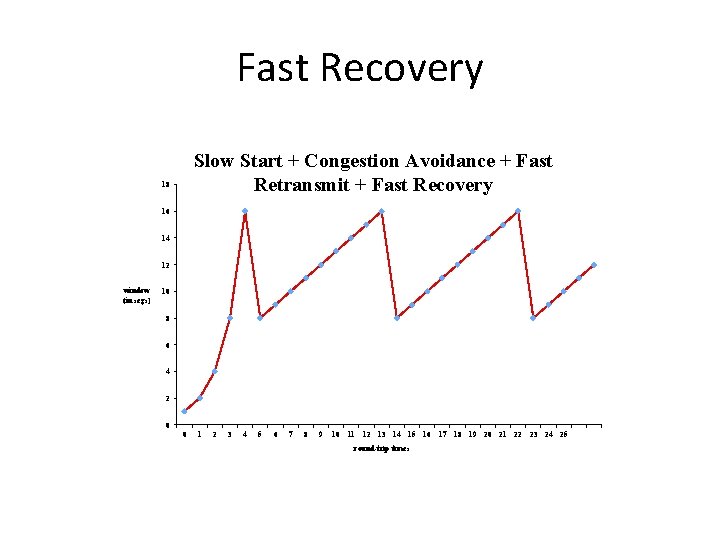
Fast Recovery • Transmit a packet for every ACK received till the retransmitted packet is ACK’d – ssthresh= (2*MSS, cwdn/2); cwnd = sshthred + 3 – On every ACK will the ACK of retransmitted packet • cwnd = cwnd + 1 • On reception of ACK of retransmitted packet – Start congestion avoidance instead of slow start • cwnd = ssthresh
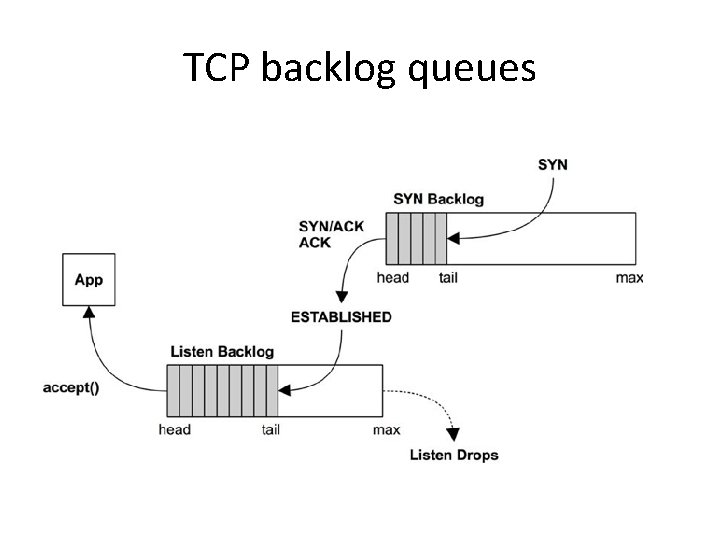
TCP backlog queues
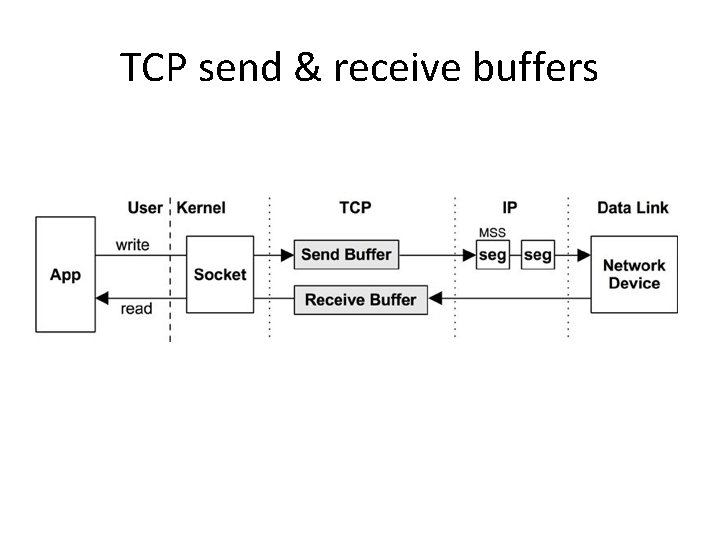
TCP send & receive buffers
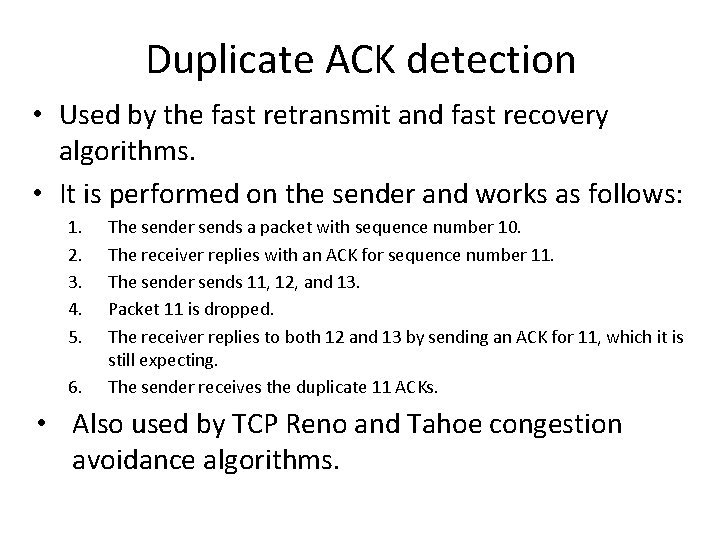
Duplicate ACK detection • Used by the fast retransmit and fast recovery algorithms. • It is performed on the sender and works as follows: 1. 2. 3. 4. 5. 6. The sender sends a packet with sequence number 10. The receiver replies with an ACK for sequence number 11. The sender sends 11, 12, and 13. Packet 11 is dropped. The receiver replies to both 12 and 13 by sending an ACK for 11, which it is still expecting. The sender receives the duplicate 11 ACKs. • Also used by TCP Reno and Tahoe congestion avoidance algorithms.
TCP Performance (Steady State) • Bandwidth as a function of – RTT? – Loss rate? – Packet size? – Receive window? 74
What if TCP connection is short? • Slow start dominates performance – What if network is unloaded? – Burstiness causes extra drops • Packet losses unreliable indicator for short flows – can lose connection setup packet – Can get loss when connection near done – Packet loss signal unrelated to sending rate • In limit, have to signal congestion (with a loss) on every connection – 50% loss rate as increase # of connections
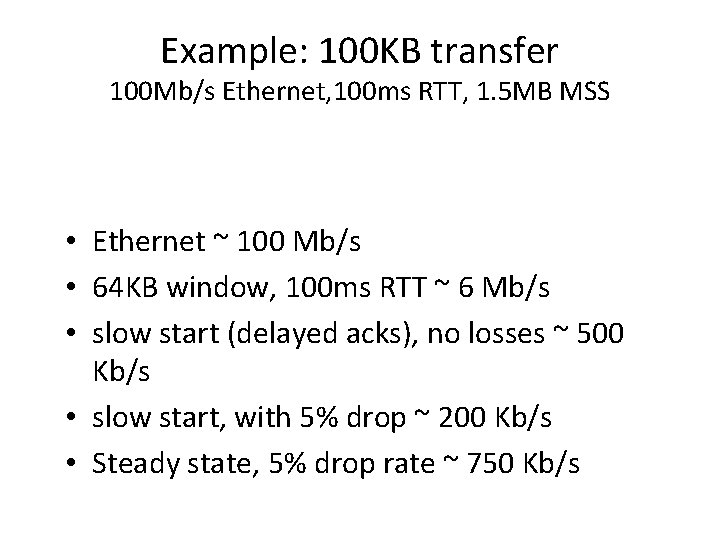
Example: 100 KB transfer 100 Mb/s Ethernet, 100 ms RTT, 1. 5 MB MSS • Ethernet ~ 100 Mb/s • 64 KB window, 100 ms RTT ~ 6 Mb/s • slow start (delayed acks), no losses ~ 500 Kb/s • slow start, with 5% drop ~ 200 Kb/s • Steady state, 5% drop rate ~ 750 Kb/s
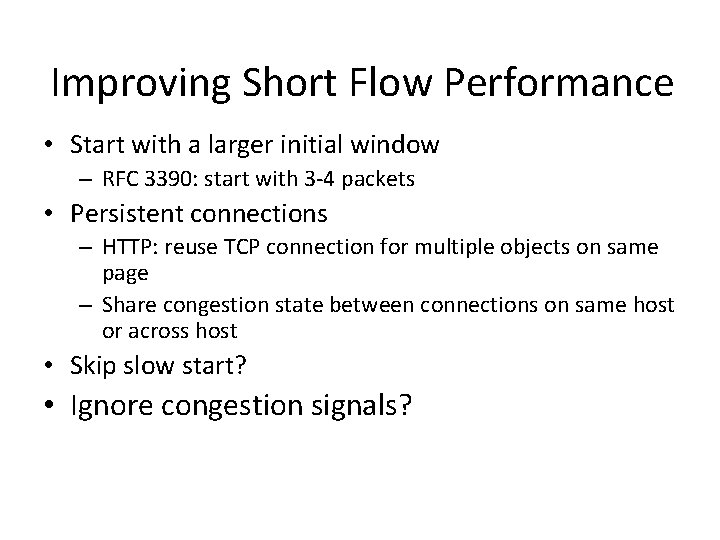
Improving Short Flow Performance • Start with a larger initial window – RFC 3390: start with 3 -4 packets • Persistent connections – HTTP: reuse TCP connection for multiple objects on same page – Share congestion state between connections on same host or across host • Skip slow start? • Ignore congestion signals?
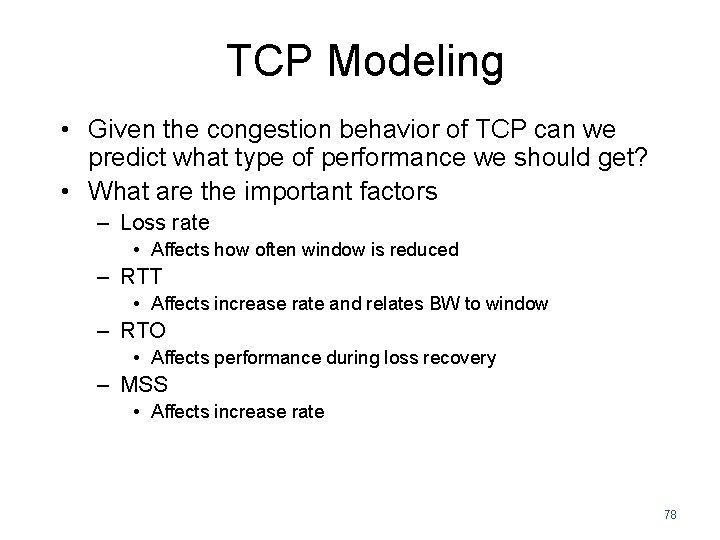
TCP Modeling • Given the congestion behavior of TCP can we predict what type of performance we should get? • What are the important factors – Loss rate • Affects how often window is reduced – RTT • Affects increase rate and relates BW to window – RTO • Affects performance during loss recovery – MSS • Affects increase rate 78
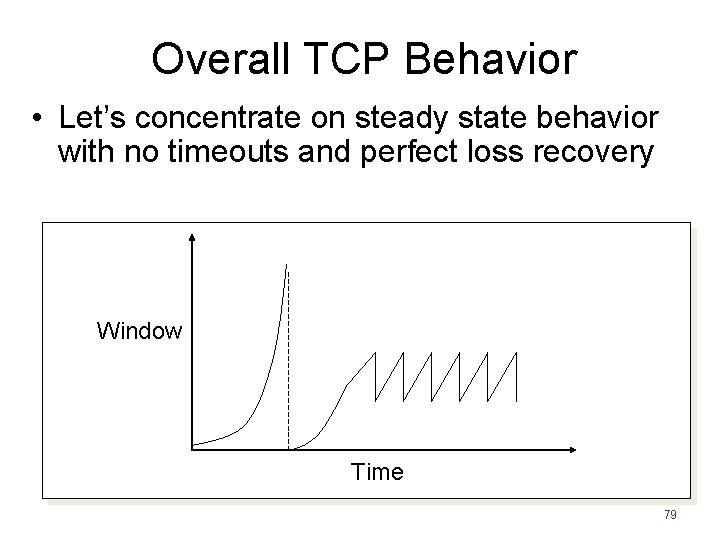
Overall TCP Behavior • Let’s concentrate on steady state behavior with no timeouts and perfect loss recovery Window Time 79
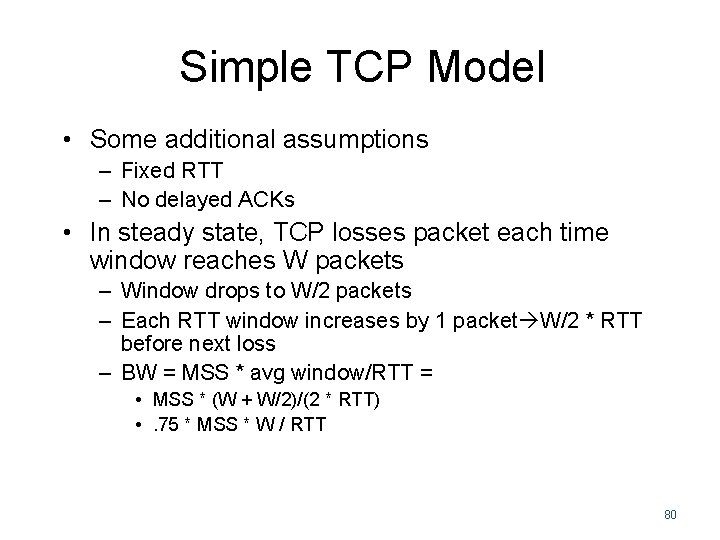
Simple TCP Model • Some additional assumptions – Fixed RTT – No delayed ACKs • In steady state, TCP losses packet each time window reaches W packets – Window drops to W/2 packets – Each RTT window increases by 1 packet W/2 * RTT before next loss – BW = MSS * avg window/RTT = • MSS * (W + W/2)/(2 * RTT) • . 75 * MSS * W / RTT 80
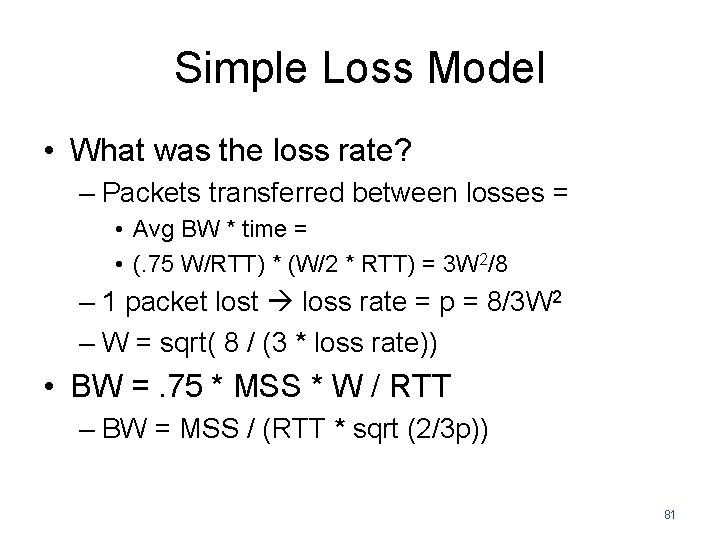
Simple Loss Model • What was the loss rate? – Packets transferred between losses = • Avg BW * time = • (. 75 W/RTT) * (W/2 * RTT) = 3 W 2/8 – 1 packet lost loss rate = p = 8/3 W 2 – W = sqrt( 8 / (3 * loss rate)) • BW =. 75 * MSS * W / RTT – BW = MSS / (RTT * sqrt (2/3 p)) 81
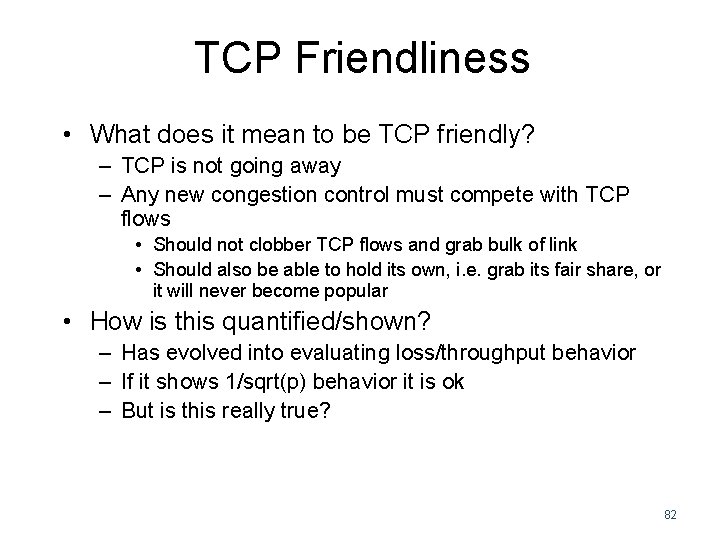
TCP Friendliness • What does it mean to be TCP friendly? – TCP is not going away – Any new congestion control must compete with TCP flows • Should not clobber TCP flows and grab bulk of link • Should also be able to hold its own, i. e. grab its fair share, or it will never become popular • How is this quantified/shown? – Has evolved into evaluating loss/throughput behavior – If it shows 1/sqrt(p) behavior it is ok – But is this really true? 82
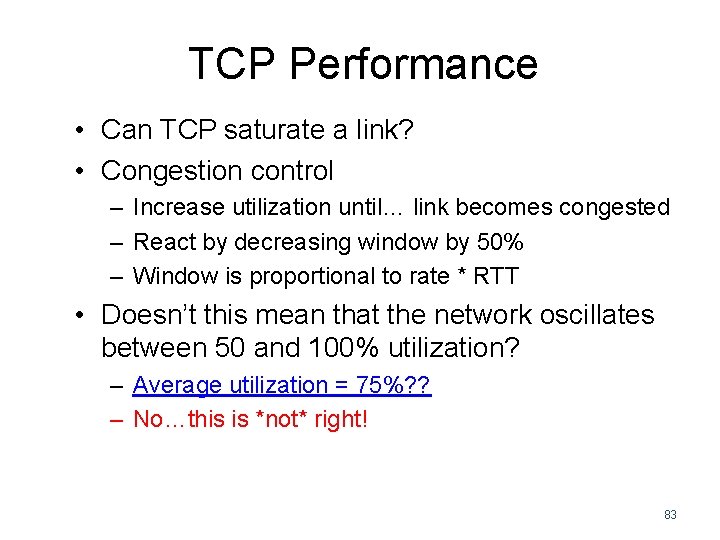
TCP Performance • Can TCP saturate a link? • Congestion control – Increase utilization until… link becomes congested – React by decreasing window by 50% – Window is proportional to rate * RTT • Doesn’t this mean that the network oscillates between 50 and 100% utilization? – Average utilization = 75%? ? – No…this is *not* right! 83
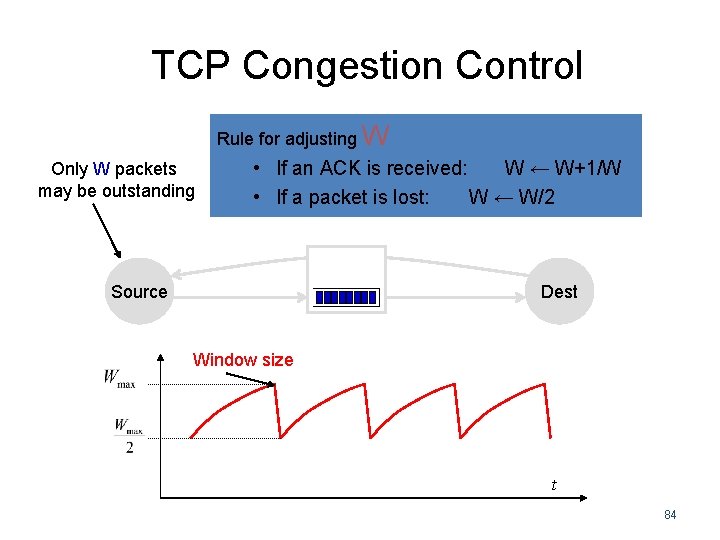
TCP Congestion Control Rule for adjusting W Only W packets may be outstanding • If an ACK is received: W ← W+1/W • If a packet is lost: W ← W/2 Source Dest Window size t 84
Congestion Control: Reno and Tahoe • Reno: triple duplicate ACKs trigger: halving of the congestion window, halving of the slow-start threshold, fast retransmit, and fast recovery • Tahoe: triple duplicate ACKs trigger: fast retransmit, halving the slow-start threshold, congestion window set to one maximum segment size (MSS), and slow-start state. • Some operating systems (e. g. , Linux and Oracle Solaris 11) allow the algorithm to be selected as part of system tuning. • Newer algorithms that have been developed for TCP include Vegas, New Reno, and Hybla.
Nagle • This algorithm [RFC 896] reduces the number of small packets on the network by delaying their transmission to allow more data to arrive and coalesce. • This delays packets only if there is data in the pipeline and delays are already being encountered. • The system may provide a tunable parameter to disable Nagle, which may be necessary if its operation conflicts with delayed ACKs.
Delayed ACKs • This algorithm [RFC 1122] delays the sending of ACKs up to 500 msec. , so that multiple ACKs may be combined. • Other TCP control messages can also be combined, reducing the number of packets on the network.
Selective ACK (SACK) • Allows the receiver to inform the sender that it received a noncontiguous block of data. • Without this, a packet drop would eventually cause the entire send window to be retransmitted, to preserve a sequential acknowledgment scheme. • This harms TCP performance and is avoided by most modern operating systems that support SACK.
Forward ACKs (FACK) • SACK has been extended by forward acknowledgments (FACK), which are supported in Linux by default. • FACKs track additional state and better regulate the amount of outstanding data in the network, improving overall performance.
Fast Recovery Slow Start + Congestion Avoidance + Fast Retransmit + Fast Recovery 18 16 14 12 window (in segs) 10 8 6 4 2 0 0 1 2 3 4 5 6 7 8 9 10 11 12 13 14 15 16 17 18 19 20 21 22 23 24 25 round-trip times
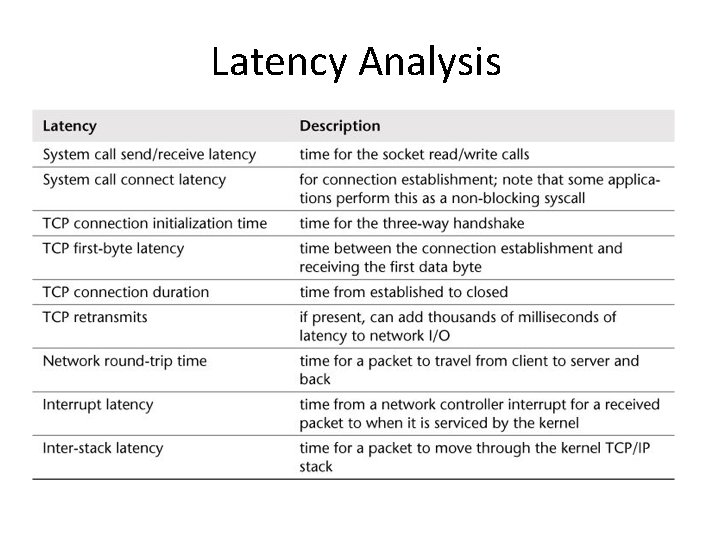
Latency Analysis
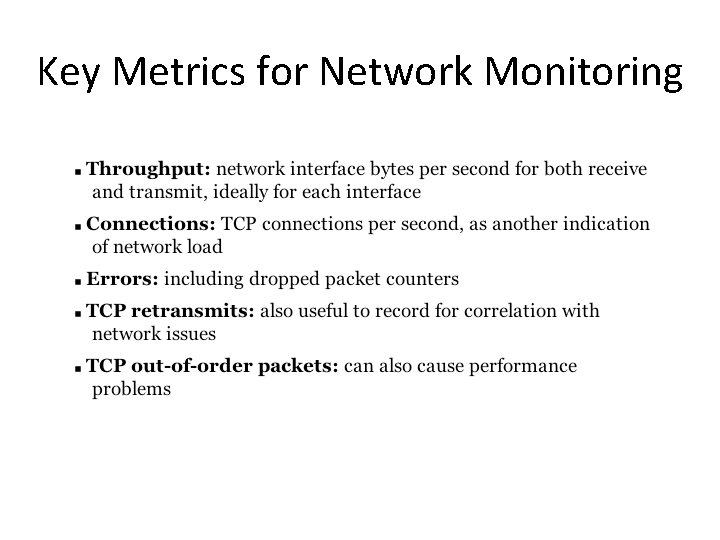
Key Metrics for Network Monitoring
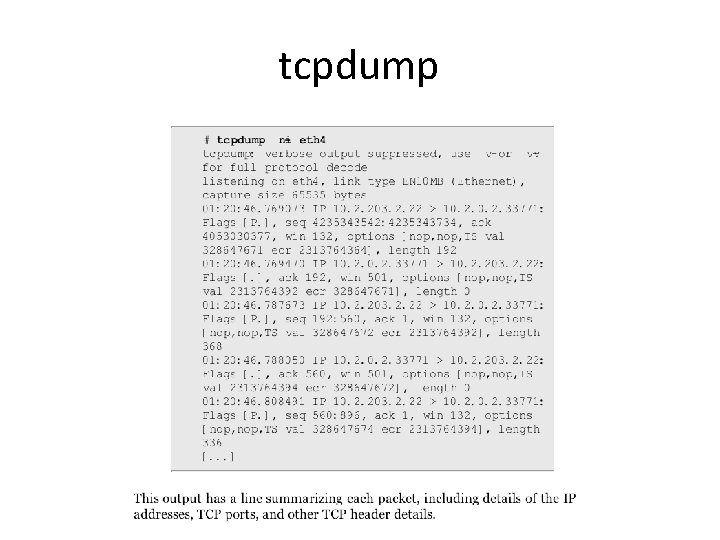
tcpdump
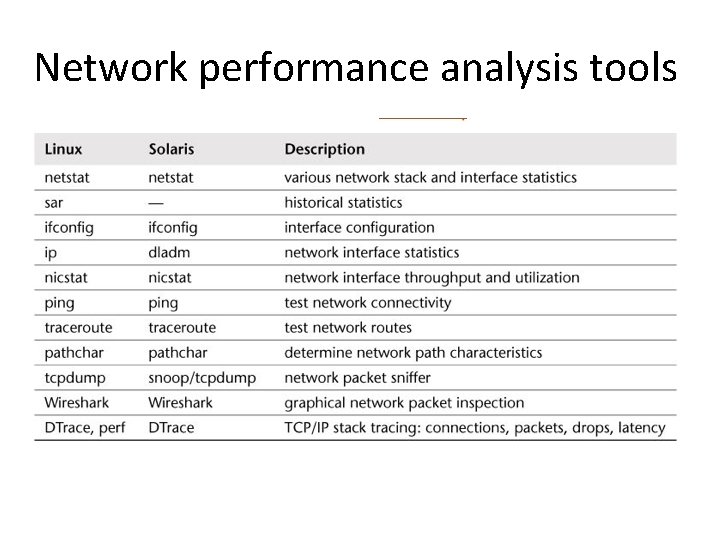
Network performance analysis tools
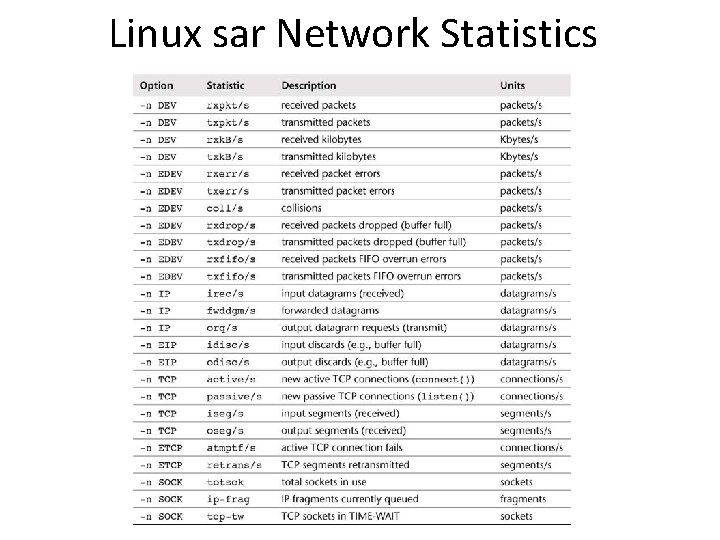
Linux sar Network Statistics
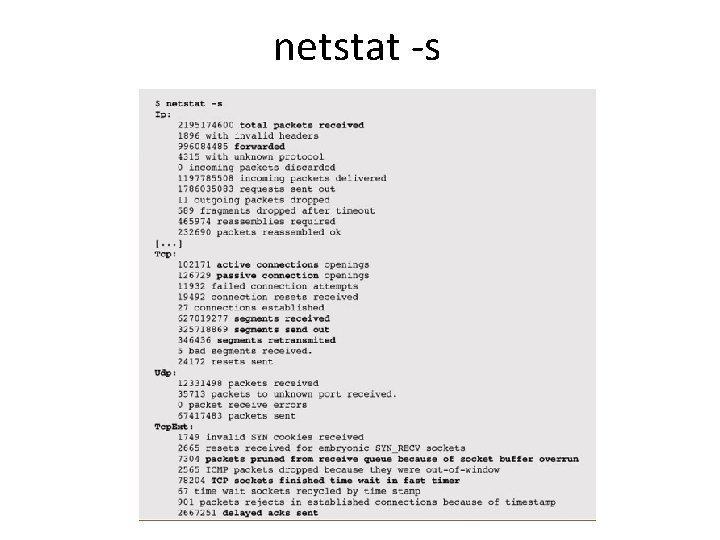
netstat -s
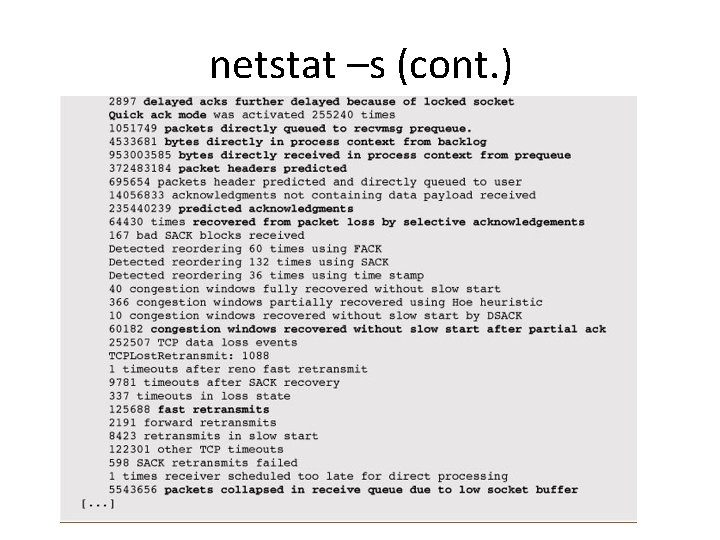
netstat –s (cont. )
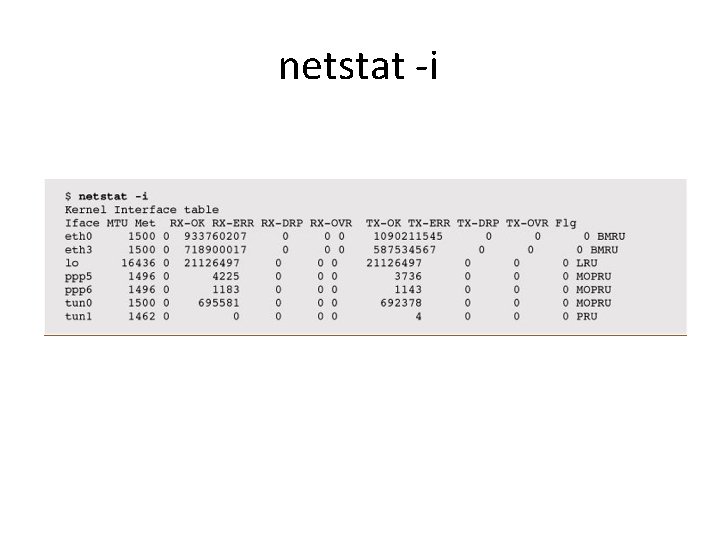
netstat -i
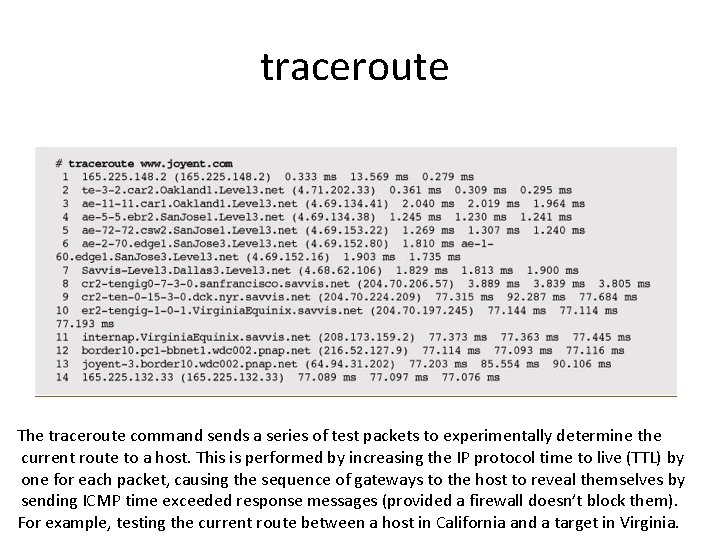
traceroute The traceroute command sends a series of test packets to experimentally determine the current route to a host. This is performed by increasing the IP protocol time to live (TTL) by one for each packet, causing the sequence of gateways to the host to reveal themselves by sending ICMP time exceeded response messages (provided a firewall doesn’t block them). For example, testing the current route between a host in California and a target in Virginia.
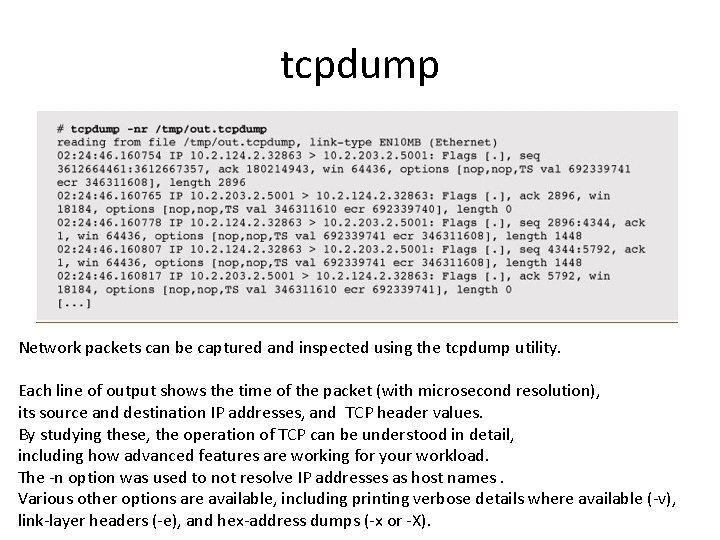
tcpdump Network packets can be captured and inspected using the tcpdump utility. Each line of output shows the time of the packet (with microsecond resolution), its source and destination IP addresses, and TCP header values. By studying these, the operation of TCP can be understood in detail, including how advanced features are working for your workload. The -n option was used to not resolve IP addresses as host names. Various other options are available, including printing verbose details where available (-v), link-layer headers (-e), and hex-address dumps (-x or -X).
Homework (4 th and 5 th eds. ) • • • 5. 13 5. 16 5. 28 5. 34 5. 39 Due 4/24