
ECE 530 Analysis Techniques for LargeScale Electrical Systems
- Slides: 33
ECE 530 – Analysis Techniques for Large-Scale Electrical Systems Lecture 23: Numeric Solution of Differential Equations Prof. Hao Zhu Dept. of Electrical and Computer Engineering University of Illinois at Urbana-Champaign haozhu@illinois. edu 11/30/2015 1
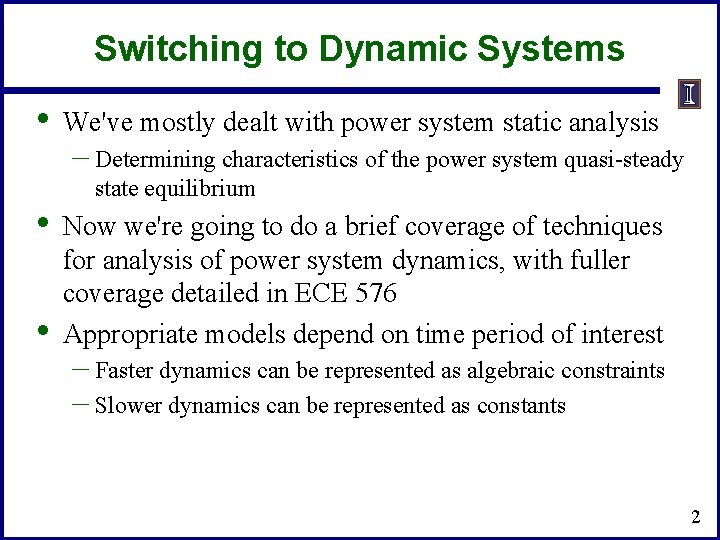
Switching to Dynamic Systems • • • We've mostly dealt with power system static analysis – Determining characteristics of the power system quasi-steady state equilibrium Now we're going to do a brief coverage of techniques for analysis of power system dynamics, with fuller coverage detailed in ECE 576 Appropriate models depend on time period of interest – Faster dynamics can be represented as algebraic constraints – Slower dynamics can be represented as constants 2
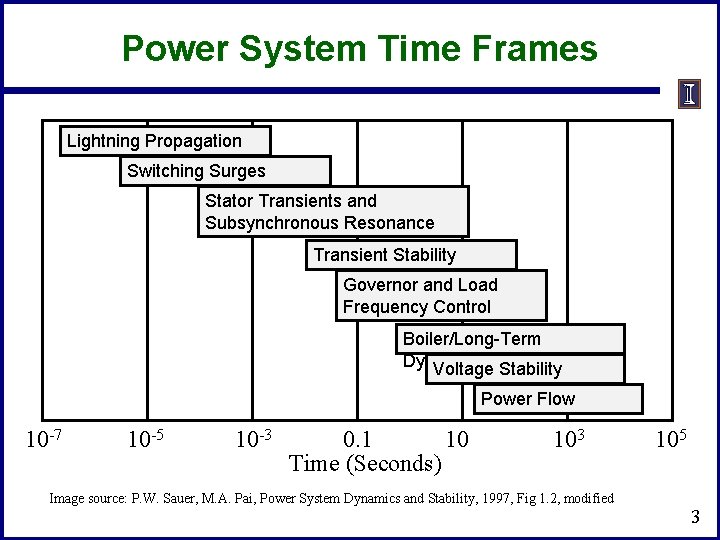
Power System Time Frames Lightning Propagation Switching Surges Stator Transients and Subsynchronous Resonance Transient Stability Governor and Load Frequency Control Boiler/Long-Term Dynamics Voltage Stability Power Flow 10 -7 10 -5 10 -3 0. 1 10 Time (Seconds) 103 Image source: P. W. Sauer, M. A. Pai, Power System Dynamics and Stability, 1997, Fig 1. 2, modified 105 3
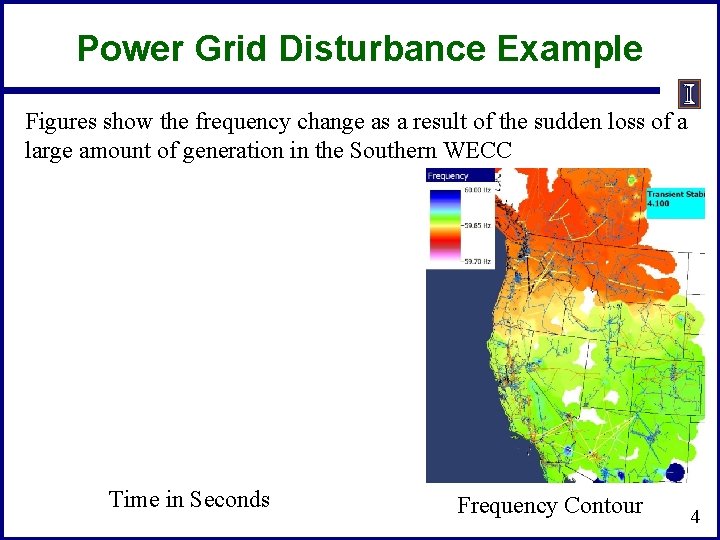
Power Grid Disturbance Example Figures show the frequency change as a result of the sudden loss of a large amount of generation in the Southern WECC Time in Seconds Frequency Contour 4
Frequency Response for Gen. Loss • In response to rapid loss of generation, in the initial seconds the system frequency will decrease as energy stored in the rotating masses is transformed into electric energy • • Solar PV has no inertia, and for most new wind turbines the inertia is not seen by the system Within seconds governors respond, increasing power output of controllable generation • Solar PV and wind are usually operated at maximum power so they have no reserves to contribute 5
Solution Considerations • • • In ECE 530 we introduce several solution methods that are more fully considered in ECE 576 A wide variety of different solution methods are possible, with different classes of problems (such as power system transient stability) having customized solutions There is a balance between the problem to be solved and the solution method – Can we bound the dynamics considered, with fast dynamics represented as algebraic constraints, and slow as constants 6
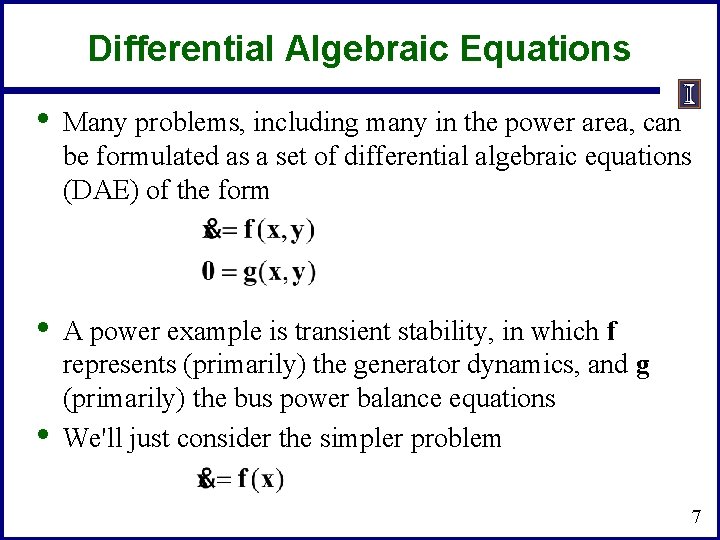
Differential Algebraic Equations • Many problems, including many in the power area, can be formulated as a set of differential algebraic equations (DAE) of the form • A power example is transient stability, in which f represents (primarily) the generator dynamics, and g (primarily) the bus power balance equations We'll just consider the simpler problem • 7
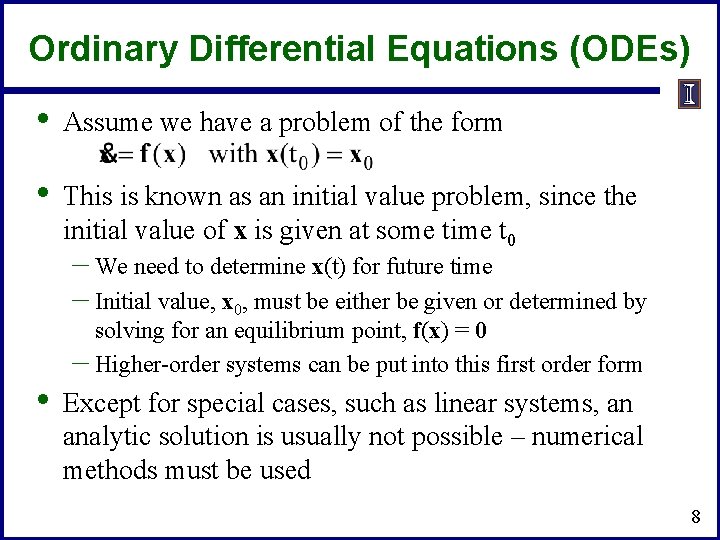
Ordinary Differential Equations (ODEs) • Assume we have a problem of the form • This is known as an initial value problem, since the initial value of x is given at some time t 0 – We need to determine x(t) for future time – Initial value, x 0, must be either be given or determined by • solving for an equilibrium point, f(x) = 0 – Higher-order systems can be put into this first order form Except for special cases, such as linear systems, an analytic solution is usually not possible – numerical methods must be used 8
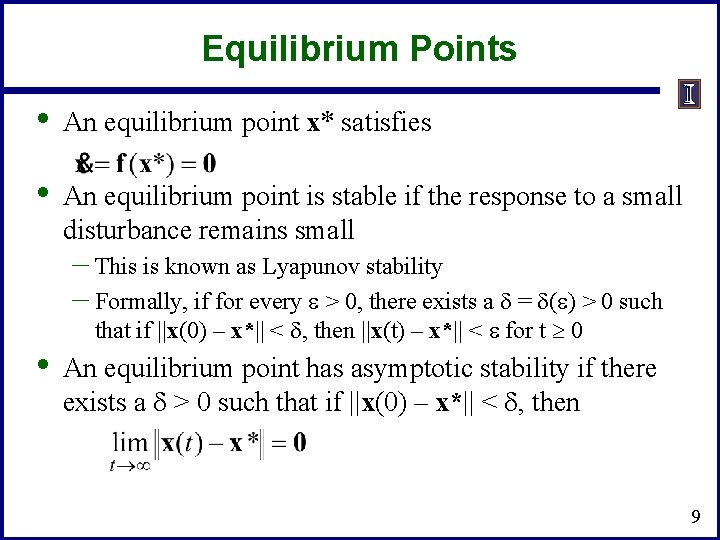
Equilibrium Points • An equilibrium point x* satisfies • An equilibrium point is stable if the response to a small disturbance remains small – This is known as Lyapunov stability – Formally, if for every e > 0, there exists a d = d(e) > 0 such • that if ||x(0) – x*|| < d, then ||x(t) – x*|| < e for t 0 An equilibrium point has asymptotic stability if there exists a d > 0 such that if ||x(0) – x*|| < d, then 9
Power System Application • • A typical power system application is to assume the power flow solution represents an equilibrium point Back solve to determine the initial state variables, x(0) At some point a contingency occurs, perturbing the state away from the equilibrium point Time domain simulation is used to determine whether the system returns to the equilibrium point 10
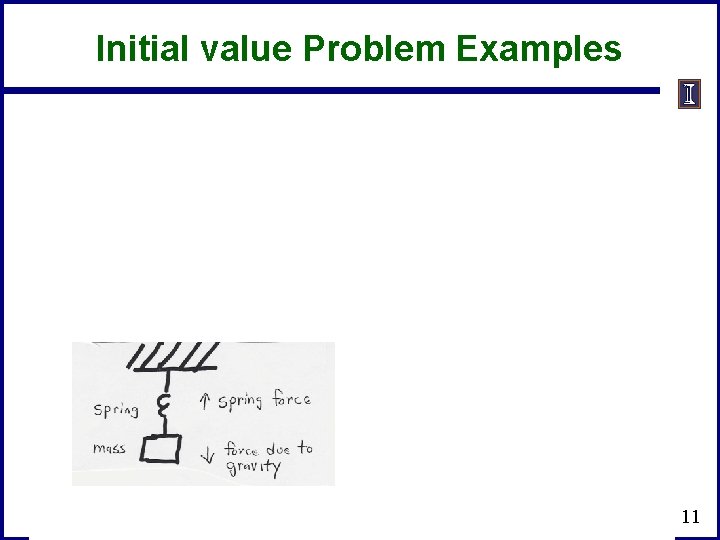
Initial value Problem Examples 11
Numerical Solution Methods • Numerical solution methods do not generate exact solutions; they practically always introduce some error – Methods assume time advances in discrete increments, called • • a stepsize (or time step), Dt – Speed accuracy tradeoff: a smaller Dt usually gives a better solution, but it takes longer to compute – Numeric roundoff error due to finite computer word size Key issue is the derivative of x, f(x) depends on x, the value we are trying to determine A solution exists as long as f(x) is continuously differentiable 12
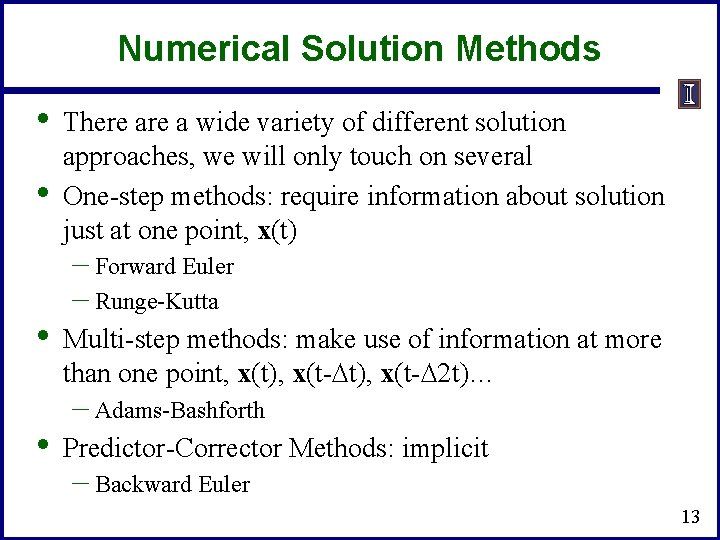
Numerical Solution Methods • • There a wide variety of different solution approaches, we will only touch on several One-step methods: require information about solution just at one point, x(t) – Forward Euler – Runge-Kutta Multi-step methods: make use of information at more than one point, x(t), x(t-D 2 t)… – Adams-Bashforth Predictor-Corrector Methods: implicit – Backward Euler 13
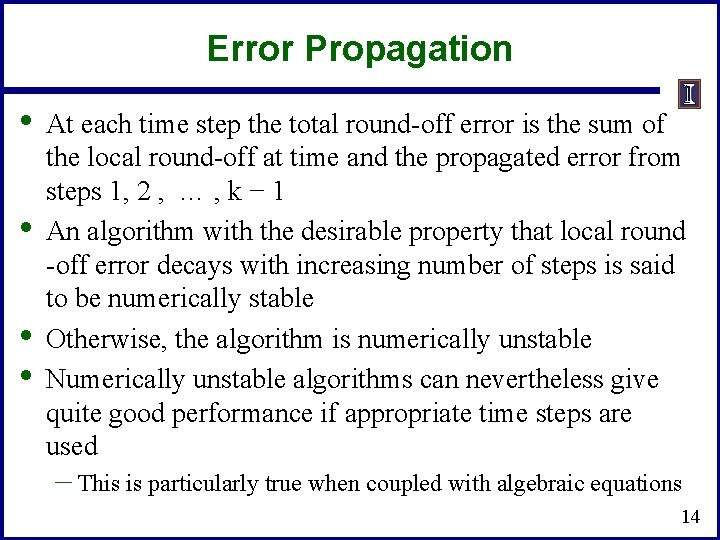
Error Propagation • • At each time step the total round-off error is the sum of the local round-off at time and the propagated error from steps 1, 2 , … , k − 1 An algorithm with the desirable property that local round -off error decays with increasing number of steps is said to be numerically stable Otherwise, the algorithm is numerically unstable Numerically unstable algorithms can nevertheless give quite good performance if appropriate time steps are used – This is particularly true when coupled with algebraic equations 14
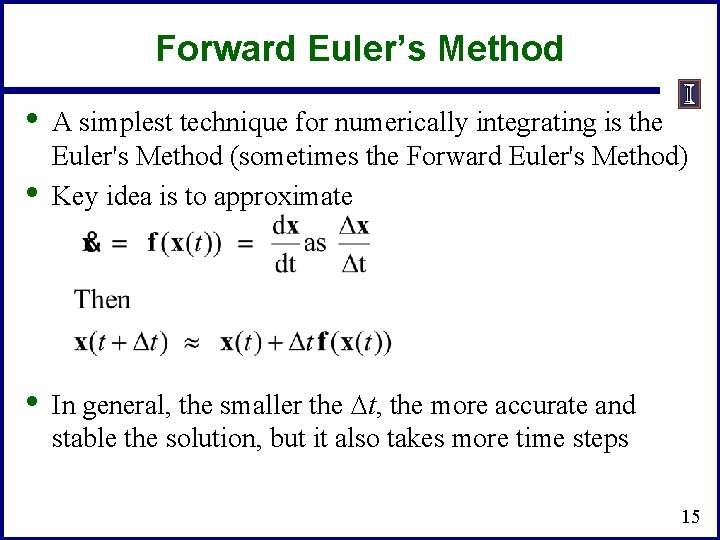
Forward Euler’s Method • • • A simplest technique for numerically integrating is the Euler's Method (sometimes the Forward Euler's Method) Key idea is to approximate In general, the smaller the Dt, the more accurate and stable the solution, but it also takes more time steps 15
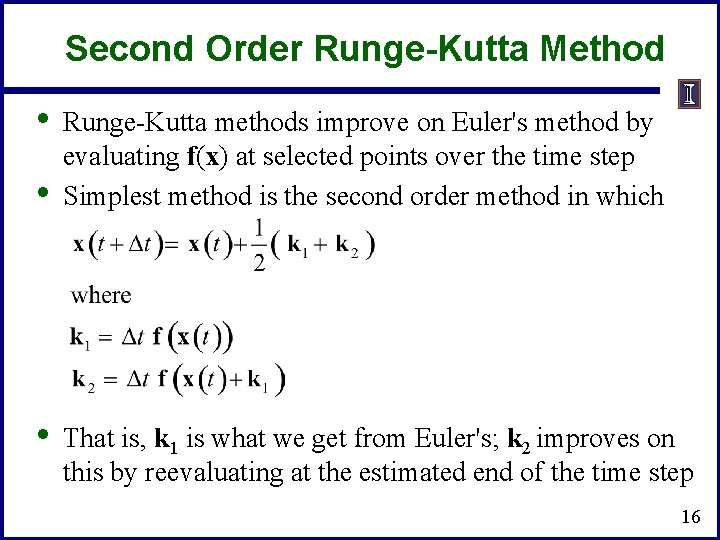
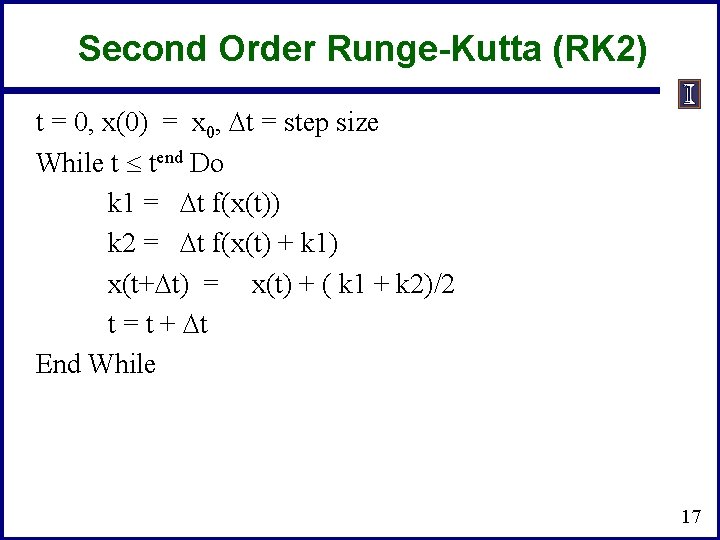
Second Order Runge-Kutta Method • • • Runge-Kutta methods improve on Euler's method by evaluating f(x) at selected points over the time step Simplest method is the second order method in which That is, k 1 is what we get from Euler's; k 2 improves on this by reevaluating at the estimated end of the time step 16
Second Order Runge-Kutta (RK 2) t = 0, x(0) = x 0, Dt = step size While t tend Do k 1 = Dt f(x(t)) k 2 = Dt f(x(t) + k 1) x(t+Dt) = x(t) + ( k 1 + k 2)/2 t = t + Dt End While 17
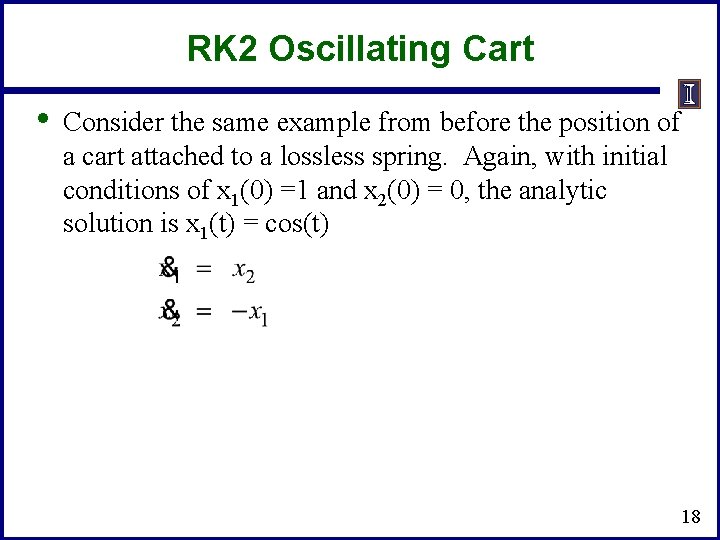
RK 2 Oscillating Cart • Consider the same example from before the position of a cart attached to a lossless spring. Again, with initial conditions of x 1(0) =1 and x 2(0) = 0, the analytic solution is x 1(t) = cos(t) 18
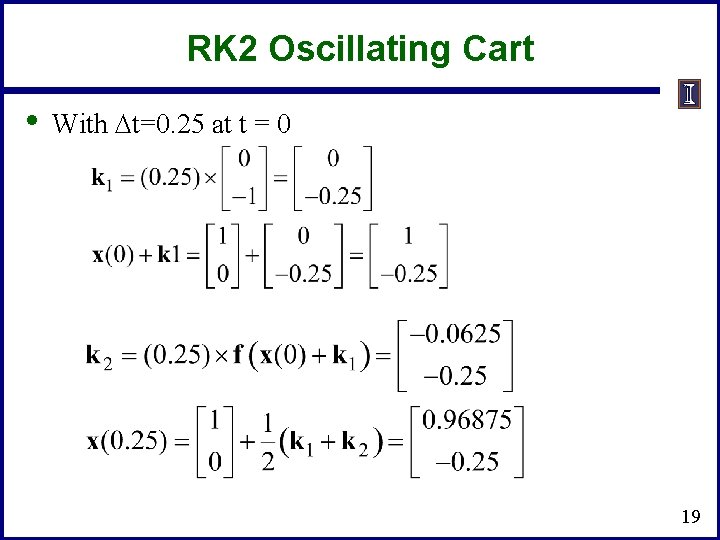
RK 2 Oscillating Cart • With Dt=0. 25 at t = 0 19
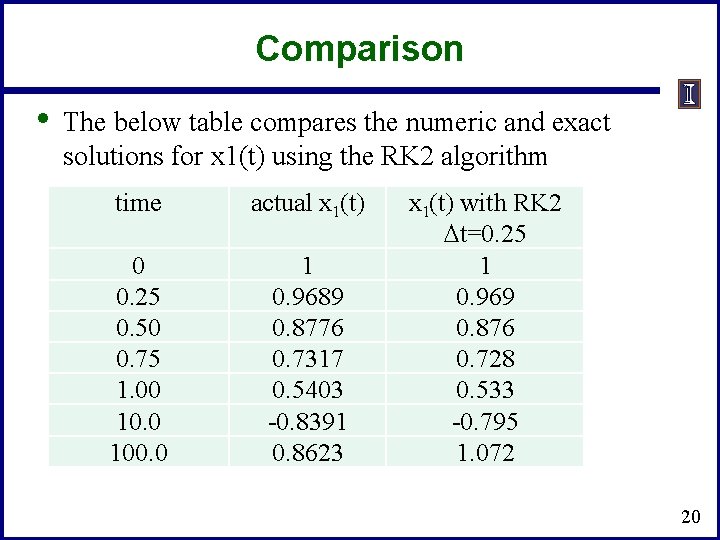
Comparison • The below table compares the numeric and exact solutions for x 1(t) using the RK 2 algorithm time actual x 1(t) 0 0. 25 0. 50 0. 75 1. 00 100. 0 1 0. 9689 0. 8776 0. 7317 0. 5403 -0. 8391 0. 8623 x 1(t) with RK 2 Dt=0. 25 1 0. 969 0. 876 0. 728 0. 533 -0. 795 1. 072 20
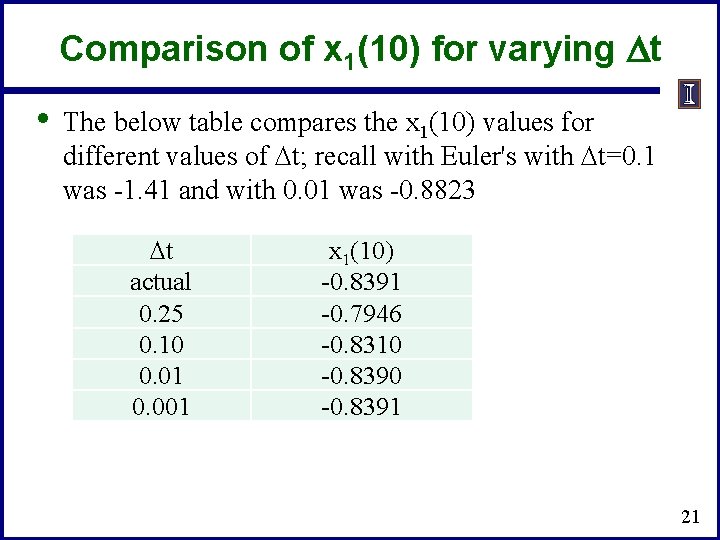
Comparison of x 1(10) for varying Dt • The below table compares the x 1(10) values for different values of Dt; recall with Euler's with Dt=0. 1 was -1. 41 and with 0. 01 was -0. 8823 Dt actual 0. 25 0. 10 0. 01 0. 001 x 1(10) -0. 8391 -0. 7946 -0. 8310 -0. 8391 21
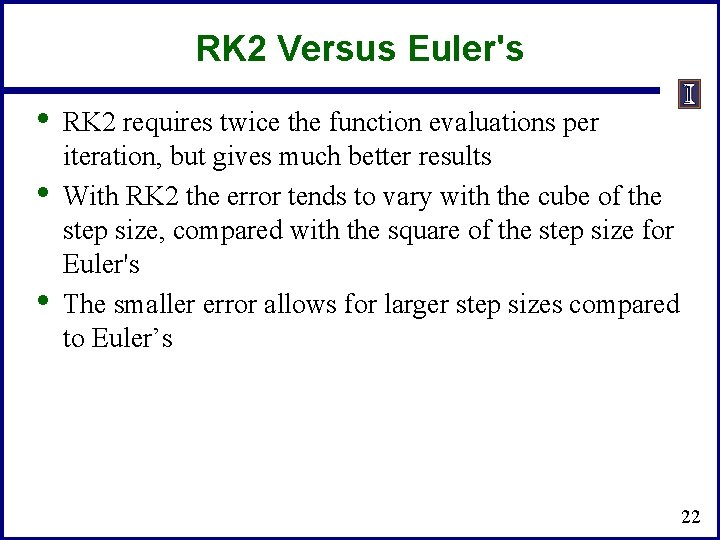
RK 2 Versus Euler's • • • RK 2 requires twice the function evaluations per iteration, but gives much better results With RK 2 the error tends to vary with the cube of the step size, compared with the square of the step size for Euler's The smaller error allows for larger step sizes compared to Euler’s 22
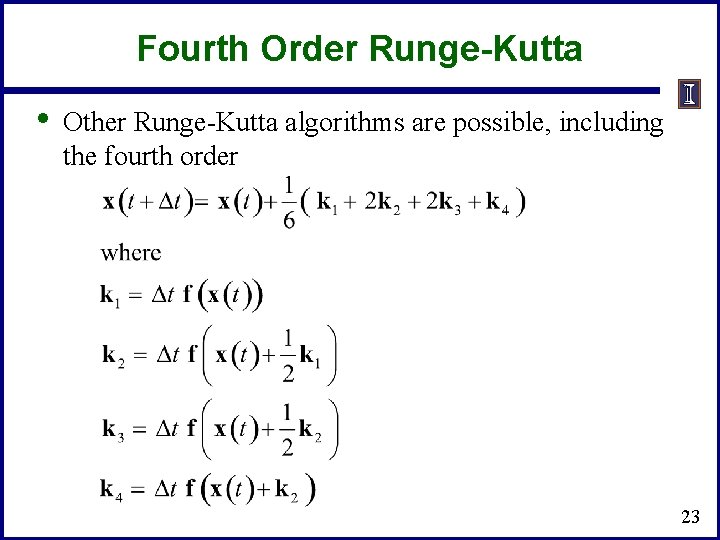
Fourth Order Runge-Kutta • Other Runge-Kutta algorithms are possible, including the fourth order 23
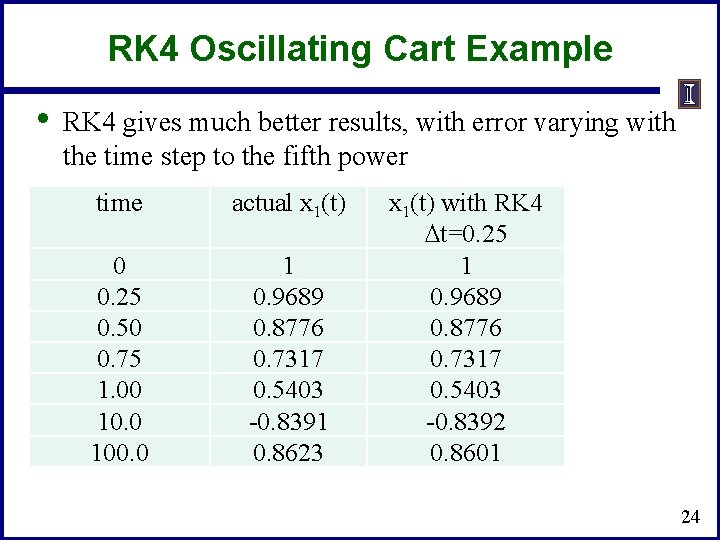
RK 4 Oscillating Cart Example • RK 4 gives much better results, with error varying with the time step to the fifth power time actual x 1(t) 0 0. 25 0. 50 0. 75 1. 00 100. 0 1 0. 9689 0. 8776 0. 7317 0. 5403 -0. 8391 0. 8623 x 1(t) with RK 4 Dt=0. 25 1 0. 9689 0. 8776 0. 7317 0. 5403 -0. 8392 0. 8601 24
Multistep Methods • • • Euler's and Runge-Kutta methods are single step approaches, in that they only use information at x(t) to determine its value at the next time step Multistep methods take advantage of the fact that using we have information about previous time steps x(t-Dt), x(t-2 Dt), etc These methods can be explicit or implicit [dependent on x(t+Dt) values]; we'll just consider the explicit Adams. Bashforth approach 25
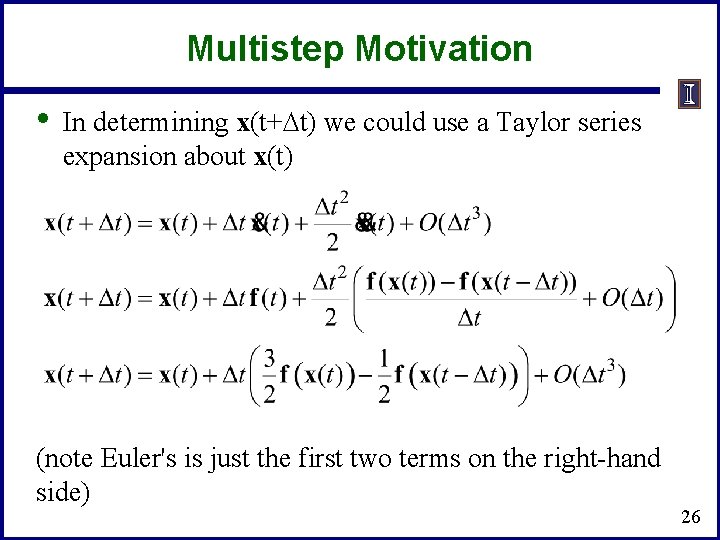
Multistep Motivation • In determining x(t+Dt) we could use a Taylor series expansion about x(t) (note Euler's is just the first two terms on the right-hand side) 26
Adams-Bashforth • What we derived is the second-order Adams-Bashforth approach. Higher-order methods are also possible, by approximating subsequent derivatives. Here we also present the second- and third-order Adams-Bashforth 27
Adams-Bashforth Versus Runge-Kutta • • The key Adams-Bashforth advantage is the approach only requires one function evaluation per time step while the RK methods require multiple evaluations A key disadvantage is when discontinuities are encountered, such as with limit violations; Another method needs to be used until there are sufficient past solutions They also have difficulties if variable time steps are used 28
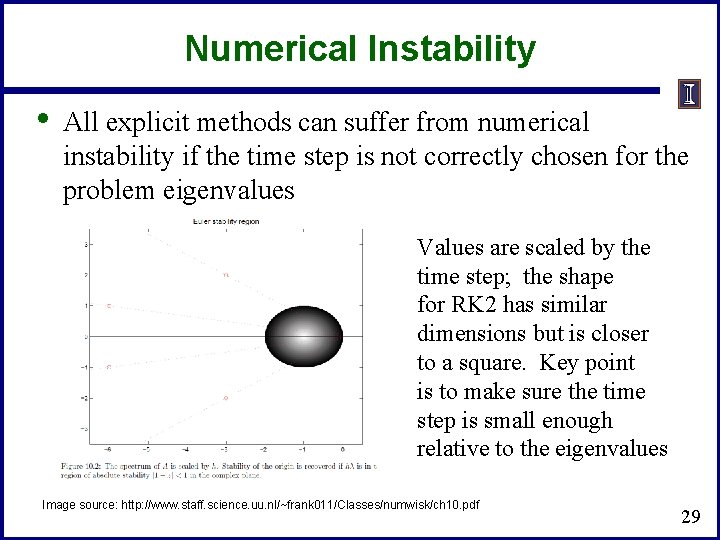
Numerical Instability • All explicit methods can suffer from numerical instability if the time step is not correctly chosen for the problem eigenvalues Values are scaled by the time step; the shape for RK 2 has similar dimensions but is closer to a square. Key point is to make sure the time step is small enough relative to the eigenvalues Image source: http: //www. staff. science. uu. nl/~frank 011/Classes/numwisk/ch 10. pdf 29
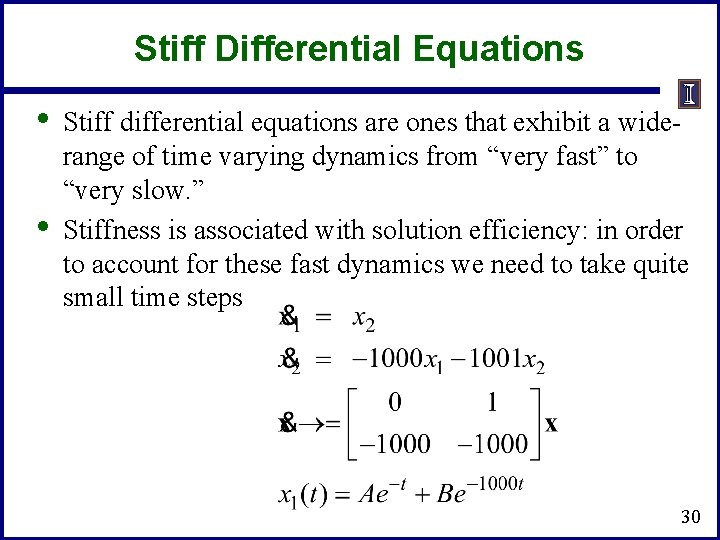
Stiff Differential Equations • • Stiff differential equations are ones that exhibit a widerange of time varying dynamics from “very fast” to “very slow. ” Stiffness is associated with solution efficiency: in order to account for these fast dynamics we need to take quite small time steps 30
Multi-Rate Methods • • • Multi-rate methods can be used with sets of differential equations in which different parts of the system have different speeds – Use small time steps for the fast parts of the system – Use larger time steps for the slower parts of the system Subsystems need to be sufficiently decoupled A good power system reference: J. Chen and M. L. Crow, "A Variable Partitioning Strategy for the Multirate Method in Power Systems, " IEEE Trans. Power Systems, vol. 23, pp. 259 -266, 2008 31
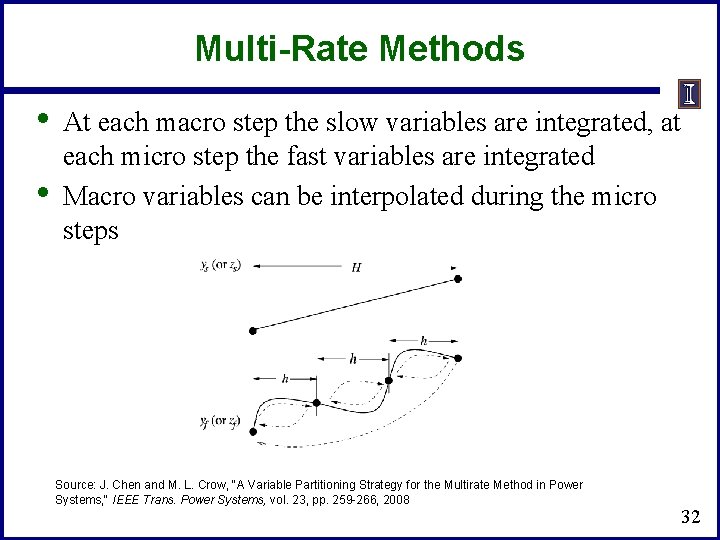
Multi-Rate Methods • • At each macro step the slow variables are integrated, at each micro step the fast variables are integrated Macro variables can be interpolated during the micro steps Source: J. Chen and M. L. Crow, "A Variable Partitioning Strategy for the Multirate Method in Power Systems, " IEEE Trans. Power Systems, vol. 23, pp. 259 -266, 2008 32
Multi-Rate Example: Transient Stability • • The power system transient stability problem is usually solved with a time step of ¼ or ½ cycle Some subsystems can have much faster time constants – When starting induction machines can exhibit very fast (relative to the time step) transients – Some types of exciters can have very fast time constants, in which the dynamics only come into play during close by faults 33