
ECE 492 Computer Engineering Design Project Poor Mans
- Slides: 1
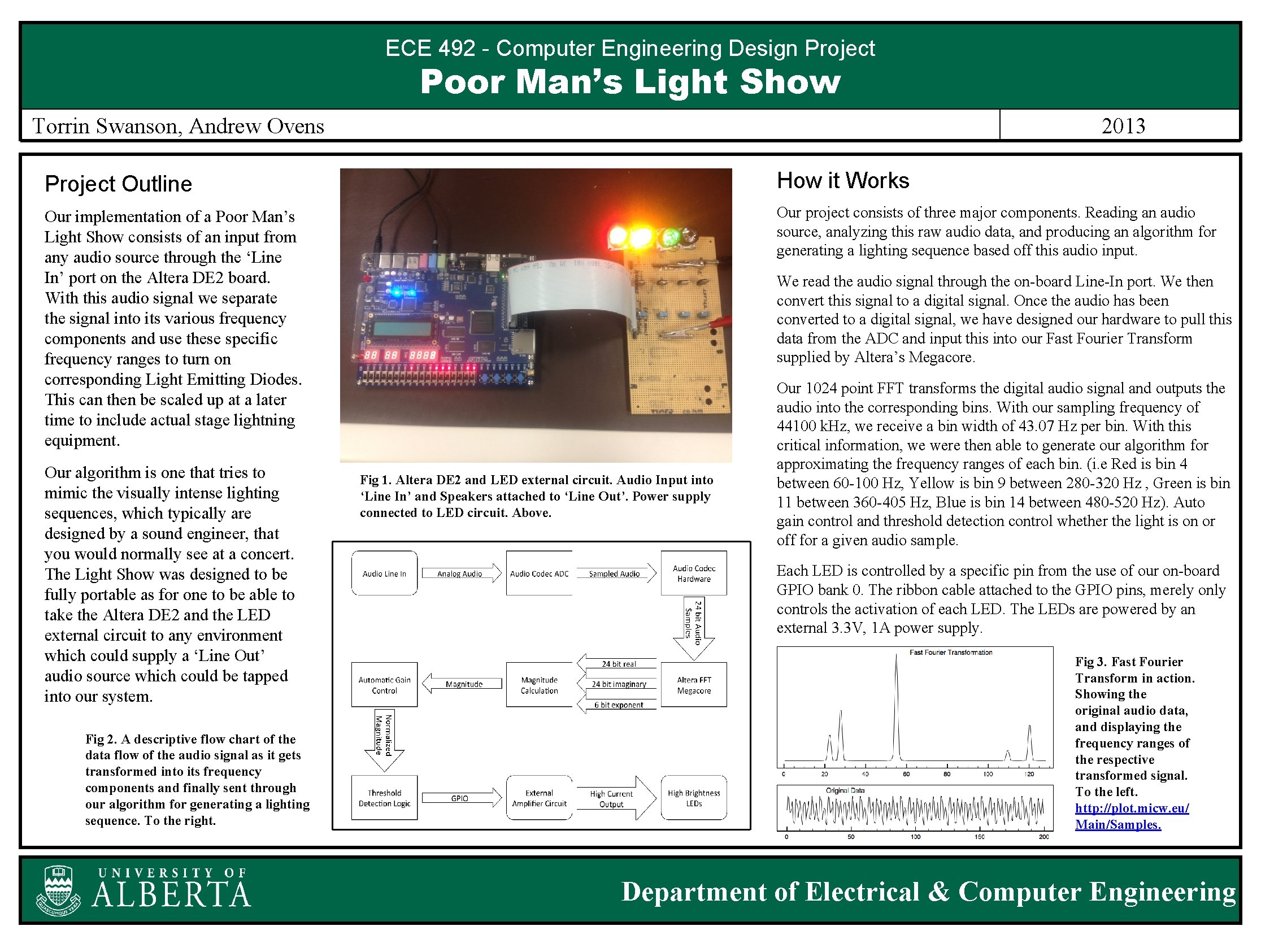
ECE 492 - Computer Engineering Design Project Poor Man’s Light Show Torrin Swanson, Andrew Ovens 2013 Project Outline How it Works Our implementation of a Poor Man’s Light Show consists of an input from any audio source through the ‘Line In’ port on the Altera DE 2 board. With this audio signal we separate the signal into its various frequency components and use these specific frequency ranges to turn on corresponding Light Emitting Diodes. This can then be scaled up at a later time to include actual stage lightning equipment. Our project consists of three major components. Reading an audio source, analyzing this raw audio data, and producing an algorithm for generating a lighting sequence based off this audio input. Our algorithm is one that tries to mimic the visually intense lighting sequences, which typically are designed by a sound engineer, that you would normally see at a concert. The Light Show was designed to be fully portable as for one to be able to take the Altera DE 2 and the LED external circuit to any environment which could supply a ‘Line Out’ audio source which could be tapped into our system. Fig 2. A descriptive flow chart of the data flow of the audio signal as it gets transformed into its frequency components and finally sent through our algorithm for generating a lighting sequence. To the right. We read the audio signal through the on-board Line-In port. We then convert this signal to a digital signal. Once the audio has been converted to a digital signal, we have designed our hardware to pull this data from the ADC and input this into our Fast Fourier Transform supplied by Altera’s Megacore. Fig 1. Altera DE 2 and LED external circuit. Audio Input into ‘Line In’ and Speakers attached to ‘Line Out’. Power supply connected to LED circuit. Above. Our 1024 point FFT transforms the digital audio signal and outputs the audio into the corresponding bins. With our sampling frequency of 44100 k. Hz, we receive a bin width of 43. 07 Hz per bin. With this critical information, we were then able to generate our algorithm for approximating the frequency ranges of each bin. (i. e Red is bin 4 between 60 -100 Hz, Yellow is bin 9 between 280 -320 Hz , Green is bin 11 between 360 -405 Hz, Blue is bin 14 between 480 -520 Hz). Auto gain control and threshold detection control whether the light is on or off for a given audio sample. Each LED is controlled by a specific pin from the use of our on-board GPIO bank 0. The ribbon cable attached to the GPIO pins, merely only controls the activation of each LED. The LEDs are powered by an external 3. 3 V, 1 A power supply. Fig 3. Fast Fourier Transform in action. Showing the original audio data, and displaying the frequency ranges of the respective transformed signal. To the left. http: //plot. micw. eu/ Main/Samples. Department of Electrical & Computer Engineering