
ECE 476 Power System Analysis Lecture 1 Introduction

- Slides: 31
ECE 476 Power System Analysis Lecture 1: Introduction Prof. Tom Overbye Dept. of Electrical and Computer Engineering University of Illinois at Urbana-Champaign overbye@illinois. edu
About Prof. Tom Overbye • Professional – – – Received BSEE, MSEE, and Ph. D. all from University of Wisconsin at Madison (83, 88, 91) Worked for eight years as engineer for an electric utility (Madison Gas & Electric) Have been at UI since 1991, doing teaching and doing research in the area of electric power systems Developed commercial power system analysis package, known now as Power. World Simulator. This package has been sold to about 600 different corporate entities worldwide DOE investigator for 8/14/2003 blackout 1
About Prof. Tom Overbye • Nonprofessional – – Married to Jo Have three children • • • – – Tim age 21 Hannah age 19 Amanda age 17 Live in country by Homer on the Salt Fork River We’ve homeschooled our kids all the way through, with Tim now starting his fourth year at UIUC in ME and Hannah her second year in psychology 2
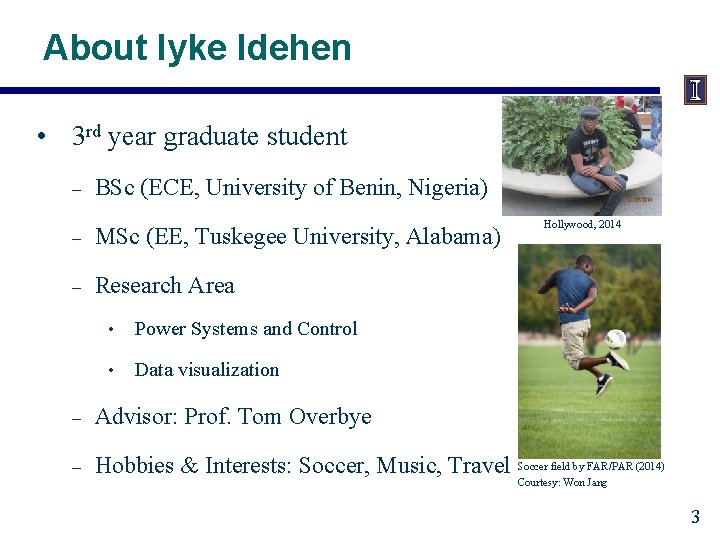
About Iyke Idehen • 3 rd year graduate student – BSc (ECE, University of Benin, Nigeria) – MSc (EE, Tuskegee University, Alabama) – Research Area • Power Systems and Control • Data visualization Hollywood, 2014 – Advisor: Prof. Tom Overbye – Hobbies & Interests: Soccer, Music, Travel Soccer field by FAR/PAR (2014) Courtesy: Won Jang 3
Simple Power System • Every power system has three major components – generation: source of power, ideally with a specified voltage and frequency – load: consumes power; ideally with a constant resistive value – transmission system: transmits power; ideally as a perfect conductor 4
Complications • No ideal voltage sources exist • Loads are seldom constant • Transmission system has resistance, inductance, capacitance and flow limitations • Simple system has no redundancy so power system will not work if any component fails 5
Notation - Power • Power: Instantaneous consumption of energy • Power Units • Watts = voltage x current for dc (W) • k. W – 1 x 10³ Watt • MW – 1 x 10⁶ Watt • GW – 1 x 10⁹ Watt • Installed U. S. generation capacity is about 1000 GW ( about 3 k. W person) • Maximum load of Champaign/Urbana about 300 MW 6
Notation - Energy • Energy: Integration of power over time; energy is what people really want from a power system • Energy Units – – Joule = 1 Watt-second (J) k. Wh = Kilowatthour (3. 6 x 10⁶ J) Btu = 1055 J; 1 MBtu=0. 292 MWh One gallon of gas has about 0. 125 MBtu (36. 5 k. Wh); • U. S. electric energy consumption is about 3600 billion k. Wh (about 13, 333 k. Wh person, which means on average we each use 1. 5 k. W of power continuously) 7
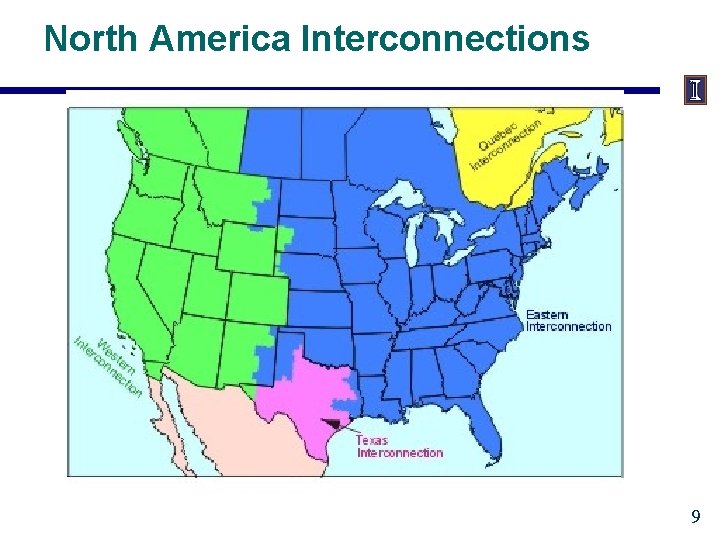
Power System Examples • Electric utility: can range from quite small, such as an island, to one covering half the continent – there are four major interconnected ac power systems in North American, each operating at 60 Hz ac; 50 Hz is used in some other countries. • Airplanes and Spaceships: reduction in weight is primary consideration; frequency is 400 Hz. • Ships and submarines • Automobiles: dc with 12 volts standard • Battery operated portable systems 8
North America Interconnections 9
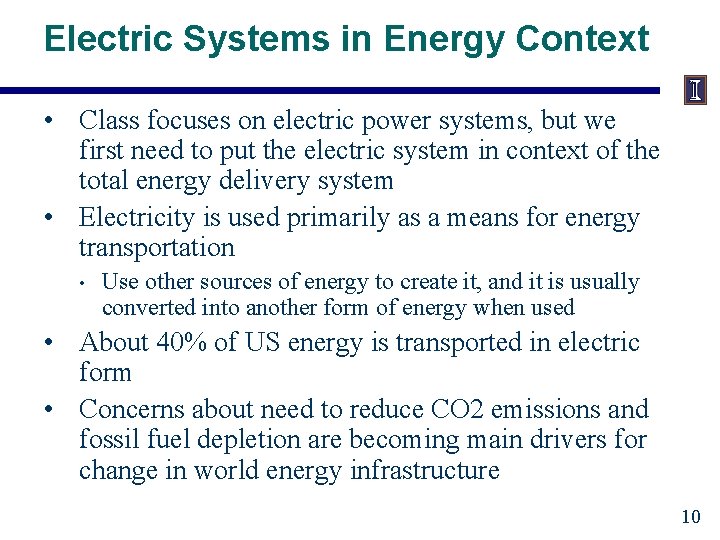
Electric Systems in Energy Context • Class focuses on electric power systems, but we first need to put the electric system in context of the total energy delivery system • Electricity is used primarily as a means for energy transportation • Use other sources of energy to create it, and it is usually converted into another form of energy when used • About 40% of US energy is transported in electric form • Concerns about need to reduce CO 2 emissions and fossil fuel depletion are becoming main drivers for change in world energy infrastructure 10
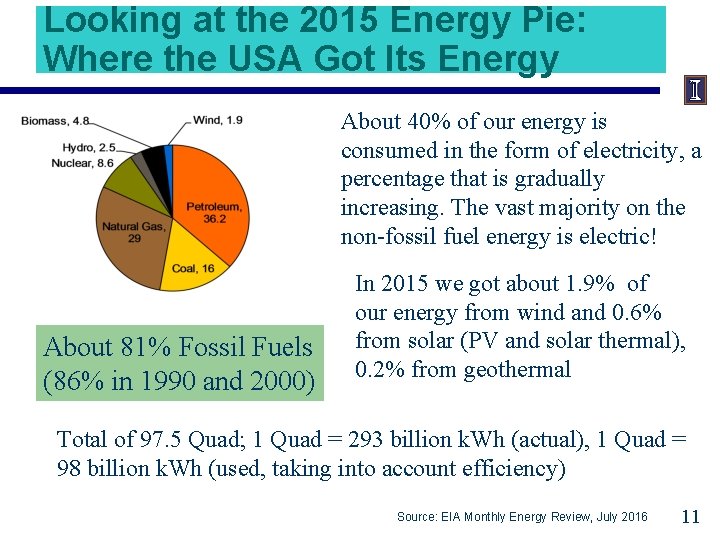
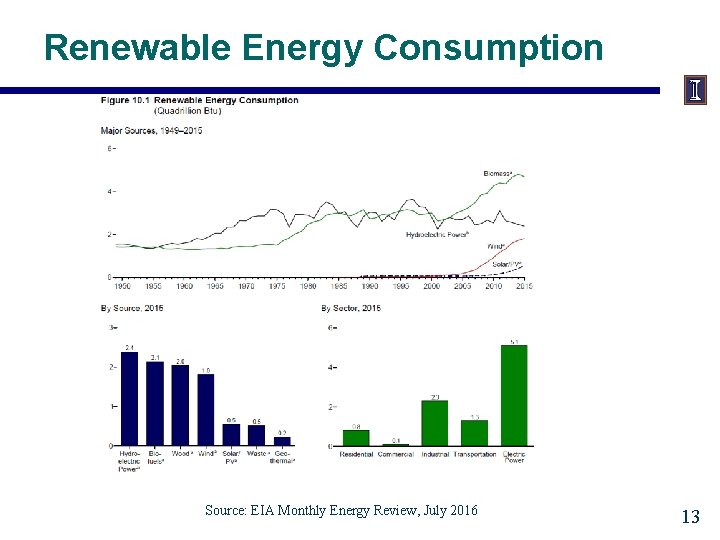
Looking at the 2015 Energy Pie: Where the USA Got Its Energy About 40% of our energy is consumed in the form of electricity, a percentage that is gradually increasing. The vast majority on the non-fossil fuel energy is electric! About 81% Fossil Fuels (86% in 1990 and 2000) In 2015 we got about 1. 9% of our energy from wind and 0. 6% from solar (PV and solar thermal), 0. 2% from geothermal Total of 97. 5 Quad; 1 Quad = 293 billion k. Wh (actual), 1 Quad = 98 billion k. Wh (used, taking into account efficiency) Source: EIA Monthly Energy Review, July 2016 11
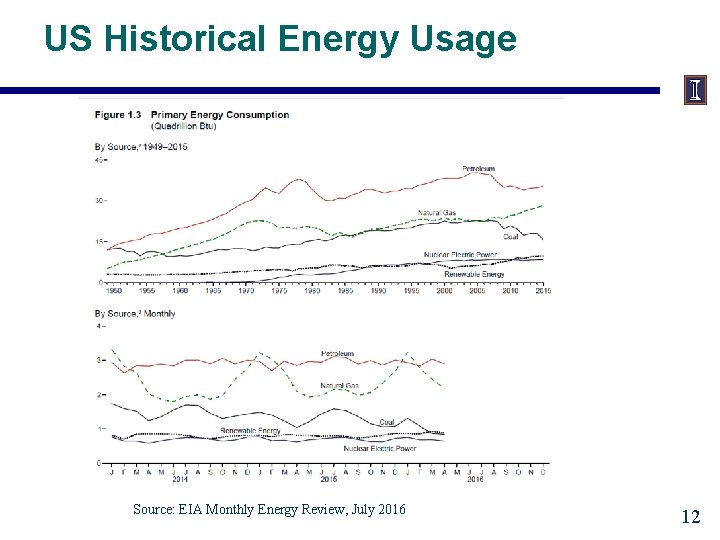
US Historical Energy Usage Source: EIA Monthly Energy Review, July 2016 12
Renewable Energy Consumption Source: EIA Monthly Energy Review, July 2016 13
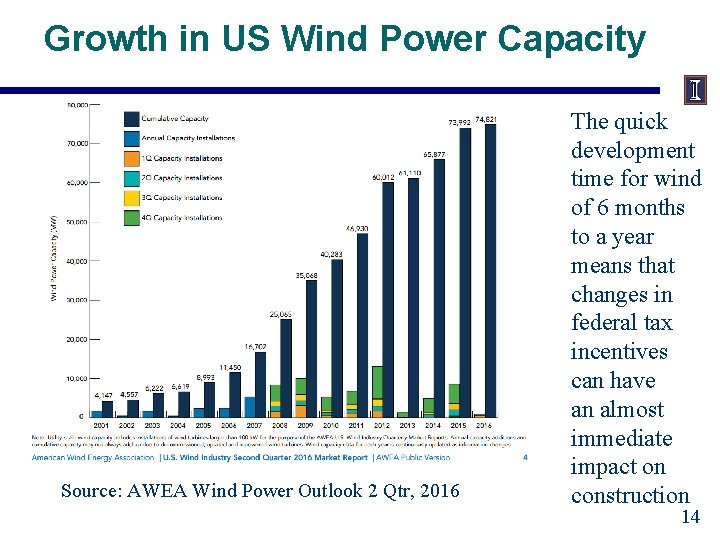
Growth in US Wind Power Capacity Source: AWEA Wind Power Outlook 2 Qtr, 2016 The quick development time for wind of 6 months to a year means that changes in federal tax incentives can have an almost immediate impact on construction 14
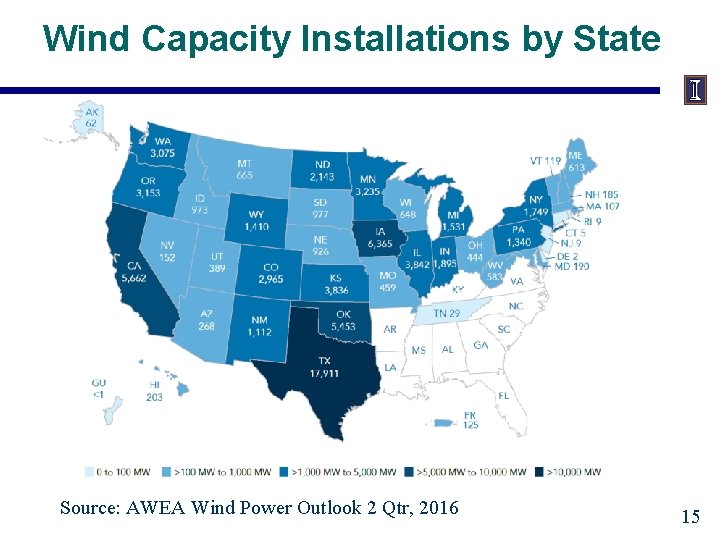
Wind Capacity Installations by State Source: AWEA Wind Power Outlook 2 Qtr, 2016 15
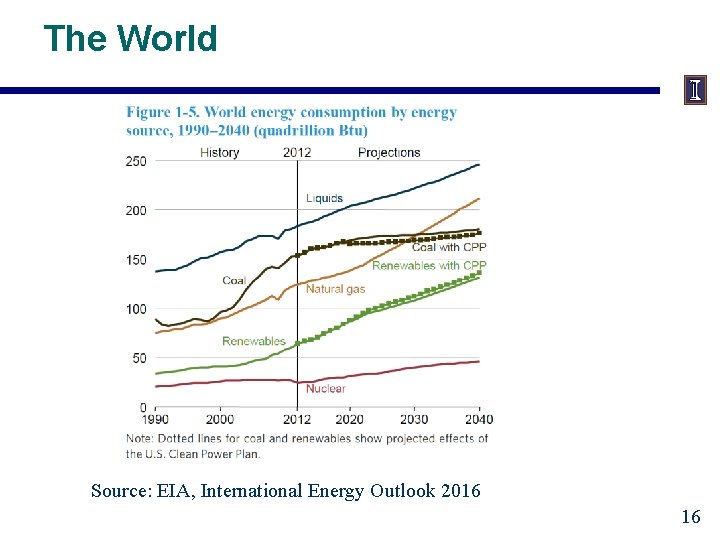
The World Source: EIA, International Energy Outlook 2016 16
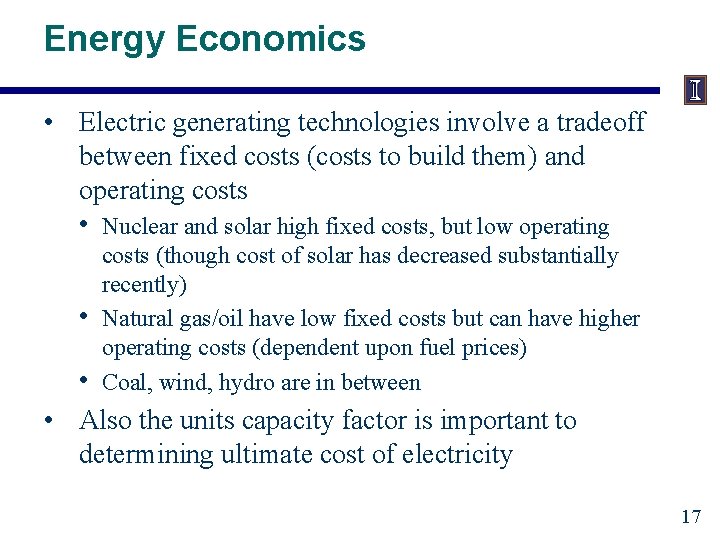
Energy Economics • Electric generating technologies involve a tradeoff between fixed costs (costs to build them) and operating costs • • • Nuclear and solar high fixed costs, but low operating costs (though cost of solar has decreased substantially recently) Natural gas/oil have low fixed costs but can have higher operating costs (dependent upon fuel prices) Coal, wind, hydro are in between • Also the units capacity factor is important to determining ultimate cost of electricity 17
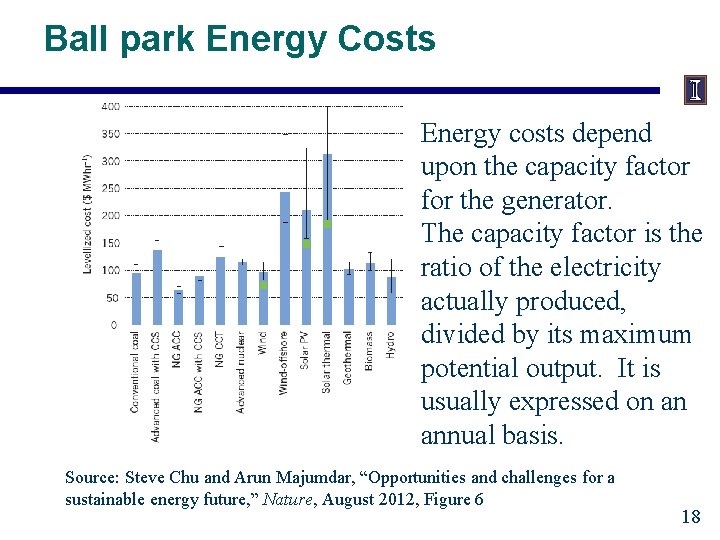
Ball park Energy Costs Energy costs depend upon the capacity factor for the generator. The capacity factor is the ratio of the electricity actually produced, divided by its maximum potential output. It is usually expressed on an annual basis. Source: Steve Chu and Arun Majumdar, “Opportunities and challenges for a sustainable energy future, ” Nature, August 2012, Figure 6 18
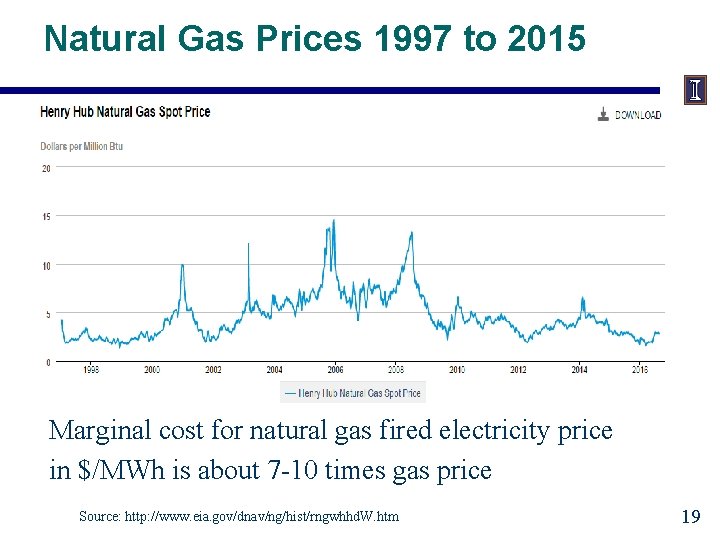
Natural Gas Prices 1997 to 2015 Marginal cost for natural gas fired electricity price in $/MWh is about 7 -10 times gas price Source: http: //www. eia. gov/dnav/ng/hist/rngwhhd. W. htm 19
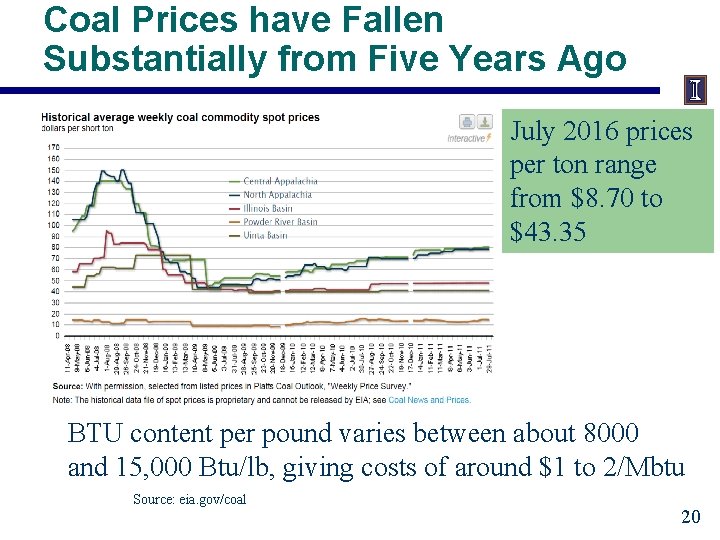
Coal Prices have Fallen Substantially from Five Years Ago July 2016 prices per ton range from $8. 70 to $43. 35 BTU content per pound varies between about 8000 and 15, 000 Btu/lb, giving costs of around $1 to 2/Mbtu Source: eia. gov/coal 20
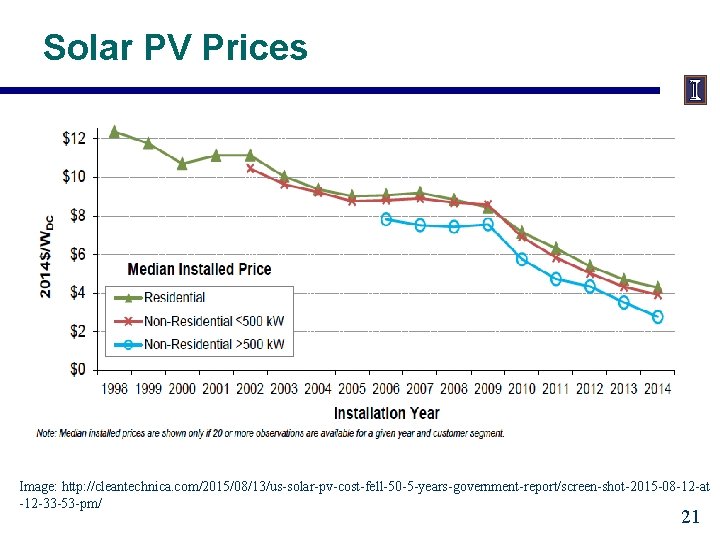
Solar PV Prices Image: http: //cleantechnica. com/2015/08/13/us-solar-pv-cost-fell-50 -5 -years-government-report/screen-shot-2015 -08 -12 -at -12 -33 -53 -pm/ 21
Course Syllabus • • • Introduction and review of phasors & three phase Transmission line modeling Per unit analysis and change of base Models for transformers, generators, and loads Power flow analysis and control Economic system operation/restructuring Short circuit analysis Transient stability System protection Distribution systems 22
Brief History of Electric Power • First real practical uses of electricity began with the telegraph (1860's) and then arc lighting in the 1870’s • Early 1880’s – Edison introduced Pearl Street dc system in Manhattan supplying 59 customers • 1884 – Sprague produces practical dc motor • 1885 – invention of transformer • Mid 1880’s – Westinghouse/Tesla introduce rival ac system • Late 1880’s – Tesla invents ac induction motor • 1893 – Three-phase transmission line at 2. 3 k. V 23
History, cont’d • 1896 – ac lines deliver electricity from hydro generation at Niagara Falls to Buffalo, 20 miles away; also 30 k. V line in Germany • Early 1900’s – Private utilities supply all customers in area (city); recognized as a natural monopoly; states step in to begin regulation • By 1920’s – Large interstate holding companies control most electricity systems 24
History, cont’d • 1935 – Congress passes Public Utility Holding Company Act to establish national regulation, breaking up large interstate utilities (repealed 2005) • This gave rise to electric utilities that only operated in one state • 1935/6 – Rural Electrification Act brought electricity to rural areas • 1930’s – Electric utilities established as vertical monopolies • Frequency standardized in the 1930’s 25
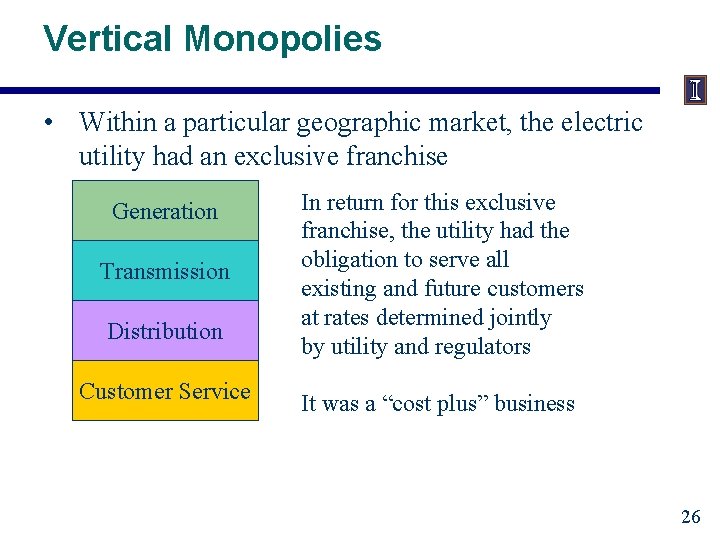
Vertical Monopolies • Within a particular geographic market, the electric utility had an exclusive franchise Generation Transmission Distribution Customer Service In return for this exclusive franchise, the utility had the obligation to serve all existing and future customers at rates determined jointly by utility and regulators It was a “cost plus” business 26
Vertical Monopolies • Within its service territory each utility was the only game in town • Neighboring utilities functioned more as colleagues than competitors • Utilities gradually interconnected their systems so by 1970 transmission lines crisscrossed North America, with voltages up to 765 k. V • Economies of scale keep resulted in decreasing rates, so most every one was happy 27
History, cont’d -- 1970’s • 1970’s brought inflation, increased fossil-fuel prices, calls for conservation and growing environmental concerns • Increasing rates replaced decreasing ones • As a result, U. S. Congress passed Public Utilities Regulator Policies Act (PURPA) in 1978, which mandated utilities must purchase power from independent generators located in their service territory (modified 2005) • PURPA introduced some competition 28
PURPA and Renewables • PURPA, through favorable contracts, caused the growth of a large amount of renewable energy in the 1980’s (about 12, 000 MW of wind, geothermal, small scale hydro, biomass, and solar thermal) – – – These were known as “qualifying facilities” (QFs) California added about 6000 MW of QF capacity during the 1980’s, including 1600 MW of wind, 2700 MW of geothermal, and 1200 MW of biomass By the 1990’s the ten-year QFs contracts written at rates of $60/MWh in 1980’s, and they were no longer profitable at the $30/MWh 1990 values so many sites were retired or abandoned 29
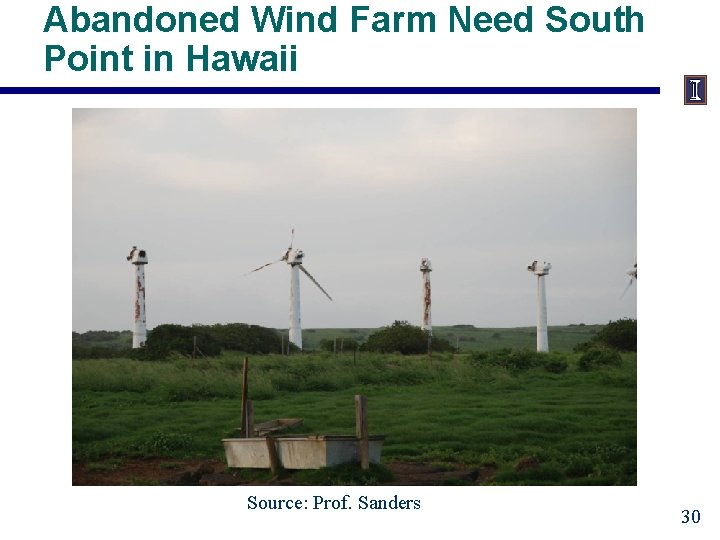
Abandoned Wind Farm Need South Point in Hawaii Source: Prof. Sanders 30