
ECE 454CS 594 Computer and Network Security Dr



- Slides: 43
ECE 454/CS 594 Computer and Network Security Dr. Jinyuan (Stella) Sun Dept. of Electrical Engineering and Computer Science University of Tennessee Fall 2011 1
Secret Key Cryptography Block cipher • DES • 3 DES • AES • 2
Generic Block Encryption • Block cipher: encryption/decryption in which a fixed- length block of plaintext is mapped to a ciphertext block of equal length • Random mapping: when any one bit of plaintext changes, every bit in ciphertext has 50% chance to change • Substitution: space complexity O(k 2^k) for k-bit blocks • Permutation: space complexity O(k logk) for k-bit blocks • Fixed key length: can be the same length as the block or different 3
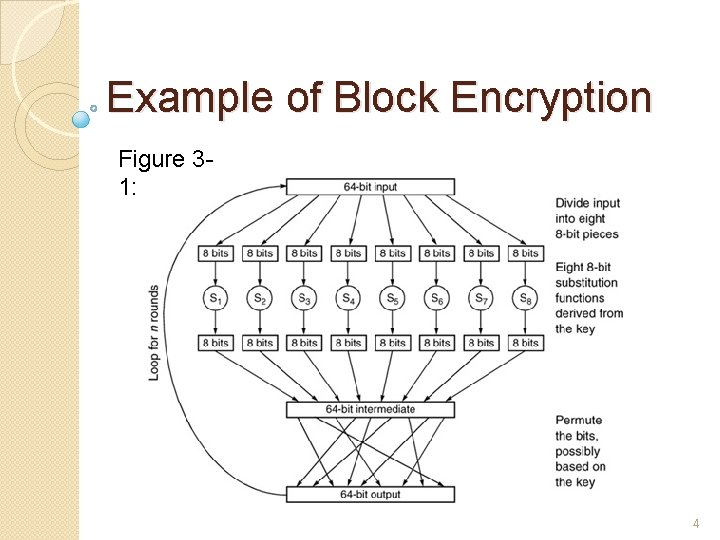
Example of Block Encryption Figure 31: 4
Diffusion and Confusion • Shannon’s proposal in 1949: develop a product cipher that alternates confusion and diffusion functions • Diffusion: the statistical structure of the plaintext is dissipated into long-range statistics of the ciphertext by having each plaintext digit affect the value of many ciphertext digits • Confusion: make the relationship between the statistics of the ciphertext and the value of the encryption key as complex as possible to thwart attempts to discover the key • They capture the essence of the desired attributes of a block cipher 5
Data Encryption Standard (DES) Designed by IBM and published by NIST in 1977 • 64 -bit input block 64 -bit output block with 56 -bit key • Not secure anymore: key size must be increased by 1 bit every 2 years • 3 DES: 112 -bit key • 6
DES Overview Figure 3 -2: Basic Structure of DES 7
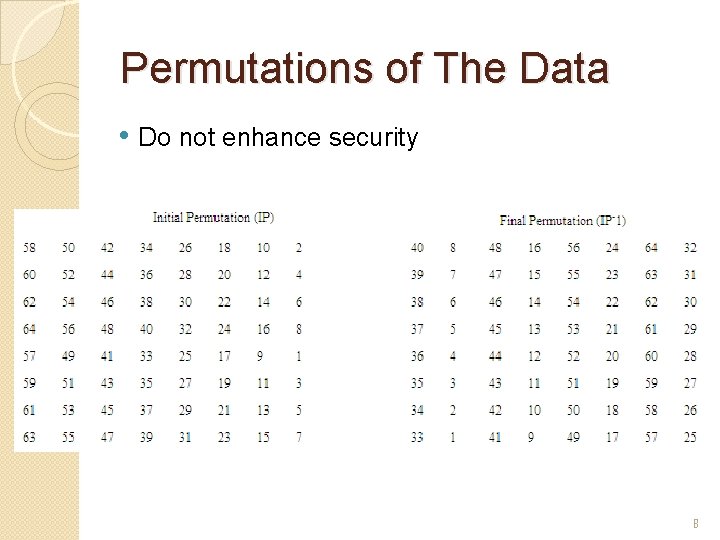
Permutations of The Data • Do not enhance security 8
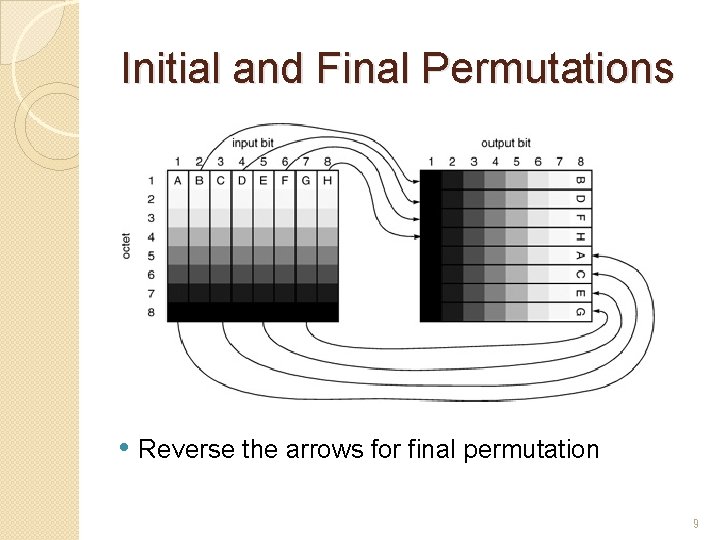
Initial and Final Permutations • Reverse the arrows for final permutation 9
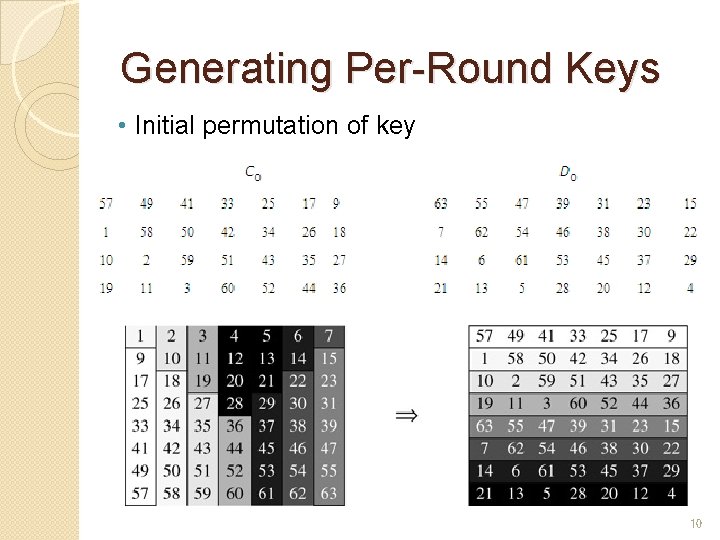
Generating Per-Round Keys • Initial permutation of key 10
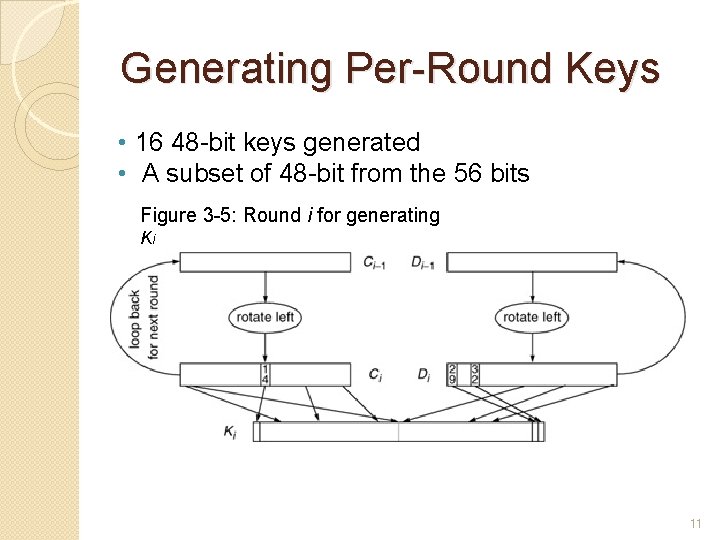
Generating Per-Round Keys • 16 48 -bit keys generated • A subset of 48 -bit from the 56 bits Figure 3 -5: Round i for generating Ki 11
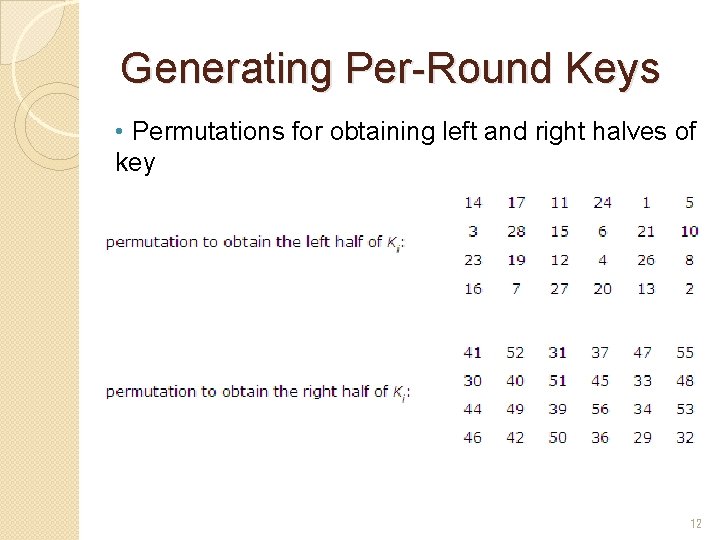
Generating Per-Round Keys • Permutations for obtaining left and right halves of key 12
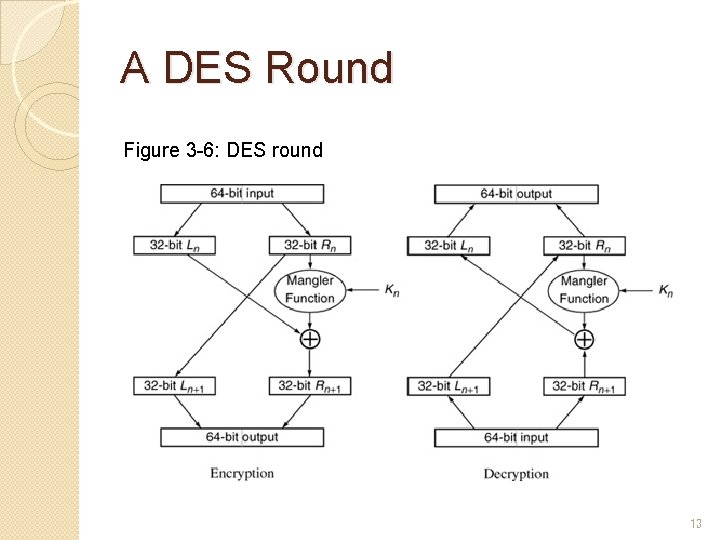
A DES Round Figure 3 -6: DES round 13
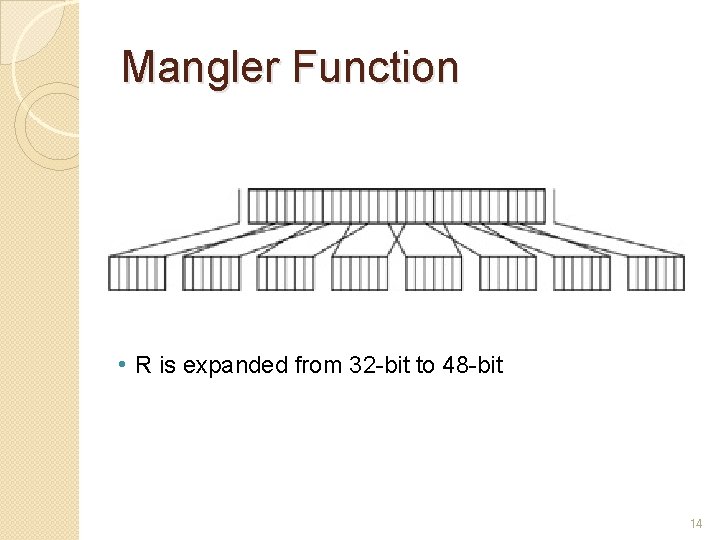
Mangler Function • R is expanded from 32 -bit to 48 -bit 14
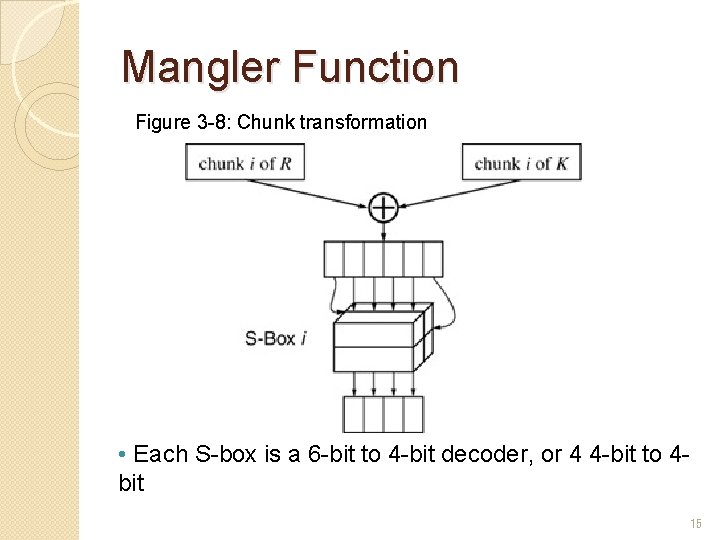
Mangler Function Figure 3 -8: Chunk transformation • Each S-box is a 6 -bit to 4 -bit decoder, or 4 4 -bit to 4 bit 15
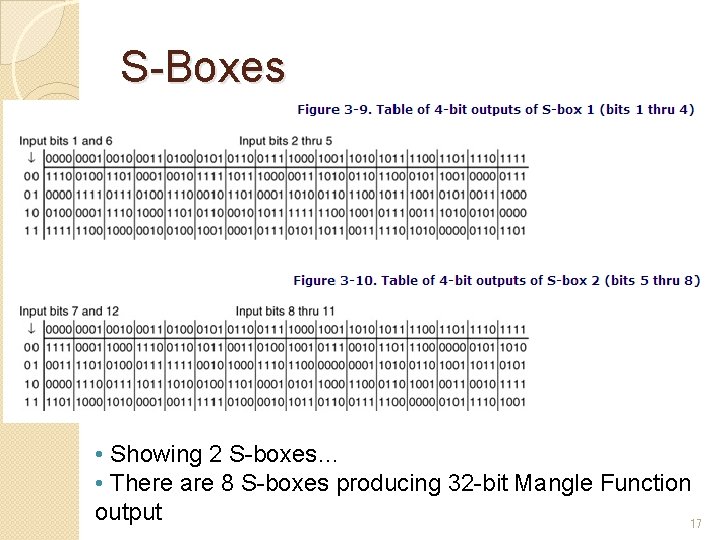
S-Box • A substitution which produces a 4 -bit output for each possible 6 -bit input • The 4 -bit output of each of the 8 S-boxes is combined into a 32 -bit quantity whose bits are then permuted • The permutation ensures: bits of the output of an Sbox on one round of DES affects the input of multiple S-boxes on the next round • Output bits of S-box should not be close to a linear function of input bits 16
S-Boxes • Showing 2 S-boxes… • There are 8 S-boxes producing 32 -bit Mangle Function output 17
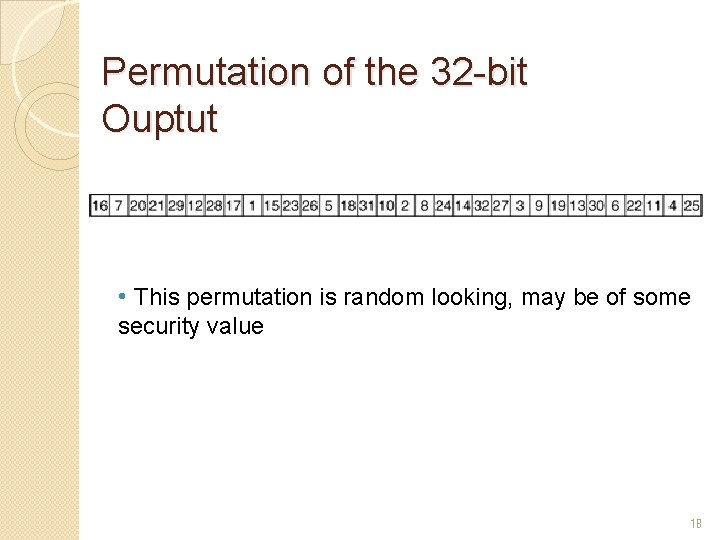
Permutation of the 32 -bit Ouptut • This permutation is random looking, may be of some security value 18
Design Parameters • Block size: larger block sizes mean greater security but reduced encryption/decryption speed for a given algorithm • Key size: larger key size means greater security but may decrease encryption/decryption speed • Number of rounds: multiple rounds offer increasing security, more is not better, sufficient is good enough • Key generation algorithm: greater complexity in this algorithm should lead to greater difficulty of cryptanalysis • Round function: greater complexity generally means greater resistance to cryptanalysis 19
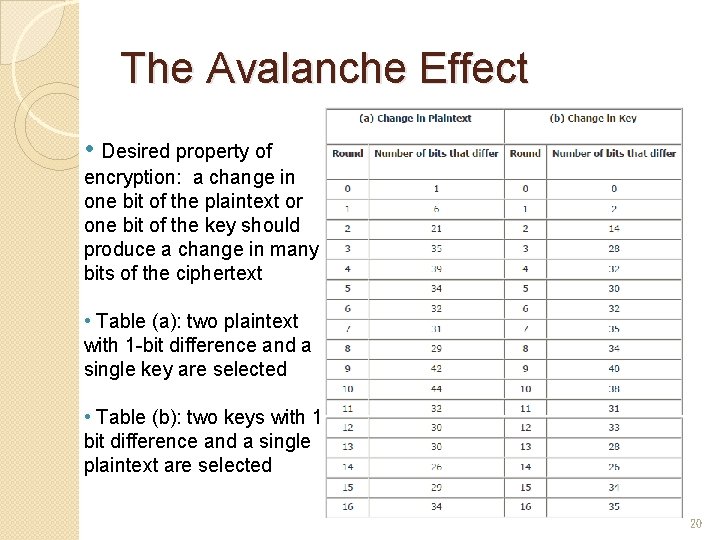
The Avalanche Effect • Desired property of encryption: a change in one bit of the plaintext or one bit of the key should produce a change in many bits of the ciphertext • Table (a): two plaintext with 1 -bit difference and a single key are selected • Table (b): two keys with 1 bit difference and a single plaintext are selected 20
Attacks on DES • Brute-force attack: 56 -bit key size not long enough • 4 weak and 12 semi-weak keys: when C 0 and D 0 are one of 4 values, 1111…, 0000…, 1010…, 0101… • Cryptanalysis by exploiting weakness in S-box design • Differential cryptanalysis: observe the behavior of pairs of text blocks evolving along each round of the cipher, can find a DES key given 247 chosen plaintexts • Linear cryptanalysis: finding linear approximations to describe the transformations performed in DES, can find a DES key given 243 known plaintexts • Timing attacks: information about the key or the plaintext is obtained by observing how long to decrypt various ciphertexts 21
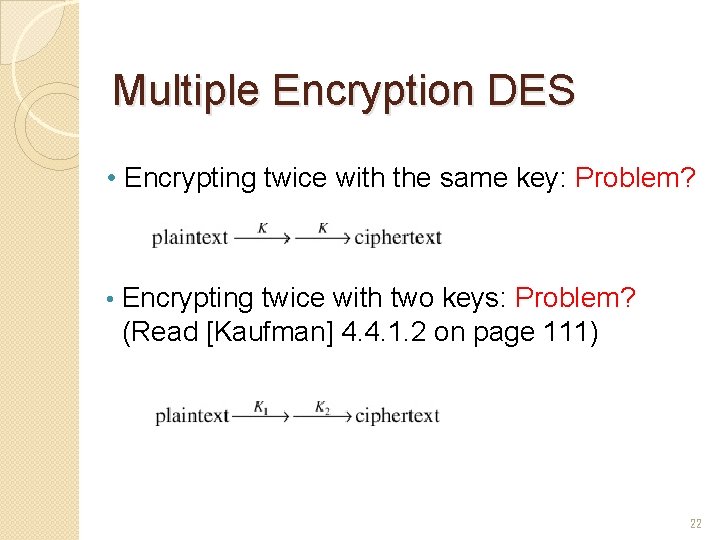
Multiple Encryption DES • Encrypting twice with the same key: Problem? • Encrypting twice with two keys: Problem? (Read [Kaufman] 4. 4. 1. 2 on page 111) 22
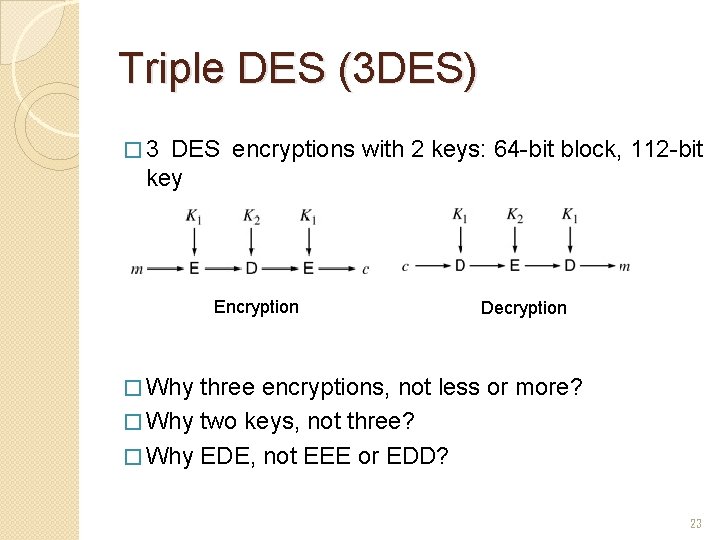
Triple DES (3 DES) � 3 DES encryptions with 2 keys: 64 -bit block, 112 -bit key Encryption Decryption � Why three encryptions, not less or more? � Why two keys, not three? � Why EDE, not EEE or EDD? 23
Other Block Ciphers �IDEA: International Data Encryption Algorithm, 64 -bit block, 128 -bit key �AES: Advanced Encryption Standard, 128 -bit block, 128/192/256 -bit key 24
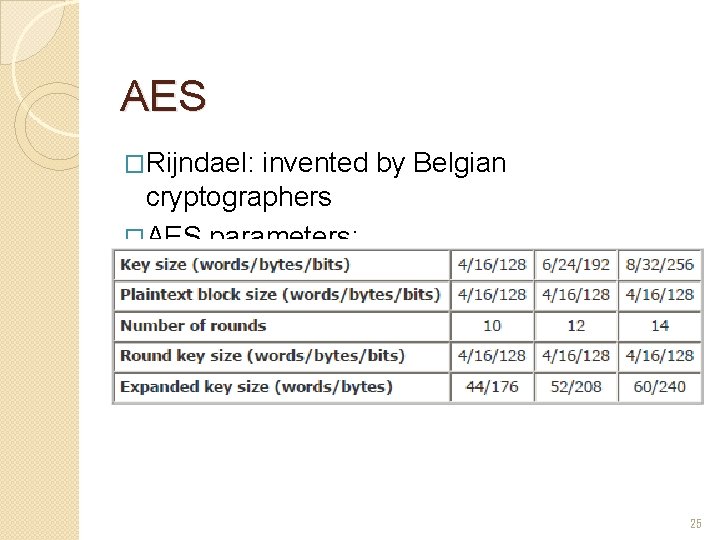
AES �Rijndael: invented by Belgian cryptographers �AES parameters: 25
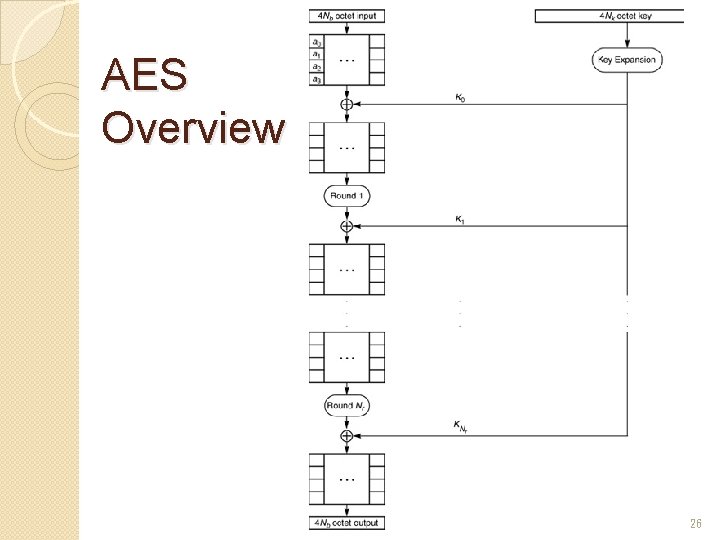
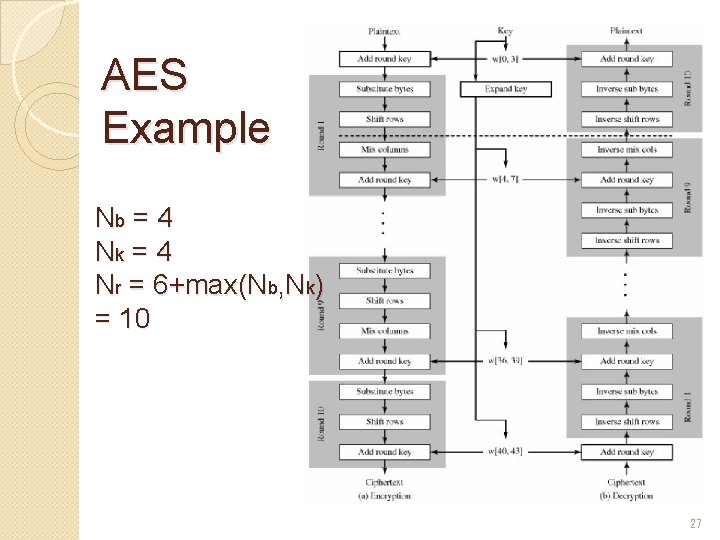
AES Overview 26
AES Example Nb = 4 Nk = 4 Nr = 6+max(Nb, Nk) = 10 27
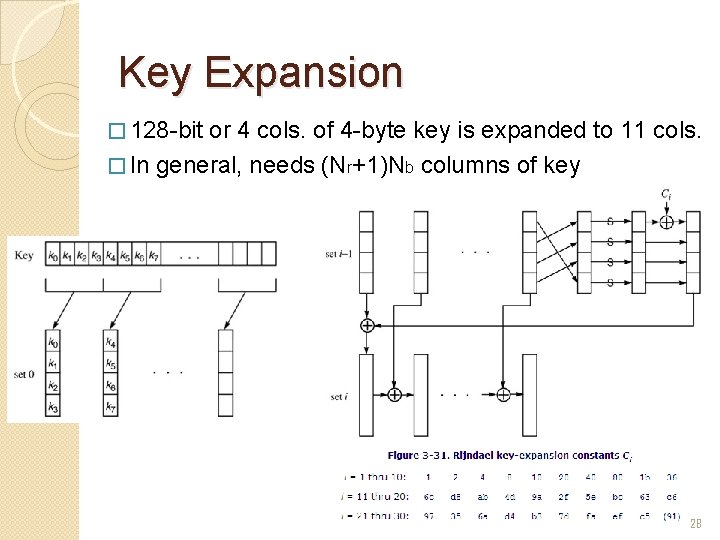
Key Expansion � 128 -bit or 4 cols. of 4 -byte key is expanded to 11 cols. � In general, needs (Nr+1)Nb columns of key 28
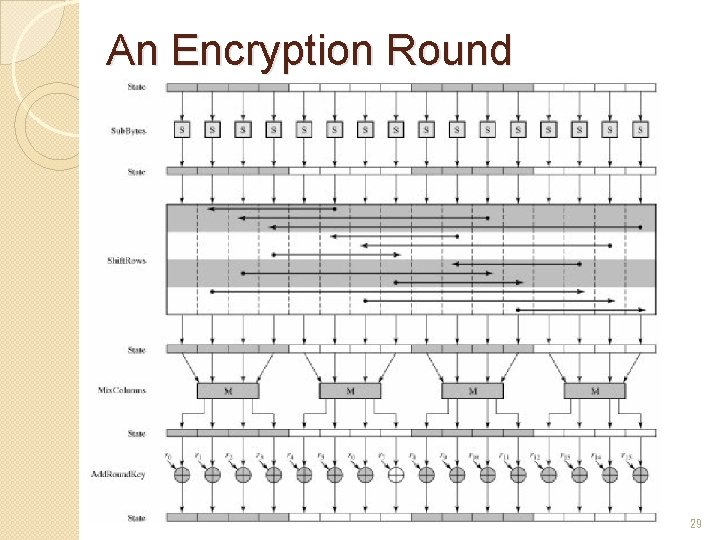
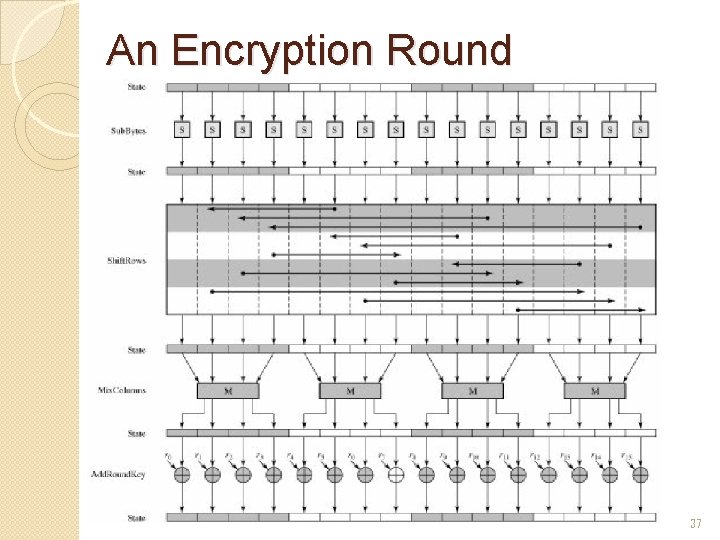
An Encryption Round 29
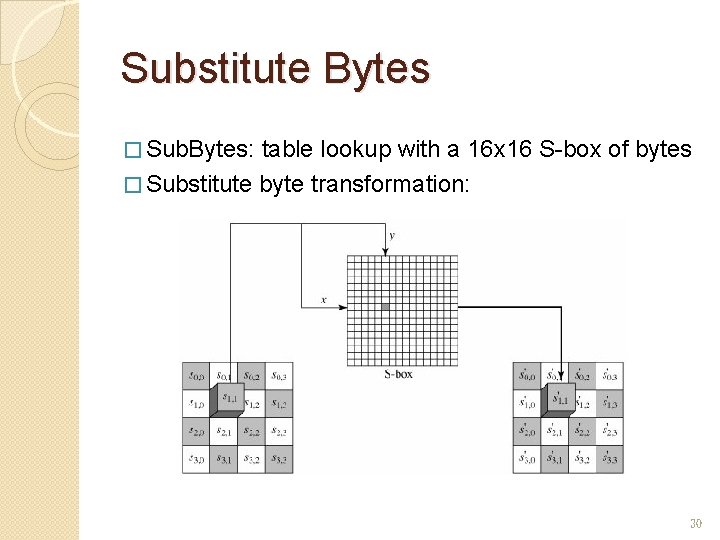
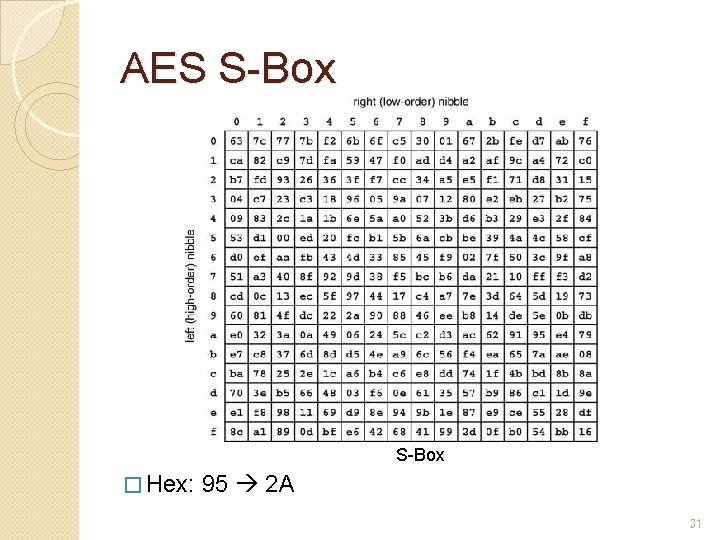
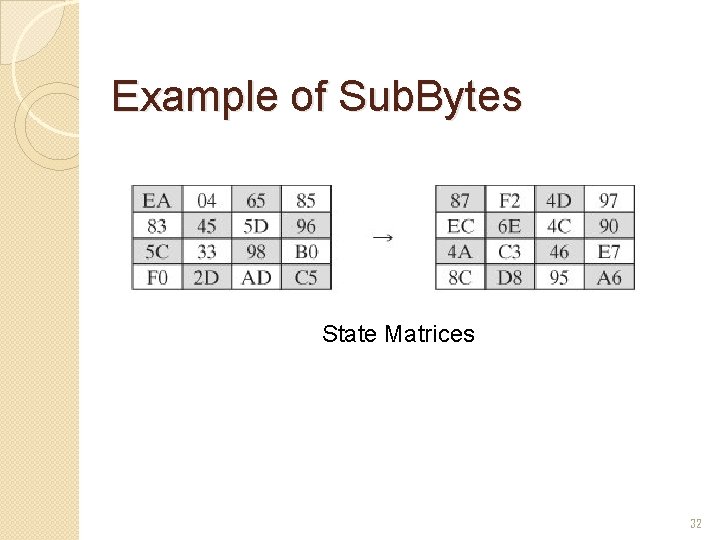
Substitute Bytes � Sub. Bytes: table lookup with a 16 x 16 S-box of bytes � Substitute byte transformation: 30
AES S-Box � Hex: 95 2 A 31
Example of Sub. Bytes State Matrices 32
An Encryption Round 33
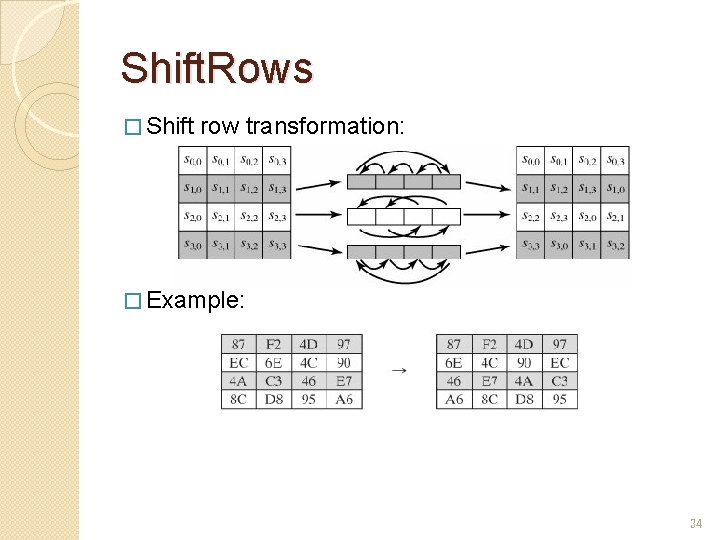
Shift. Rows � Shift row transformation: � Example: 34
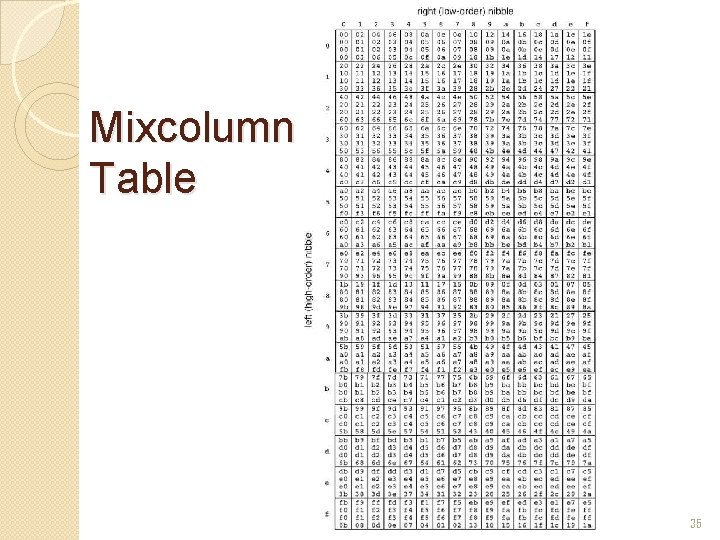
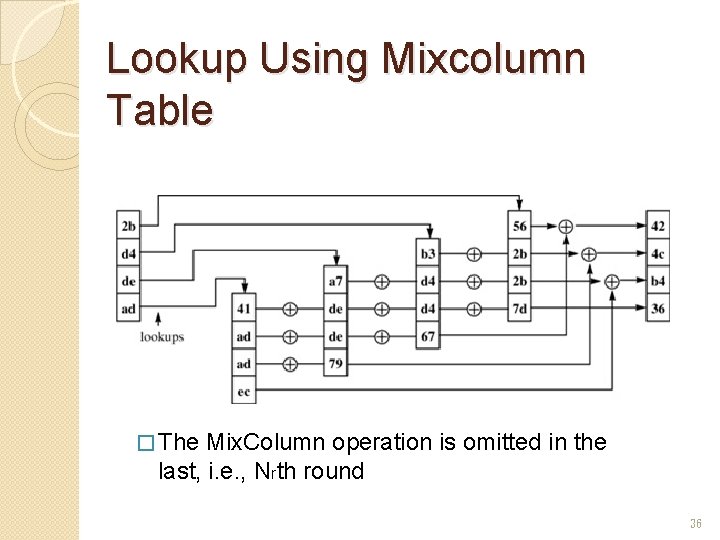
Mixcolumn Table 35
Lookup Using Mixcolumn Table � The Mix. Column operation is omitted in the last, i. e. , Nrth round 36
An Encryption Round 37
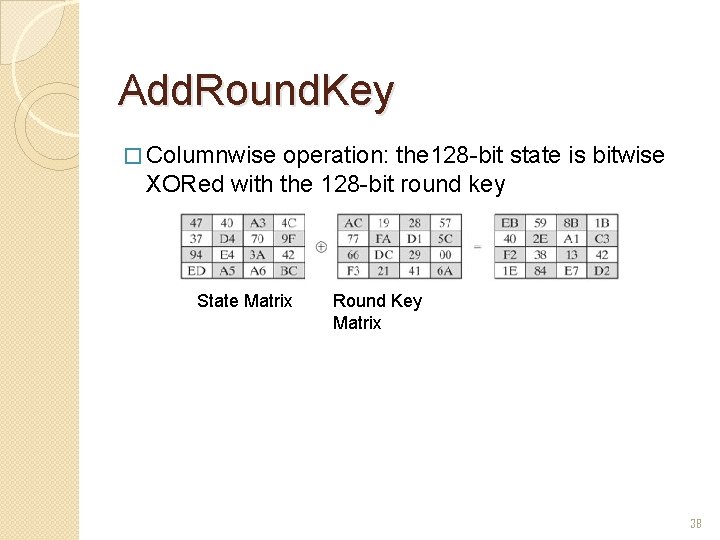
Add. Round. Key � Columnwise operation: the 128 -bit state is bitwise XORed with the 128 -bit round key State Matrix Round Key Matrix 38
Summary: Four Stages One permutation and three substitutions � Substitute bytes: uses an S-box to perform a byteby-byte substitution of the block � Shift. Rows: a simple permutation � Mix. Columns: a substitution that makes use of arithmetic over GF(28) � Add. Round. Key: a simple bitwise XOR of the current block with a portion of the expanded key � Each stage is easily reversible—decryption 39
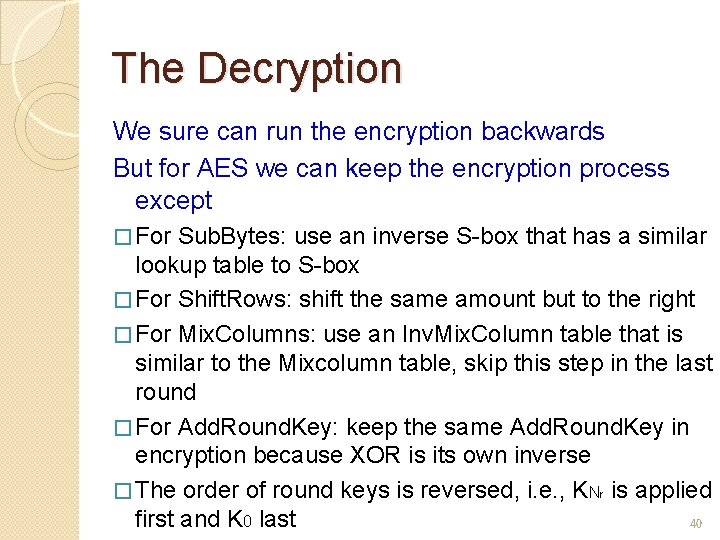
The Decryption We sure can run the encryption backwards But for AES we can keep the encryption process except � For Sub. Bytes: use an inverse S-box that has a similar lookup table to S-box � For Shift. Rows: shift the same amount but to the right � For Mix. Columns: use an Inv. Mix. Column table that is similar to the Mixcolumn table, skip this step in the last round � For Add. Round. Key: keep the same Add. Round. Key in encryption because XOR is its own inverse � The order of round keys is reversed, i. e. , KNr is applied first and K 0 last 40
Now We Have Every Piece of The Puzzle �Let’s work through an AES encryption on board… �Then verify the result using an AES calculator… 41
Strength of Rijndael �Resistant to brute-force attack �Resistant to differential and linear cryptanalysis 42
Reading Assignments �[Kaufman] Chapter 3, 4. 4, 8. 5 43