
ECE 450 Software Engineering II Today Risk ECE
- Slides: 13
ECE 450 – Software Engineering II Today: Risk ECE 450 - Software Engineering II 1
Risk • What is risk? – “The possibility of suffering loss” – Not inherently bad • Essential to progress! – The challenge is to manage the amount of risk ECE 450 - Software Engineering II 2
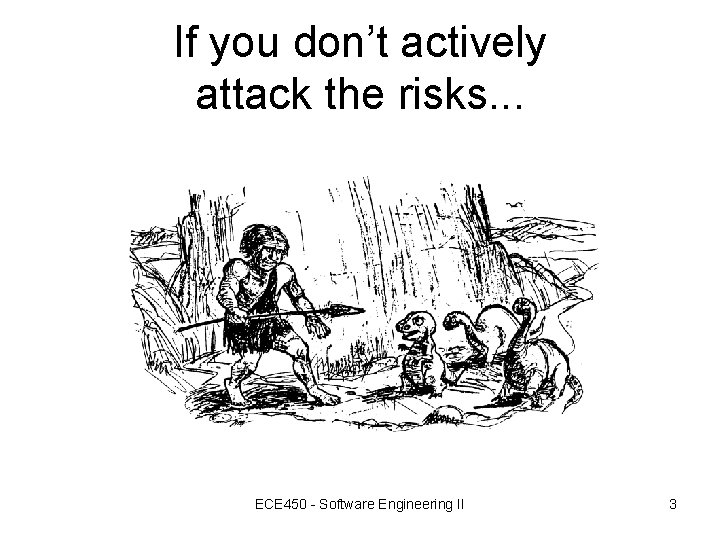
If you don’t actively attack the risks. . . ECE 450 - Software Engineering II 3
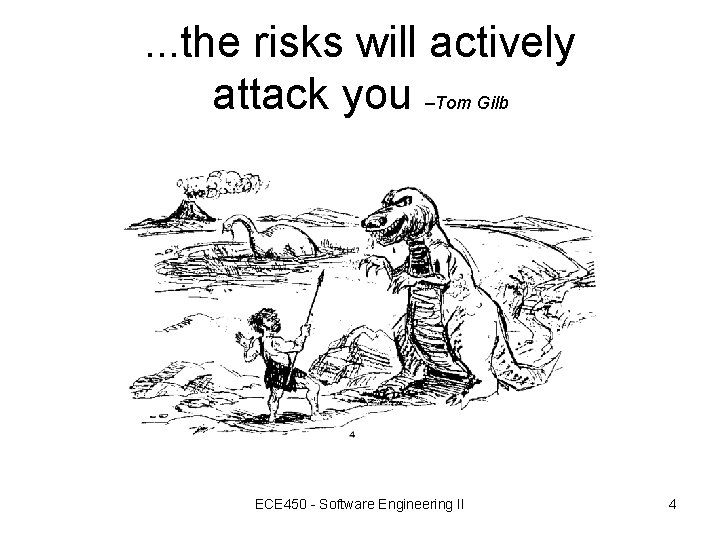
. . . the risks will actively attack you –Tom Gilb ECE 450 - Software Engineering II 4
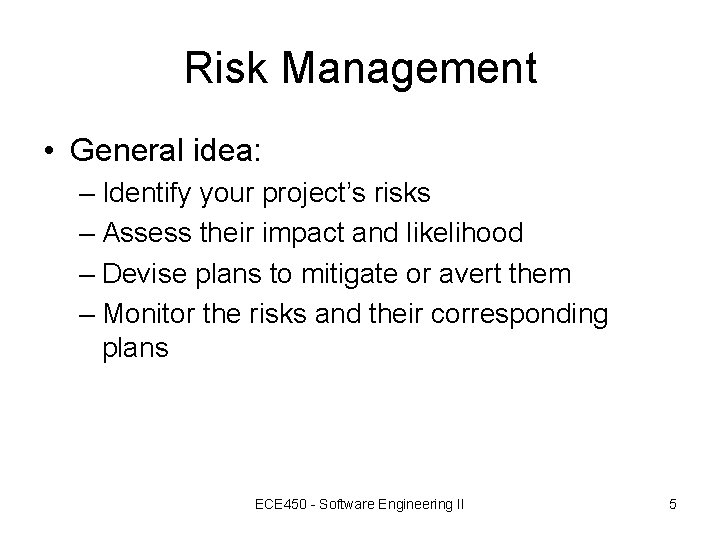
Risk Management • General idea: – Identify your project’s risks – Assess their impact and likelihood – Devise plans to mitigate or avert them – Monitor the risks and their corresponding plans ECE 450 - Software Engineering II 5
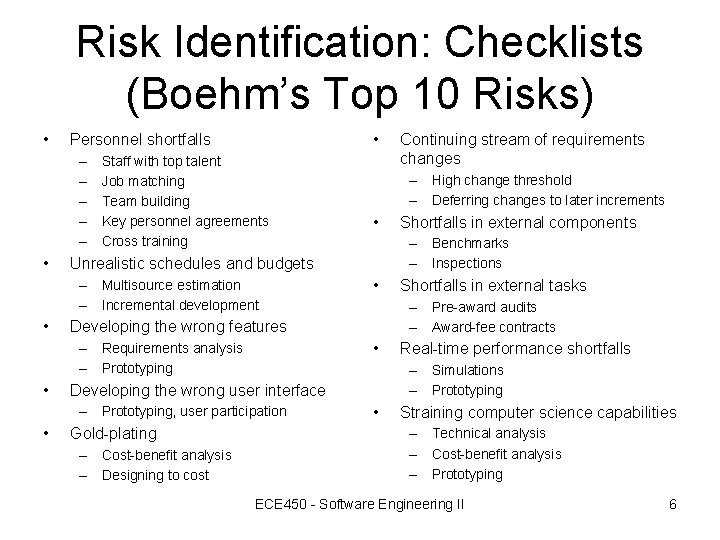
Risk Identification: Checklists (Boehm’s Top 10 Risks) • – – – • • Personnel shortfalls Staff with top talent Job matching Team building Key personnel agreements Cross training • • – Cost-benefit analysis – Designing to cost Shortfalls in external tasks – Pre-award audits – Award-fee contracts Real-time performance shortfalls – Simulations – Prototyping Developing the wrong user interface Gold-plating Shortfalls in external components – Benchmarks – Inspections • – Prototyping, user participation • • Developing the wrong features – Requirements analysis – Prototyping • – High change threshold – Deferring changes to later increments Unrealistic schedules and budgets – Multisource estimation – Incremental development Continuing stream of requirements changes • Straining computer science capabilities – Technical analysis – Cost-benefit analysis – Prototyping ECE 450 - Software Engineering II 6
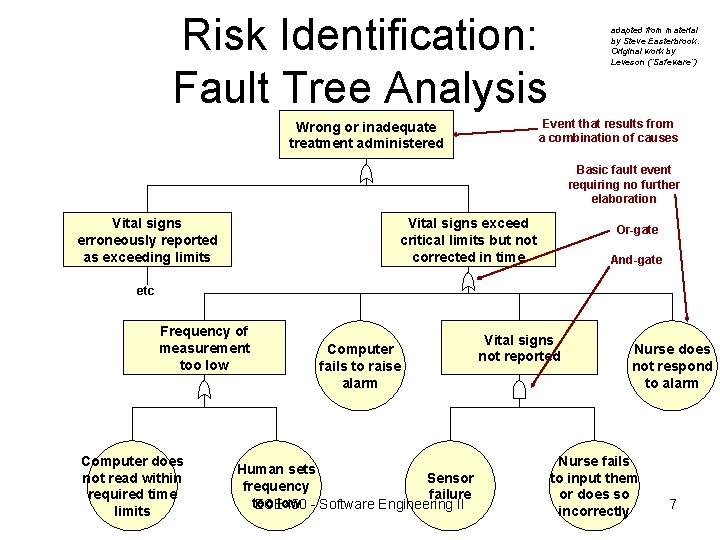
Risk Identification: Fault Tree Analysis adapted from material by Steve Easterbrook. Original work by Leveson (“Safeware”) Event that results from a combination of causes Wrong or inadequate treatment administered Basic fault event requiring no further elaboration Vital signs erroneously reported as exceeding limits Vital signs exceed critical limits but not corrected in time Or-gate And-gate etc Frequency of measurement too low Computer does not read within required time limits Computer fails to raise alarm Human sets Sensor frequency failure too low - Software Engineering II ECE 450 Vital signs not reported Nurse does not respond to alarm Nurse fails to input them or does so incorrectly 7
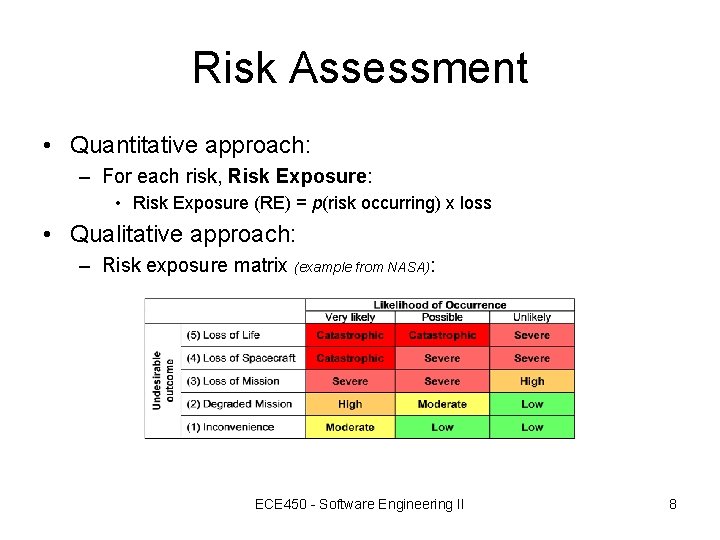
Risk Assessment • Quantitative approach: – For each risk, Risk Exposure: • Risk Exposure (RE) = p(risk occurring) x loss • Qualitative approach: – Risk exposure matrix (example from NASA): ECE 450 - Software Engineering II 8
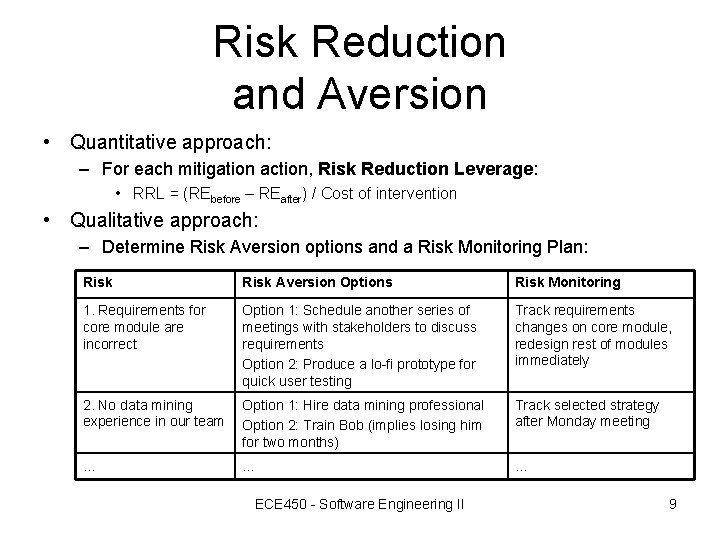
Risk Reduction and Aversion • Quantitative approach: – For each mitigation action, Risk Reduction Leverage: • RRL = (REbefore – REafter) / Cost of intervention • Qualitative approach: – Determine Risk Aversion options and a Risk Monitoring Plan: Risk Aversion Options Risk Monitoring 1. Requirements for core module are incorrect Option 1: Schedule another series of meetings with stakeholders to discuss requirements Option 2: Produce a lo-fi prototype for quick user testing Track requirements changes on core module, redesign rest of modules immediately 2. No data mining experience in our team Option 1: Hire data mining professional Option 2: Train Bob (implies losing him for two months) Track selected strategy after Monday meeting . . ECE 450 - Software Engineering II 9
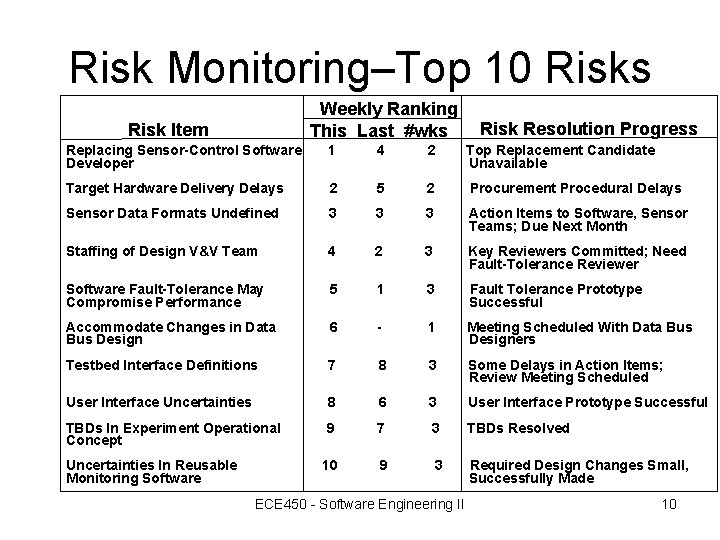
Risk Monitoring–Top 10 Risks Weekly Ranking This Last #wks Risk Item Risk Resolution Progress Replacing Sensor-Control Software Developer 1 4 2 Top Replacement Candidate Unavailable Target Hardware Delivery Delays 2 5 2 Procurement Procedural Delays Sensor Data Formats Undefined 3 3 3 Action Items to Software, Sensor Teams; Due Next Month Staffing of Design V&V Team 4 2 3 Key Reviewers Committed; Need Fault-Tolerance Reviewer Software Fault-Tolerance May Compromise Performance 5 1 3 Fault Tolerance Prototype Successful Accommodate Changes in Data Bus Design 6 - 1 Meeting Scheduled With Data Bus Designers Testbed Interface Definitions 7 8 3 Some Delays in Action Items; Review Meeting Scheduled User Interface Uncertainties 8 6 3 User Interface Prototype Successful TBDs In Experiment Operational Concept 9 7 3 TBDs Resolved 10 9 3 Required Design Changes Small, Successfully Made Uncertainties In Reusable Monitoring Software ECE 450 - Software Engineering II 10
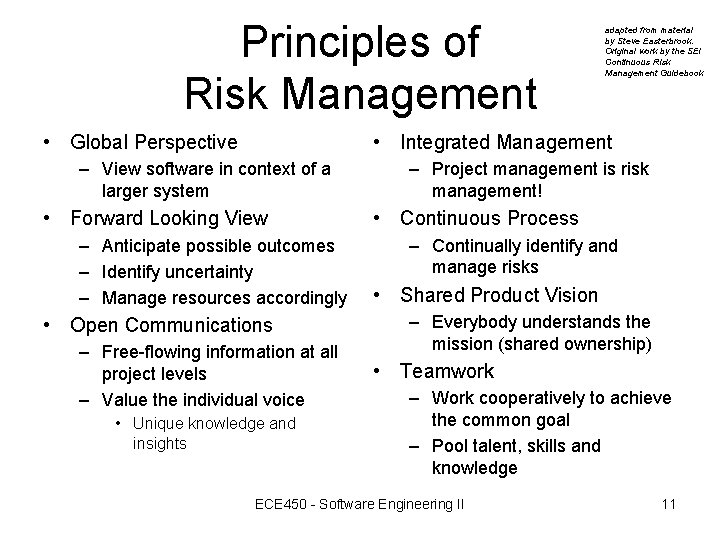
Principles of Risk Management • Global Perspective adapted from material by Steve Easterbrook. Original work by the SEI Continuous Risk Management Guidebook • Integrated Management – View software in context of a larger system • Forward Looking View – Anticipate possible outcomes – Identify uncertainty – Manage resources accordingly • Open Communications – Free-flowing information at all project levels – Value the individual voice • Unique knowledge and insights – Project management is risk management! • Continuous Process – Continually identify and manage risks • Shared Product Vision – Everybody understands the mission (shared ownership) • Teamwork – Work cooperatively to achieve the common goal – Pool talent, skills and knowledge ECE 450 - Software Engineering II 11
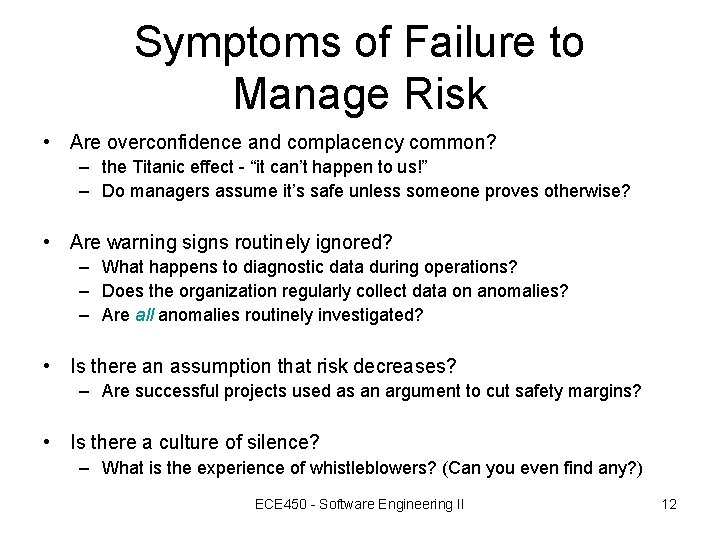
Symptoms of Failure to Manage Risk • Are overconfidence and complacency common? – the Titanic effect - “it can’t happen to us!” – Do managers assume it’s safe unless someone proves otherwise? • Are warning signs routinely ignored? – What happens to diagnostic data during operations? – Does the organization regularly collect data on anomalies? – Are all anomalies routinely investigated? • Is there an assumption that risk decreases? – Are successful projects used as an argument to cut safety margins? • Is there a culture of silence? – What is the experience of whistleblowers? (Can you even find any? ) ECE 450 - Software Engineering II 12
Do PMs manage risk? • Unfortunately, not in most companies – Pity them – They usually do when developing mission-critical systems • Or when a lot of money is at stake • One of the simplest techniques to apply, with great payoff – Takes a few minutes each week – Saves major headaches down the road – Bottom line: No excuse not to do it! ECE 450 - Software Engineering II 13