
ECE 434 Advanced Digital System L 9 Electrical
- Slides: 42
ECE 434 Advanced Digital System L 9 Electrical and Computer Engineering University of Western Ontario
Outline • What we know – Design of Combinational and Sequential Networks – VHDL description of combinational networks – VHDL processes – description of sequential networks • What we do not know – How to use VHDL for design, simulation/verification, and synthesis 10/29/2020 2
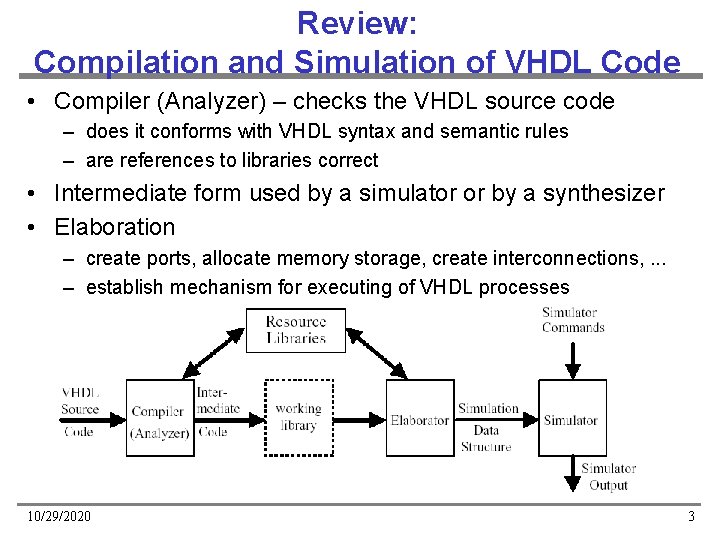
Review: Compilation and Simulation of VHDL Code • Compiler (Analyzer) – checks the VHDL source code – does it conforms with VHDL syntax and semantic rules – are references to libraries correct • Intermediate form used by a simulator or by a synthesizer • Elaboration – create ports, allocate memory storage, create interconnections, . . . – establish mechanism for executing of VHDL processes 10/29/2020 3
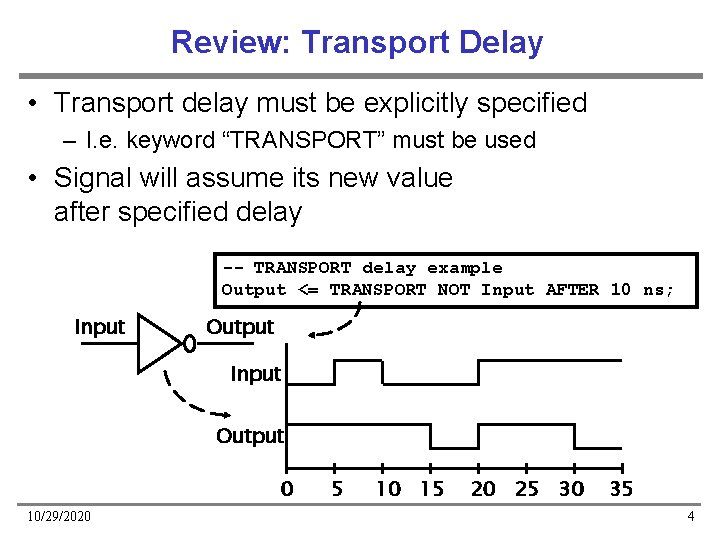
Review: Transport Delay • Transport delay must be explicitly specified – I. e. keyword “TRANSPORT” must be used • Signal will assume its new value after specified delay -- TRANSPORT delay example Output <= TRANSPORT NOT Input AFTER 10 ns; Input Output 0 10/29/2020 5 10 15 20 25 30 35 4
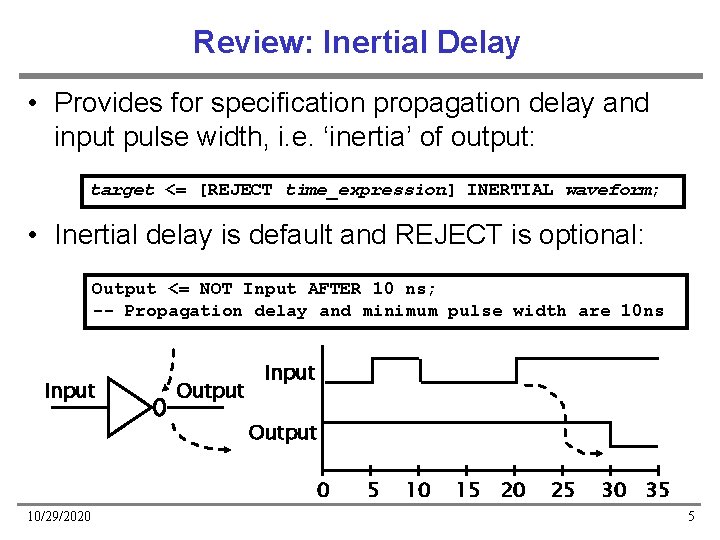
Review: Inertial Delay • Provides for specification propagation delay and input pulse width, i. e. ‘inertia’ of output: target <= [REJECT time_expression] INERTIAL waveform; • Inertial delay is default and REJECT is optional: Output <= NOT Input AFTER 10 ns; -- Propagation delay and minimum pulse width are 10 ns Input Output 0 10/29/2020 5 10 15 20 25 30 35 5
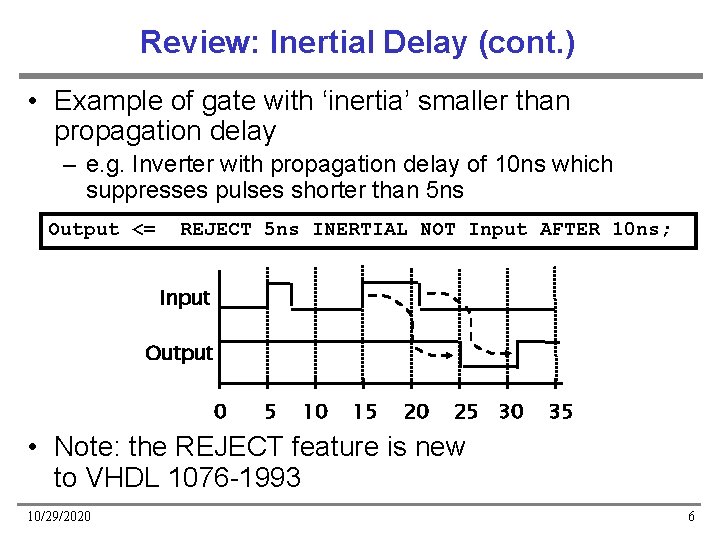
Review: Inertial Delay (cont. ) • Example of gate with ‘inertia’ smaller than propagation delay – e. g. Inverter with propagation delay of 10 ns which suppresses pulses shorter than 5 ns Output <= REJECT 5 ns INERTIAL NOT Input AFTER 10 ns; Input Output 0 5 10 15 20 25 30 35 • Note: the REJECT feature is new to VHDL 1076 -1993 10/29/2020 6
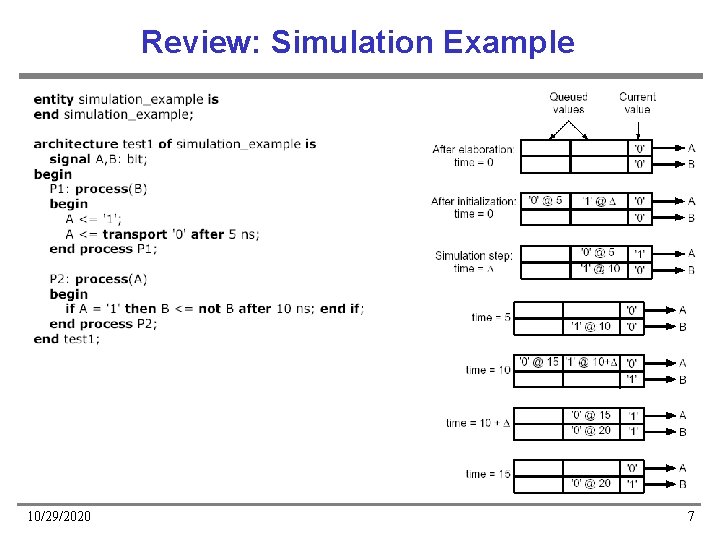
Review: Simulation Example 10/29/2020 7
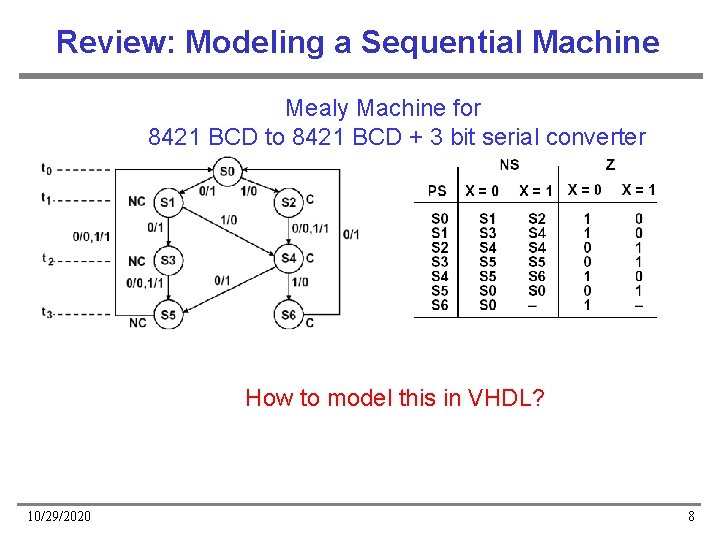
Review: Modeling a Sequential Machine Mealy Machine for 8421 BCD to 8421 BCD + 3 bit serial converter How to model this in VHDL? 10/29/2020 8
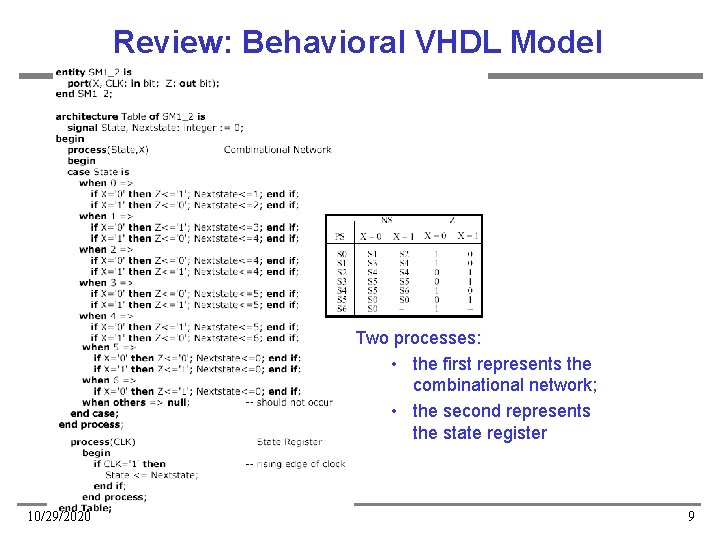
Review: Behavioral VHDL Model Two processes: • the first represents the combinational network; • the second represents the state register 10/29/2020 9
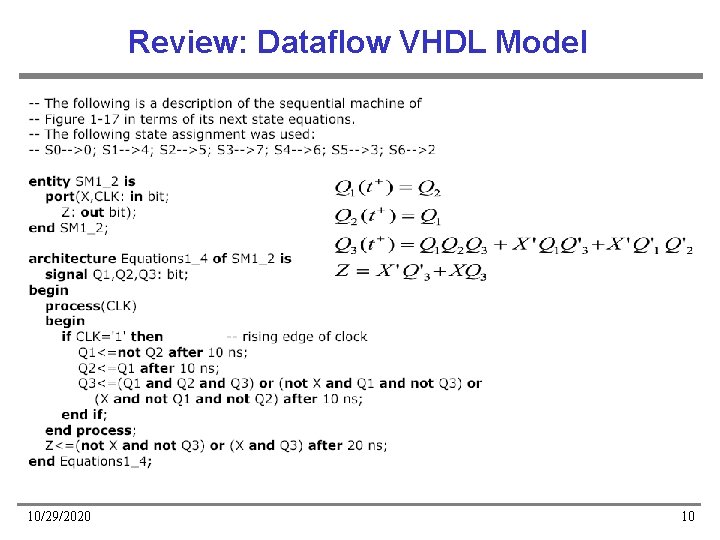
Review: Dataflow VHDL Model 10/29/2020 10
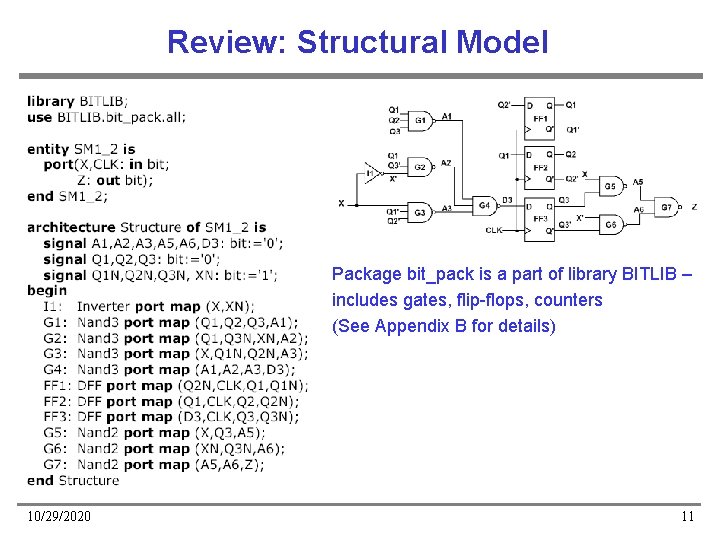
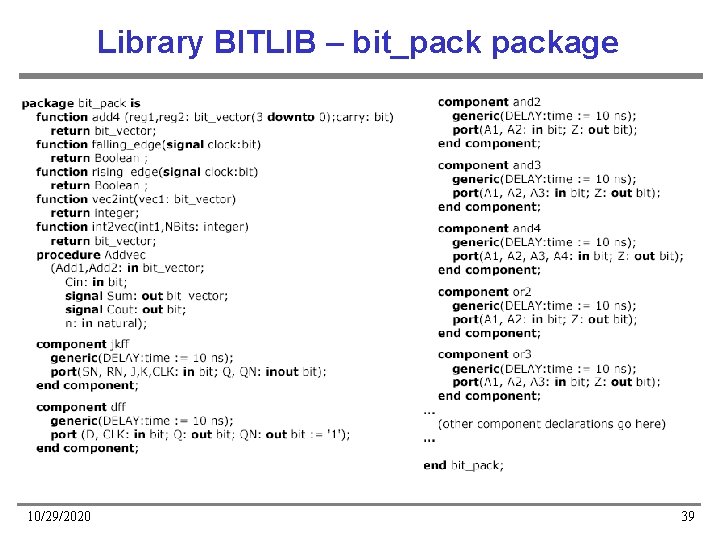
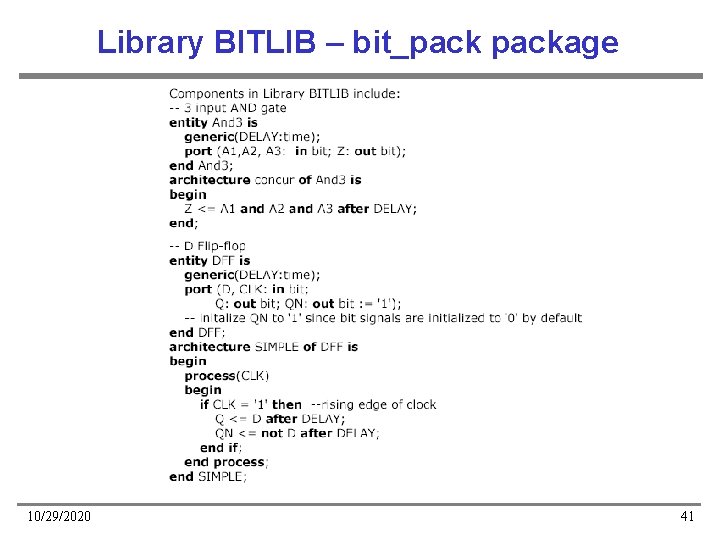
Review: Structural Model Package bit_pack is a part of library BITLIB – includes gates, flip-flops, counters (See Appendix B for details) 10/29/2020 11
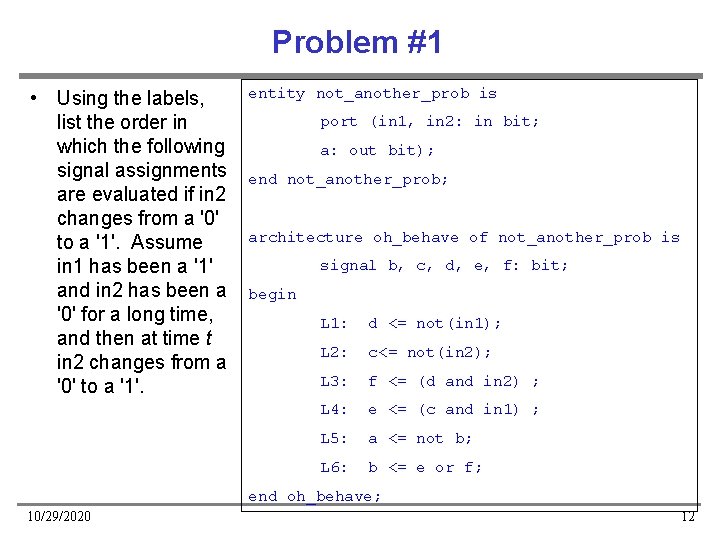
Problem #1 • Using the labels, list the order in which the following signal assignments are evaluated if in 2 changes from a '0' to a '1'. Assume in 1 has been a '1' and in 2 has been a '0' for a long time, and then at time t in 2 changes from a '0' to a '1'. entity not_another_prob is port (in 1, in 2: in bit; a: out bit); end not_another_prob; architecture oh_behave of not_another_prob is signal b, c, d, e, f: bit; begin L 1: d <= not(in 1); L 2: c<= not(in 2); L 3: f <= (d and in 2) ; L 4: e <= (c and in 1) ; L 5: a <= not b; L 6: b <= e or f; end oh_behave; 10/29/2020 12
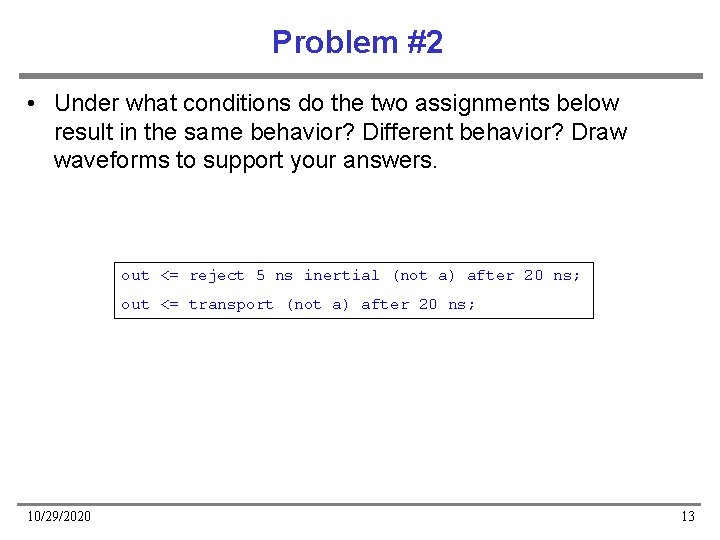
Problem #2 • Under what conditions do the two assignments below result in the same behavior? Different behavior? Draw waveforms to support your answers. out <= reject 5 ns inertial (not a) after 20 ns; out <= transport (not a) after 20 ns; 10/29/2020 13
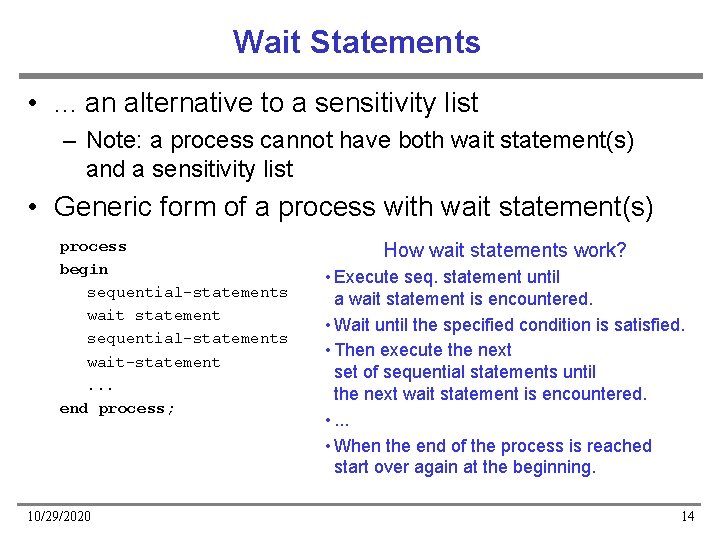
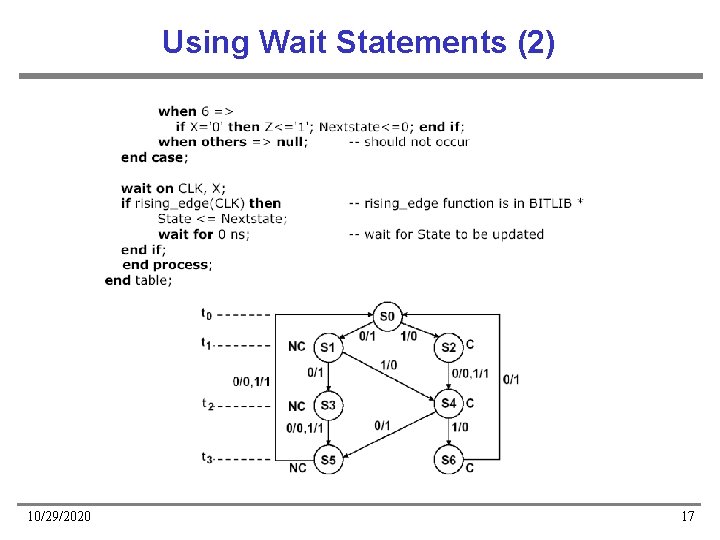
Wait Statements • . . . an alternative to a sensitivity list – Note: a process cannot have both wait statement(s) and a sensitivity list • Generic form of a process with wait statement(s) process begin sequential-statements wait statement sequential-statements wait-statement. . . end process; 10/29/2020 How wait statements work? • Execute seq. statement until a wait statement is encountered. • Wait until the specified condition is satisfied. • Then execute the next set of sequential statements until the next wait statement is encountered. • . . . • When the end of the process is reached start over again at the beginning. 14
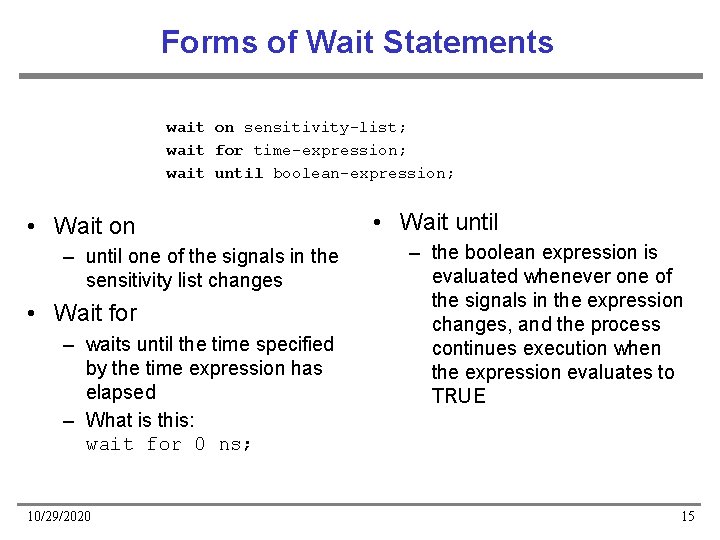
Forms of Wait Statements wait on sensitivity-list; wait for time-expression; wait until boolean-expression; • Wait on – until one of the signals in the sensitivity list changes • Wait for – waits until the time specified by the time expression has elapsed – What is this: wait for 0 ns; 10/29/2020 • Wait until – the boolean expression is evaluated whenever one of the signals in the expression changes, and the process continues execution when the expression evaluates to TRUE 15
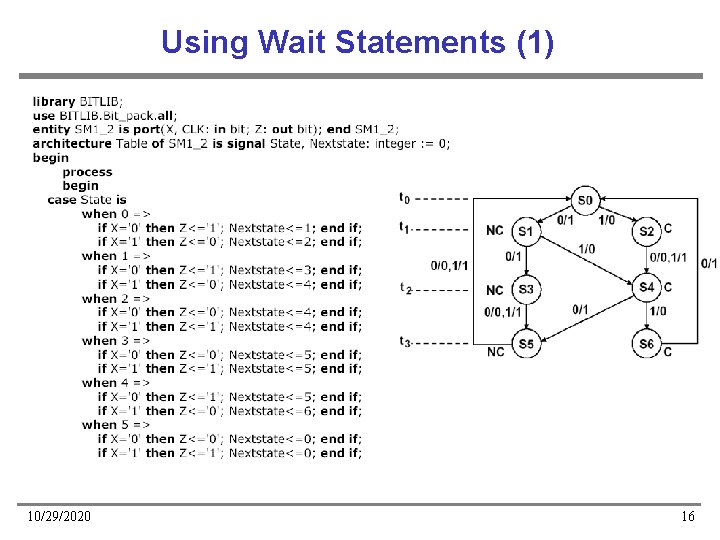
Using Wait Statements (1) 10/29/2020 16
Using Wait Statements (2) 10/29/2020 17
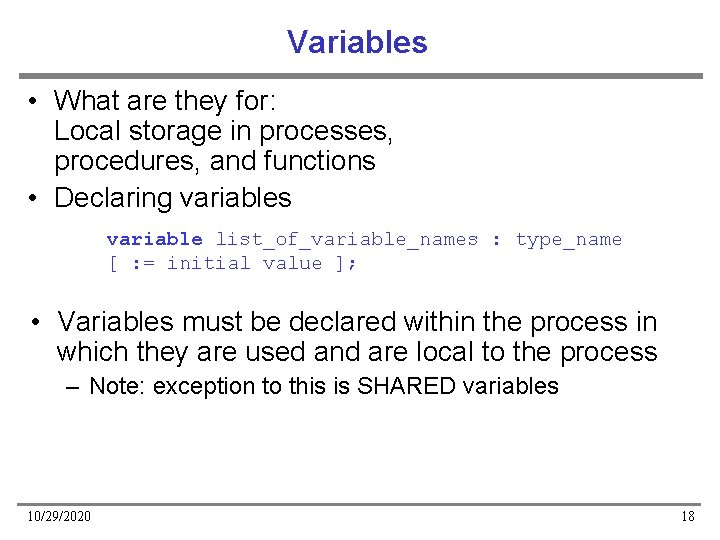
Variables • What are they for: Local storage in processes, procedures, and functions • Declaring variables variable list_of_variable_names : type_name [ : = initial value ]; • Variables must be declared within the process in which they are used and are local to the process – Note: exception to this is SHARED variables 10/29/2020 18
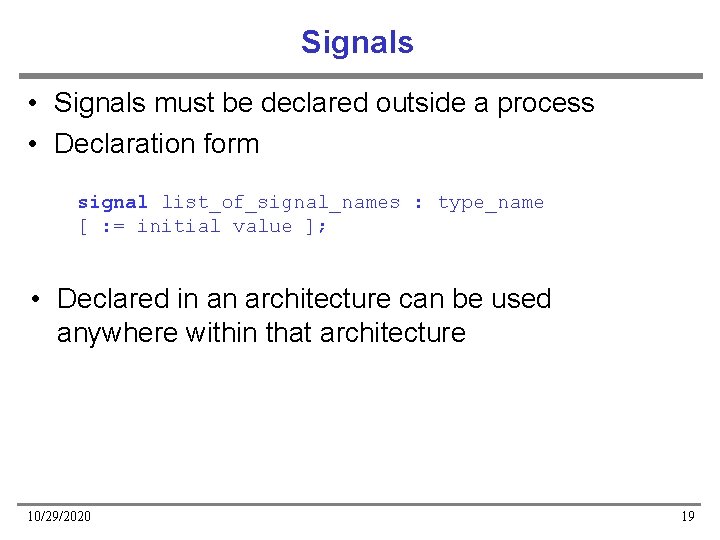
Signals • Signals must be declared outside a process • Declaration form signal list_of_signal_names : type_name [ : = initial value ]; • Declared in an architecture can be used anywhere within that architecture 10/29/2020 19
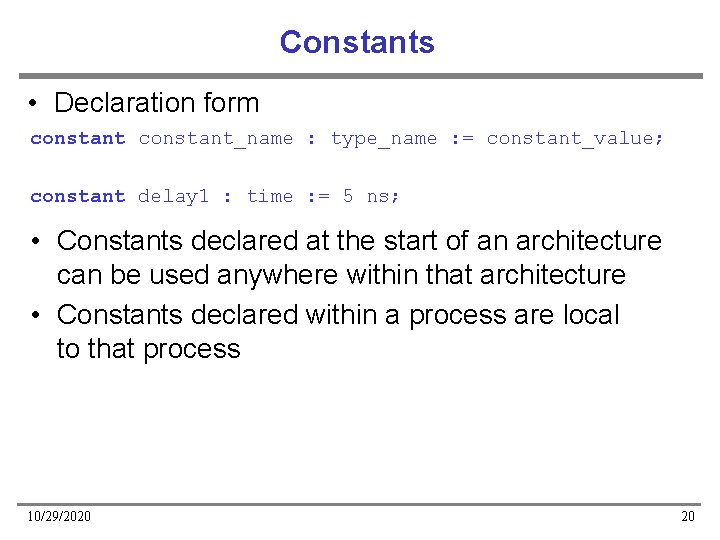
Constants • Declaration form constant_name : type_name : = constant_value; constant delay 1 : time : = 5 ns; • Constants declared at the start of an architecture can be used anywhere within that architecture • Constants declared within a process are local to that process 10/29/2020 20
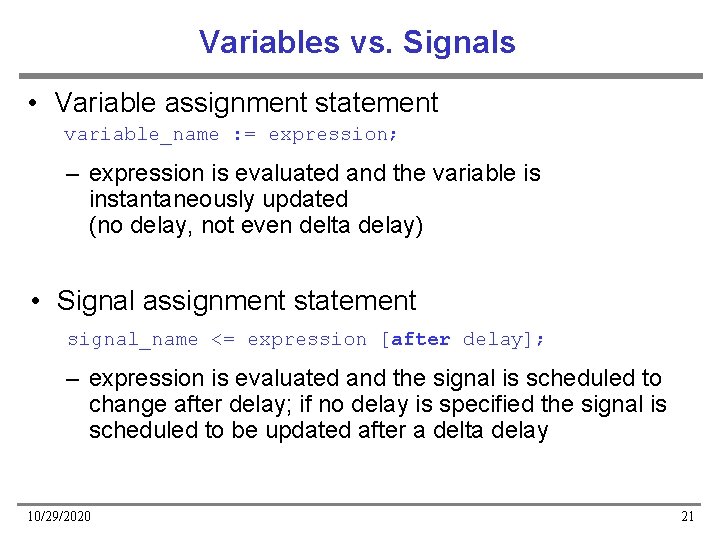
Variables vs. Signals • Variable assignment statement variable_name : = expression; – expression is evaluated and the variable is instantaneously updated (no delay, not even delta delay) • Signal assignment statement signal_name <= expression [after delay]; – expression is evaluated and the signal is scheduled to change after delay; if no delay is specified the signal is scheduled to be updated after a delta delay 10/29/2020 21
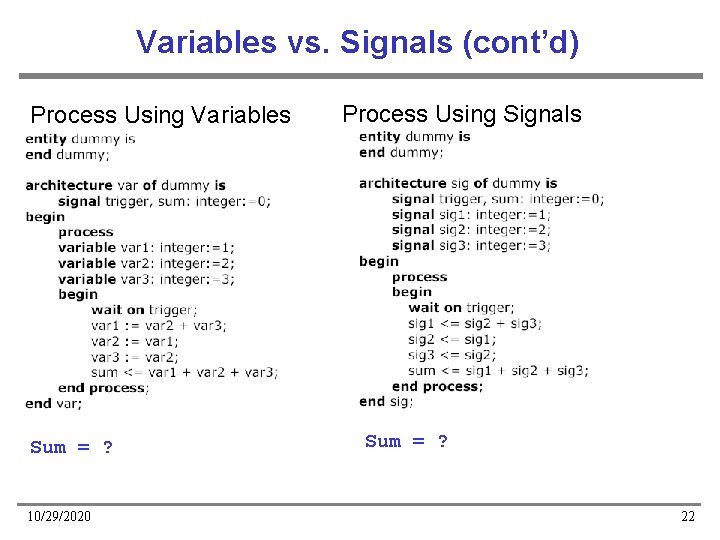
Variables vs. Signals (cont’d) Process Using Variables Sum = ? 10/29/2020 Process Using Signals Sum = ? 22
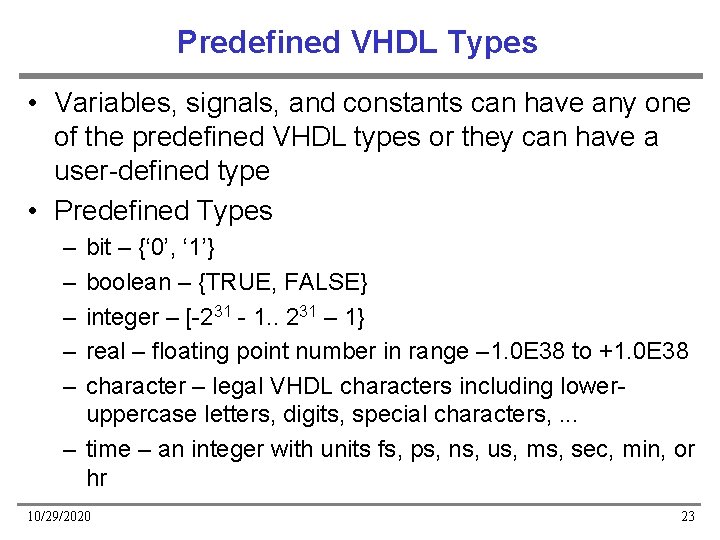
Predefined VHDL Types • Variables, signals, and constants can have any one of the predefined VHDL types or they can have a user-defined type • Predefined Types – – – bit – {‘ 0’, ‘ 1’} boolean – {TRUE, FALSE} integer – [-231 - 1. . 231 – 1} real – floating point number in range – 1. 0 E 38 to +1. 0 E 38 character – legal VHDL characters including loweruppercase letters, digits, special characters, . . . – time – an integer with units fs, ps, ns, us, ms, sec, min, or hr 10/29/2020 23
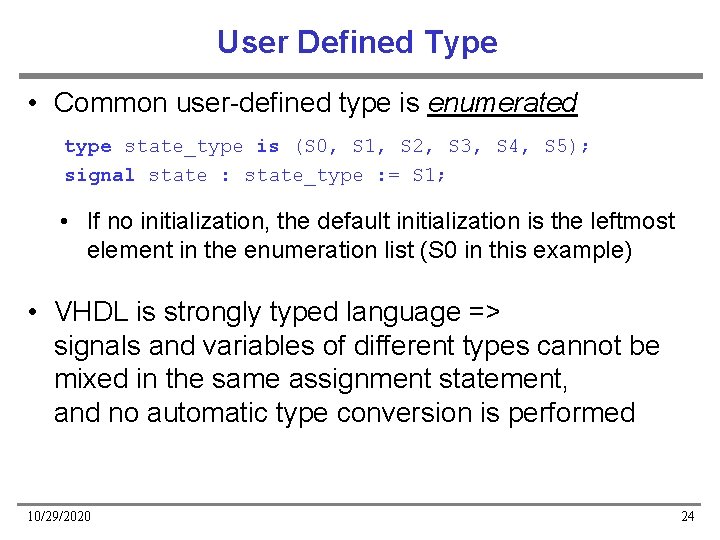
User Defined Type • Common user-defined type is enumerated type state_type is (S 0, S 1, S 2, S 3, S 4, S 5); signal state : state_type : = S 1; • If no initialization, the default initialization is the leftmost element in the enumeration list (S 0 in this example) • VHDL is strongly typed language => signals and variables of different types cannot be mixed in the same assignment statement, and no automatic type conversion is performed 10/29/2020 24
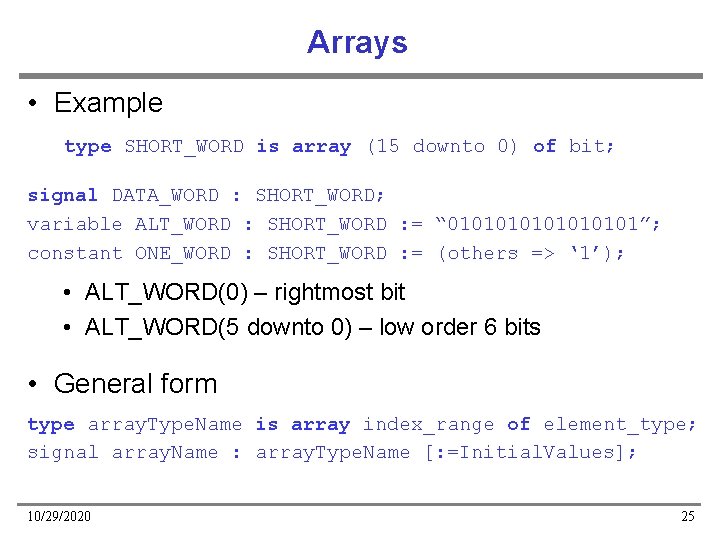
Arrays • Example type SHORT_WORD is array (15 downto 0) of bit; signal DATA_WORD : SHORT_WORD; variable ALT_WORD : SHORT_WORD : = “ 01010101”; constant ONE_WORD : SHORT_WORD : = (others => ‘ 1’); • ALT_WORD(0) – rightmost bit • ALT_WORD(5 downto 0) – low order 6 bits • General form type array. Type. Name is array index_range of element_type; signal array. Name : array. Type. Name [: =Initial. Values]; 10/29/2020 25
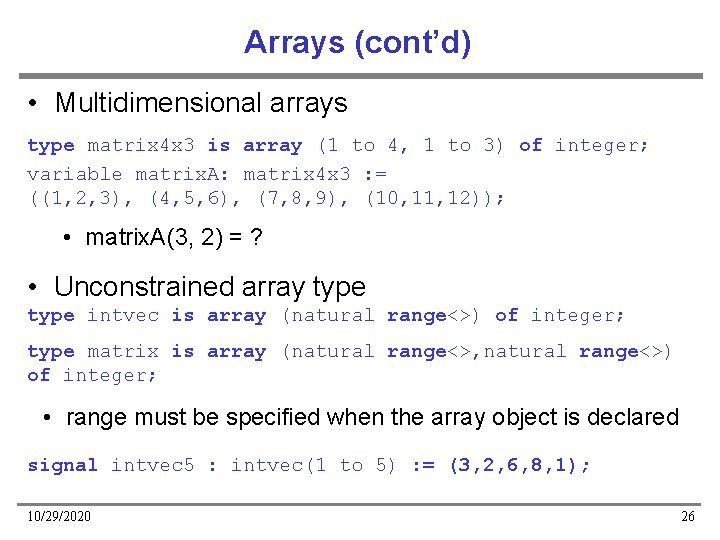
Arrays (cont’d) • Multidimensional arrays type matrix 4 x 3 is array (1 to 4, 1 to 3) of integer; variable matrix. A: matrix 4 x 3 : = ((1, 2, 3), (4, 5, 6), (7, 8, 9), (10, 11, 12)); • matrix. A(3, 2) = ? • Unconstrained array type intvec is array (natural range<>) of integer; type matrix is array (natural range<>, natural range<>) of integer; • range must be specified when the array object is declared signal intvec 5 : intvec(1 to 5) : = (3, 2, 6, 8, 1); 10/29/2020 26
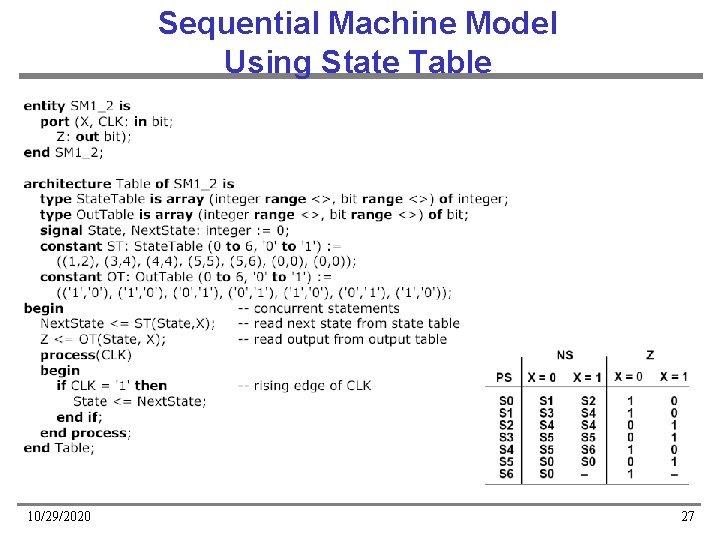
Sequential Machine Model Using State Table 10/29/2020 27
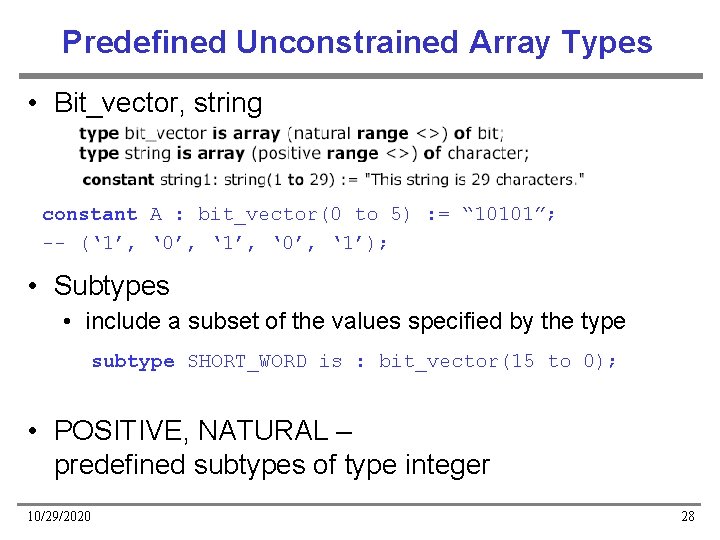
Predefined Unconstrained Array Types • Bit_vector, string constant A : bit_vector(0 to 5) : = “ 10101”; -- (‘ 1’, ‘ 0’, ‘ 1’); • Subtypes • include a subset of the values specified by the type subtype SHORT_WORD is : bit_vector(15 to 0); • POSITIVE, NATURAL – predefined subtypes of type integer 10/29/2020 28
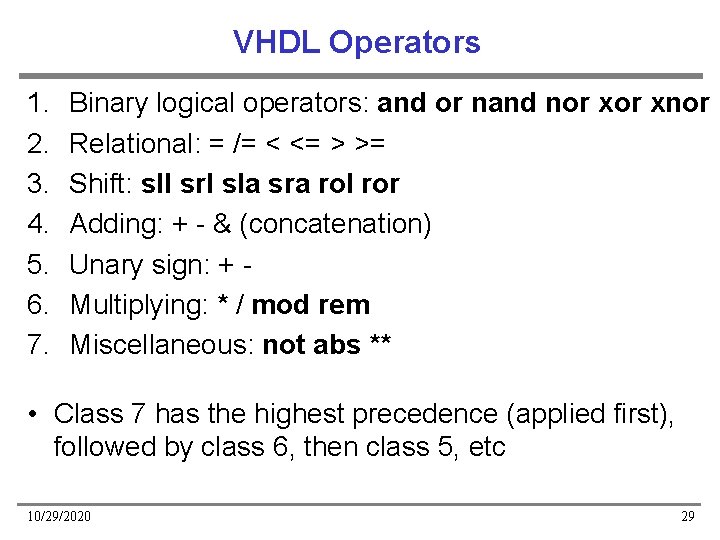
VHDL Operators 1. 2. 3. 4. 5. 6. 7. Binary logical operators: and or nand nor xnor Relational: = /= < <= > >= Shift: sll srl sla sra rol ror Adding: + - & (concatenation) Unary sign: + Multiplying: * / mod rem Miscellaneous: not abs ** • Class 7 has the highest precedence (applied first), followed by class 6, then class 5, etc 10/29/2020 29
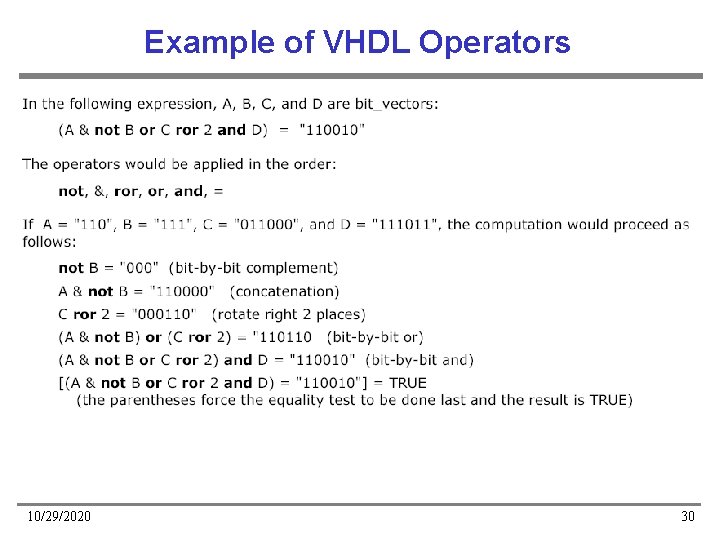
Example of VHDL Operators 10/29/2020 30
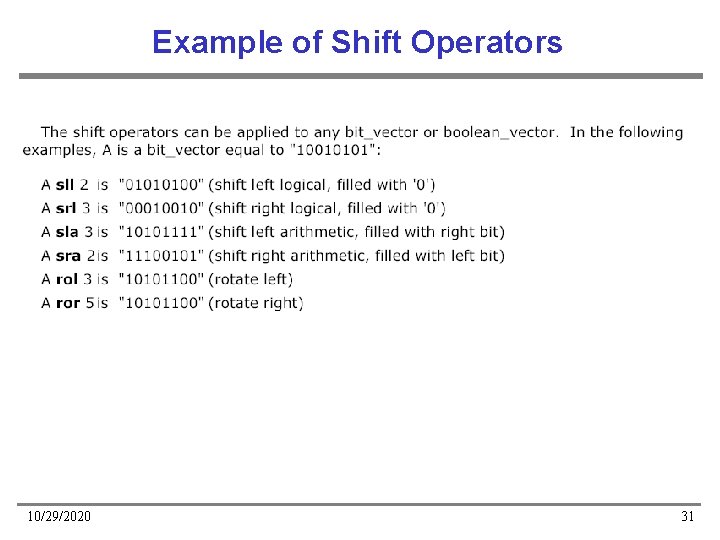
Example of Shift Operators 10/29/2020 31
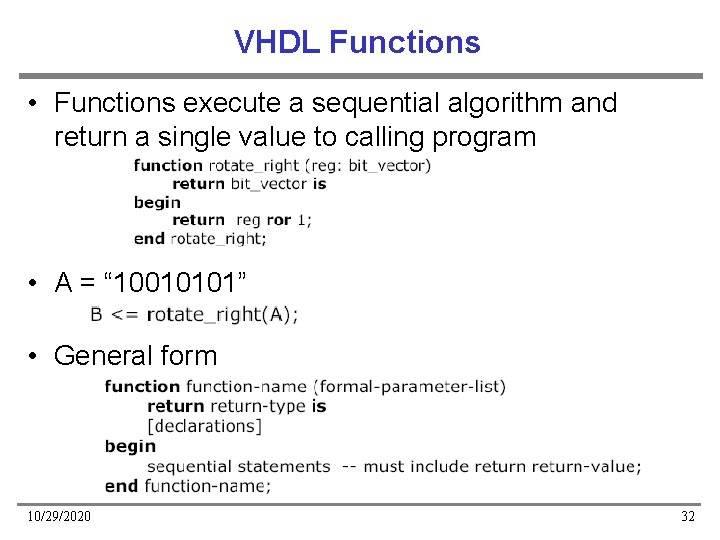
VHDL Functions • Functions execute a sequential algorithm and return a single value to calling program • A = “ 10010101” • General form 10/29/2020 32
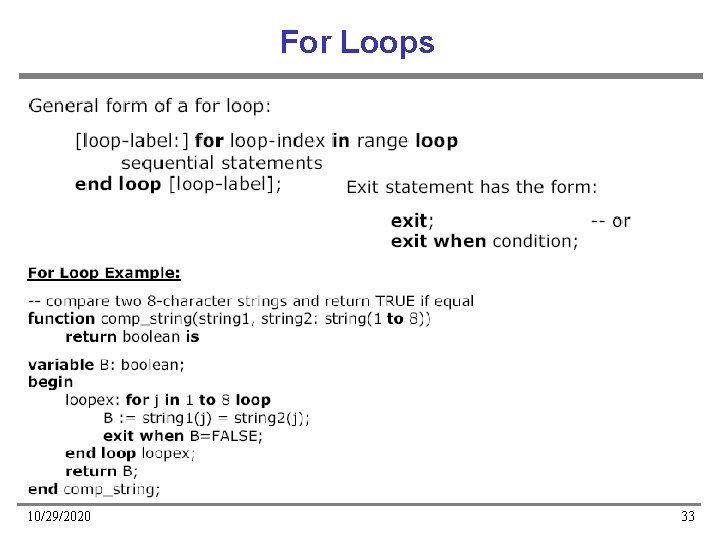
For Loops 10/29/2020 33
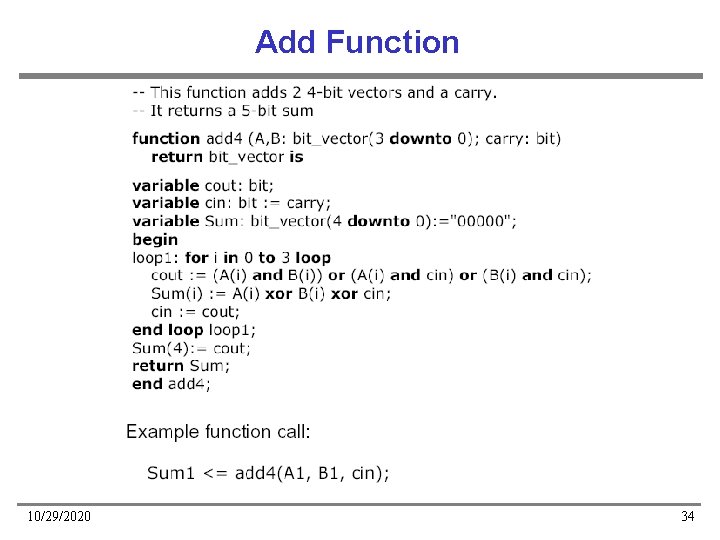
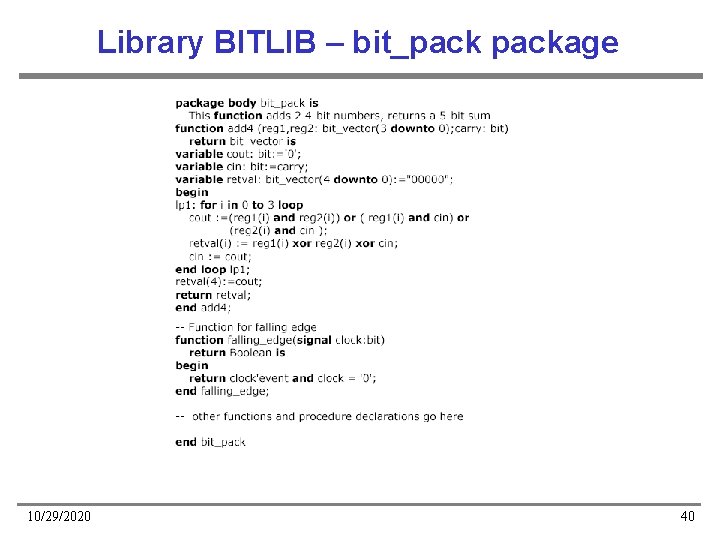
Add Function 10/29/2020 34
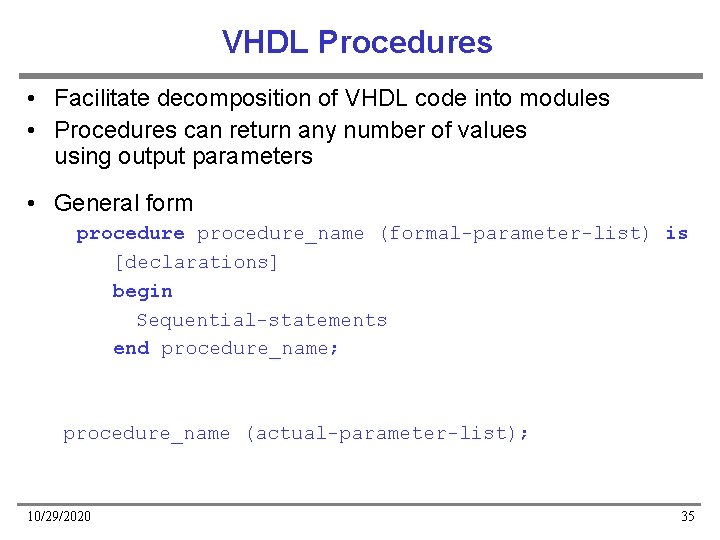
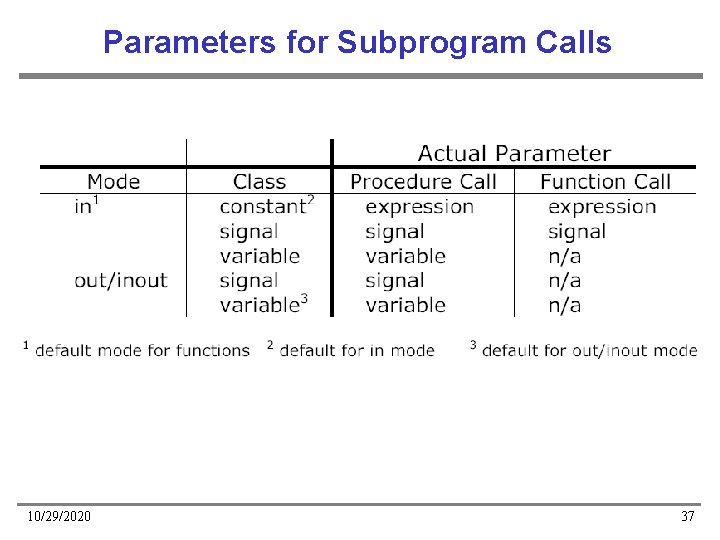
VHDL Procedures • Facilitate decomposition of VHDL code into modules • Procedures can return any number of values using output parameters • General form procedure_name (formal-parameter-list) is [declarations] begin Sequential-statements end procedure_name; procedure_name (actual-parameter-list); 10/29/2020 35
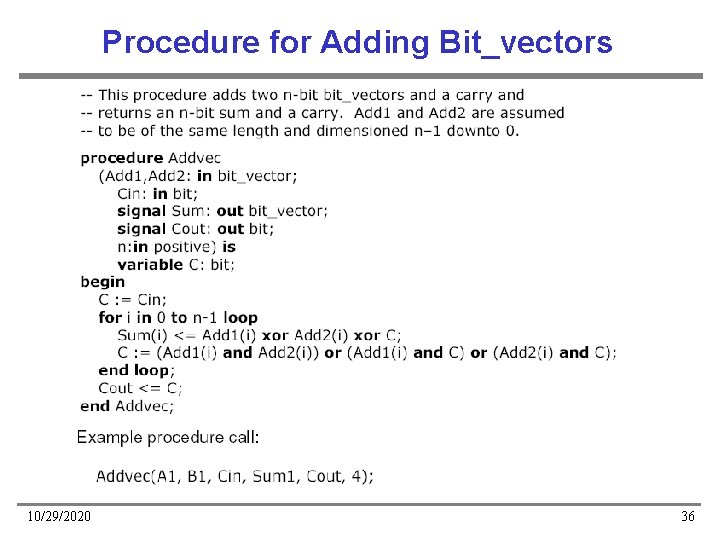
Procedure for Adding Bit_vectors 10/29/2020 36
Parameters for Subprogram Calls 10/29/2020 37
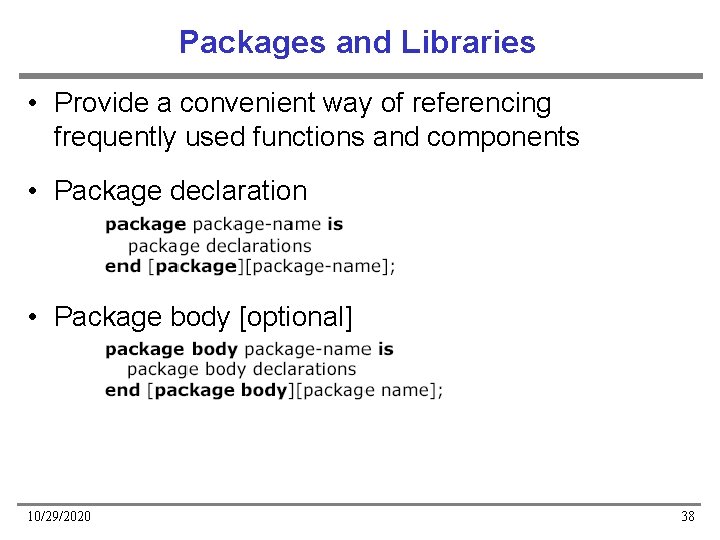
Packages and Libraries • Provide a convenient way of referencing frequently used functions and components • Package declaration • Package body [optional] 10/29/2020 38
Library BITLIB – bit_package 10/29/2020 39
Library BITLIB – bit_package 10/29/2020 40
Library BITLIB – bit_package 10/29/2020 41
To Do • Read – Textbook chapters 2. 6, 2. 7, 2. 8, 2. 9, 2. 10, 2. 11 10/29/2020 42