
ECE 408CS 483CSE 408 Fall 2017 Convolutional Neural
- Slides: 21
ECE 408/CS 483/CSE 408 Fall 2017 Convolutional Neural Networks Carl Pearson pearson@Illinois. edu
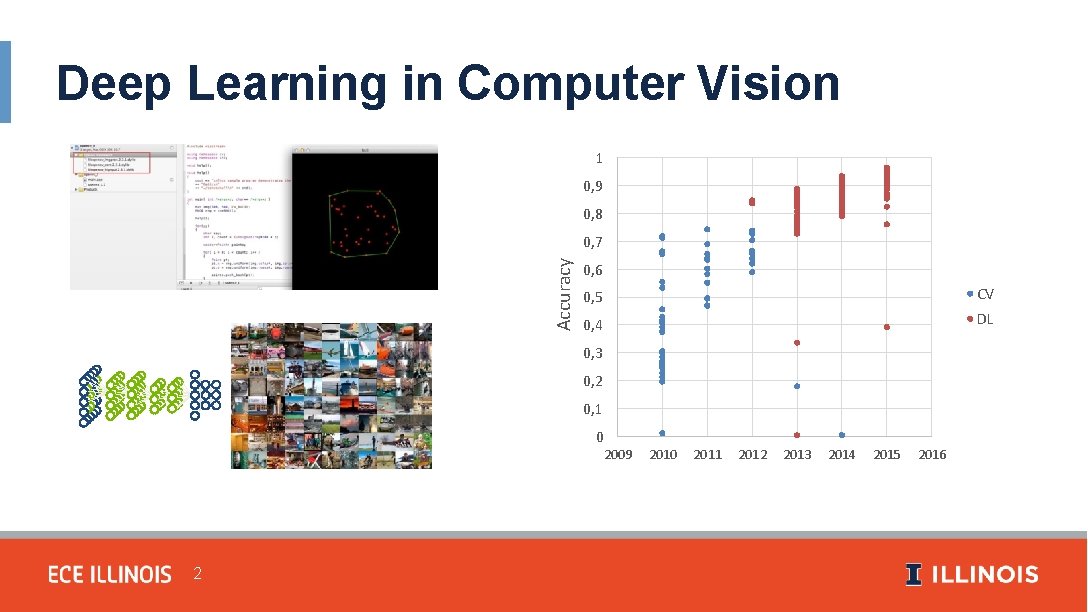
Deep Learning in Computer Vision 1 0, 9 0, 8 Accuracy 0, 7 0, 6 0, 5 CV 0, 4 DL 0, 3 0, 2 0, 1 0 2009 2 2010 2011 2012 2013 2014 2015 2016
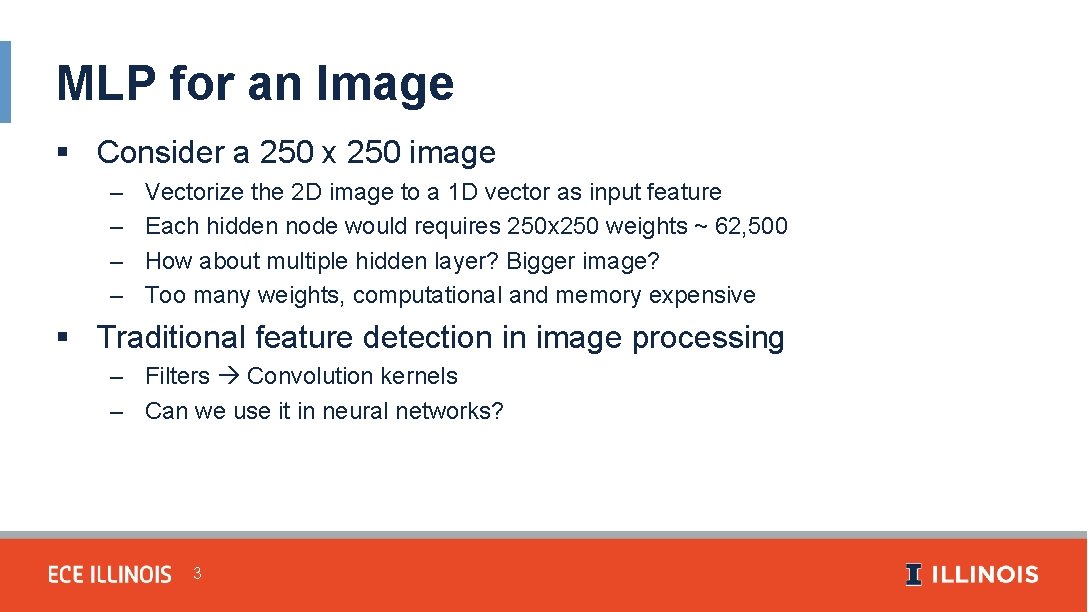
MLP for an Image § Consider a 250 x 250 image – – Vectorize the 2 D image to a 1 D vector as input feature Each hidden node would requires 250 x 250 weights ~ 62, 500 How about multiple hidden layer? Bigger image? Too many weights, computational and memory expensive § Traditional feature detection in image processing – Filters Convolution kernels – Can we use it in neural networks? 3
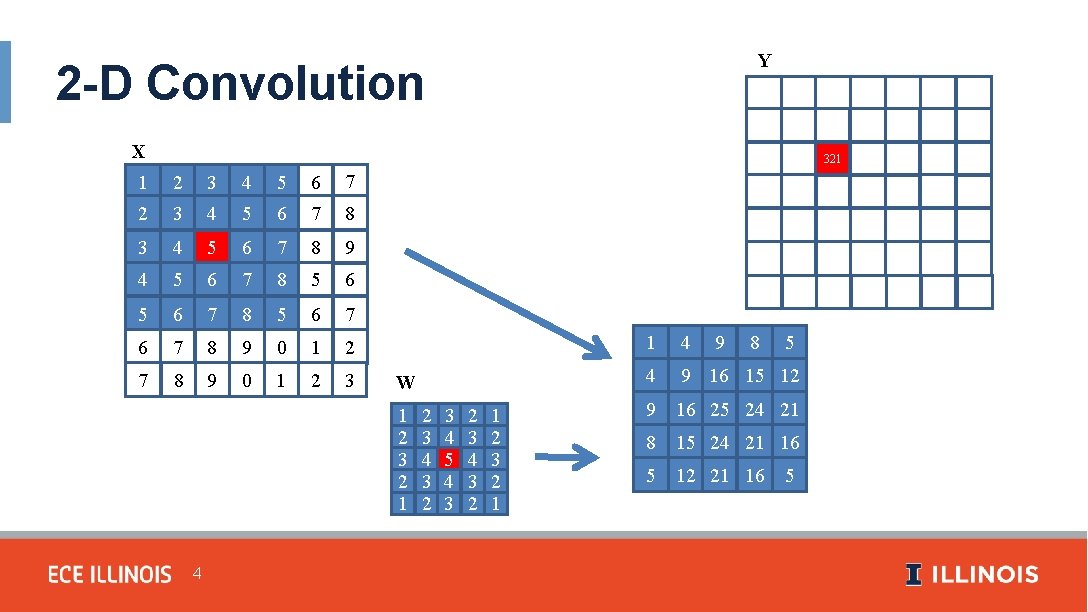
Y 2 -D Convolution X 1 2 3 4 5 6 7 8 9 4 5 6 7 8 5 6 7 6 7 8 9 0 1 2 3 W 1 2 3 2 1 4 2 3 4 3 2 3 4 5 4 3 2 3 4 3 2 1 2 3 2 1 9 1 2 3 4 5 6 3 4 321 6 7 4 5 6 7 8 5 1 4 8 5 4 9 16 15 12 9 16 25 24 21 8 15 24 21 16 5 12 21 16 5
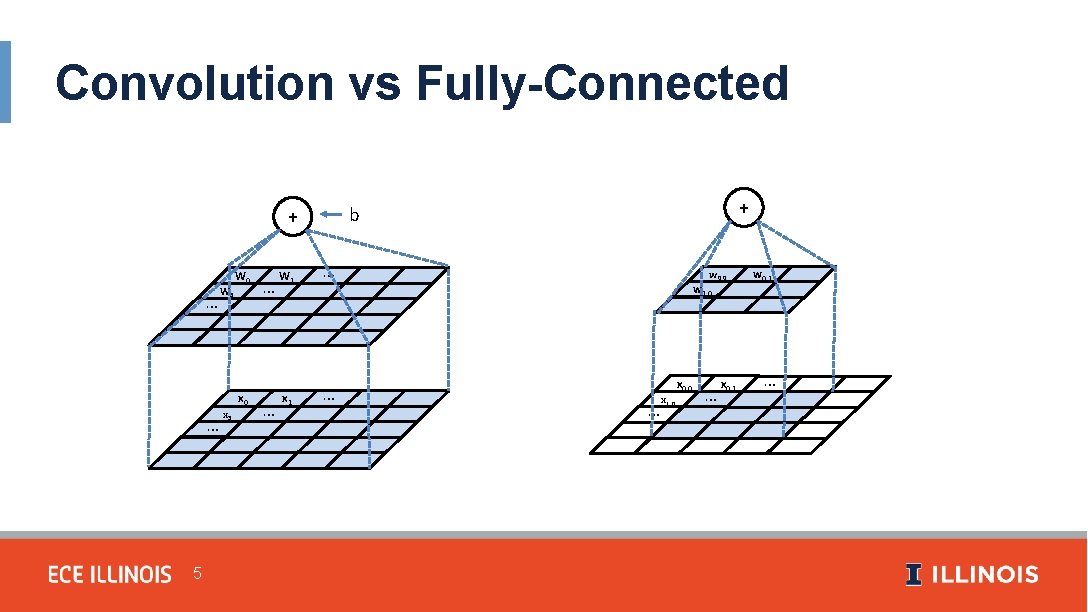
Convolution vs Fully-Connected … … 5 W 5 x 5 W 0 x 0 … … W 1 x 1 + b + … … w 0, 0 w 1, 0 … x 1, 0 x 0, 0 … x 0, 1 w 0, 1 …
Applicability of Convolution § Fixed-size inputs § Variably-sized inputs – Varying observations of the same kind of thing • Audio recording of different lengths • Image with more/fewer pixels 6
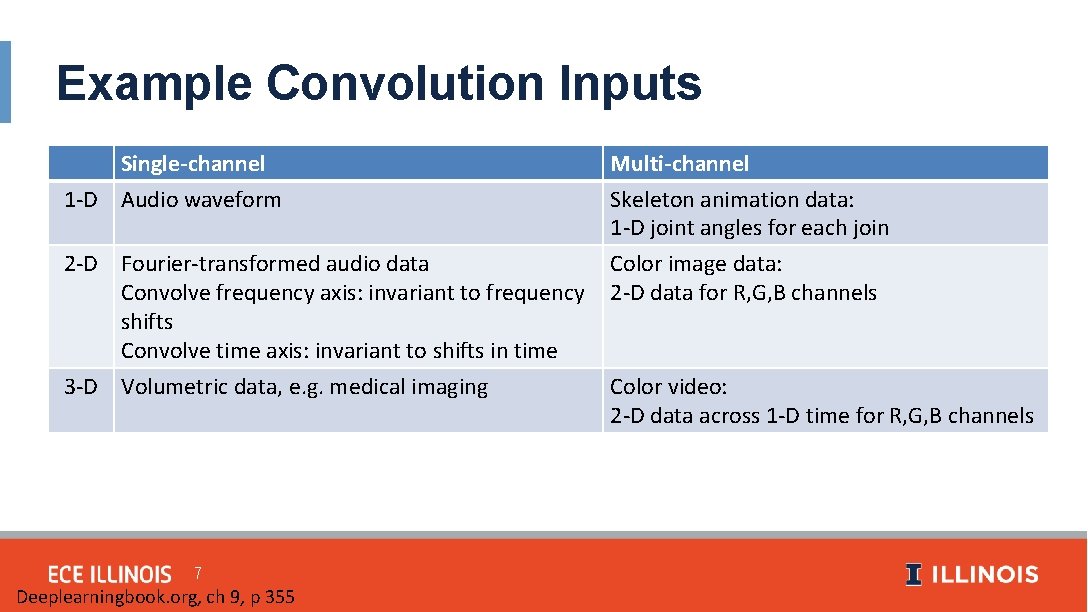
Example Convolution Inputs Single-channel 1 -D Audio waveform Multi-channel Skeleton animation data: 1 -D joint angles for each join 2 -D Fourier-transformed audio data Convolve frequency axis: invariant to frequency shifts Convolve time axis: invariant to shifts in time 3 -D Volumetric data, e. g. medical imaging Color image data: 2 -D data for R, G, B channels 7 Deeplearningbook. org, ch 9, p 355 Color video: 2 -D data across 1 -D time for R, G, B channels
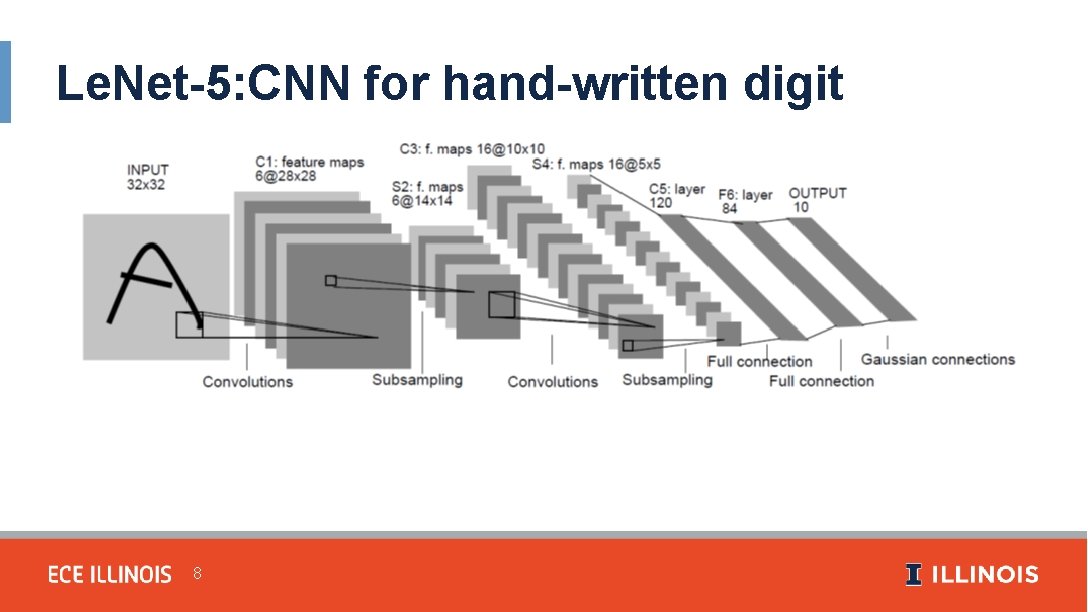
Le. Net-5: CNN for hand-written digit recognition 8
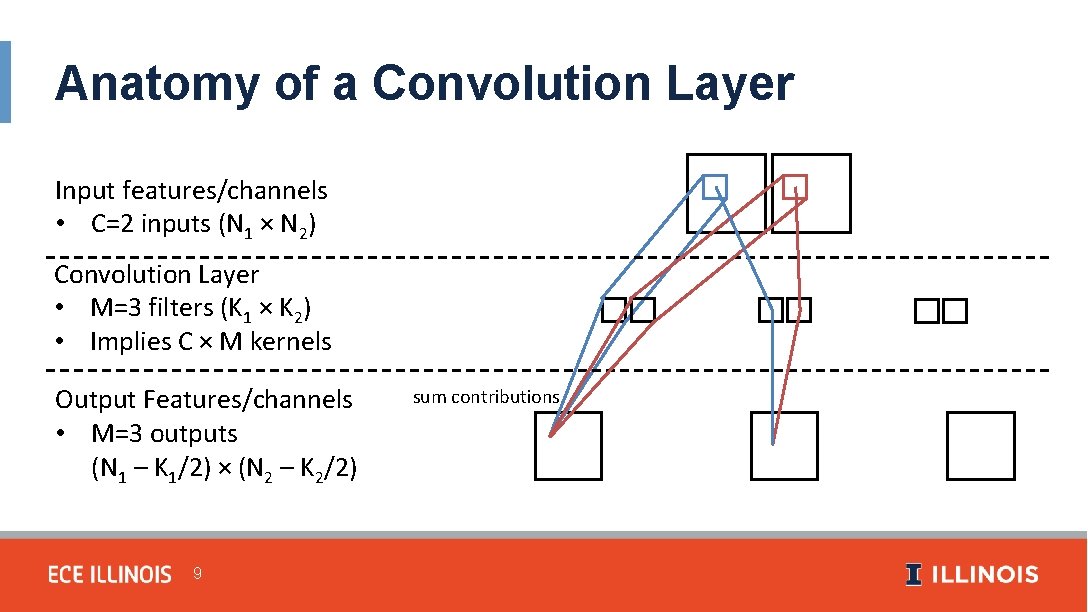
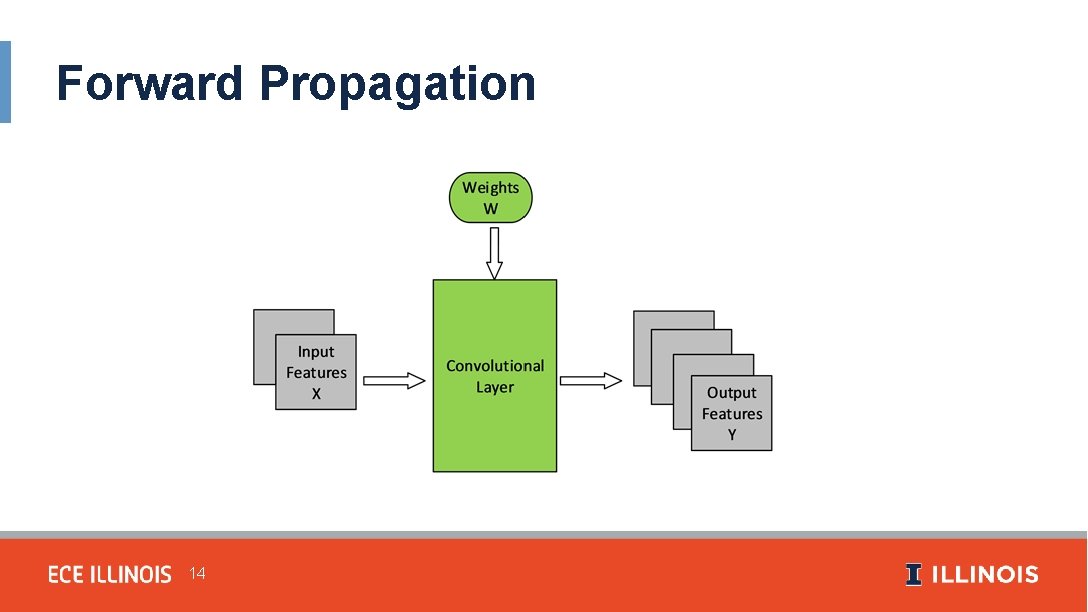
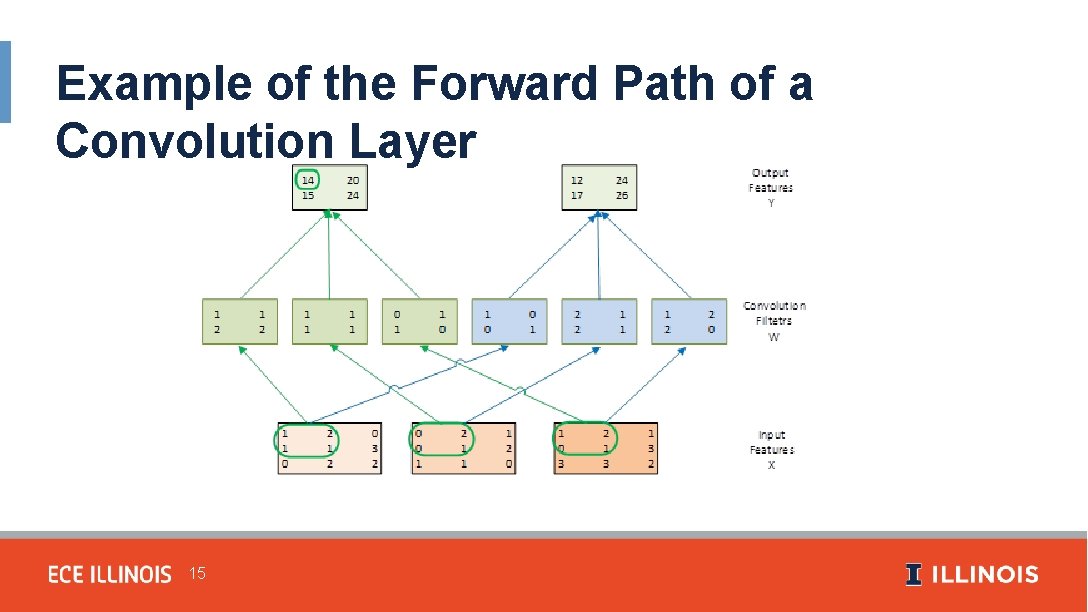
Anatomy of a Convolution Layer Input features/channels • C=2 inputs (N 1 × N 2) Convolution Layer • M=3 filters (K 1 × K 2) • Implies C × M kernels Output Features/channels • M=3 outputs (N 1 – K 1/2) × (N 2 – K 2/2) 9 sum contributions
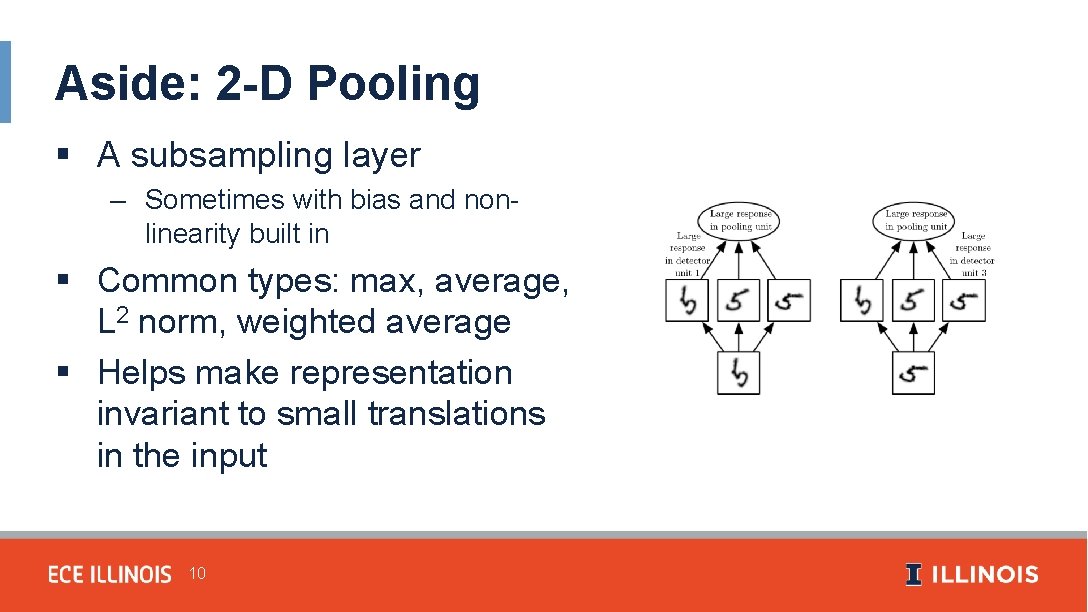
Aside: 2 -D Pooling § A subsampling layer – Sometimes with bias and nonlinearity built in § Common types: max, average, L 2 norm, weighted average § Helps make representation invariant to small translations in the input 10
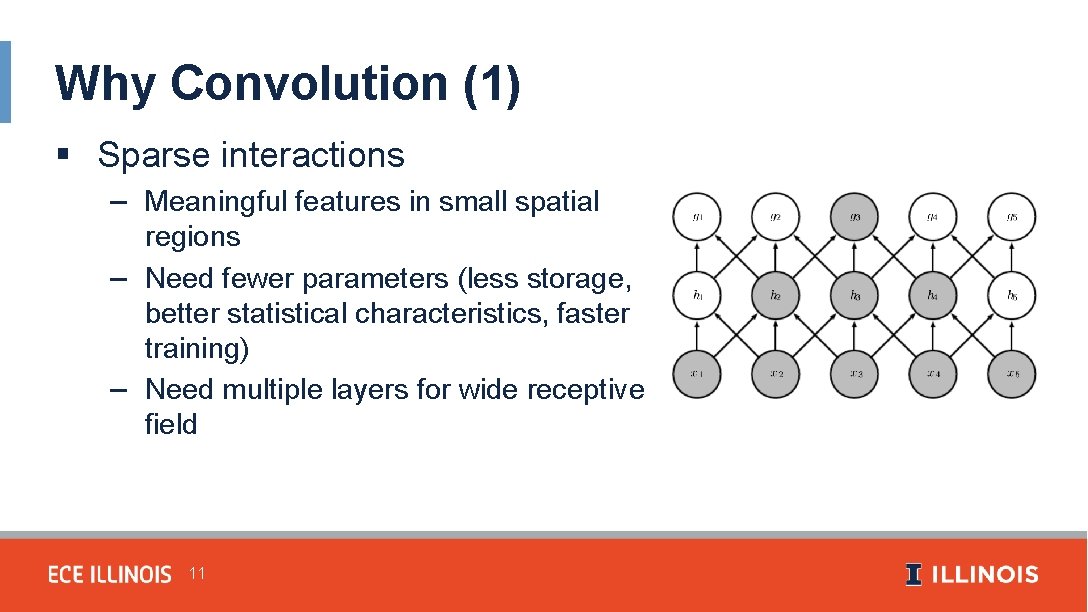
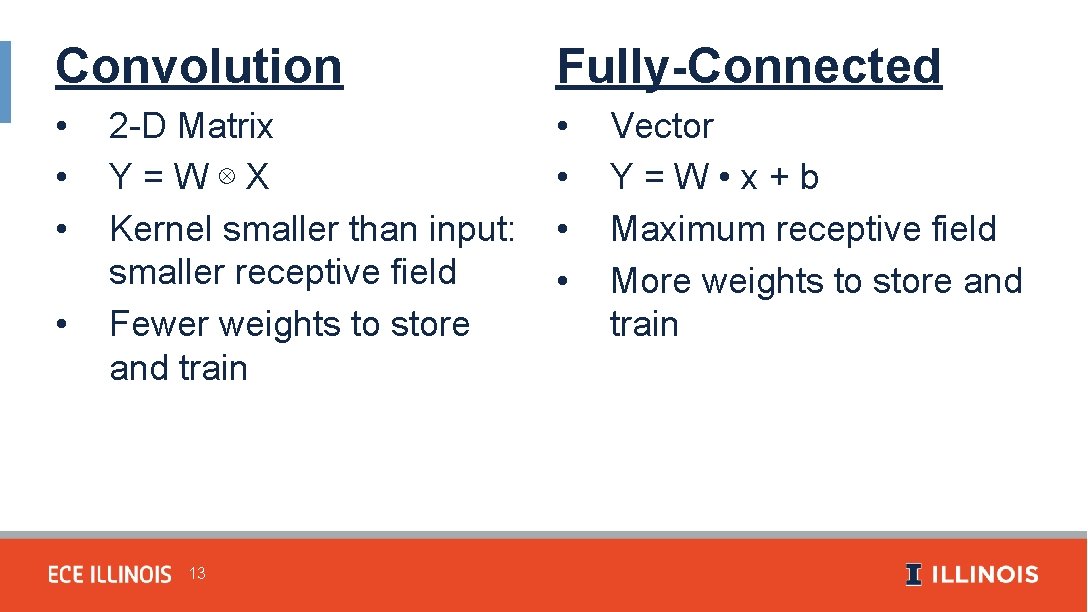
Why Convolution (1) § Sparse interactions – Meaningful features in small spatial regions – Need fewer parameters (less storage, better statistical characteristics, faster training) – Need multiple layers for wide receptive field 11
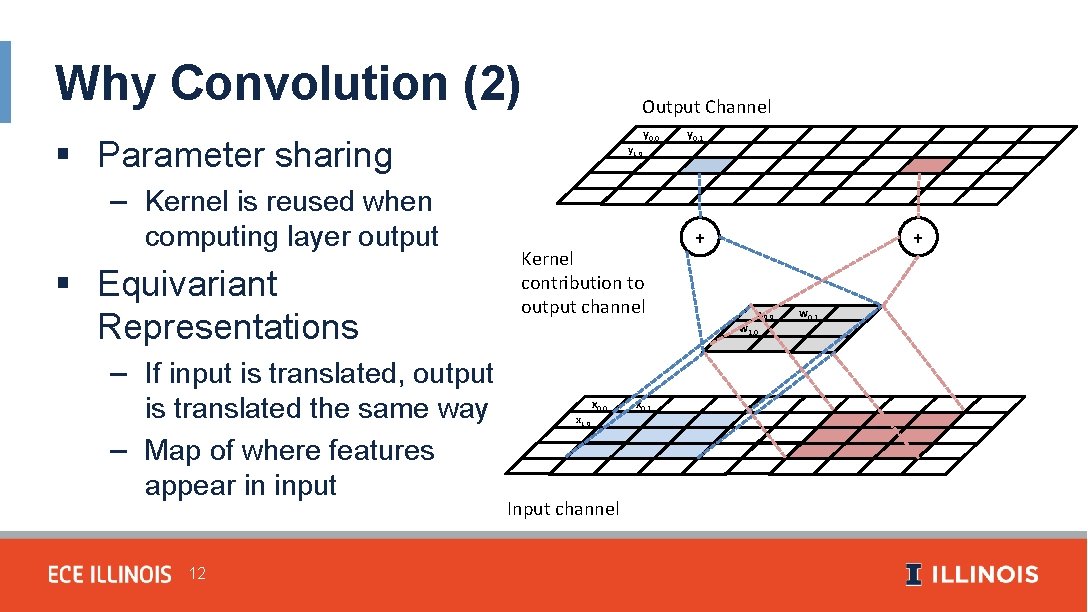
Why Convolution (2) Output Channel § Parameter sharing – Kernel is reused when computing layer output § Equivariant Representations – If input is translated, output is translated the same way – Map of where features appear in input 12 y 1, 0 y 0, 0 Kernel contribution to output channel y 0, 1 … + + w 0, 0 w 1, 0 x 0, 0 Input channel x 0, 1 w 0, 1 …
Convolution Fully-Connected • • 2 -D Matrix Y=W⊗X Kernel smaller than input: smaller receptive field Fewer weights to store and train 13 Vector Y=W • x+b Maximum receptive field More weights to store and train
Forward Propagation 14
Example of the Forward Path of a Convolution Layer 15
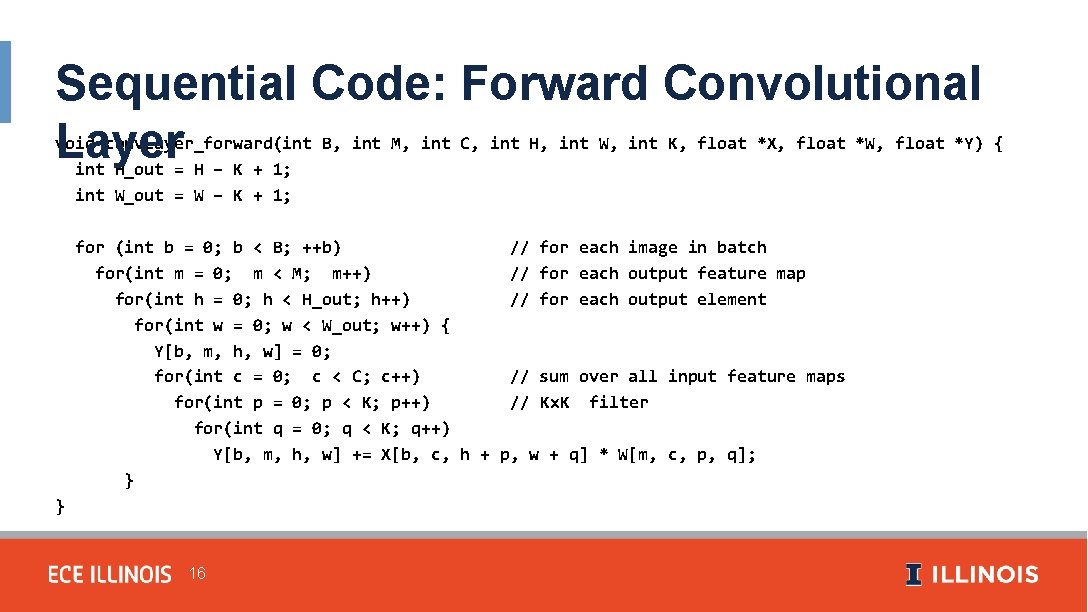
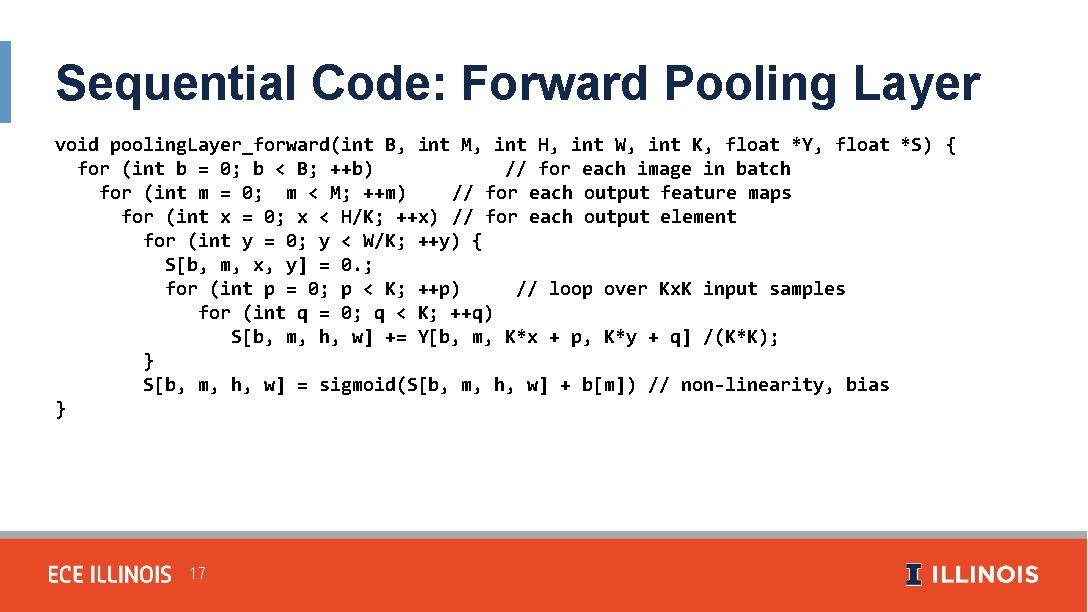
Sequential Code: Forward Convolutional Layer void conv. Layer_forward(int B, int M, int C, int H, int W, int K, float *X, float *W, float *Y) { int H_out = H – K + 1; int W_out = W – K + 1; for (int b = 0; b < B; ++b) // for each image in batch for(int m = 0; m < M; m++) // for each output feature map for(int h = 0; h < H_out; h++) // for each output element for(int w = 0; w < W_out; w++) { Y[b, m, h, w] = 0; for(int c = 0; c < C; c++) // sum over all input feature maps for(int p = 0; p < K; p++) // Kx. K filter for(int q = 0; q < K; q++) Y[b, m, h, w] += X[b, c, h + p, w + q] * W[m, c, p, q]; } } 16
Sequential Code: Forward Pooling Layer void pooling. Layer_forward(int B, int M, int H, int W, int K, float *Y, float *S) { for (int b = 0; b < B; ++b) // for each image in batch for (int m = 0; m < M; ++m) // for each output feature maps for (int x = 0; x < H/K; ++x) // for each output element for (int y = 0; y < W/K; ++y) { S[b, m, x, y] = 0. ; for (int p = 0; p < K; ++p) // loop over Kx. K input samples for (int q = 0; q < K; ++q) S[b, m, h, w] += Y[b, m, K*x + p, K*y + q] /(K*K); } S[b, m, h, w] = sigmoid(S[b, m, h, w] + b[m]) // non-linearity, bias } 17
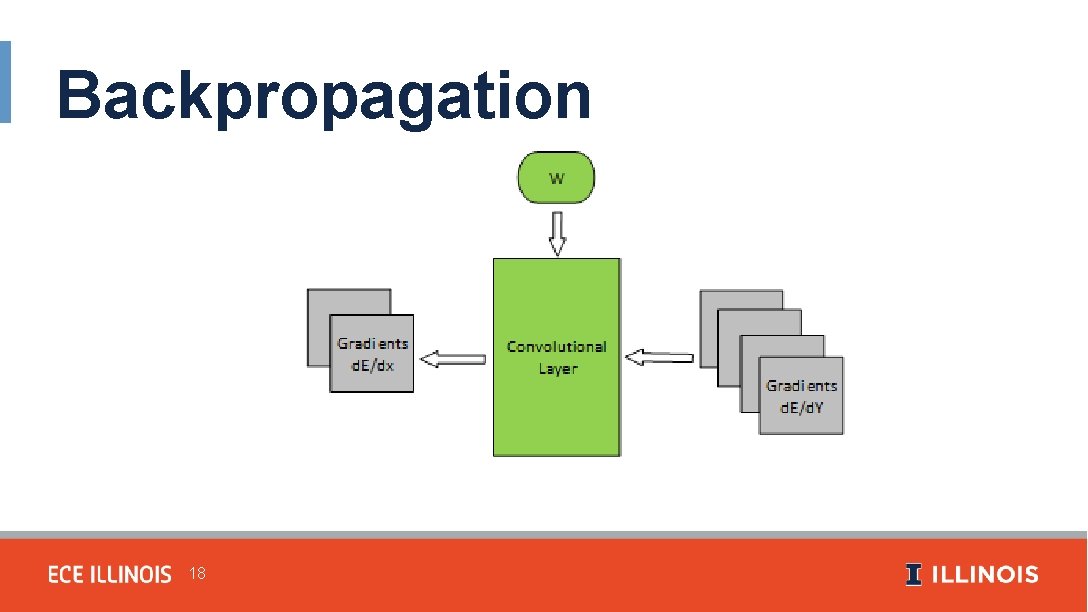
Backpropagation 18
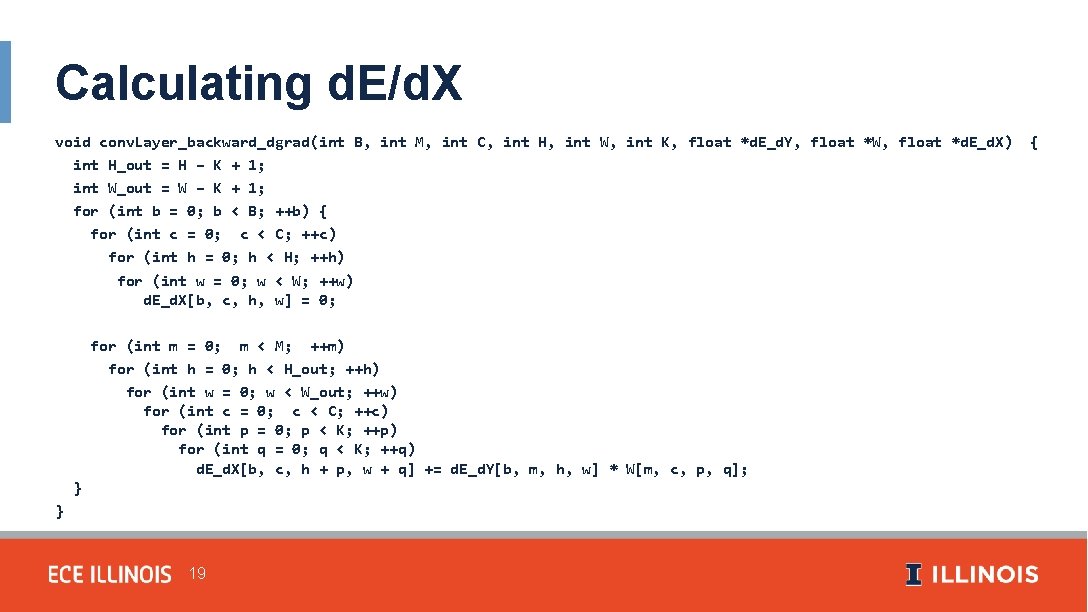
Calculating d. E/d. X void conv. Layer_backward_dgrad(int B, int M, int C, int H, int W, int K, float *d. E_d. Y, float *W, float *d. E_d. X) int H_out = H – K + 1; int W_out = W – K + 1; for (int b = 0; b < B; ++b) { for (int c = 0; c < C; ++c) for (int h = 0; h < H; ++h) for (int w = 0; w < W; ++w) d. E_d. X[b, c, h, w] = 0; for (int m = 0; m < M; ++m) for (int h = 0; h < H_out; ++h) for (int w = 0; w < W_out; ++w) for (int c = 0; c < C; ++c) for (int p = 0; p < K; ++p) for (int q = 0; q < K; ++q) d. E_d. X[b, c, h + p, w + q] += d. E_d. Y[b, m, h, w] * W[m, c, p, q]; } } 19 {
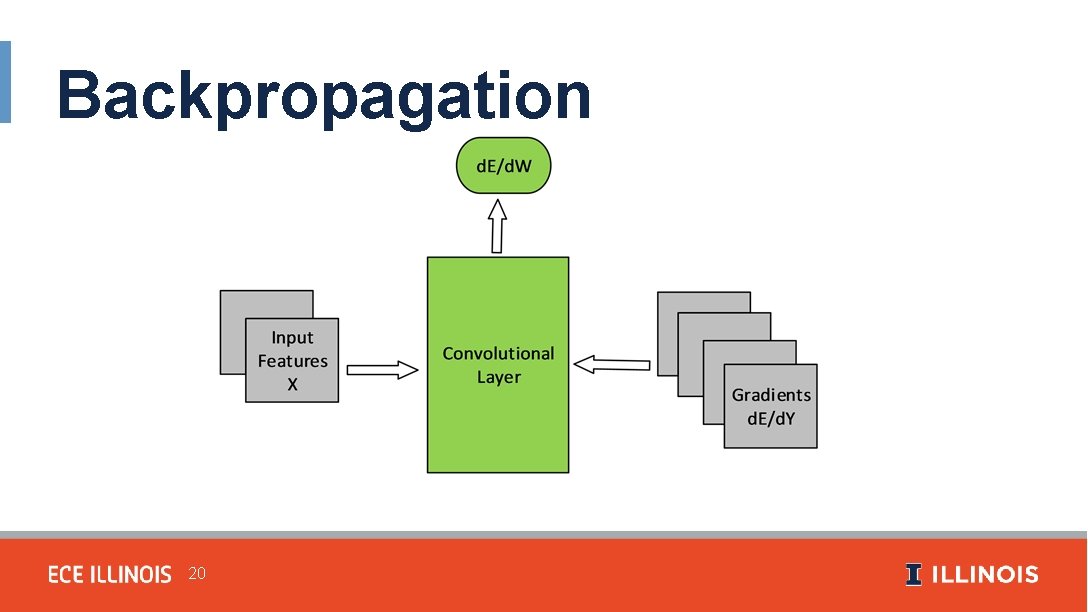
Backpropagation 20
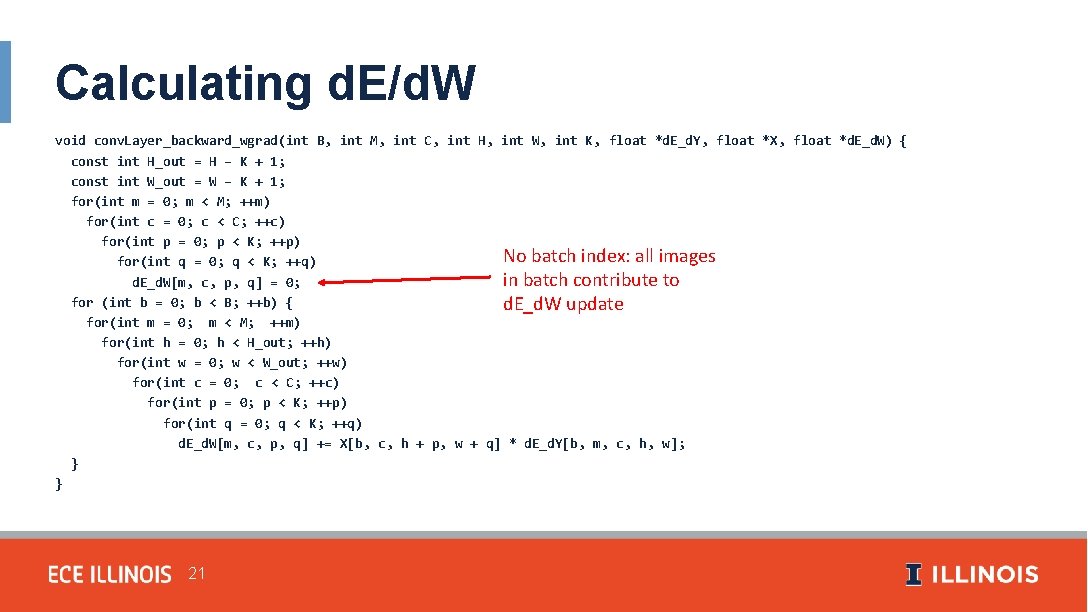
Calculating d. E/d. W void conv. Layer_backward_wgrad(int B, int M, int C, int H, int W, int K, float *d. E_d. Y, float *X, float *d. E_d. W) { const int H_out = H – K + 1; const int W_out = W – K + 1; for(int m = 0; m < M; ++m) for(int c = 0; c < C; ++c) for(int p = 0; p < K; ++p) No batch index: all images for(int q = 0; q < K; ++q) in batch contribute to d. E_d. W[m, c, p, q] = 0; for (int b = 0; b < B; ++b) { d. E_d. W update for(int m = 0; m < M; ++m) for(int h = 0; h < H_out; ++h) for(int w = 0; w < W_out; ++w) for(int c = 0; c < C; ++c) for(int p = 0; p < K; ++p) for(int q = 0; q < K; ++q) d. E_d. W[m, c, p, q] += X[b, c, h + p, w + q] * d. E_d. Y[b, m, c, h, w]; } } 21