
ECE 340 Lecture 35 MOS FieldEffect Transistor MOSFET
- Slides: 17
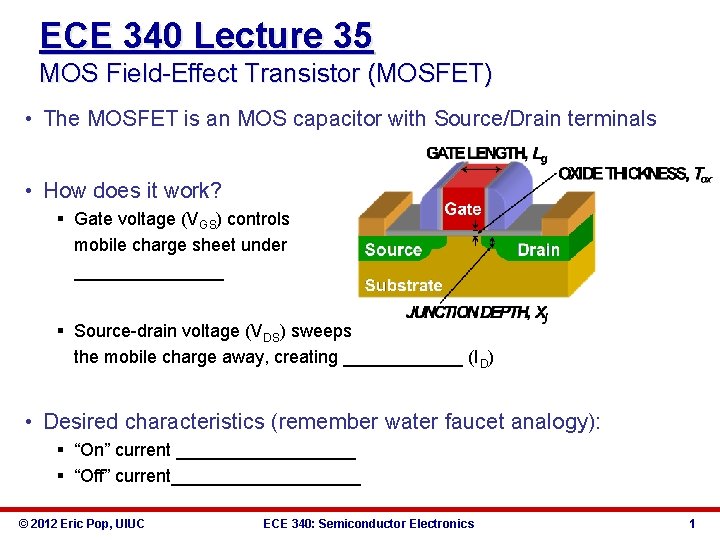
ECE 340 Lecture 35 MOS Field-Effect Transistor (MOSFET) • The MOSFET is an MOS capacitor with Source/Drain terminals • How does it work? § Gate voltage (VGS) controls mobile charge sheet under ________ § Source-drain voltage (VDS) sweeps the mobile charge away, creating ______ (ID) • Desired characteristics (remember water faucet analogy): § “On” current _________ § “Off” current__________ © 2012 Eric Pop, UIUC ECE 340: Semiconductor Electronics 1
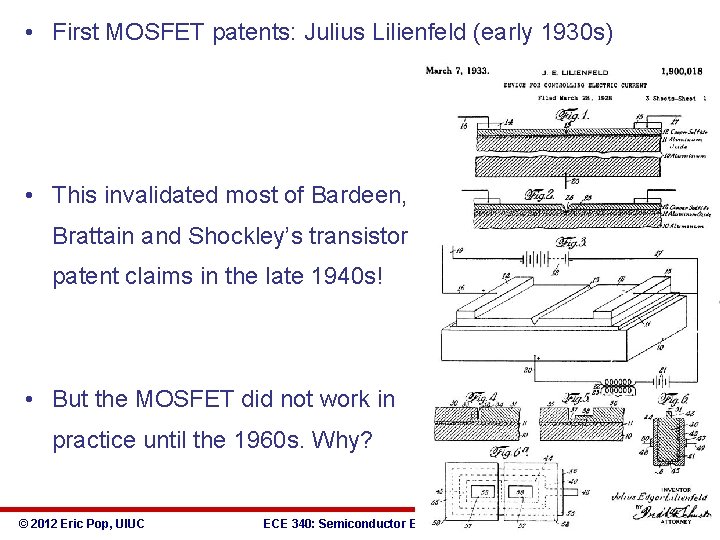
• First MOSFET patents: Julius Lilienfeld (early 1930 s) • This invalidated most of Bardeen, Brattain and Shockley’s transistor patent claims in the late 1940 s! • But the MOSFET did not work in practice until the 1960 s. Why? © 2012 Eric Pop, UIUC ECE 340: Semiconductor Electronics 2
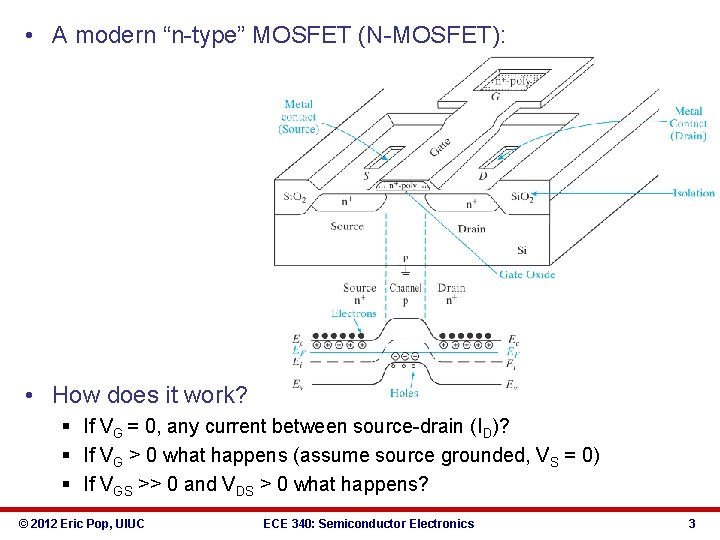
• A modern “n-type” MOSFET (N-MOSFET): • How does it work? § If VG = 0, any current between source-drain (ID)? § If VG > 0 what happens (assume source grounded, VS = 0) § If VGS >> 0 and VDS > 0 what happens? © 2012 Eric Pop, UIUC ECE 340: Semiconductor Electronics 3
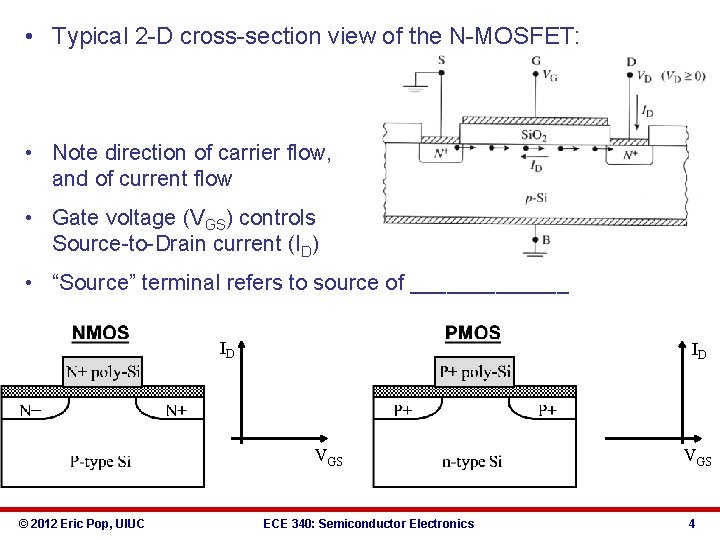
• Typical 2 -D cross-section view of the N-MOSFET: • Note direction of carrier flow, and of current flow • Gate voltage (VGS) controls Source-to-Drain current (ID) • “Source” terminal refers to source of _______ ID ID VGS © 2012 Eric Pop, UIUC ECE 340: Semiconductor Electronics VGS 4
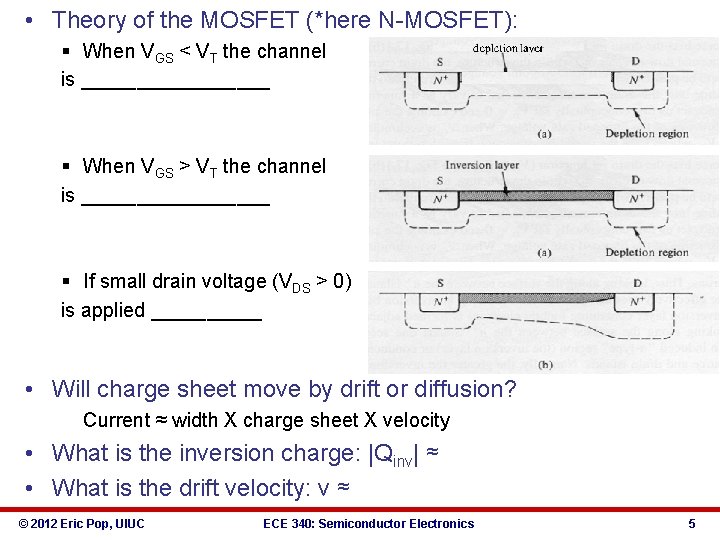
• Theory of the MOSFET (*here N-MOSFET): § When VGS < VT the channel is _________ § When VGS > VT the channel is _________ § If small drain voltage (VDS > 0) is applied _____ • Will charge sheet move by drift or diffusion? Current ≈ width X charge sheet X velocity • What is the inversion charge: |Qinv| ≈ • What is the drift velocity: v ≈ © 2012 Eric Pop, UIUC ECE 340: Semiconductor Electronics 5
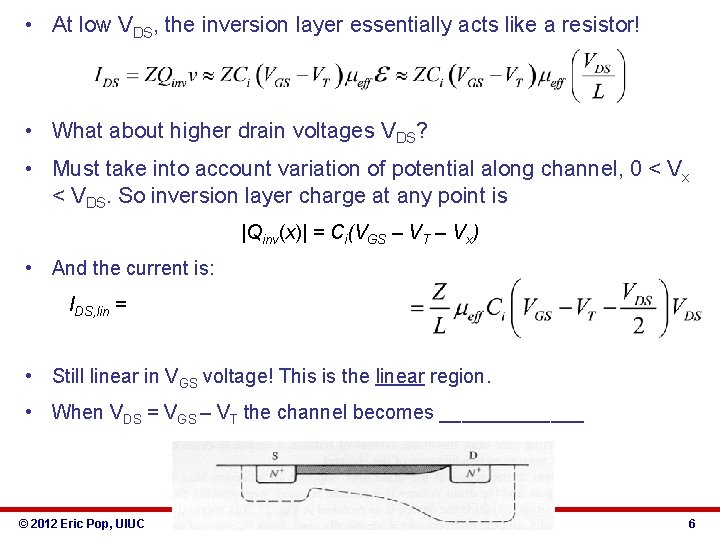
• At low VDS, the inversion layer essentially acts like a resistor! • What about higher drain voltages VDS? • Must take into account variation of potential along channel, 0 < Vx < VDS. So inversion layer charge at any point is |Qinv(x)| = Ci(VGS – VT – Vx) • And the current is: IDS, lin = • Still linear in VGS voltage! This is the linear region. • When VDS = VGS – VT the channel becomes _______ © 2012 Eric Pop, UIUC ECE 340: Semiconductor Electronics 6
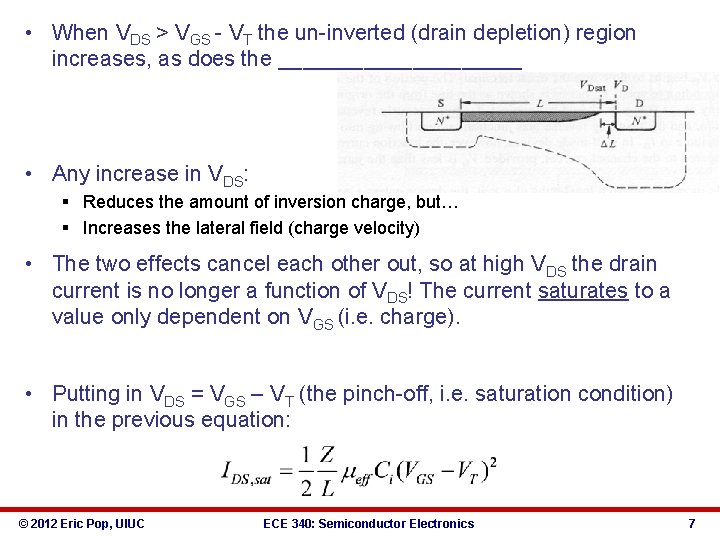
• When VDS > VGS - VT the un-inverted (drain depletion) region increases, as does the __________ • Any increase in VDS: § Reduces the amount of inversion charge, but… § Increases the lateral field (charge velocity) • The two effects cancel each other out, so at high VDS the drain current is no longer a function of VDS! The current saturates to a value only dependent on VGS (i. e. charge). • Putting in VDS = VGS – VT (the pinch-off, i. e. saturation condition) in the previous equation: © 2012 Eric Pop, UIUC ECE 340: Semiconductor Electronics 7
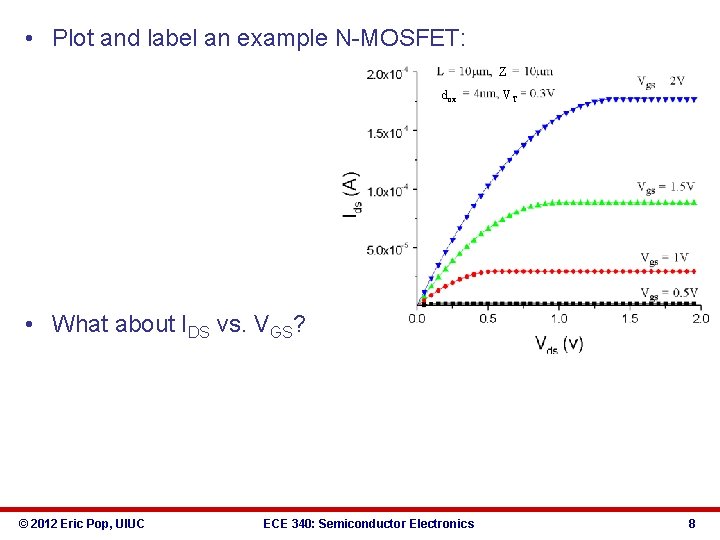
• Plot and label an example N-MOSFET: Z dox VT • What about IDS vs. VGS? © 2012 Eric Pop, UIUC ECE 340: Semiconductor Electronics 8
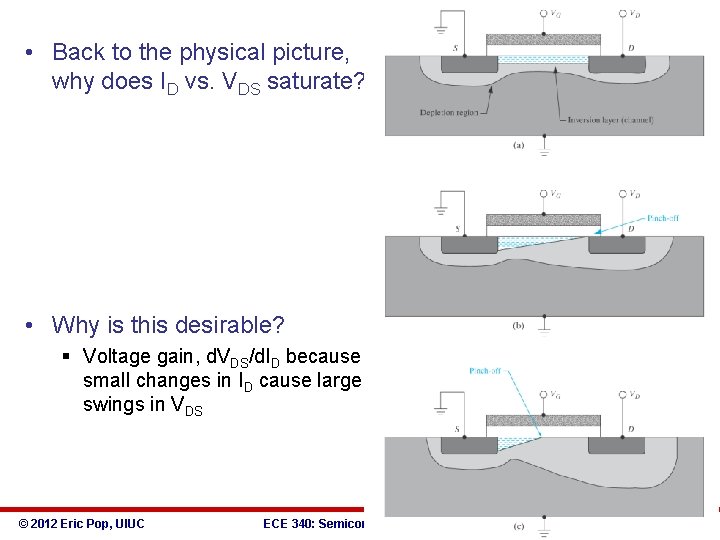
• Back to the physical picture, why does ID vs. VDS saturate? • Why is this desirable? § Voltage gain, d. VDS/d. ID because small changes in ID cause large swings in VDS © 2012 Eric Pop, UIUC ECE 340: Semiconductor Electronics 9
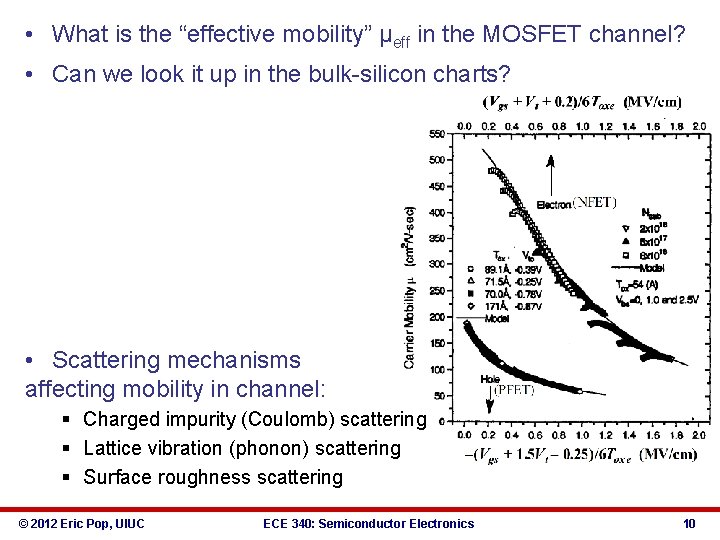
• What is the “effective mobility” μeff in the MOSFET channel? • Can we look it up in the bulk-silicon charts? • Scattering mechanisms affecting mobility in channel: § Charged impurity (Coulomb) scattering § Lattice vibration (phonon) scattering § Surface roughness scattering © 2012 Eric Pop, UIUC ECE 340: Semiconductor Electronics 10
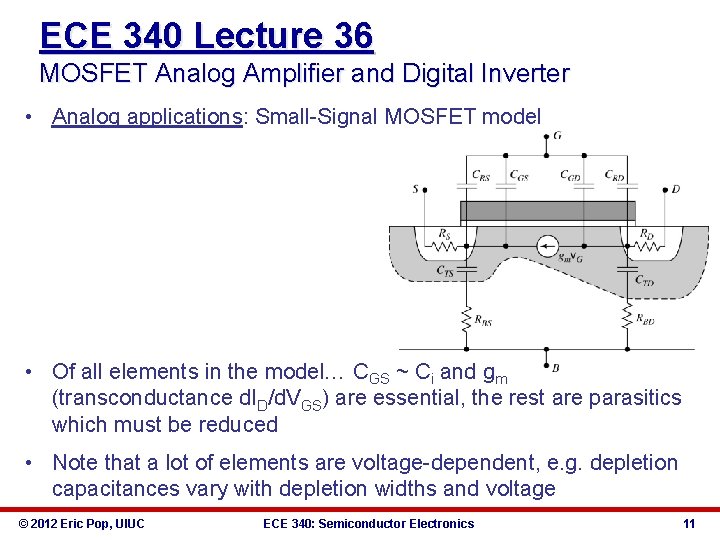
ECE 340 Lecture 36 MOSFET Analog Amplifier and Digital Inverter • Analog applications: Small-Signal MOSFET model • Of all elements in the model… CGS ~ Ci and gm (transconductance d. ID/d. VGS) are essential, the rest are parasitics which must be reduced • Note that a lot of elements are voltage-dependent, e. g. depletion capacitances vary with depletion widths and voltage © 2012 Eric Pop, UIUC ECE 340: Semiconductor Electronics 11
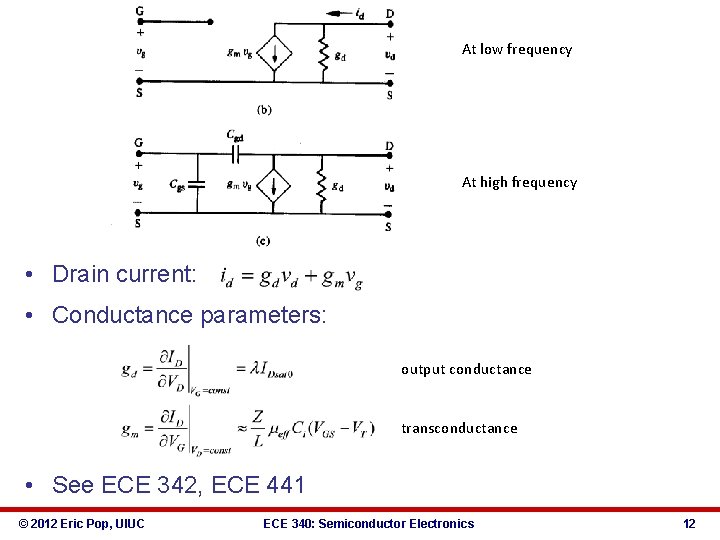
At low frequency At high frequency • Drain current: • Conductance parameters: output conductance transconductance • See ECE 342, ECE 441 © 2012 Eric Pop, UIUC ECE 340: Semiconductor Electronics 12
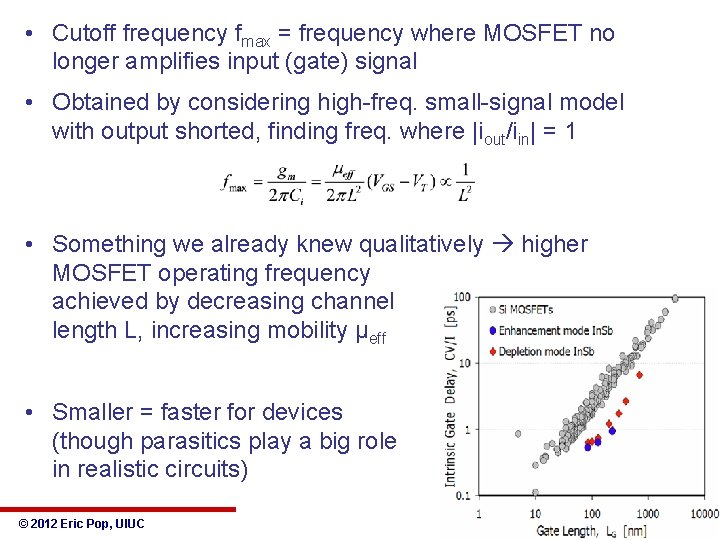
• Cutoff frequency fmax = frequency where MOSFET no longer amplifies input (gate) signal • Obtained by considering high-freq. small-signal model with output shorted, finding freq. where |iout/iin| = 1 • Something we already knew qualitatively higher MOSFET operating frequency achieved by decreasing channel length L, increasing mobility μeff • Smaller = faster for devices (though parasitics play a big role in realistic circuits) © 2012 Eric Pop, UIUC ECE 340: Semiconductor Electronics 13
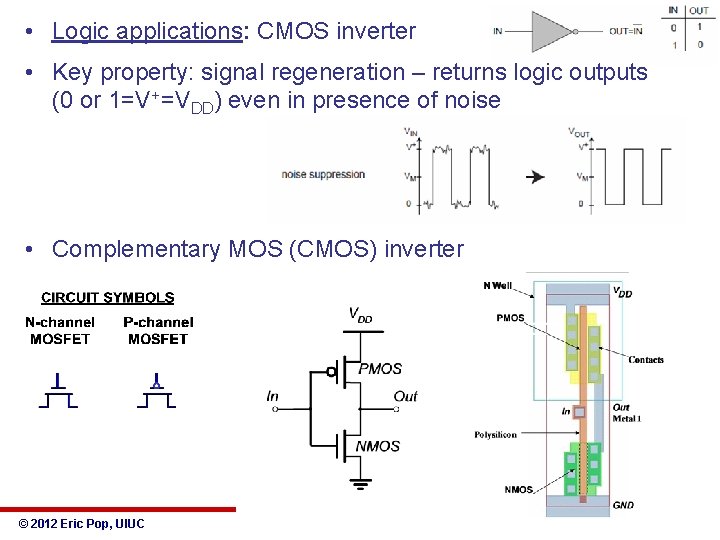
• Logic applications: CMOS inverter • Key property: signal regeneration – returns logic outputs (0 or 1=V+=VDD) even in presence of noise • Complementary MOS (CMOS) inverter © 2012 Eric Pop, UIUC ECE 340: Semiconductor Electronics
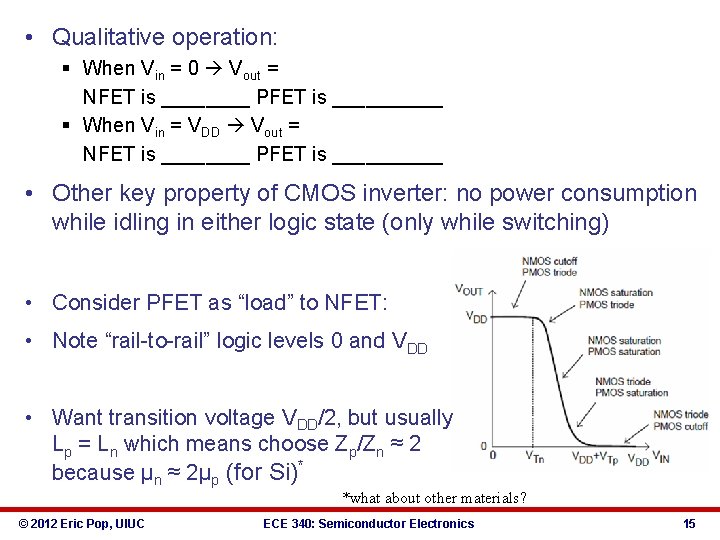
• Qualitative operation: § When Vin = 0 Vout = NFET is ____ PFET is _____ § When Vin = VDD Vout = NFET is ____ PFET is _____ • Other key property of CMOS inverter: no power consumption while idling in either logic state (only while switching) • Consider PFET as “load” to NFET: • Note “rail-to-rail” logic levels 0 and VDD • Want transition voltage VDD/2, but usually Lp = Ln which means choose Zp/Zn ≈ 2 because μn ≈ 2μp (for Si)* *what about other materials? © 2012 Eric Pop, UIUC ECE 340: Semiconductor Electronics 15
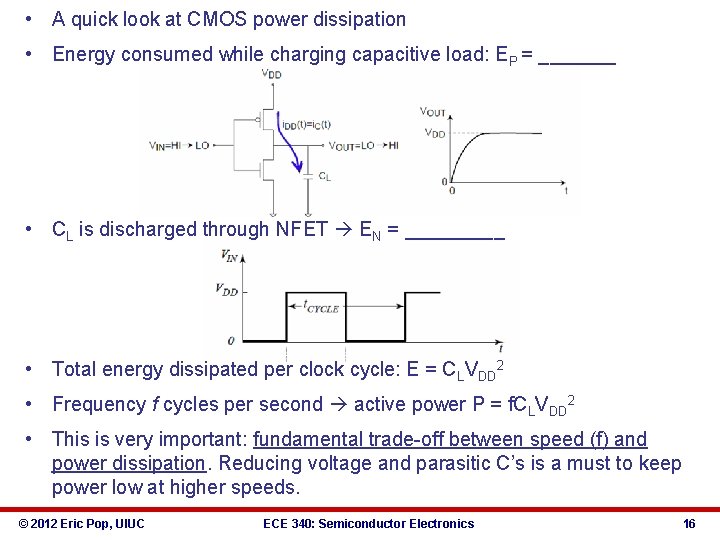
• A quick look at CMOS power dissipation • Energy consumed while charging capacitive load: EP = _______ • CL is discharged through NFET EN = _____ • Total energy dissipated per clock cycle: E = CLVDD 2 • Frequency f cycles per second active power P = f. CLVDD 2 • This is very important: fundamental trade-off between speed (f) and power dissipation. Reducing voltage and parasitic C’s is a must to keep power low at higher speeds. © 2012 Eric Pop, UIUC ECE 340: Semiconductor Electronics 16
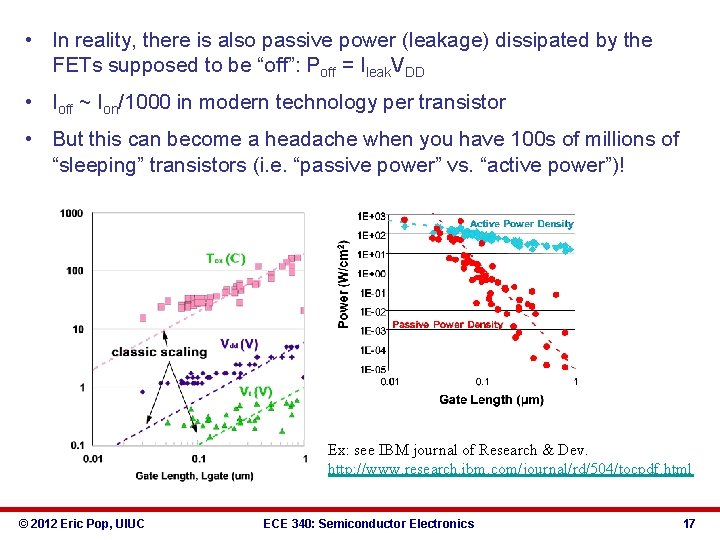
• In reality, there is also passive power (leakage) dissipated by the FETs supposed to be “off”: Poff = Ileak. VDD • Ioff ~ Ion/1000 in modern technology per transistor • But this can become a headache when you have 100 s of millions of “sleeping” transistors (i. e. “passive power” vs. “active power”)! Ex: see IBM journal of Research & Dev. http: //www. research. ibm. com/journal/rd/504/tocpdf. html © 2012 Eric Pop, UIUC ECE 340: Semiconductor Electronics 17