
ECE 340 Lecture 30 MetalSemiconductor Contacts Real semiconductor
- Slides: 13
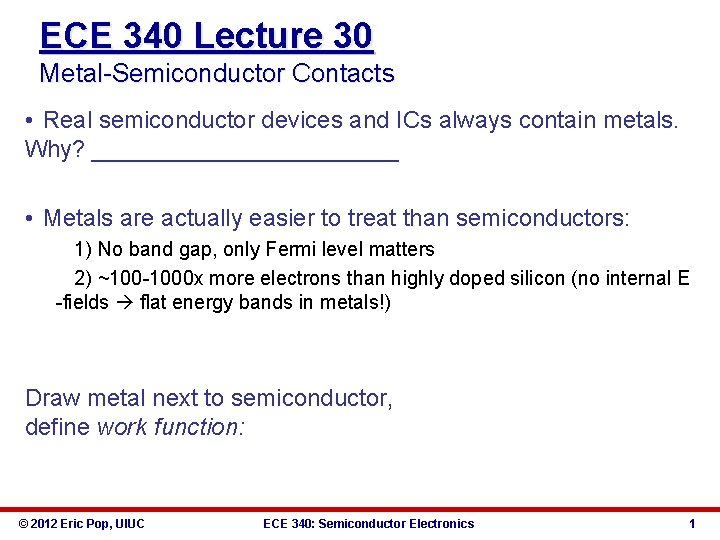
ECE 340 Lecture 30 Metal-Semiconductor Contacts • Real semiconductor devices and ICs always contain metals. Why? ____________ • Metals are actually easier to treat than semiconductors: 1) No band gap, only Fermi level matters 2) ~100 -1000 x more electrons than highly doped silicon (no internal E -fields flat energy bands in metals!) Draw metal next to semiconductor, define work function: © 2012 Eric Pop, UIUC ECE 340: Semiconductor Electronics 1
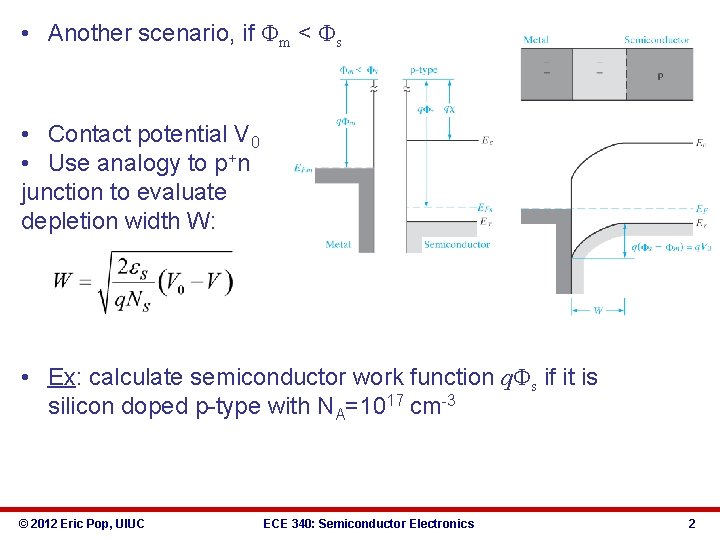
• Another scenario, if Φm < Φs • Contact potential V 0 • Use analogy to p+n junction to evaluate depletion width W: • Ex: calculate semiconductor work function qΦs if it is silicon doped p-type with NA=1017 cm-3 © 2012 Eric Pop, UIUC ECE 340: Semiconductor Electronics 2
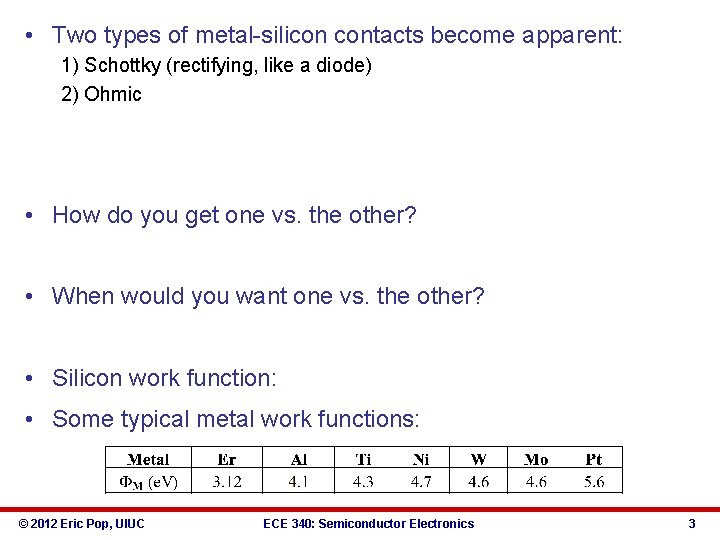
• Two types of metal-silicon contacts become apparent: 1) Schottky (rectifying, like a diode) 2) Ohmic • How do you get one vs. the other? • When would you want one vs. the other? • Silicon work function: • Some typical metal work functions: © 2012 Eric Pop, UIUC ECE 340: Semiconductor Electronics 3
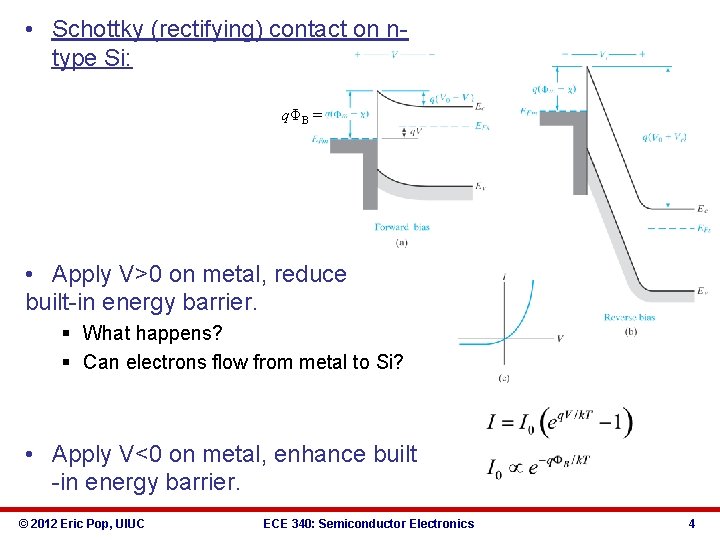
• Schottky (rectifying) contact on ntype Si: qΦB = • Apply V>0 on metal, reduce built-in energy barrier. § What happens? § Can electrons flow from metal to Si? • Apply V<0 on metal, enhance built -in energy barrier. © 2012 Eric Pop, UIUC ECE 340: Semiconductor Electronics 4
• Ohmic contacts on silicon, two ways to achieve them: 1) Choose metal with appropriate work function to “match” the Fermi level of p- or n-type Si 2) Dope silicon highly, to thin out Schottky barrier, so electrons can tunnel through (almost) regardless of Φm © 2012 Eric Pop, UIUC ECE 340: Semiconductor Electronics 5
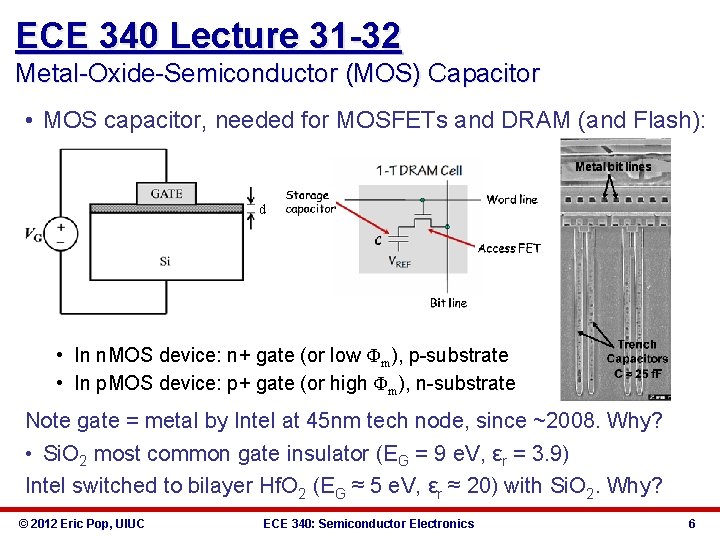
ECE 340 Lecture 31 -32 Metal-Oxide-Semiconductor (MOS) Capacitor • MOS capacitor, needed for MOSFETs and DRAM (and Flash): d • In n. MOS device: n+ gate (or low Φm), p-substrate • In p. MOS device: p+ gate (or high Φm), n-substrate Note gate = metal by Intel at 45 nm tech node, since ~2008. Why? • Si. O 2 most common gate insulator (EG = 9 e. V, εr = 3. 9) Intel switched to bilayer Hf. O 2 (EG ≈ 5 e. V, εr ≈ 20) with Si. O 2. Why? © 2012 Eric Pop, UIUC ECE 340: Semiconductor Electronics 6
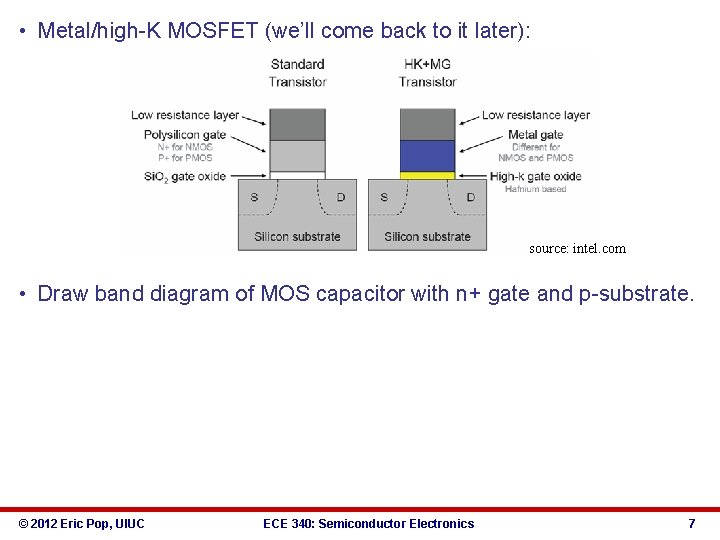
• Metal/high-K MOSFET (we’ll come back to it later): source: intel. com • Draw band diagram of MOS capacitor with n+ gate and p-substrate. © 2012 Eric Pop, UIUC ECE 340: Semiconductor Electronics 7
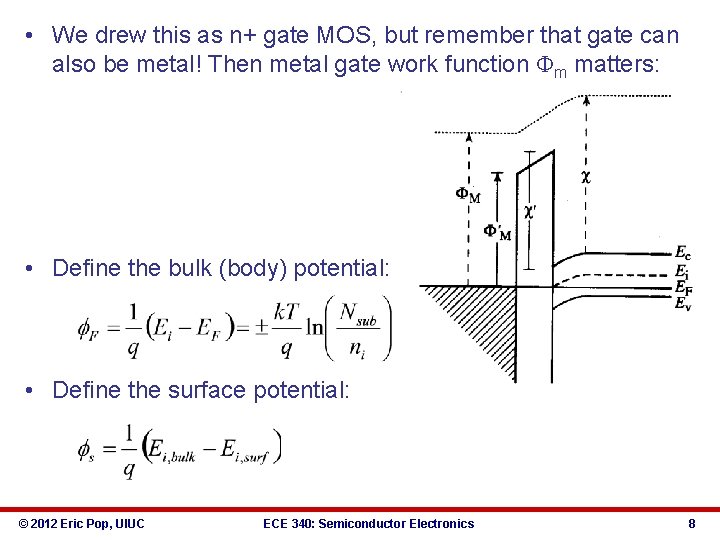
• We drew this as n+ gate MOS, but remember that gate can also be metal! Then metal gate work function Φm matters: • Define the bulk (body) potential: • Define the surface potential: © 2012 Eric Pop, UIUC ECE 340: Semiconductor Electronics 8
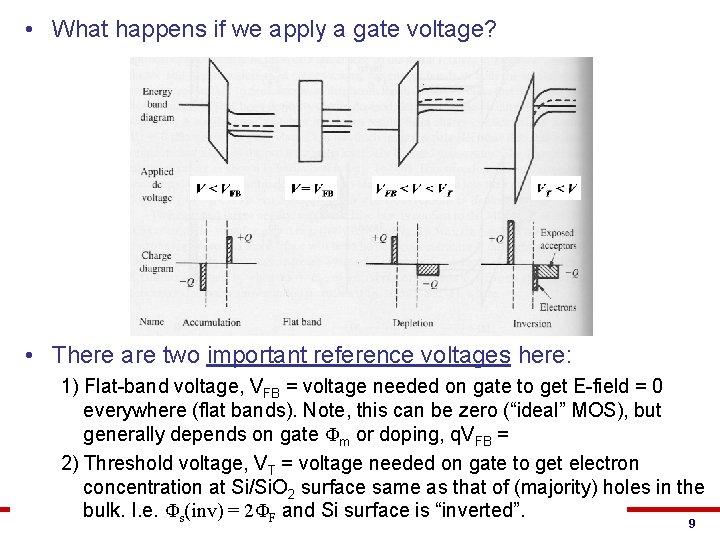
• What happens if we apply a gate voltage? • There are two important reference voltages here: 1) Flat-band voltage, VFB = voltage needed on gate to get E-field = 0 everywhere (flat bands). Note, this can be zero (“ideal” MOS), but generally depends on gate Φm or doping, q. VFB = 2) Threshold voltage, VT = voltage needed on gate to get electron concentration at Si/Si. O 2 surface same as that of (majority) holes in the bulk. I. e. Φs(inv) = 2ΦF and Si surface is “inverted”. © 2012 Eric Pop, UIUC ECE 340: Semiconductor Electronics 9
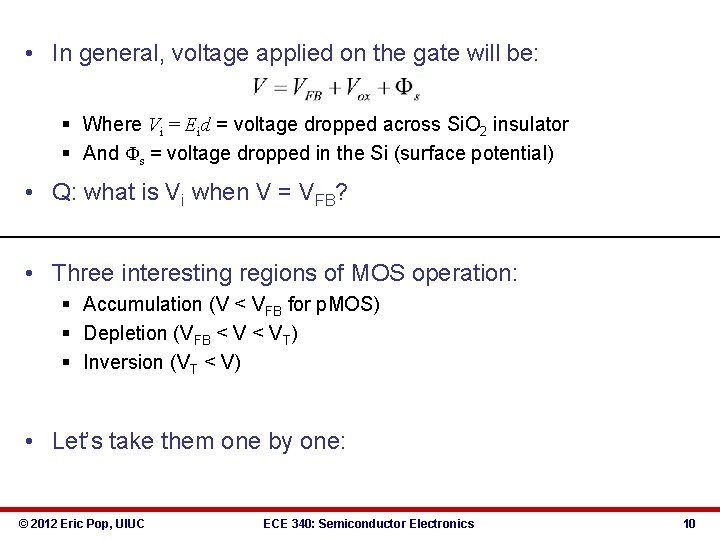
• In general, voltage applied on the gate will be: § Where Vi = Eid = voltage dropped across Si. O 2 insulator § And Φs = voltage dropped in the Si (surface potential) • Q: what is Vi when V = VFB? • Three interesting regions of MOS operation: § Accumulation (V < VFB for p. MOS) § Depletion (VFB < VT) § Inversion (VT < V) • Let’s take them one by one: © 2012 Eric Pop, UIUC ECE 340: Semiconductor Electronics 10
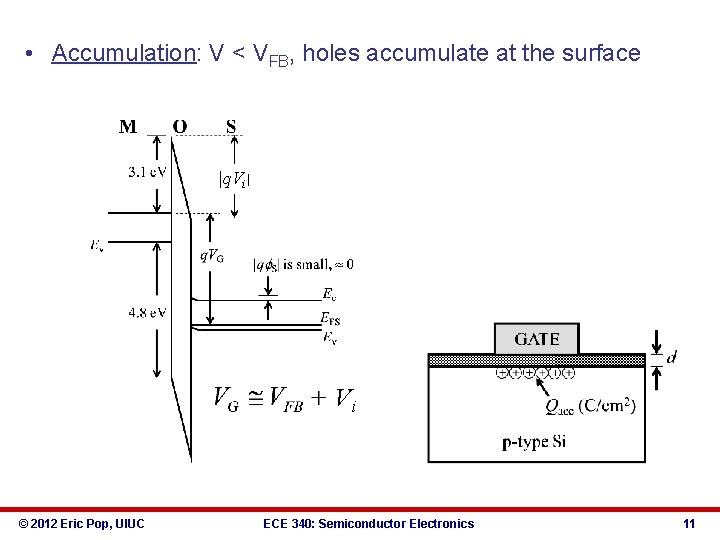
• Accumulation: V < VFB, holes accumulate at the surface |q. Vi| Vi © 2012 Eric Pop, UIUC ECE 340: Semiconductor Electronics 11
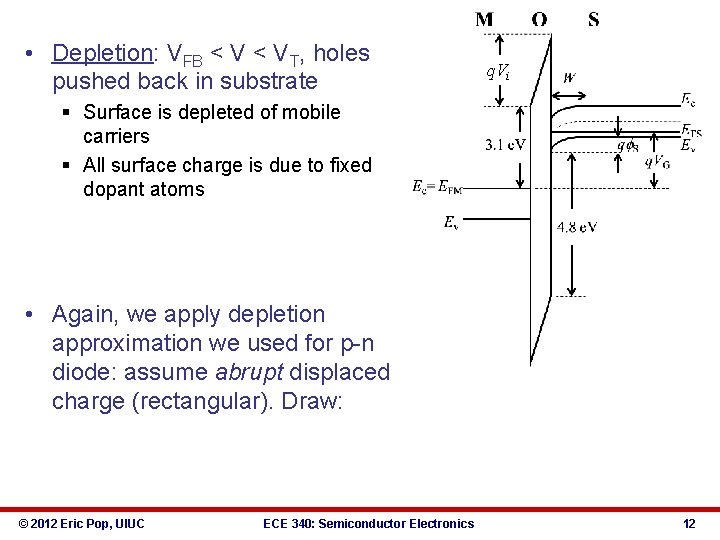
• Depletion: VFB < VT, holes pushed back in substrate q. Vi § Surface is depleted of mobile carriers § All surface charge is due to fixed dopant atoms • Again, we apply depletion approximation we used for p-n diode: assume abrupt displaced charge (rectangular). Draw: © 2012 Eric Pop, UIUC ECE 340: Semiconductor Electronics 12
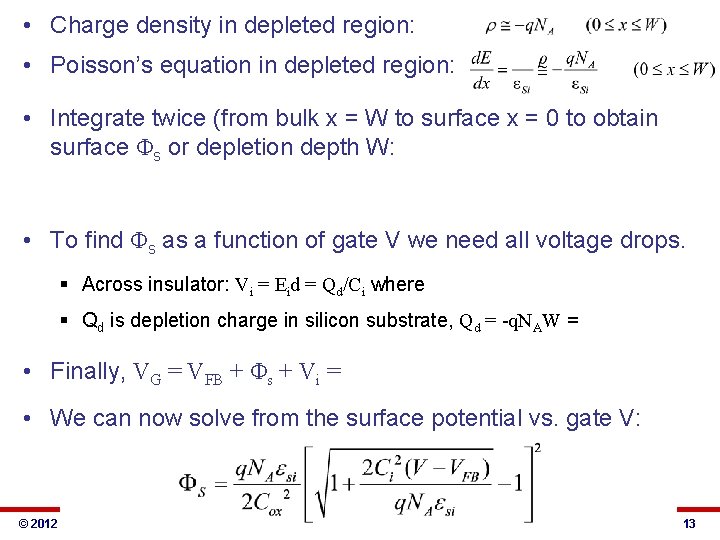
• Charge density in depleted region: • Poisson’s equation in depleted region: • Integrate twice (from bulk x = W to surface x = 0 to obtain surface Φs or depletion depth W: • To find Φs as a function of gate V we need all voltage drops. § Across insulator: Vi = Eid = Qd/Ci where § Qd is depletion charge in silicon substrate, Qd = -q. NAW = • Finally, VG = VFB + Φs + Vi = • We can now solve from the surface potential vs. gate V: © 2012 Eric Pop, UIUC ECE 340: Semiconductor Electronics 13