
ECE 333 Renewable Energy Systems Lecture 10 Wind
ECE 333 Renewable Energy Systems Lecture 10: Wind Power Systems Prof. Tom Overbye Dept. of Electrical and Computer Engineering University of Illinois at Urbana-Champaign overbye@illinois. edu
Announcements • • Read Chapter 7 Quiz today on HW 4 HW 5 is posted on the website; there will be no quiz on this material, but it certainly may be included in the exams First exam is March 5 (during class); closed book, closed notes; you may bring in standard calculators and one 8. 5 by 11 inch handwritten note sheet – In ECEB 3017 and 3002 1
Variable-Slip Induction Generators • • • Purposely add variable resistance to the rotor External adjustable resistors - this can mean using a wound rotor with slip rings and brushes which requires more maintenance Mount resistors and control electronics on the rotor and use an optical fiber link to send the rotor a signal for how much resistance to provide 2
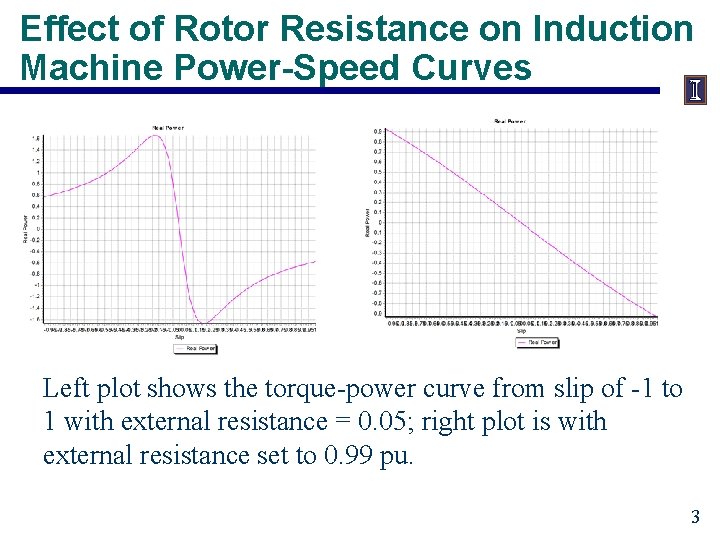
Effect of Rotor Resistance on Induction Machine Power-Speed Curves Left plot shows the torque-power curve from slip of -1 to 1 with external resistance = 0. 05; right plot is with external resistance set to 0. 99 pu. 3
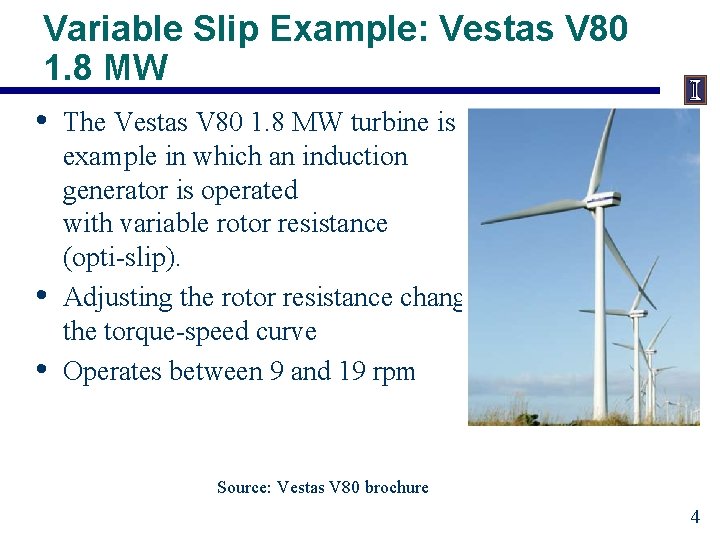
Variable Slip Example: Vestas V 80 1. 8 MW • The Vestas V 80 1. 8 MW turbine is an • • example in which an induction generator is operated with variable rotor resistance (opti-slip). Adjusting the rotor resistance changes the torque-speed curve Operates between 9 and 19 rpm Source: Vestas V 80 brochure 4
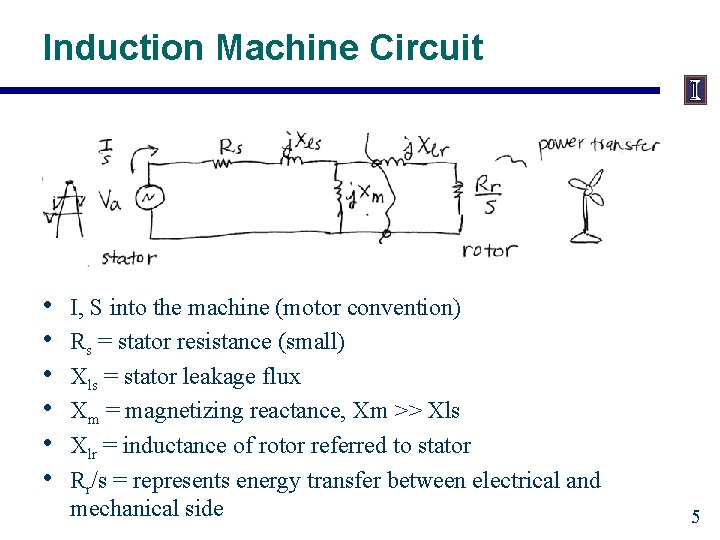
Induction Machine Circuit • • • I, S into the machine (motor convention) Rs = stator resistance (small) Xls = stator leakage flux Xm = magnetizing reactance, Xm >> Xls Xlr = inductance of rotor referred to stator Rr/s = represents energy transfer between electrical and mechanical side 5
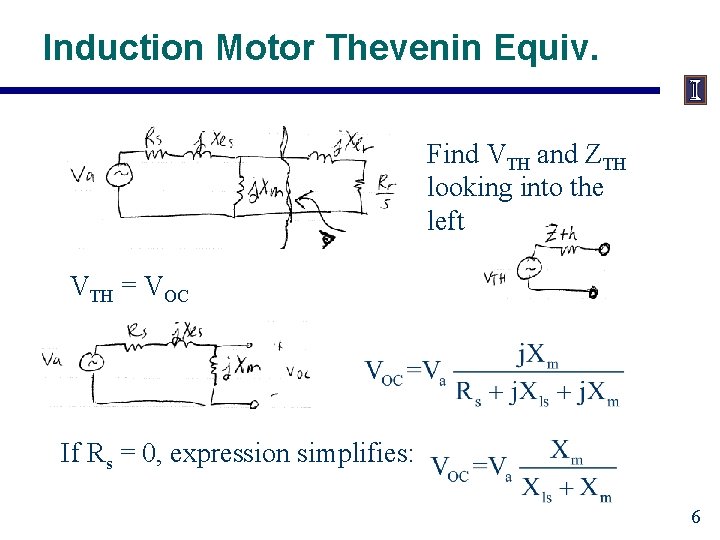
Induction Motor Thevenin Equiv. Find VTH and ZTH looking into the left VTH = VOC If Rs = 0, expression simplifies: 6
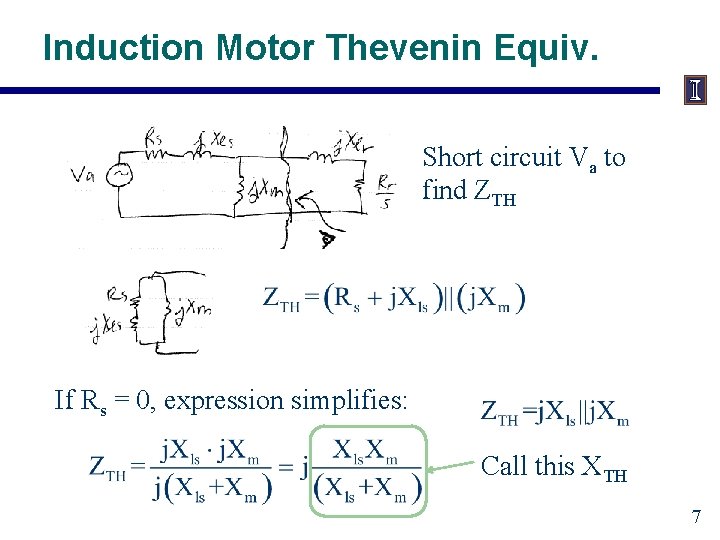
Induction Motor Thevenin Equiv. Short circuit Va to find ZTH If Rs = 0, expression simplifies: Call this XTH 7
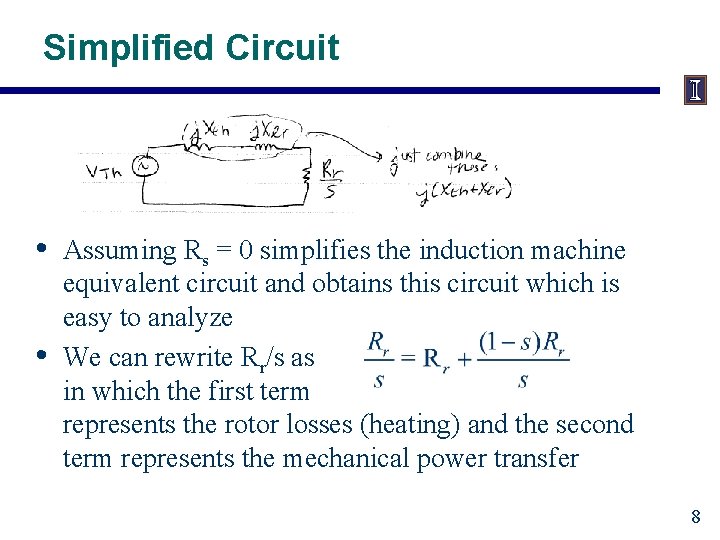
Simplified Circuit • • Assuming Rs = 0 simplifies the induction machine equivalent circuit and obtains this circuit which is easy to analyze We can rewrite Rr/s as in which the first term represents the rotor losses (heating) and the second term represents the mechanical power transfer 8
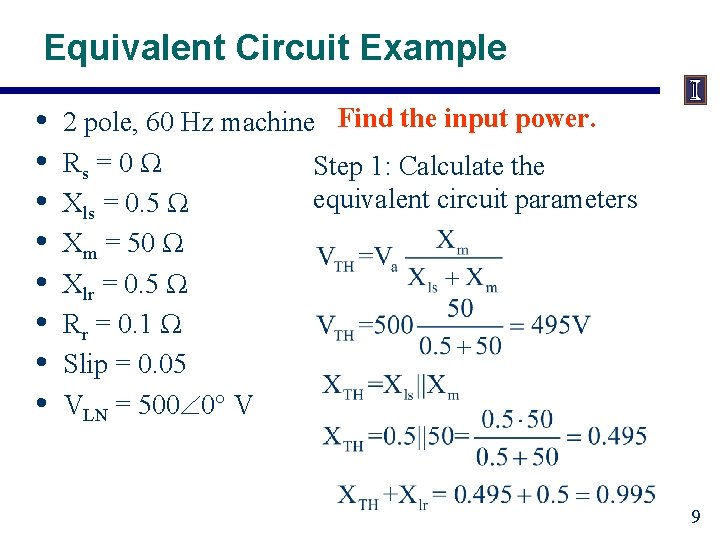
Equivalent Circuit Example • • 2 pole, 60 Hz machine Find the input power. Rs = 0 Ω Step 1: Calculate the equivalent circuit parameters Xls = 0. 5 Ω Xm = 50 Ω Xlr = 0. 5 Ω Rr = 0. 1 Ω Slip = 0. 05 VLN = 500 0° V 9
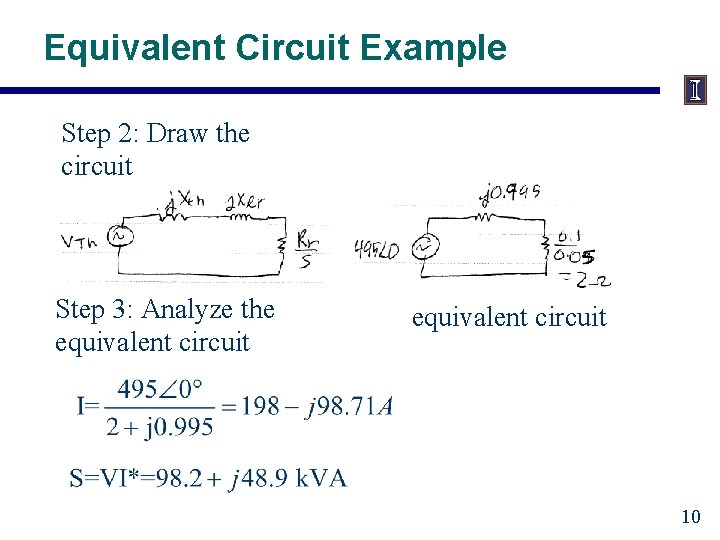
Equivalent Circuit Example Step 2: Draw the circuit Step 3: Analyze the equivalent circuit 10
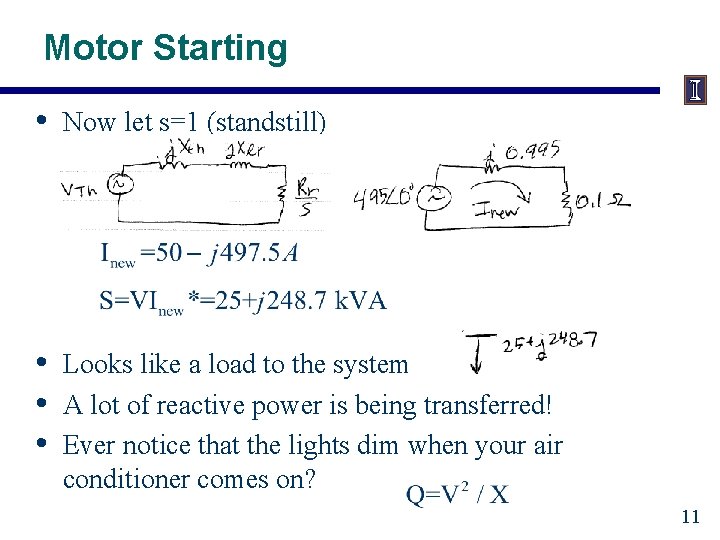
Motor Starting • Now let s=1 (standstill) • • • Looks like a load to the system A lot of reactive power is being transferred! Ever notice that the lights dim when your air conditioner comes on? 11
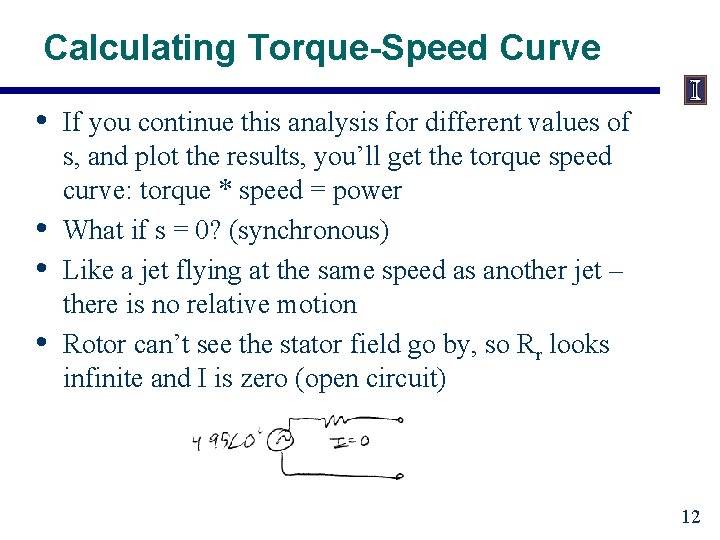
Calculating Torque-Speed Curve • • If you continue this analysis for different values of s, and plot the results, you’ll get the torque speed curve: torque * speed = power What if s = 0? (synchronous) Like a jet flying at the same speed as another jet – there is no relative motion Rotor can’t see the stator field go by, so Rr looks infinite and I is zero (open circuit) 12
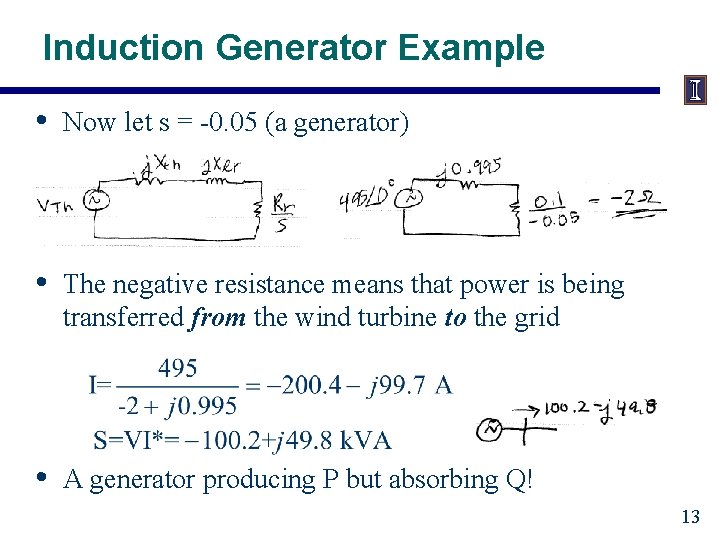
Induction Generator Example • Now let s = -0. 05 (a generator) • The negative resistance means that power is being transferred from the wind turbine to the grid • A generator producing P but absorbing Q! 13
Reactive Power Support • • Wind turbine generators can produce real power but consume reactive power This is especially a problem with Types 1 and 2 wind turbines which are induction machines, like this model Capacitors or other power factor correction devices are needed Types 3 and 4 can provide reactive support, details beyond the scope of this class 14
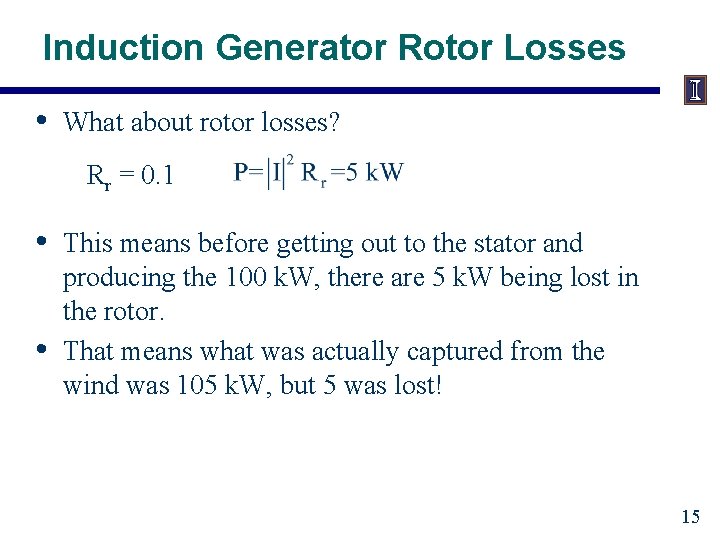
Induction Generator Rotor Losses • What about rotor losses? Rr = 0. 1 • • This means before getting out to the stator and producing the 100 k. W, there are 5 k. W being lost in the rotor. That means what was actually captured from the wind was 105 k. W, but 5 was lost! 15
Doubly-Fed Induction Generators • • • Another common approach is to use what is called a doubly-fed induction generator in which there is an electrical connection between the rotor and supply electrical system using an ac-ac converter This allows operation over a wide-range of speed, for example 30% with the GE 1. 5 MW and 3. 6 MW machines Called Type 3 wind turbines 16
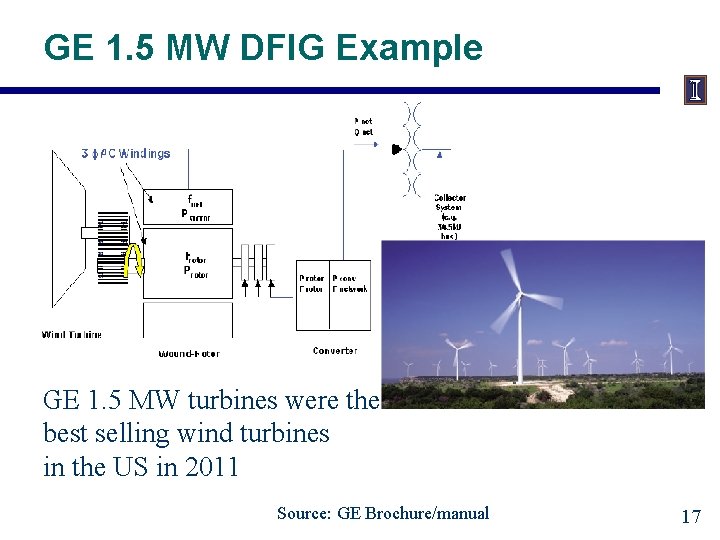
GE 1. 5 MW DFIG Example GE 1. 5 MW turbines were the best selling wind turbines in the US in 2011 Source: GE Brochure/manual 17
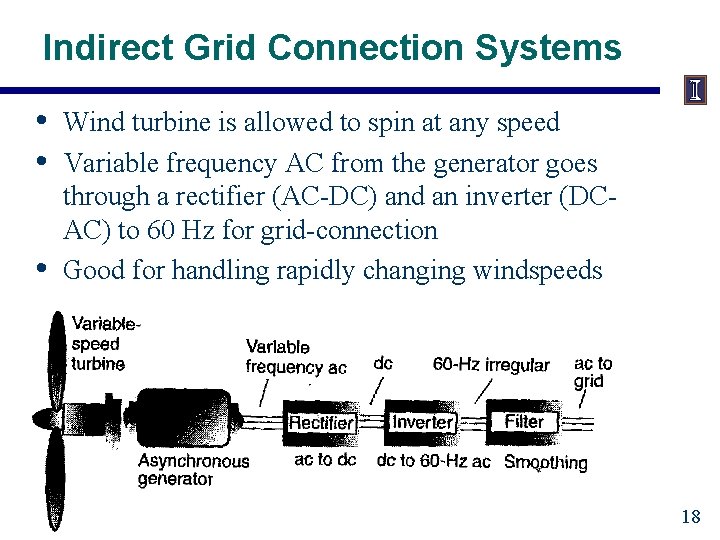
Indirect Grid Connection Systems • • • Wind turbine is allowed to spin at any speed Variable frequency AC from the generator goes through a rectifier (AC-DC) and an inverter (DCAC) to 60 Hz for grid-connection Good for handling rapidly changing windspeeds 18
Wind Turbine Gearboxes • A significant portion of the weight in the nacelle is due to the gearbox – • • Needed to change the slow blade shaft speed into the higher speed needed for the electric machine Gearboxes require periodic maintenance (e. g. , change the oil), and have also be a common source of wind turbine failure Some wind turbine designs are now getting rid of the gearbox by using electric generators with many pole pairs (direct-drive systems) 19
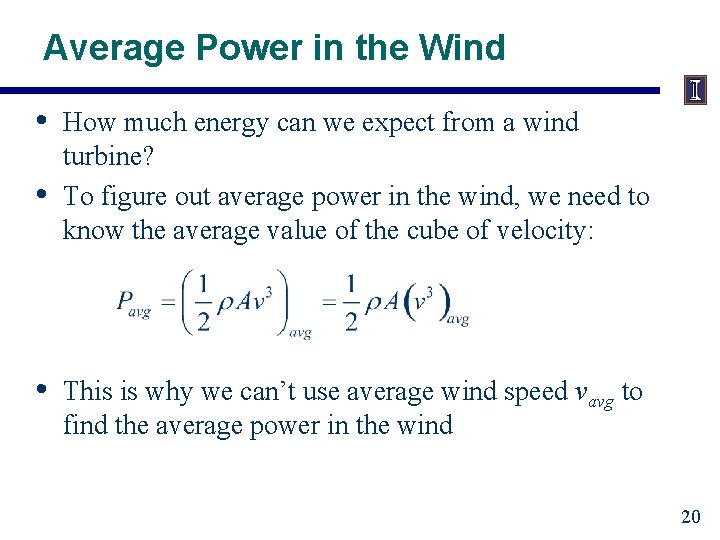
Average Power in the Wind • • • How much energy can we expect from a wind turbine? To figure out average power in the wind, we need to know the average value of the cube of velocity: This is why we can’t use average wind speed vavg to find the average power in the wind 20
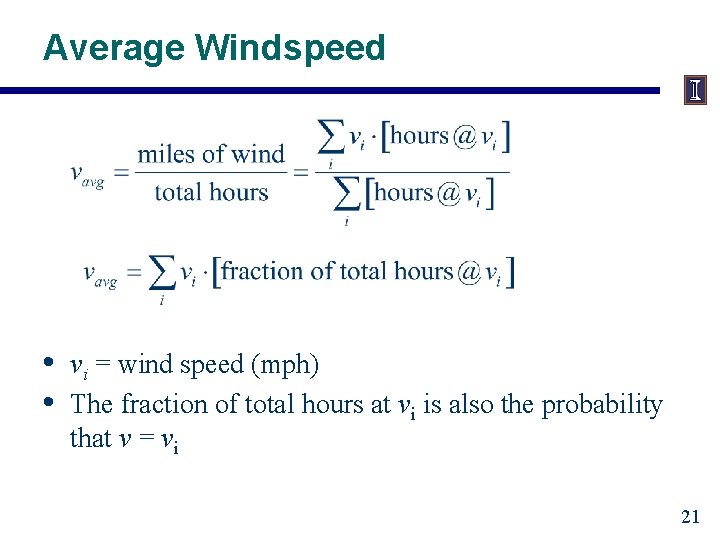
Average Windspeed • • vi = wind speed (mph) The fraction of total hours at vi is also the probability that v = vi 21
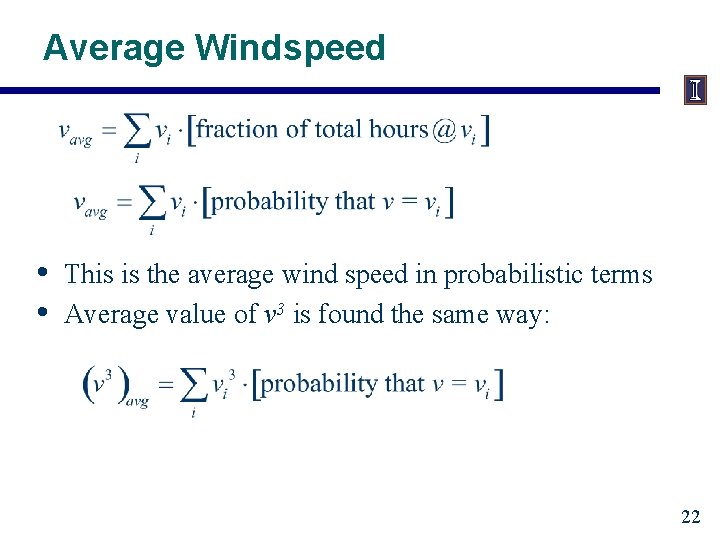
Average Windspeed • • This is the average wind speed in probabilistic terms Average value of v 3 is found the same way: 22
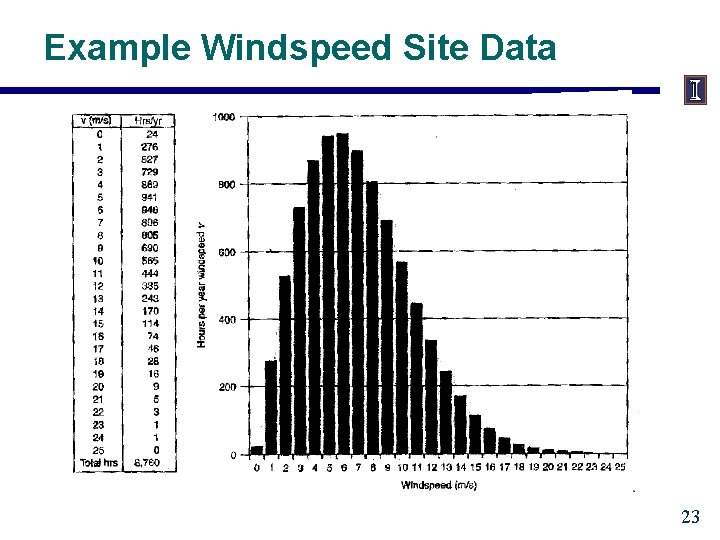
Example Windspeed Site Data 23
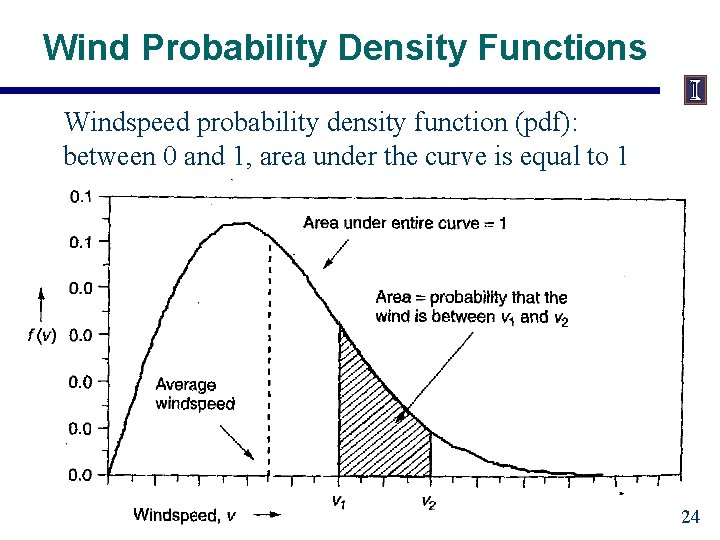
Wind Probability Density Functions Windspeed probability density function (pdf): between 0 and 1, area under the curve is equal to 1 24
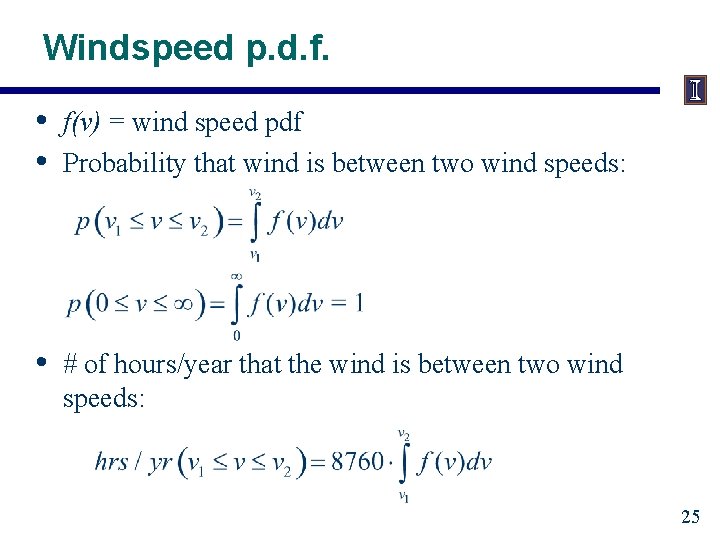
Windspeed p. d. f. • • f(v) = wind speed pdf Probability that wind is between two wind speeds: • # of hours/year that the wind is between two wind speeds: 25
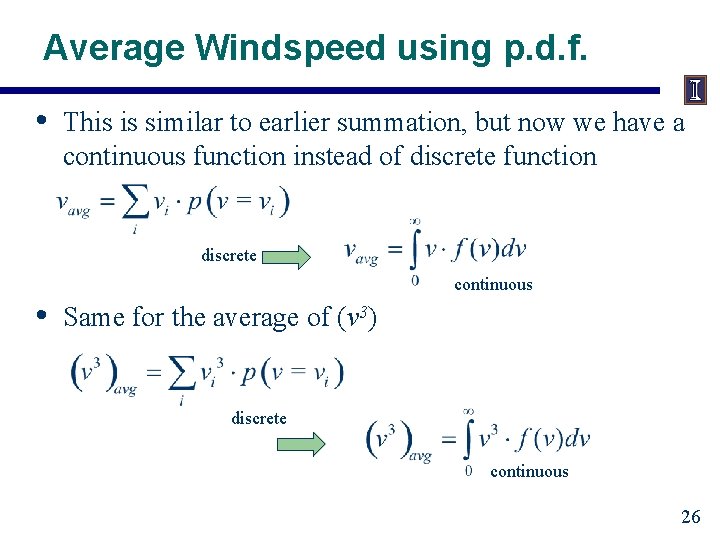
Average Windspeed using p. d. f. • This is similar to earlier summation, but now we have a continuous function instead of discrete function discrete continuous • Same for the average of (v 3) discrete continuous 26
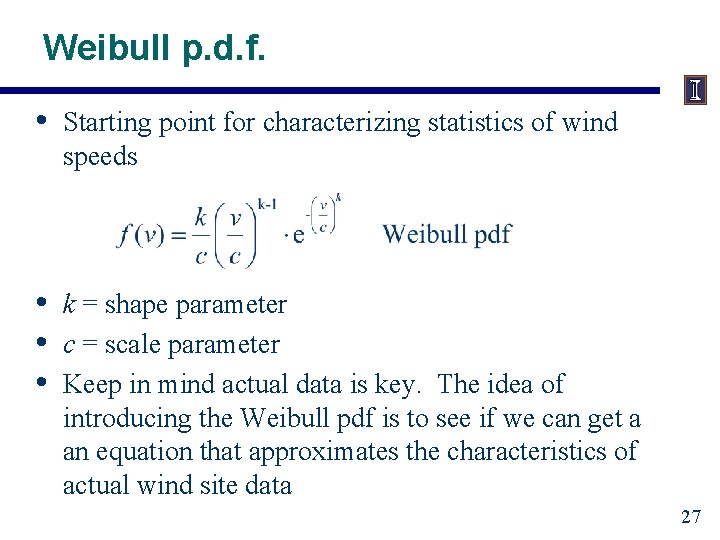
Weibull p. d. f. • Starting point for characterizing statistics of wind speeds • • • k = shape parameter c = scale parameter Keep in mind actual data is key. The idea of introducing the Weibull pdf is to see if we can get a an equation that approximates the characteristics of actual wind site data 27
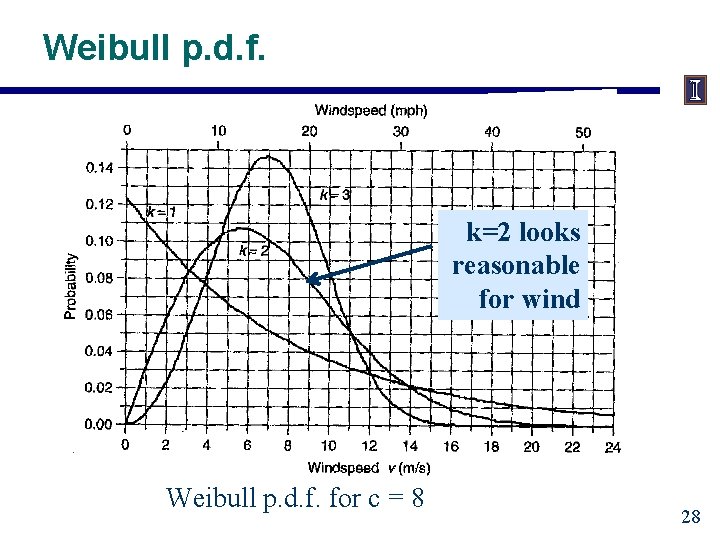
Weibull p. d. f. k=2 looks reasonable for wind Weibull p. d. f. for c = 8 28
Where did the Weibull PDF Come From • • Invented by Waloddi Weibull in 1937, and presented in hallmark American paper in 1951 Weibull's claim was that it fit data for a wide range of problems, ranging from strength of steel to the height of adult males Initially greeted with skepticism – it seemed too good to be true, but further testing has shown its value Widely used since it allows a complete pdf response to be approximated from a small set of samples – But this approximation is not going to work well for every data set!! Reference: http: //www. barringer 1. com/pdf/Chpt 1 -5 th-edition. pdf 29
- Slides: 30