
ECE 3130 Digital Electronics and Design Lab 2
ECE 3130 – Digital Electronics and Design Lab 2 Adders and Multiplexers Fall 2012 Allan Guan
Objectives • Learn how adders and multiplexers work • Build and simulate a half and full adder • Build and simulate a 2 -to-1 and 4 -to-1 multiplexer Allan Guan
What are adders? • Digital circuits that perform addition of numbers • Half adder – Adds two 1 -bit binary numbers • Full adder – Adds three 1 -bit binary numbers Allan Guan
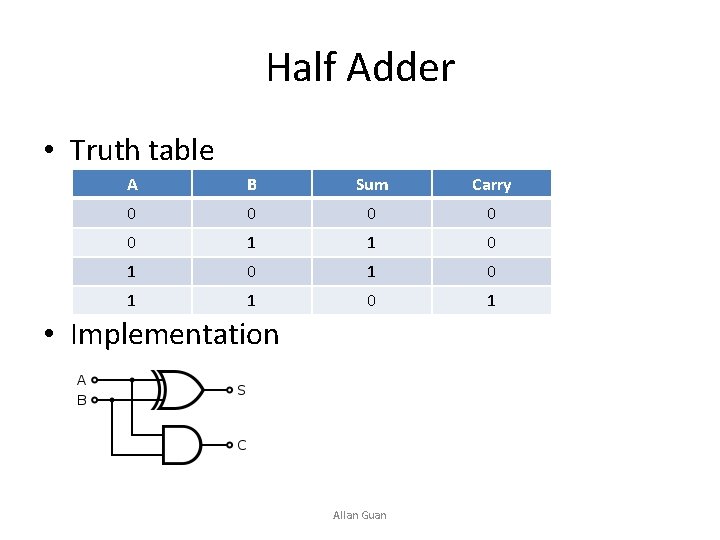
Half Adder • Truth table A B Sum Carry 0 0 0 1 1 0 1 0 1 • Implementation Allan Guan
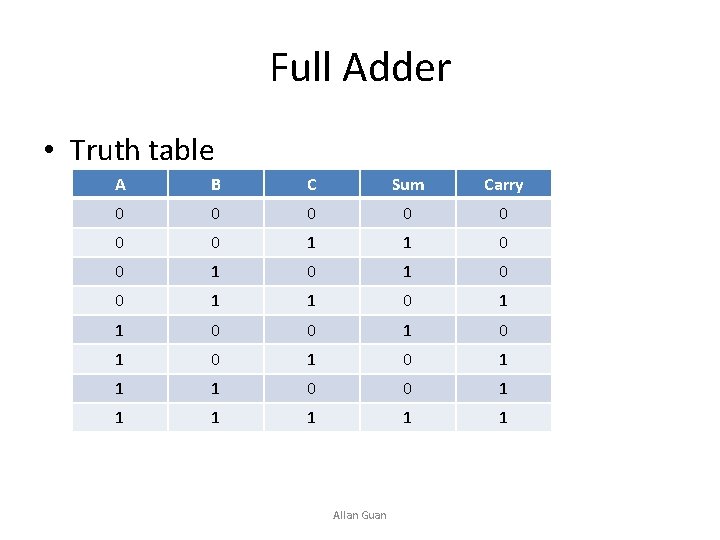
Full Adder • Truth table A B C Sum Carry 0 0 0 0 1 1 0 0 1 0 1 1 1 0 0 1 1 1 Allan Guan
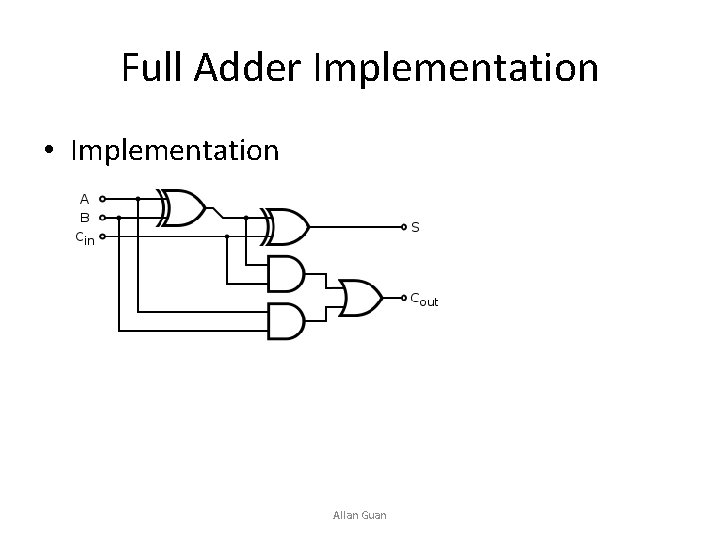
Full Adder Implementation • Implementation Allan Guan
Analysis • In addition to the truth table, include the Boolean equation for the sum and carry of the half and full adder. • Report, in tabular form, the propagation delays (t. PHL, t. PLH) of the sum and carry for the half adder. • Which output has longer delay: sum or carry? Can you say why? Allan Guan
What is a multiplexer (MUX)? • A device with multiple inputs and one output • Also known as a data selector or controlled switch Allan Guan
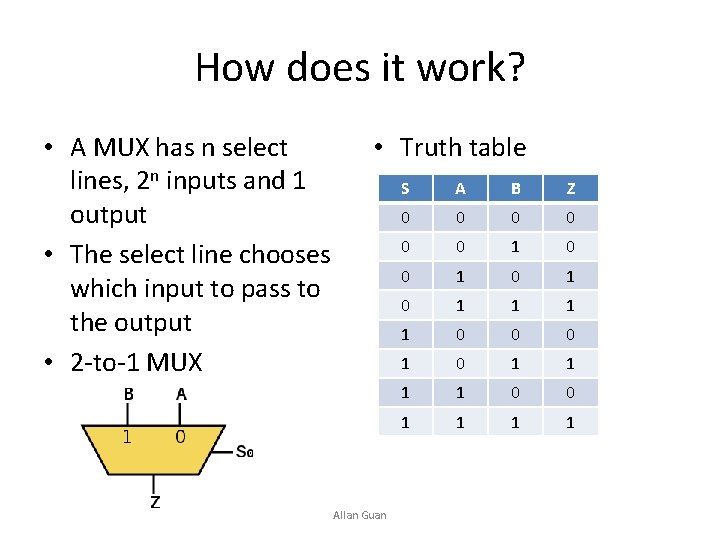
How does it work? • A MUX has n select lines, 2 n inputs and 1 output • The select line chooses which input to pass to the output • 2 -to-1 MUX • Truth table Allan Guan S A B Z 0 0 0 1 0 1 1 0 0 0 1 1 1 1 0 0 1 1
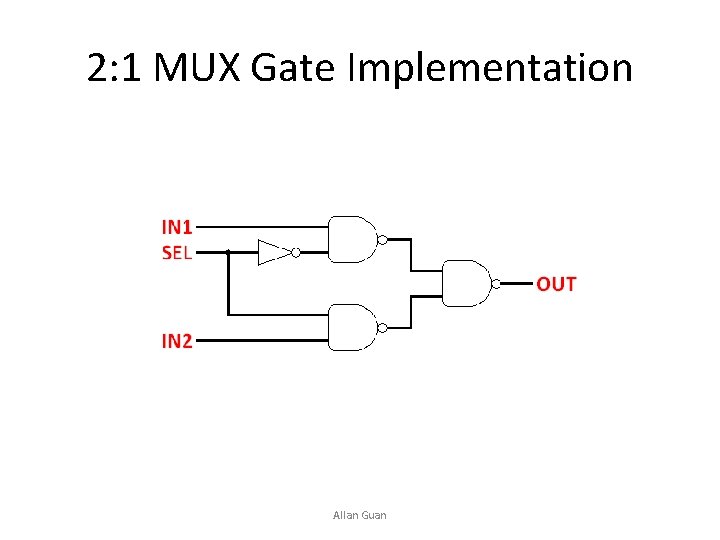
2: 1 MUX Gate Implementation Allan Guan
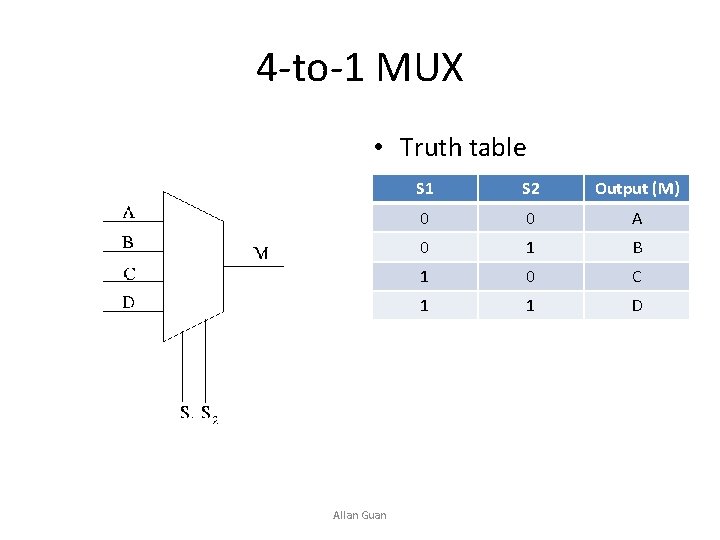
4 -to-1 MUX • Truth table Allan Guan S 1 S 2 Output (M) 0 0 A 0 1 B 1 0 C 1 1 D
Homework • Build a 2: 1 MUX and simulate it • Build a 4: 1 MUX from your 2: 1 MUX (hint: you will need three 2: 1 MUX’s) and simulate it • You will be using the 4: 1 MUX next lab Allan Guan
- Slides: 12