
ECE 2795 Microgrid Concepts and Distributed Generation Technologies
ECE 2795 Microgrid Concepts and Distributed Generation Technologies Spring 2015 Week #6 © A. Kwasinski, 2014
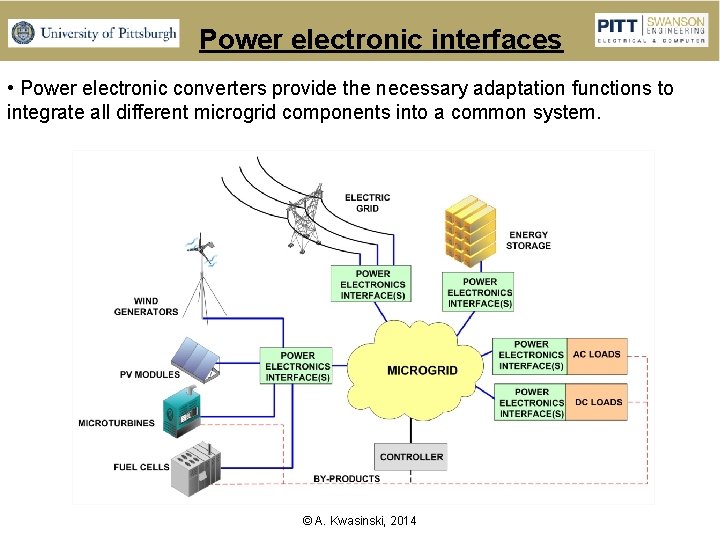
Power electronic interfaces • Power electronic converters provide the necessary adaptation functions to integrate all different microgrid components into a common system. © A. Kwasinski, 2014
Power electronic interfaces • Integration needs: • Component with different characteristics: • dc or ac architecture. • Sources, loads, and energy storage devices output. • Control issues: • Stabilization • Operational issues: • Optimization based on some goal • Efficiency (e. g. MPPT) • Flexibility • Reliability • Safety • Other issues: • Interaction with other systems (e. g. the main grid) © A. Kwasinski, 2014
Power electronics basics • Types of interfaces: • dc-dc: dc-dc converter • ac-dc: rectifier • dc-ac: inverter • ac-ac: cycloconverter (used less often) • Power electronic converters components: • Semiconductor switches: • Diodes • MOSFETs • IGBTs • SCRs • Energy storage elements • Inductors • Capacitors • Other components: • Transformer • Control circuit © A. Kwasinski, 2014
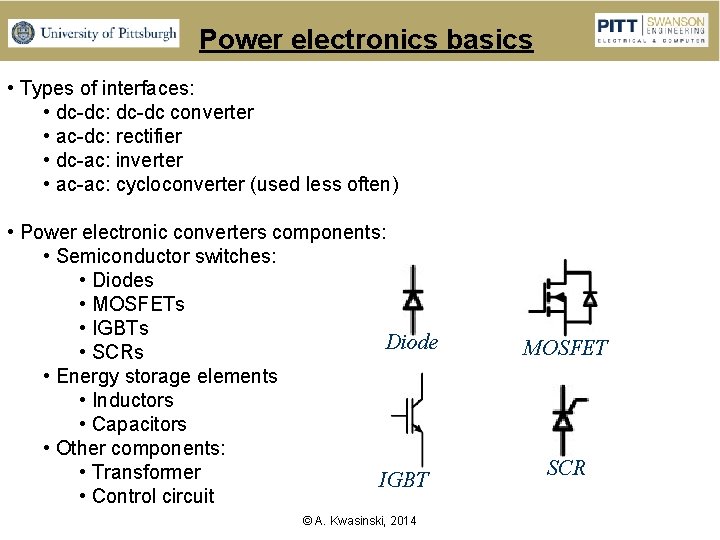
Power electronics basics • Types of interfaces: • dc-dc: dc-dc converter • ac-dc: rectifier • dc-ac: inverter • ac-ac: cycloconverter (used less often) • Power electronic converters components: • Semiconductor switches: • Diodes • MOSFETs • IGBTs Diode • SCRs • Energy storage elements • Inductors • Capacitors • Other components: • Transformer IGBT • Control circuit © A. Kwasinski, 2014 MOSFET SCR
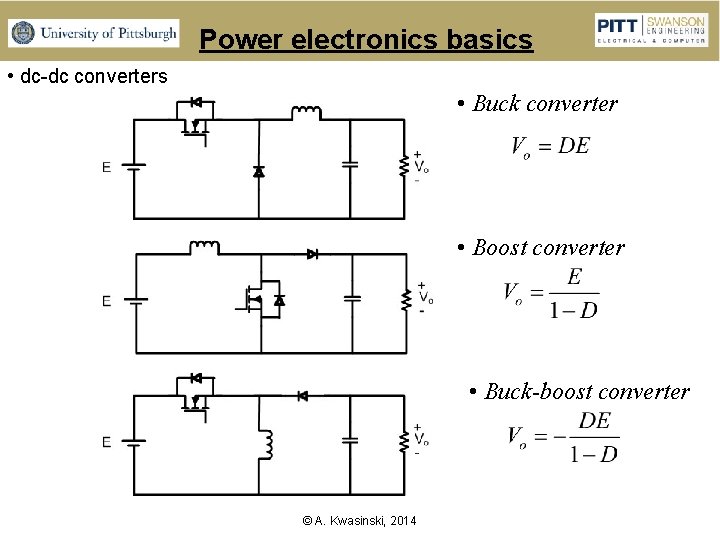
Power electronics basics • dc-dc converters • Buck converter • Boost converter • Buck-boost converter © A. Kwasinski, 2014
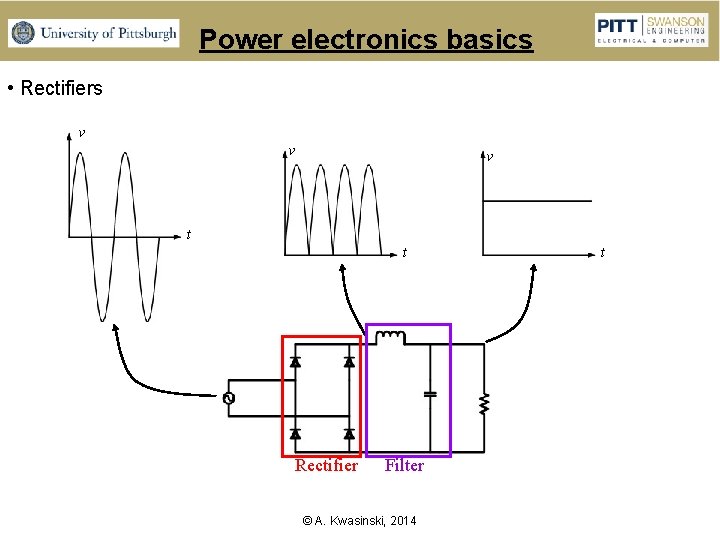
Power electronics basics • Rectifiers v v v t t Rectifier Filter © A. Kwasinski, 2014 t
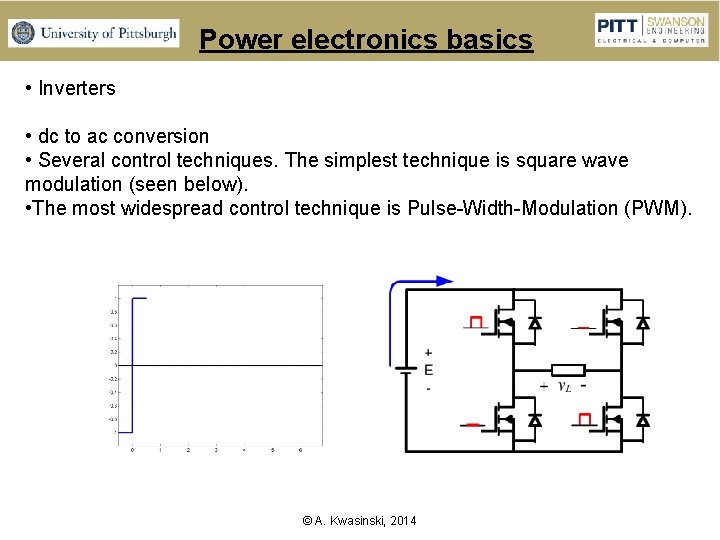
Power electronics basics • Inverters • dc to ac conversion • Several control techniques. The simplest technique is square wave modulation (seen below). • The most widespread control technique is Pulse-Width-Modulation (PWM). © A. Kwasinski, 2014
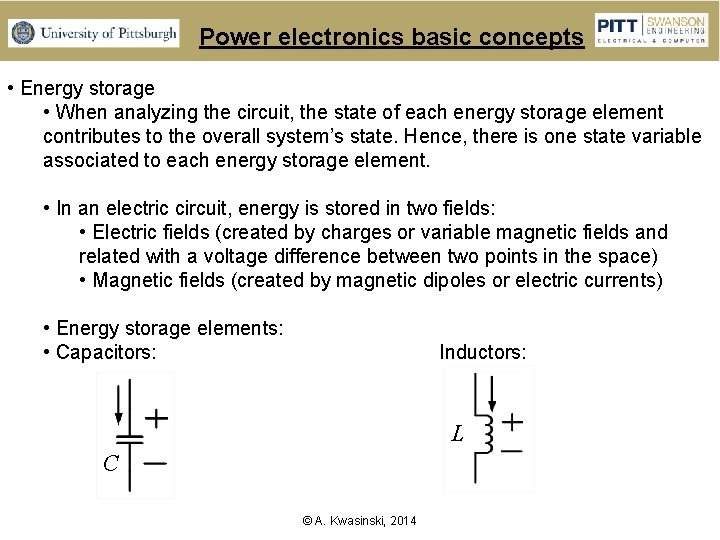
Power electronics basic concepts • Energy storage • When analyzing the circuit, the state of each energy storage element contributes to the overall system’s state. Hence, there is one state variable associated to each energy storage element. • In an electric circuit, energy is stored in two fields: • Electric fields (created by charges or variable magnetic fields and related with a voltage difference between two points in the space) • Magnetic fields (created by magnetic dipoles or electric currents) • Energy storage elements: • Capacitors: Inductors: L C © A. Kwasinski, 2014
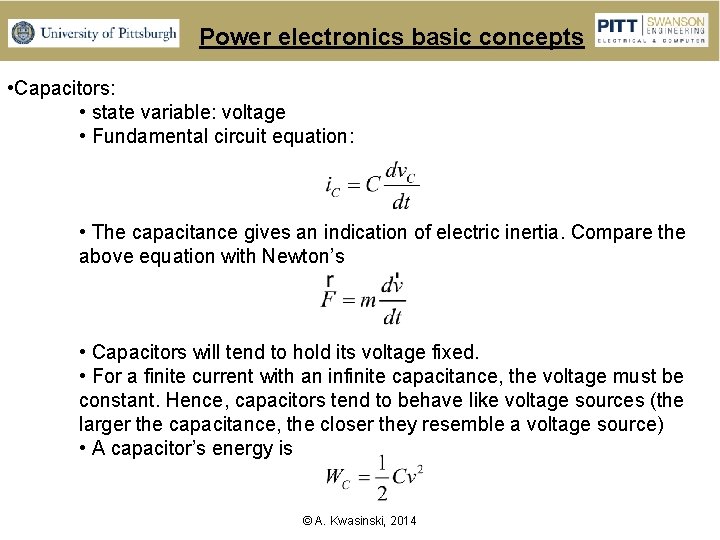
Power electronics basic concepts • Capacitors: • state variable: voltage • Fundamental circuit equation: • The capacitance gives an indication of electric inertia. Compare the above equation with Newton’s • Capacitors will tend to hold its voltage fixed. • For a finite current with an infinite capacitance, the voltage must be constant. Hence, capacitors tend to behave like voltage sources (the larger the capacitance, the closer they resemble a voltage source) • A capacitor’s energy is © A. Kwasinski, 2014
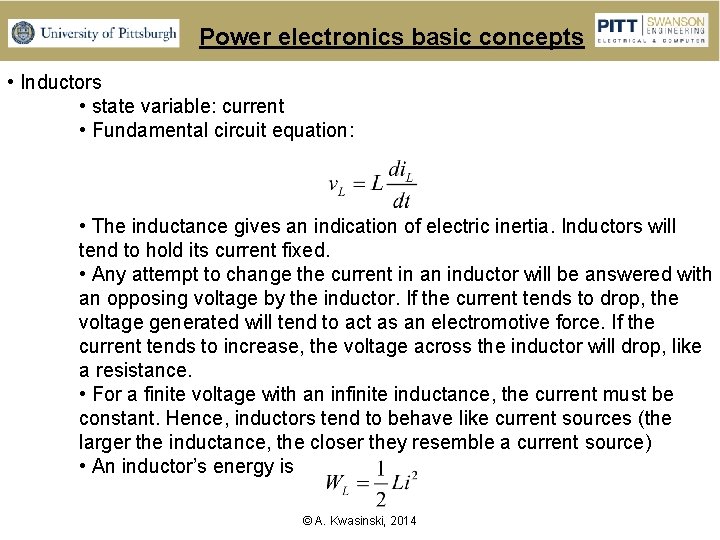
Power electronics basic concepts • Inductors • state variable: current • Fundamental circuit equation: • The inductance gives an indication of electric inertia. Inductors will tend to hold its current fixed. • Any attempt to change the current in an inductor will be answered with an opposing voltage by the inductor. If the current tends to drop, the voltage generated will tend to act as an electromotive force. If the current tends to increase, the voltage across the inductor will drop, like a resistance. • For a finite voltage with an infinite inductance, the current must be constant. Hence, inductors tend to behave like current sources (the larger the inductance, the closer they resemble a current source) • An inductor’s energy is © A. Kwasinski, 2014
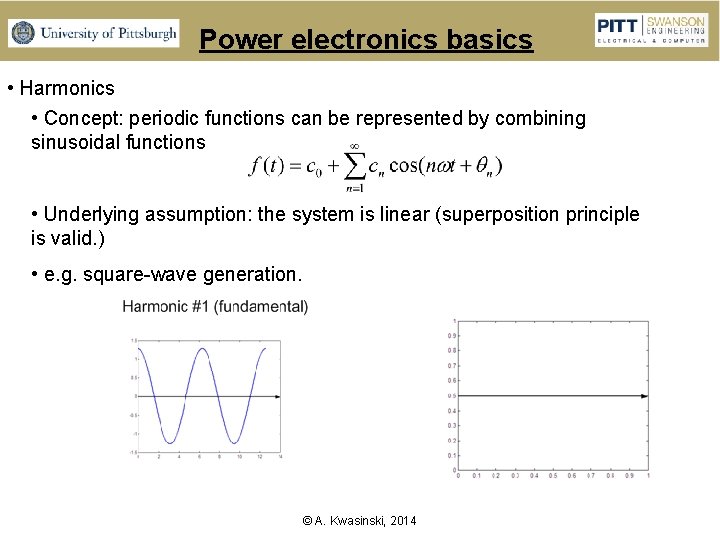
Power electronics basics • Harmonics • Concept: periodic functions can be represented by combining sinusoidal functions • Underlying assumption: the system is linear (superposition principle is valid. ) • e. g. square-wave generation. © A. Kwasinski, 2014

Power electronics basics • Additional definitions related with Fourier analysis © A. Kwasinski, 2014
- Slides: 13