
ECE 250 Algorithms and Data Structures Quicksort Douglas






- Slides: 127
ECE 250 Algorithms and Data Structures Quicksort Douglas Wilhelm Harder, M. Math. LEL Department of Electrical and Computer Engineering University of Waterloo, Ontario, Canada ece. uwaterloo. ca dwharder@alumni. uwaterloo. ca © 2006 -2013 by Douglas Wilhelm Harder. Some rights reserved.
Quicksort 2 Outline In this topic we will look at quicksort: – – – The idea behind the algorithm The run time and worst-case scenario Strategy for avoiding the worst-case: median-of-three Implementing quicksort in place Examples
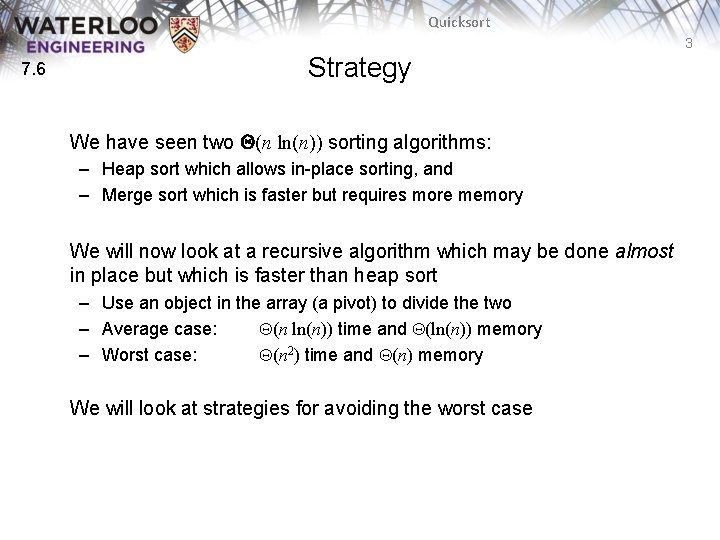
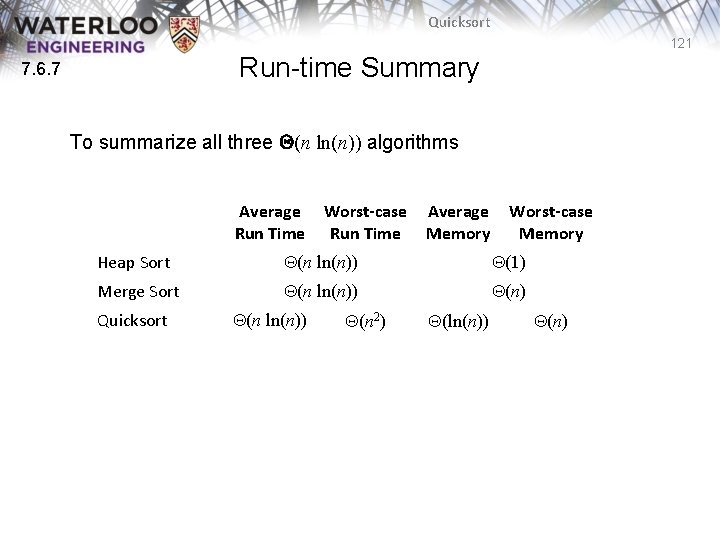
Quicksort 3 7. 6 Strategy We have seen two Q(n ln(n)) sorting algorithms: – Heap sort which allows in-place sorting, and – Merge sort which is faster but requires more memory We will now look at a recursive algorithm which may be done almost in place but which is faster than heap sort – Use an object in the array (a pivot) to divide the two – Average case: Q(n ln(n)) time and Q(ln(n)) memory – Worst case: Q(n 2) time and Q(n) memory We will look at strategies for avoiding the worst case
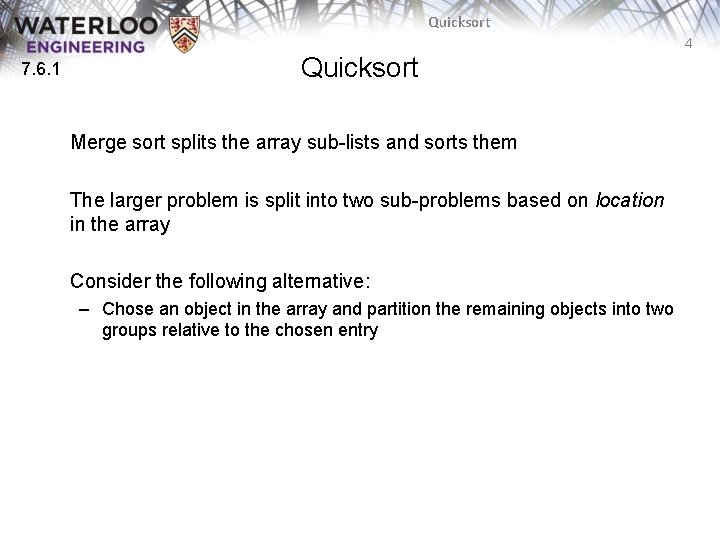
Quicksort 4 7. 6. 1 Quicksort Merge sort splits the array sub-lists and sorts them The larger problem is split into two sub-problems based on location in the array Consider the following alternative: – Chose an object in the array and partition the remaining objects into two groups relative to the chosen entry
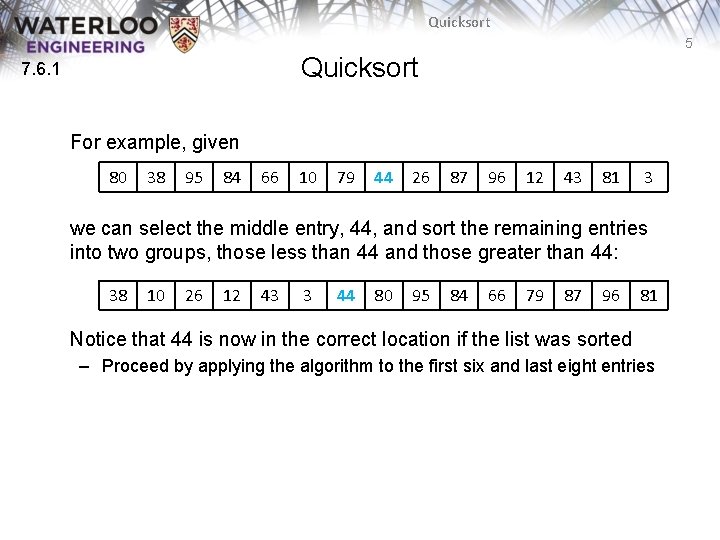
Quicksort 5 Quicksort 7. 6. 1 For example, given 80 38 95 84 66 10 79 44 26 87 96 12 43 81 3 we can select the middle entry, 44, and sort the remaining entries into two groups, those less than 44 and those greater than 44: 38 10 26 12 43 3 44 80 95 84 66 79 87 96 81 Notice that 44 is now in the correct location if the list was sorted – Proceed by applying the algorithm to the first six and last eight entries
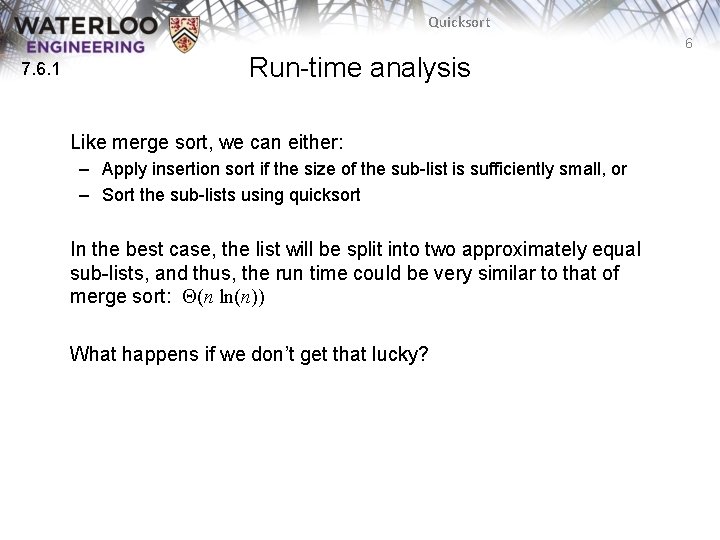
Quicksort 6 7. 6. 1 Run-time analysis Like merge sort, we can either: – Apply insertion sort if the size of the sub-list is sufficiently small, or – Sort the sub-lists using quicksort In the best case, the list will be split into two approximately equal sub-lists, and thus, the run time could be very similar to that of merge sort: Q(n ln(n)) What happens if we don’t get that lucky?
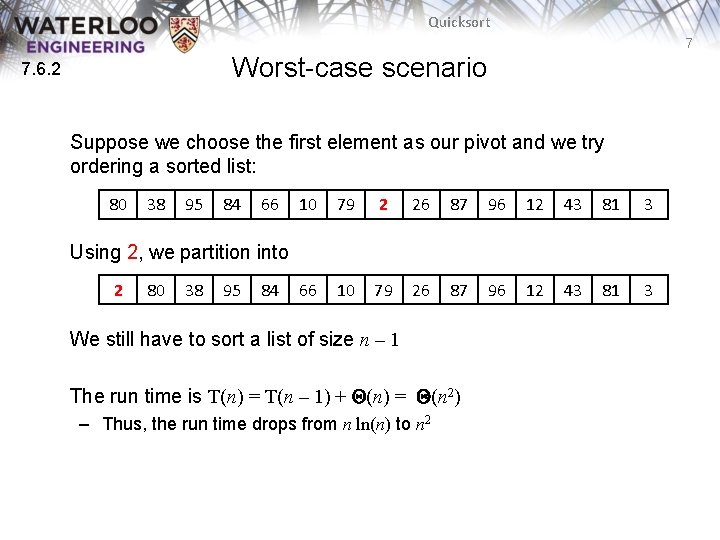
Quicksort 7 Worst-case scenario 7. 6. 2 Suppose we choose the first element as our pivot and we try ordering a sorted list: 80 38 95 84 66 10 79 2 26 87 96 12 43 81 3 66 10 79 26 87 96 12 43 81 3 Using 2, we partition into 2 80 38 95 84 We still have to sort a list of size n – 1 The run time is T(n) = T(n – 1) + Q(n) = Q(n 2) – Thus, the run time drops from n ln(n) to n 2
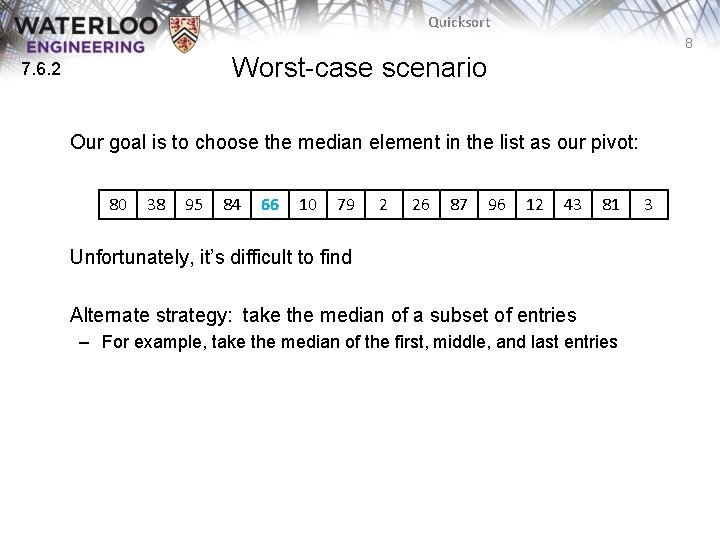
Quicksort 8 Worst-case scenario 7. 6. 2 Our goal is to choose the median element in the list as our pivot: 80 38 95 84 66 10 79 2 26 87 96 12 43 81 Unfortunately, it’s difficult to find Alternate strategy: take the median of a subset of entries – For example, take the median of the first, middle, and last entries 3
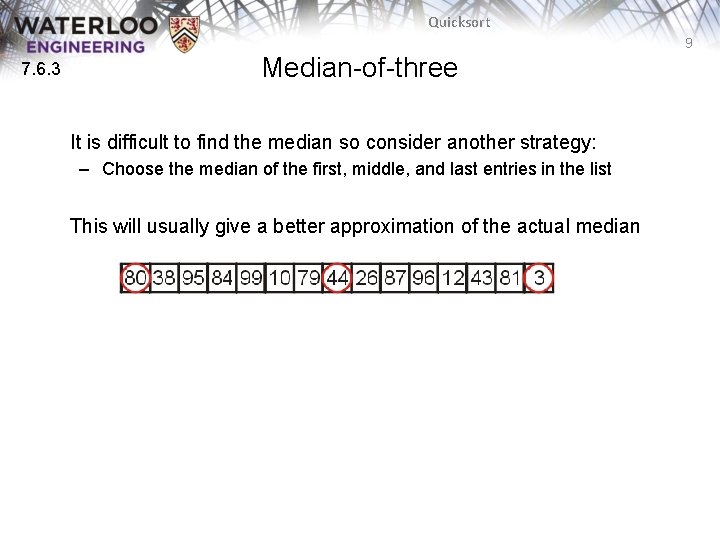
Quicksort 9 7. 6. 3 Median-of-three It is difficult to find the median so consider another strategy: – Choose the median of the first, middle, and last entries in the list This will usually give a better approximation of the actual median
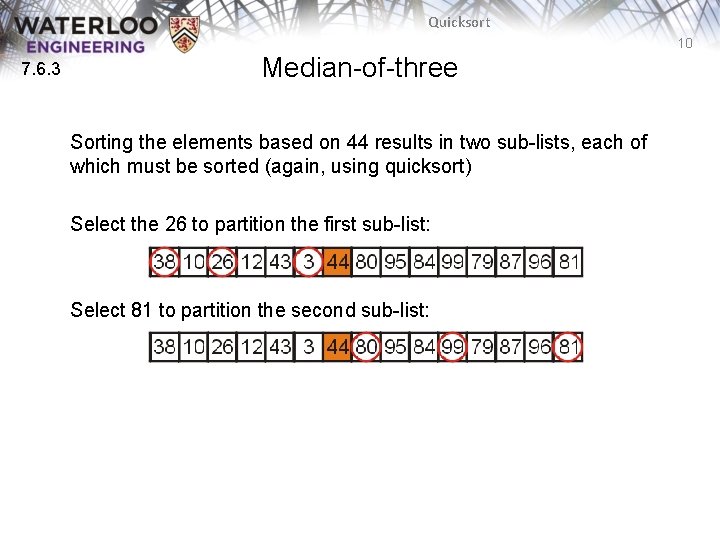
Quicksort 10 7. 6. 3 Median-of-three Sorting the elements based on 44 results in two sub-lists, each of which must be sorted (again, using quicksort) Select the 26 to partition the first sub-list: Select 81 to partition the second sub-list:
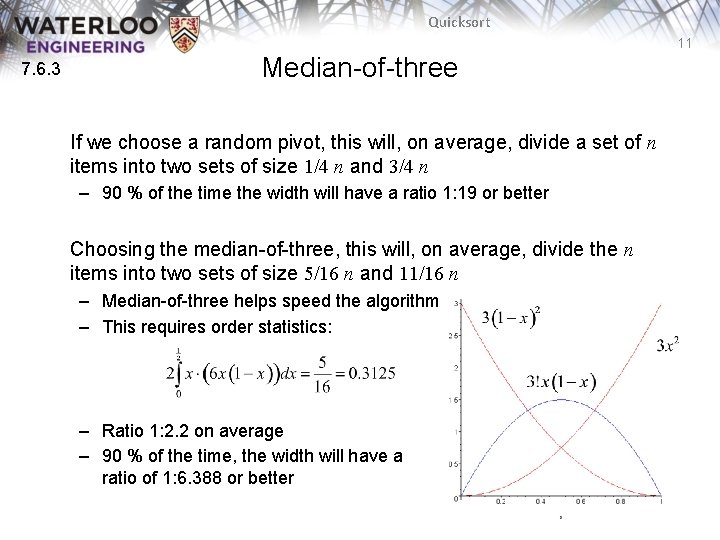
Quicksort 11 7. 6. 3 Median-of-three If we choose a random pivot, this will, on average, divide a set of n items into two sets of size 1/4 n and 3/4 n – 90 % of the time the width will have a ratio 1: 19 or better Choosing the median-of-three, this will, on average, divide the n items into two sets of size 5/16 n and 11/16 n – Median-of-three helps speed the algorithm – This requires order statistics: – Ratio 1: 2. 2 on average – 90 % of the time, the width will have a ratio of 1: 6. 388 or better
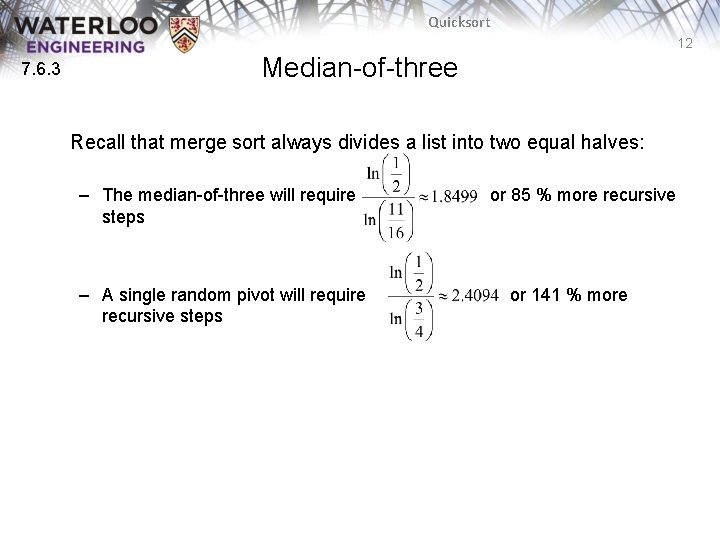
Quicksort 12 7. 6. 3 Median-of-three Recall that merge sort always divides a list into two equal halves: – The median-of-three will require steps – A single random pivot will require recursive steps or 85 % more recursive or 141 % more
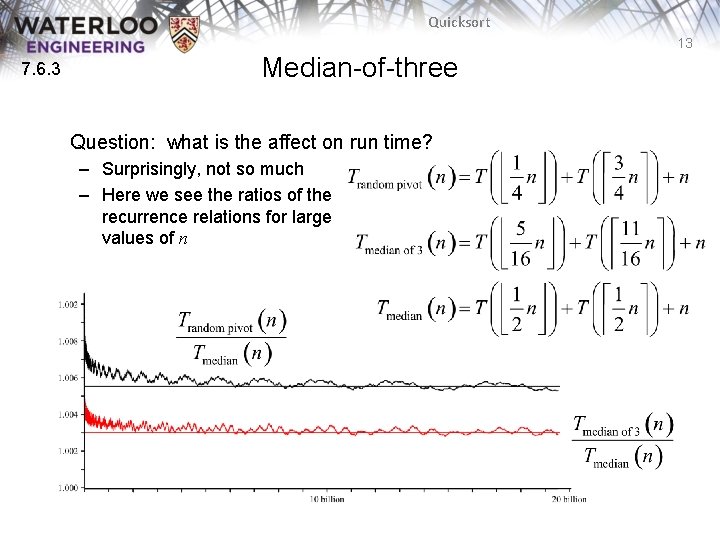
Quicksort 13 7. 6. 3 Median-of-three Question: what is the affect on run time? – Surprisingly, not so much – Here we see the ratios of the recurrence relations for large values of n
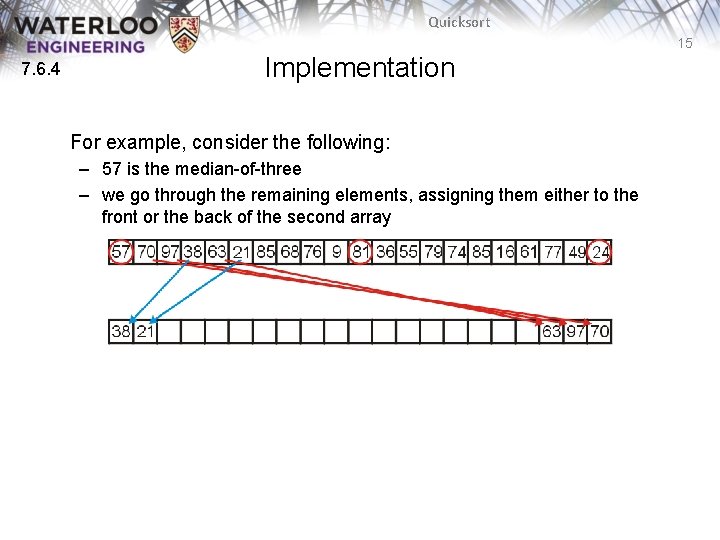
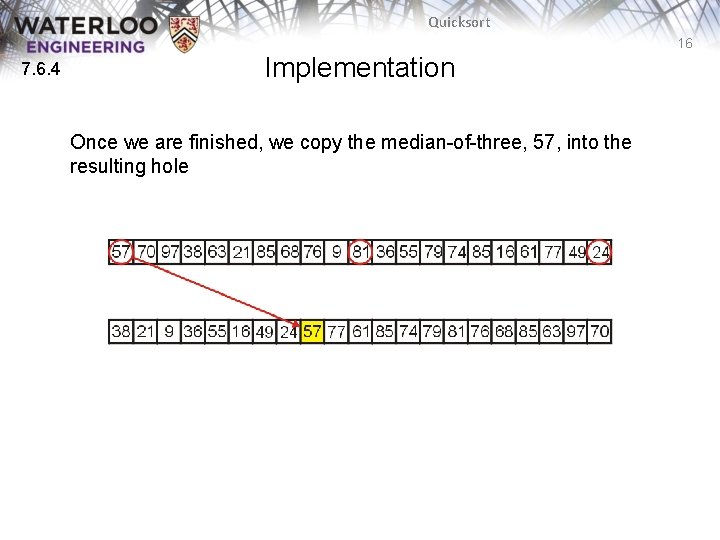
Quicksort 14 7. 6. 4 Implementation If we choose to allocate memory for an additional array, we can implement the partitioning by copying elements either to the front or the back of the additional array Finally, we would place the pivot into the resulting hole
Quicksort 15 7. 6. 4 Implementation For example, consider the following: – 57 is the median-of-three – we go through the remaining elements, assigning them either to the front or the back of the second array
Quicksort 16 7. 6. 4 Implementation Once we are finished, we copy the median-of-three, 57, into the resulting hole
Quicksort 17 7. 6. 4 Implementation Note, however, we can do a better job with merge sort, it always divides the numbers being sorted into two equal or near-equal arrays Can we implement quicksort in place?
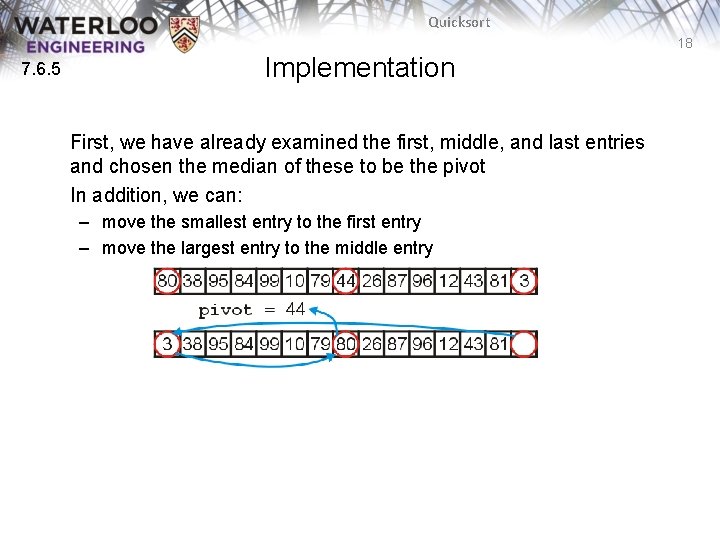
Quicksort 18 7. 6. 5 Implementation First, we have already examined the first, middle, and last entries and chosen the median of these to be the pivot In addition, we can: – move the smallest entry to the first entry – move the largest entry to the middle entry
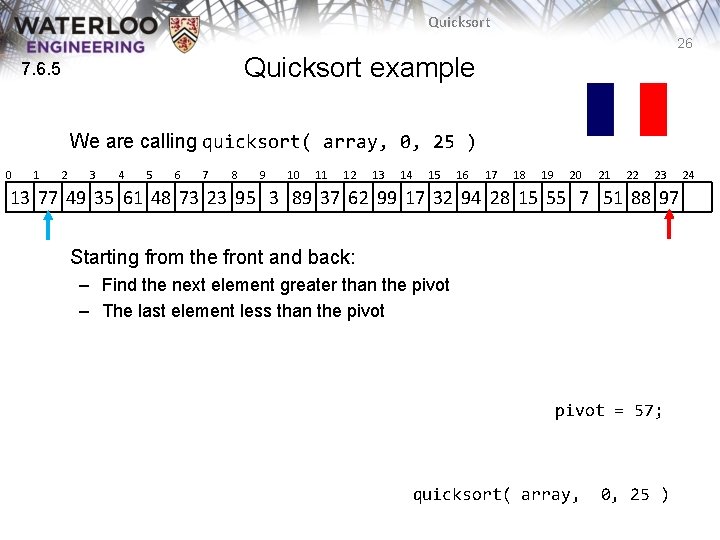
Quicksort 19 7. 6. 5 Implementation Next, recall that our goal is to partition all remaining elements based on whether they are smaller than or greater than the pivot We will find two entries: – One larger than the pivot (staring from the front) – One smaller than the pivot (starting from the back) which are out of order and then swap them
Quicksort 20 7. 6. 5 Implementation Continue doing so until the appropriate entries you find are actually in order The index to the larger entry we found would be the first large entry in the list (as seen from the left) Therefore, we could move this entry into the last entry of the list We can fill this spot with the pivot
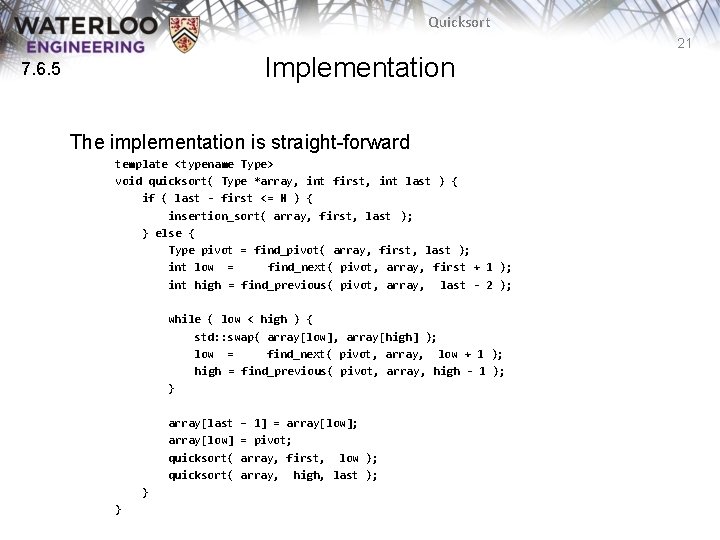
Quicksort 21 Implementation 7. 6. 5 The implementation is straight-forward template <typename Type> void quicksort( Type *array, int first, int last ) { if ( last - first <= N ) { insertion_sort( array, first, last ); } else { Type pivot = find_pivot( array, first, last ); int low = find_next( pivot, array, first + 1 ); int high = find_previous( pivot, array, last - 2 ); while ( low < high ) { std: : swap( array[low], array[high] ); low = find_next( pivot, array, low + 1 ); high = find_previous( pivot, array, high - 1 ); } array[last array[low] quicksort( } } – 1] = array[low]; = pivot; array, first, low ); array, high, last );
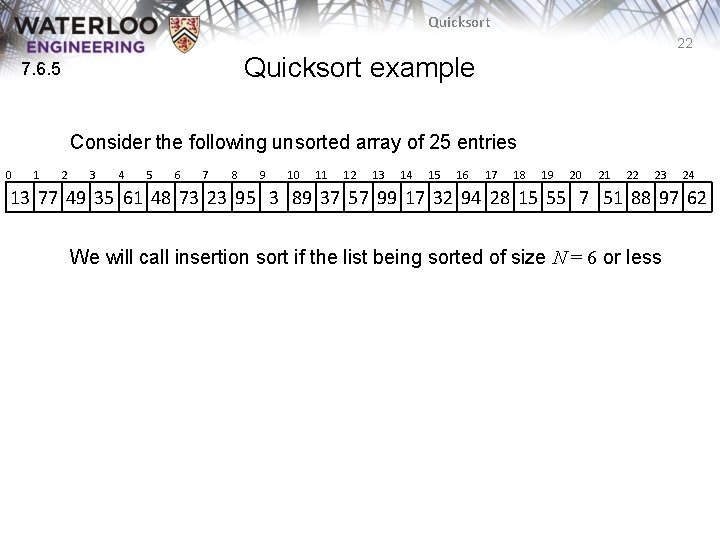
Quicksort 22 Quicksort example 7. 6. 5 Consider the following unsorted array of 25 entries 0 1 2 3 4 5 6 7 8 9 10 11 12 13 14 15 16 17 18 19 20 21 22 23 24 13 77 49 35 61 48 73 23 95 3 89 37 57 99 17 32 94 28 15 55 7 51 88 97 62 We will call insertion sort if the list being sorted of size N = 6 or less
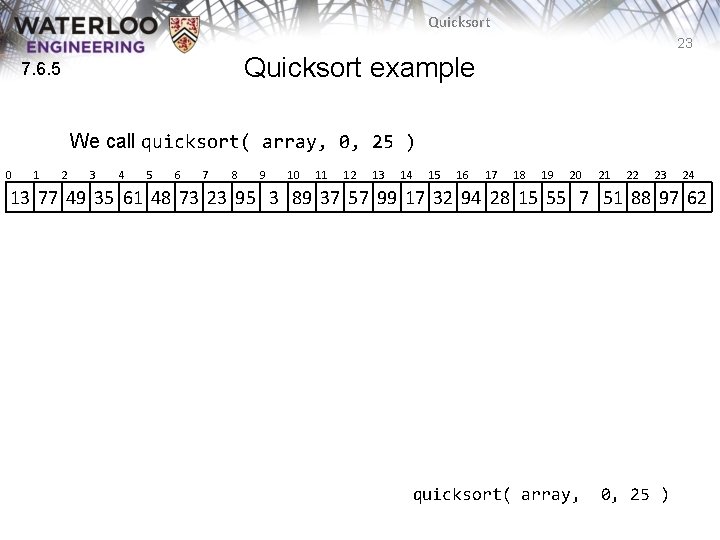
Quicksort 23 Quicksort example 7. 6. 5 We call quicksort( array, 0, 25 ) 0 1 2 3 4 5 6 7 8 9 10 11 12 13 14 15 16 17 18 19 20 21 22 23 24 13 77 49 35 61 48 73 23 95 3 89 37 57 99 17 32 94 28 15 55 7 51 88 97 62 quicksort( array, 0, 25 )
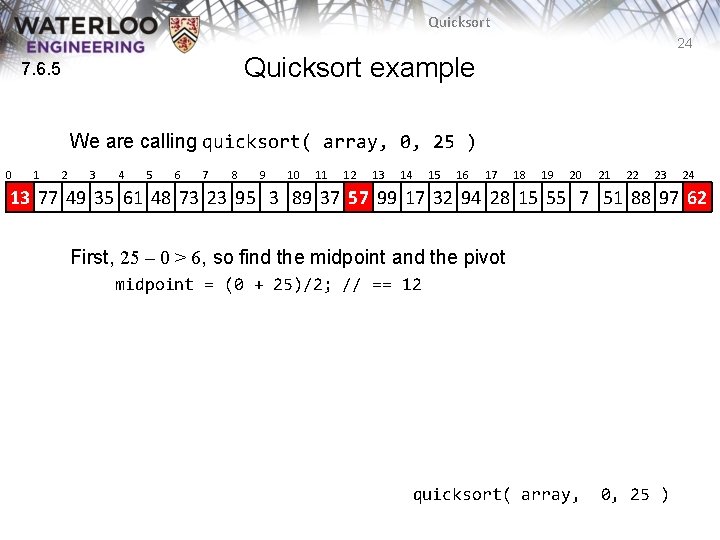
Quicksort 24 Quicksort example 7. 6. 5 We are calling quicksort( array, 0, 25 ) 0 1 2 3 4 5 6 7 8 9 10 11 12 13 14 15 16 17 18 19 20 21 22 23 24 13 77 49 35 61 48 73 23 95 3 89 37 57 99 17 32 94 28 15 55 7 51 88 97 62 First, 25 – 0 > 6, so find the midpoint and the pivot midpoint = (0 + 25)/2; // == 12 quicksort( array, 0, 25 )
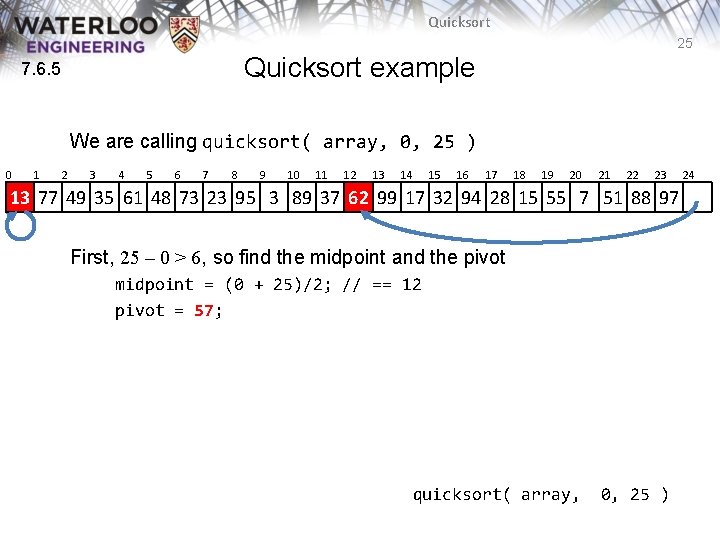
Quicksort 25 Quicksort example 7. 6. 5 We are calling quicksort( array, 0, 25 ) 0 1 2 3 4 5 6 7 8 9 10 11 12 13 14 15 16 17 18 19 20 21 22 23 13 77 49 35 61 48 73 23 95 3 89 37 62 99 17 32 94 28 15 55 7 51 88 97 First, 25 – 0 > 6, so find the midpoint and the pivot midpoint = (0 + 25)/2; // == 12 pivot = 57; quicksort( array, 0, 25 ) 24
Quicksort 26 Quicksort example 7. 6. 5 We are calling quicksort( array, 0, 25 ) 0 1 2 3 4 5 6 7 8 9 10 11 12 13 14 15 16 17 18 19 20 21 22 23 13 77 49 35 61 48 73 23 95 3 89 37 62 99 17 32 94 28 15 55 7 51 88 97 Starting from the front and back: – Find the next element greater than the pivot – The last element less than the pivot = 57; quicksort( array, 0, 25 ) 24
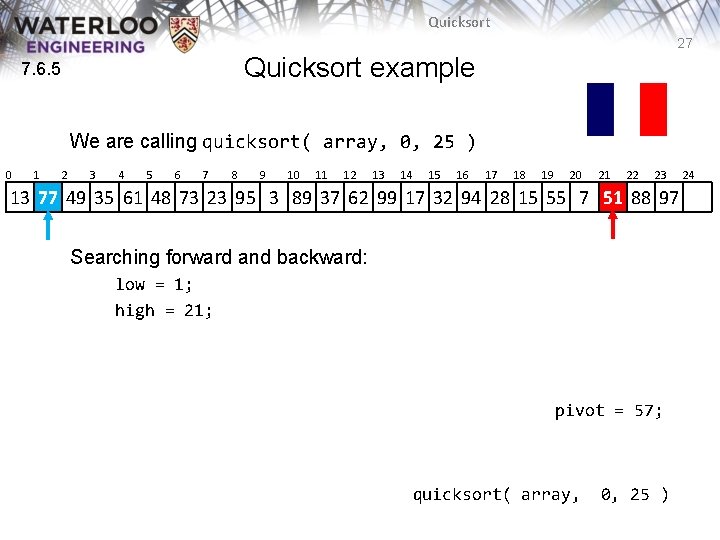
Quicksort 27 Quicksort example 7. 6. 5 We are calling quicksort( array, 0, 25 ) 0 1 2 3 4 5 6 7 8 9 10 11 12 13 14 15 16 17 18 19 20 21 22 23 13 77 49 35 61 48 73 23 95 3 89 37 62 99 17 32 94 28 15 55 7 51 88 97 Searching forward and backward: low = 1; high = 21; pivot = 57; quicksort( array, 0, 25 ) 24
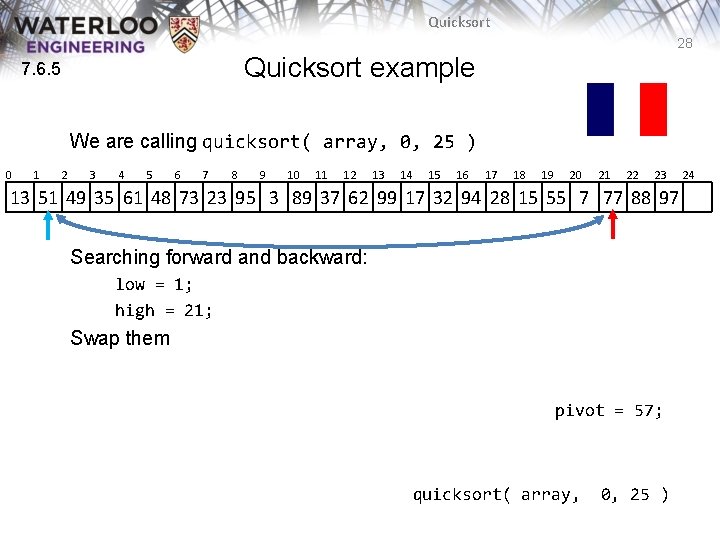
Quicksort 28 Quicksort example 7. 6. 5 We are calling quicksort( array, 0, 25 ) 0 1 2 3 4 5 6 7 8 9 10 11 12 13 14 15 16 17 18 19 20 21 22 23 13 51 49 35 61 48 73 23 95 3 89 37 62 99 17 32 94 28 15 55 7 77 88 97 Searching forward and backward: low = 1; high = 21; Swap them pivot = 57; quicksort( array, 0, 25 ) 24
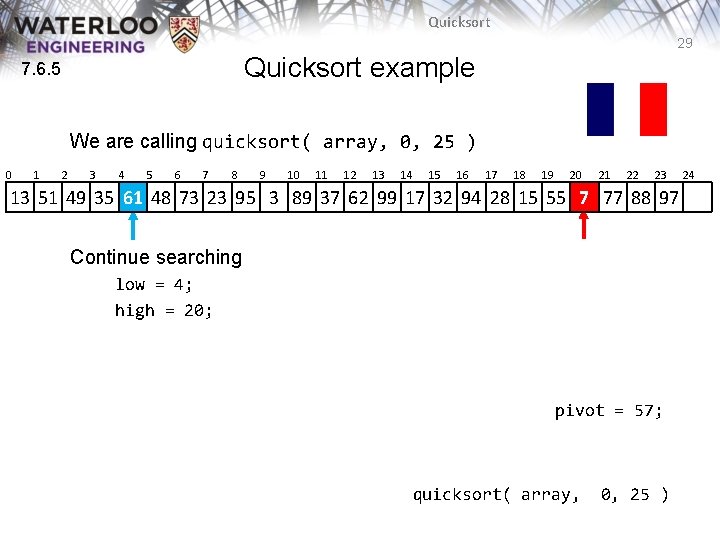
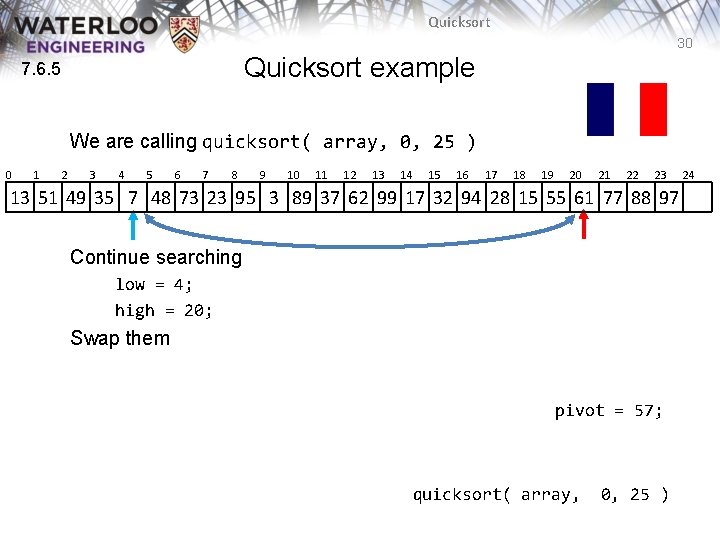
Quicksort 29 Quicksort example 7. 6. 5 We are calling quicksort( array, 0, 25 ) 0 1 2 3 4 5 6 7 8 9 10 11 12 13 14 15 16 17 18 19 20 21 22 23 13 51 49 35 61 48 73 23 95 3 89 37 62 99 17 32 94 28 15 55 7 77 88 97 Continue searching low = 4; high = 20; pivot = 57; quicksort( array, 0, 25 ) 24
Quicksort 30 Quicksort example 7. 6. 5 We are calling quicksort( array, 0, 25 ) 0 1 2 3 4 5 6 7 8 9 10 11 12 13 14 15 16 17 18 19 20 21 22 23 13 51 49 35 7 48 73 23 95 3 89 37 62 99 17 32 94 28 15 55 61 77 88 97 Continue searching low = 4; high = 20; Swap them pivot = 57; quicksort( array, 0, 25 ) 24
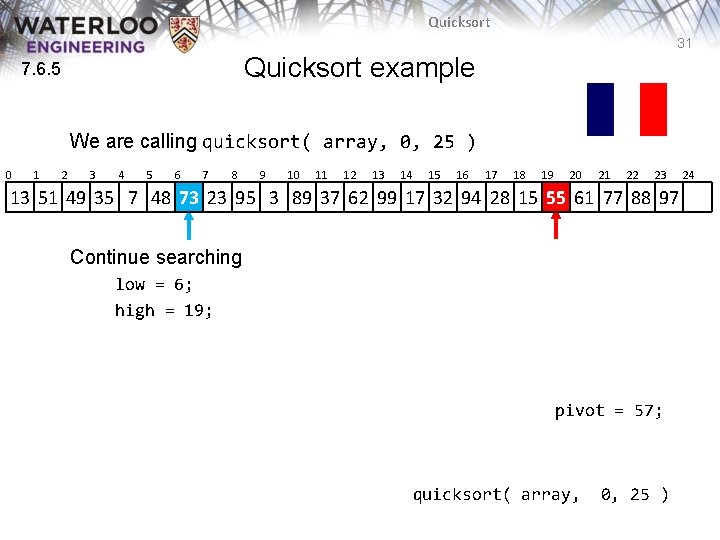
Quicksort 31 Quicksort example 7. 6. 5 We are calling quicksort( array, 0, 25 ) 0 1 2 3 4 5 6 7 8 9 10 11 12 13 14 15 16 17 18 19 20 21 22 23 13 51 49 35 7 48 73 23 95 3 89 37 62 99 17 32 94 28 15 55 61 77 88 97 Continue searching low = 6; high = 19; pivot = 57; quicksort( array, 0, 25 ) 24
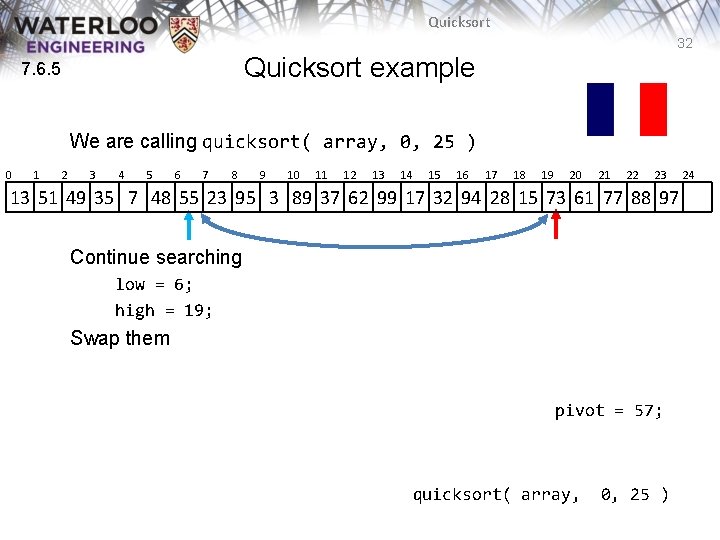
Quicksort 32 Quicksort example 7. 6. 5 We are calling quicksort( array, 0, 25 ) 0 1 2 3 4 5 6 7 8 9 10 11 12 13 14 15 16 17 18 19 20 21 22 23 13 51 49 35 7 48 55 23 95 3 89 37 62 99 17 32 94 28 15 73 61 77 88 97 Continue searching low = 6; high = 19; Swap them pivot = 57; quicksort( array, 0, 25 ) 24
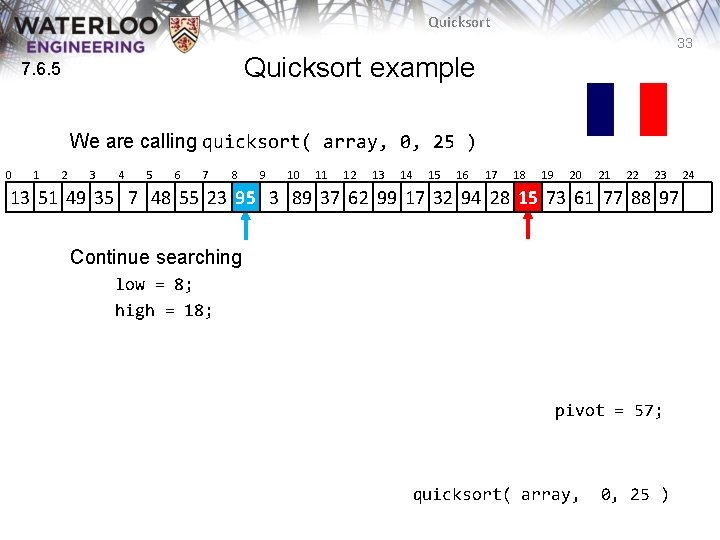
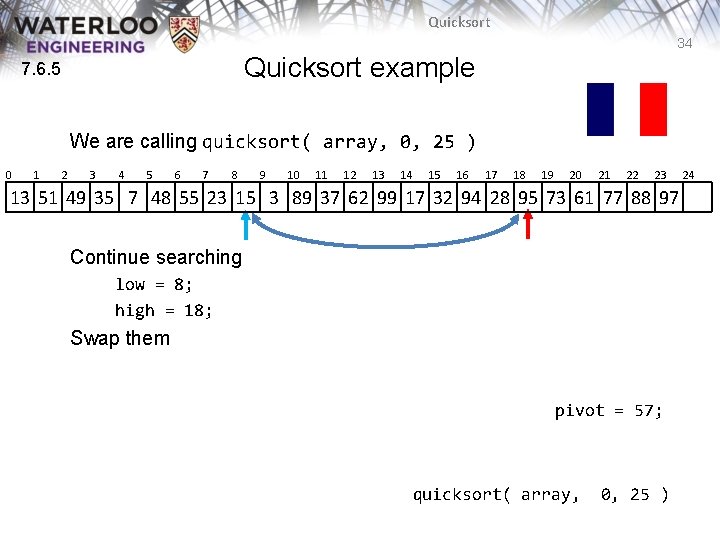
Quicksort 33 Quicksort example 7. 6. 5 We are calling quicksort( array, 0, 25 ) 0 1 2 3 4 5 6 7 8 9 10 11 12 13 14 15 16 17 18 19 20 21 22 23 13 51 49 35 7 48 55 23 95 3 89 37 62 99 17 32 94 28 15 73 61 77 88 97 Continue searching low = 8; high = 18; pivot = 57; quicksort( array, 0, 25 ) 24
Quicksort 34 Quicksort example 7. 6. 5 We are calling quicksort( array, 0, 25 ) 0 1 2 3 4 5 6 7 8 9 10 11 12 13 14 15 16 17 18 19 20 21 22 23 13 51 49 35 7 48 55 23 15 3 89 37 62 99 17 32 94 28 95 73 61 77 88 97 Continue searching low = 8; high = 18; Swap them pivot = 57; quicksort( array, 0, 25 ) 24
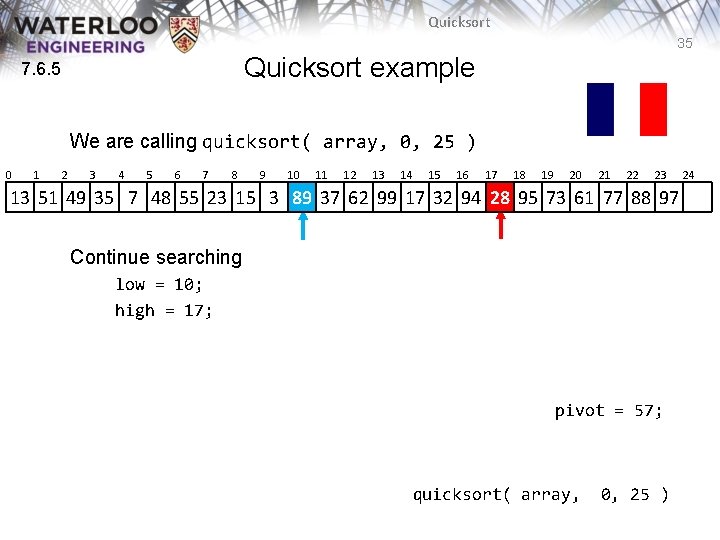
Quicksort 35 Quicksort example 7. 6. 5 We are calling quicksort( array, 0, 25 ) 0 1 2 3 4 5 6 7 8 9 10 11 12 13 14 15 16 17 18 19 20 21 22 23 13 51 49 35 7 48 55 23 15 3 89 37 62 99 17 32 94 28 95 73 61 77 88 97 Continue searching low = 10; high = 17; pivot = 57; quicksort( array, 0, 25 ) 24
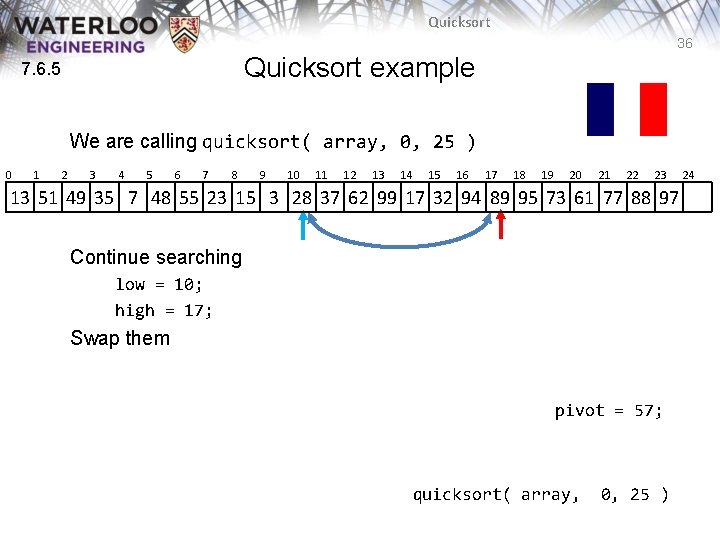
Quicksort 36 Quicksort example 7. 6. 5 We are calling quicksort( array, 0, 25 ) 0 1 2 3 4 5 6 7 8 9 10 11 12 13 14 15 16 17 18 19 20 21 22 23 13 51 49 35 7 48 55 23 15 3 28 37 62 99 17 32 94 89 95 73 61 77 88 97 Continue searching low = 10; high = 17; Swap them pivot = 57; quicksort( array, 0, 25 ) 24
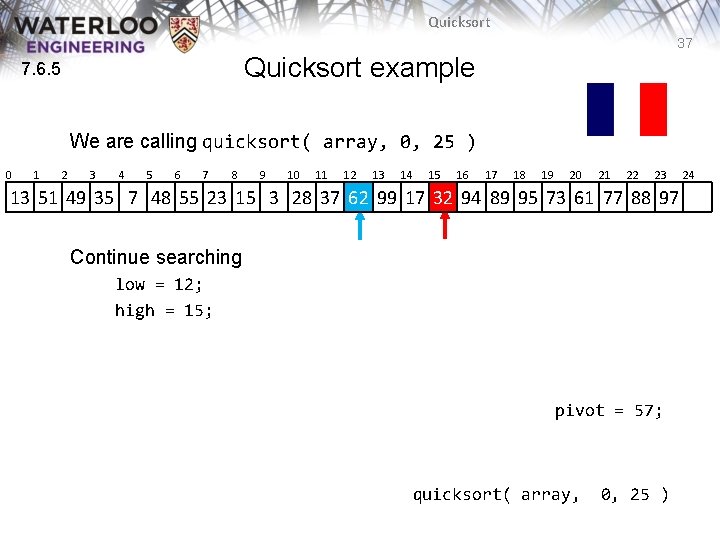
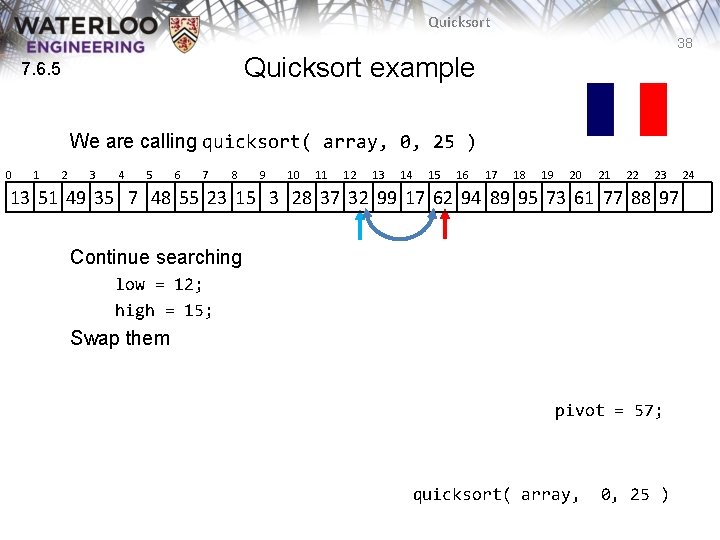
Quicksort 37 Quicksort example 7. 6. 5 We are calling quicksort( array, 0, 25 ) 0 1 2 3 4 5 6 7 8 9 10 11 12 13 14 15 16 17 18 19 20 21 22 23 13 51 49 35 7 48 55 23 15 3 28 37 62 99 17 32 94 89 95 73 61 77 88 97 Continue searching low = 12; high = 15; pivot = 57; quicksort( array, 0, 25 ) 24
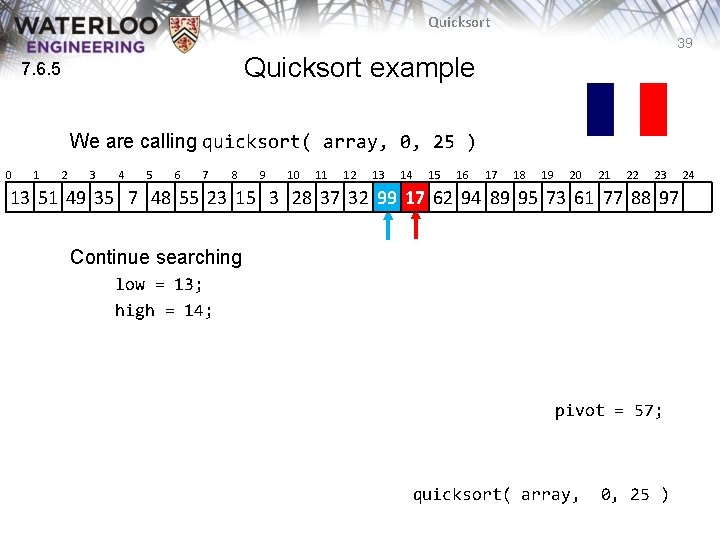
Quicksort 38 Quicksort example 7. 6. 5 We are calling quicksort( array, 0, 25 ) 0 1 2 3 4 5 6 7 8 9 10 11 12 13 14 15 16 17 18 19 20 21 22 23 13 51 49 35 7 48 55 23 15 3 28 37 32 99 17 62 94 89 95 73 61 77 88 97 Continue searching low = 12; high = 15; Swap them pivot = 57; quicksort( array, 0, 25 ) 24
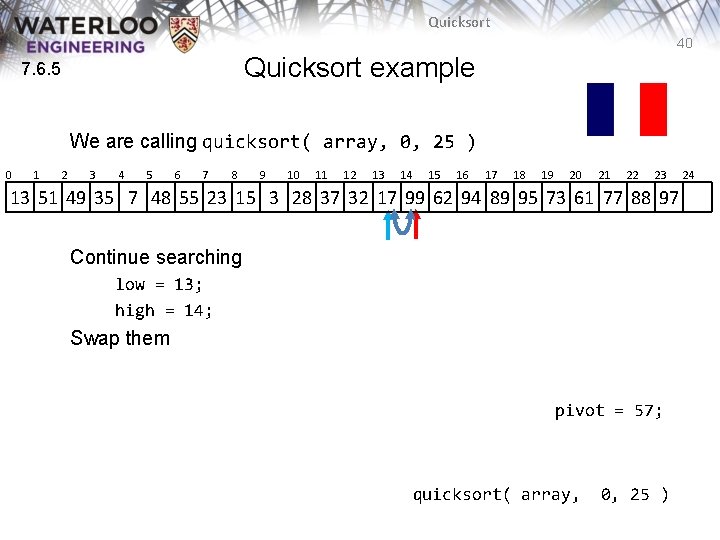
Quicksort 39 Quicksort example 7. 6. 5 We are calling quicksort( array, 0, 25 ) 0 1 2 3 4 5 6 7 8 9 10 11 12 13 14 15 16 17 18 19 20 21 22 23 13 51 49 35 7 48 55 23 15 3 28 37 32 99 17 62 94 89 95 73 61 77 88 97 Continue searching low = 13; high = 14; pivot = 57; quicksort( array, 0, 25 ) 24
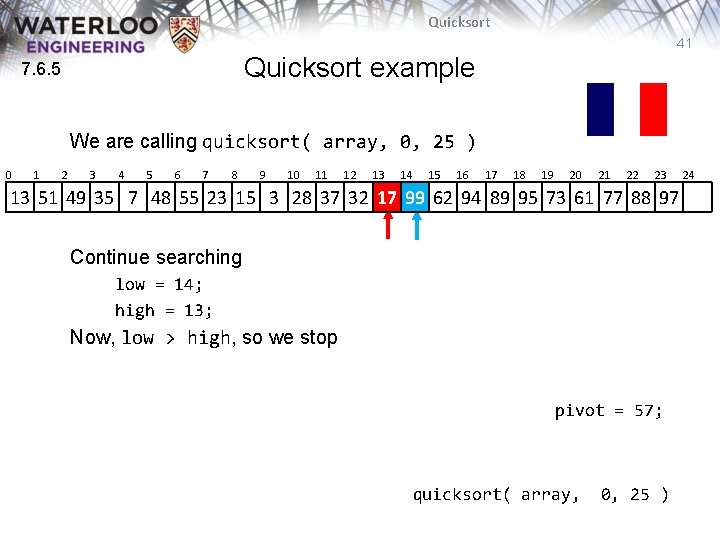
Quicksort 40 Quicksort example 7. 6. 5 We are calling quicksort( array, 0, 25 ) 0 1 2 3 4 5 6 7 8 9 10 11 12 13 14 15 16 17 18 19 20 21 22 23 13 51 49 35 7 48 55 23 15 3 28 37 32 17 99 62 94 89 95 73 61 77 88 97 Continue searching low = 13; high = 14; Swap them pivot = 57; quicksort( array, 0, 25 ) 24
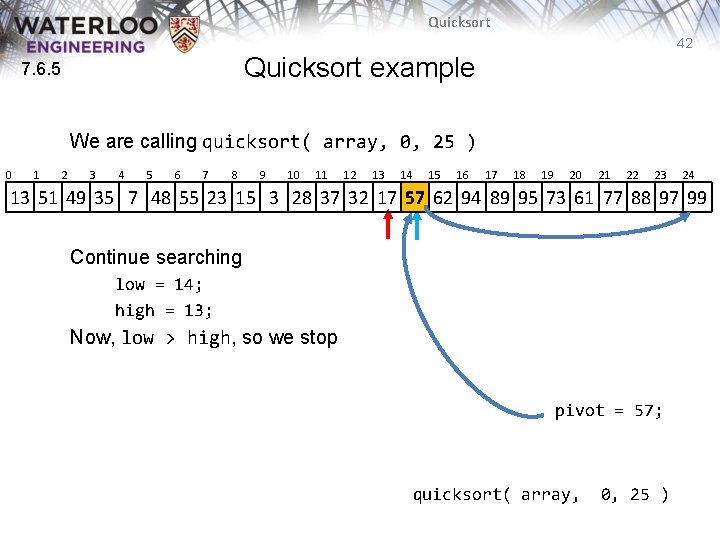
Quicksort 41 Quicksort example 7. 6. 5 We are calling quicksort( array, 0, 25 ) 0 1 2 3 4 5 6 7 8 9 10 11 12 13 14 15 16 17 18 19 20 21 22 23 13 51 49 35 7 48 55 23 15 3 28 37 32 17 99 62 94 89 95 73 61 77 88 97 Continue searching low = 14; high = 13; Now, low > high, so we stop pivot = 57; quicksort( array, 0, 25 ) 24
Quicksort 42 Quicksort example 7. 6. 5 We are calling quicksort( array, 0, 25 ) 0 1 2 3 4 5 6 7 8 9 10 11 12 13 14 15 16 17 18 19 20 21 22 23 24 13 51 49 35 7 48 55 23 15 3 28 37 32 17 57 62 94 89 95 73 61 77 88 97 99 Continue searching low = 14; high = 13; Now, low > high, so we stop pivot = 57; quicksort( array, 0, 25 )
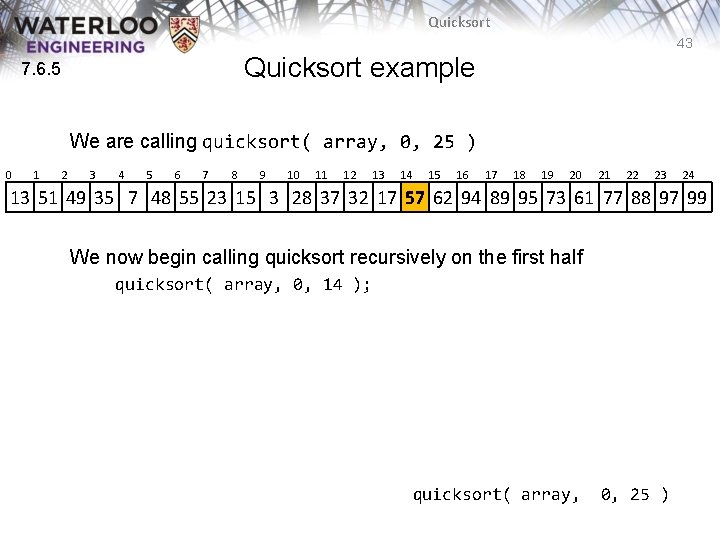
Quicksort 43 Quicksort example 7. 6. 5 We are calling quicksort( array, 0, 25 ) 0 1 2 3 4 5 6 7 8 9 10 11 12 13 14 15 16 17 18 19 20 21 22 23 24 13 51 49 35 7 48 55 23 15 3 28 37 32 17 57 62 94 89 95 73 61 77 88 97 99 We now begin calling quicksort recursively on the first half quicksort( array, 0, 14 ); quicksort( array, 0, 25 )
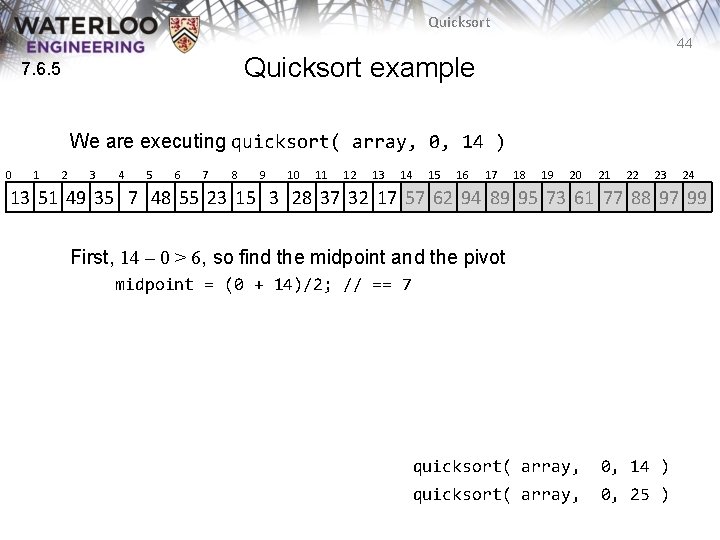
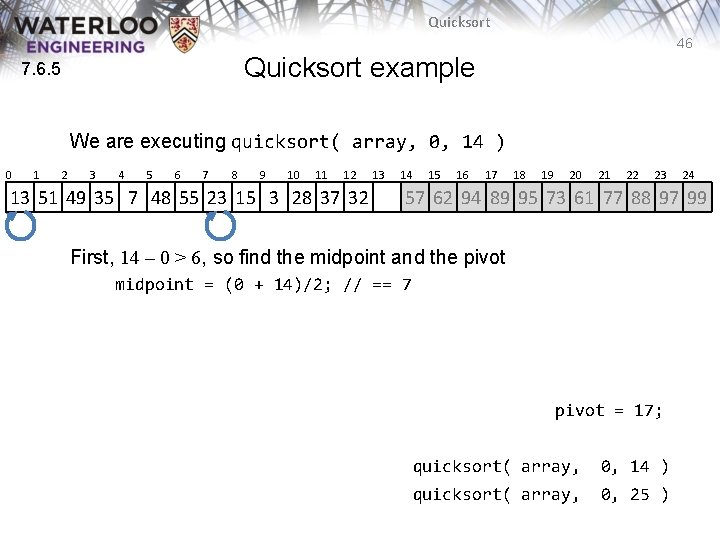
Quicksort 44 Quicksort example 7. 6. 5 We are executing quicksort( array, 0, 14 ) 0 1 2 3 4 5 6 7 8 9 10 11 12 13 14 15 16 17 18 19 20 21 22 23 24 13 51 49 35 7 48 55 23 15 3 28 37 32 17 57 62 94 89 95 73 61 77 88 97 99 First, 14 – 0 > 6, so find the midpoint and the pivot midpoint = (0 + 14)/2; // == 7 quicksort( array, 0, 14 ) quicksort( array, 0, 25 )
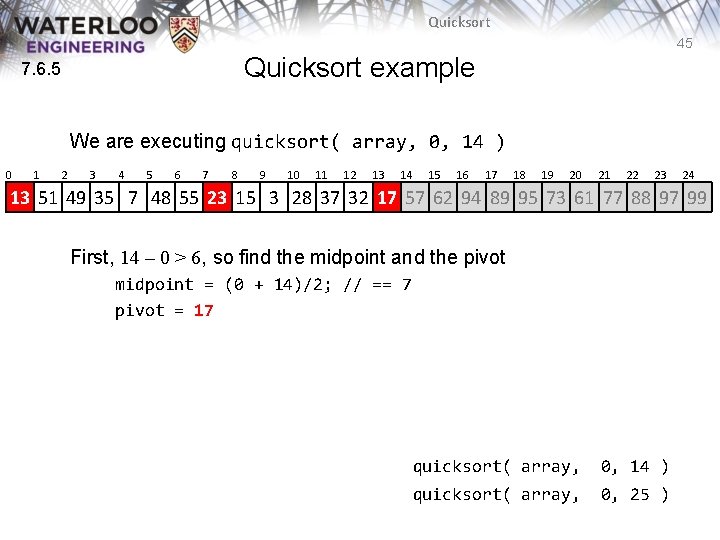
Quicksort 45 Quicksort example 7. 6. 5 We are executing quicksort( array, 0, 14 ) 0 1 2 3 4 5 6 7 8 9 10 11 12 13 14 15 16 17 18 19 20 21 22 23 24 13 51 49 35 7 48 55 23 15 3 28 37 32 17 57 62 94 89 95 73 61 77 88 97 99 First, 14 – 0 > 6, so find the midpoint and the pivot midpoint = (0 + 14)/2; // == 7 pivot = 17 quicksort( array, 0, 14 ) quicksort( array, 0, 25 )
Quicksort 46 Quicksort example 7. 6. 5 We are executing quicksort( array, 0, 14 ) 0 1 2 3 4 5 6 7 8 9 10 11 12 13 51 49 35 7 48 55 23 15 3 28 37 32 13 14 15 16 17 18 19 20 21 22 23 24 57 62 94 89 95 73 61 77 88 97 99 First, 14 – 0 > 6, so find the midpoint and the pivot midpoint = (0 + 14)/2; // == 7 pivot = 17; quicksort( array, 0, 14 ) quicksort( array, 0, 25 )
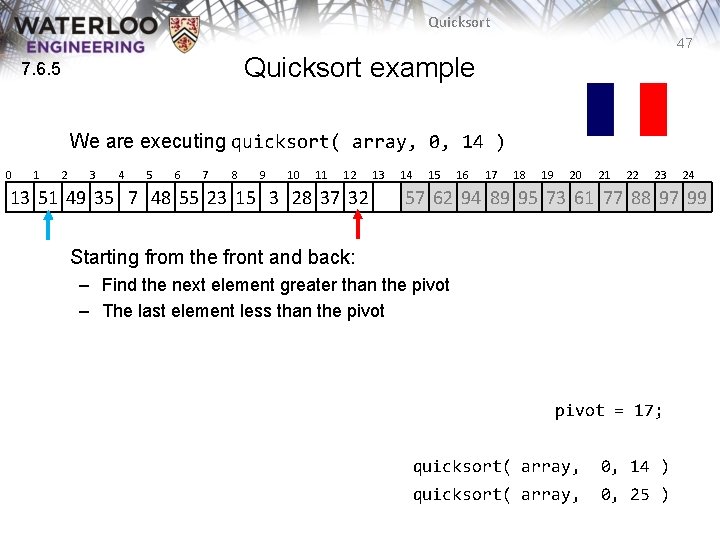
Quicksort 47 Quicksort example 7. 6. 5 We are executing quicksort( array, 0, 14 ) 0 1 2 3 4 5 6 7 8 9 10 11 12 13 51 49 35 7 48 55 23 15 3 28 37 32 13 14 15 16 17 18 19 20 21 22 23 24 57 62 94 89 95 73 61 77 88 97 99 Starting from the front and back: – Find the next element greater than the pivot – The last element less than the pivot = 17; quicksort( array, 0, 14 ) quicksort( array, 0, 25 )
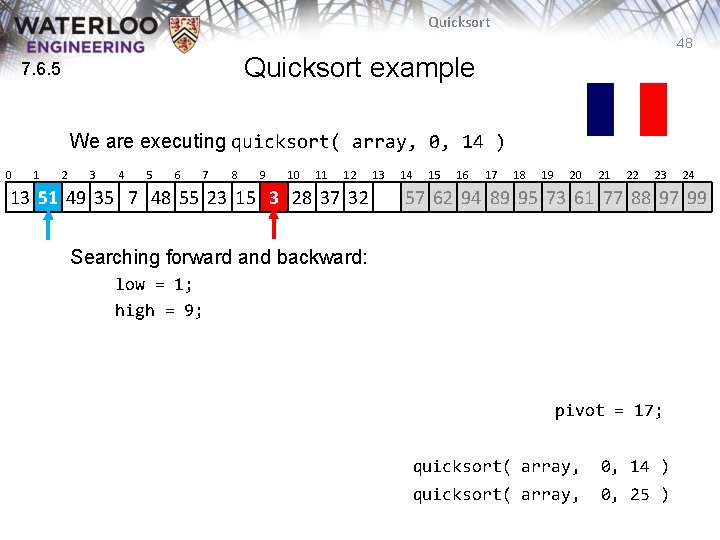
Quicksort 48 Quicksort example 7. 6. 5 We are executing quicksort( array, 0, 14 ) 0 1 2 3 4 5 6 7 8 9 10 11 12 13 51 49 35 7 48 55 23 15 3 28 37 32 13 14 15 16 17 18 19 20 21 22 23 24 57 62 94 89 95 73 61 77 88 97 99 Searching forward and backward: low = 1; high = 9; pivot = 17; quicksort( array, 0, 14 ) quicksort( array, 0, 25 )
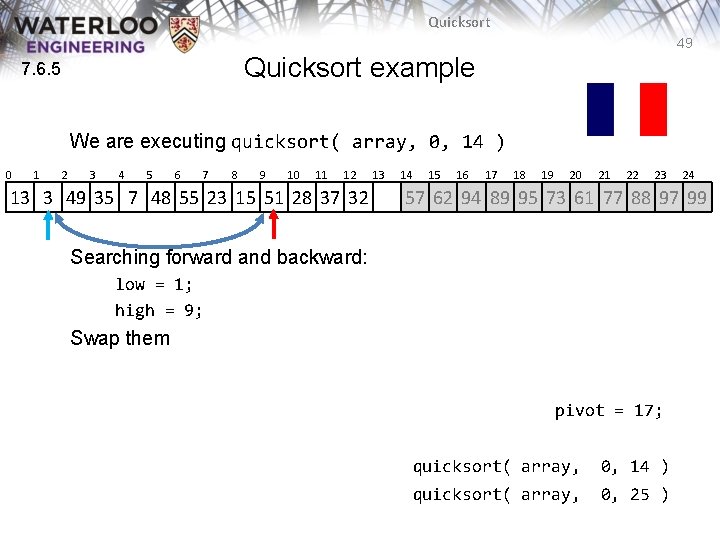
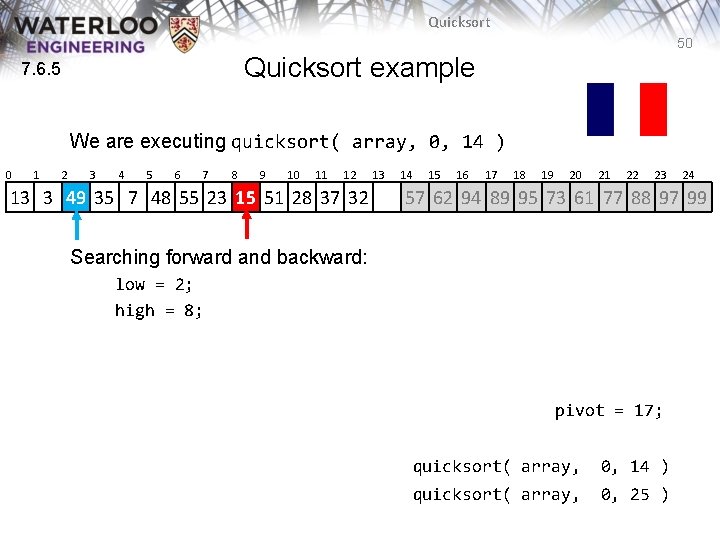
Quicksort 49 Quicksort example 7. 6. 5 We are executing quicksort( array, 0, 14 ) 0 1 2 3 4 5 6 7 8 9 10 11 12 13 3 49 35 7 48 55 23 15 51 28 37 32 13 14 15 16 17 18 19 20 21 22 23 24 57 62 94 89 95 73 61 77 88 97 99 Searching forward and backward: low = 1; high = 9; Swap them pivot = 17; quicksort( array, 0, 14 ) quicksort( array, 0, 25 )
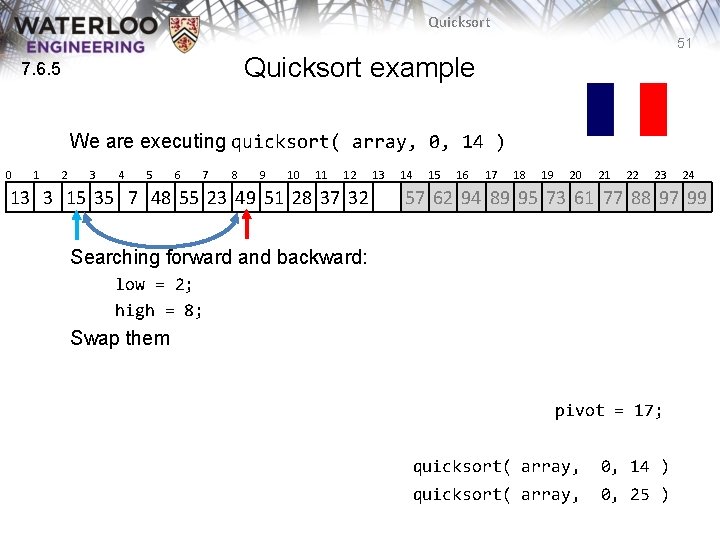
Quicksort 50 Quicksort example 7. 6. 5 We are executing quicksort( array, 0, 14 ) 0 1 2 3 4 5 6 7 8 9 10 11 12 13 3 49 35 7 48 55 23 15 51 28 37 32 13 14 15 16 17 18 19 20 21 22 23 24 57 62 94 89 95 73 61 77 88 97 99 Searching forward and backward: low = 2; high = 8; pivot = 17; quicksort( array, 0, 14 ) quicksort( array, 0, 25 )
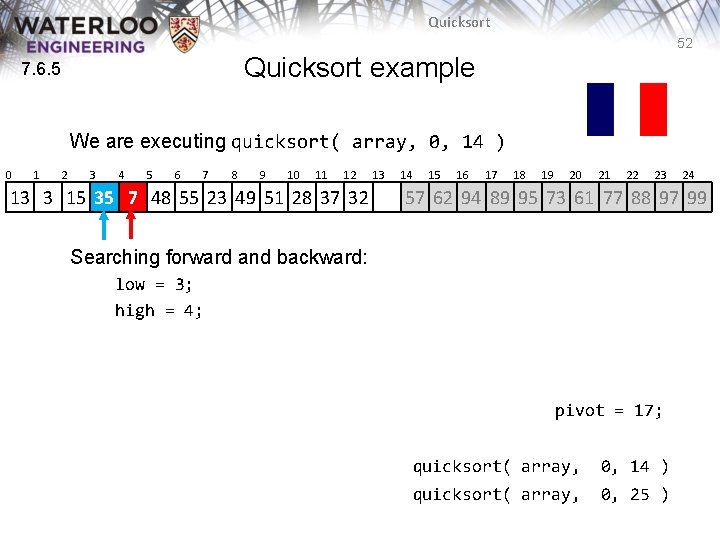
Quicksort 51 Quicksort example 7. 6. 5 We are executing quicksort( array, 0, 14 ) 0 1 2 3 4 5 6 7 8 9 10 11 12 13 3 15 35 7 48 55 23 49 51 28 37 32 13 14 15 16 17 18 19 20 21 22 23 24 57 62 94 89 95 73 61 77 88 97 99 Searching forward and backward: low = 2; high = 8; Swap them pivot = 17; quicksort( array, 0, 14 ) quicksort( array, 0, 25 )
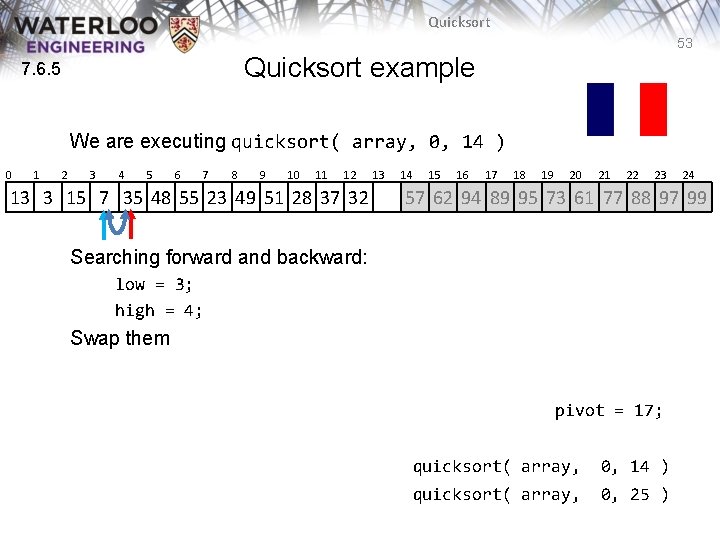
Quicksort 52 Quicksort example 7. 6. 5 We are executing quicksort( array, 0, 14 ) 0 1 2 3 4 5 6 7 8 9 10 11 12 13 3 15 35 7 48 55 23 49 51 28 37 32 13 14 15 16 17 18 19 20 21 22 23 24 57 62 94 89 95 73 61 77 88 97 99 Searching forward and backward: low = 3; high = 4; pivot = 17; quicksort( array, 0, 14 ) quicksort( array, 0, 25 )
Quicksort 53 Quicksort example 7. 6. 5 We are executing quicksort( array, 0, 14 ) 0 1 2 3 4 5 6 7 8 9 10 11 12 13 3 15 7 35 48 55 23 49 51 28 37 32 13 14 15 16 17 18 19 20 21 22 23 24 57 62 94 89 95 73 61 77 88 97 99 Searching forward and backward: low = 3; high = 4; Swap them pivot = 17; quicksort( array, 0, 14 ) quicksort( array, 0, 25 )
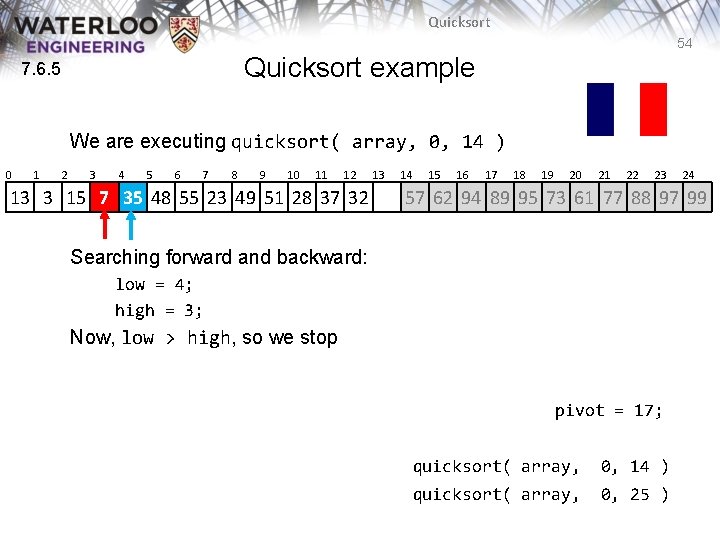
Quicksort 54 Quicksort example 7. 6. 5 We are executing quicksort( array, 0, 14 ) 0 1 2 3 4 5 6 7 8 9 10 11 12 13 3 15 7 35 48 55 23 49 51 28 37 32 13 14 15 16 17 18 19 20 21 22 23 24 57 62 94 89 95 73 61 77 88 97 99 Searching forward and backward: low = 4; high = 3; Now, low > high, so we stop pivot = 17; quicksort( array, 0, 14 ) quicksort( array, 0, 25 )
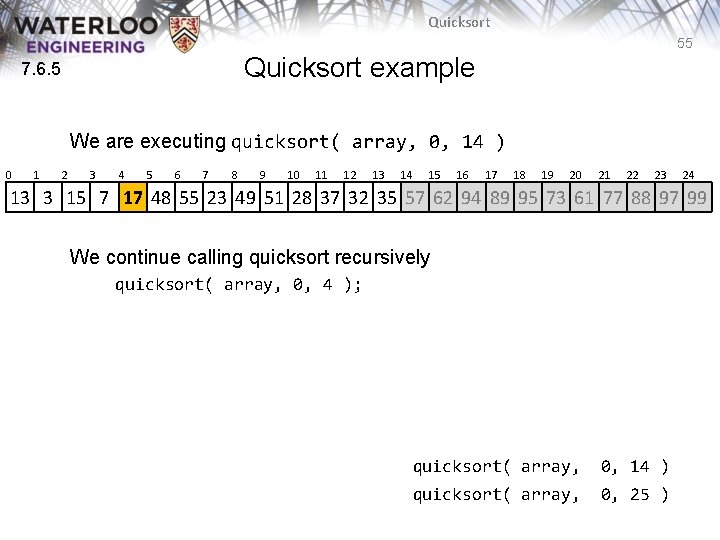
Quicksort 55 Quicksort example 7. 6. 5 We are executing quicksort( array, 0, 14 ) 0 1 2 3 4 5 6 7 8 9 10 11 12 13 14 15 16 17 18 19 20 21 22 23 24 13 3 15 7 17 48 55 23 49 51 28 37 32 35 57 62 94 89 95 73 61 77 88 97 99 We continue calling quicksort recursively quicksort( array, 0, 4 ); quicksort( array, 0, 14 ) quicksort( array, 0, 25 )
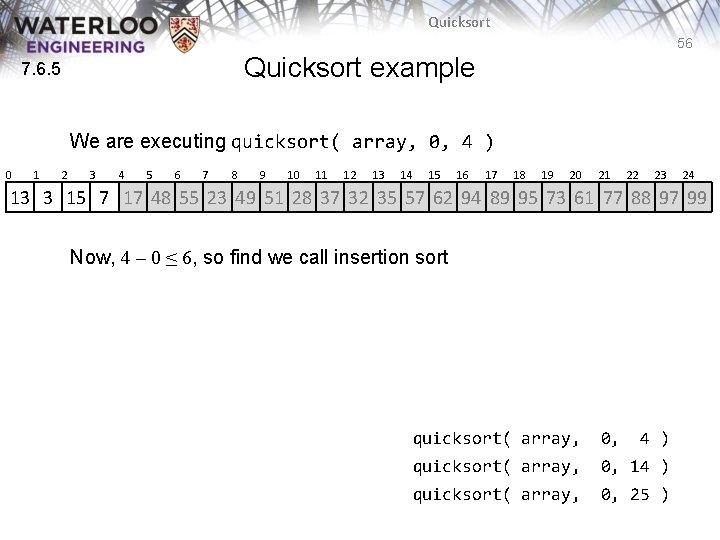
Quicksort 56 Quicksort example 7. 6. 5 We are executing quicksort( array, 0, 4 ) 0 1 2 3 4 5 6 7 8 9 10 11 12 13 14 15 16 17 18 19 20 21 22 23 24 13 3 15 7 17 48 55 23 49 51 28 37 32 35 57 62 94 89 95 73 61 77 88 97 99 Now, 4 – 0 ≤ 6, so find we call insertion sort quicksort( array, 0, 4 ) quicksort( array, 0, 14 ) quicksort( array, 0, 25 )
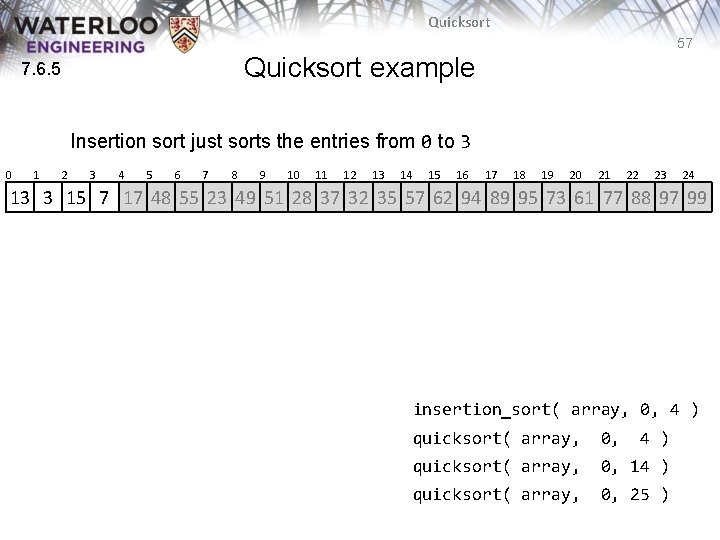
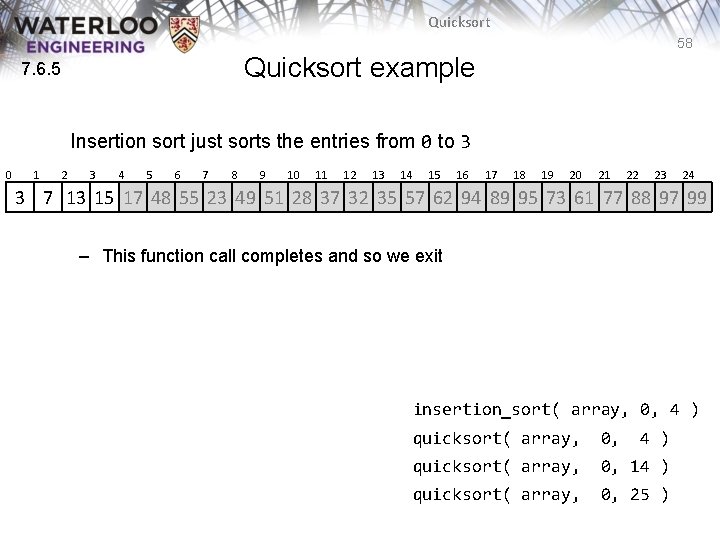
Quicksort 57 Quicksort example 7. 6. 5 Insertion sort just sorts the entries from 0 to 3 0 1 2 3 4 5 6 7 8 9 10 11 12 13 14 15 16 17 18 19 20 21 22 23 24 13 3 15 7 17 48 55 23 49 51 28 37 32 35 57 62 94 89 95 73 61 77 88 97 99 insertion_sort( array, 0, 4 ) quicksort( array, 0, 14 ) quicksort( array, 0, 25 )
Quicksort 58 Quicksort example 7. 6. 5 Insertion sort just sorts the entries from 0 to 3 0 1 2 3 4 5 6 7 8 9 10 11 12 13 14 15 16 17 18 19 20 21 22 23 24 3 7 13 15 17 48 55 23 49 51 28 37 32 35 57 62 94 89 95 73 61 77 88 97 99 – This function call completes and so we exit insertion_sort( array, 0, 4 ) quicksort( array, 0, 14 ) quicksort( array, 0, 25 )
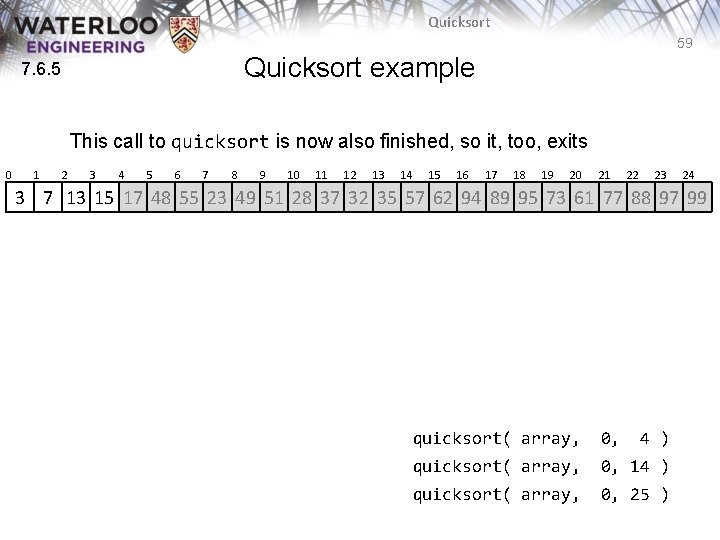
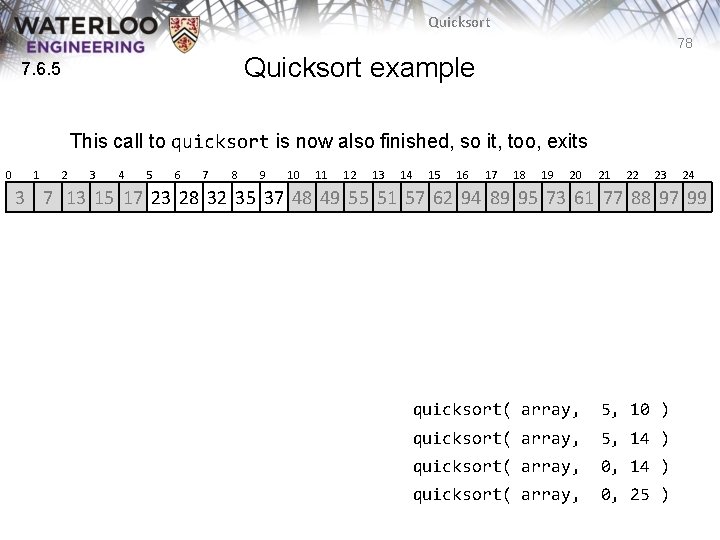
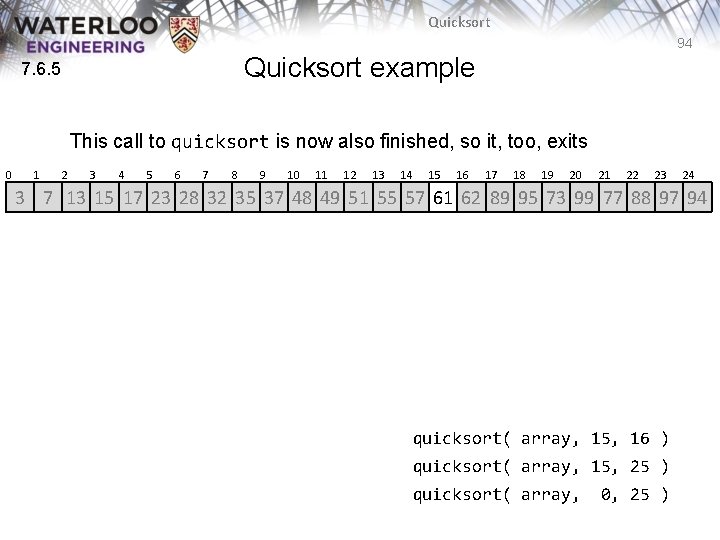
Quicksort 59 Quicksort example 7. 6. 5 This call to quicksort is now also finished, so it, too, exits 0 1 2 3 4 5 6 7 8 9 10 11 12 13 14 15 16 17 18 19 20 21 22 23 24 3 7 13 15 17 48 55 23 49 51 28 37 32 35 57 62 94 89 95 73 61 77 88 97 99 quicksort( array, 0, 4 ) quicksort( array, 0, 14 ) quicksort( array, 0, 25 )
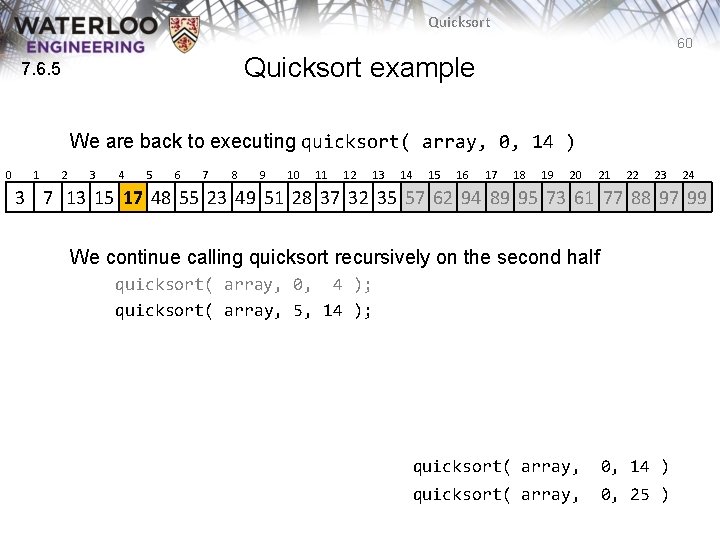
Quicksort 60 Quicksort example 7. 6. 5 We are back to executing quicksort( array, 0, 14 ) 0 1 2 3 4 5 6 7 8 9 10 11 12 13 14 15 16 17 18 19 20 21 22 23 24 3 7 13 15 17 48 55 23 49 51 28 37 32 35 57 62 94 89 95 73 61 77 88 97 99 We continue calling quicksort recursively on the second half quicksort( array, 0, 4 ); quicksort( array, 5, 14 ); quicksort( array, 0, 14 ) quicksort( array, 0, 25 )
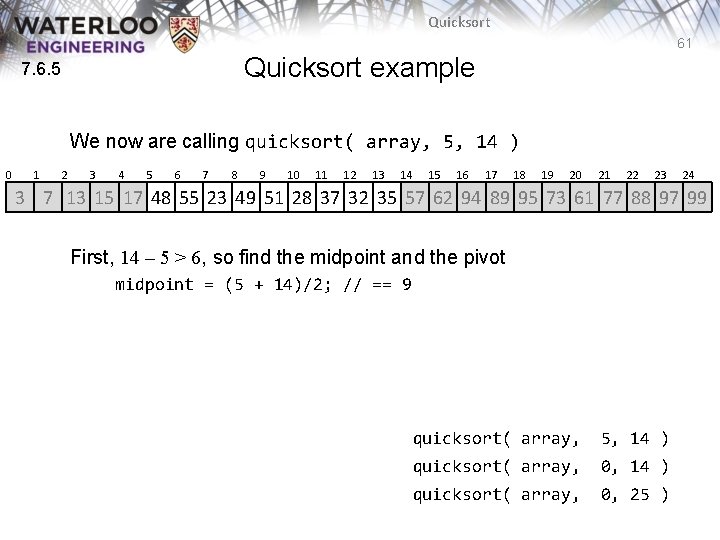
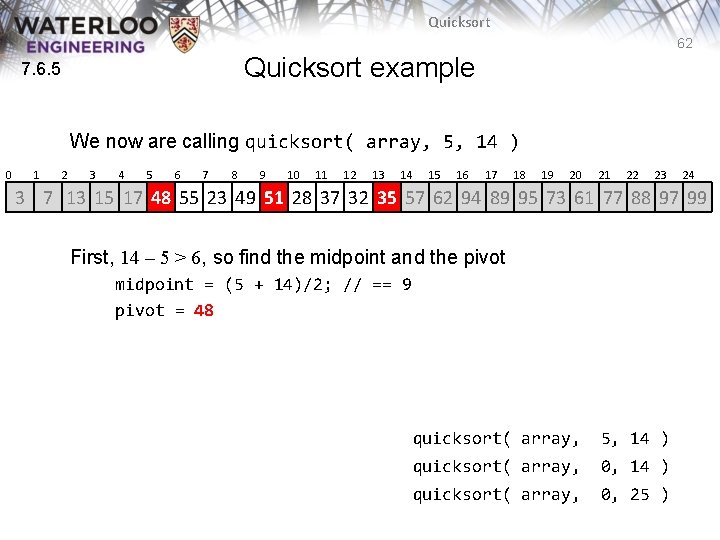
Quicksort 61 Quicksort example 7. 6. 5 We now are calling quicksort( array, 5, 14 ) 0 1 2 3 4 5 6 7 8 9 10 11 12 13 14 15 16 17 18 19 20 21 22 23 24 3 7 13 15 17 48 55 23 49 51 28 37 32 35 57 62 94 89 95 73 61 77 88 97 99 First, 14 – 5 > 6, so find the midpoint and the pivot midpoint = (5 + 14)/2; // == 9 quicksort( array, 5, 14 ) quicksort( array, 0, 25 )
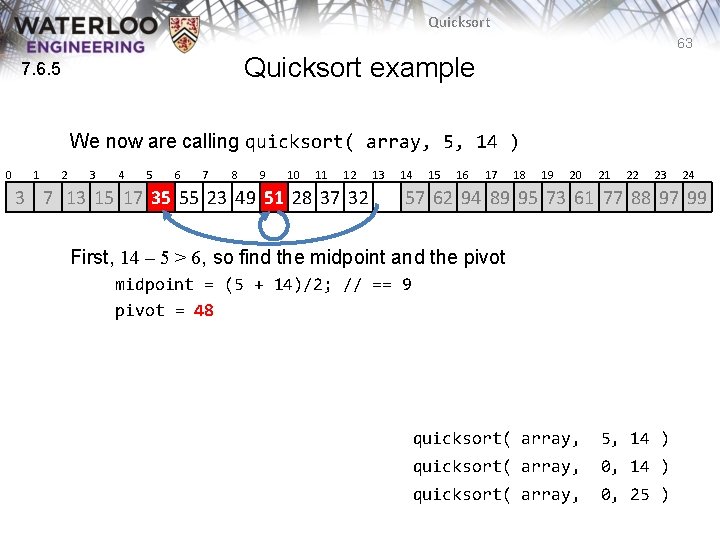
Quicksort 62 Quicksort example 7. 6. 5 We now are calling quicksort( array, 5, 14 ) 0 1 2 3 4 5 6 7 8 9 10 11 12 13 14 15 16 17 18 19 20 21 22 23 24 3 7 13 15 17 48 55 23 49 51 28 37 32 35 57 62 94 89 95 73 61 77 88 97 99 First, 14 – 5 > 6, so find the midpoint and the pivot midpoint = (5 + 14)/2; // == 9 pivot = 48 quicksort( array, 5, 14 ) quicksort( array, 0, 25 )
Quicksort 63 Quicksort example 7. 6. 5 We now are calling quicksort( array, 5, 14 ) 0 1 2 3 4 5 6 7 8 9 10 11 12 3 7 13 15 17 35 55 23 49 51 28 37 32 13 14 15 16 17 18 19 20 21 22 23 24 57 62 94 89 95 73 61 77 88 97 99 First, 14 – 5 > 6, so find the midpoint and the pivot midpoint = (5 + 14)/2; // == 9 pivot = 48 quicksort( array, 5, 14 ) quicksort( array, 0, 25 )
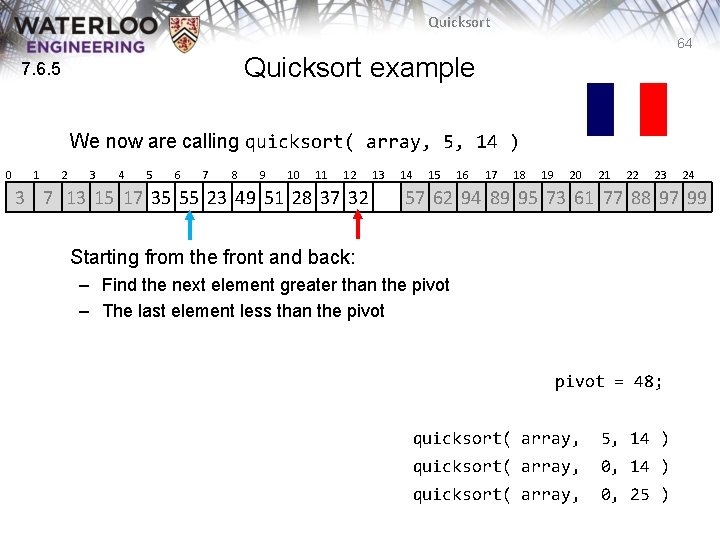
Quicksort 64 Quicksort example 7. 6. 5 We now are calling quicksort( array, 5, 14 ) 0 1 2 3 4 5 6 7 8 9 10 11 12 3 7 13 15 17 35 55 23 49 51 28 37 32 13 14 15 16 17 18 19 20 21 22 23 24 57 62 94 89 95 73 61 77 88 97 99 Starting from the front and back: – Find the next element greater than the pivot – The last element less than the pivot = 48; quicksort( array, 5, 14 ) quicksort( array, 0, 25 )
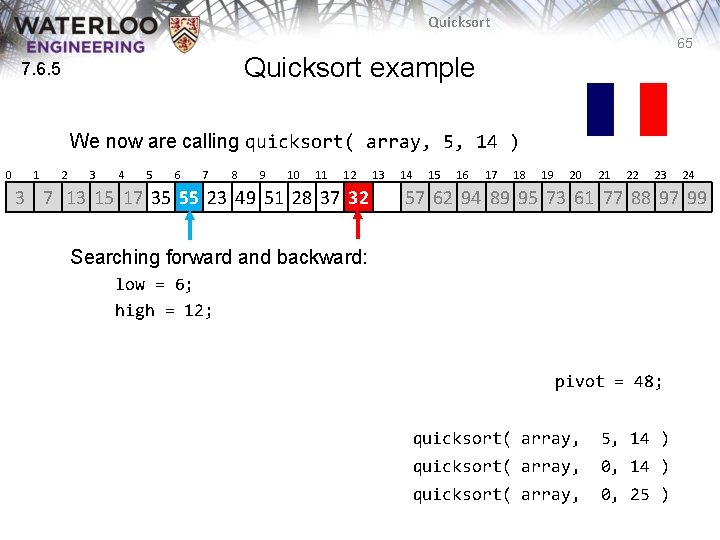
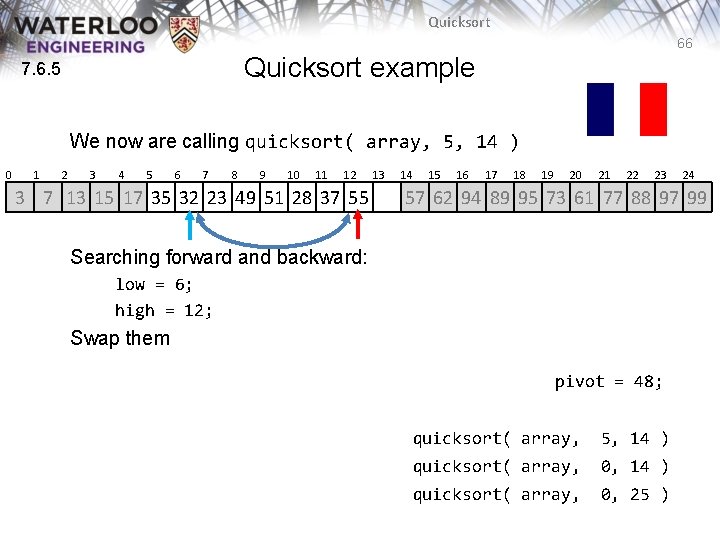
Quicksort 65 Quicksort example 7. 6. 5 We now are calling quicksort( array, 5, 14 ) 0 1 2 3 4 5 6 7 8 9 10 11 12 3 7 13 15 17 35 55 23 49 51 28 37 32 13 14 15 16 17 18 19 20 21 22 23 24 57 62 94 89 95 73 61 77 88 97 99 Searching forward and backward: low = 6; high = 12; pivot = 48; quicksort( array, 5, 14 ) quicksort( array, 0, 25 )
Quicksort 66 Quicksort example 7. 6. 5 We now are calling quicksort( array, 5, 14 ) 0 1 2 3 4 5 6 7 8 9 10 11 12 3 7 13 15 17 35 32 23 49 51 28 37 55 13 14 15 16 17 18 19 20 21 22 23 24 57 62 94 89 95 73 61 77 88 97 99 Searching forward and backward: low = 6; high = 12; Swap them pivot = 48; quicksort( array, 5, 14 ) quicksort( array, 0, 25 )
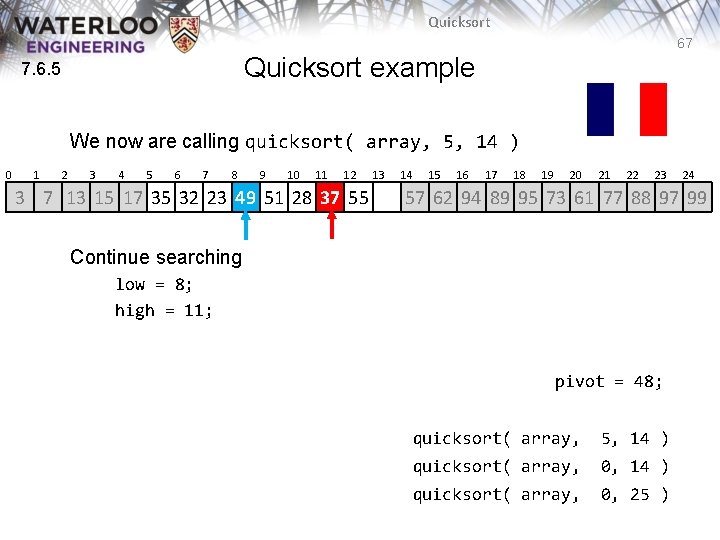
Quicksort 67 Quicksort example 7. 6. 5 We now are calling quicksort( array, 5, 14 ) 0 1 2 3 4 5 6 7 8 9 10 11 12 3 7 13 15 17 35 32 23 49 51 28 37 55 13 14 15 16 17 18 19 20 21 22 23 24 57 62 94 89 95 73 61 77 88 97 99 Continue searching low = 8; high = 11; pivot = 48; quicksort( array, 5, 14 ) quicksort( array, 0, 25 )
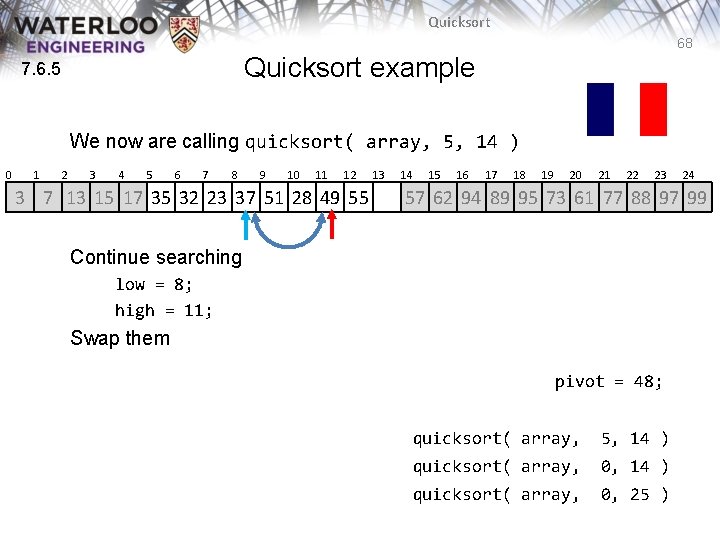
Quicksort 68 Quicksort example 7. 6. 5 We now are calling quicksort( array, 5, 14 ) 0 1 2 3 4 5 6 7 8 9 10 11 12 3 7 13 15 17 35 32 23 37 51 28 49 55 13 14 15 16 17 18 19 20 21 22 23 24 57 62 94 89 95 73 61 77 88 97 99 Continue searching low = 8; high = 11; Swap them pivot = 48; quicksort( array, 5, 14 ) quicksort( array, 0, 25 )
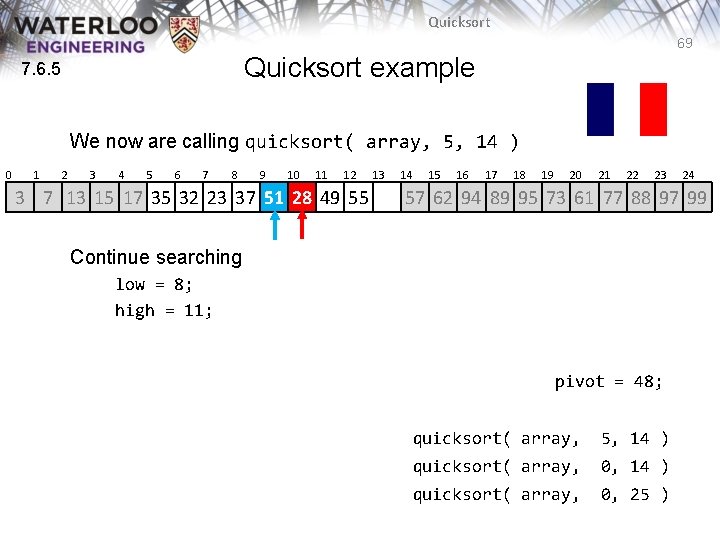
Quicksort 69 Quicksort example 7. 6. 5 We now are calling quicksort( array, 5, 14 ) 0 1 2 3 4 5 6 7 8 9 10 11 12 3 7 13 15 17 35 32 23 37 51 28 49 55 13 14 15 16 17 18 19 20 21 22 23 24 57 62 94 89 95 73 61 77 88 97 99 Continue searching low = 8; high = 11; pivot = 48; quicksort( array, 5, 14 ) quicksort( array, 0, 25 )
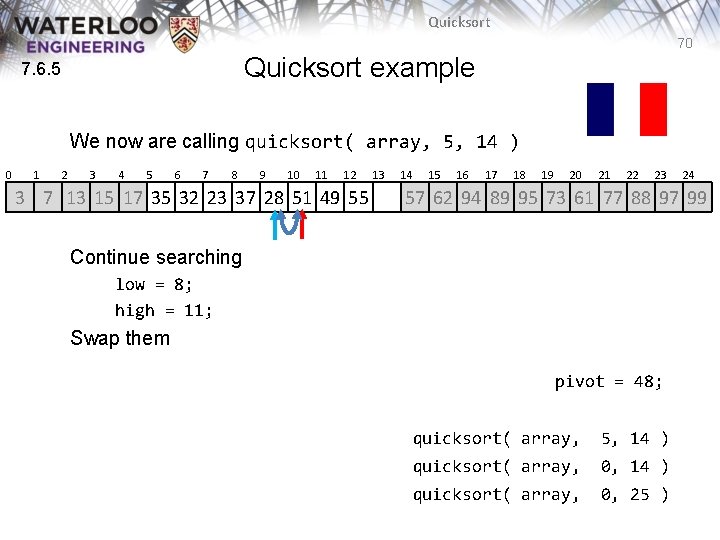
Quicksort 70 Quicksort example 7. 6. 5 We now are calling quicksort( array, 5, 14 ) 0 1 2 3 4 5 6 7 8 9 10 11 12 3 7 13 15 17 35 32 23 37 28 51 49 55 13 14 15 16 17 18 19 20 21 22 23 24 57 62 94 89 95 73 61 77 88 97 99 Continue searching low = 8; high = 11; Swap them pivot = 48; quicksort( array, 5, 14 ) quicksort( array, 0, 25 )
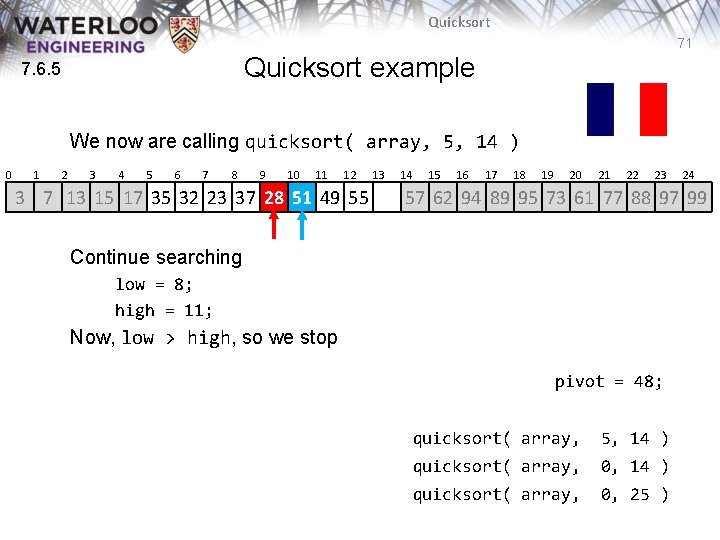
Quicksort 71 Quicksort example 7. 6. 5 We now are calling quicksort( array, 5, 14 ) 0 1 2 3 4 5 6 7 8 9 10 11 12 3 7 13 15 17 35 32 23 37 28 51 49 55 13 14 15 16 17 18 19 20 21 22 23 24 57 62 94 89 95 73 61 77 88 97 99 Continue searching low = 8; high = 11; Now, low > high, so we stop pivot = 48; quicksort( array, 5, 14 ) quicksort( array, 0, 25 )
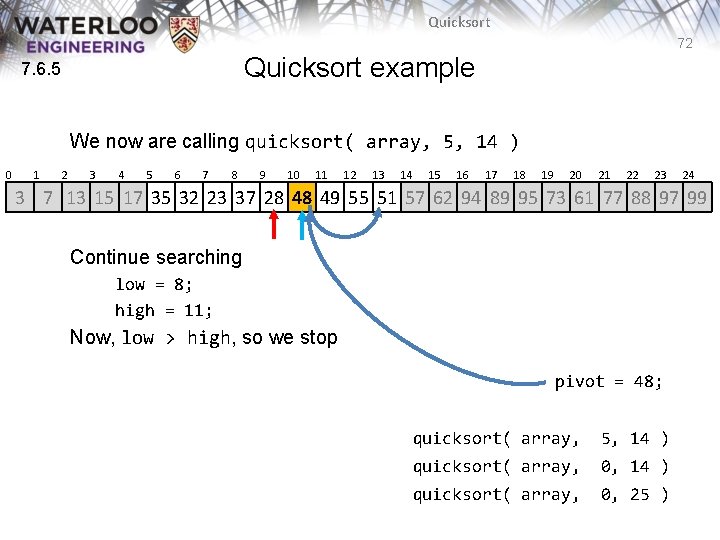
Quicksort 72 Quicksort example 7. 6. 5 We now are calling quicksort( array, 5, 14 ) 0 1 2 3 4 5 6 7 8 9 10 11 12 13 14 15 16 17 18 19 20 21 22 23 24 3 7 13 15 17 35 32 23 37 28 48 49 55 51 57 62 94 89 95 73 61 77 88 97 99 Continue searching low = 8; high = 11; Now, low > high, so we stop pivot = 48; quicksort( array, 5, 14 ) quicksort( array, 0, 25 )
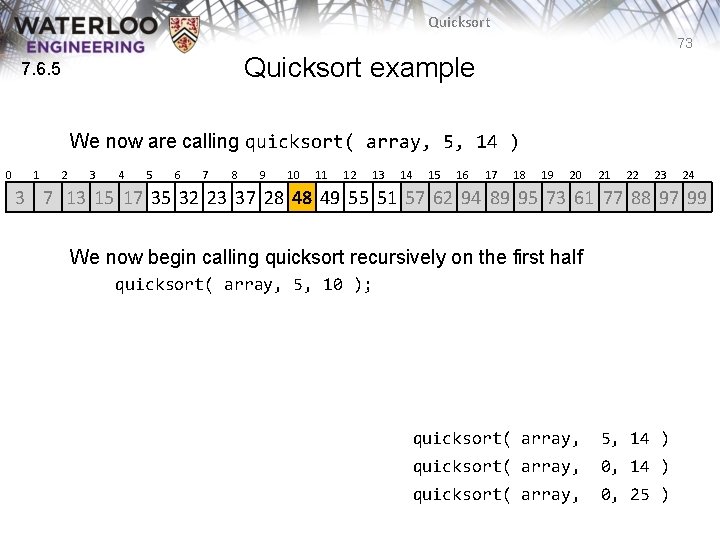
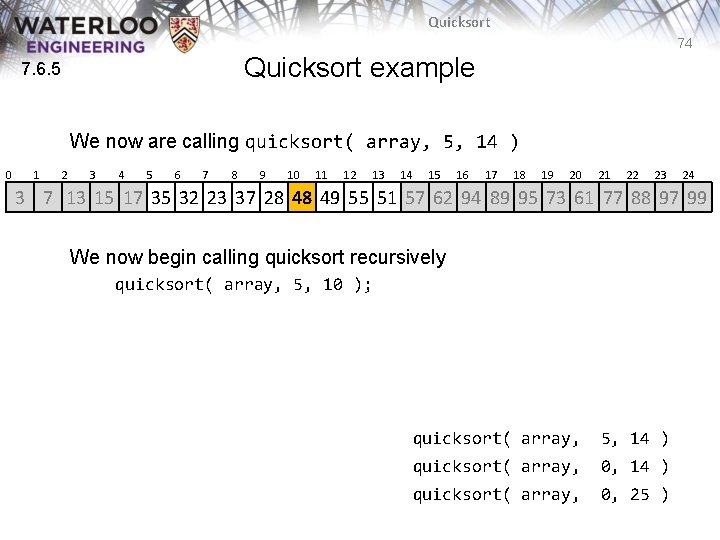
Quicksort 73 Quicksort example 7. 6. 5 We now are calling quicksort( array, 5, 14 ) 0 1 2 3 4 5 6 7 8 9 10 11 12 13 14 15 16 17 18 19 20 21 22 23 24 3 7 13 15 17 35 32 23 37 28 48 49 55 51 57 62 94 89 95 73 61 77 88 97 99 We now begin calling quicksort recursively on the first half quicksort( array, 5, 10 ); quicksort( array, 5, 14 ) quicksort( array, 0, 25 )
Quicksort 74 Quicksort example 7. 6. 5 We now are calling quicksort( array, 5, 14 ) 0 1 2 3 4 5 6 7 8 9 10 11 12 13 14 15 16 17 18 19 20 21 22 23 24 3 7 13 15 17 35 32 23 37 28 48 49 55 51 57 62 94 89 95 73 61 77 88 97 99 We now begin calling quicksort recursively quicksort( array, 5, 10 ); quicksort( array, 5, 14 ) quicksort( array, 0, 25 )
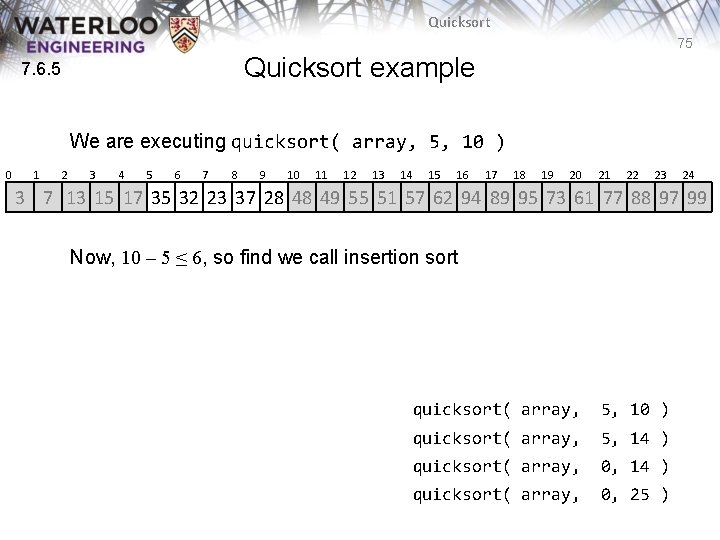
Quicksort 75 Quicksort example 7. 6. 5 We are executing quicksort( array, 5, 10 ) 0 1 2 3 4 5 6 7 8 9 10 11 12 13 14 15 16 17 18 19 20 21 22 23 24 3 7 13 15 17 35 32 23 37 28 48 49 55 51 57 62 94 89 95 73 61 77 88 97 99 Now, 10 – 5 ≤ 6, so find we call insertion sort quicksort( array, 5, 10 ) quicksort( array, 5, 14 ) quicksort( array, 0, 25 )
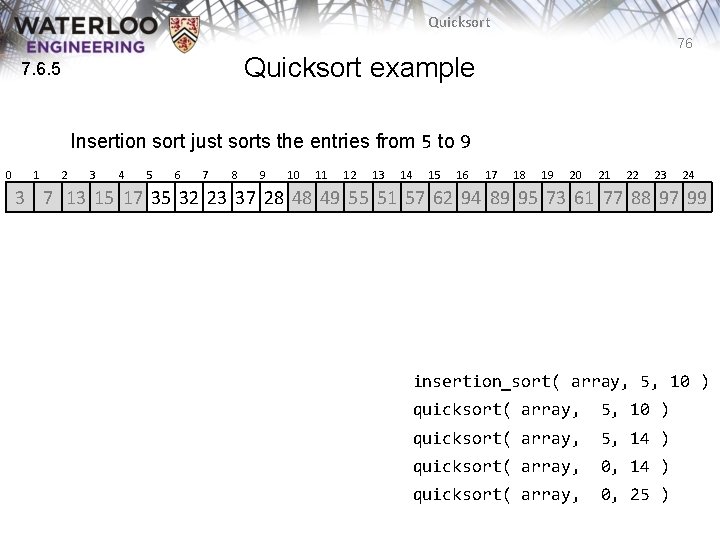
Quicksort 76 Quicksort example 7. 6. 5 Insertion sort just sorts the entries from 5 to 9 0 1 2 3 4 5 6 7 8 9 10 11 12 13 14 15 16 17 18 19 20 21 22 23 24 3 7 13 15 17 35 32 23 37 28 48 49 55 51 57 62 94 89 95 73 61 77 88 97 99 insertion_sort( array, 5, 10 ) quicksort( array, 5, 14 ) quicksort( array, 0, 25 )
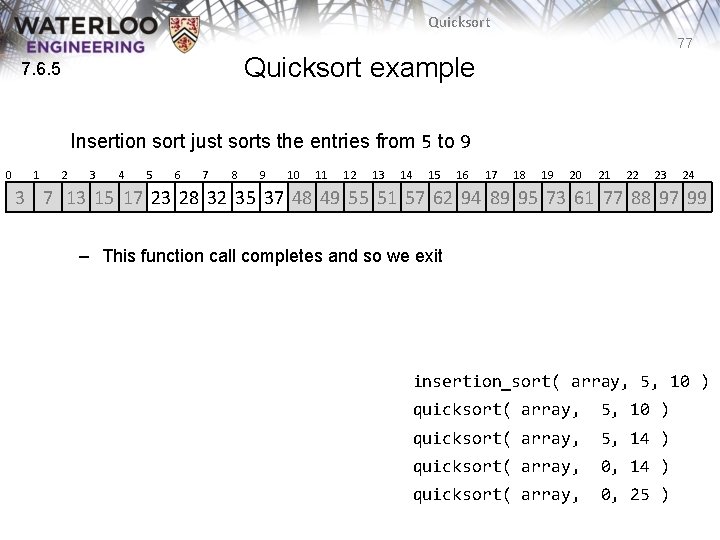
Quicksort 77 Quicksort example 7. 6. 5 Insertion sort just sorts the entries from 5 to 9 0 1 2 3 4 5 6 7 8 9 10 11 12 13 14 15 16 17 18 19 20 21 22 23 24 3 7 13 15 17 23 28 32 35 37 48 49 55 51 57 62 94 89 95 73 61 77 88 97 99 – This function call completes and so we exit insertion_sort( array, 5, 10 ) quicksort( array, 5, 14 ) quicksort( array, 0, 25 )
Quicksort 78 Quicksort example 7. 6. 5 This call to quicksort is now also finished, so it, too, exits 0 1 2 3 4 5 6 7 8 9 10 11 12 13 14 15 16 17 18 19 20 21 22 23 24 3 7 13 15 17 23 28 32 35 37 48 49 55 51 57 62 94 89 95 73 61 77 88 97 99 quicksort( array, 5, 10 ) quicksort( array, 5, 14 ) quicksort( array, 0, 25 )
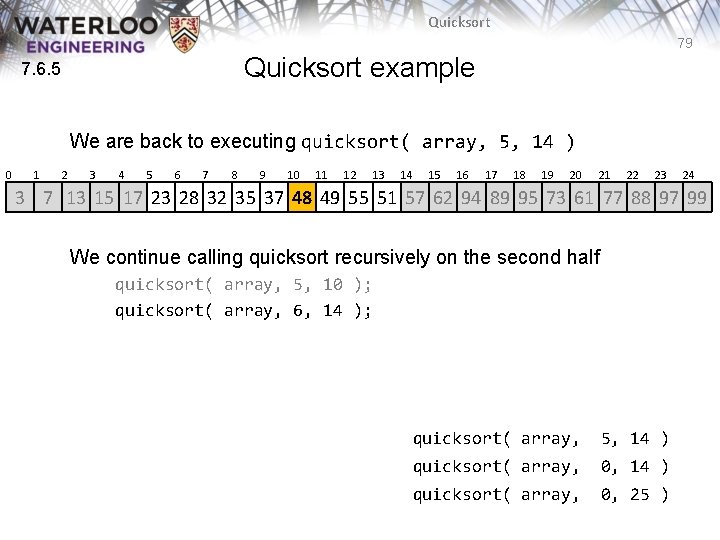
Quicksort 79 Quicksort example 7. 6. 5 We are back to executing quicksort( array, 5, 14 ) 0 1 2 3 4 5 6 7 8 9 10 11 12 13 14 15 16 17 18 19 20 21 22 23 24 3 7 13 15 17 23 28 32 35 37 48 49 55 51 57 62 94 89 95 73 61 77 88 97 99 We continue calling quicksort recursively on the second half quicksort( array, 5, 10 ); quicksort( array, 6, 14 ); quicksort( array, 5, 14 ) quicksort( array, 0, 25 )
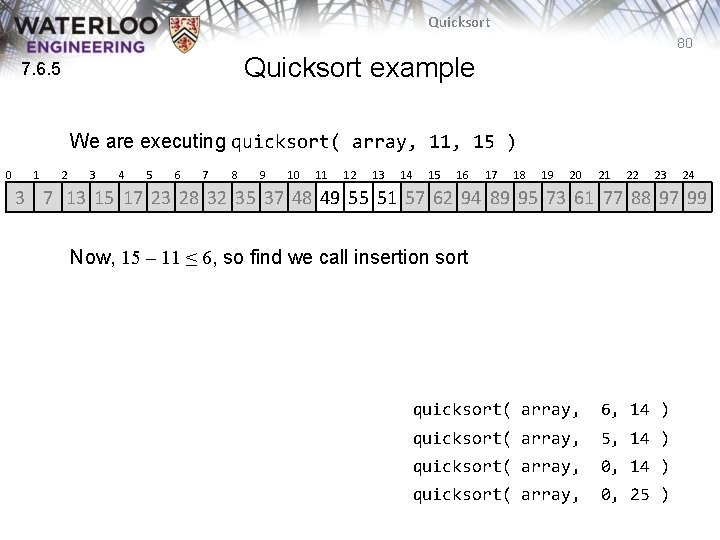
Quicksort 80 Quicksort example 7. 6. 5 We are executing quicksort( array, 11, 15 ) 0 1 2 3 4 5 6 7 8 9 10 11 12 13 14 15 16 17 18 19 20 21 22 23 24 3 7 13 15 17 23 28 32 35 37 48 49 55 51 57 62 94 89 95 73 61 77 88 97 99 Now, 15 – 11 ≤ 6, so find we call insertion sort quicksort( array, 6, 14 ) quicksort( array, 5, 14 ) quicksort( array, 0, 25 )
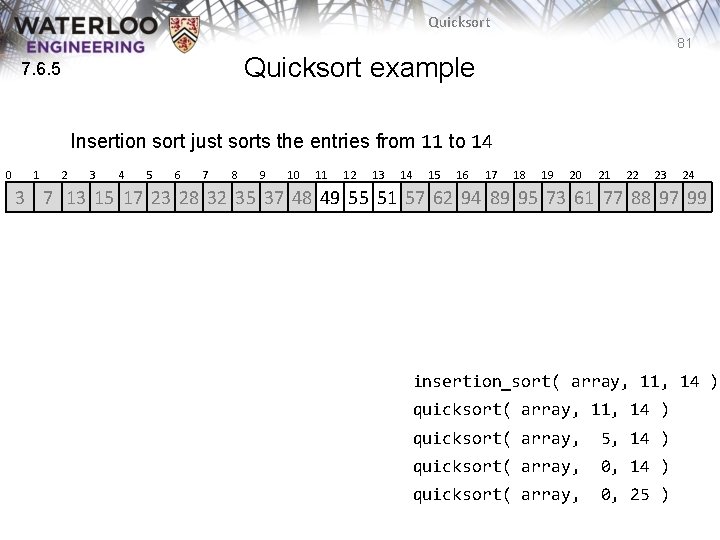
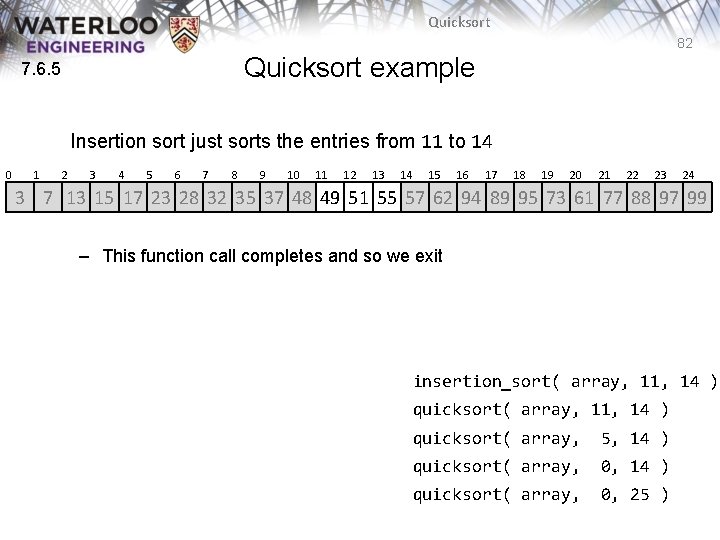
Quicksort 81 Quicksort example 7. 6. 5 Insertion sort just sorts the entries from 11 to 14 0 1 2 3 4 5 6 7 8 9 10 11 12 13 14 15 16 17 18 19 20 21 22 23 24 3 7 13 15 17 23 28 32 35 37 48 49 55 51 57 62 94 89 95 73 61 77 88 97 99 insertion_sort( array, 11, 14 ) quicksort( array, 5, 14 ) quicksort( array, 0, 25 )
Quicksort 82 Quicksort example 7. 6. 5 Insertion sort just sorts the entries from 11 to 14 0 1 2 3 4 5 6 7 8 9 10 11 12 13 14 15 16 17 18 19 20 21 22 23 24 3 7 13 15 17 23 28 32 35 37 48 49 51 55 57 62 94 89 95 73 61 77 88 97 99 – This function call completes and so we exit insertion_sort( array, 11, 14 ) quicksort( array, 5, 14 ) quicksort( array, 0, 25 )
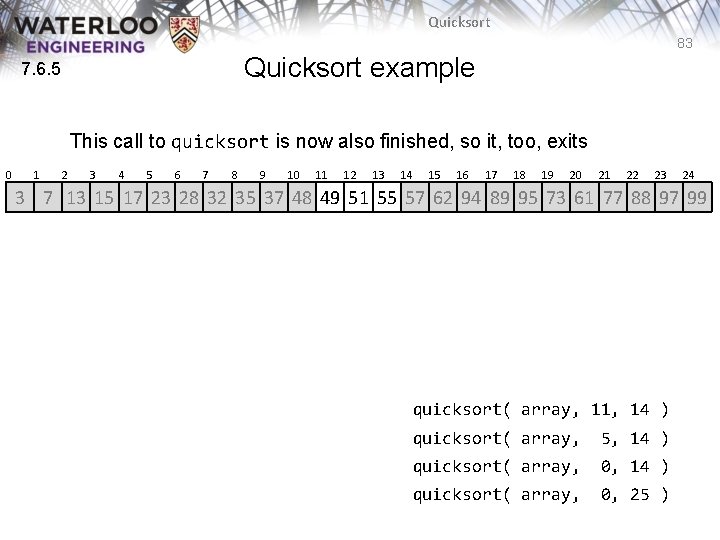
Quicksort 83 Quicksort example 7. 6. 5 This call to quicksort is now also finished, so it, too, exits 0 1 2 3 4 5 6 7 8 9 10 11 12 13 14 15 16 17 18 19 20 21 22 23 24 3 7 13 15 17 23 28 32 35 37 48 49 51 55 57 62 94 89 95 73 61 77 88 97 99 quicksort( array, 11, 14 ) quicksort( array, 5, 14 ) quicksort( array, 0, 25 )
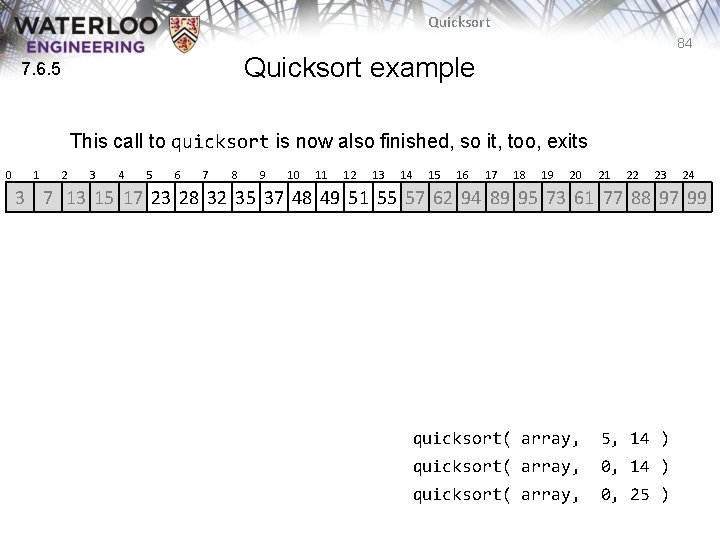
Quicksort 84 Quicksort example 7. 6. 5 This call to quicksort is now also finished, so it, too, exits 0 1 2 3 4 5 6 7 8 9 10 11 12 13 14 15 16 17 18 19 20 21 22 23 24 3 7 13 15 17 23 28 32 35 37 48 49 51 55 57 62 94 89 95 73 61 77 88 97 99 quicksort( array, 5, 14 ) quicksort( array, 0, 25 )
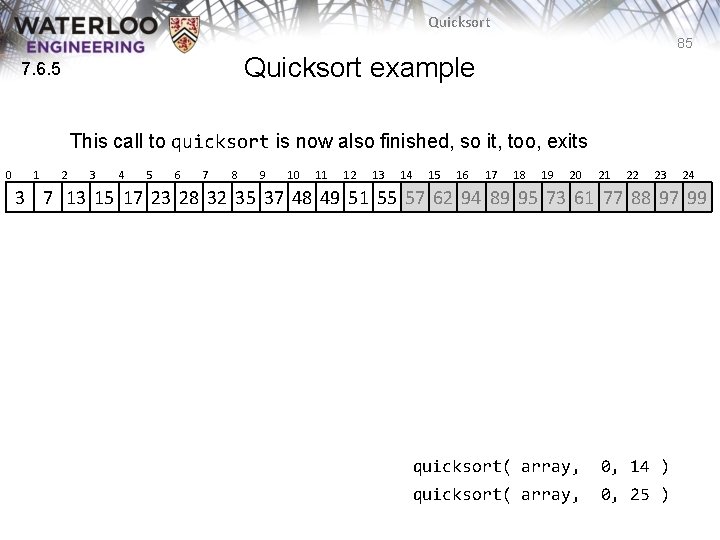
Quicksort 85 Quicksort example 7. 6. 5 This call to quicksort is now also finished, so it, too, exits 0 1 2 3 4 5 6 7 8 9 10 11 12 13 14 15 16 17 18 19 20 21 22 23 24 3 7 13 15 17 23 28 32 35 37 48 49 51 55 57 62 94 89 95 73 61 77 88 97 99 quicksort( array, 0, 14 ) quicksort( array, 0, 25 )
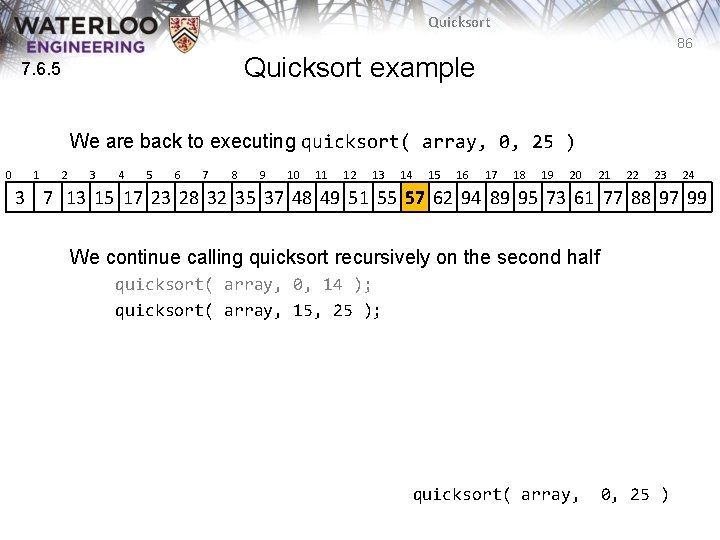
Quicksort 86 Quicksort example 7. 6. 5 We are back to executing quicksort( array, 0, 25 ) 0 1 2 3 4 5 6 7 8 9 10 11 12 13 14 15 16 17 18 19 20 21 22 23 24 3 7 13 15 17 23 28 32 35 37 48 49 51 55 57 62 94 89 95 73 61 77 88 97 99 We continue calling quicksort recursively on the second half quicksort( array, 0, 14 ); quicksort( array, 15, 25 ); quicksort( array, 0, 25 )
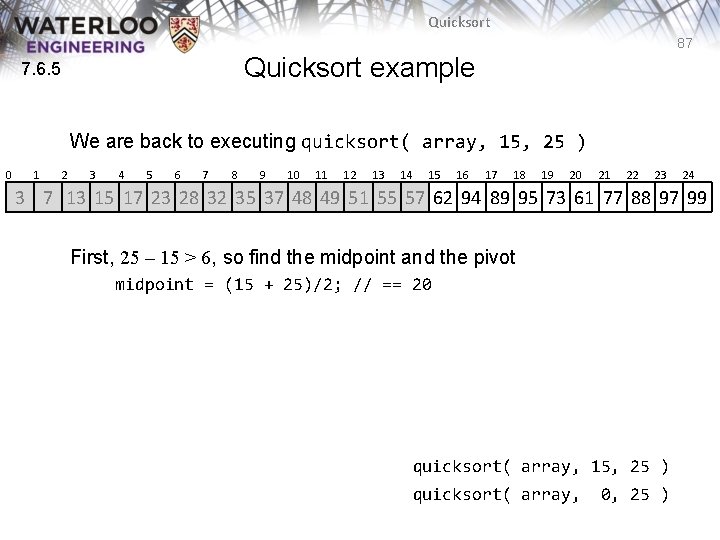
Quicksort 87 Quicksort example 7. 6. 5 We are back to executing quicksort( array, 15, 25 ) 0 1 2 3 4 5 6 7 8 9 10 11 12 13 14 15 16 17 18 19 20 21 22 23 24 3 7 13 15 17 23 28 32 35 37 48 49 51 55 57 62 94 89 95 73 61 77 88 97 99 First, 25 – 15 > 6, so find the midpoint and the pivot midpoint = (15 + 25)/2; // == 20 quicksort( array, 15, 25 ) quicksort( array, 0, 25 )
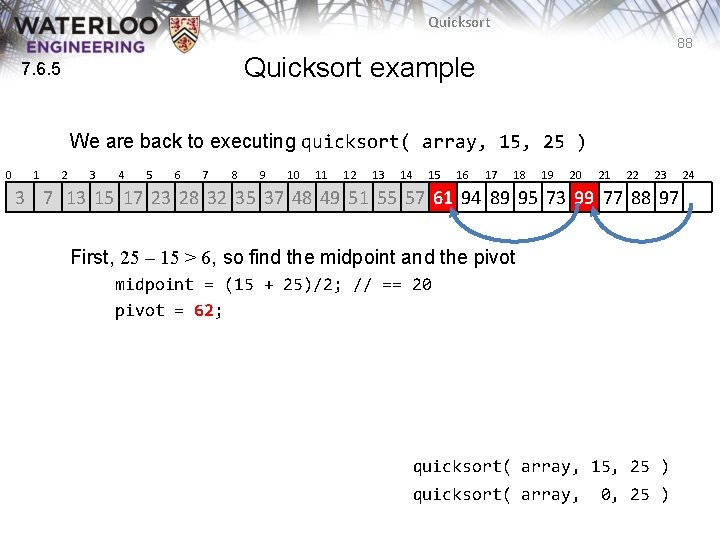
Quicksort 88 Quicksort example 7. 6. 5 We are back to executing quicksort( array, 15, 25 ) 0 1 2 3 4 5 6 7 8 9 10 11 12 13 14 15 16 17 18 19 20 21 22 23 3 7 13 15 17 23 28 32 35 37 48 49 51 55 57 61 94 89 95 73 99 77 88 97 First, 25 – 15 > 6, so find the midpoint and the pivot midpoint = (15 + 25)/2; // == 20 pivot = 62; quicksort( array, 15, 25 ) quicksort( array, 0, 25 ) 24
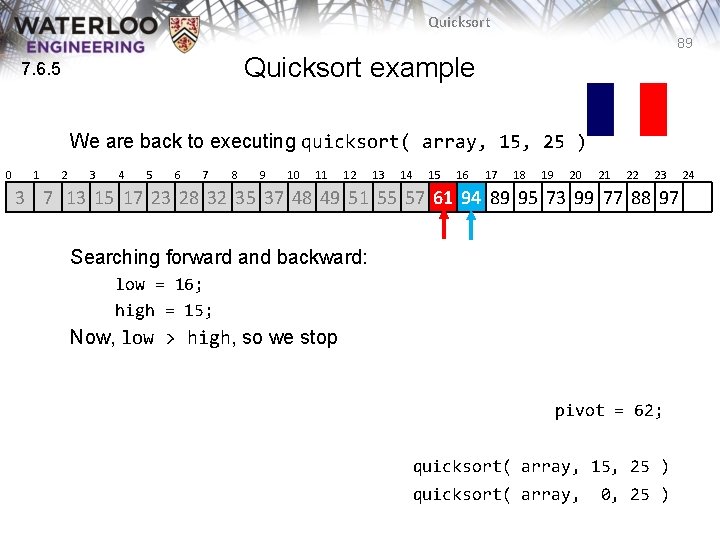
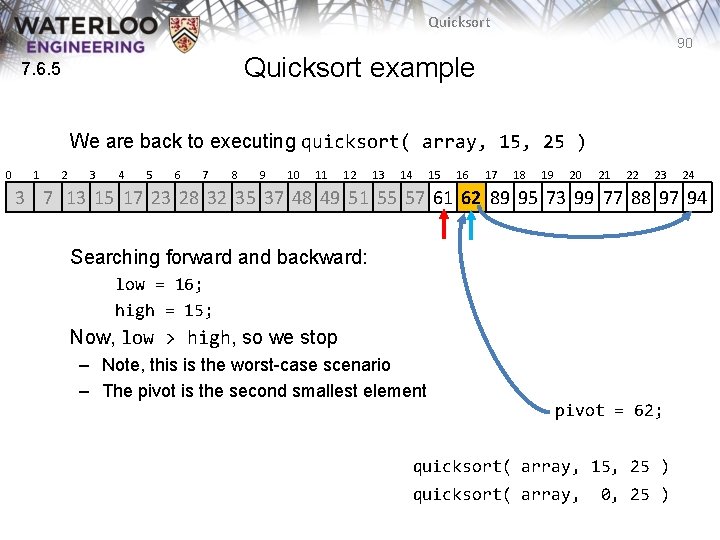
Quicksort 89 Quicksort example 7. 6. 5 We are back to executing quicksort( array, 15, 25 ) 0 1 2 3 4 5 6 7 8 9 10 11 12 13 14 15 16 17 18 19 20 21 22 23 3 7 13 15 17 23 28 32 35 37 48 49 51 55 57 61 94 89 95 73 99 77 88 97 Searching forward and backward: low = 16; high = 15; Now, low > high, so we stop pivot = 62; quicksort( array, 15, 25 ) quicksort( array, 0, 25 ) 24
Quicksort 90 Quicksort example 7. 6. 5 We are back to executing quicksort( array, 15, 25 ) 0 1 2 3 4 5 6 7 8 9 10 11 12 13 14 15 16 17 18 19 20 21 22 23 24 3 7 13 15 17 23 28 32 35 37 48 49 51 55 57 61 62 89 95 73 99 77 88 97 94 Searching forward and backward: low = 16; high = 15; Now, low > high, so we stop – Note, this is the worst-case scenario – The pivot is the second smallest element pivot = 62; quicksort( array, 15, 25 ) quicksort( array, 0, 25 )
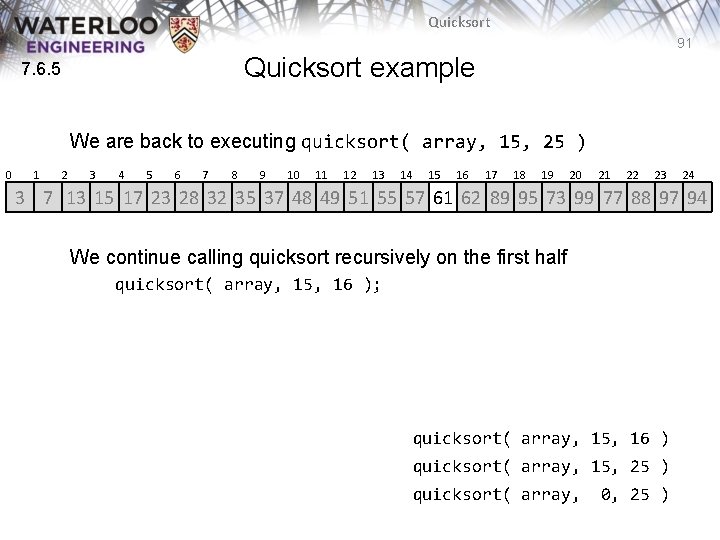
Quicksort 91 Quicksort example 7. 6. 5 We are back to executing quicksort( array, 15, 25 ) 0 1 2 3 4 5 6 7 8 9 10 11 12 13 14 15 16 17 18 19 20 21 22 23 24 3 7 13 15 17 23 28 32 35 37 48 49 51 55 57 61 62 89 95 73 99 77 88 97 94 We continue calling quicksort recursively on the first half quicksort( array, 15, 16 ); quicksort( array, 15, 16 ) quicksort( array, 15, 25 ) quicksort( array, 0, 25 )
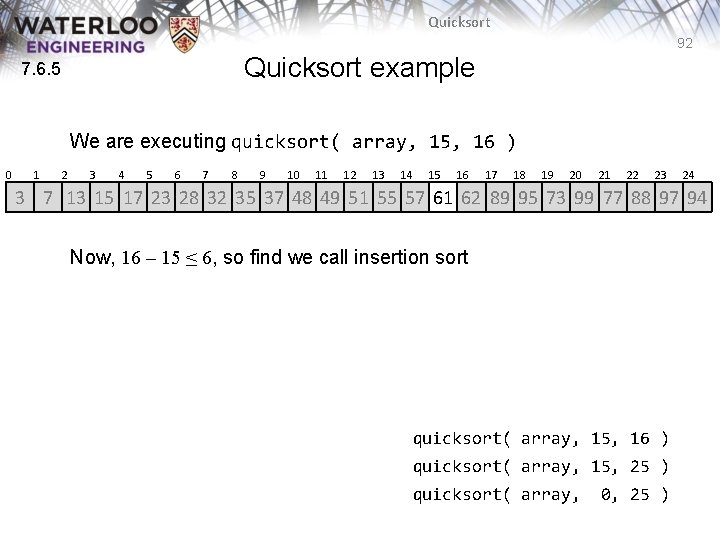
Quicksort 92 Quicksort example 7. 6. 5 We are executing quicksort( array, 15, 16 ) 0 1 2 3 4 5 6 7 8 9 10 11 12 13 14 15 16 17 18 19 20 21 22 23 24 3 7 13 15 17 23 28 32 35 37 48 49 51 55 57 61 62 89 95 73 99 77 88 97 94 Now, 16 – 15 ≤ 6, so find we call insertion sort quicksort( array, 15, 16 ) quicksort( array, 15, 25 ) quicksort( array, 0, 25 )
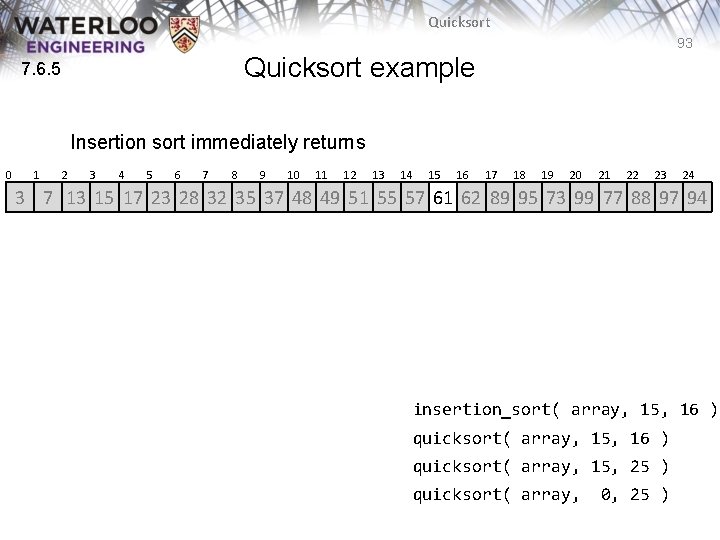
Quicksort 93 Quicksort example 7. 6. 5 Insertion sort immediately returns 0 1 2 3 4 5 6 7 8 9 10 11 12 13 14 15 16 17 18 19 20 21 22 23 24 3 7 13 15 17 23 28 32 35 37 48 49 51 55 57 61 62 89 95 73 99 77 88 97 94 insertion_sort( array, 15, 16 ) quicksort( array, 15, 25 ) quicksort( array, 0, 25 )
Quicksort 94 Quicksort example 7. 6. 5 This call to quicksort is now also finished, so it, too, exits 0 1 2 3 4 5 6 7 8 9 10 11 12 13 14 15 16 17 18 19 20 21 22 23 24 3 7 13 15 17 23 28 32 35 37 48 49 51 55 57 61 62 89 95 73 99 77 88 97 94 quicksort( array, 15, 16 ) quicksort( array, 15, 25 ) quicksort( array, 0, 25 )
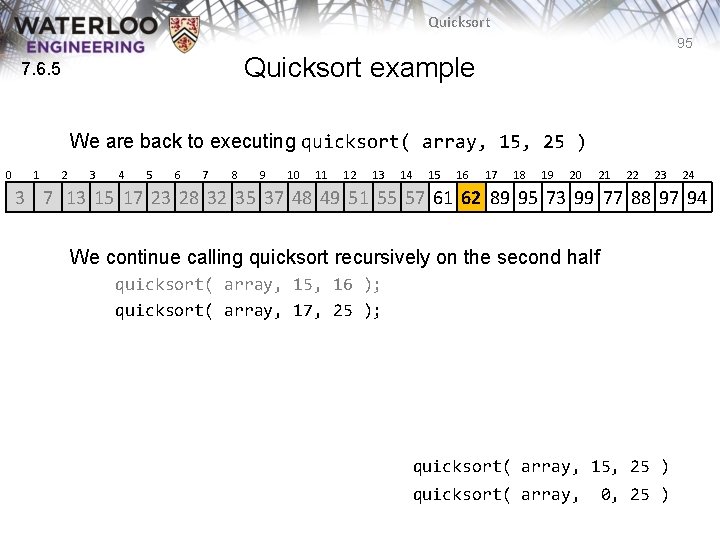
Quicksort 95 Quicksort example 7. 6. 5 We are back to executing quicksort( array, 15, 25 ) 0 1 2 3 4 5 6 7 8 9 10 11 12 13 14 15 16 17 18 19 20 21 22 23 24 3 7 13 15 17 23 28 32 35 37 48 49 51 55 57 61 62 89 95 73 99 77 88 97 94 We continue calling quicksort recursively on the second half quicksort( array, 15, 16 ); quicksort( array, 17, 25 ); quicksort( array, 15, 25 ) quicksort( array, 0, 25 )
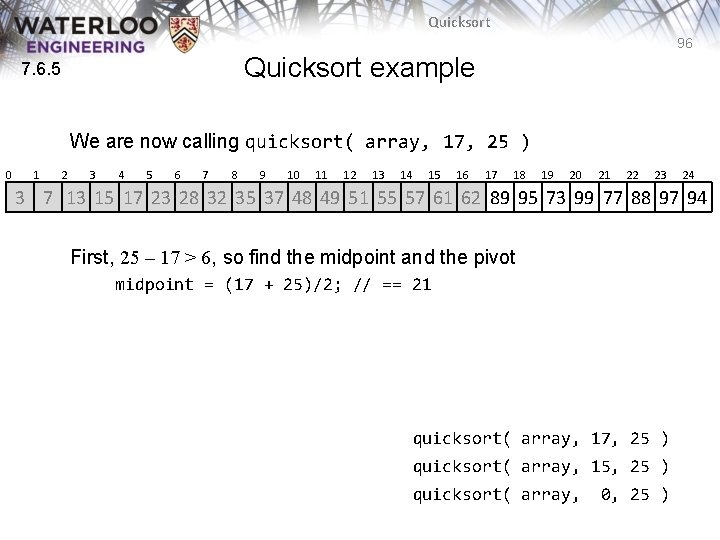
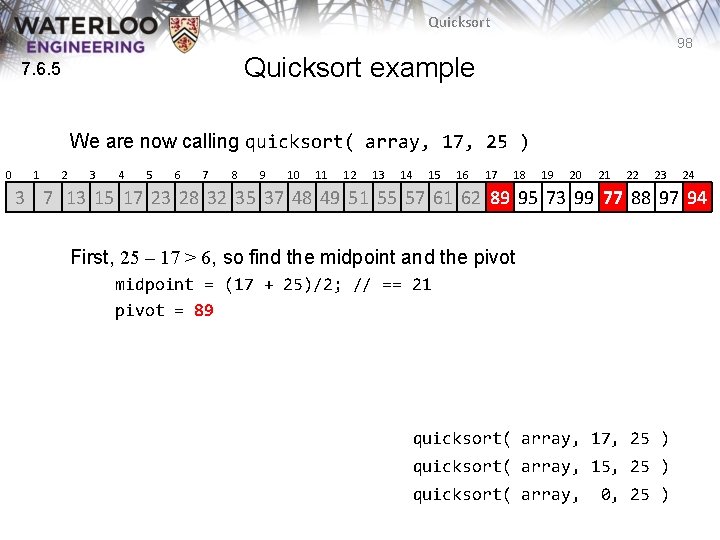
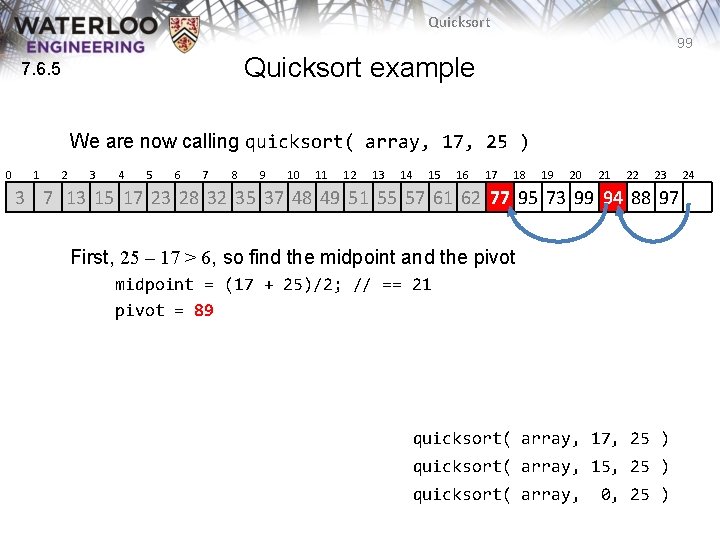
Quicksort 96 Quicksort example 7. 6. 5 We are now calling quicksort( array, 17, 25 ) 0 1 2 3 4 5 6 7 8 9 10 11 12 13 14 15 16 17 18 19 20 21 22 23 24 3 7 13 15 17 23 28 32 35 37 48 49 51 55 57 61 62 89 95 73 99 77 88 97 94 First, 25 – 17 > 6, so find the midpoint and the pivot midpoint = (17 + 25)/2; // == 21 quicksort( array, 17, 25 ) quicksort( array, 15, 25 ) quicksort( array, 0, 25 )
Quicksort 97 Quicksort example 7. 6. 5 We are now calling quicksort( array, 17, 25 ) 0 1 2 3 4 5 6 7 8 9 10 11 12 13 14 15 16 17 18 19 20 21 22 23 24 3 7 13 15 17 23 28 32 35 37 48 49 51 55 57 61 62 89 95 73 99 77 88 97 94 First, 25 – 17 > 6, so find the midpoint and the pivot midpoint = (17 + 25)/2; // == 21 quicksort( array, 17, 25 ) quicksort( array, 15, 25 ) quicksort( array, 0, 25 )
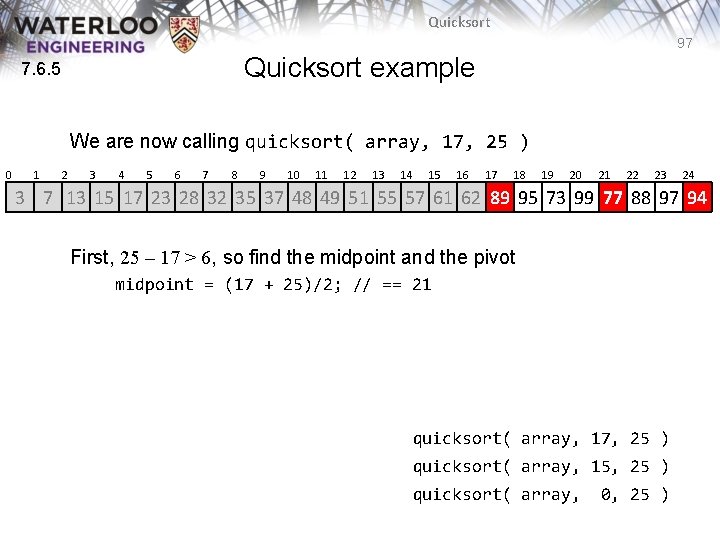
Quicksort 98 Quicksort example 7. 6. 5 We are now calling quicksort( array, 17, 25 ) 0 1 2 3 4 5 6 7 8 9 10 11 12 13 14 15 16 17 18 19 20 21 22 23 24 3 7 13 15 17 23 28 32 35 37 48 49 51 55 57 61 62 89 95 73 99 77 88 97 94 First, 25 – 17 > 6, so find the midpoint and the pivot midpoint = (17 + 25)/2; // == 21 pivot = 89 quicksort( array, 17, 25 ) quicksort( array, 15, 25 ) quicksort( array, 0, 25 )
Quicksort 99 Quicksort example 7. 6. 5 We are now calling quicksort( array, 17, 25 ) 0 1 2 3 4 5 6 7 8 9 10 11 12 13 14 15 16 17 18 19 20 21 22 23 3 7 13 15 17 23 28 32 35 37 48 49 51 55 57 61 62 77 95 73 99 94 88 97 First, 25 – 17 > 6, so find the midpoint and the pivot midpoint = (17 + 25)/2; // == 21 pivot = 89 quicksort( array, 17, 25 ) quicksort( array, 15, 25 ) quicksort( array, 0, 25 ) 24
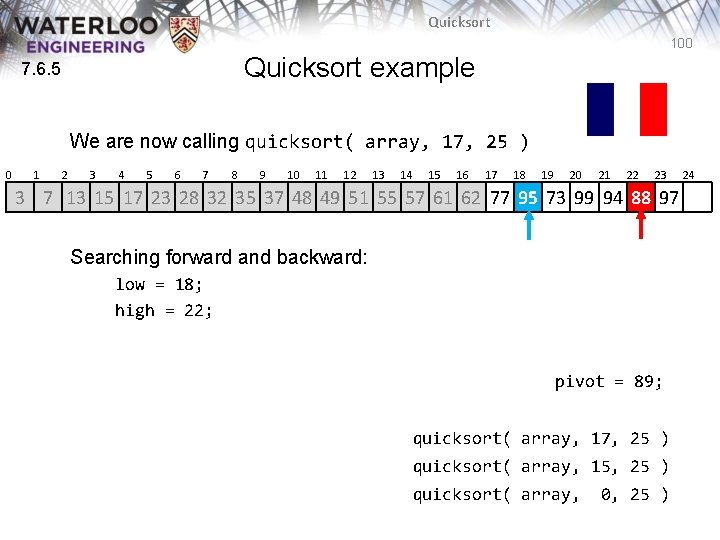
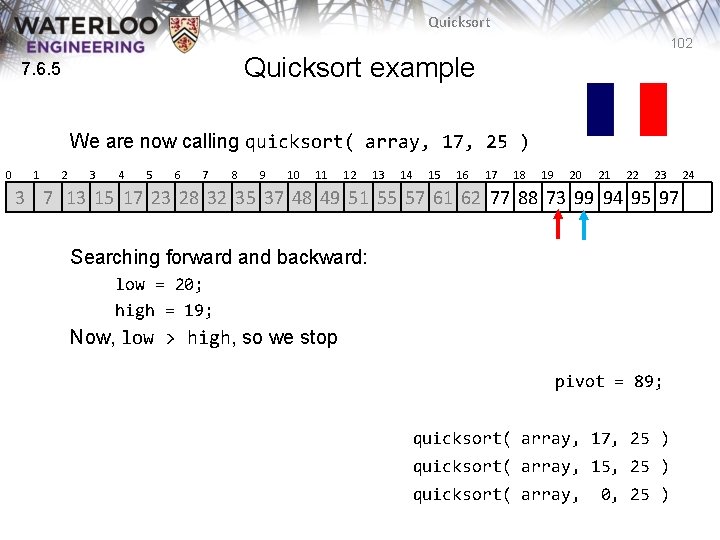
Quicksort 100 Quicksort example 7. 6. 5 We are now calling quicksort( array, 17, 25 ) 0 1 2 3 4 5 6 7 8 9 10 11 12 13 14 15 16 17 18 19 20 21 22 23 3 7 13 15 17 23 28 32 35 37 48 49 51 55 57 61 62 77 95 73 99 94 88 97 Searching forward and backward: low = 18; high = 22; pivot = 89; quicksort( array, 17, 25 ) quicksort( array, 15, 25 ) quicksort( array, 0, 25 ) 24
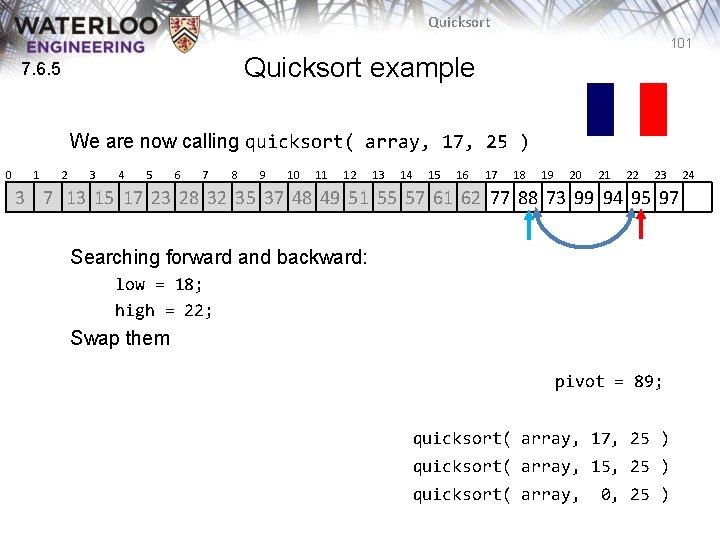
Quicksort 101 Quicksort example 7. 6. 5 We are now calling quicksort( array, 17, 25 ) 0 1 2 3 4 5 6 7 8 9 10 11 12 13 14 15 16 17 18 19 20 21 22 23 3 7 13 15 17 23 28 32 35 37 48 49 51 55 57 61 62 77 88 73 99 94 95 97 Searching forward and backward: low = 18; high = 22; Swap them pivot = 89; quicksort( array, 17, 25 ) quicksort( array, 15, 25 ) quicksort( array, 0, 25 ) 24
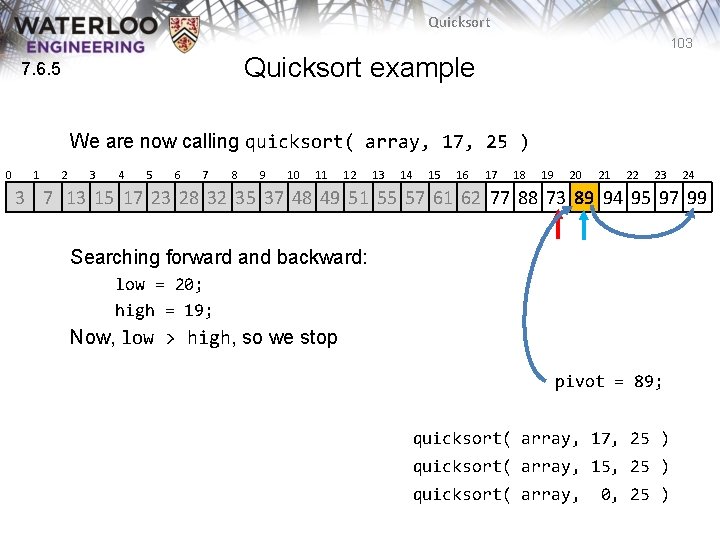
Quicksort 102 Quicksort example 7. 6. 5 We are now calling quicksort( array, 17, 25 ) 0 1 2 3 4 5 6 7 8 9 10 11 12 13 14 15 16 17 18 19 20 21 22 23 3 7 13 15 17 23 28 32 35 37 48 49 51 55 57 61 62 77 88 73 99 94 95 97 Searching forward and backward: low = 20; high = 19; Now, low > high, so we stop pivot = 89; quicksort( array, 17, 25 ) quicksort( array, 15, 25 ) quicksort( array, 0, 25 ) 24
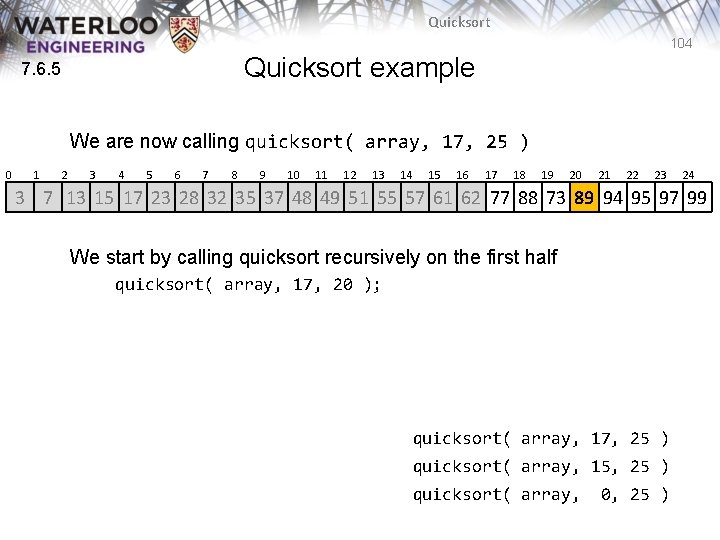
Quicksort 103 Quicksort example 7. 6. 5 We are now calling quicksort( array, 17, 25 ) 0 1 2 3 4 5 6 7 8 9 10 11 12 13 14 15 16 17 18 19 20 21 22 23 24 3 7 13 15 17 23 28 32 35 37 48 49 51 55 57 61 62 77 88 73 89 94 95 97 99 Searching forward and backward: low = 20; high = 19; Now, low > high, so we stop pivot = 89; quicksort( array, 17, 25 ) quicksort( array, 15, 25 ) quicksort( array, 0, 25 )
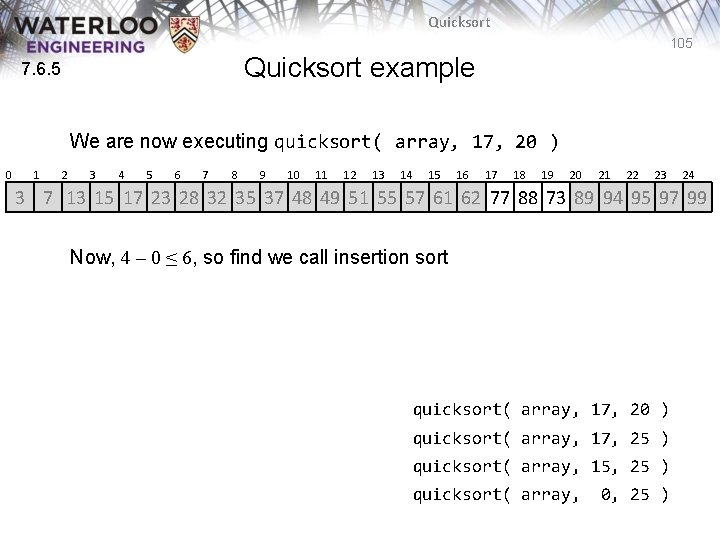
Quicksort 104 Quicksort example 7. 6. 5 We are now calling quicksort( array, 17, 25 ) 0 1 2 3 4 5 6 7 8 9 10 11 12 13 14 15 16 17 18 19 20 21 22 23 24 3 7 13 15 17 23 28 32 35 37 48 49 51 55 57 61 62 77 88 73 89 94 95 97 99 We start by calling quicksort recursively on the first half quicksort( array, 17, 20 ); quicksort( array, 17, 25 ) quicksort( array, 15, 25 ) quicksort( array, 0, 25 )
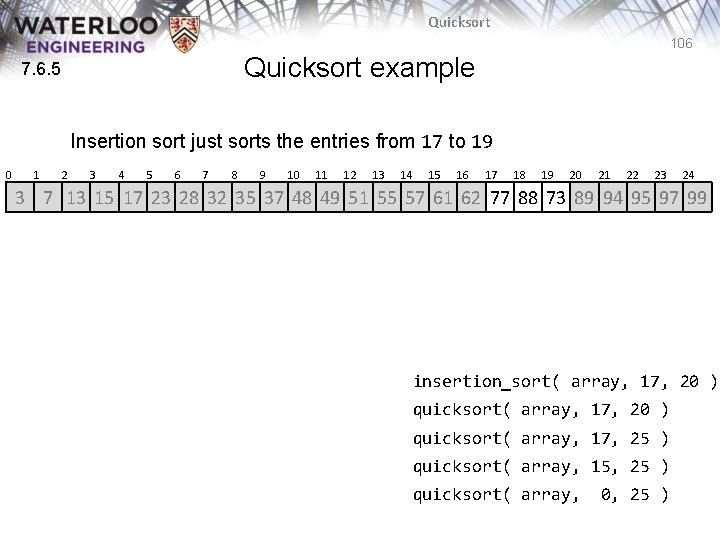
Quicksort 105 Quicksort example 7. 6. 5 We are now executing quicksort( array, 17, 20 ) 0 1 2 3 4 5 6 7 8 9 10 11 12 13 14 15 16 17 18 19 20 21 22 23 24 3 7 13 15 17 23 28 32 35 37 48 49 51 55 57 61 62 77 88 73 89 94 95 97 99 Now, 4 – 0 ≤ 6, so find we call insertion sort quicksort( array, 17, 20 ) quicksort( array, 17, 25 ) quicksort( array, 15, 25 ) quicksort( array, 0, 25 )
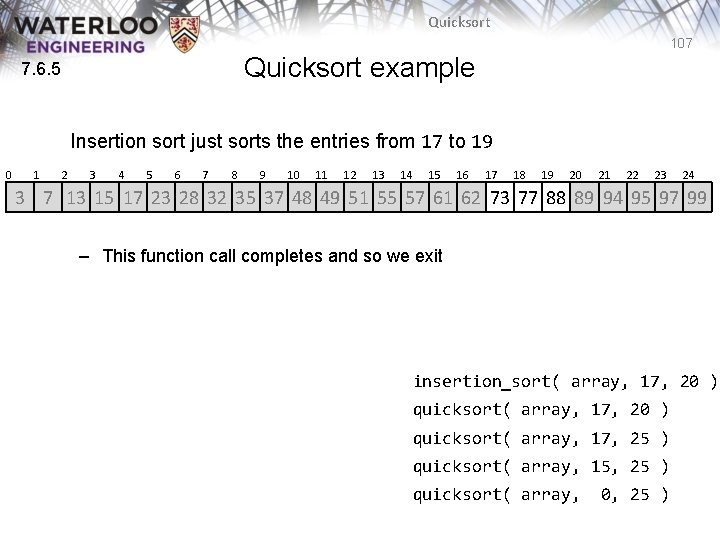
Quicksort 106 Quicksort example 7. 6. 5 Insertion sort just sorts the entries from 17 to 19 0 1 2 3 4 5 6 7 8 9 10 11 12 13 14 15 16 17 18 19 20 21 22 23 24 3 7 13 15 17 23 28 32 35 37 48 49 51 55 57 61 62 77 88 73 89 94 95 97 99 insertion_sort( array, 17, 20 ) quicksort( array, 17, 25 ) quicksort( array, 15, 25 ) quicksort( array, 0, 25 )
Quicksort 107 Quicksort example 7. 6. 5 Insertion sort just sorts the entries from 17 to 19 0 1 2 3 4 5 6 7 8 9 10 11 12 13 14 15 16 17 18 19 20 21 22 23 24 3 7 13 15 17 23 28 32 35 37 48 49 51 55 57 61 62 73 77 88 89 94 95 97 99 – This function call completes and so we exit insertion_sort( array, 17, 20 ) quicksort( array, 17, 25 ) quicksort( array, 15, 25 ) quicksort( array, 0, 25 )
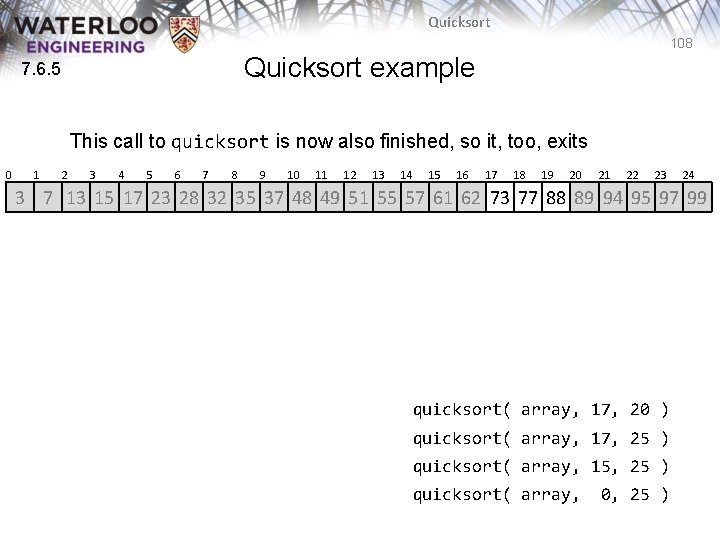
Quicksort 108 Quicksort example 7. 6. 5 This call to quicksort is now also finished, so it, too, exits 0 1 2 3 4 5 6 7 8 9 10 11 12 13 14 15 16 17 18 19 20 21 22 23 24 3 7 13 15 17 23 28 32 35 37 48 49 51 55 57 61 62 73 77 88 89 94 95 97 99 quicksort( array, 17, 20 ) quicksort( array, 17, 25 ) quicksort( array, 15, 25 ) quicksort( array, 0, 25 )
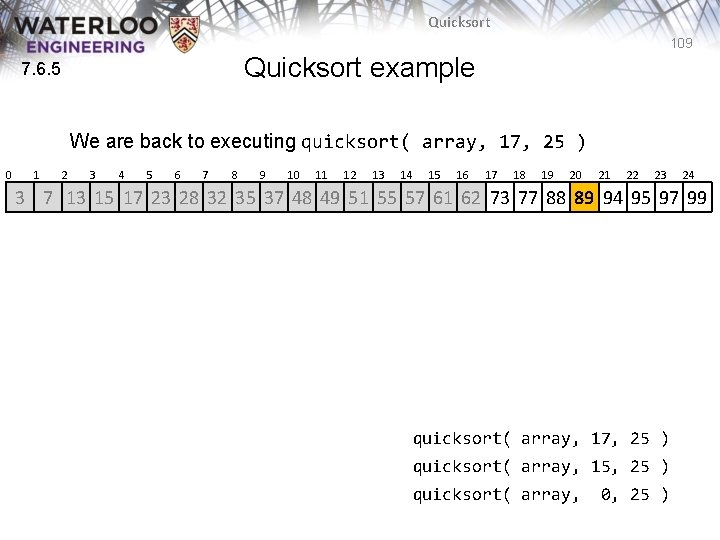
Quicksort 109 Quicksort example 7. 6. 5 We are back to executing quicksort( array, 17, 25 ) 0 1 2 3 4 5 6 7 8 9 10 11 12 13 14 15 16 17 18 19 20 21 22 23 24 3 7 13 15 17 23 28 32 35 37 48 49 51 55 57 61 62 73 77 88 89 94 95 97 99 quicksort( array, 17, 25 ) quicksort( array, 15, 25 ) quicksort( array, 0, 25 )
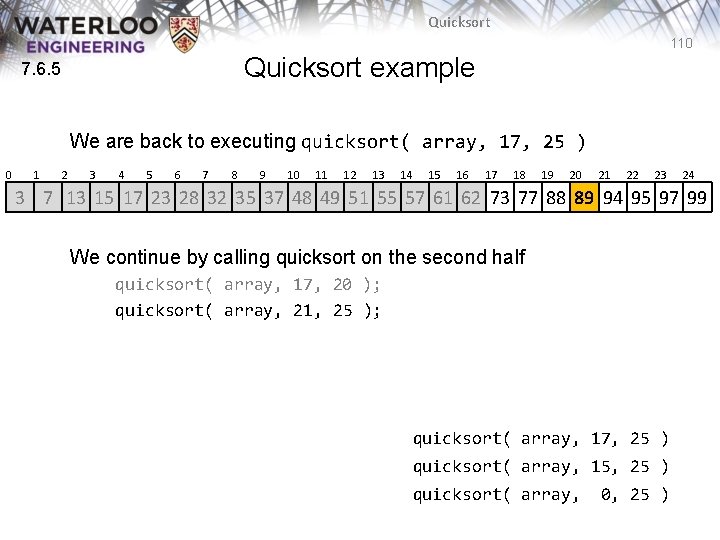
Quicksort 110 Quicksort example 7. 6. 5 We are back to executing quicksort( array, 17, 25 ) 0 1 2 3 4 5 6 7 8 9 10 11 12 13 14 15 16 17 18 19 20 21 22 23 24 3 7 13 15 17 23 28 32 35 37 48 49 51 55 57 61 62 73 77 88 89 94 95 97 99 We continue by calling quicksort on the second half quicksort( array, 17, 20 ); quicksort( array, 21, 25 ); quicksort( array, 17, 25 ) quicksort( array, 15, 25 ) quicksort( array, 0, 25 )
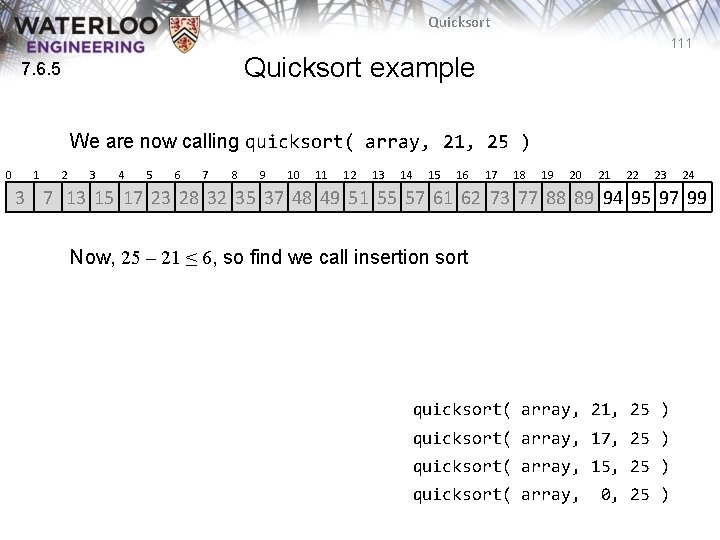
Quicksort 111 Quicksort example 7. 6. 5 We are now calling quicksort( array, 21, 25 ) 0 1 2 3 4 5 6 7 8 9 10 11 12 13 14 15 16 17 18 19 20 21 22 23 24 3 7 13 15 17 23 28 32 35 37 48 49 51 55 57 61 62 73 77 88 89 94 95 97 99 Now, 25 – 21 ≤ 6, so find we call insertion sort quicksort( array, 21, 25 ) quicksort( array, 17, 25 ) quicksort( array, 15, 25 ) quicksort( array, 0, 25 )
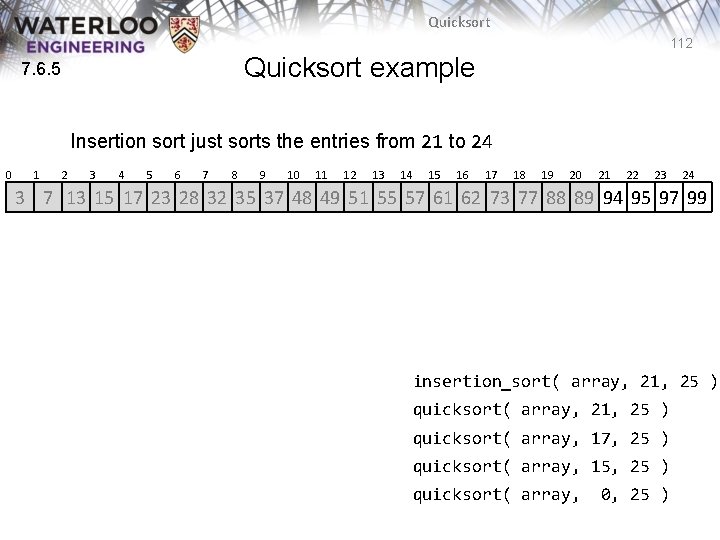
Quicksort 112 Quicksort example 7. 6. 5 Insertion sort just sorts the entries from 21 to 24 0 1 2 3 4 5 6 7 8 9 10 11 12 13 14 15 16 17 18 19 20 21 22 23 24 3 7 13 15 17 23 28 32 35 37 48 49 51 55 57 61 62 73 77 88 89 94 95 97 99 insertion_sort( array, 21, 25 ) quicksort( array, 17, 25 ) quicksort( array, 15, 25 ) quicksort( array, 0, 25 )
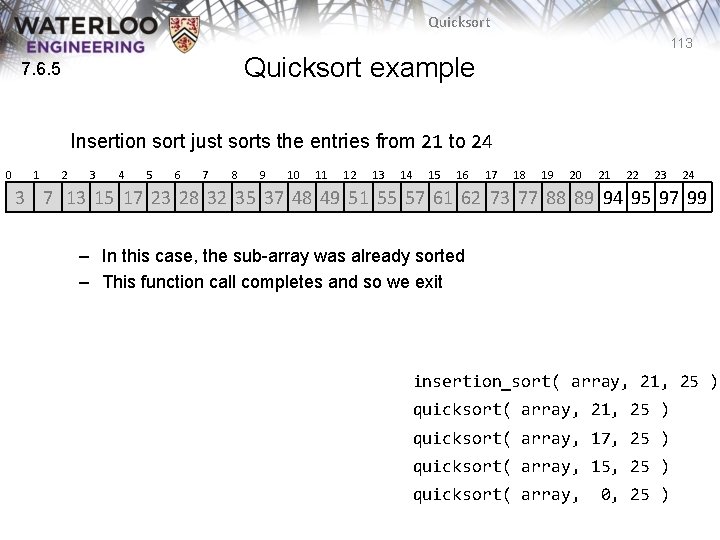
Quicksort 113 Quicksort example 7. 6. 5 Insertion sort just sorts the entries from 21 to 24 0 1 2 3 4 5 6 7 8 9 10 11 12 13 14 15 16 17 18 19 20 21 22 23 24 3 7 13 15 17 23 28 32 35 37 48 49 51 55 57 61 62 73 77 88 89 94 95 97 99 – In this case, the sub-array was already sorted – This function call completes and so we exit insertion_sort( array, 21, 25 ) quicksort( array, 17, 25 ) quicksort( array, 15, 25 ) quicksort( array, 0, 25 )
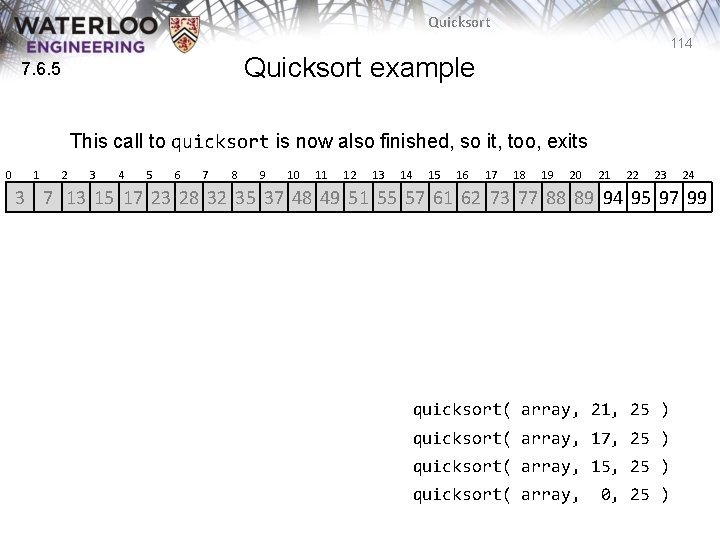
Quicksort 114 Quicksort example 7. 6. 5 This call to quicksort is now also finished, so it, too, exits 0 1 2 3 4 5 6 7 8 9 10 11 12 13 14 15 16 17 18 19 20 21 22 23 24 3 7 13 15 17 23 28 32 35 37 48 49 51 55 57 61 62 73 77 88 89 94 95 97 99 quicksort( array, 21, 25 ) quicksort( array, 17, 25 ) quicksort( array, 15, 25 ) quicksort( array, 0, 25 )
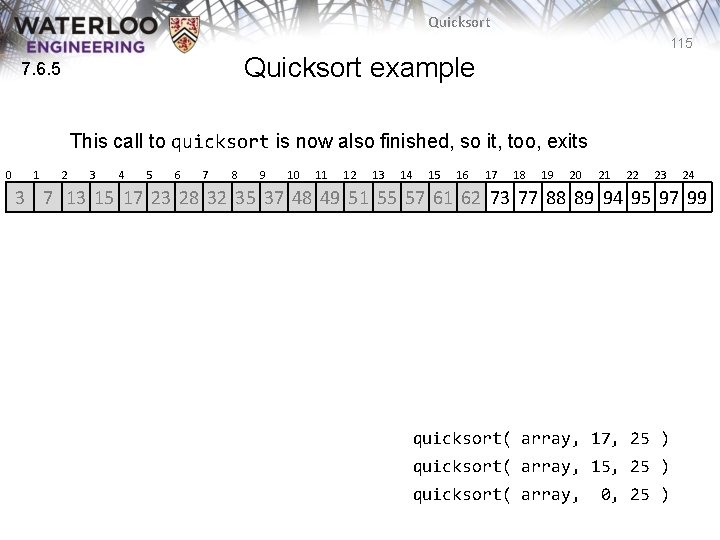
Quicksort 115 Quicksort example 7. 6. 5 This call to quicksort is now also finished, so it, too, exits 0 1 2 3 4 5 6 7 8 9 10 11 12 13 14 15 16 17 18 19 20 21 22 23 24 3 7 13 15 17 23 28 32 35 37 48 49 51 55 57 61 62 73 77 88 89 94 95 97 99 quicksort( array, 17, 25 ) quicksort( array, 15, 25 ) quicksort( array, 0, 25 )
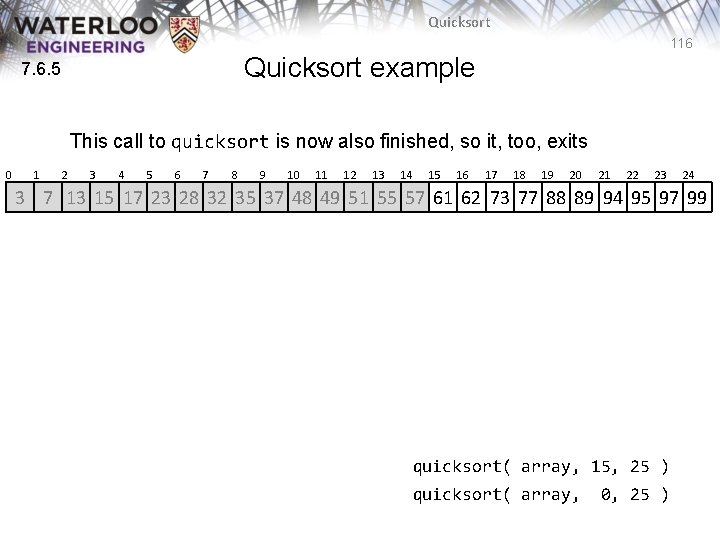
Quicksort 116 Quicksort example 7. 6. 5 This call to quicksort is now also finished, so it, too, exits 0 1 2 3 4 5 6 7 8 9 10 11 12 13 14 15 16 17 18 19 20 21 22 23 24 3 7 13 15 17 23 28 32 35 37 48 49 51 55 57 61 62 73 77 88 89 94 95 97 99 quicksort( array, 15, 25 ) quicksort( array, 0, 25 )
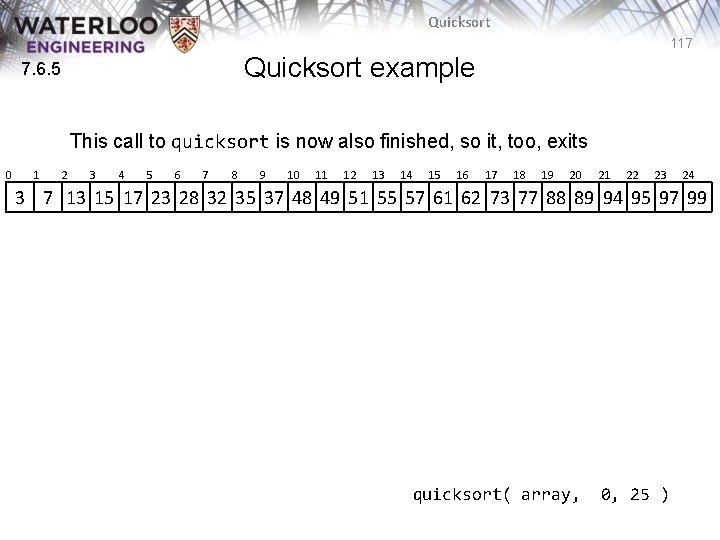
Quicksort 117 Quicksort example 7. 6. 5 This call to quicksort is now also finished, so it, too, exits 0 1 2 3 4 5 6 7 8 9 10 11 12 13 14 15 16 17 18 19 20 21 22 23 24 3 7 13 15 17 23 28 32 35 37 48 49 51 55 57 61 62 73 77 88 89 94 95 97 99 quicksort( array, 0, 25 )
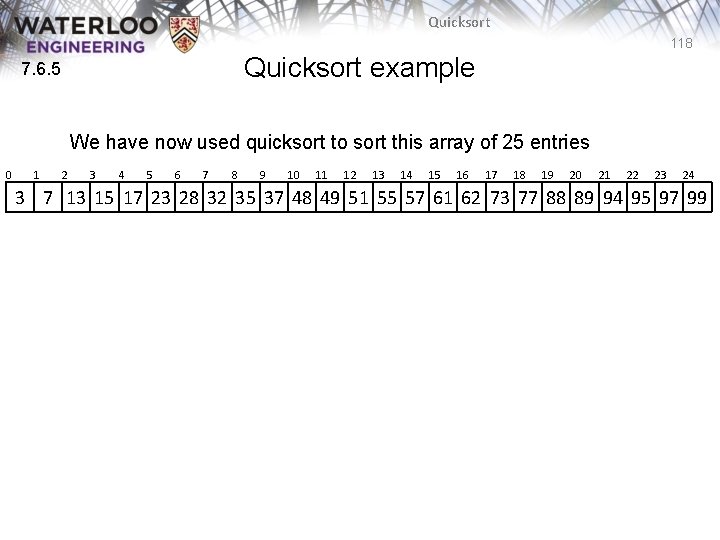
Quicksort 118 Quicksort example 7. 6. 5 We have now used quicksort to sort this array of 25 entries 0 1 2 3 4 5 6 7 8 9 10 11 12 13 14 15 16 17 18 19 20 21 22 23 24 3 7 13 15 17 23 28 32 35 37 48 49 51 55 57 61 62 73 77 88 89 94 95 97 99
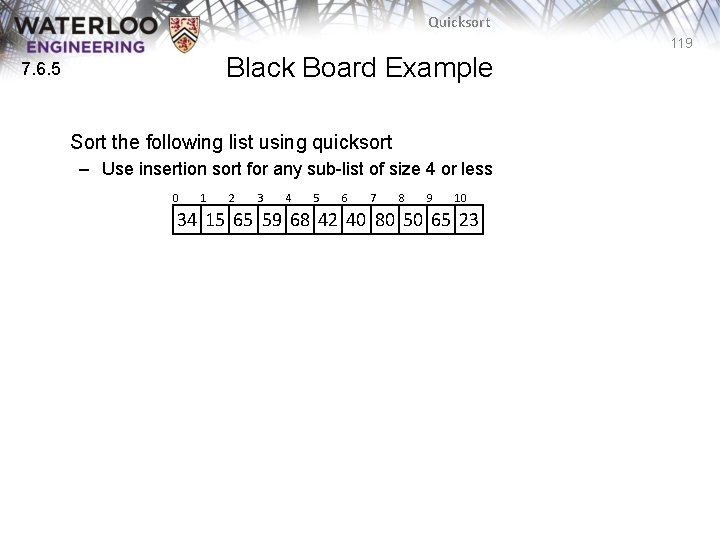
Quicksort 119 Black Board Example 7. 6. 5 Sort the following list using quicksort – Use insertion sort for any sub-list of size 4 or less 0 1 2 3 4 5 6 7 8 9 10 34 15 65 59 68 42 40 80 50 65 23
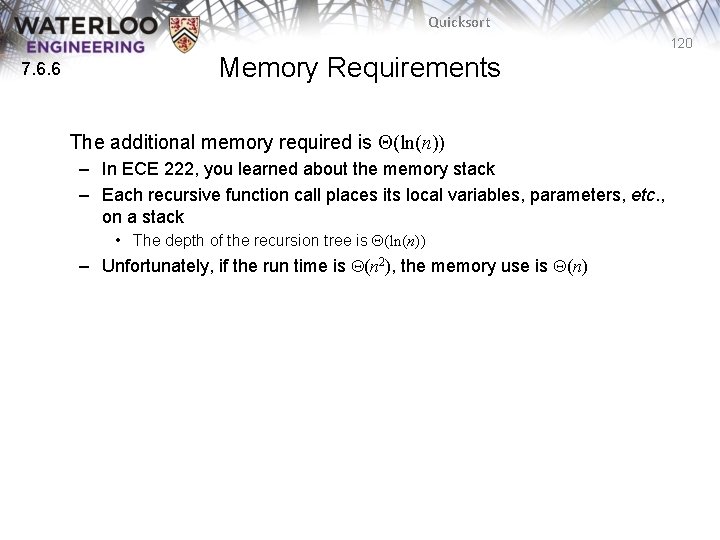
Quicksort 120 7. 6. 6 Memory Requirements The additional memory required is Q(ln(n)) – In ECE 222, you learned about the memory stack – Each recursive function call places its local variables, parameters, etc. , on a stack • The depth of the recursion tree is Q(ln(n)) – Unfortunately, if the run time is Q(n 2), the memory use is Q(n)
Quicksort 121 Run-time Summary 7. 6. 7 To summarize all three Q(n ln(n)) algorithms Average Run Time Worst-case Run Time Average Memory Worst-case Memory Heap Sort Q(n ln(n)) Q(1) Merge Sort Q(n ln(n)) Q(n) Quicksort Q(n ln(n)) Q(n 2) Q(ln(n)) Q(n)
Quicksort 122 7. 6. 7 Further modifications Our implementation is by no means optimal: An excellent paper on quicksort was written by Jon L. Bentley and M. Douglas Mc. Ilroy: Engineering a Sort Function found in Software—Practice and Experience, Vol. 23(11), Nov 1993
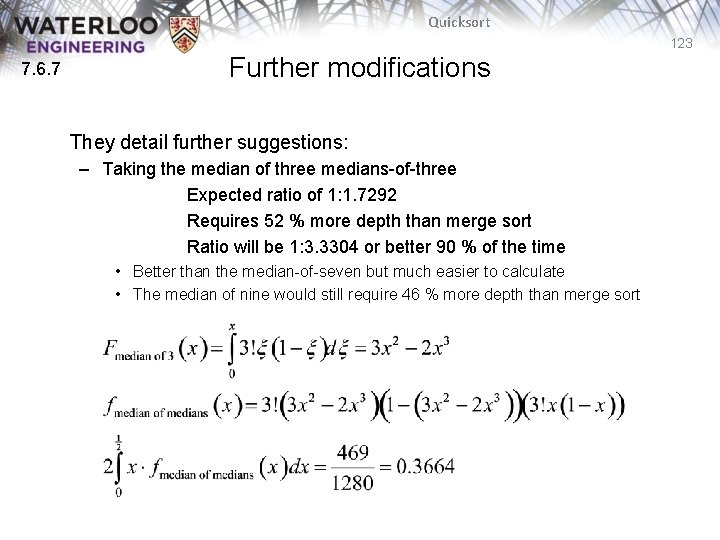
Quicksort 123 7. 6. 7 Further modifications They detail further suggestions: – Taking the median of three medians-of-three Expected ratio of 1: 1. 7292 Requires 52 % more depth than merge sort Ratio will be 1: 3. 3304 or better 90 % of the time • Better than the median-of-seven but much easier to calculate • The median of nine would still require 46 % more depth than merge sort
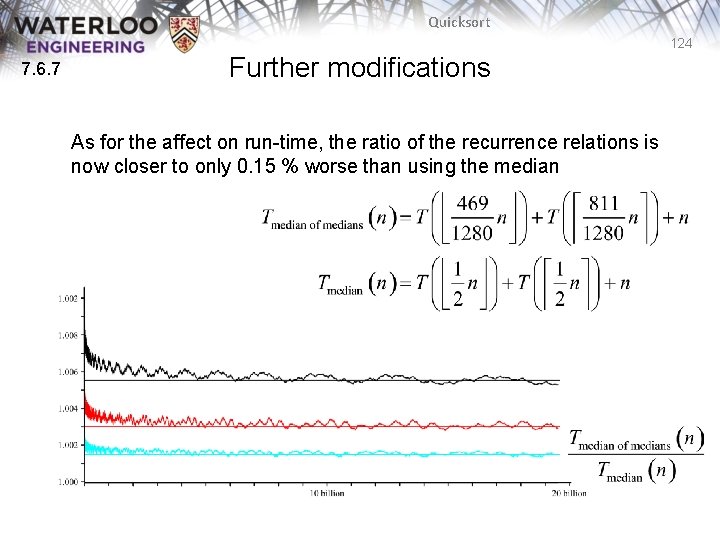
Quicksort 124 7. 6. 7 Further modifications As for the affect on run-time, the ratio of the recurrence relations is now closer to only 0. 15 % worse than using the median
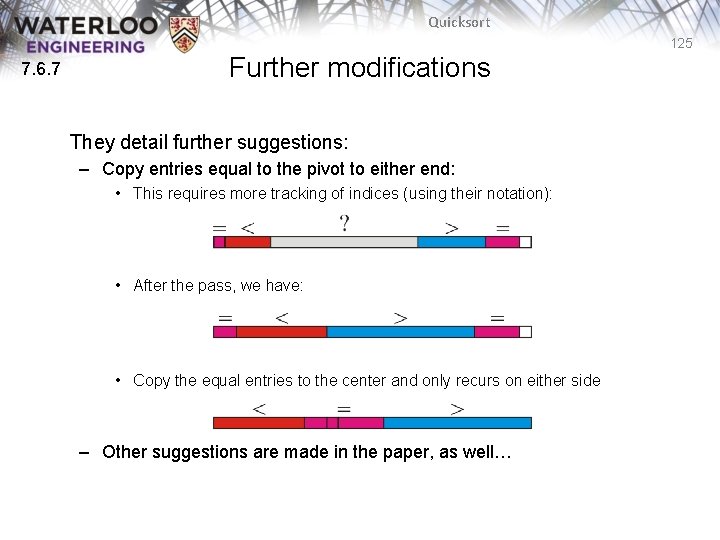
Quicksort 125 7. 6. 7 Further modifications They detail further suggestions: – Copy entries equal to the pivot to either end: • This requires more tracking of indices (using their notation): • After the pass, we have: • Copy the equal entries to the center and only recurs on either side – Other suggestions are made in the paper, as well…
Quicksort 126 Summary This topic covered quicksort – On average faster than heap sort or merge sort – Uses a pivot to partition the objects – Using the median of three pivots is a reasonably means of finding the pivot – Average run time of Q(n ln(n)) and Q(ln(n)) memory – Worst case run time of Q(n 2) and Q(n) memory
Quicksort 127 References Wikipedia, http: //en. wikipedia. org/wiki/Quicksort [1] Donald E. Knuth, The Art of Computer Programming, Volume 3: Sorting and Searching, 2 nd Ed. , Addison Wesley, 1998, § 5. 1, 2, 3. [2] Cormen, Leiserson, and Rivest, Introduction to Algorithms, Mc. Graw Hill, 1990, p. 137 -9 and § 9. 1. [3] Weiss, Data Structures and Algorithm Analysis in C++, 3 rd Ed. , Addison Wesley, § 7. 1, p. 261 -2. [4] Gruber, Holzer, and Ruepp, Sorting the Slow Way: An Analysis of Perversely Awful Randomized Sorting Algorithms, 4 th International Conference on Fun with Algorithms, Castiglioncello, Italy, 2007. These slides are provided for the ECE 250 Algorithms and Data Structures course. The material in it reflects Douglas W. Harder’s best judgment in light of the information available to him at the time of preparation. Any reliance on these course slides by any party for any other purpose are the responsibility of such parties. Douglas W. Harder accepts no responsibility for damages, if any, suffered by any party as a result of decisions made or actions based on these course slides for any other purpose than that for which it was intended.