
ECE 250 Algorithms and Data Structures dary heaps


- Slides: 24
ECE 250 Algorithms and Data Structures d-ary heaps Douglas Wilhelm Harder, M. Math. LEL Department of Electrical and Computer Engineering University of Waterloo, Ontario, Canada ece. uwaterloo. ca dwharder@alumni. uwaterloo. ca © 20143 by Douglas Wilhelm Harder. Some rights reserved.
d-ary heaps 2 Outline In this topic, we will: – – – Definition of a d-ary min heap Implementation as a complete tree Examples of binary, ternary, quaternary, and quinary min heaps Properties Relative speeds • Optimal choice is a quaternary heap
d-ary heaps 3 Definition The relationship between a binary min heap and a d-ary min heap is the same as a binary tree and an N-ary tree – Every node has up to d children The relationship is the same—all children are greater than their parent
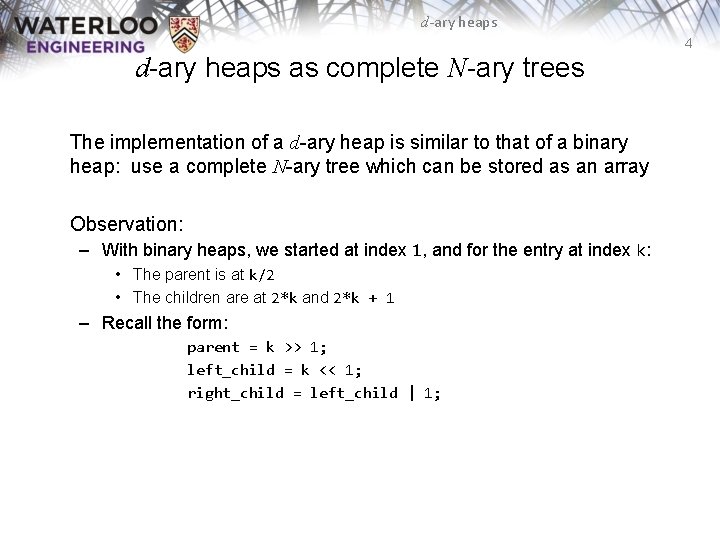
d-ary heaps 4 d-ary heaps as complete N-ary trees The implementation of a d-ary heap is similar to that of a binary heap: use a complete N-ary tree which can be stored as an array Observation: – With binary heaps, we started at index 1, and for the entry at index k: • The parent is at k/2 • The children are at 2*k and 2*k + 1 – Recall the form: parent = k >> 1; left_child = k << 1; right_child = left_child | 1;
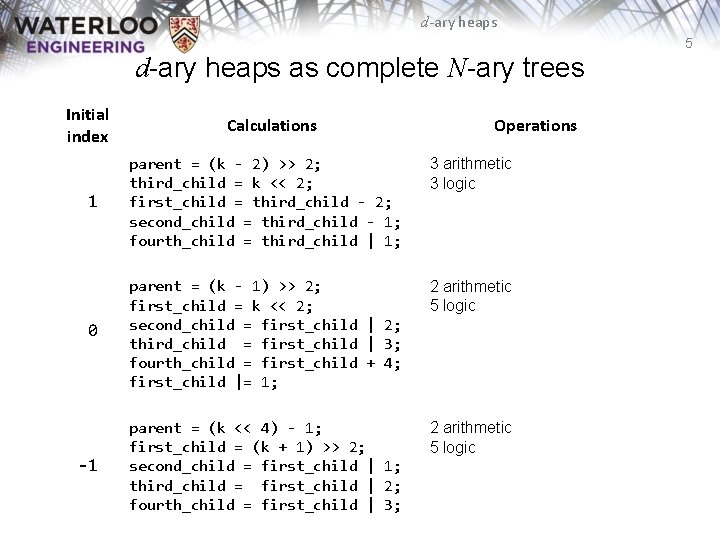
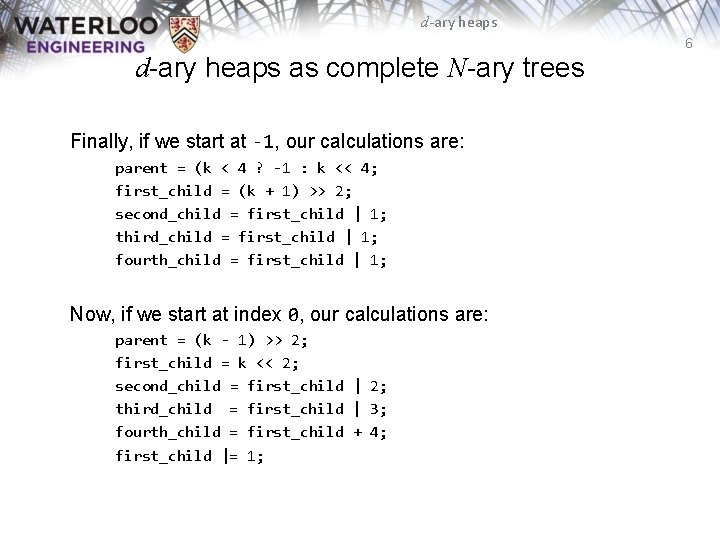
d-ary heaps 5 d-ary heaps as complete N-ary trees Initial index Calculations Operations 1 parent = (k - 2) >> 2; third_child = k << 2; first_child = third_child - 2; second_child = third_child - 1; fourth_child = third_child | 1; 3 arithmetic 3 logic 2 arithmetic 5 logic 0 parent = (k - 1) >> 2; first_child = k << 2; second_child = first_child | 2; third_child = first_child | 3; fourth_child = first_child + 4; first_child |= 1; -1 parent = (k << 4) - 1; first_child = (k + 1) >> 2; second_child = first_child | 1; third_child = first_child | 2; fourth_child = first_child | 3; 2 arithmetic 5 logic
d-ary heaps 6 d-ary heaps as complete N-ary trees Finally, if we start at -1, our calculations are: parent = (k < 4 ? -1 : k << 4; first_child = (k + 1) >> 2; second_child = first_child | 1; third_child = first_child | 1; fourth_child = first_child | 1; Now, if we start at index 0, our calculations are: parent = (k - 1) >> 2; first_child = k << 2; second_child = first_child | 2; third_child = first_child | 3; fourth_child = first_child + 4; first_child |= 1;
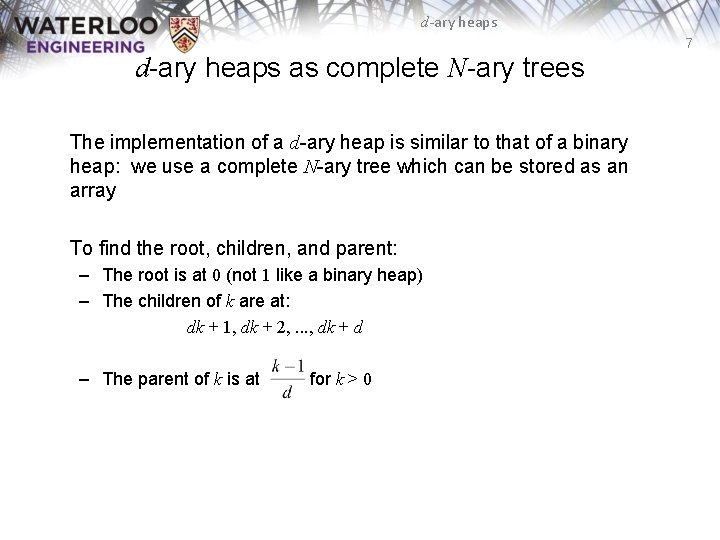
d-ary heaps 7 d-ary heaps as complete N-ary trees The implementation of a d-ary heap is similar to that of a binary heap: we use a complete N-ary tree which can be stored as an array To find the root, children, and parent: – The root is at 0 (not 1 like a binary heap) – The children of k are at: dk + 1, dk + 2, . . . , dk + d – The parent of k is at for k > 0
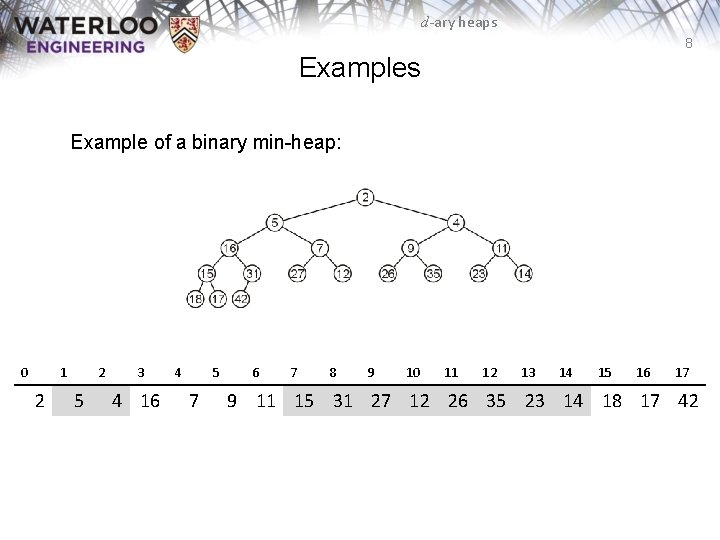
d-ary heaps 8 Examples Example of a binary min-heap: 0 1 2 2 5 3 4 16 4 5 7 6 7 8 9 10 11 12 13 14 15 16 17 9 11 15 31 27 12 26 35 23 14 18 17 42
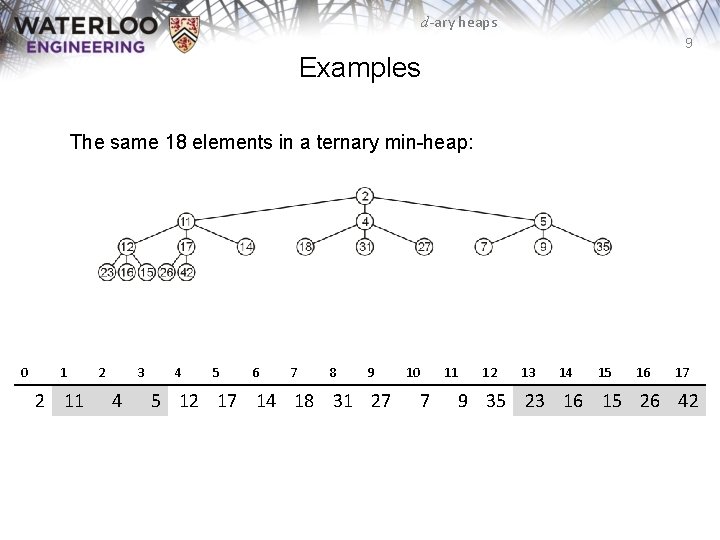
d-ary heaps 9 Examples The same 18 elements in a ternary min-heap: 0 1 2 11 2 3 4 4 5 6 7 8 9 5 12 17 14 18 31 27 10 7 11 12 13 14 15 16 17 9 35 23 16 15 26 42
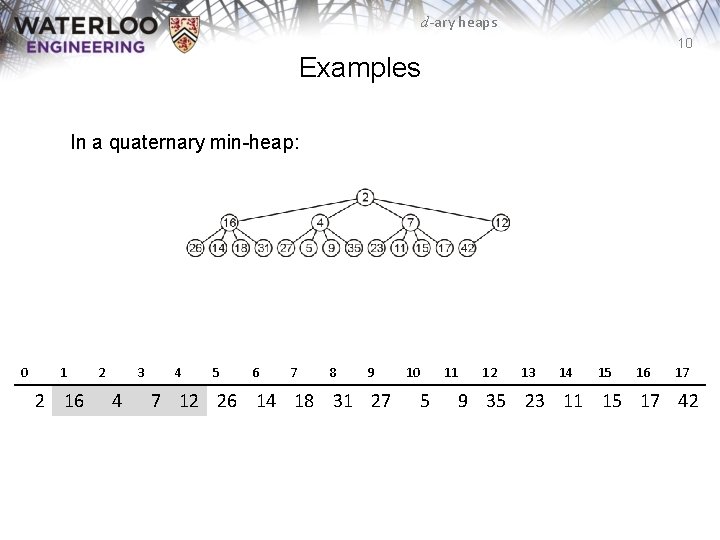
d-ary heaps 10 Examples In a quaternary min-heap: 0 1 2 16 2 3 4 4 5 6 7 8 9 7 12 26 14 18 31 27 10 5 11 12 13 14 15 16 17 9 35 23 11 15 17 42
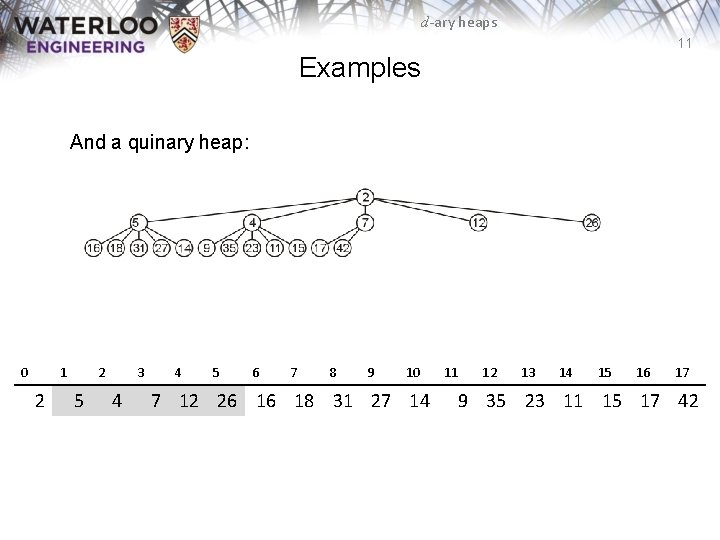
d-ary heaps 11 Examples And a quinary heap: 0 1 2 2 5 3 4 4 5 6 7 8 9 10 7 12 26 16 18 31 27 14 11 12 13 14 15 16 17 9 35 23 11 15 17 42
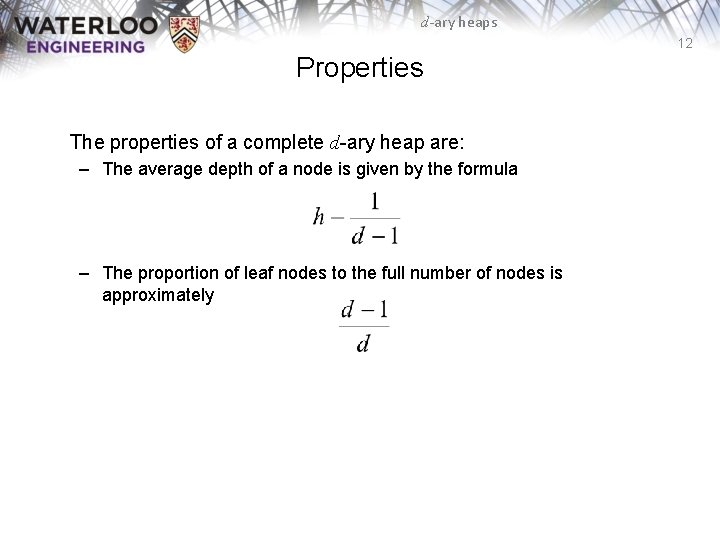
d-ary heaps 12 Properties The properties of a complete d-ary heap are: – The average depth of a node is given by the formula – The proportion of leaf nodes to the full number of nodes is approximately
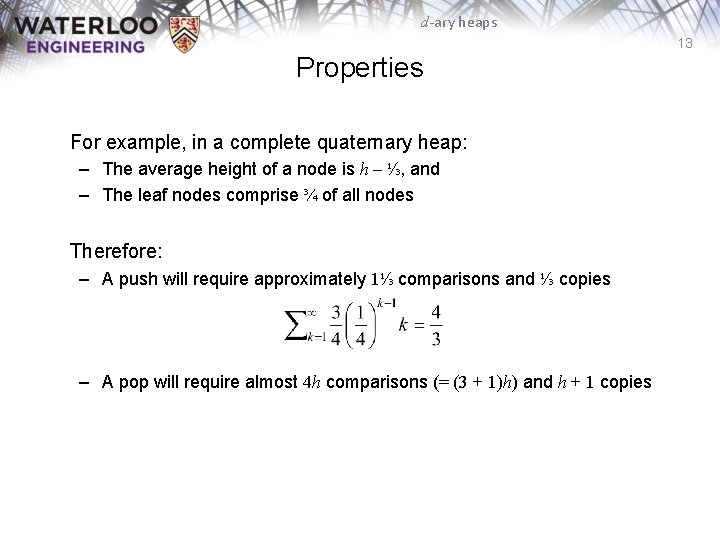
d-ary heaps 13 Properties For example, in a complete quaternary heap: – The average height of a node is h – ⅓, and – The leaf nodes comprise ¾ of all nodes Therefore: – A push will require approximately 1⅓ comparisons and ⅓ copies – A pop will require almost 4 h comparisons (= (3 + 1)h) and h + 1 copies
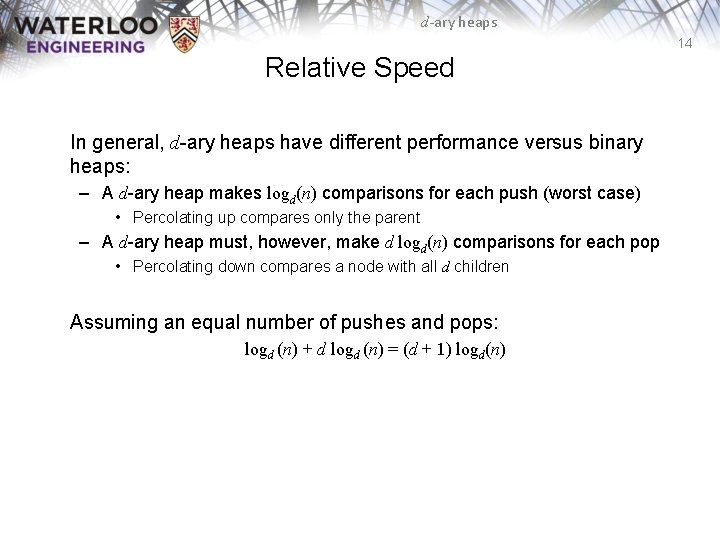
d-ary heaps 14 Relative Speed In general, d-ary heaps have different performance versus binary heaps: – A d-ary heap makes logd(n) comparisons for each push (worst case) • Percolating up compares only the parent – A d-ary heap must, however, make d logd(n) comparisons for each pop • Percolating down compares a node with all d children Assuming an equal number of pushes and pops: logd (n) + d logd (n) = (d + 1) logd(n)
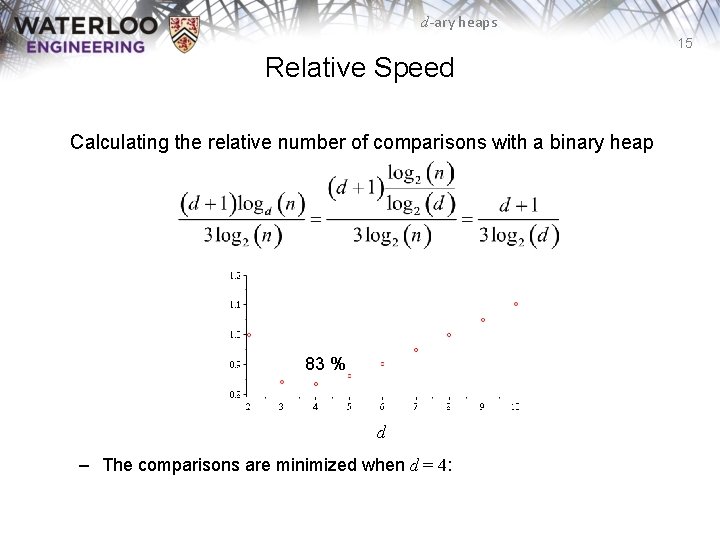
d-ary heaps 15 Relative Speed Calculating the relative number of comparisons with a binary heap 83 % d – The comparisons are minimized when d = 4:
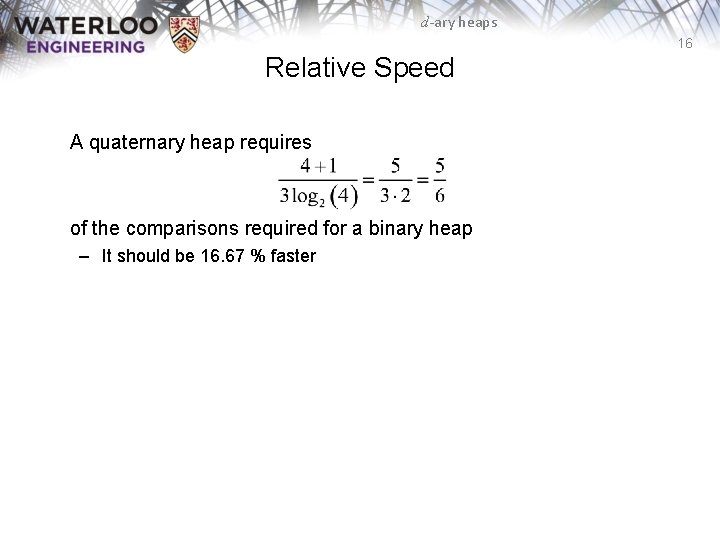
d-ary heaps 16 Relative Speed A quaternary heap requires of the comparisons required for a binary heap – It should be 16. 67 % faster
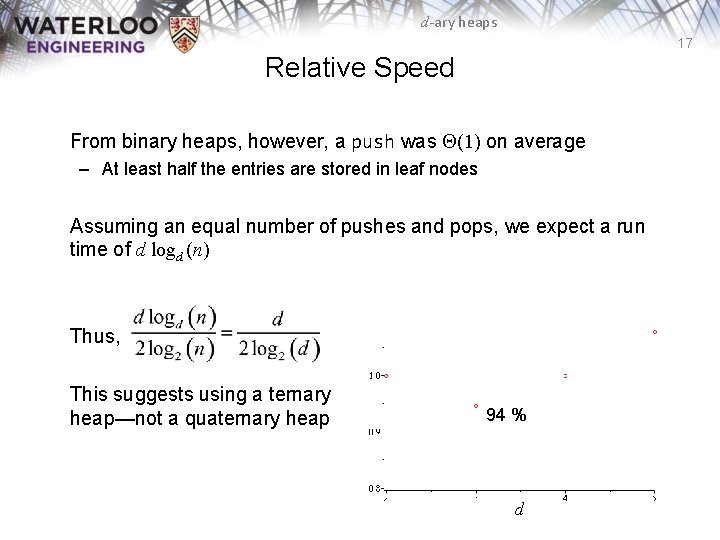
d-ary heaps 17 Relative Speed From binary heaps, however, a push was Q(1) on average – At least half the entries are stored in leaf nodes Assuming an equal number of pushes and pops, we expect a run time of d logd (n) Thus, This suggests using a ternary heap—not a quaternary heap 94 % d
d-ary heaps 18 Relative Speed In order to test this, 1. 5 billion pushes and pops were performed on similar implementations of binary, ternary, quaternary, and quinary min heaps with two cases http: //ece. uwaterloo. ca/~dwharder/aads/Algorithms/d-ary_heaps/
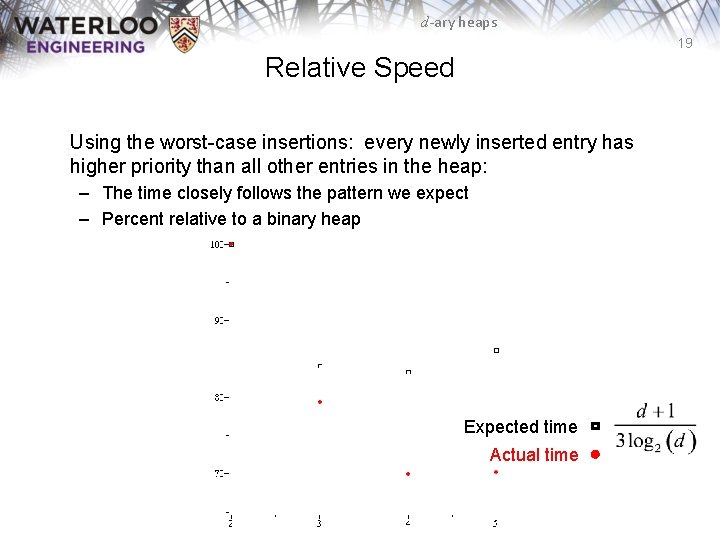
d-ary heaps 19 Relative Speed Using the worst-case insertions: every newly inserted entry has higher priority than all other entries in the heap: – The time closely follows the pattern we expect – Percent relative to a binary heap Expected time Actual time
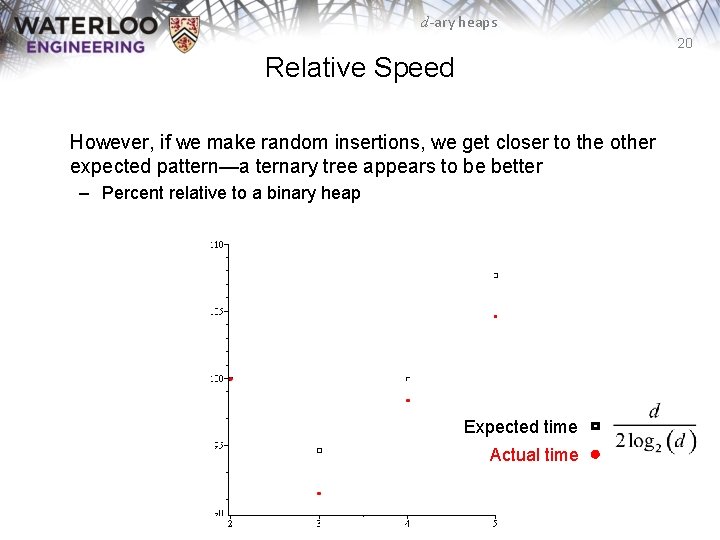
d-ary heaps 20 Relative Speed However, if we make random insertions, we get closer to the other expected pattern—a ternary tree appears to be better – Percent relative to a binary heap Expected time Actual time
d-ary heaps 21 Cache Why are the run-times better than expected? – Recall that the cache is faster than main memory: Cache 1 GHz Main memory (SDRAM): 100 MHz – Recall that the cache is faster than main memory but not every page can be cached simultaneously • Fewer memory accesses may result in fewer cache misses
d-ary heaps 22 Summary In this topic, we: – Defined d-ary min heaps • n-ary trees interpreted as heaps – – Similar array implementation for complete d-ary heaps Saw some examples Properties of the complete heaps Ternary heaps are apparently optimal • Actual tests partially confirms theoretical limits
d-ary heaps 23 References [1] Cormen, Leiserson, and Rivest, Introduction to Algorithms, Mc. Graw Hill, 1990, § 7. 1 -3, p. 152. [2] Weiss, Data Structures and Algorithm Analysis in C++, 3 rd Ed. , Addison Wesley, § 6. 5 -6, p. 215 -25.
d-ary heaps 24 Usage Notes • These slides are made publicly available on the web for anyone to use • If you choose to use them, or a part thereof, for a course at another institution, I ask only three things: – that you inform me that you are using the slides, – that you acknowledge my work, and – that you alert me of any mistakes which I made or changes which you make, and allow me the option of incorporating such changes (with an acknowledgment) in my set of slides Sincerely, Douglas Wilhelm Harder, MMath dwharder@alumni. uwaterloo. ca