
ECE 232 Hardware Organization and Design Part 4
- Slides: 35
ECE 232: Hardware Organization and Design Part 4: Datapath Design – Multiplication and Floating-point representations and operations http: //www. ecs. umass. edu/ece 232/ Adapted from Computer Organization and Design, Patterson & Hennessy, UCB
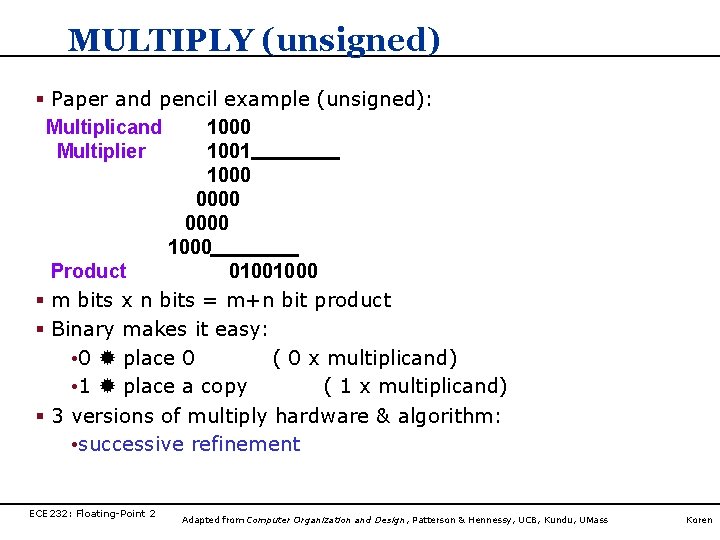
MULTIPLY (unsigned) § Paper and pencil example (unsigned): Multiplicand 1000 Multiplier 1001 1000 0000 1000 Product 01001000 § m bits x n bits = m+n bit product § Binary makes it easy: • 0 place 0 ( 0 x multiplicand) • 1 place a copy ( 1 x multiplicand) § 3 versions of multiply hardware & algorithm: • successive refinement ECE 232: Floating-Point 2 Adapted from Computer Organization and Design, Patterson & Hennessy, UCB, Kundu, UMass Koren
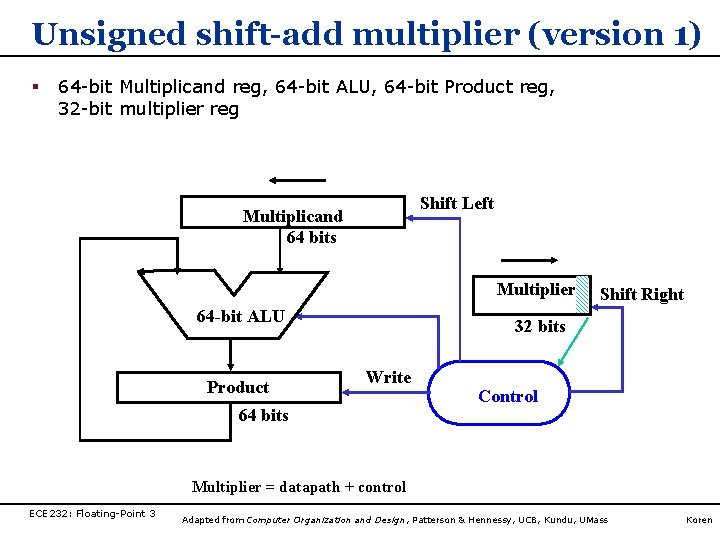
Unsigned shift-add multiplier (version 1) § 64 -bit Multiplicand reg, 64 -bit ALU, 64 -bit Product reg, 32 -bit multiplier reg Shift Left Multiplicand 64 bits Multiplier 64 -bit ALU Product Shift Right 32 bits Write 64 bits Control Multiplier = datapath + control ECE 232: Floating-Point 3 Adapted from Computer Organization and Design, Patterson & Hennessy, UCB, Kundu, UMass Koren
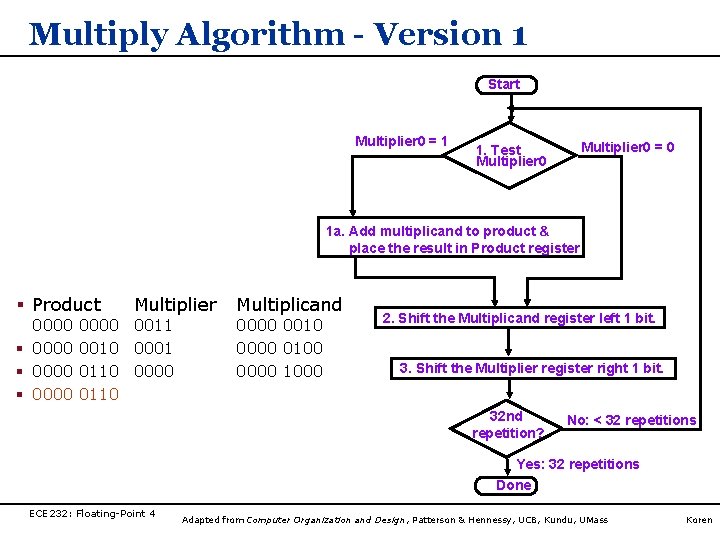
Multiply Algorithm - Version 1 Start Multiplier 0 = 1 Multiplier 0 = 0 1. Test Multiplier 0 1 a. Add multiplicand to product & place the result in Product register § Product Multiplier 0000 0011 § 0000 0010 0001 § 0000 0110 0000 § 0000 0110 Multiplicand 0000 0010 0000 0100 0000 1000 2. Shift the Multiplicand register left 1 bit. 3. Shift the Multiplier register right 1 bit. 32 nd repetition? No: < 32 repetitions Yes: 32 repetitions Done ECE 232: Floating-Point 4 Adapted from Computer Organization and Design, Patterson & Hennessy, UCB, Kundu, UMass Koren
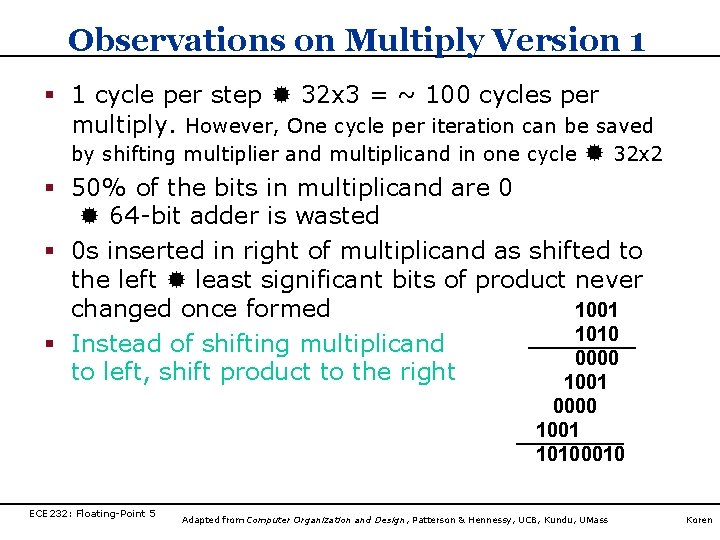
Observations on Multiply Version 1 § 1 cycle per step 32 x 3 = ~ 100 cycles per multiply. However, One cycle per iteration can be saved by shifting multiplier and multiplicand in one cycle 32 x 2 § 50% of the bits in multiplicand are 0 64 -bit adder is wasted § 0 s inserted in right of multiplicand as shifted to the left least significant bits of product never changed once formed 1001 1010 § Instead of shifting multiplicand 0000 to left, shift product to the right 1001 0000 1001 10100010 ECE 232: Floating-Point 5 Adapted from Computer Organization and Design, Patterson & Hennessy, UCB, Kundu, UMass Koren
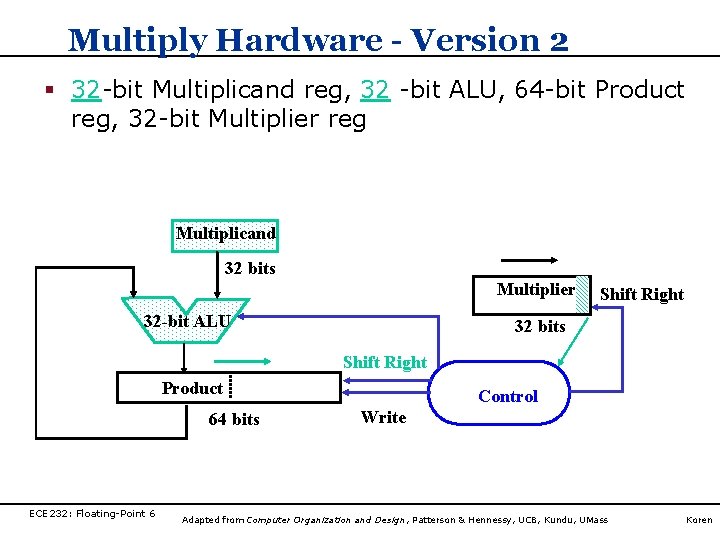
Multiply Hardware - Version 2 § 32 -bit Multiplicand reg, 32 -bit ALU, 64 -bit Product reg, 32 -bit Multiplier reg Multiplicand 32 bits Multiplier 32 -bit ALU Shift Right 32 bits Shift Right Product 64 bits ECE 232: Floating-Point 6 Control Write Adapted from Computer Organization and Design, Patterson & Hennessy, UCB, Kundu, UMass Koren
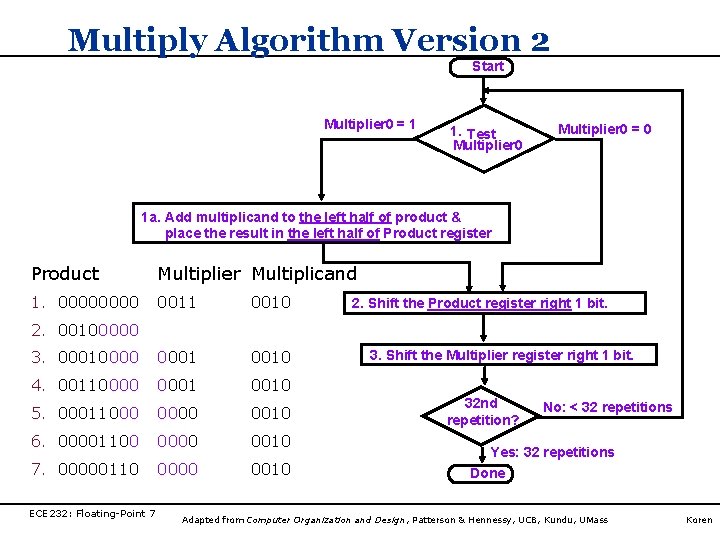
Multiply Algorithm Version 2 Start Multiplier 0 = 1 1. Test Multiplier 0 = 0 1 a. Add multiplicand to the left half of product & place the result in the left half of Product register Product Multiplier Multiplicand 1. 0000 0011 0010 3. 00010000 0001 0010 4. 00110000 0001 0010 5. 00011000 0010 6. 00001100 0010 7. 00000110 0000 0010 2. Shift the Product register right 1 bit. 2. 00100000 ECE 232: Floating-Point 7 3. Shift the Multiplier register right 1 bit. 32 nd repetition? No: < 32 repetitions Yes: 32 repetitions Done Adapted from Computer Organization and Design, Patterson & Hennessy, UCB, Kundu, UMass Koren
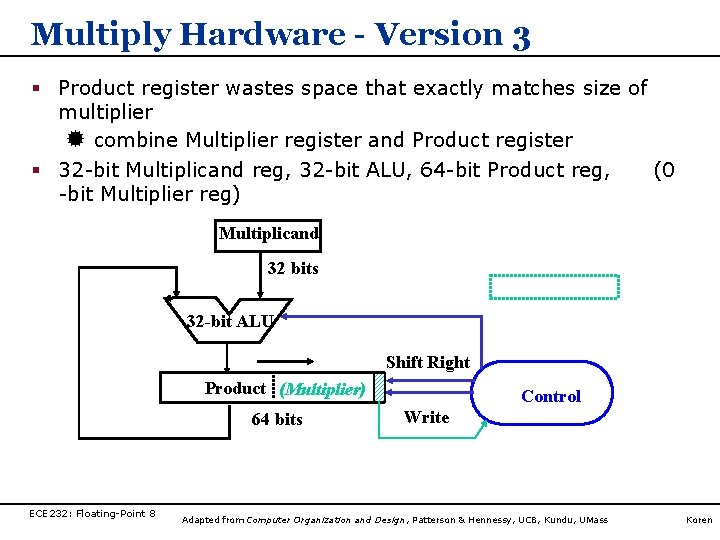
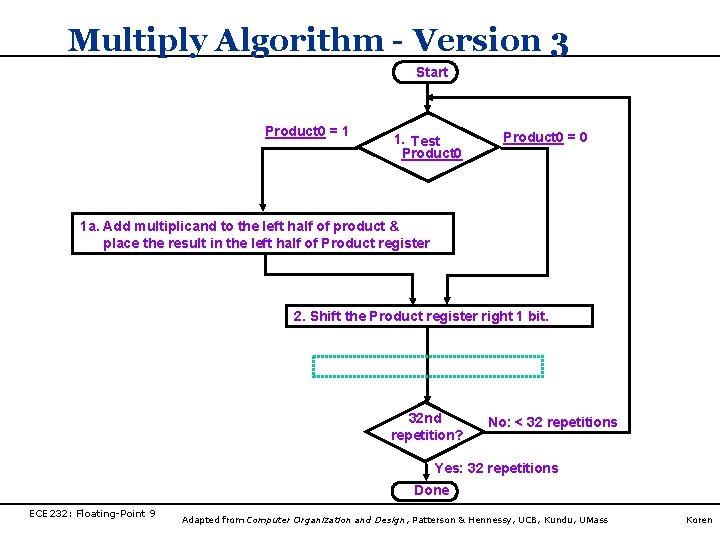
Multiply Hardware - Version 3 § Product register wastes space that exactly matches size of multiplier combine Multiplier register and Product register § 32 -bit Multiplicand reg, 32 -bit ALU, 64 -bit Product reg, (0 -bit Multiplier reg) Multiplicand 32 bits 32 -bit ALU Shift Right Product (Multiplier) 64 bits ECE 232: Floating-Point 8 Control Write Adapted from Computer Organization and Design, Patterson & Hennessy, UCB, Kundu, UMass Koren
Multiply Algorithm - Version 3 Start Product 0 = 1 1. Test Product 0 = 0 1 a. Add multiplicand to the left half of product & place the result in the left half of Product register 2. Shift the Product register right 1 bit. 32 nd repetition? No: < 32 repetitions Yes: 32 repetitions Done ECE 232: Floating-Point 9 Adapted from Computer Organization and Design, Patterson & Hennessy, UCB, Kundu, UMass Koren
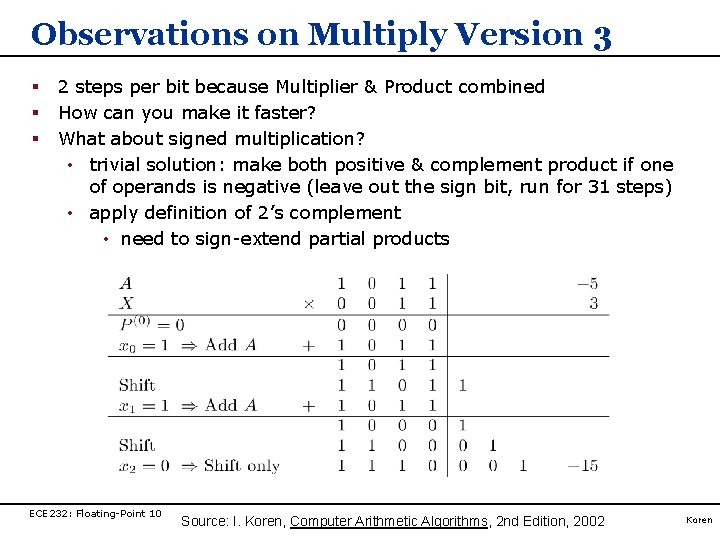
Observations on Multiply Version 3 § § § 2 steps per bit because Multiplier & Product combined How can you make it faster? What about signed multiplication? • trivial solution: make both positive & complement product if one of operands is negative (leave out the sign bit, run for 31 steps) • apply definition of 2’s complement • need to sign-extend partial products ECE 232: Floating-Point 10 Adapted from Computer Organization and Design, Patterson & Hennessy, UCB, Kundu, UMass Source: I. Koren, Computer Arithmetic Algorithms, 2 nd Edition, 2002 Koren
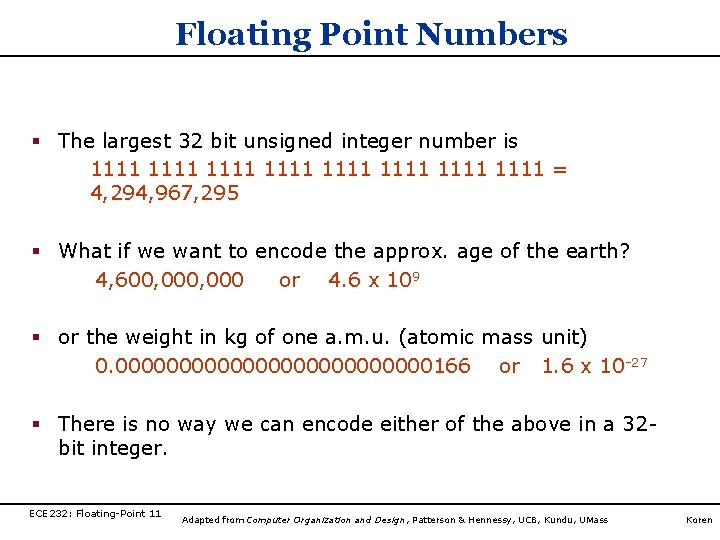
Floating Point Numbers § The largest 32 bit unsigned integer number is 1111 1111 = 4, 294, 967, 295 § What if we want to encode the approx. age of the earth? 4, 600, 000 or 4. 6 x 10⁹ § or the weight in kg of one a. m. u. (atomic mass unit) 0. 0000000000000166 or 1. 6 x 10 -27 § There is no way we can encode either of the above in a 32 bit integer. ECE 232: Floating-Point 11 Adapted from Computer Organization and Design, Patterson & Hennessy, UCB, Kundu, UMass Koren
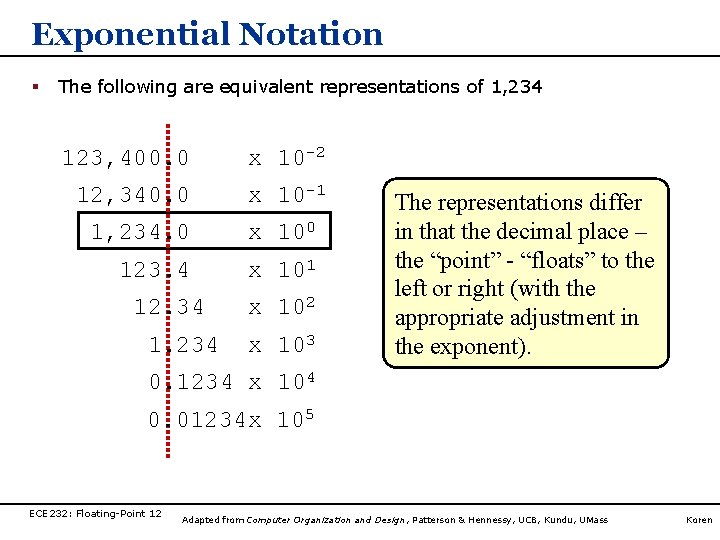
Exponential Notation § The following are equivalent representations of 1, 234 123, 400. 0 x 10 -2 12, 340. 0 x 10 -1 1, 234. 0 x 100 123. 4 x 101 12. 34 1. 234 x 102 x 103 The representations differ in that the decimal place – the “point” - “floats” to the left or right (with the appropriate adjustment in the exponent). 0. 1234 x 104 0. 01234 x 105 ECE 232: Floating-Point 12 Adapted from Computer Organization and Design, Patterson & Hennessy, UCB, Kundu, UMass Koren
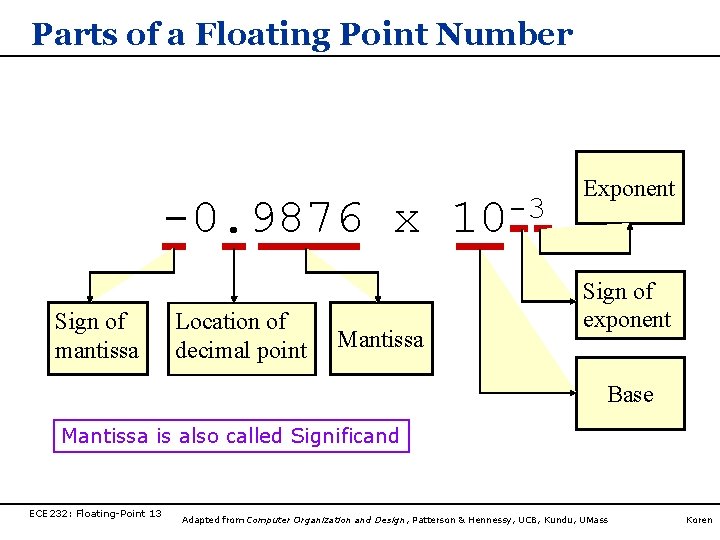
Parts of a Floating Point Number -0. 9876 x Sign of mantissa Location of decimal point Mantissa -3 10 Exponent Sign of exponent Base Mantissa is also called Significand ECE 232: Floating-Point 13 Adapted from Computer Organization and Design, Patterson & Hennessy, UCB, Kundu, UMass Koren
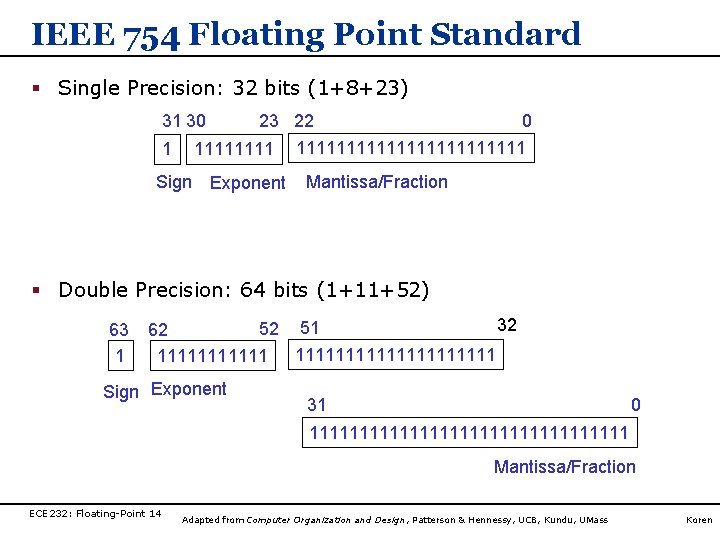
IEEE 754 Floating Point Standard § Single Precision: 32 bits (1+8+23) 31 30 1 1111 Sign 23 22 Exponent 0 111111111111 Mantissa/Fraction § Double Precision: 64 bits (1+11+52) 63 1 32 52 51 62 1111111111 Sign Exponent 31 0 1111111111111111 Mantissa/Fraction ECE 232: Floating-Point 14 Adapted from Computer Organization and Design, Patterson & Hennessy, UCB, Kundu, UMass Koren
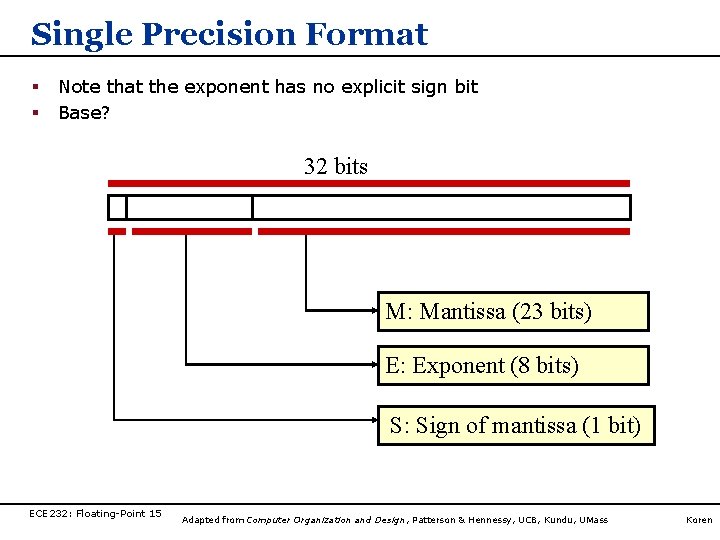
Single Precision Format § § Note that the exponent has no explicit sign bit Base? 32 bits M: Mantissa (23 bits) E: Exponent (8 bits) S: Sign of mantissa (1 bit) ECE 232: Floating-Point 15 Adapted from Computer Organization and Design, Patterson & Hennessy, UCB, Kundu, UMass Koren
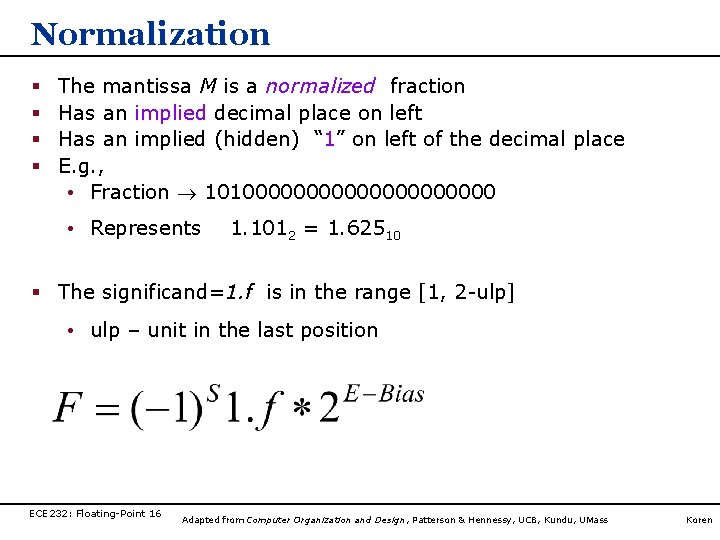
Normalization § § The mantissa M is a normalized fraction Has an implied decimal place on left Has an implied (hidden) “ 1” on left of the decimal place E. g. , • Fraction 1010000000000 • Represents 1. 1012 = 1. 62510 § The significand=1. f is in the range [1, 2 -ulp] • ulp – unit in the last position ECE 232: Floating-Point 16 Adapted from Computer Organization and Design, Patterson & Hennessy, UCB, Kundu, UMass Koren
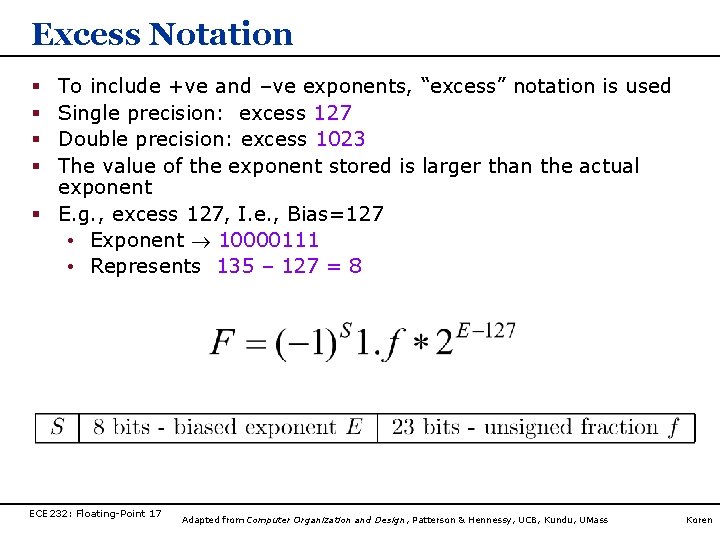
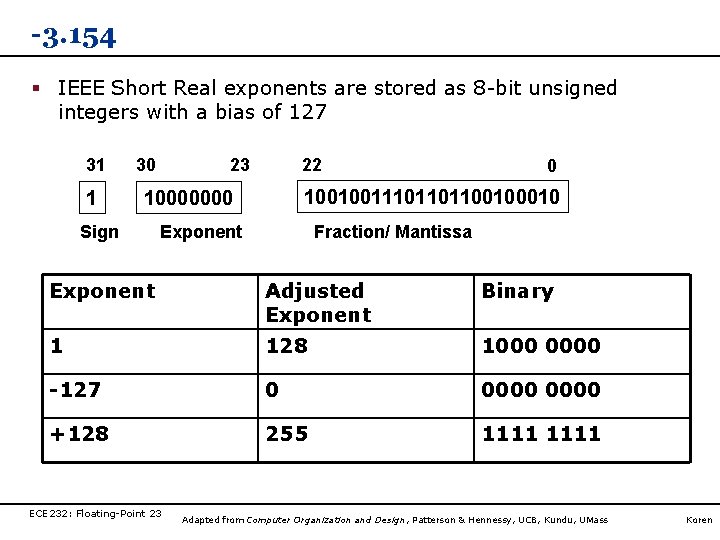
Excess Notation To include +ve and –ve exponents, “excess” notation is used Single precision: excess 127 Double precision: excess 1023 The value of the exponent stored is larger than the actual exponent § E. g. , excess 127, I. e. , Bias=127 • Exponent 10000111 • Represents 135 – 127 = 8 § § ECE 232: Floating-Point 17 Adapted from Computer Organization and Design, Patterson & Hennessy, UCB, Kundu, UMass Koren
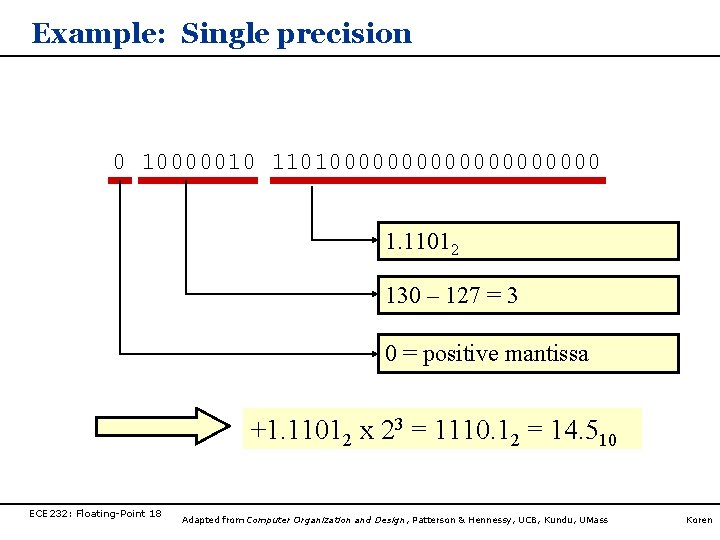
Example: Single precision 0 10000010 11010000000000 1. 11012 130 – 127 = 3 0 = positive mantissa +1. 11012 x 23 = 1110. 12 = 14. 510 ECE 232: Floating-Point 18 Adapted from Computer Organization and Design, Patterson & Hennessy, UCB, Kundu, UMass Koren
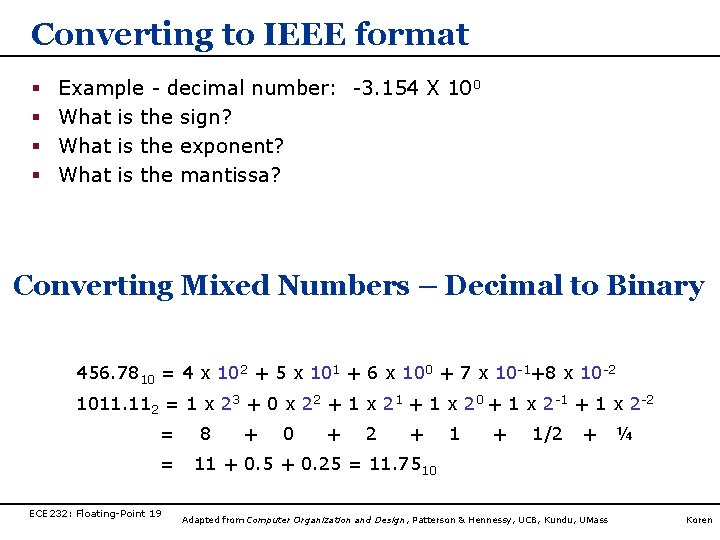
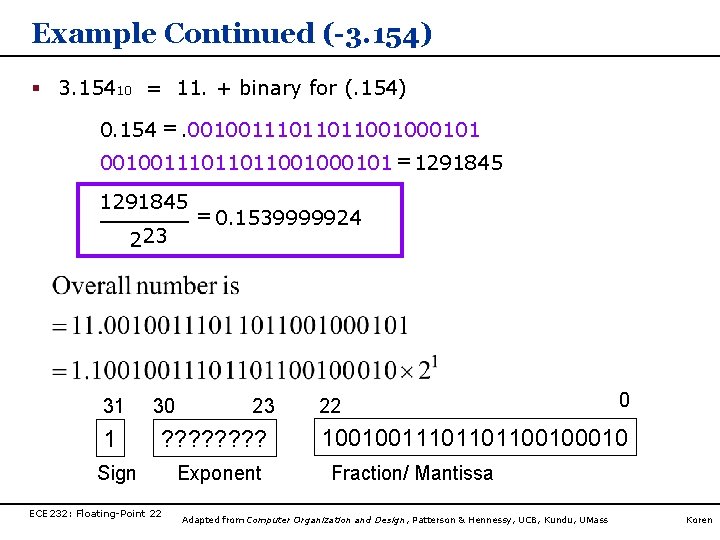
Converting to IEEE format § § Example - decimal number: -3. 154 X 100 What is the sign? What is the exponent? What is the mantissa? Converting Mixed Numbers – Decimal to Binary 456. 7810 = 4 x 10² + 5 x 101 + 6 x 100 + 7 x 10 -1+8 x 10 -2 1011. 112 = 1 x 23 + 0 x 22 + 1 x 21 + 1 x 20 + 1 x 2 -1 + 1 x 2 -2 = 8 + 0 + 2 + 1/2 + ¼ = 11 + 0. 5 + 0. 25 = 11. 7510 ECE 232: Floating-Point 19 Adapted from Computer Organization and Design, Patterson & Hennessy, UCB, Kundu, UMass Koren
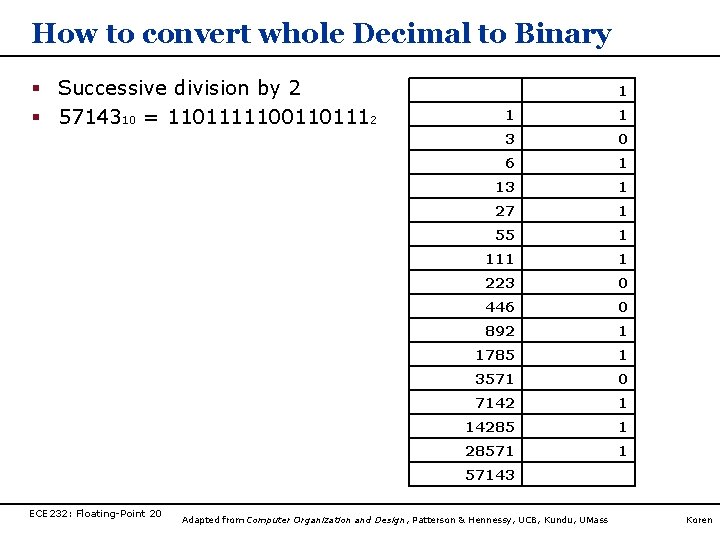
How to convert whole Decimal to Binary § Successive division by 2 § 5714310 = 11011111001101112 1 1 1 3 0 6 1 13 1 27 1 55 1 111 1 223 0 446 0 892 1 1785 1 3571 0 7142 1 14285 1 28571 1 57143 ECE 232: Floating-Point 20 Adapted from Computer Organization and Design, Patterson & Hennessy, UCB, Kundu, UMass Koren
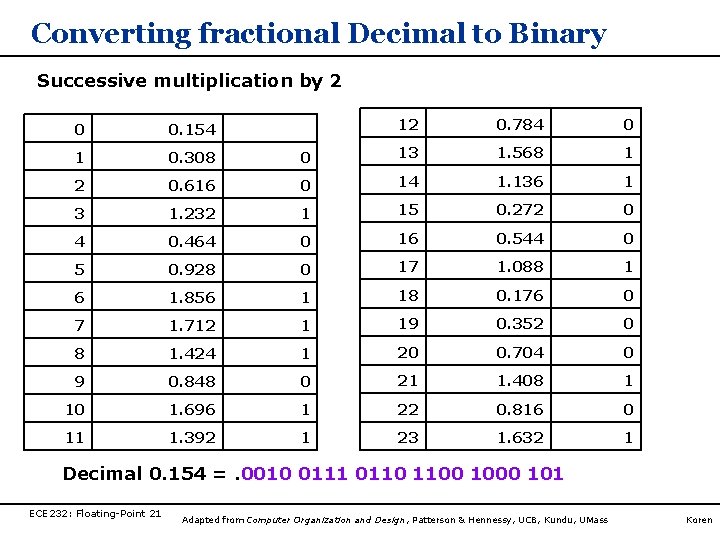
Converting fractional Decimal to Binary Successive multiplication by 2 12 0. 784 0 0 13 1. 568 1 0. 616 0 14 1. 136 1 3 1. 232 1 15 0. 272 0 4 0. 464 0 16 0. 544 0 5 0. 928 0 17 1. 088 1 6 1. 856 1 18 0. 176 0 7 1. 712 1 19 0. 352 0 8 1. 424 1 20 0. 704 0 9 0. 848 0 21 1. 408 1 10 1. 696 1 22 0. 816 0 11 1. 392 1 23 1. 632 1 0 0. 154 1 0. 308 2 Decimal 0. 154 =. 0010 0111 0110 1100 101 ECE 232: Floating-Point 21 Adapted from Computer Organization and Design, Patterson & Hennessy, UCB, Kundu, UMass Koren
Example Continued (-3. 154) § 3. 15410 = 11. + binary for (. 154) 0. 154 =. 00100111011011001000 101 0010011101101100101 = 1291845 2 23 31 1 30 = 0. 1539999924 23 ? ? ? ? Sign ECE 232: Floating-Point 22 Exponent 22 0 1001001110110110010 Fraction/ Mantissa Adapted from Computer Organization and Design, Patterson & Hennessy, UCB, Kundu, UMass Koren
-3. 154 § IEEE Short Real exponents are stored as 8 -bit unsigned integers with a bias of 127 31 1 30 23 22 1001001110110110010 10000000 Sign 0 Exponent Fraction/ Mantissa Exponent Adjusted Exponent Binary 1 128 1000 0000 -127 0 0000 +128 255 1111 ECE 232: Floating-Point 23 Adapted from Computer Organization and Design, Patterson & Hennessy, UCB, Kundu, UMass Koren
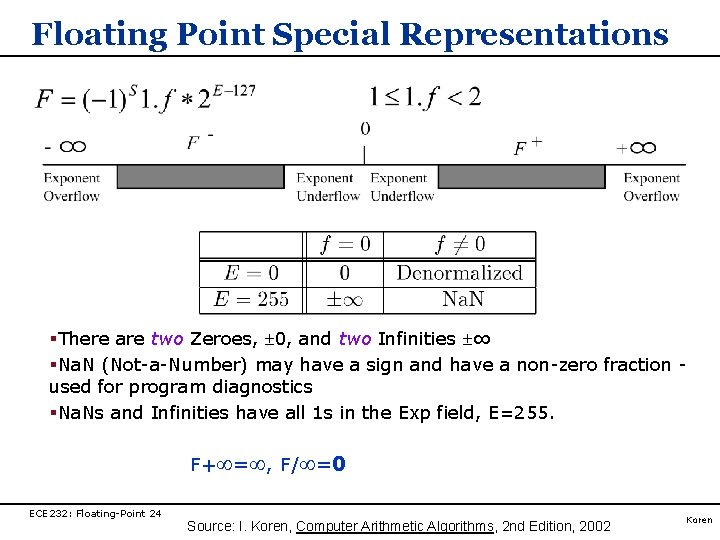
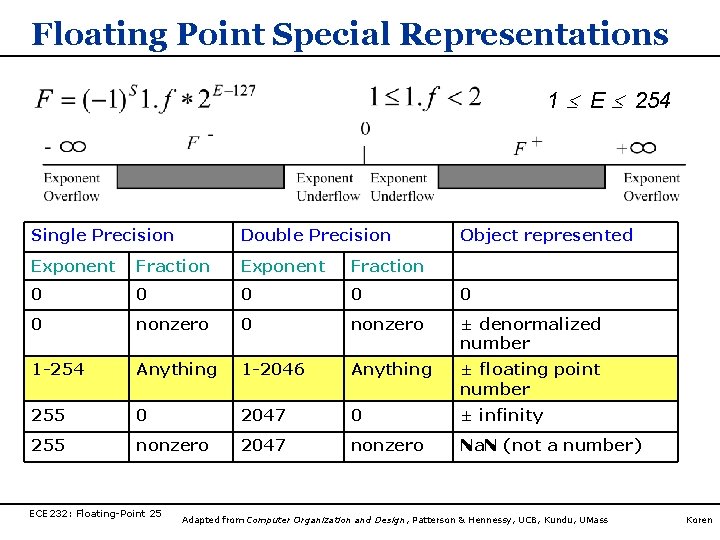
Floating Point Special Representations §There are two Zeroes, 0, and two Infinities ∞ §Na. N (Not-a-Number) may have a sign and have a non-zero fraction - used for program diagnostics §Na. Ns and Infinities have all 1 s in the Exp field, E=255. F+ = , F/ =0 ECE 232: Floating-Point 24 Adapted from Computer Organization and Design, Patterson & Hennessy, UCB, Kundu, UMass Source: I. Koren, Computer Arithmetic Algorithms, 2 nd Edition, 2002 Koren
Floating Point Special Representations 1 E 254 Single Precision Double Precision Exponent Fraction Exponent Fraction 0 0 0 nonzero ± denormalized number 1 -254 Anything 1 -2046 Anything ± floating point number 255 0 2047 0 ± infinity 255 nonzero 2047 nonzero Na. N (not a number) ECE 232: Floating-Point 25 Object represented Adapted from Computer Organization and Design, Patterson & Hennessy, UCB, Kundu, UMass Koren
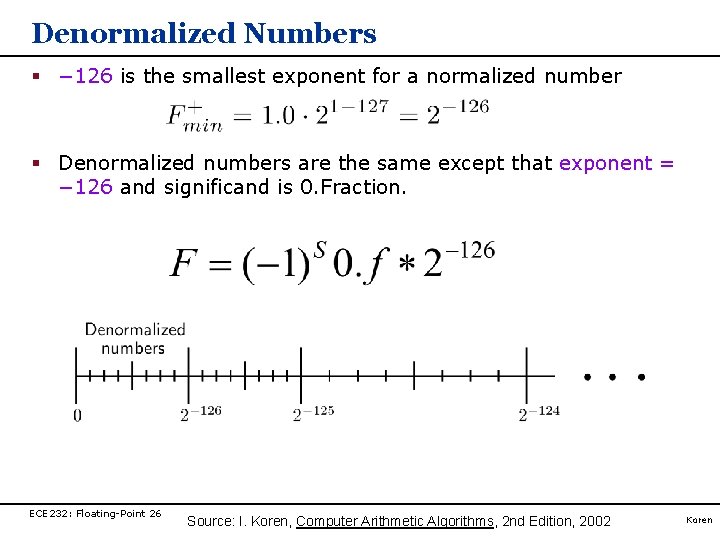
Denormalized Numbers § − 126 is the smallest exponent for a normalized number § Denormalized numbers are the same except that exponent = − 126 and significand is 0. Fraction. ECE 232: Floating-Point 26 Adapted from Computer Design, Patterson & Hennessy, UCB, Kundu, UMass Source: I. Koren, Organization Computerand Arithmetic Algorithms, 2 nd Edition, 2002 Koren
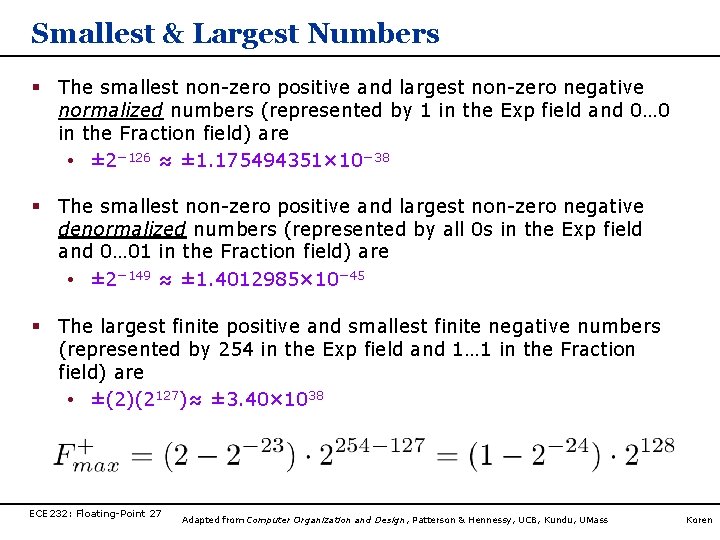
Smallest & Largest Numbers § The smallest non-zero positive and largest non-zero negative normalized numbers (represented by 1 in the Exp field and 0… 0 in the Fraction field) are • ± 2− 126 ≈ ± 1. 175494351× 10− 38 § The smallest non-zero positive and largest non-zero negative denormalized numbers (represented by all 0 s in the Exp field and 0… 01 in the Fraction field) are • ± 2− 149 ≈ ± 1. 4012985× 10− 45 § The largest finite positive and smallest finite negative numbers (represented by 254 in the Exp field and 1… 1 in the Fraction field) are • ±(2)(2127)≈ ± 3. 40× 1038 ECE 232: Floating-Point 27 Adapted from Computer Organization and Design, Patterson & Hennessy, UCB, Kundu, UMass Koren
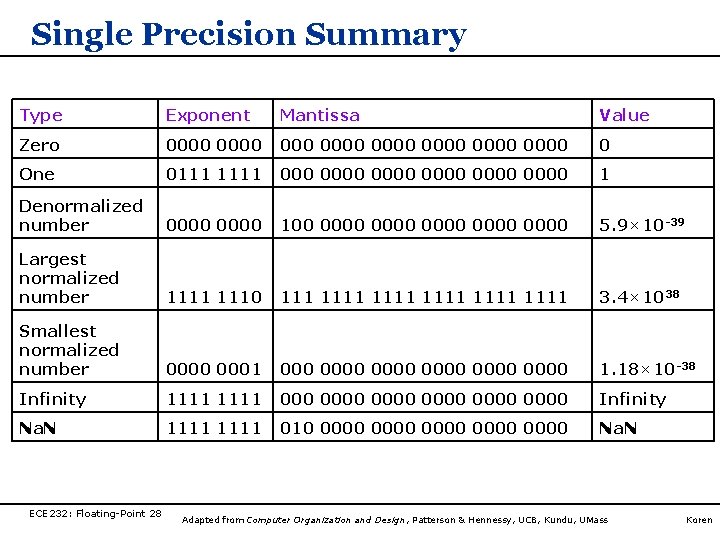
Single Precision Summary Type Exponent Zero 0000 0000 0 One 0111 1111 0000 0000 1 Denormalized number 0000 100 0000 0000 5. 9× 10 -39 Largest normalized number 1111 1110 1111 1111 3. 4× 1038 Smallest normalized number 0000 0001 0000 0000 1. 18× 10 -38 Infinity 1111 0000 0000 Infinity Na. N 1111 010 0000 0000 Na. N ECE 232: Floating-Point 28 Mantissa Value Adapted from Computer Organization and Design, Patterson & Hennessy, UCB, Kundu, UMass Koren
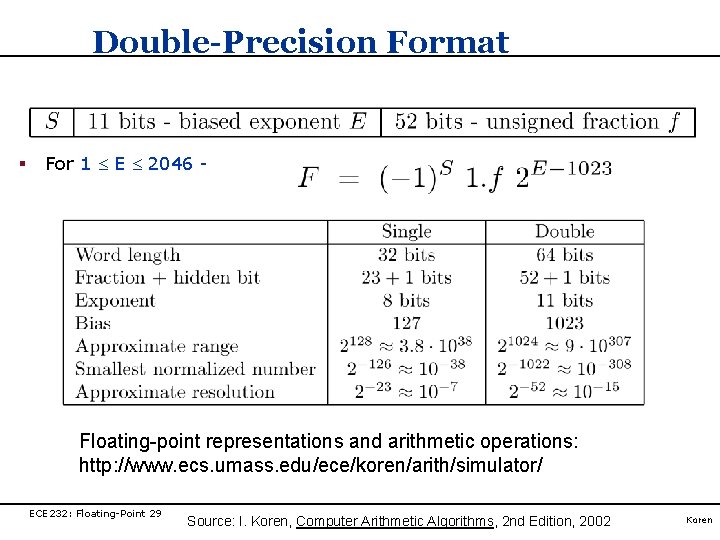
Double-Precision Format § For 1 E 2046 - Floating-point representations and arithmetic operations: http: //www. ecs. umass. edu/ece/koren/arith/simulator/ ECE 232: Floating-Point 29 Adapted from Computer Design, Patterson & Hennessy, UCB, Kundu, UMass Source: I. Koren, Organization Computerand Arithmetic Algorithms, 2 nd Edition, 2002 Koren
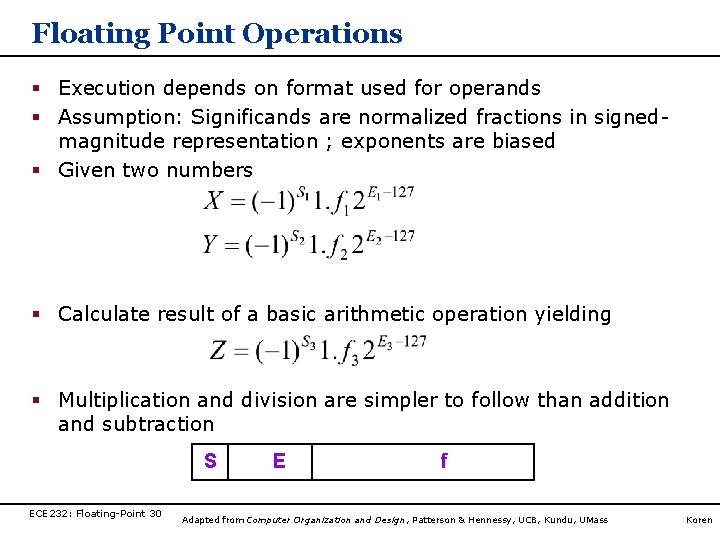
Floating Point Operations § Execution depends on format used for operands § Assumption: Significands are normalized fractions in signedmagnitude representation ; exponents are biased § Given two numbers § Calculate result of a basic arithmetic operation yielding § Multiplication and division are simpler to follow than addition and subtraction S ECE 232: Floating-Point 30 E f Adapted from Computer Organization and Design, Patterson & Hennessy, UCB, Kundu, UMass Koren
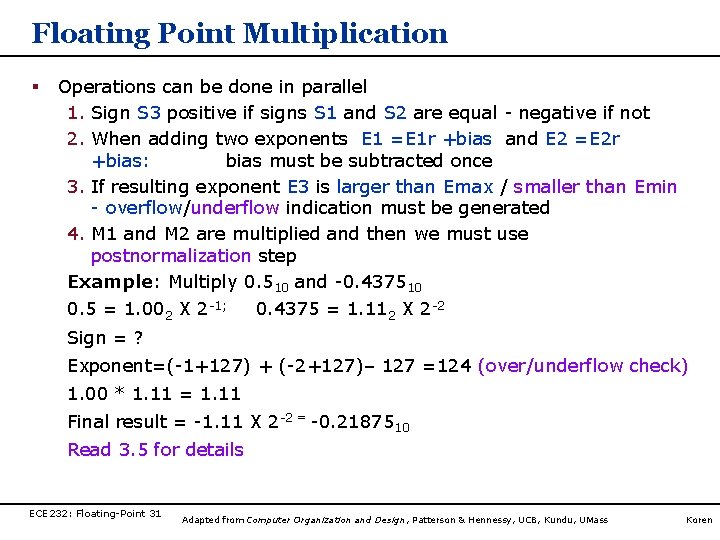
Floating Point Multiplication § Operations can be done in parallel 1. Sign S 3 positive if signs S 1 and S 2 are equal - negative if not 2. When adding two exponents E 1 =E 1 r +bias and E 2 =E 2 r +bias: bias must be subtracted once 3. If resulting exponent E 3 is larger than Emax / smaller than Emin - overflow/underflow indication must be generated 4. M 1 and M 2 are multiplied and then we must use postnormalization step Example: Multiply 0. 510 and -0. 437510 0. 5 = 1. 002 X 2 -1; 0. 4375 = 1. 112 X 2 -2 Sign = ? Exponent=(-1+127) + (-2+127)– 127 =124 (over/underflow check) 1. 00 * 1. 11 = 1. 11 Final result = -1. 11 X 2 -2 = -0. 2187510 Read 3. 5 for details ECE 232: Floating-Point 31 Adapted from Computer Organization and Design, Patterson & Hennessy, UCB, Kundu, UMass Koren
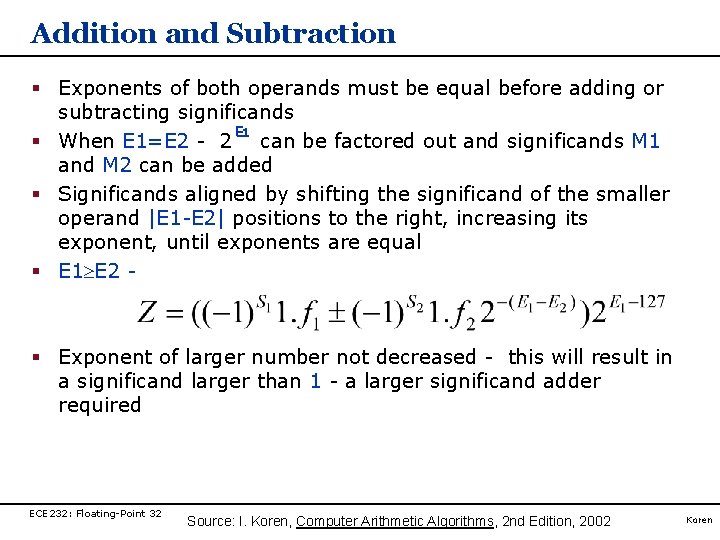
Addition and Subtraction § Exponents of both operands must be equal before adding or subtracting significands E 1 § When E 1=E 2 - 2 can be factored out and significands M 1 and M 2 can be added § Significands aligned by shifting the significand of the smaller operand |E 1 -E 2| positions to the right, increasing its exponent, until exponents are equal § E 1 E 2 - § Exponent of larger number not decreased - this will result in a significand larger than 1 - a larger significand adder required ECE 232: Floating-Point 32 Adapted from Computer Design, Patterson & Hennessy, UCB, Kundu, UMass Source: I. Koren, Organization Computerand Arithmetic Algorithms, 2 nd Edition, 2002 Koren
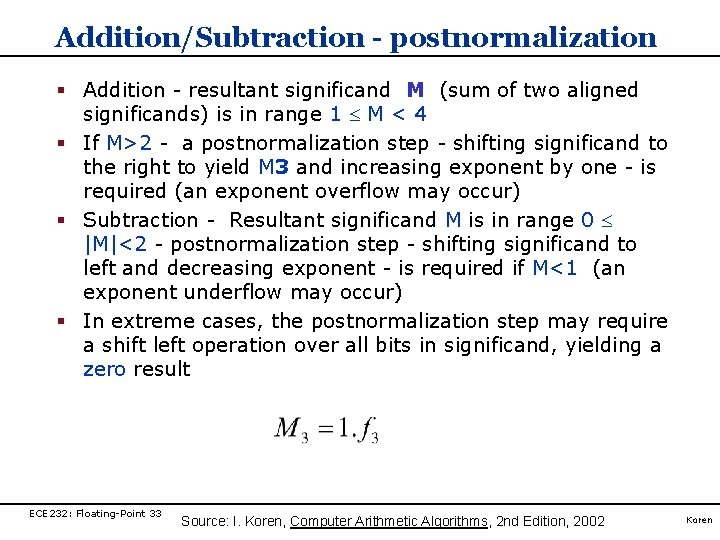
Addition/Subtraction - postnormalization § Addition - resultant significand M (sum of two aligned significands) is in range 1 M < 4 § If M>2 - a postnormalization step - shifting significand to the right to yield M 3 and increasing exponent by one - is required (an exponent overflow may occur) § Subtraction - Resultant significand M is in range 0 |M|<2 - postnormalization step - shifting significand to left and decreasing exponent - is required if M<1 (an exponent underflow may occur) § In extreme cases, the postnormalization step may require a shift left operation over all bits in significand, yielding a zero result ECE 232: Floating-Point 33 Adapted from Computer Organization and Design, Patterson & Hennessy, UCB, Kundu, UMass Source: I. Koren, Computer Arithmetic Algorithms, 2 nd Edition, 2002 Koren
Steps in Addition/Subtraction § Step 1: Calculate difference d of the two exponents - d=|E 1 - E 2| § Step 2: Shift significand of smaller number by d positions to the right § Step 3: Add aligned significands and set exponent of result to exponent of larger operand § Step 4: Normalize resultant significand adjust exponent if necessary § Step 5: Round resultant significand adjust exponent if necessary ECE 232: Floating-Point 34 Adapted from Computer Organization and Design, Patterson & Hennessy, UCB, Kundu, UMass Source: I. Koren, Computer Arithmetic Algorithms, 2 nd Edition, 2002 Koren
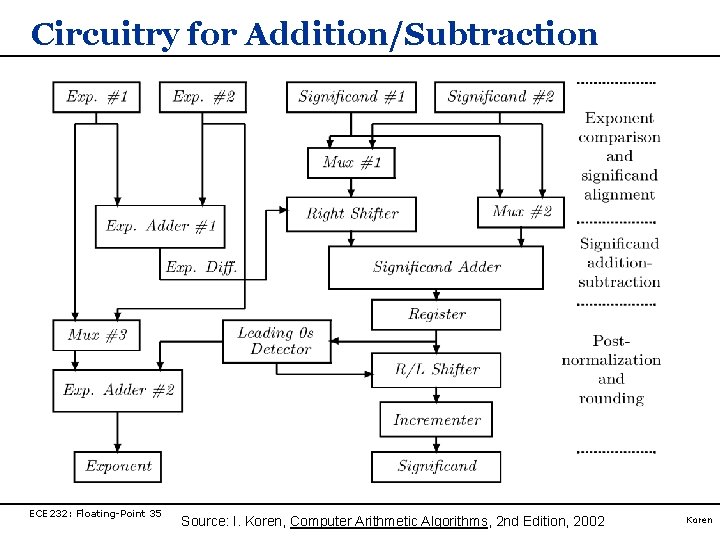
Circuitry for Addition/Subtraction ECE 232: Floating-Point 35 Adapted from Computer Organization and Design, Patterson & Hennessy, UCB, Kundu, UMass Source: I. Koren, Computer Arithmetic Algorithms, 2 nd Edition, 2002 Koren