
ECE 2201 Circuit Analysis Lecture Set 11 Superposition

- Slides: 23
ECE 2201 Circuit Analysis Lecture Set #11 Superposition Version 3 Dr. Dave Shattuck Associate Professor, ECE Dept.
Superposition
Overview Superposition In this lecture set, we will cover the following topics: • Superposition • Example Problem
Textbook Coverage This material is introduced in different ways in different textbooks. Approximately this same material is covered in the Nilsson and Riedel textbook in the following sections: • Electric Circuits 10 th Ed. by Nilsson and Riedel: Section 4. 13
Superposition The circuits we cover in this course fit into the category that are called Linear Circuits. This will be true as long as the circuits are made up of only the five basic circuit elements that we introduce in this course. One of the definitions of Linear Circuits is that Linear Circuits are the circuits where superposition holds. If for no other reason, we should know what superposition is, so that we can understand this definition.
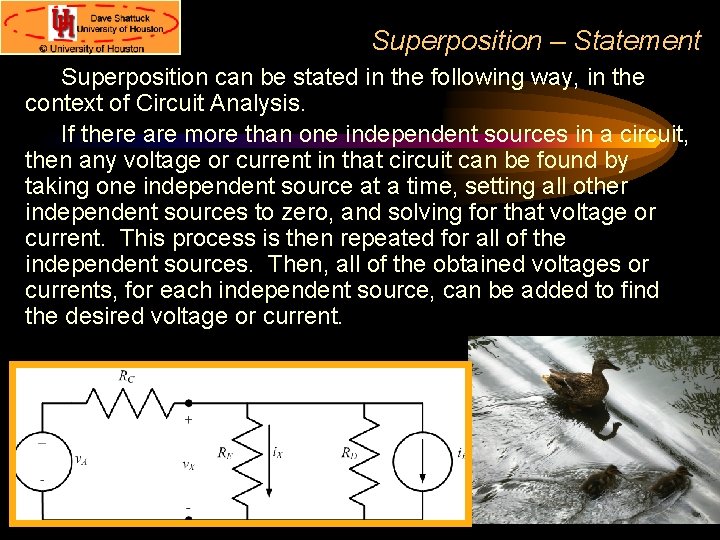
Superposition – Statement Superposition can be stated in the following way, in the context of Circuit Analysis. If there are more than one independent sources in a circuit, then any voltage or current in that circuit can be found by taking one independent source at a time, setting all other independent sources to zero, and solving for that voltage or current. This process is then repeated for all of the independent sources. Then, all of the obtained voltages or currents, for each independent source, can be added to find the desired voltage or current.
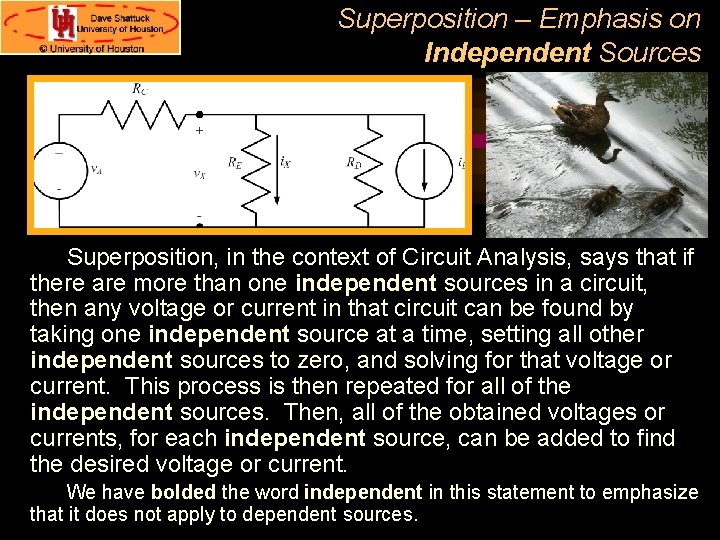
Superposition – Emphasis on Independent Sources Superposition, in the context of Circuit Analysis, says that if there are more than one independent sources in a circuit, then any voltage or current in that circuit can be found by taking one independent source at a time, setting all other independent sources to zero, and solving for that voltage or current. This process is then repeated for all of the independent sources. Then, all of the obtained voltages or currents, for each independent source, can be added to find the desired voltage or current. We have bolded the word independent in this statement to emphasize that it does not apply to dependent sources.
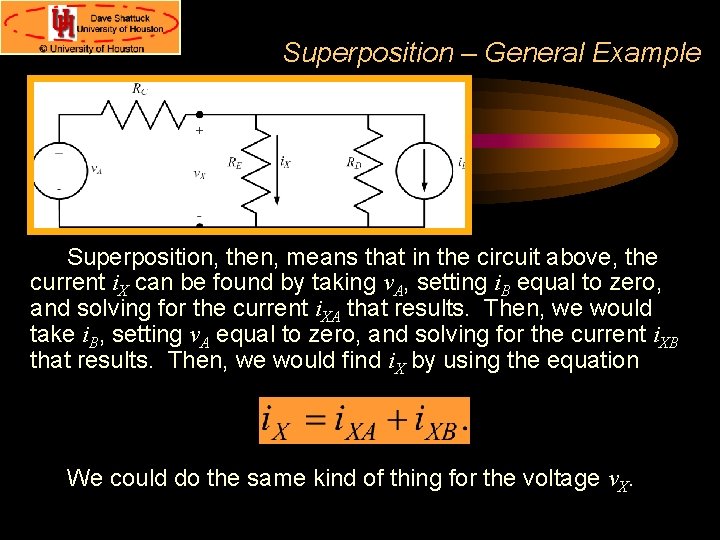
Superposition – General Example Superposition, then, means that in the circuit above, the current i. X can be found by taking v. A, setting i. B equal to zero, and solving for the current i. XA that results. Then, we would take i. B, setting v. A equal to zero, and solving for the current i. XB that results. Then, we would find i. X by using the equation We could do the same kind of thing for the voltage v. X.
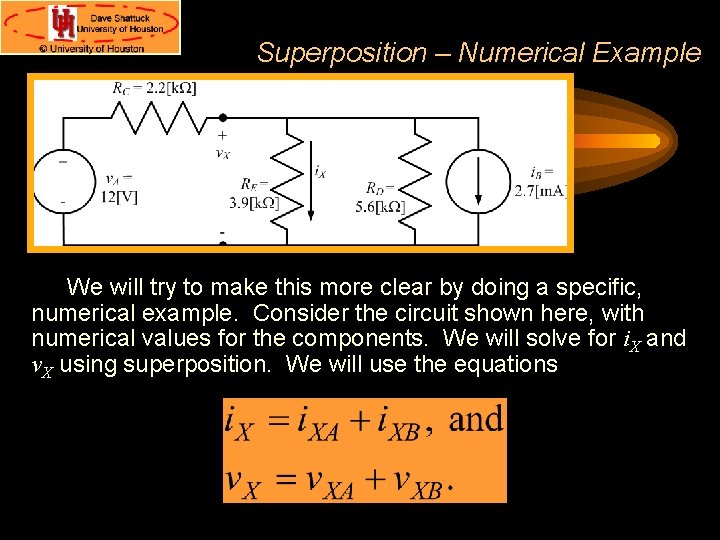
Superposition – Numerical Example We will try to make this more clear by doing a specific, numerical example. Consider the circuit shown here, with numerical values for the components. We will solve for i. X and v. X using superposition. We will use the equations
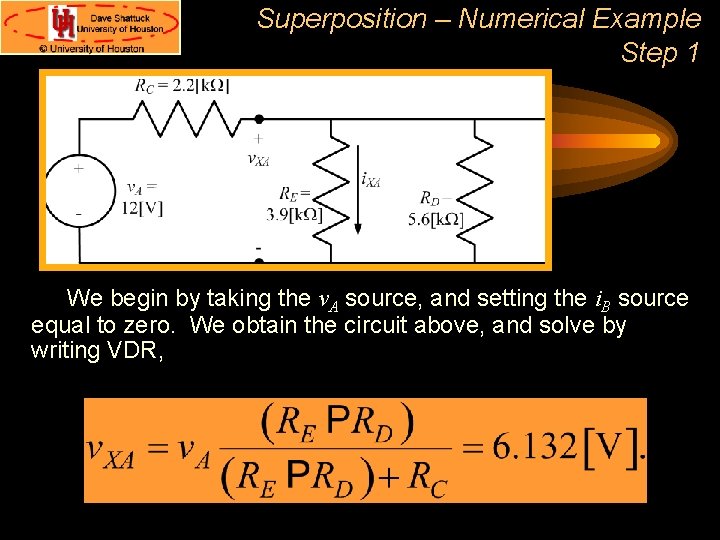
Superposition – Numerical Example Step 1 We begin by taking the v. A source, and setting the i. B source equal to zero. We obtain the circuit above, and solve by writing VDR,
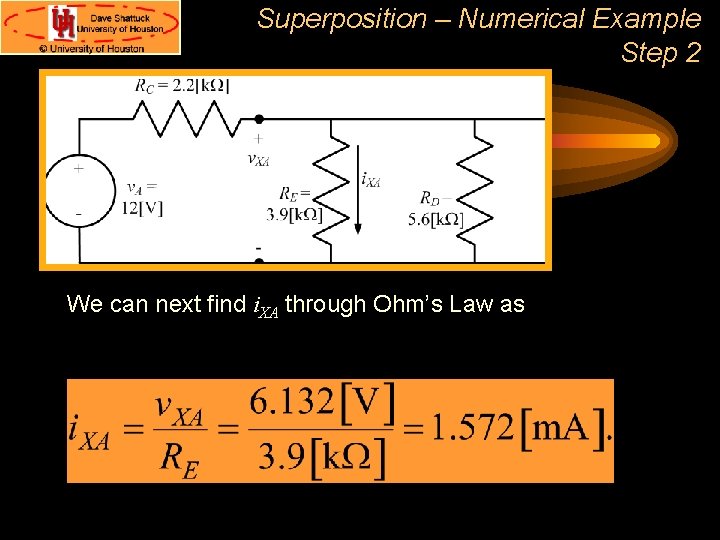
Superposition – Numerical Example Step 2 We can next find i. XA through Ohm’s Law as
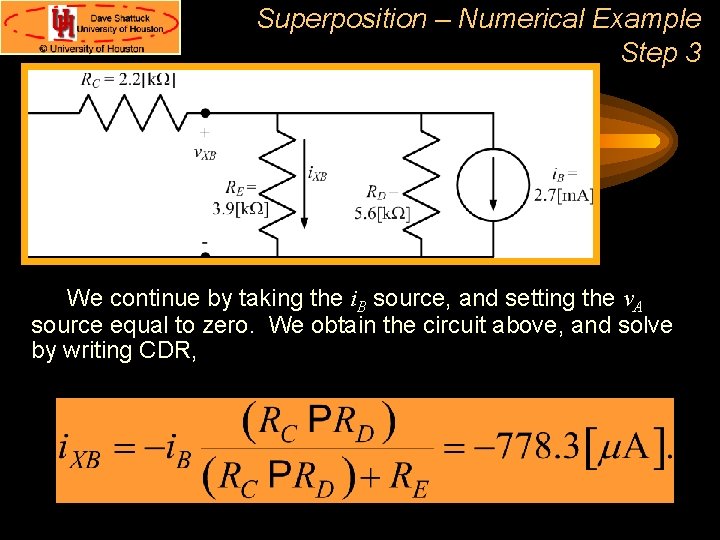
Superposition – Numerical Example Step 3 We continue by taking the i. B source, and setting the v. A source equal to zero. We obtain the circuit above, and solve by writing CDR,
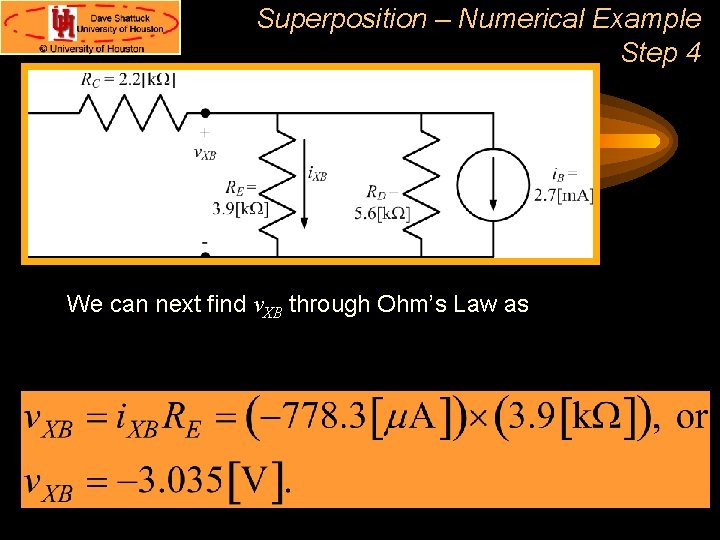
Superposition – Numerical Example Step 4 We can next find v. XB through Ohm’s Law as
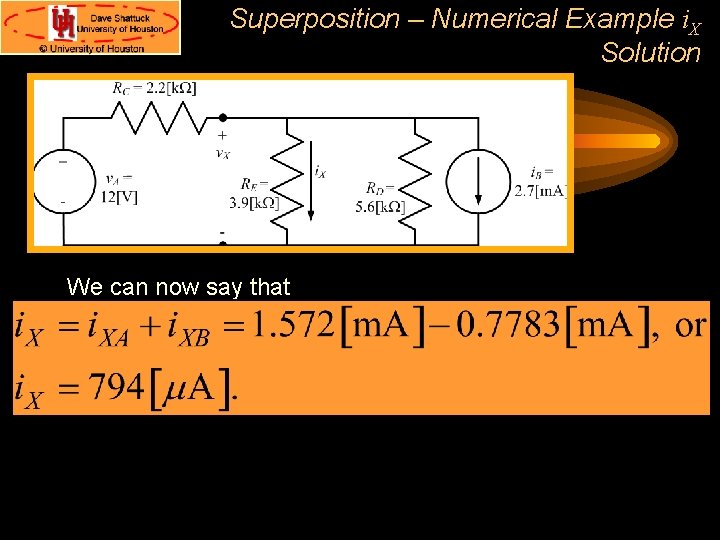
Superposition – Numerical Example i. X Solution We can now say that
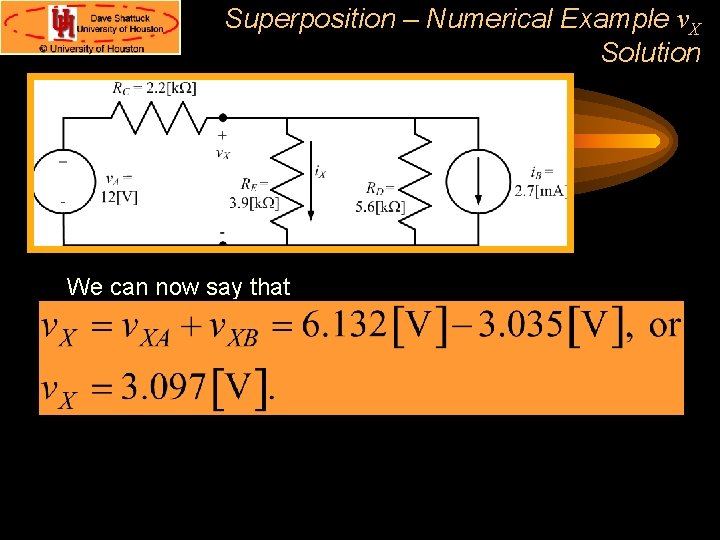
Superposition – Numerical Example v. X Solution We can now say that
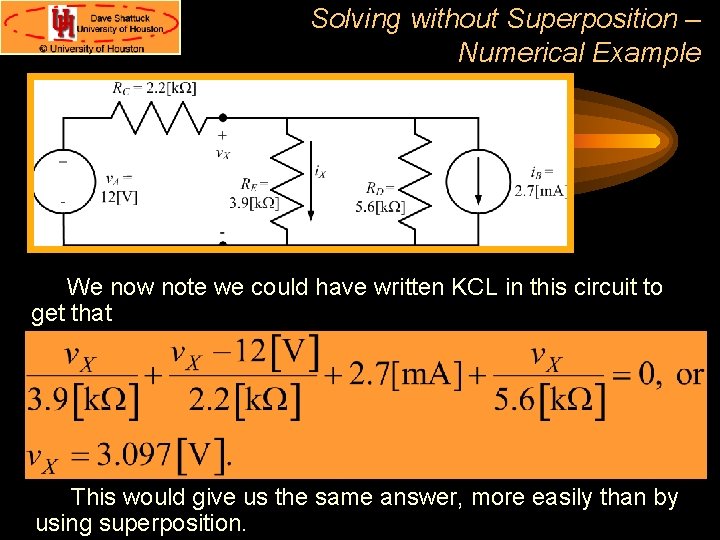
Solving without Superposition – Numerical Example We now note we could have written KCL in this circuit to get that This would give us the same answer, more easily than by using superposition.
Notes 1. We found that superposition means that we can find voltages and currents by adding the inputs of each of the independent sources, taking each independent source one at a time. 2. This superposition approach, however, is not really a very efficient way to solve the problems we have at this point. 3. Later in this course, we will introduce a situation where superposition allows us to use a technique we will call phasor analysis in places where we can take a much more efficient approach using that superposition concept. So, soon it will be very valuable.
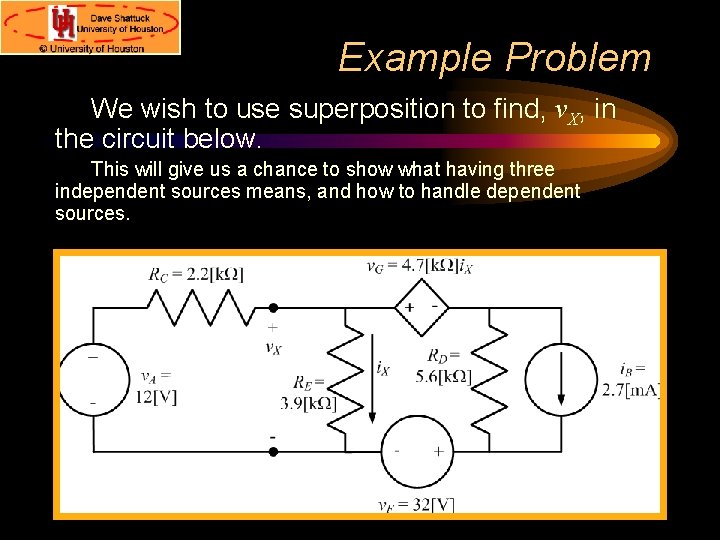
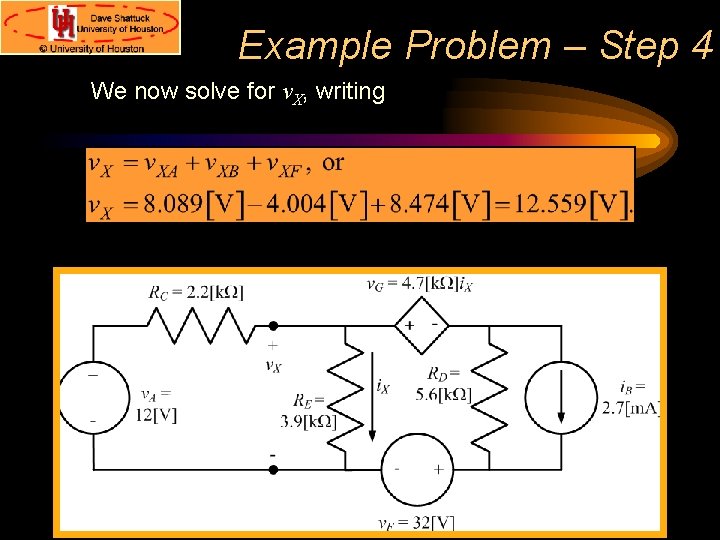
Example Problem We wish to use superposition to find, v. X, in the circuit below. This will give us a chance to show what having three independent sources means, and how to handle dependent sources.
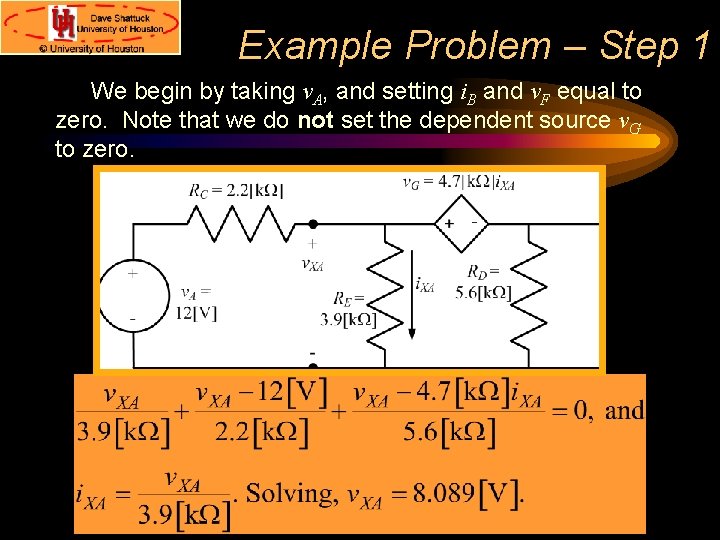
Example Problem – Step 1 We begin by taking v. A, and setting i. B and v. F equal to zero. Note that we do not set the dependent source v. G to zero.
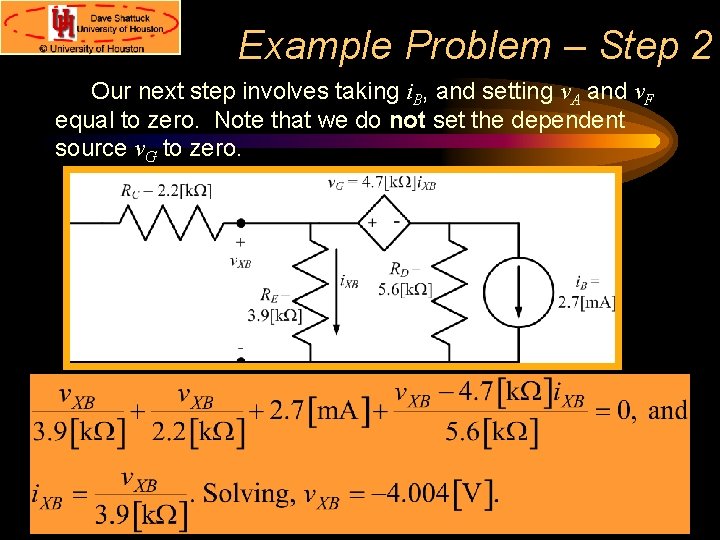
Example Problem – Step 2 Our next step involves taking i. B, and setting v. A and v. F equal to zero. Note that we do not set the dependent source v. G to zero.
Example Problem – Step 3 Finally, by taking v. F, and setting v. A and i. B equal to zero. Note that we do not set the dependent source v. G to zero.
Example Problem – Step 4 We now solve for v. X, writing
What is the deal here? Is this worth all this trouble? • This is a good question. No, for what we have right now, superposition is not worth the trouble. However, later, we will encounter problems where superposition makes the solution much easier. So, yes, this concept of superposition is very much worth knowing and understanding. It is a very powerful concept.