
ECE 1754 Loop Transformations by Eric La Forest
ECE 1754 Loop Transformations by: Eric La. Forest
Motivation Improving loop behaviour/performance usually parallelism sometimes memory, register usage
Motivation Improving loop behaviour/performance usually parallelism sometimes memory, register usage Why focus on loops? they contain most of the busy code
Motivation Improving loop behaviour/performance usually parallelism sometimes memory, register usage Why focus on loops? they contain most of the busy code informal proof: else, program size would be proportional to data size
Data-Flow-Based Transformations
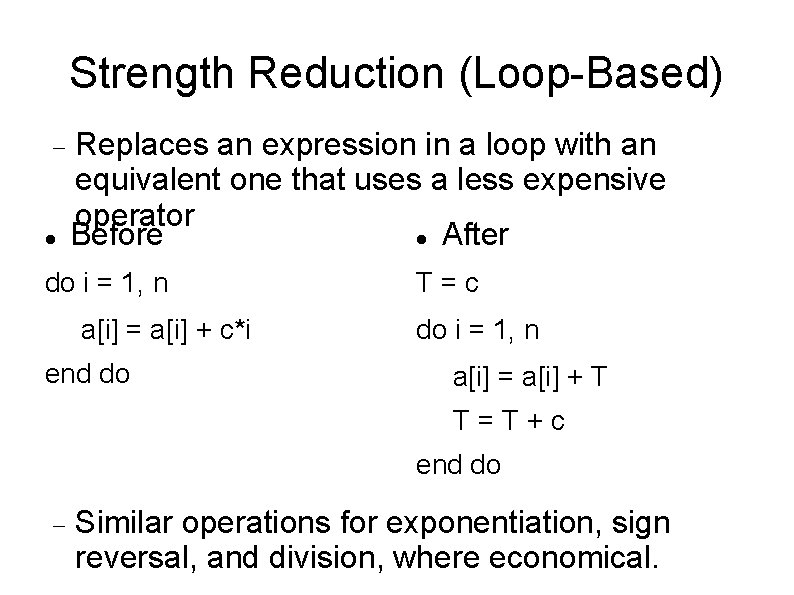
Strength Reduction (Loop-Based) Replaces an expression in a loop with an equivalent one that uses a less expensive operator Before After do i = 1, n a[i] = a[i] + c*i end do T=c do i = 1, n a[i] = a[i] + T T=T+c end do Similar operations for exponentiation, sign reversal, and division, where economical.
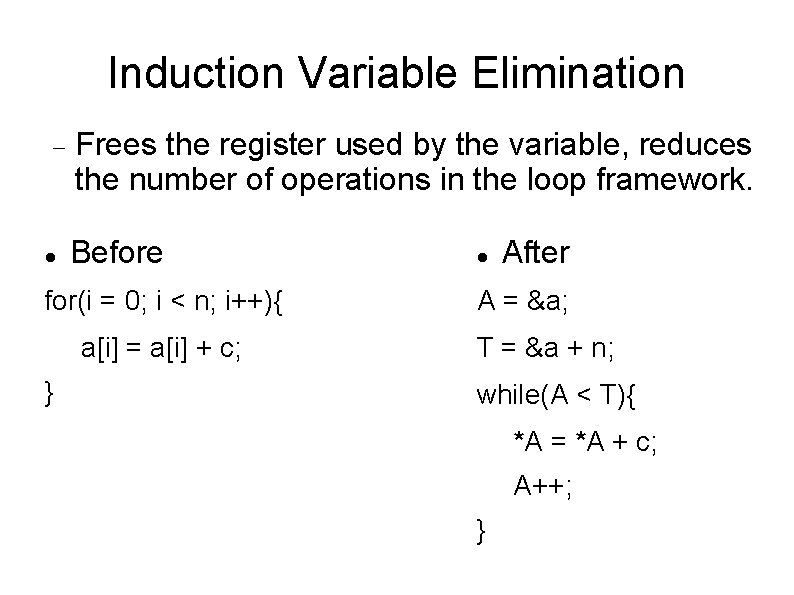
Induction Variable Elimination Frees the register used by the variable, reduces the number of operations in the loop framework. Before for(i = 0; i < n; i++){ a[i] = a[i] + c; } After A = &a; T = &a + n; while(A < T){ *A = *A + c; A++; }

Loop-Invariant Code Motion A specific case of code hoisting Needs a register to hold the invariant value Ex: multi-dim. indices, pointers, structures Before do i = 1, n a[i] = a[i] + sqrt(x) end do After if (n > 0) C = sqrt(x) do i = 1, n a[i] = a[i] + C end do
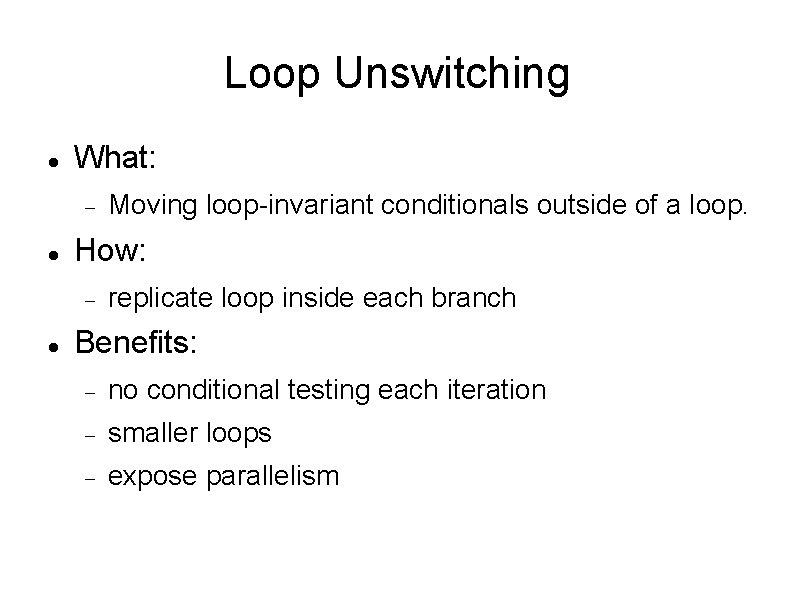
Loop Unswitching What: How: Moving loop-invariant conditionals outside of a loop. replicate loop inside each branch Benefits: no conditional testing each iteration smaller loops expose parallelism
![Loop Unswitching Before do i = 2, n a[i] = a[i] + c After](http://slidetodoc.com/presentation_image_h2/7c36dd539c1e5ee004331ced74ddf504/image-10.jpg "Loop Unswitching Before do i = 2, n a[i] = a[i] + c After")
Loop Unswitching Before do i = 2, n a[i] = a[i] + c After if (n > 2) then if (x < 7) then do all i = 2, n if (x < 7) then a[i] = a[i] + c b[i] = a[i] * c[i] end do b[i] = a[i] * c[i] else b[i] = a[i-1] * b[i-1] else end if do i = 2, n end do a[i] = a[i] + c b[i] = a[i-1] * b[i-1] end do end if
Loop Reordering Transformations (changing the relative iteration order of nested loops)
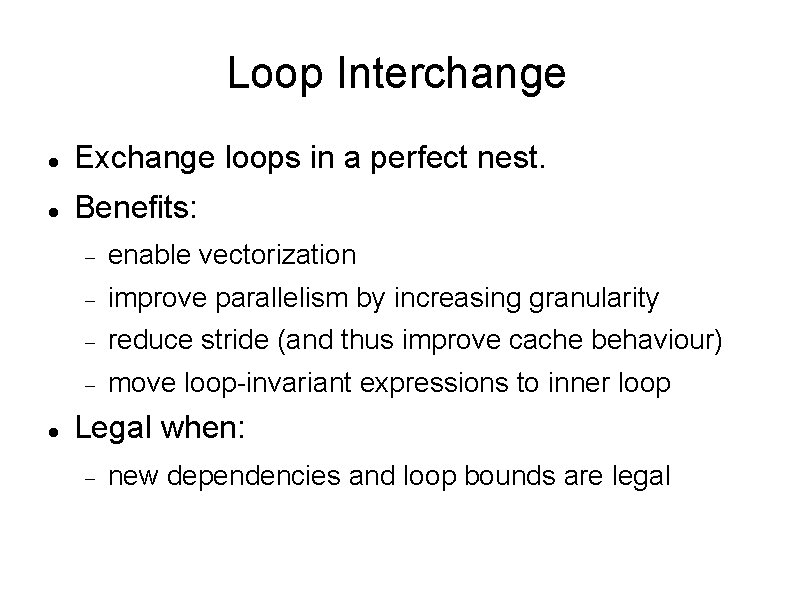
Loop Interchange Exchange loops in a perfect nest. Benefits: enable vectorization improve parallelism by increasing granularity reduce stride (and thus improve cache behaviour) move loop-invariant expressions to inner loop Legal when: new dependencies and loop bounds are legal
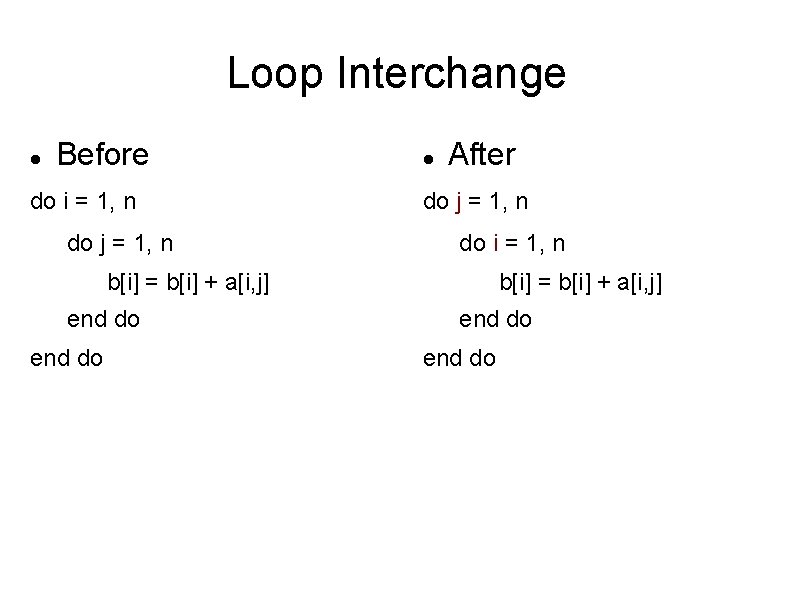
Loop Interchange Before do i = 1, n do j = 1, n After do j = 1, n do i = 1, n b[i] = b[i] + a[i, j] end do
![Loop Interchange do i = 2, n do j = 1, n-1 a[i, j]](http://slidetodoc.com/presentation_image_h2/7c36dd539c1e5ee004331ced74ddf504/image-14.jpg "Loop Interchange do i = 2, n do j = 1, n-1 a[i, j]")
Loop Interchange do i = 2, n do j = 1, n-1 a[i, j] = a[i-1, j+1] end do Cannot be interchanged due to (1, -1) dependence. would end up using a prior uncomputed value
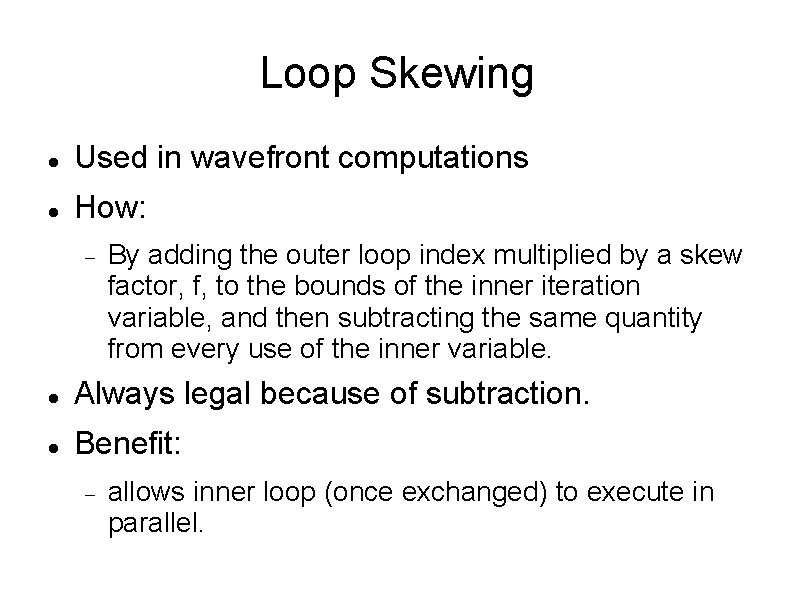
Loop Skewing Used in wavefront computations How: By adding the outer loop index multiplied by a skew factor, f, to the bounds of the inner iteration variable, and then subtracting the same quantity from every use of the inner variable. Always legal because of subtraction. Benefit: allows inner loop (once exchanged) to execute in parallel.
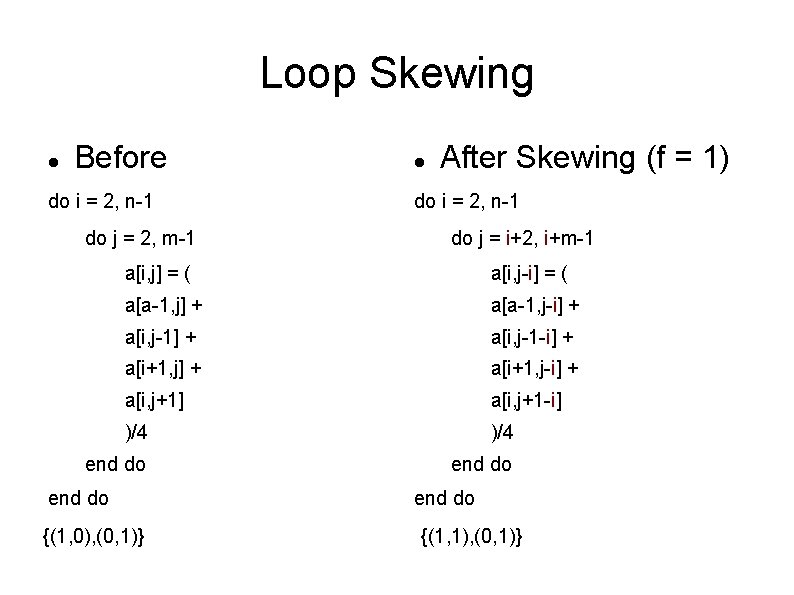
Loop Skewing Before do i = 2, n-1 do j = 2, m-1 After Skewing (f = 1) do i = 2, n-1 do j = i+2, i+m-1 a[i, j] = ( a[i, j-i] = ( a[a-1, j] + a[a-1, j-i] + a[i, j-1 -i] + a[i+1, j-i] + a[i, j+1] a[i, j+1 -i] )/4 end do {(1, 0), (0, 1)} end do {(1, 1), (0, 1)}
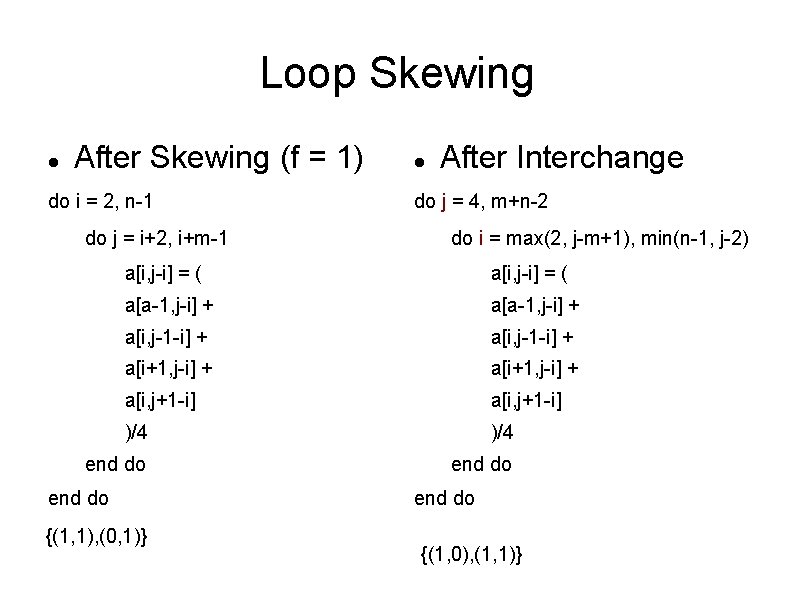
Loop Skewing After Skewing (f = 1) do i = 2, n-1 do j = i+2, i+m-1 After Interchange do j = 4, m+n-2 do i = max(2, j-m+1), min(n-1, j-2) a[i, j-i] = ( a[a-1, j-i] + a[i, j-1 -i] + a[i+1, j-i] + a[i, j+1 -i] )/4 end do {(1, 1), (0, 1)} end do {(1, 0), (1, 1)}
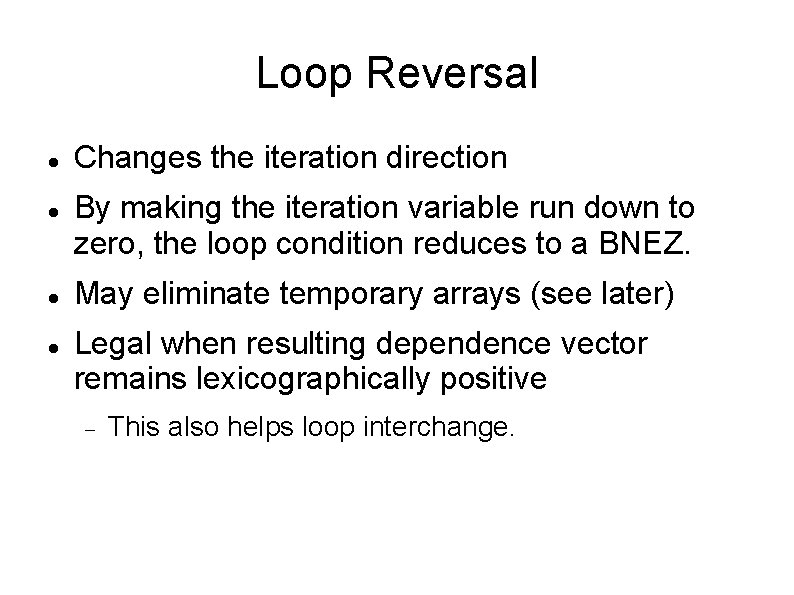
Loop Reversal Changes the iteration direction By making the iteration variable run down to zero, the loop condition reduces to a BNEZ. May eliminate temporary arrays (see later) Legal when resulting dependence vector remains lexicographically positive This also helps loop interchange.
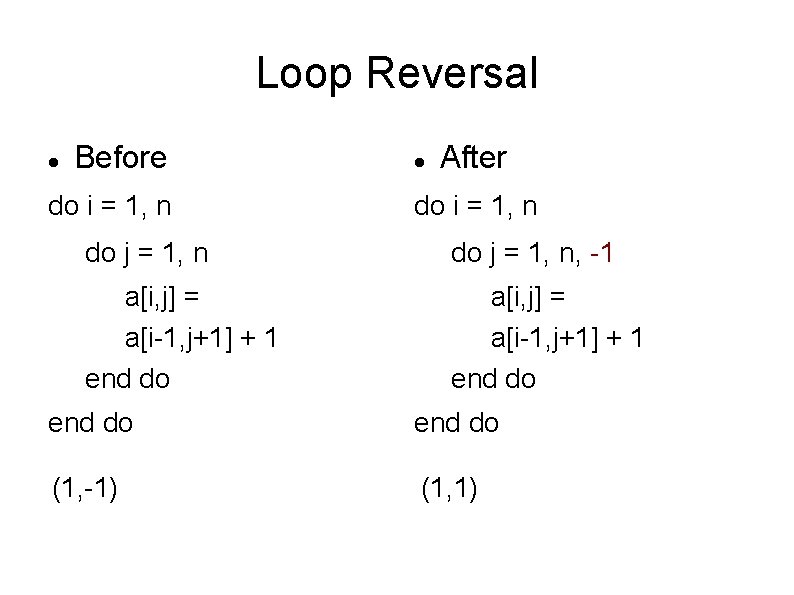
Loop Reversal Before do i = 1, n After do i = 1, n do j = 1, n, -1 a[i, j] = a[i-1, j+1] + 1 end do (1, -1) (1, 1)
Strip Mining Adjusts the granularity of an operation usually for vectorization also controlling array size, grouping operations Often requires other transforms first
![Strip Mining Before do i = 1, n a[i] = a[i] + c end](http://slidetodoc.com/presentation_image_h2/7c36dd539c1e5ee004331ced74ddf504/image-21.jpg "Strip Mining Before do i = 1, n a[i] = a[i] + c end")
Strip Mining Before do i = 1, n a[i] = a[i] + c end do After TN = (n/64)*64 do TI = 1, TN, 64 a[TI: TI+63] = a[TI: TI+63] + c end do do i= TN+1, n a[i] = a[i] + c end do
Cycle Shrinking Specialization of strip mining: parallelize when dependence distance > 1 Legal when: distance must be constant and positive
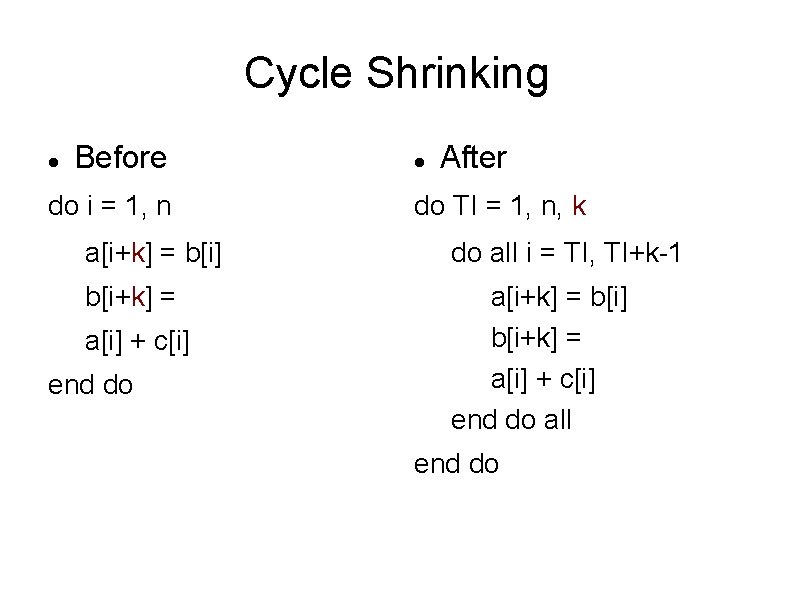
Cycle Shrinking Before do i = 1, n After do TI = 1, n, k a[i+k] = b[i] do all i = TI, TI+k-1 b[i+k] = a[i+k] = b[i] b[i+k] = a[i] + c[i] end do all a[i] + c[i] end do
Loop Tiling Multidimensional specialization of strip mining Goal: to improve cache reuse Adjacent loops can be tiled if they can be interchanged.
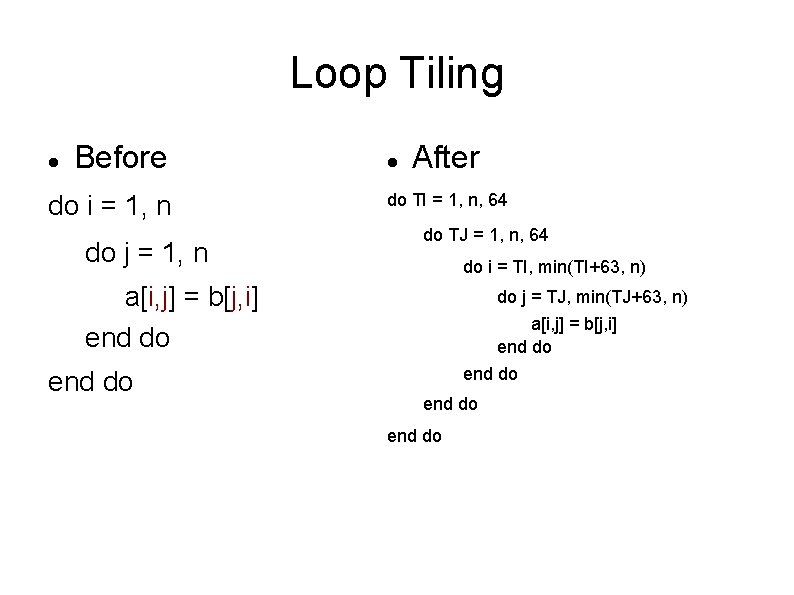
Loop Tiling Before do i = 1, n do j = 1, n After do TI = 1, n, 64 do TJ = 1, n, 64 do i = TI, min(TI+63, n) a[i, j] = b[j, i] end do do j = TJ, min(TJ+63, n) a[i, j] = b[j, i] end do
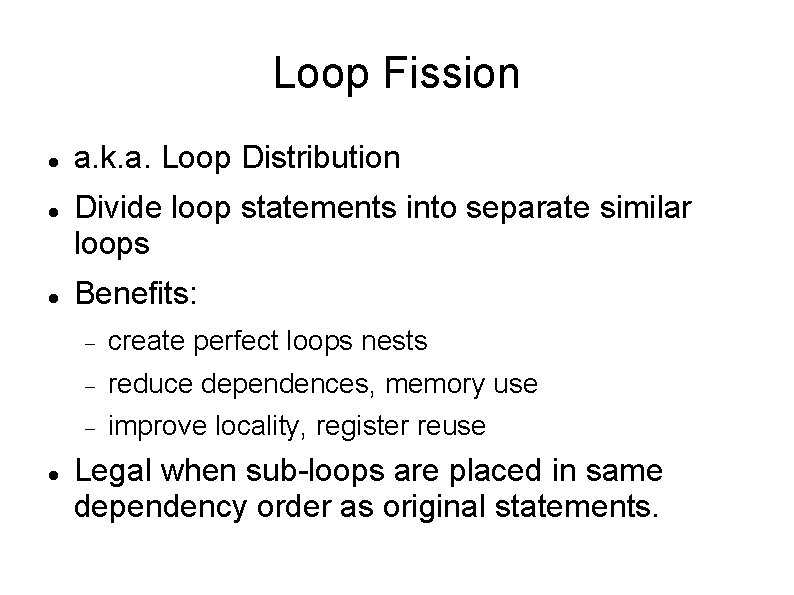
Loop Fission a. k. a. Loop Distribution Divide loop statements into separate similar loops Benefits: create perfect loops nests reduce dependences, memory use improve locality, register reuse Legal when sub-loops are placed in same dependency order as original statements.
![Loop Fission Before do i = 1, n a[i] = a[i] + c x[i+1]](http://slidetodoc.com/presentation_image_h2/7c36dd539c1e5ee004331ced74ddf504/image-27.jpg "Loop Fission Before do i = 1, n a[i] = a[i] + c x[i+1]")
Loop Fission Before do i = 1, n a[i] = a[i] + c x[i+1] = x[i]*7 + x[i+1] + a[i] end do After do all i = 1, n a[i] = a[i] + c end do all do i = 1, n x[i+1] = x[i]*7 + x[i+1] + a[i] end do
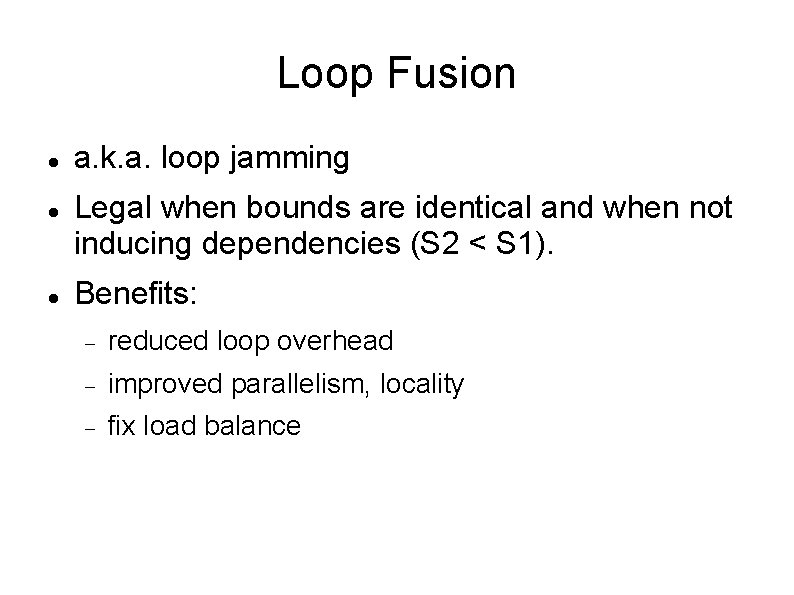
Loop Fusion a. k. a. loop jamming Legal when bounds are identical and when not inducing dependencies (S 2 < S 1). Benefits: reduced loop overhead improved parallelism, locality fix load balance
Restructuring Transformations (Alters the structure, but not the computations or iteration order)
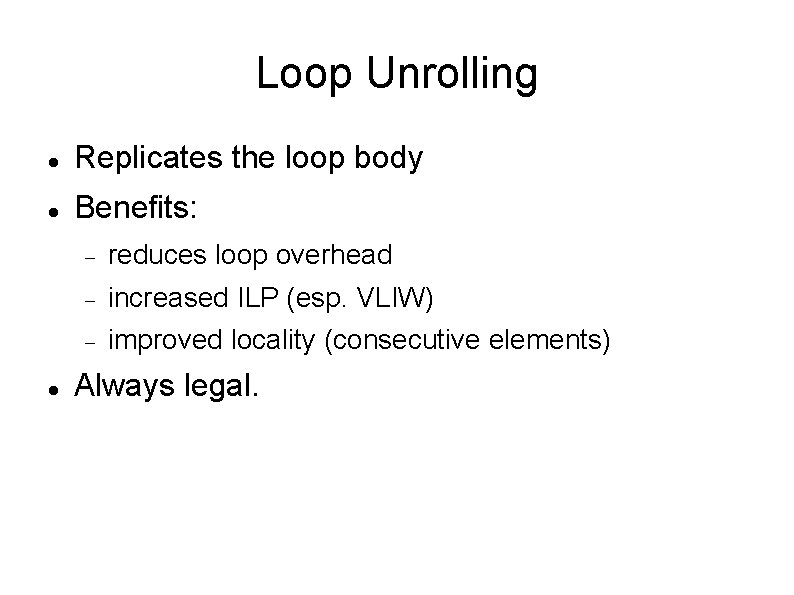
Loop Unrolling Replicates the loop body Benefits: reduces loop overhead increased ILP (esp. VLIW) improved locality (consecutive elements) Always legal.
![Loop Unrolling Before do i = 2, n-1 a[i] = a[i] + a[i-1] *](http://slidetodoc.com/presentation_image_h2/7c36dd539c1e5ee004331ced74ddf504/image-31.jpg "Loop Unrolling Before do i = 2, n-1 a[i] = a[i] + a[i-1] *")
Loop Unrolling Before do i = 2, n-1 a[i] = a[i] + a[i-1] * a[i+1] end do After do i = 1, n-2, 2 a[i] = a[i] + a[i-1] * a[i+1] = a[i+1] + a[i] * a[i+2] end do if (mod(n-2, 2) = 1) then a[n-1] = a[n-1] + a[n-2] * a[n] end if
![Software Pipelining Before do i = 1, n a[i] = a[i] + c end](http://slidetodoc.com/presentation_image_h2/7c36dd539c1e5ee004331ced74ddf504/image-32.jpg "Software Pipelining Before do i = 1, n a[i] = a[i] + c end")
Software Pipelining Before do i = 1, n a[i] = a[i] + c end do After (approx. ) do i = 1, n, 3 a[i] = a[i] + c a[i+1] = a[i+1] + c a[i+2] = a[i+2] + c end do note: assume a 2 -way superscalar CPU
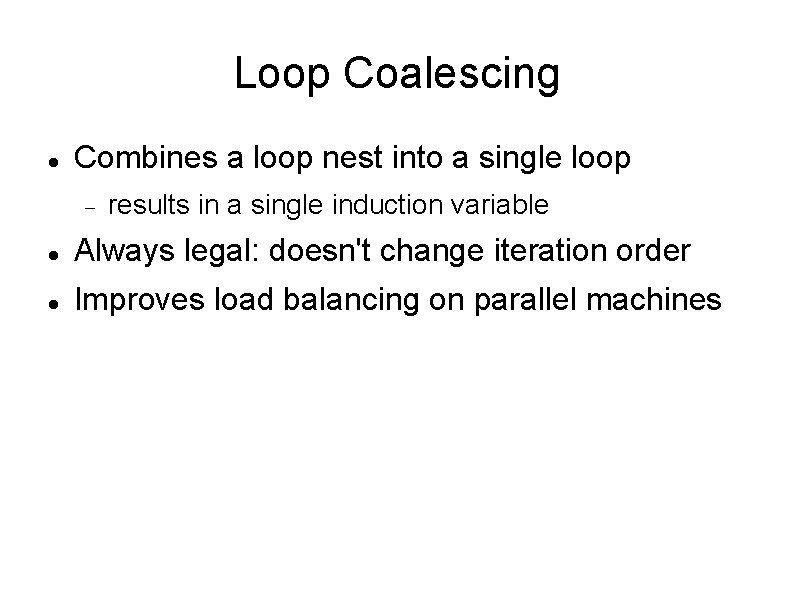
Loop Coalescing Combines a loop nest into a single loop results in a single induction variable Always legal: doesn't change iteration order Improves load balancing on parallel machines
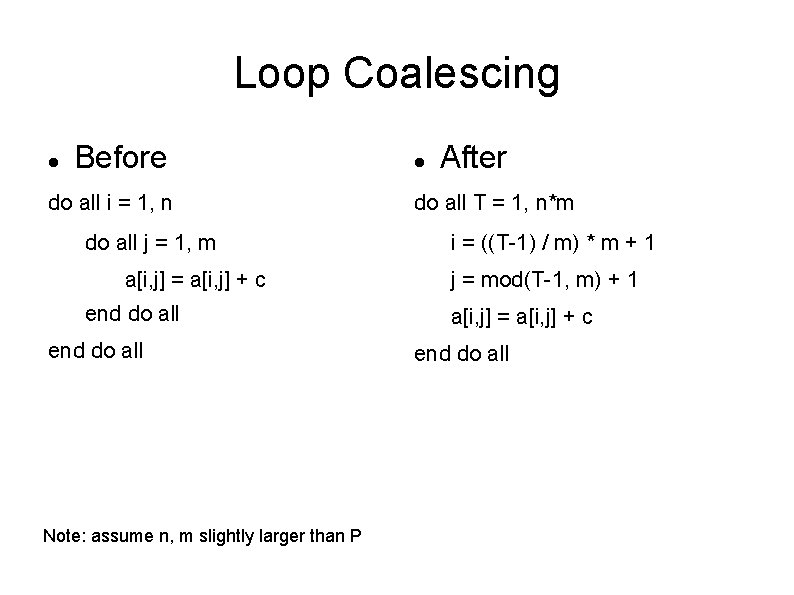
Loop Coalescing Before do all i = 1, n do all j = 1, m a[i, j] = a[i, j] + c end do all Note: assume n, m slightly larger than P After do all T = 1, n*m i = ((T-1) / m) * m + 1 j = mod(T-1, m) + 1 a[i, j] = a[i, j] + c end do all
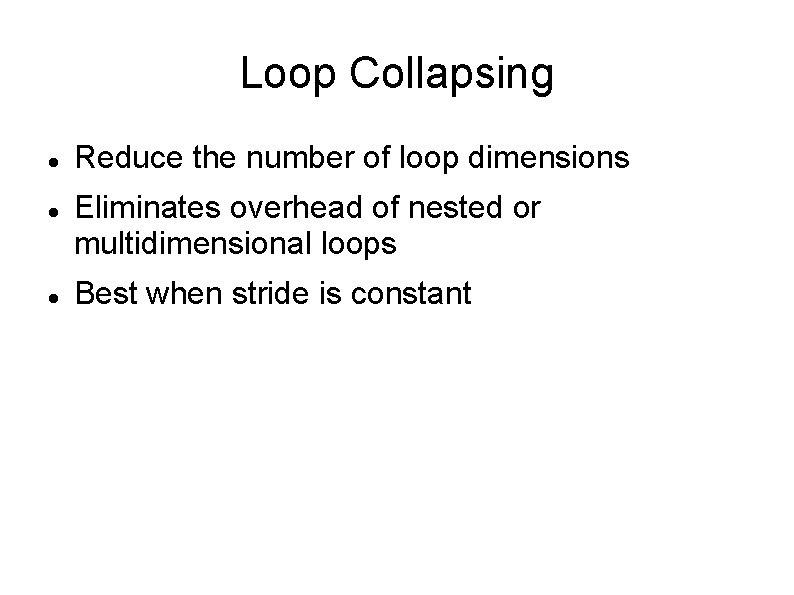
Loop Collapsing Reduce the number of loop dimensions Eliminates overhead of nested or multidimensional loops Best when stride is constant
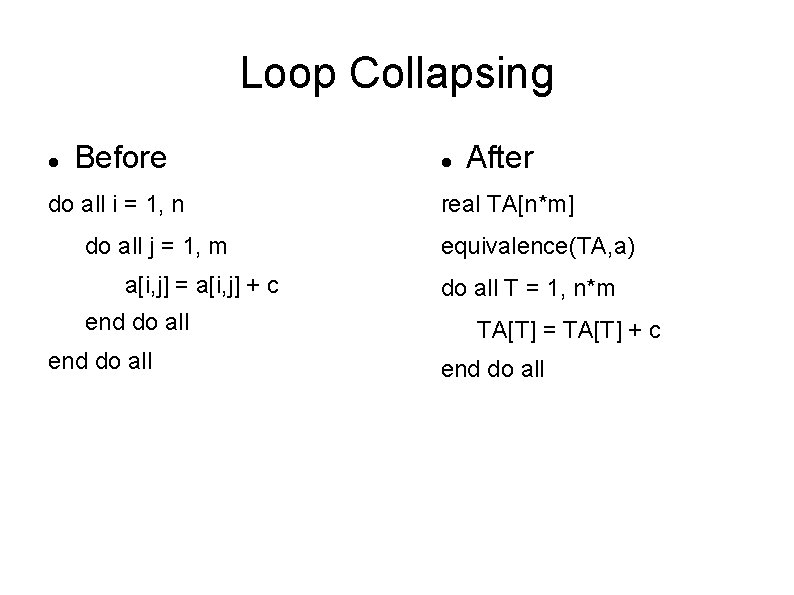
Loop Collapsing Before do all i = 1, n do all j = 1, m a[i, j] = a[i, j] + c end do all After real TA[n*m] equivalence(TA, a) do all T = 1, n*m TA[T] = TA[T] + c end do all
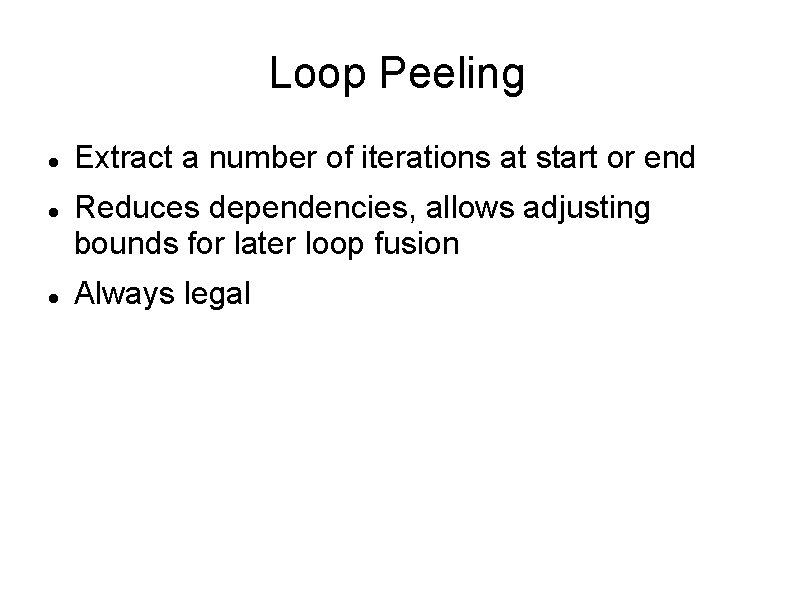
Loop Peeling Extract a number of iterations at start or end Reduces dependencies, allows adjusting bounds for later loop fusion Always legal
![Loop Peeling Before do i = 2, n b[i] = b[i] + b[2] After](http://slidetodoc.com/presentation_image_h2/7c36dd539c1e5ee004331ced74ddf504/image-38.jpg "Loop Peeling Before do i = 2, n b[i] = b[i] + b[2] After")
Loop Peeling Before do i = 2, n b[i] = b[i] + b[2] After if (2 <= n) then b[2] = b[2] + b[2] end do end if do all i = 3, n a[i] = a[i] + c end do all b[i] = b[i] + b[2] a[i] = a[i] + c end do all
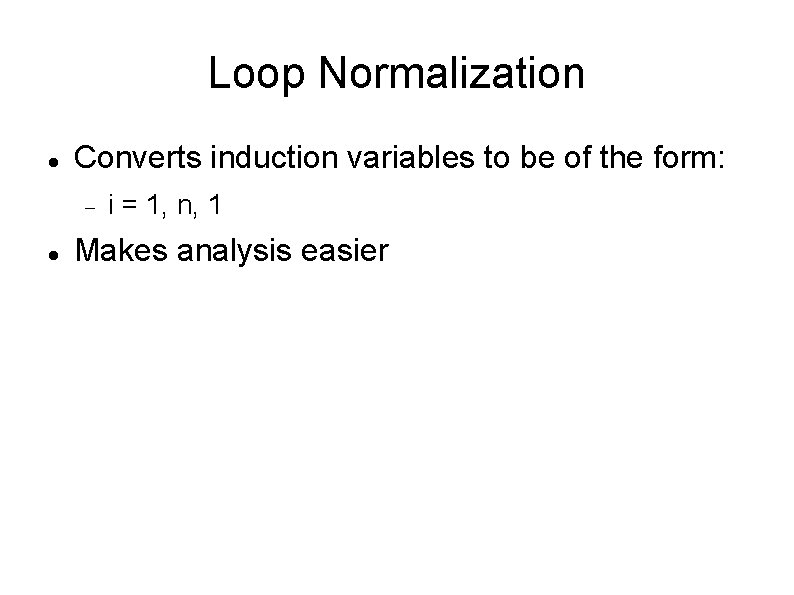
Loop Normalization Converts induction variables to be of the form: i = 1, n, 1 Makes analysis easier
![Loop Normalization Before do i = 1, n a[i] = a[i] + c After](http://slidetodoc.com/presentation_image_h2/7c36dd539c1e5ee004331ced74ddf504/image-40.jpg "Loop Normalization Before do i = 1, n a[i] = a[i] + c After")
Loop Normalization Before do i = 1, n a[i] = a[i] + c After do i = 1, n a[i] = a[i] + c end do do i = 2, n+1 do i = 1, n b[i] = a[i-1] * b[i] end do note: new loops can be fused b[i+1] = a[i] * b[i+1] end do
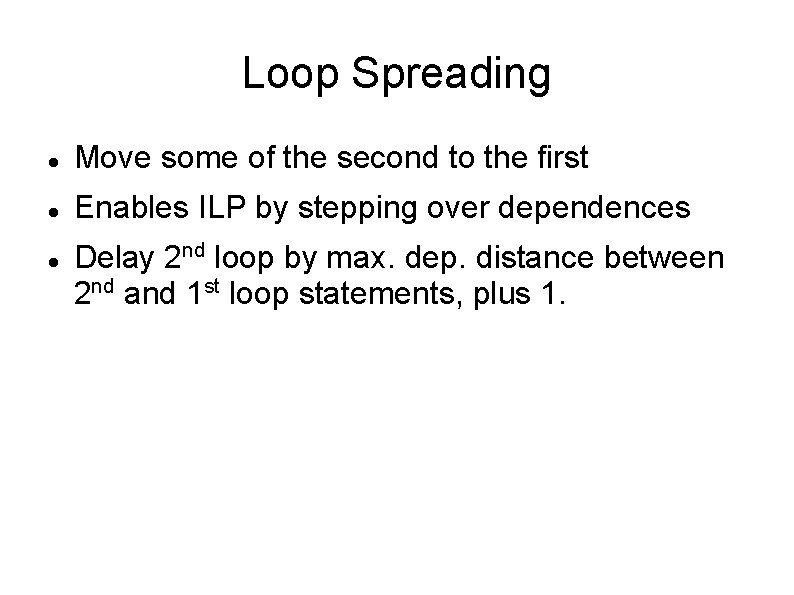
Loop Spreading Move some of the second to the first Enables ILP by stepping over dependences Delay 2 nd loop by max. dep. distance between 2 nd and 1 st loop statements, plus 1.
![Loop Spreading Before do i = 1, n/2 a[i+1] = a[i+1] + a[i] After](http://slidetodoc.com/presentation_image_h2/7c36dd539c1e5ee004331ced74ddf504/image-42.jpg "Loop Spreading Before do i = 1, n/2 a[i+1] = a[i+1] + a[i] After")
Loop Spreading Before do i = 1, n/2 a[i+1] = a[i+1] + a[i] After do i = 1, n/2 COBEGIN end do a[i+1] = a[i+1] + a[i] do i = 1, n-3 if(i > 3) then b[i-2] = b[i-2] + b[i-3] * a[i] end if b[i+1] = b[i+1] +b[i] * a[i+3] end do COEND end do do i = n/2 -3, n-3 b[i+1] = b[i+1] + b[i] * a[i+3] end do
Replacement Transformations (these change everything)
![Reduction Recognition Before do i = 1, n s = s + a[i] end](http://slidetodoc.com/presentation_image_h2/7c36dd539c1e5ee004331ced74ddf504/image-44.jpg "Reduction Recognition Before do i = 1, n s = s + a[i] end")
Reduction Recognition Before do i = 1, n s = s + a[i] end do After real TS[64] TS[1: 64] = 0. 0 do TI = 1, n, 64 TS[1: 64] = TS[1: 64] + a[TI: TI+63] end do do TI = 1, 64 s = s + TS[TI] end do note: legal if *fully* associative (watch out for FP ops. . . )
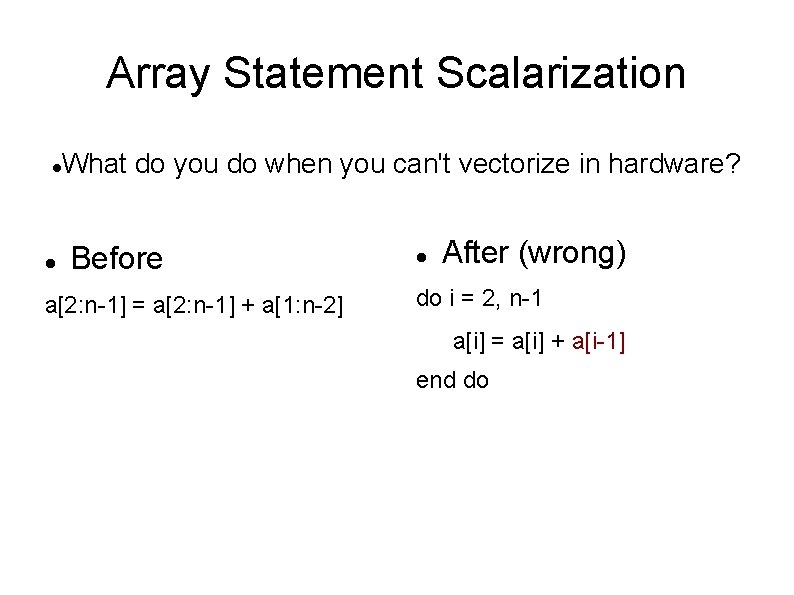
Array Statement Scalarization What do you do when you can't vectorize in hardware? Before a[2: n-1] = a[2: n-1] + a[1: n-2] After (wrong) do i = 2, n-1 a[i] = a[i] + a[i-1] end do
![Array Statement Scalarization Before a[2: n-1] = a[2: n-1] + a[1: n-2] After (wrong)](http://slidetodoc.com/presentation_image_h2/7c36dd539c1e5ee004331ced74ddf504/image-46.jpg "Array Statement Scalarization Before a[2: n-1] = a[2: n-1] + a[1: n-2] After (wrong)")
Array Statement Scalarization Before a[2: n-1] = a[2: n-1] + a[1: n-2] After (wrong) do i = 2, n-1 a[i] = a[i] + a[a-1] end do After (right) do i = 2, n-1 T[i] = a[i] + a[i-1] end do do i = 2, n-1 a[i] = T[i] end do
![Array Statement Scalarization After (right) do i = 2, n-1 T[i] = a[i] +](http://slidetodoc.com/presentation_image_h2/7c36dd539c1e5ee004331ced74ddf504/image-47.jpg "Array Statement Scalarization After (right) do i = 2, n-1 T[i] = a[i] +")
Array Statement Scalarization After (right) do i = 2, n-1 T[i] = a[i] + a[a-1] end do do i = 2, n-1 a[i] = T[i] end do After (even better) do i = n-1, 2, -1 a[i] = a[i] + a[a-1] end do
![Array Statement Scalarization However: a[2: n-1] = a[2: n-1] + a[1: n-2] + a[3:](http://slidetodoc.com/presentation_image_h2/7c36dd539c1e5ee004331ced74ddf504/image-48.jpg "Array Statement Scalarization However: a[2: n-1] = a[2: n-1] + a[1: n-2] + a[3:")
Array Statement Scalarization However: a[2: n-1] = a[2: n-1] + a[1: n-2] + a[3: n] must use a temporary, because: do i = 2, n-1 a[i] = a[i] + a[i-1] + a[i+1] end do has antidependence either way.

Memory Access Transformations (love your DRAM)
![Array Padding Before After real a[8, 512] real a[9, 512] do i = 1,](http://slidetodoc.com/presentation_image_h2/7c36dd539c1e5ee004331ced74ddf504/image-50.jpg "Array Padding Before After real a[8, 512] real a[9, 512] do i = 1,")
Array Padding Before After real a[8, 512] real a[9, 512] do i = 1, 512 a[1, i] = a[1, i] + c end do note: assumes 8 banks of memory, similar for cache and TLB sets
Scalar Expansion Converts scalars to vectors Removes antidependences from temporaries Must be done when vectorizing
![Scalar Expansion Before do i = 1, n c = b[i] a[i] = a[i]](http://slidetodoc.com/presentation_image_h2/7c36dd539c1e5ee004331ced74ddf504/image-52.jpg "Scalar Expansion Before do i = 1, n c = b[i] a[i] = a[i]")
Scalar Expansion Before do i = 1, n c = b[i] a[i] = a[i] + c end do After real T[n] do all i = 1, n T[i] = b[i] a[i] = a[i] + T[i] end do all
![Array Contraction Before After real T[n, n] real T[n] do i = 1, n](http://slidetodoc.com/presentation_image_h2/7c36dd539c1e5ee004331ced74ddf504/image-53.jpg "Array Contraction Before After real T[n, n] real T[n] do i = 1, n")
Array Contraction Before After real T[n, n] real T[n] do i = 1, n do all j = 1, n T[i, j] = a[i, j]*3 T[j] = a[i, j]*3 b[i, j[ = T[i, j] + b[i, j]/T[i, j] b[i, j[ = T[j] + b[i, j]/T[j] end do all end do do all j = 1, n end do all end do
![Scalar Replacement Before do i = 1, n do j = 1, n total[i]](http://slidetodoc.com/presentation_image_h2/7c36dd539c1e5ee004331ced74ddf504/image-54.jpg "Scalar Replacement Before do i = 1, n do j = 1, n total[i]")
Scalar Replacement Before do i = 1, n do j = 1, n total[i] = total[i] + a[i, j] After do i = 1, n T = total[i] do j = 1, n end do T = T + a[i, j] end do total[i] = T end do
Transformations for Parallel Machines (sharing the load)
![Guard Introduction Before do i = 1, n a[i] = a[i] + c b[i]](http://slidetodoc.com/presentation_image_h2/7c36dd539c1e5ee004331ced74ddf504/image-56.jpg "Guard Introduction Before do i = 1, n a[i] = a[i] + c b[i]")
Guard Introduction Before do i = 1, n a[i] = a[i] + c b[i] = b[i] + c end do After LBA = (n/Pnum)*Pid + 1 UBA = (n/Pnum)*(Pid + 1) LBB = (n/Pnum)*Pid + 1 UBB = (n/Pnum)*(Pid + 1) do i = 1, n if (LBA <= 1. and. i <= UBA) a[i] = a[i] + c if (LBB <= 1. and. i <= UBB) b[i] = b[i] + c end do
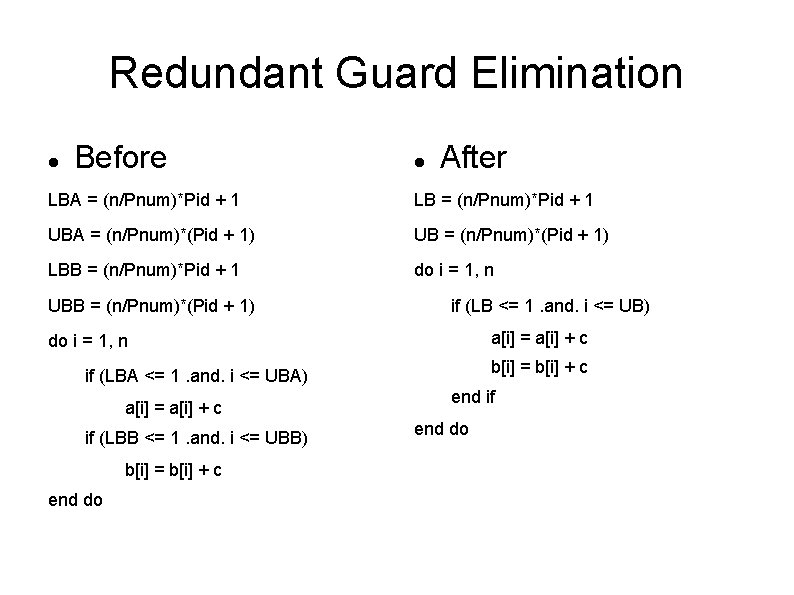
Redundant Guard Elimination Before After LBA = (n/Pnum)*Pid + 1 LB = (n/Pnum)*Pid + 1 UBA = (n/Pnum)*(Pid + 1) UB = (n/Pnum)*(Pid + 1) LBB = (n/Pnum)*Pid + 1 do i = 1, n UBB = (n/Pnum)*(Pid + 1) if (LB <= 1. and. i <= UB) a[i] = a[i] + c do i = 1, n b[i] = b[i] + c if (LBA <= 1. and. i <= UBA) a[i] = a[i] + c if (LBB <= 1. and. i <= UBB) b[i] = b[i] + c end do end if end do
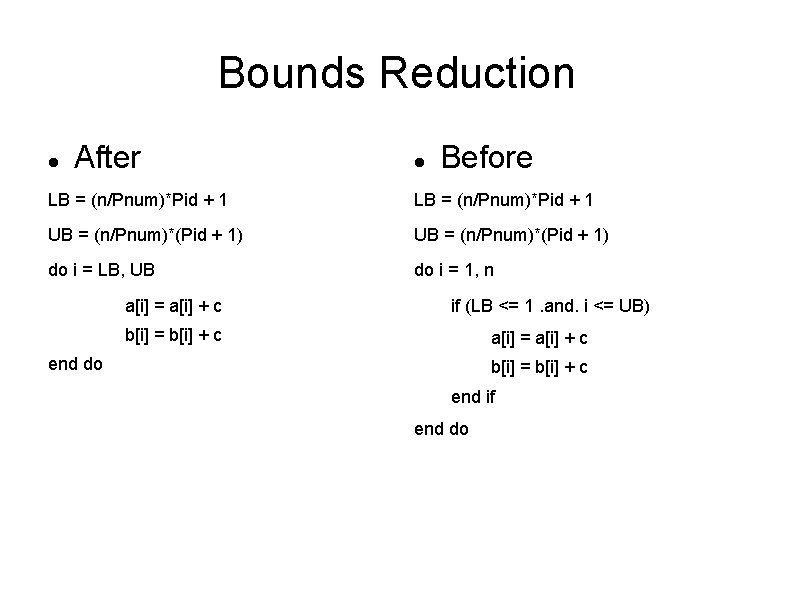
Bounds Reduction After Before LB = (n/Pnum)*Pid + 1 UB = (n/Pnum)*(Pid + 1) do i = LB, UB do i = 1, n a[i] = a[i] + c if (LB <= 1. and. i <= UB) b[i] = b[i] + c a[i] = a[i] + c end do b[i] = b[i] + c end if end do

That's all folks!
- Slides: 59