
ECE 150 Fundamentals of Programming Repetitious operations Prof
- Slides: 17
ECE 150 Fundamentals of Programming Repetitious operations Prof. Hiren Patel, Ph. D. Douglas Wilhelm Harder, M. Math. LEL hdpatel@uwaterloo. ca dwharder@uwaterloo. ca © © 2018 by by Douglas Wilhelm Harder and Hiren Patel.
Repetitiousoperations Outline • In this presentation, we will: – Review conditional statements – Introduce repetitious operations • Review the game of Pictionary. TM – Describe how these solve specific real-wold problems – Understand the need for true/false conditions to continue looping – Look at the flow chart
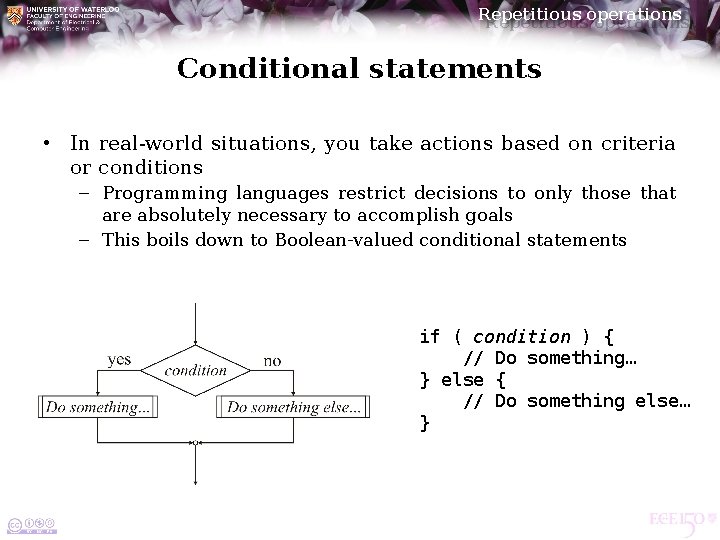
Repetitiousoperations Conditional statements • In real-world situations, you take actions based on criteria or conditions – Programming languages restrict decisions to only those that are absolutely necessary to accomplish goals – This boils down to Boolean-valued conditional statements if ( condition ) { // Do something… } else { // Do something else… }
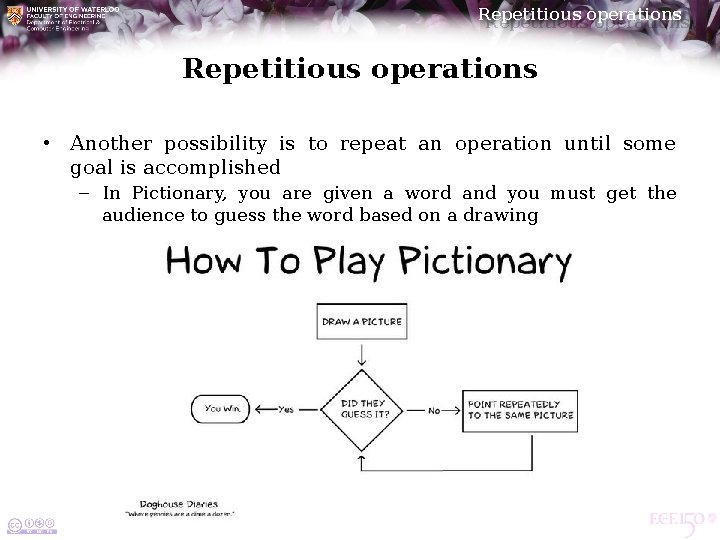
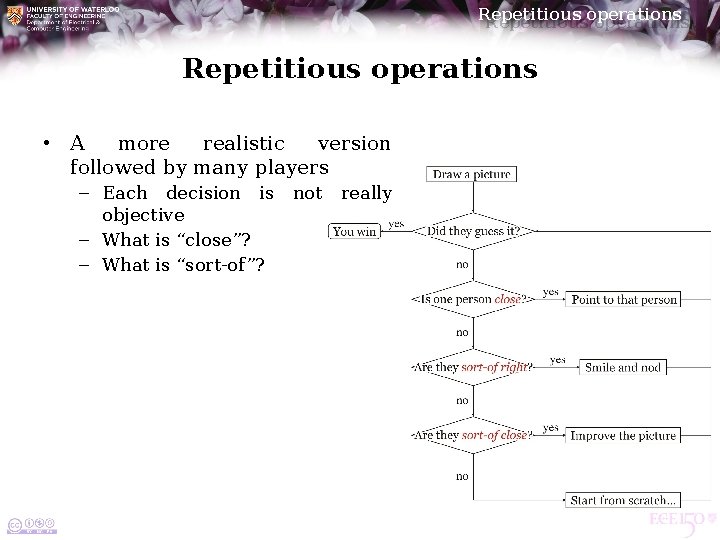
Repetitiousoperations Repetitious operations • Another possibility is to repeat an operation until some goal is accomplished – In Pictionary, you are given a word and you must get the audience to guess the word based on a drawing
Repetitiousoperations Repetitious operations • A more realistic version followed by many players – Each decision is objective – What is “close”? – What is “sort-of”? not really
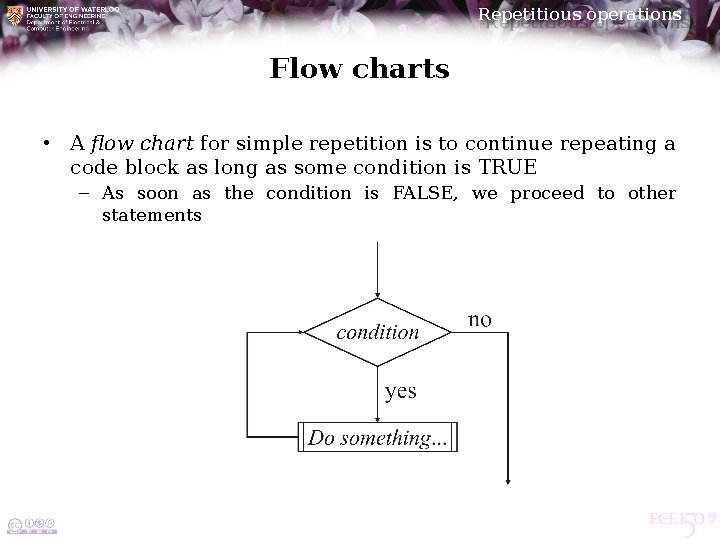
Repetitiousoperations Flow charts • A flow chart for simple repetition is to continue repeating a code block as long as some condition is TRUE – As soon as the condition is FALSE, we proceed to other statements
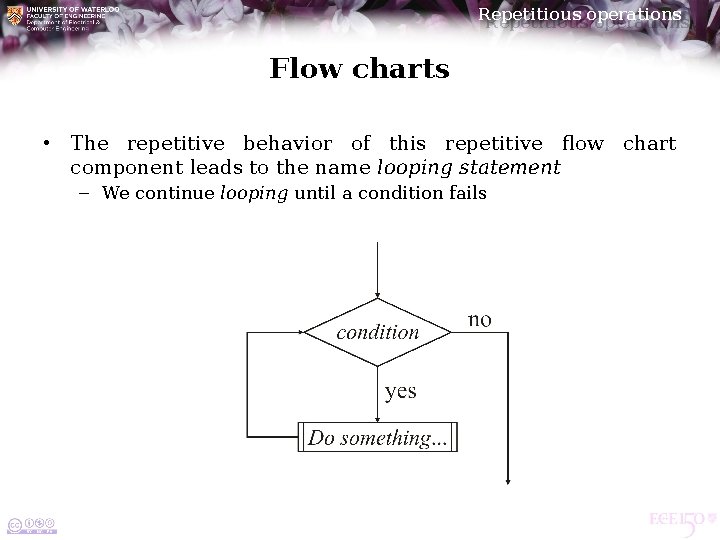
Repetitiousoperations Flow charts • The repetitive behavior of this repetitive flow chart component leads to the name looping statement – We continue looping until a condition fails
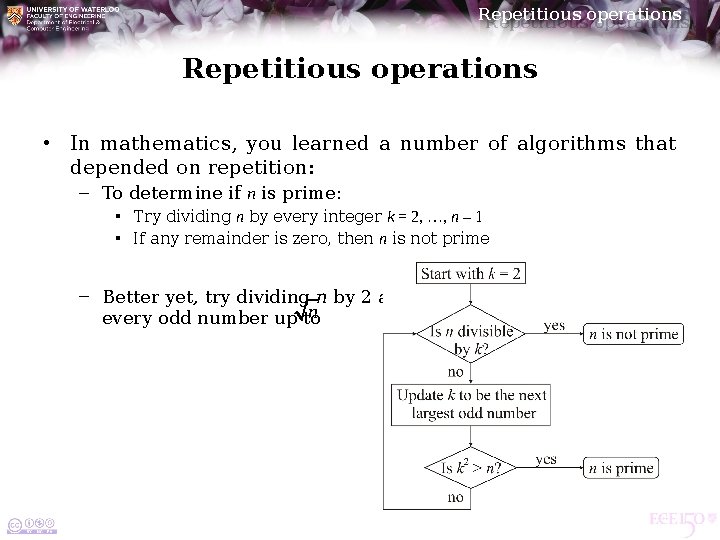
Repetitiousoperations Repetitious operations • In mathematics, you learned a number of algorithms that depended on repetition: – To determine if n is prime: • Try dividing n by every integer k = 2, …, n – 1 • If any remainder is zero, then n is not prime – Better yet, try dividing n by 2 and n every odd number up to
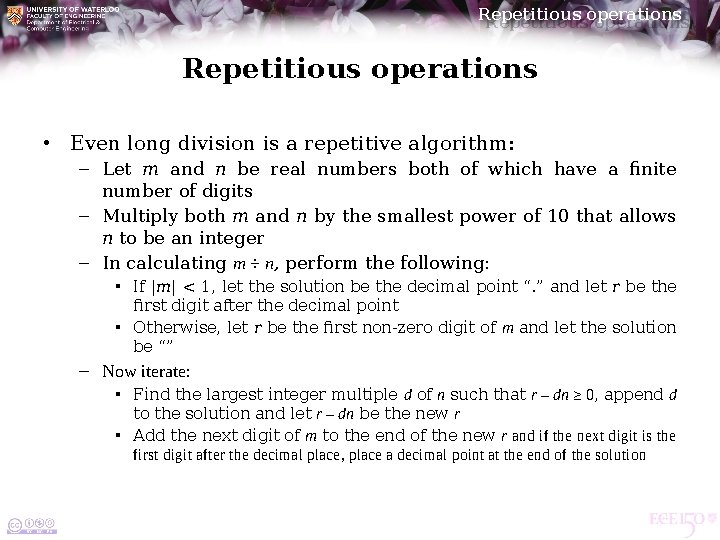
Repetitiousoperations Repetitious operations • Even long division is a repetitive algorithm: – Let m and n be real numbers both of which have a finite number of digits – Multiply both m and n by the smallest power of 10 that allows n to be an integer – In calculating m ÷ n, perform the following: • If |m| < 1, let the solution be the decimal point “. ” and let r be the first digit after the decimal point • Otherwise, let r be the first non-zero digit of m and let the solution be “” – Now iterate: • Find the largest integer multiple d of n such that r – dn ≥ 0, append d to the solution and let r – dn be the new r • Add the next digit of m to the end of the new r and if the next digit is the first digit after the decimal place, place a decimal point at the end of the solution
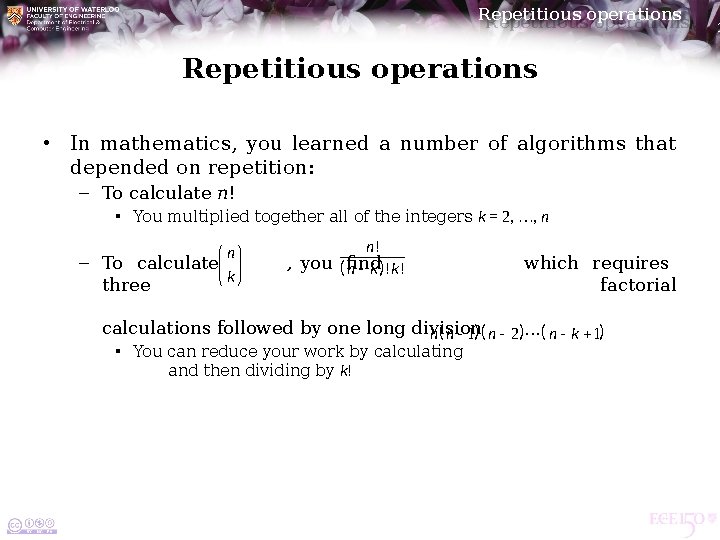
Repetitiousoperations Repetitious operations • In mathematics, you learned a number of algorithms that depended on repetition: – To calculate n! • You multiplied together all of the integers k = 2, …, n n – To calculate k three n! , you find n k !k ! which requires factorial calculations followed by one long division n n 1 n 2 n k 1 • You can reduce your work by calculating and then dividing by k! 1
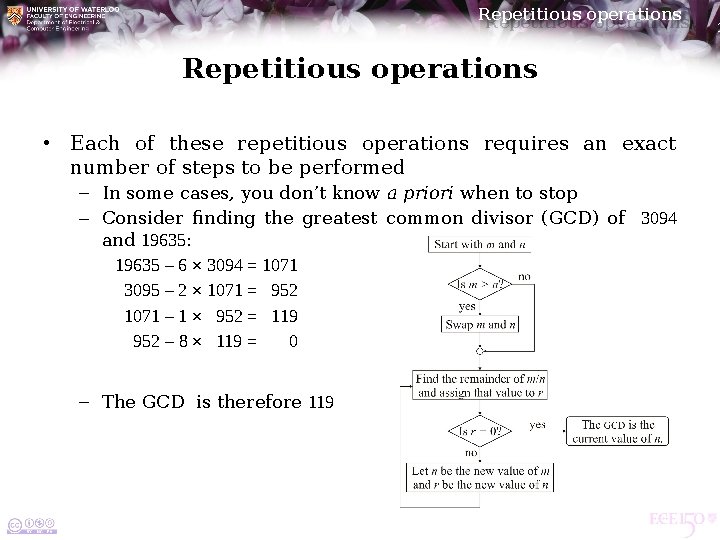
Repetitiousoperations Repetitious operations • Each of these repetitious operations requires an exact number of steps to be performed – In some cases, you don’t know a priori when to stop – Consider finding the greatest common divisor (GCD) of 3094 and 19635: 19635 – 6 × 3094 = 1071 3095 – 2 × 1071 = 952 1071 – 1 × 952 = 119 952 – 8 × 119 = 0 – The GCD is therefore 119 1
Repetitiousoperations Repetitious operations • In programming languages, it is also repetitively perform a sequence of actions necessary to – In Pictionary, the choice of action was someone fuzzy – In mathematics, in each case the repetitive operation is well defined – In some cases, we know how often we will have to repeat an operation, in others, we may not know until we get a solution • That is, if a solution even exists • Like decision making, in programming languages we will have to reduce the decision as to how often to repeat down to a simple yes-no question 1
Repetitiousoperations Summary • In this presentation, you now – Are familiar with repetitious operations – Have re-familiarized yourself with such operations in secondary school – Know the flow chart for such operations – Understand that the conditions for looping must be Booleanvalued • Either true or false 1
Repetitiousoperations References [1] Wikipedia https: //en. wikipedia. org/wiki/Pictionary 1
Repetitiousoperations Acknowledgments Proof read by Charlie Liu. 1
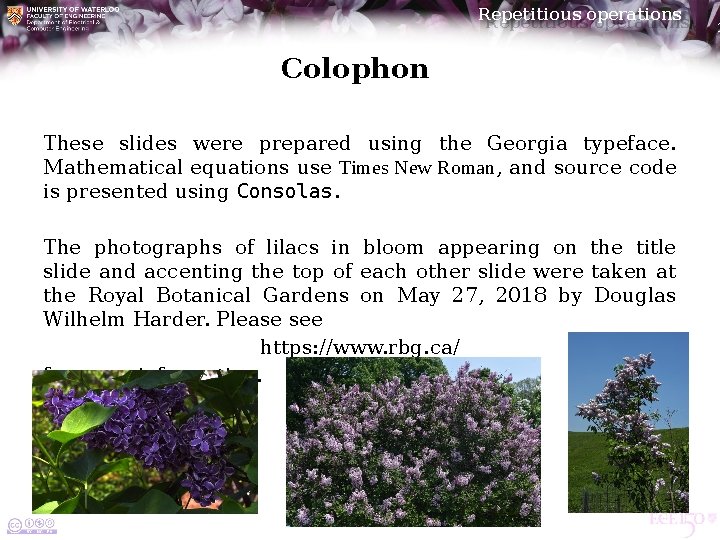
Repetitiousoperations Colophon These slides were prepared using the Georgia typeface. Mathematical equations use Times New Roman, and source code is presented using Consolas. The photographs of lilacs in bloom appearing on the title slide and accenting the top of each other slide were taken at the Royal Botanical Gardens on May 27, 2018 by Douglas Wilhelm Harder. Please see https: //www. rbg. ca/ for more information. 1
Repetitiousoperations Disclaimer These slides are provided for the ECE 150 Fundamentals of Programming course taught at the University of Waterloo. The material in it reflects the authors’ best judgment in light of the information available to them at the time of preparation. Any reliance on these course slides by any party for any other purpose are the responsibility of such parties. The authors accept no responsibility for damages, if any, suffered by any party as a result of decisions made or actions based on these course slides for any other purpose than that for which it was intended. 1