
ECE 1111 8443 Engineering Pattern Recognition Computation I
- Slides: 45
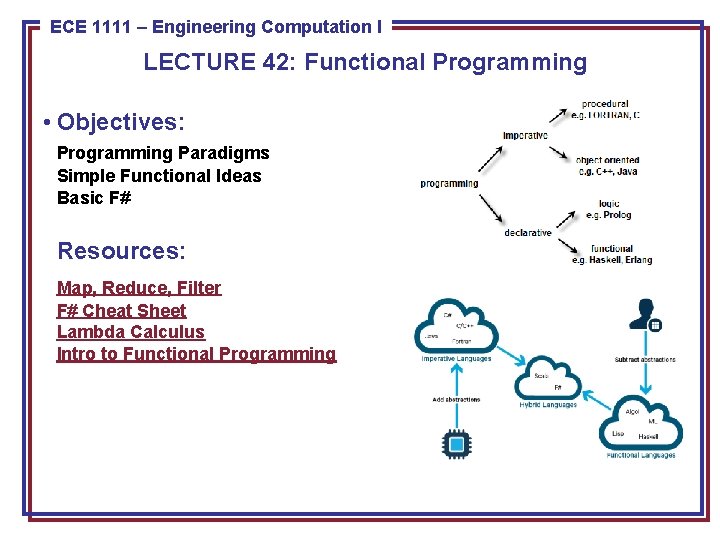
ECE 1111 8443 – Engineering Pattern Recognition Computation I LECTURE 42: Functional Programming • Objectives: Programming Paradigms Simple Functional Ideas Basic F# Resources: Map, Reduce, Filter F# Cheat Sheet Lambda Calculus Intro to Functional Programming
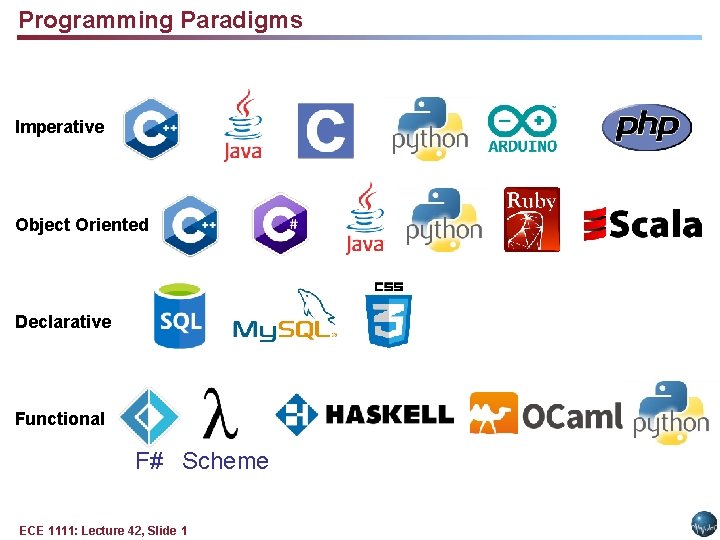
Programming Paradigms Imperative Object Oriented Declarative Functional F# Scheme ECE 1111: Lecture 42, Slide 1
Why Should I Use Functional Programming? • Fewer Bugs • Code Simpler/More Maintainable Code • No Side Effects • Easy to Parallelize & Scale • Mathematically Provable • Its been around a while ECE 1111: Lecture 42, Slide 2
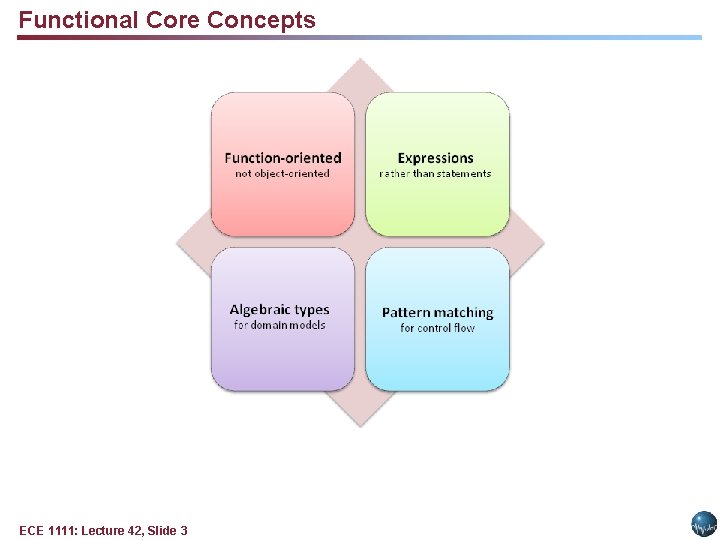
Functional Core Concepts ECE 1111: Lecture 42, Slide 3
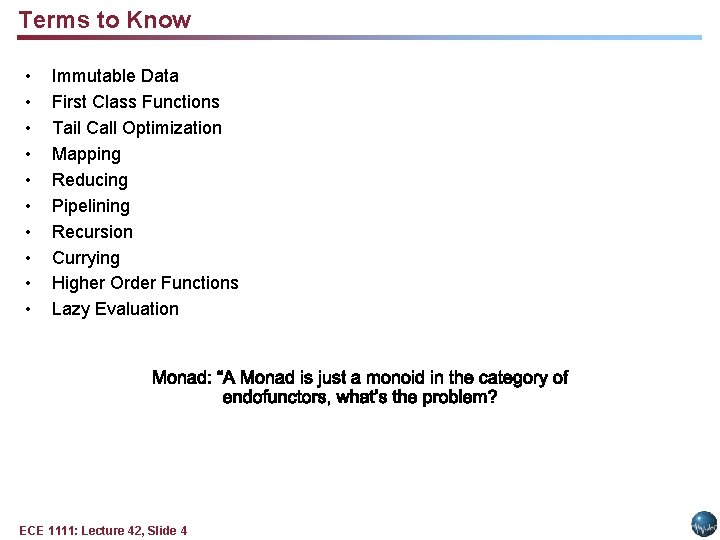
Terms to Know • • • Immutable Data First Class Functions Tail Call Optimization Mapping Reducing Pipelining Recursion Currying Higher Order Functions Lazy Evaluation ECE 1111: Lecture 42, Slide 4
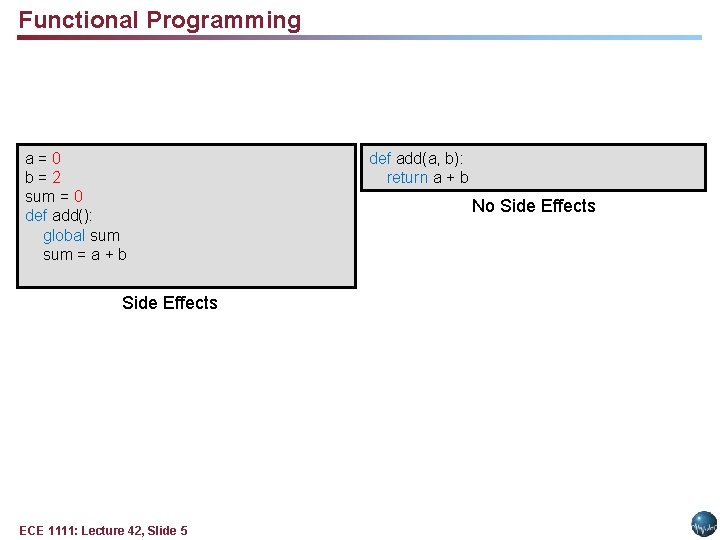
Functional Programming a = 0 b = 2 sum = 0 def add(): global sum = a + b Side Effects ECE 1111: Lecture 42, Slide 5 def add(a, b): return a + b No Side Effects
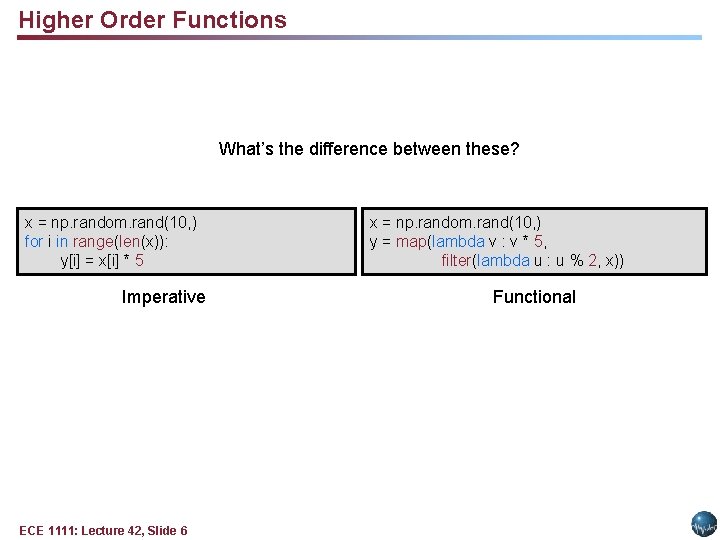
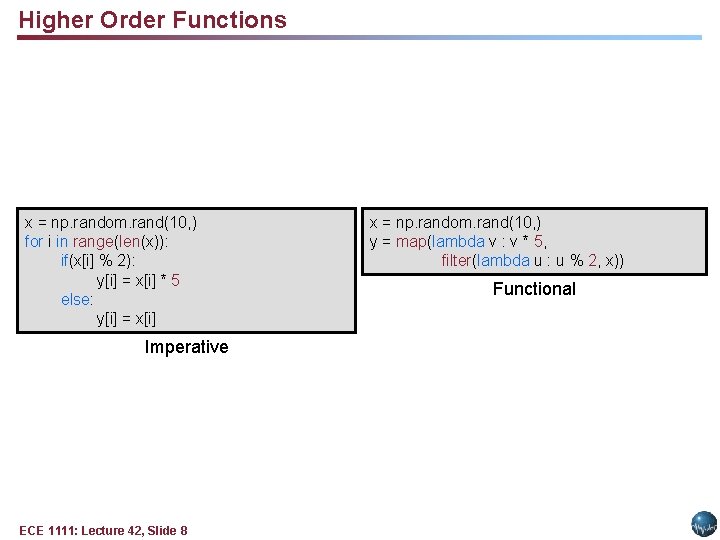
Higher Order Functions What’s the difference between these? x = np. random. rand(10, ) for i in range(len(x)): y[i] = x[i] * 5 Imperative ECE 1111: Lecture 42, Slide 6 x = np. random. rand(10, ) y = map(lambda v : v * 5, filter(lambda u : u % 2, x)) Functional
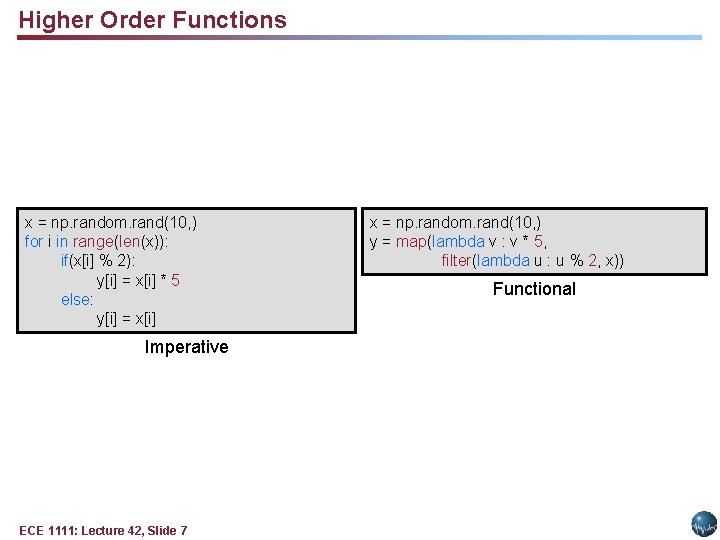
Higher Order Functions x = np. random. rand(10, ) for i in range(len(x)): if(x[i] % 2): y[i] = x[i] * 5 else: y[i] = x[i] Imperative ECE 1111: Lecture 42, Slide 7 x = np. random. rand(10, ) y = map(lambda v : v * 5, filter(lambda u : u % 2, x)) Functional
Higher Order Functions x = np. random. rand(10, ) for i in range(len(x)): if(x[i] % 2): y[i] = x[i] * 5 else: y[i] = x[i] Imperative ECE 1111: Lecture 42, Slide 8 x = np. random. rand(10, ) y = map(lambda v : v * 5, filter(lambda u : u % 2, x)) Functional
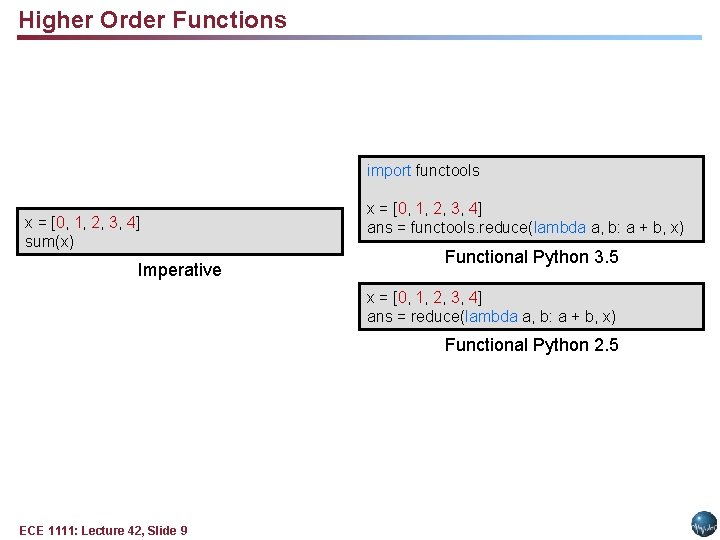
Higher Order Functions import functools x = [0, 1, 2, 3, 4] sum(x) Imperative x = [0, 1, 2, 3, 4] ans = functools. reduce(lambda a, b: a + b, x) Functional Python 3. 5 x = [0, 1, 2, 3, 4] ans = reduce(lambda a, b: a + b, x) Functional Python 2. 5 ECE 1111: Lecture 42, Slide 9
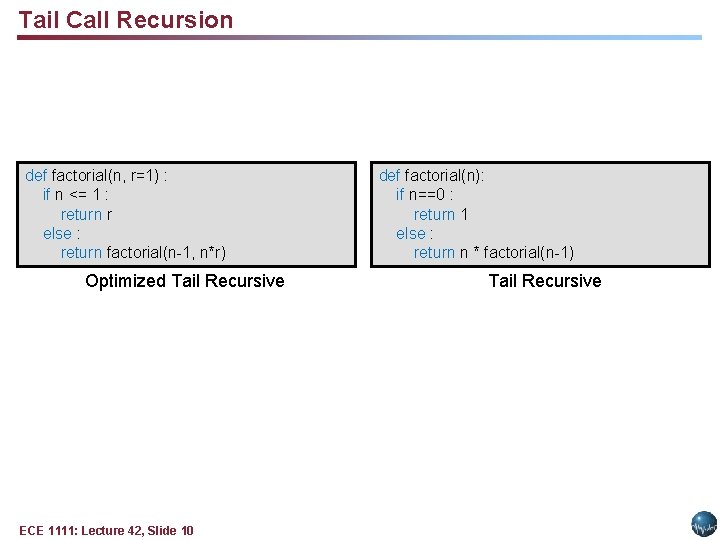
Tail Call Recursion def factorial(n, r=1) : if n <= 1 : return r else : return factorial(n-1, n*r) Optimized Tail Recursive ECE 1111: Lecture 42, Slide 10 def factorial(n): if n==0 : return 1 else : return n * factorial(n-1) Tail Recursive
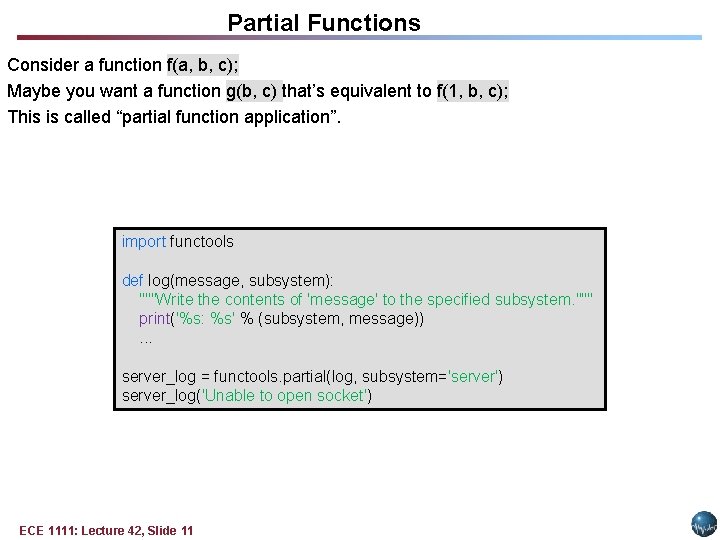
Partial Functions Consider a function f(a, b, c); Maybe you want a function g(b, c) that’s equivalent to f(1, b, c); This is called “partial function application”. import functools def log(message, subsystem): """Write the contents of 'message' to the specified subsystem. """ print('%s: %s' % (subsystem, message)) . . . server_log = functools. partial(log, subsystem='server') server_log('Unable to open socket') ECE 1111: Lecture 42, Slide 11
What’s Next? ECE 1111: Lecture 42, Slide 12
Functional Basics with F# ECE 1111: Lecture 42, Slide 13
F# Syntax Cheat Sheets • • http: //dungpa. github. io/fsharp-cheatsheet/ http: //www. samskivert. com/code/fsharp-cheat-sheet. pdf https: //msdn. microsoft. com/en-us/library/dd 233181. aspx http: //en. wikibooks. org/wiki/F_Sharp_Programming ECE 1111: Lecture 42, Slide 14
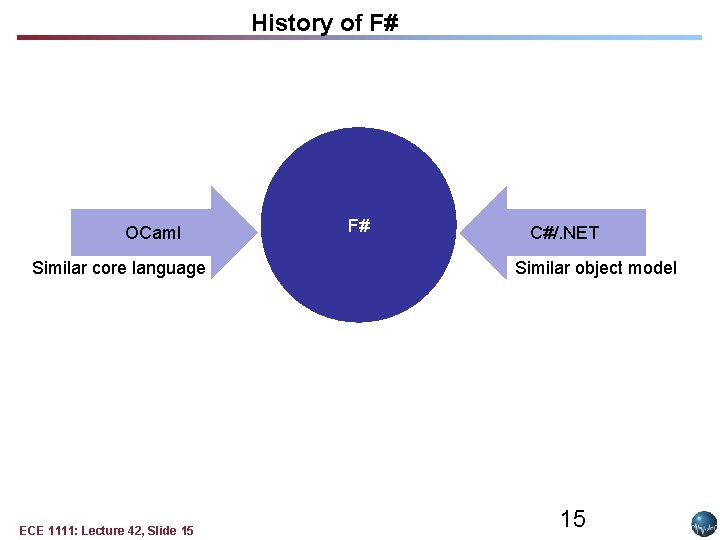
History of F# OCaml Similar core language ECE 1111: Lecture 42, Slide 15 F# C#/. NET Similar object model 15
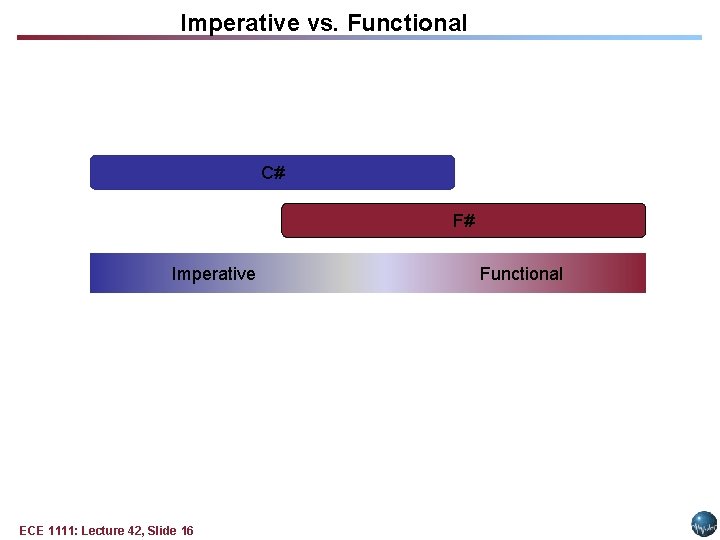
Imperative vs. Functional C# F# Imperative Functional ECE 1111: Lecture 42, Slide 16
What does “functional” even mean? • • Preferring immutability – Avoid state changes, side effects, and mutable data as much as possible. Using data in data out transformations – Try modeling your problem as a mapping of inputs to outputs. – Everything is an expression! Too much |> ignore is often an anti-pattern Treating functions as the unit of work, not objects Looking at problems recursively – Think of ways to model a problem as successively smaller chunks of the same problem ECE 1111: Lecture 42, Slide 17
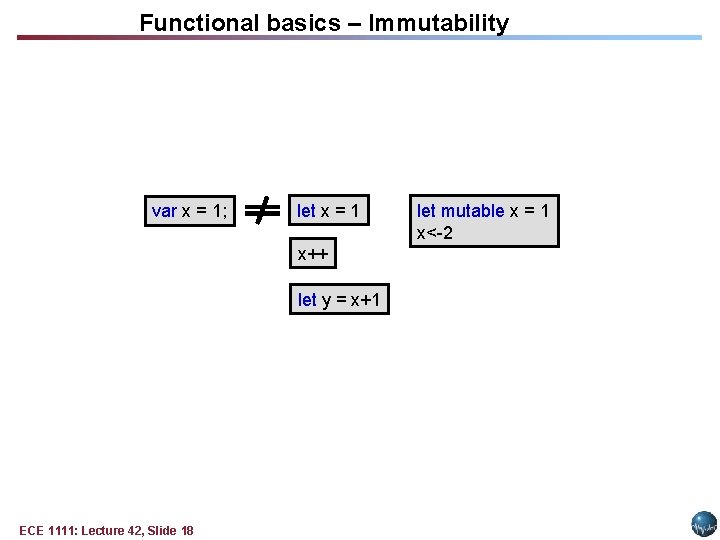
Functional basics – Immutability var x = 1; let x = 1 x++ let y = x+1 ECE 1111: Lecture 42, Slide 18 let mutable x = 1 x<-2
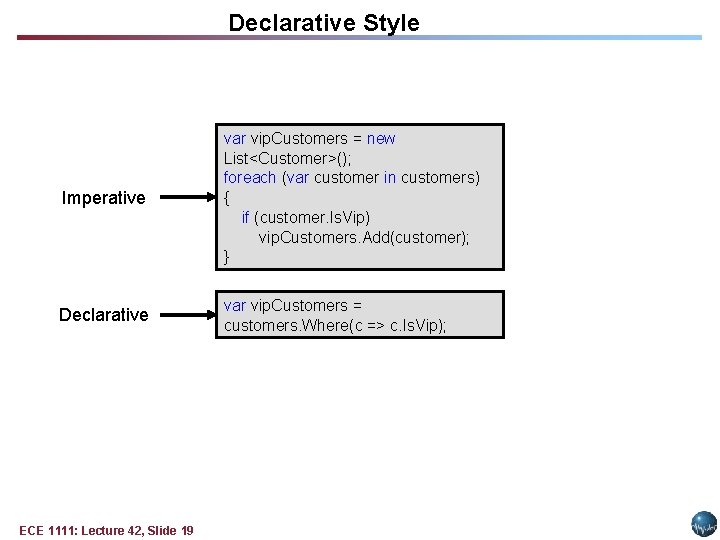
Declarative Style Imperative var vip. Customers = new List<Customer>(); foreach (var customer in customers) { if (customer. Is. Vip) vip. Customers. Add(customer); } Declarative var vip. Customers = customers. Where(c => c. Is. Vip); ECE 1111: Lecture 42, Slide 19
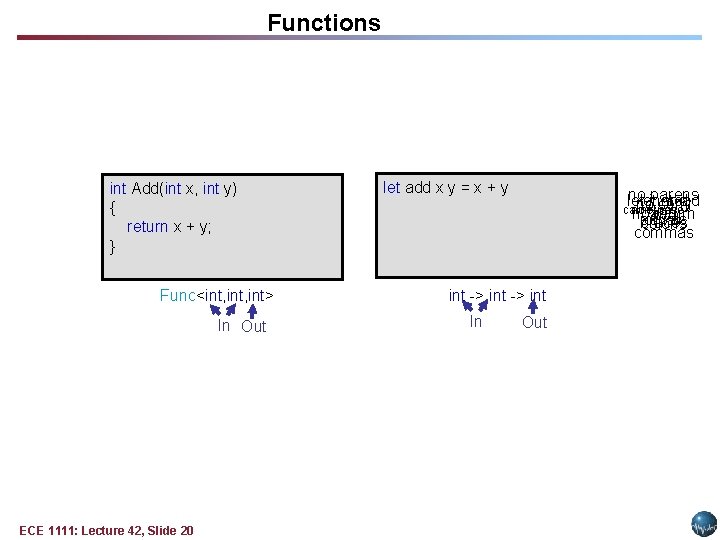
Functions int Add(int x, int y) { var z = x + y; return z; } } Func<int, int> In Out ECE 1111: Lecture 42, Slide 20 Add(x, y) int Add(int x, int y) add(x, y) add x y let add x y = x + y let add x y = { let z = x + y var z = x + y; var z = x + y let z = x + y z return z; return z z } no parens let instead let and no curly no semi camel case no types and no return equals of var braces colons commas int -> int In Out
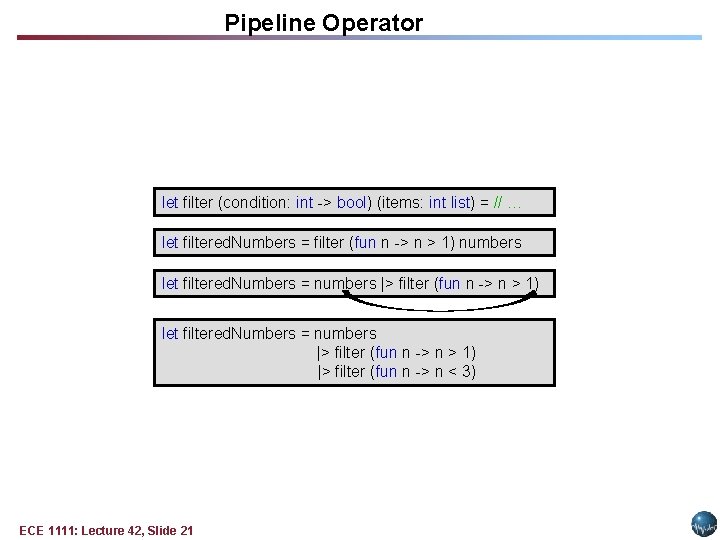
Pipeline Operator let filter (condition: int -> bool) (items: int list) = // … let filtered. Numbers = filter (fun n -> n > 1) numbers let filtered. Numbers = numbers |> filter (fun n -> n > 1) let filtered. Numbers = numbers |> filter (fun n -> n > 1) |> filter (fun n -> n < 3) ECE 1111: Lecture 42, Slide 21
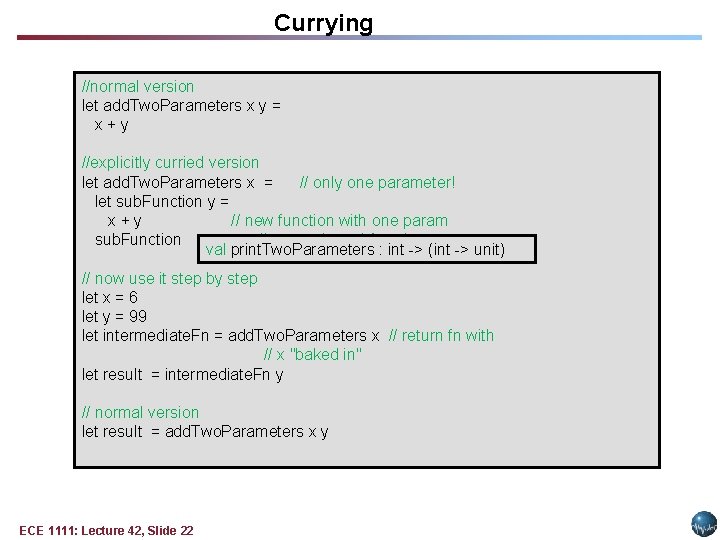
Currying //normal version let add. Two. Parameters x y = x + y //explicitly curried version let add. Two. Parameters x = // only one parameter! let sub. Function y = x + y // new function with one param sub. Function // return the subfunction val print. Two. Parameters : int -> (int -> unit) // now use it step by step let x = 6 let y = 99 let intermediate. Fn = add. Two. Parameters x // return fn with // x "baked in" let result = intermediate. Fn y // normal version let result = add. Two. Parameters x y ECE 1111: Lecture 42, Slide 22
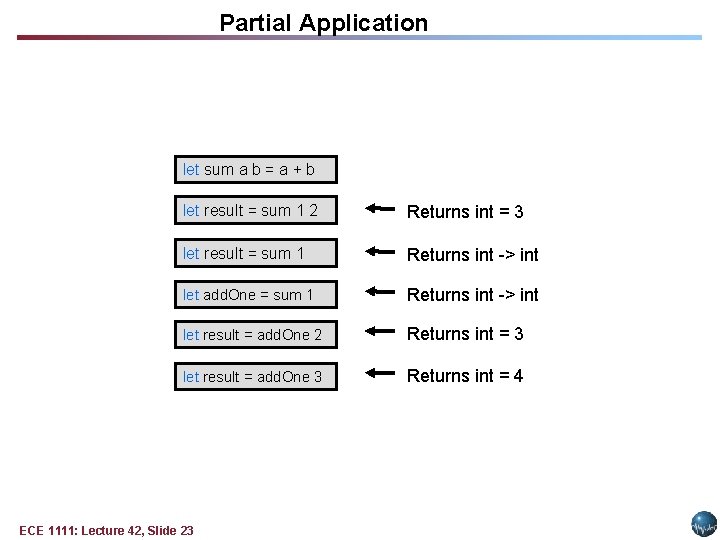
Partial Application let sum a b = a + b let result = sum 1 2 Returns int = 3 let result = sum 1 Returns int -> int let add. One = sum 1 Returns int -> int let result = add. One 2 Returns int = 3 let result = add. One 3 Returns int = 4 ECE 1111: Lecture 42, Slide 23
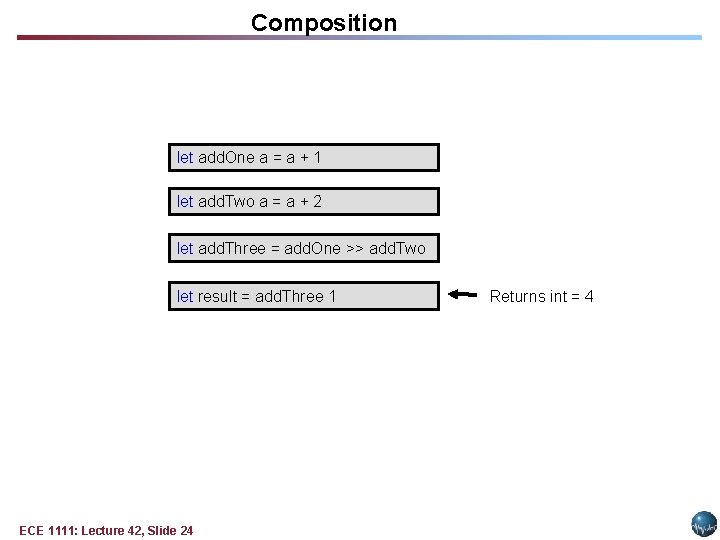
Composition let add. One a = a + 1 let add. Two a = a + 2 let add. Three = add. One >> add. Two let result = add. Three 1 ECE 1111: Lecture 42, Slide 24 Returns int = 4
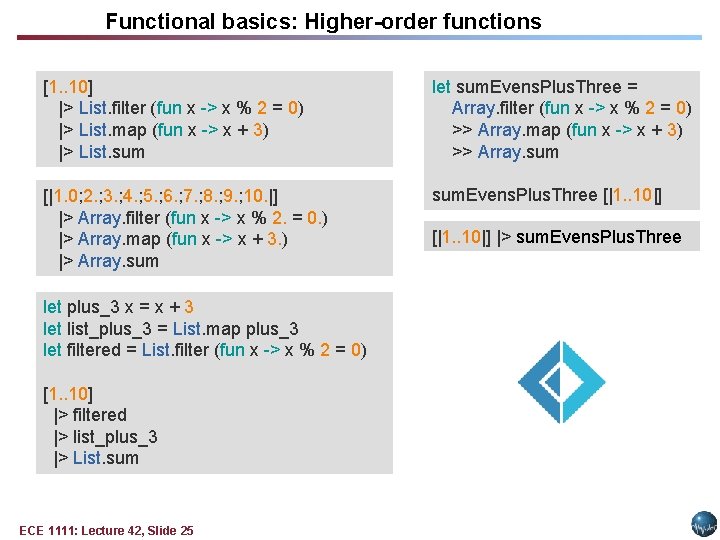
Functional basics: Higher-order functions [1. . 10] |> List. filter (fun x -> x % 2 = 0) |> List. map (fun x -> x + 3) |> List. sum let sum. Evens. Plus. Three = Array. filter (fun x -> x % 2 = 0) >> Array. map (fun x -> x + 3) >> Array. sum [|1. 0; 2. ; 3. ; 4. ; 5. ; 6. ; 7. ; 8. ; 9. ; 10. |] |> Array. filter (fun x -> x % 2. = 0. ) |> Array. map (fun x -> x + 3. ) |> Array. sum. Evens. Plus. Three [|1. . 10|] let plus_3 x = x + 3 let list_plus_3 = List. map plus_3 let filtered = List. filter (fun x -> x % 2 = 0) [1. . 10] |> filtered |> list_plus_3 |> List. sum ECE 1111: Lecture 42, Slide 25 [|1. . 10|] |> sum. Evens. Plus. Three
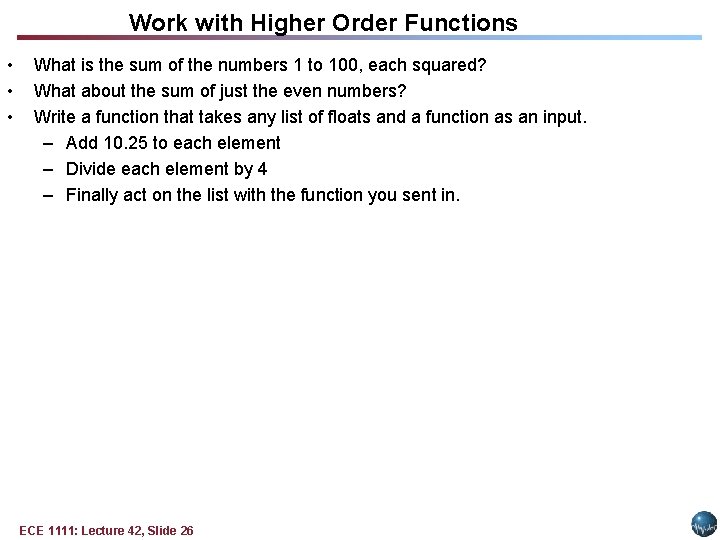
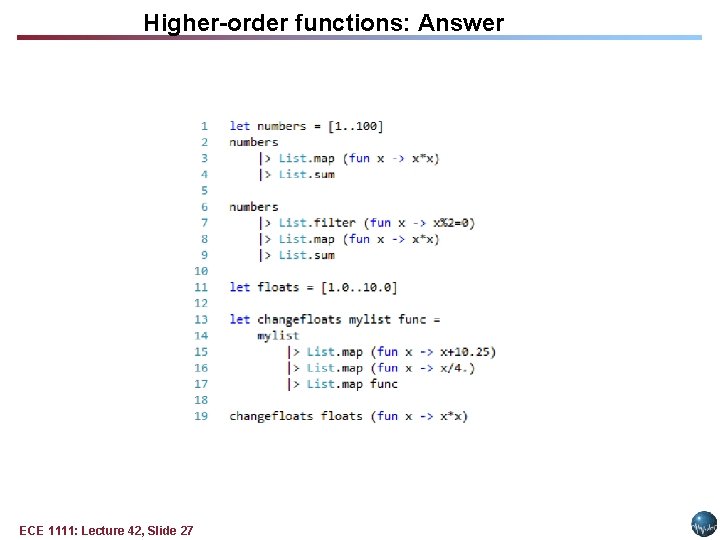
Work with Higher Order Functions • • • What is the sum of the numbers 1 to 100, each squared? What about the sum of just the even numbers? Write a function that takes any list of floats and a function as an input. – Add 10. 25 to each element – Divide each element by 4 – Finally act on the list with the function you sent in. ECE 1111: Lecture 42, Slide 26
Higher-order functions: Answer ECE 1111: Lecture 42, Slide 27
The Iterator and Disposable patterns in F# • • • F# provides the use keyword as an equivalent of C#’s using statement keyword (not to be confused with C#’s using directive keyword, whose F# equivalent is open) In F#, seq is provided as a shorthand for IEnumerable Your preference for collections should be (in descending order): list, array, seq ECE 1111: Lecture 42, Slide 28
What is polymorphism? • Subtype polymorphism: when a data type is related to another by substitutability • Parametric polymorphism: when code is written without mention to any specific type (e. g. , list of X type, array of X type) • Ad hoc polymorphism: when a function can be applied to arguments of different types • Overloading (built-in and/or custom) • Haskell: type classes • F# specific feature: statically resolved type parameters ECE 1111: Lecture 42, Slide 29
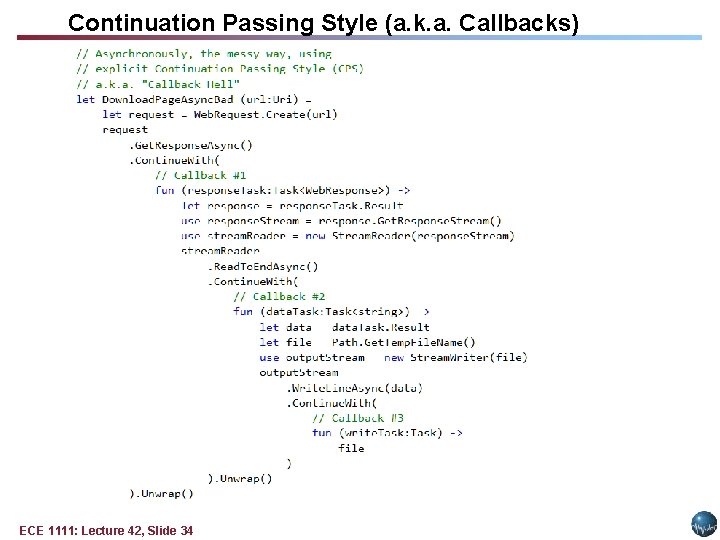
Continuation Passing Style (a. k. a. Callbacks) • • • “Hey, when you’re done doing that…” Explicitly pass the next thing to do Provides a method of composition of functions that can alter control flow More common than you may realize (we’ll come back to this…) Very common in Javascript as well ECE 1111: Lecture 42, Slide 30
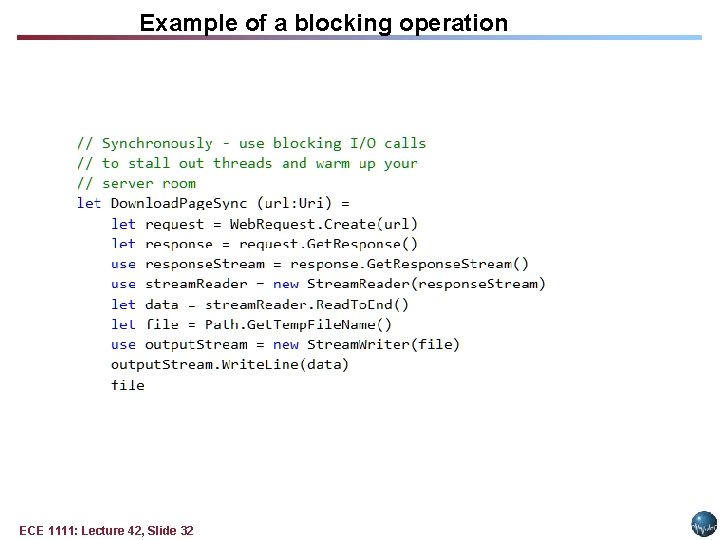
Blocking I/O and You – the reason for Async • • • The operating system schedules sequential operations to run in a thread If code requires external I/O, the thread running that code will block until it is complete This is bad ECE 1111: Lecture 42, Slide 31
Example of a blocking operation ECE 1111: Lecture 42, Slide 32
Your Web Server, Running Blocking I/O ECE 1111: Lecture 42, Slide 33
Continuation Passing Style (a. k. a. Callbacks) ECE 1111: Lecture 42, Slide 34
Continuation Pas Style (a. k. a Callback Hell) ECE 1111: Lecture 42, Slide 35
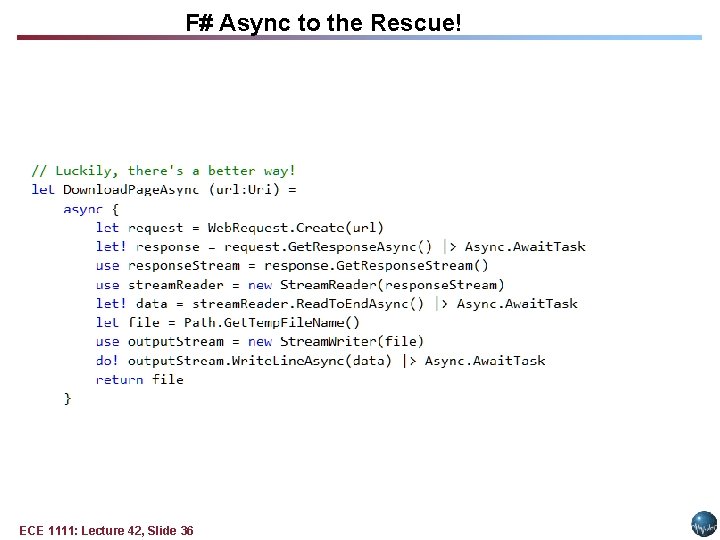
F# Async to the Rescue! ECE 1111: Lecture 42, Slide 36
ECE 1111: Lecture 42, Slide 37
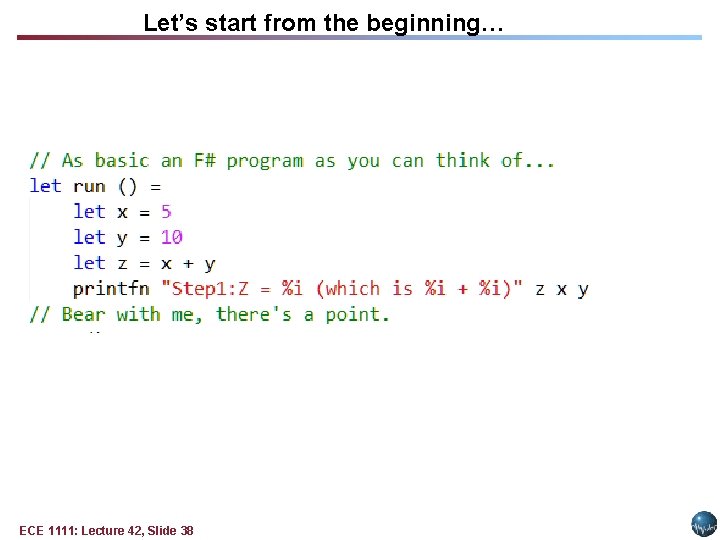
Let’s start from the beginning… ECE 1111: Lecture 42, Slide 38
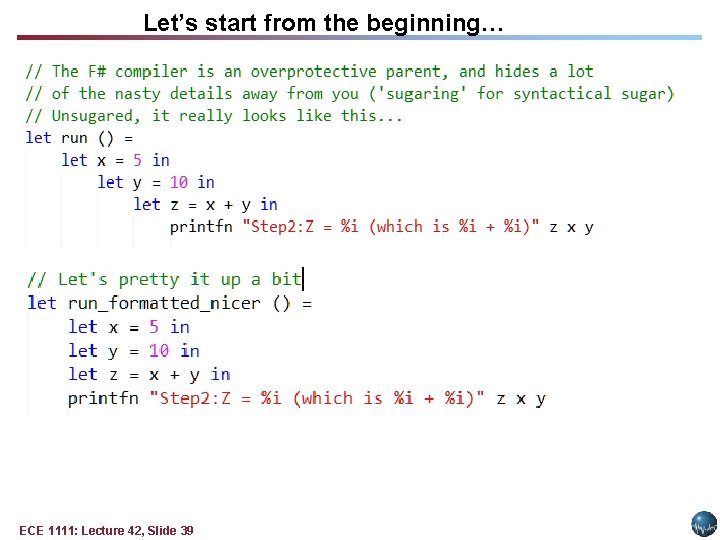
Let’s start from the beginning… ECE 1111: Lecture 42, Slide 39
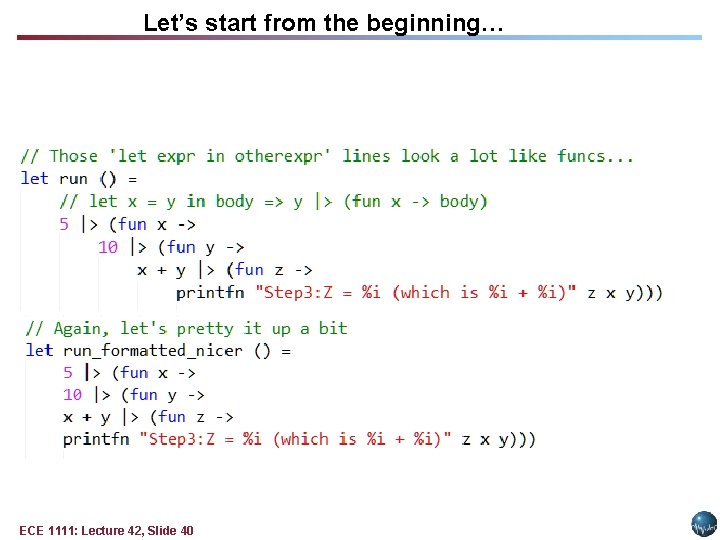
Let’s start from the beginning… ECE 1111: Lecture 42, Slide 40
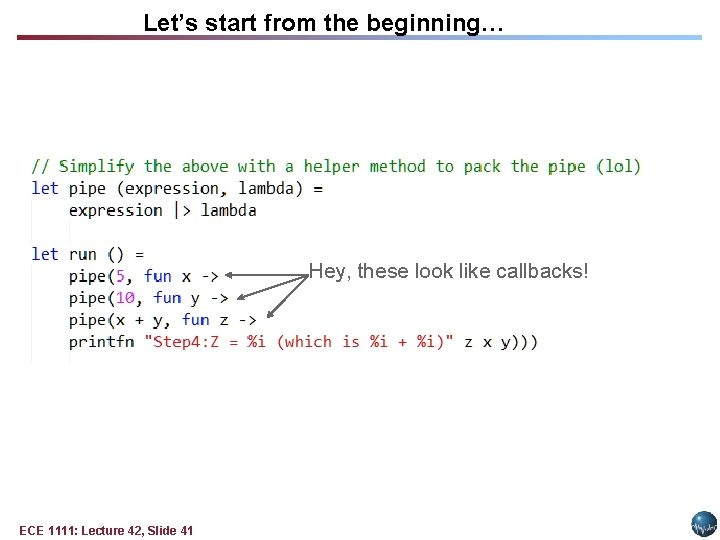
Let’s start from the beginning… Hey, these look like callbacks! ECE 1111: Lecture 42, Slide 41
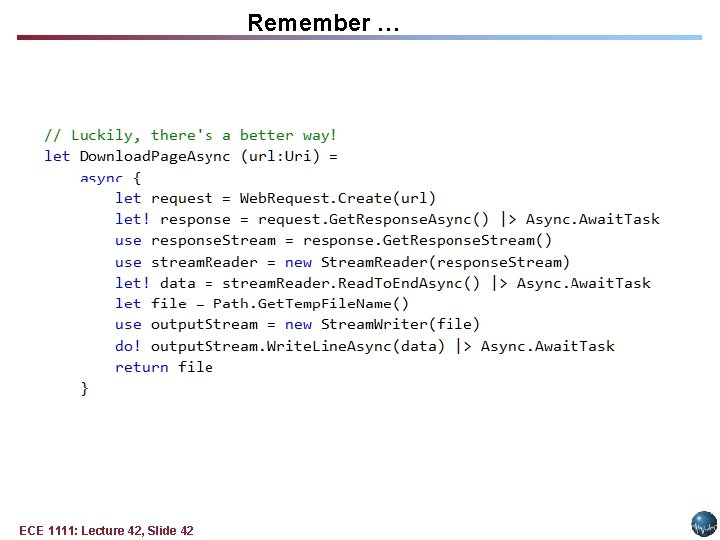
Remember … ECE 1111: Lecture 42, Slide 42
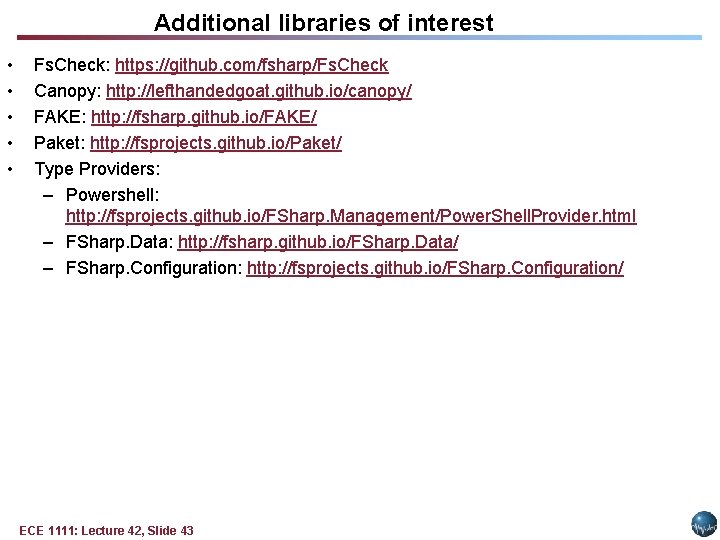
Additional libraries of interest • • • Fs. Check: https: //github. com/fsharp/Fs. Check Canopy: http: //lefthandedgoat. github. io/canopy/ FAKE: http: //fsharp. github. io/FAKE/ Paket: http: //fsprojects. github. io/Paket/ Type Providers: – Powershell: http: //fsprojects. github. io/FSharp. Management/Power. Shell. Provider. html – FSharp. Data: http: //fsharp. github. io/FSharp. Data/ – FSharp. Configuration: http: //fsprojects. github. io/FSharp. Configuration/ ECE 1111: Lecture 42, Slide 43
• General resources General Resources & Additional Readings – – – – Me! Team leads Slack - #fsharp channel F# chat on SO http: //fsharp. org/ Twitter: #fsharp F# channel on Functional Programming Slack • Additional reading – F# for Fun and Profit – F# Weekly – Try F# ECE 1111: Lecture 42, Slide 44