
Ecclesiology Session 32 Dr Andy Woods Senior Pastor
- Slides: 76
Ecclesiology Session 32 Dr. Andy Woods Senior Pastor – Sugar Land Bible Church President – Chafer Theological Seminary
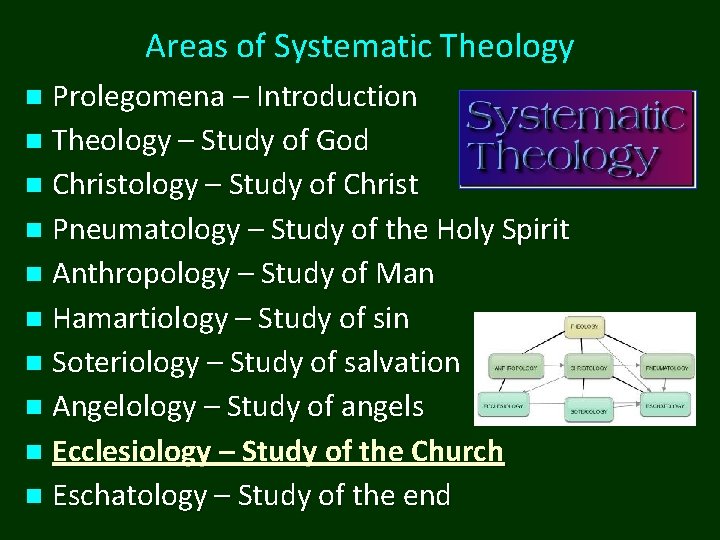
Areas of Systematic Theology Prolegomena – Introduction n Theology – Study of God n Christology – Study of Christ n Pneumatology – Study of the Holy Spirit n Anthropology – Study of Man n Hamartiology – Study of sin n Soteriology – Study of salvation n Angelology – Study of angels n Ecclesiology – Study of the Church n Eschatology – Study of the end n
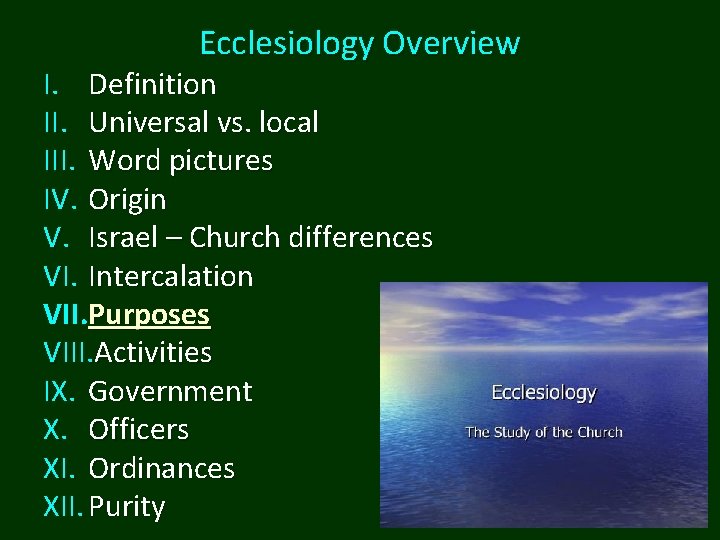
Ecclesiology Overview I. Definition II. Universal vs. local III. Word pictures IV. Origin V. Israel – Church differences VI. Intercalation VII. Purposes VIII. Activities IX. Government X. Officers XI. Ordinances XII. Purity
VII. Purposes of the Local Church n Glorify God (Eph 3: 21) n Edify the saints (Eph 4: 11 -16) n Fulfill the Great Commission (Matt 28: 18 -20)
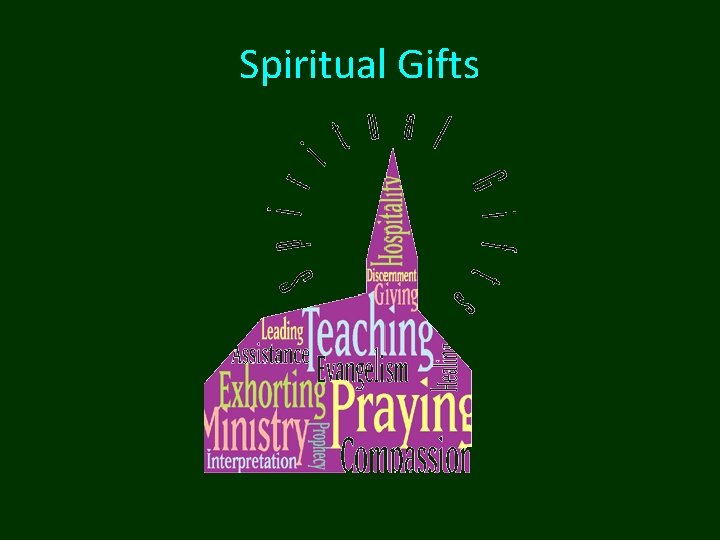
Spiritual Gifts
Four Questions 1. What are some general observations about spiritual gifts? 2. Are all the spiritual gifts for today? 3. What are the spiritual gifts? 4. How do we discover our own unique area of gifting?
Four Questions 1. What are some general observations about spiritual gifts? 2. Are all the spiritual gifts for today? 3. What are the spiritual gifts? 4. How do we discover our own unique area of gifting?
Four Questions 1. What are some general observations about spiritual gifts? 2. Are all the spiritual gifts for today? 3. What are the spiritual gifts? 4. How do we discover our own unique area of gifting?
The Case for Selective Cessationism I. Preliminary thoughts II. Four categories of gifts A. Foundational (Eph 2: 20) B. Confirmatory (Heb 2: 3 -4) C. Revelatory (Jude 3) D. Edificatory gifts continue (Eph. 4: 11 -16) III. Church history and selective cessationism IV. Properation of the Sign & Revelatory gifts V. True source of the charismatic movement VI. Explanation of the Charismatic movement's popularity
The Case for Selective Cessationism I. Preliminary thoughts II. Four categories of gifts A. Foundational (Eph 2: 20) B. Confirmatory (Heb 2: 3 -4) C. Revelatory (Jude 3) D. Edificatory gifts continue (Eph. 4: 11 -16) III. Church history and selective cessationism IV. Properation of the Sign & Revelatory gifts V. True source of the charismatic movement VI. Explanation of the Charismatic movement's popularity
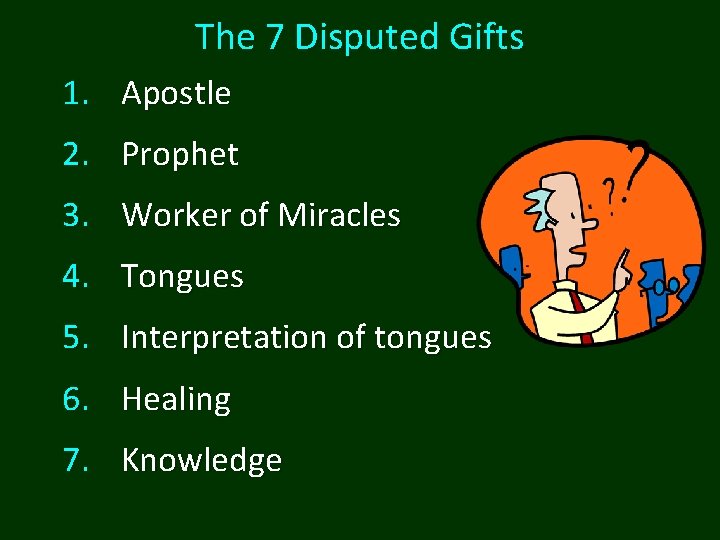
The 7 Disputed Gifts 1. Apostle 2. Prophet 3. Worker of Miracles 4. Tongues 5. Interpretation of tongues 6. Healing 7. Knowledge
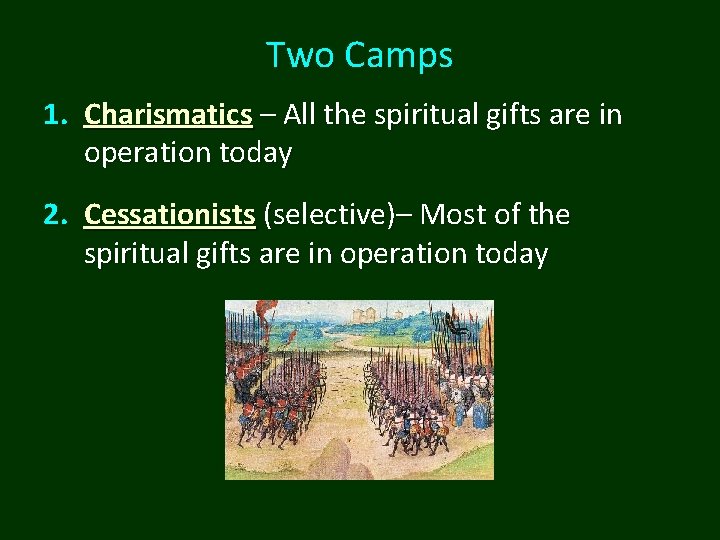
Two Camps 1. Charismatics – All the spiritual gifts are in operation today 2. Cessationists (selective)– Most of the spiritual gifts are in operation today
SLBC Position Statement No. 7 “TEMPORARY SPIRITUAL GIFTS – This church teaches that the miraculous sign gifts, including the gift of tongues, (always the ability to speak in a previously unlearned, known language) along with the gift of healings were temporal gifts, given by the Holy Spirit solely to authenticate both the apostles and their message before the close of the canon of Scripture (1 Cor. 13: 8 -10). We do not believe that these are active as gifts today. However, we affirm that God is sovereign and may heal and/or give someone the ability to speak in a tongue (foreign language) today. We believe that the majority of what is termed ‘miraculous’ within the contemporary charismatic movement is something other than the Biblical gifts of tongues or healing. ”
The Case for Selective Cessationism I. Preliminary thoughts II. Four categories of gifts A. Foundational (Eph 2: 20) B. Confirmatory (Heb 2: 3 -4) C. Revelatory (Jude 3) D. Edificatory gifts continue (Eph. 4: 11 -16) III. Church history and selective cessationism IV. Properation of the Sign & Revelatory gifts V. True source of the charismatic movement VI. Explanation of the Charismatic movement's popularity
The Case for Selective Cessationism I. Preliminary thoughts II. Four categories of gifts A. Foundational (Eph 2: 20) B. Confirmatory (Heb 2: 3 -4) C. Revelatory (Jude 3) D. Edificatory gifts continue (Eph. 4: 11 -16) III. Church history and selective cessationism IV. Properation of the Sign & Revelatory gifts V. True source of the charismatic movement VI. Explanation of the Charismatic movement's popularity
The Case for Selective Cessationism I. Preliminary thoughts II. Four categories of gifts A. Foundational (Eph 2: 20) B. Confirmatory (Heb 2: 3 -4) C. Revelatory (Jude 3) D. Edificatory gifts continue (Eph. 4: 11 -16) III. Church history and selective cessationism IV. Properation of the Sign & Revelatory gifts V. True source of the charismatic movement VI. Explanation of the Charismatic movement's popularity
SLBC Position Statement No. 7 “TEMPORARY SPIRITUAL GIFTS – This church teaches that the miraculous sign gifts, including the gift of tongues, (always the ability to speak in a previously unlearned, known language) along with the gift of healings were temporal gifts, given by the Holy Spirit solely to authenticate both the apostles and their message before the close of the canon of Scripture (1 Cor. 13: 8 -10). We do not believe that these are active as gifts today. However, we affirm that God is sovereign and may heal and/or give someone the ability to speak in a tongue (foreign language) today. We believe that the majority of what is termed ‘miraculous’ within the contemporary charismatic movement is something other than the Biblical gifts of tongues or healing. ”
IV. Proper Operation of the Sign & Revelatory Gifts I. Prophecy II. Tongues
IV. Proper Operation of the Sign & Revelatory Gifts I. Prophecy II. Tongues
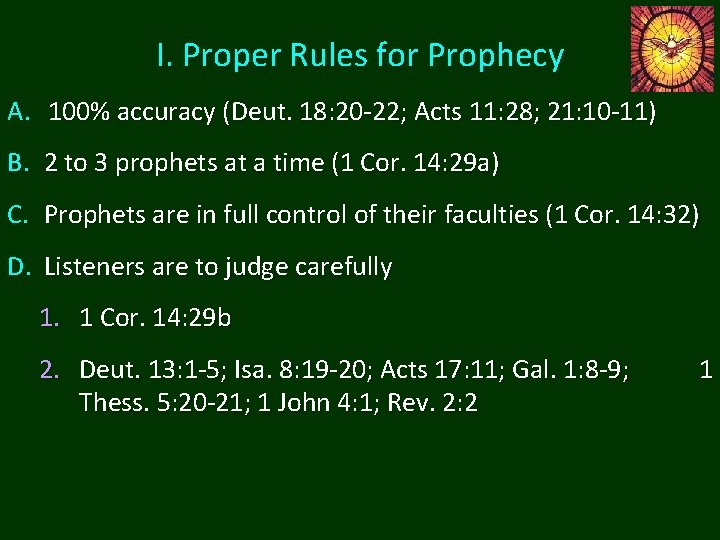
I. Proper Rules for Prophecy A. 100% accuracy (Deut. 18: 20 -22; Acts 11: 28; 21: 10 -11) B. 2 to 3 prophets at a time (1 Cor. 14: 29 a) C. Prophets are in full control of their faculties (1 Cor. 14: 32) D. Listeners are to judge carefully 1. 1 Cor. 14: 29 b 2. Deut. 13: 1 -5; Isa. 8: 19 -20; Acts 17: 11; Gal. 1: 8 -9; 1 Thess. 5: 20 -21; 1 John 4: 1; Rev. 2: 2
1 Samuel 3: 19 “Thus Samuel grew and the Lord was with him and let none of his words fail. ”
IV. Proper Operation of the Sign & Revelatory Gifts I. Prophecy II. Tongues
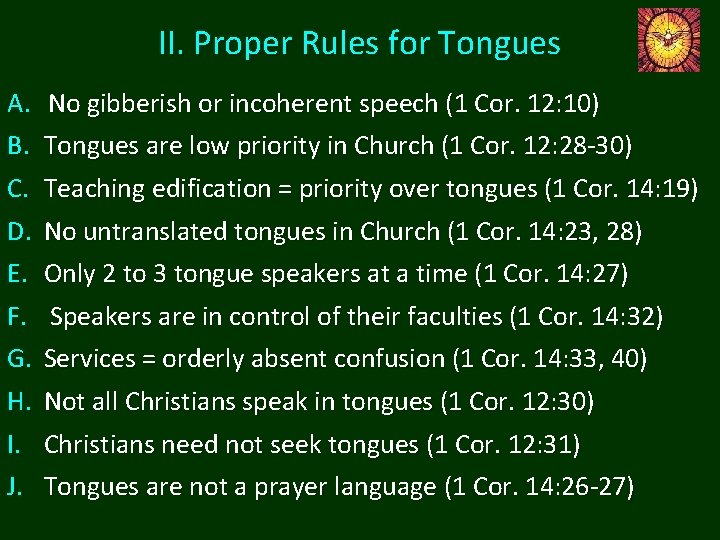
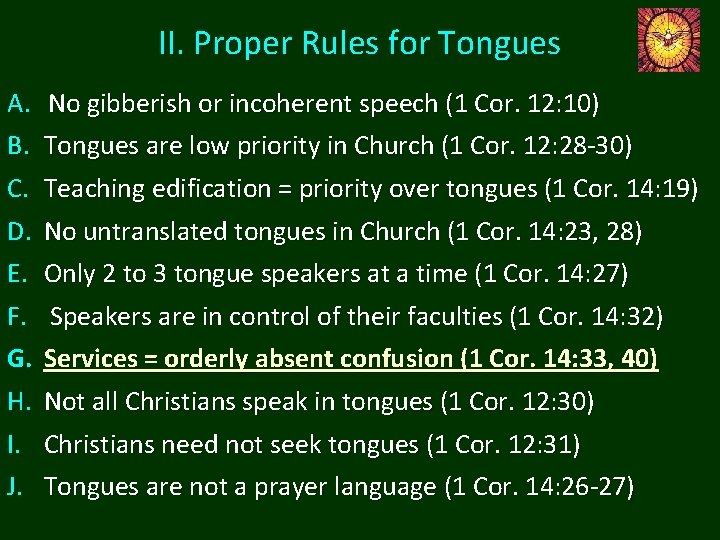
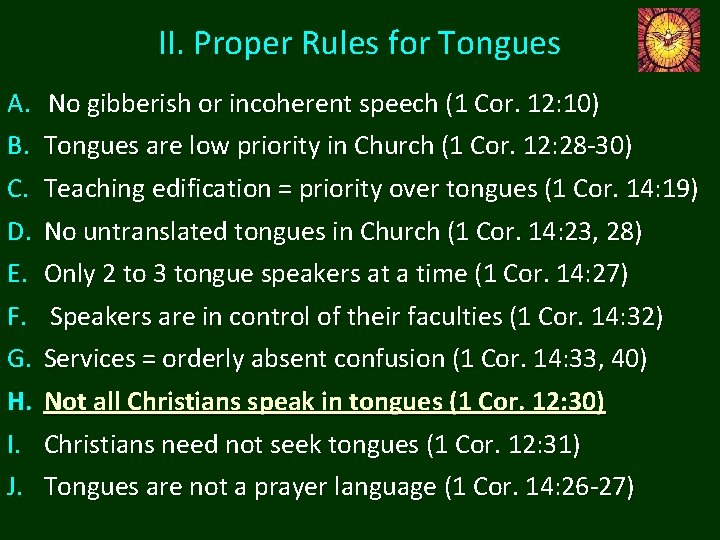
II. Proper Rules for Tongues A. B. C. D. E. F. G. H. I. J. No gibberish or incoherent speech (1 Cor. 12: 10) Tongues are low priority in Church (1 Cor. 12: 28 -30) Teaching edification = priority over tongues (1 Cor. 14: 19) No untranslated tongues in Church (1 Cor. 14: 23, 28) Only 2 to 3 tongue speakers at a time (1 Cor. 14: 27) Speakers are in control of their faculties (1 Cor. 14: 32) Services = orderly absent confusion (1 Cor. 14: 33, 40) Not all Christians speak in tongues (1 Cor. 12: 30) Christians need not seek tongues (1 Cor. 12: 31) Tongues are not a prayer language (1 Cor. 14: 26 -27)
II. Proper Rules for Tongues A. B. C. D. E. F. G. H. I. J. No gibberish or incoherent speech (1 Cor. 12: 10) Tongues are low priority in Church (1 Cor. 12: 28 -30) Teaching edification = priority over tongues (1 Cor. 14: 19) No untranslated tongues in Church (1 Cor. 14: 23, 28) Only 2 to 3 tongue speakers at a time (1 Cor. 14: 27) Speakers are in control of their faculties (1 Cor. 14: 32) Services = orderly absent confusion (1 Cor. 14: 33, 40) Not all Christians speak in tongues (1 Cor. 12: 30) Christians need not seek tongues (1 Cor. 12: 31) Tongues are not a prayer language (1 Cor. 14: 26 -27)
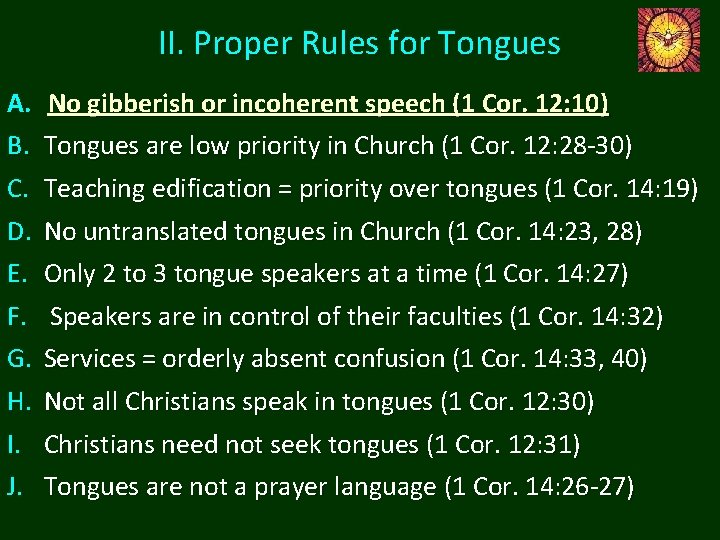
1 Corinthians 12: 10 (KJV) “To another the working of miracles; to another prophecy; to another discerning of spirits; to another divers kinds of tongues [glōssa]; to another the interpretation of tongues [glōssa]. ”
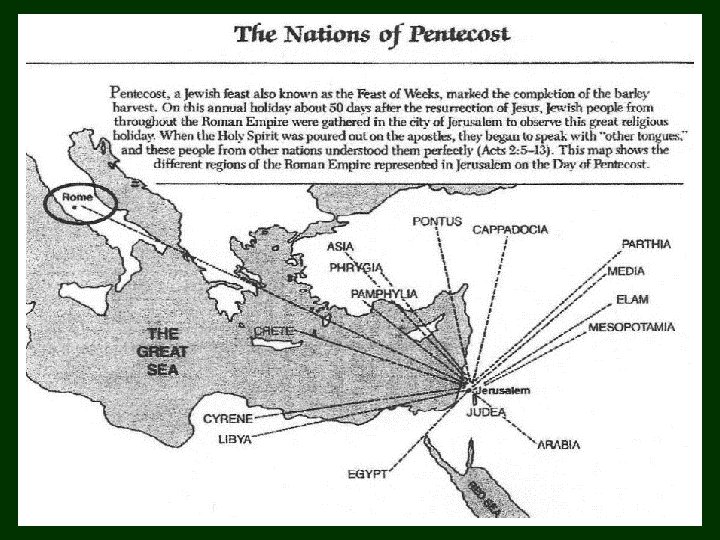
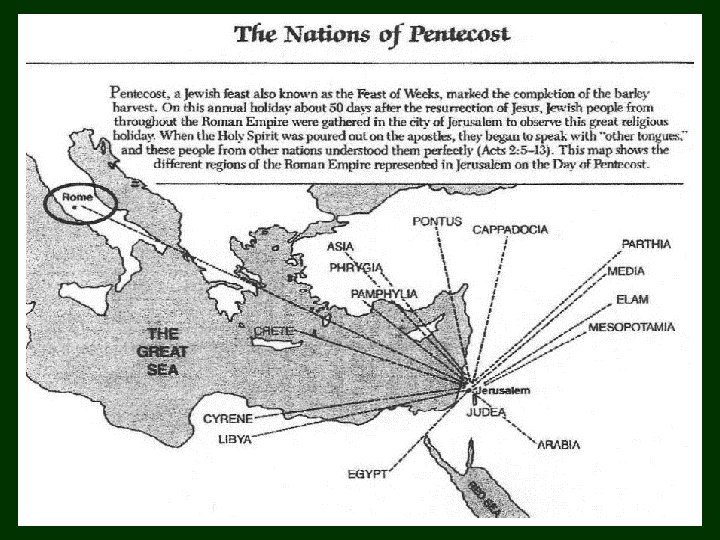
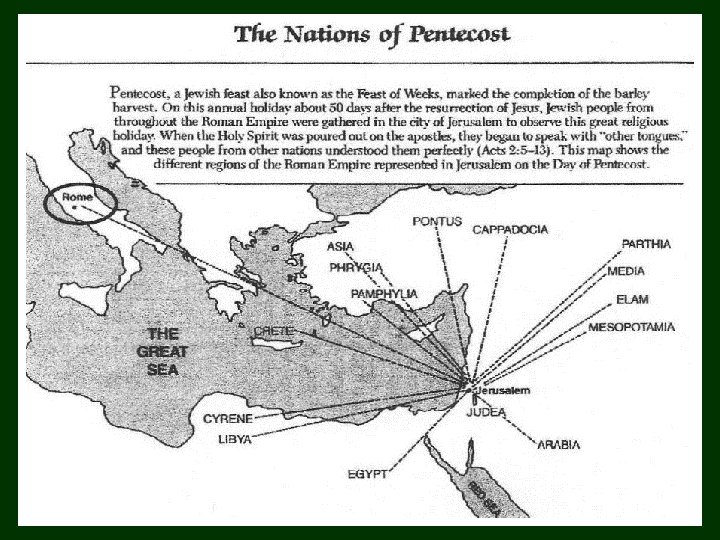
Acts 2: 6 “Now when this was noised abroad, the multitude came together, and were confounded, because that every man heard them speak in his own language [dialektos]. ”
Revelation 9: 11 (KJV) “And they had a king over them, which is the angel of the bottomless pit, whose name in the Hebrew tongue is Abaddon, but in the Greek tongue hath his name Apollyon. ”
1 Corinthians 14: 21 -22 “ 21 In the Law it is written, ‘BY MEN OF STRANGE TONGUES AND BY THE LIPS OF STRANGERS I WILL SPEAK TO THIS PEOPLE, AND EVEN SO THEY WILL NOT LISTEN TO ME, ’ says the Lord. 22 So then tongues are for a sign, not to those who believe but to unbelievers; but prophecy is for a sign, not to unbelievers but to those who believe. ”
1 Corinthians 14: 26 -27 “ 26 What is the outcome then, brethren? When you assemble, each one has a psalm, has a teaching, has a revelation, has a tongue, has an interpretation. Let all things be done for edification. 27 If anyone speaks in a tongue, it should be by two or at the most three, and each in turn, and one must interpret. ”
Mathew 6: 7 “And when you are praying, do not use meaningless repetition as the Gentiles do, for they suppose that they will be heard for their many words. ”
1 Corinthians 14: 15 “What is the outcome then? I will pray with the spirit and I will pray with the mind also; I will sing with the spirit and I will sing with the mind also. ”
Mark 12: 30 “ 30 and you shall love the Lord your God with all your heart, and with all your soul, and with all your mind, and with all your strength. ”
Christianity Today June 4, 1971 “A scientific study of glossolalia concludes that utterances of people tested did not have the characteristics regarded as essential to human language, and in a tape experiment, tongues speakers were found to disagree on the meaning of what the others said…. The study showed that the tendency of tongues speakers is ‘to be more submissive, suggestible, and dependent in the presence of authority figures. It is generally not the speaking in tongues that brings the great feelings, of euphoria (buoyancy) that these people experience; rather, it is the submission to the authority of the leader. ’…”
Christianity Today June 4, 1971 “…The research project was initiated at the Lutheran Medical Center in Brooklyn, New York. The findings were based largely upon tests and interviews conducted with twenty-six people who spoke in tongues and thirteen who did not. Linguist William Samarin stated that where certain prominent tongues -speakers had visited, whole groups of glossolalists would speak in his style of speech…. The report listed features that linguistic experts say characterize human language and argued that recordings of people speaking in tongues did not display enough of these features to warrant the conclusion that the utterances were any kind of human language, known or unknown, living or dead. ”
Virgil, 1 st century B. C. commenting of the priestess on the Isle of Delos. “She attained her ecstatic state and speech in a haunted cave where drafts and winds made weird sounds and music. When she became united in spirit with the god Apollo, she began to speak in tongues, sometimes understood, sometimes incoherent. ” Cited by John Miles, The Subject of Tongues, an Introduction to Christian Doctrine: An Outline Course, (Grand Rapids; Grand Rapids School of the Bible and Music, 1974), p. 2.
National Geographic on the Priestess at Delphi. “In a trance, perhaps induced by narcotic herbs, she sat on a tripod and raved. Priests enriched themselves by translating her incoherent cries into rhymed prophecies. ” Greece and Rome: Builders of Our World, National Geographic Society, 1968), p. 171.
Chrysostom, a 4 th Century Christian on Priestess of Delphi. “…This same Pythoness then is said to be female, to sit at times upon the tripod of Apollos astride, and thus the evil spirit ascending from beneath and entering the lower part of her body, fills the woman with madness, and she with disheveled hair begins to play the bacchanal and to foam at the mouth, and thus being in frenzy to utter the words of her madness. ” Cited by John Miles, The Subject of Tongues, an Introduction to Christian Doctrine: An Outline Course, (Grand Rapids; Grand Rapids School of the Bible and Music, 1974), p. 2.
1 Corinthians 14: 21 -22 “ 21 In the Law it is written, ‘BY MEN OF STRANGE TONGUES AND BY THE LIPS OF STRANGERS I WILL SPEAK TO THIS PEOPLE, AND EVEN SO THEY WILL NOT LISTEN TO ME, ’ says the Lord. 22 So then tongues are for a sign, not to those who believe but to unbelievers; but prophecy is for a sign, not to unbelievers but to those who believe. ”
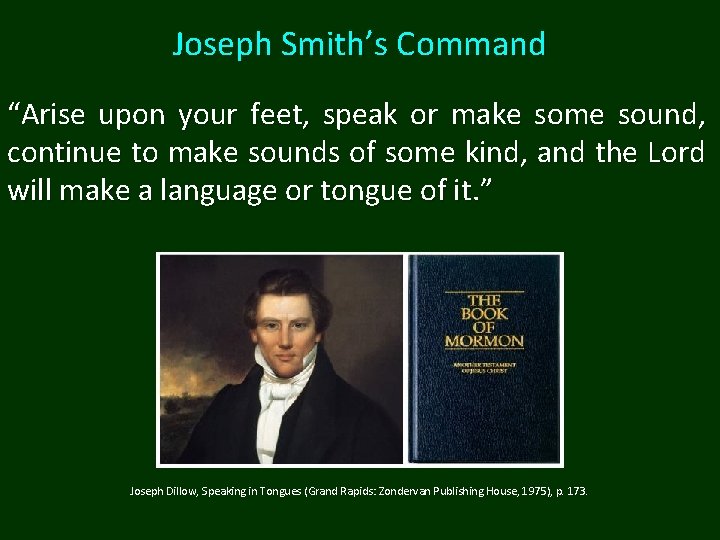
Joseph Smith’s Command “Arise upon your feet, speak or make some sound, continue to make sounds of some kind, and the Lord will make a language or tongue of it. ” Joseph Dillow, Speaking in Tongues (Grand Rapids: Zondervan Publishing House, 1975), p. 173.
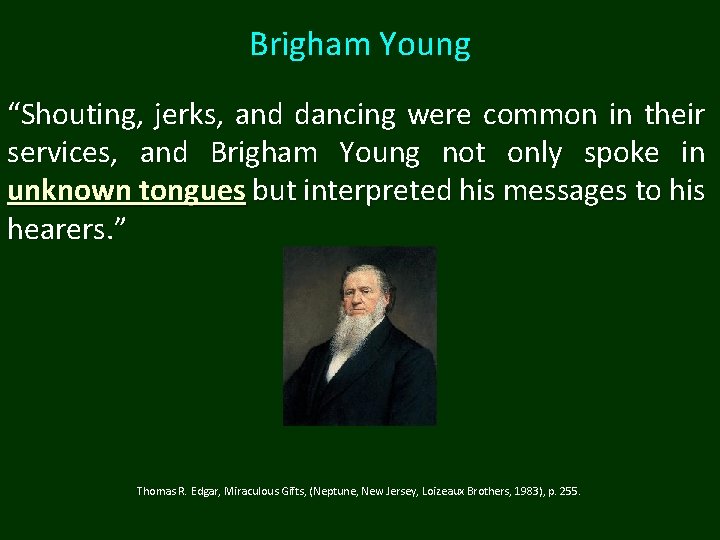
Brigham Young “Shouting, jerks, and dancing were common in their services, and Brigham Young not only spoke in unknown tongues but interpreted his messages to his hearers. ” Thomas R. Edgar, Miraculous Gifts, (Neptune, New Jersey, Loizeaux Brothers, 1983), p. 255.
Tongues and the Unsaved “Now before you sit down and write me a letter telling me how real your experience with tongues is, let me tell you about mine. I’ve spoken in tongues on several occasions. I’ve walked down aisles, I’ve prayed through at the altar, I’ve followed the instructions of the spiritual leaders who were telling me how to speak in tongues, and I spoke in tongues. It was very real. It happened. There was nothing unreal about it. But it was not of the Holy Spirit! How do I know? I wasn’t even saved at the time. That’s how I know. I became convinced by the preaching I heard that I must speak in tongues to be right with God. I was determined to do it, and I did it. ” Cited by John Miles, The Subject of Tongues, an Introduction to Christian Doctrine: An Outline Course, (Grand Rapids; Grand Rapids School of the Bible and Music, 1974), p. 3.
II. Proper Rules for Tongues A. B. C. D. E. F. G. H. I. J. No gibberish or incoherent speech (1 Cor. 12: 10) Tongues are low priority in Church (1 Cor. 12: 28 -30) Teaching edification = priority over tongues (1 Cor. 14: 19) No untranslated tongues in Church (1 Cor. 14: 23, 28) Only 2 to 3 tongue speakers at a time (1 Cor. 14: 27) Speakers are in control of their faculties (1 Cor. 14: 32) Services = orderly absent confusion (1 Cor. 14: 33, 40) Not all Christians speak in tongues (1 Cor. 12: 30) Christians need not seek tongues (1 Cor. 12: 31) Tongues are not a prayer language (1 Cor. 14: 26 -27)
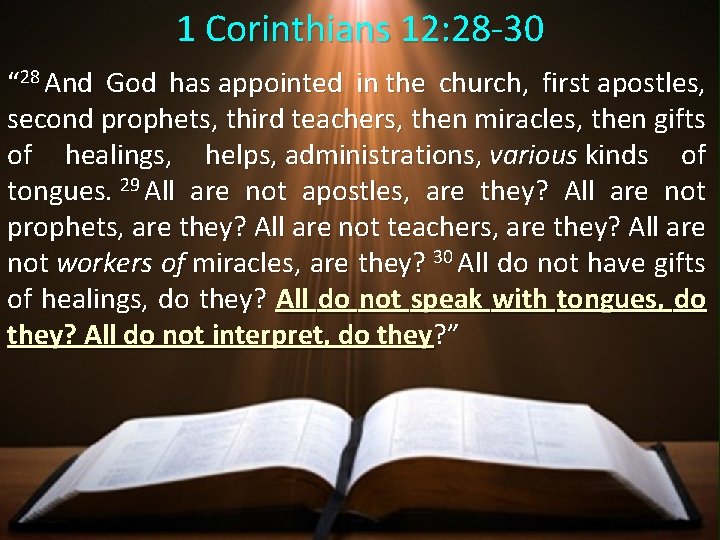
1 Corinthians 12: 28 -30 “ 28 And God has appointed in the church, first apostles, second prophets, third teachers, then miracles, then gifts of healings, helps, administrations, various kinds of tongues. 29 All are not apostles, are they? All are not prophets, are they? All are not teachers, are they? All are not workers of miracles, are they? 30 All do not have gifts of healings, do they? All do not speak with tongues, do they? All do not interpret, do they? ”
II. Proper Rules for Tongues A. B. C. D. E. F. G. H. I. J. No gibberish or incoherent speech (1 Cor. 12: 10) Tongues are low priority in Church (1 Cor. 12: 28 -30) Teaching edification = priority over tongues (1 Cor. 14: 19) No untranslated tongues in Church (1 Cor. 14: 23, 28) Only 2 to 3 tongue speakers at a time (1 Cor. 14: 27) Speakers are in control of their faculties (1 Cor. 14: 32) Services = orderly absent confusion (1 Cor. 14: 33, 40) Not all Christians speak in tongues (1 Cor. 12: 30) Christians need not seek tongues (1 Cor. 12: 31) Tongues are not a prayer language (1 Cor. 14: 26 -27)
VII. Purposes of the Local Church n Glorify God (Eph 3: 21) n Edify the saints (Eph 4: 11 -16) n Fulfill the Great Commission (Matt 28: 18 -20)
Ephesians 4: 11 -12 “ 11 And He gave some as apostles, and some as prophets, and some as evangelists, and some as pastors and teachers, 12 for the equipping of the saints for the work of service, to the building up of the body of Christ; ”
2 Timothy 3: 16 -17 “ 16 All Scripture is inspired by God and profitable for teaching, for reproof, for correction, for training in righteousness; 17 so that the man of God may be adequate, equipped for every good work. ”
Emphasis of 2 Timothy “By my count, there are twenty-seven explicit commands given in the body of this letter. In 27 words Paul tells pastors what to focus on. You have to be blind to miss the thrust of Paul's instructions here, because eighteen of those commands--fully twothirds--have to do with the ministry of the Word. ” Daniel Wallace, “Crisis of the Word: A Message to Pastors or Would-be Pastors, ” Conservative Theological Journal 1, no. 2 (August 1997): 108.
II. Proper Rules for Tongues A. B. C. D. E. F. G. H. I. J. No gibberish or incoherent speech (1 Cor. 12: 10) Tongues are low priority in Church (1 Cor. 12: 28 -30) Teaching edification = priority over tongues (1 Cor. 14: 19) No untranslated tongues in Church (1 Cor. 14: 23, 28) Only 2 to 3 tongue speakers at a time (1 Cor. 14: 27) Speakers are in control of their faculties (1 Cor. 14: 32) Services = orderly absent confusion (1 Cor. 14: 33, 40) Not all Christians speak in tongues (1 Cor. 12: 30) Christians need not seek tongues (1 Cor. 12: 31) Tongues are not a prayer language (1 Cor. 14: 26 -27)
II. Proper Rules for Tongues A. B. C. D. E. F. G. H. I. J. No gibberish or incoherent speech (1 Cor. 12: 10) Tongues are low priority in Church (1 Cor. 12: 28 -30) Teaching edification = priority over tongues (1 Cor. 14: 19) No untranslated tongues in Church (1 Cor. 14: 23, 28) Only 2 to 3 tongue speakers at a time (1 Cor. 14: 27) Speakers are in control of their faculties (1 Cor. 14: 32) Services = orderly absent confusion (1 Cor. 14: 33, 40) Not all Christians speak in tongues (1 Cor. 12: 30) Christians need not seek tongues (1 Cor. 12: 31) Tongues are not a prayer language (1 Cor. 14: 26 -27)
1 Corinthians 14: 26 -27 “ 26 What is the outcome then, brethren? When you assemble, each one has a psalm, has a teaching, has a revelation, has a tongue, has an interpretation. Let all things be done for edification. 27 If anyone speaks in a tongue, it should be by two or at the most three, and each in turn, and one must interpret. ”
II. Proper Rules for Tongues A. B. C. D. E. F. G. H. I. J. No gibberish or incoherent speech (1 Cor. 12: 10) Tongues are low priority in Church (1 Cor. 12: 28 -30) Teaching edification = priority over tongues (1 Cor. 14: 19) No untranslated tongues in Church (1 Cor. 14: 23, 28) Only 2 to 3 tongue speakers at a time (1 Cor. 14: 27) Speakers are in control of their faculties (1 Cor. 14: 32) Services = orderly absent confusion (1 Cor. 14: 33, 40) Not all Christians speak in tongues (1 Cor. 12: 30) Christians need not seek tongues (1 Cor. 12: 31) Tongues are not a prayer language (1 Cor. 14: 26 -27)
1 Corinthians 14: 32 “and the spirits of prophets are subject to prophets. ”
1 Corinthians 14: 26 -27 “ 26 What is the outcome then, brethren? When you assemble, each one has a psalm, has a teaching, has a revelation, has a tongue, has an interpretation. Let all things be done for edification. 27 If anyone speaks in a tongue, it should be by two or at the most three, and each in turn, and one must interpret. ”
II. Proper Rules for Tongues A. B. C. D. E. F. G. H. I. J. No gibberish or incoherent speech (1 Cor. 12: 10) Tongues are low priority in Church (1 Cor. 12: 28 -30) Teaching edification = priority over tongues (1 Cor. 14: 19) No untranslated tongues in Church (1 Cor. 14: 23, 28) Only 2 to 3 tongue speakers at a time (1 Cor. 14: 27) Speakers are in control of their faculties (1 Cor. 14: 32) Services = orderly absent confusion (1 Cor. 14: 33, 40) Not all Christians speak in tongues (1 Cor. 12: 30) Christians need not seek tongues (1 Cor. 12: 31) Tongues are not a prayer language (1 Cor. 14: 26 -27)
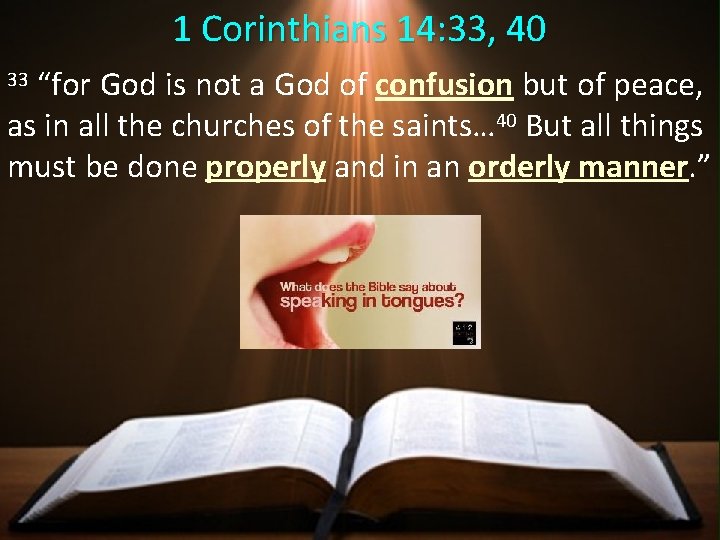
1 Corinthians 14: 33, 40 “for God is not a God of confusion but of peace, as in all the churches of the saints… 40 But all things must be done properly and in an orderly manner. ” 33
II. Proper Rules for Tongues A. B. C. D. E. F. G. H. I. J. No gibberish or incoherent speech (1 Cor. 12: 10) Tongues are low priority in Church (1 Cor. 12: 28 -30) Teaching edification = priority over tongues (1 Cor. 14: 19) No untranslated tongues in Church (1 Cor. 14: 23, 28) Only 2 to 3 tongue speakers at a time (1 Cor. 14: 27) Speakers are in control of their faculties (1 Cor. 14: 32) Services = orderly absent confusion (1 Cor. 14: 33, 40) Not all Christians speak in tongues (1 Cor. 12: 30) Christians need not seek tongues (1 Cor. 12: 31) Tongues are not a prayer language (1 Cor. 14: 26 -27)
1 Corinthians 12: 28 -30 “ 28 And God has appointed in the church, first apostles, second prophets, third teachers, then miracles, then gifts of healings, helps, administrations, various kinds of tongues. 29 All are not apostles, are they? All are not prophets, are they? All are not teachers, are they? All are not workers of miracles, are they? 30 All do not have gifts of healings, do they? All do not speak with tongues, do they? All do not interpret, do they? ”
II. Proper Rules for Tongues A. B. C. D. E. F. G. H. I. J. No gibberish or incoherent speech (1 Cor. 12: 10) Tongues are low priority in Church (1 Cor. 12: 28 -30) Teaching edification = priority over tongues (1 Cor. 14: 19) No untranslated tongues in Church (1 Cor. 14: 23, 28) Only 2 to 3 tongue speakers at a time (1 Cor. 14: 27) Speakers are in control of their faculties (1 Cor. 14: 32) Services = orderly absent confusion (1 Cor. 14: 33, 40) Not all Christians speak in tongues (1 Cor. 12: 30) Christians need not seek tongues (1 Cor. 12: 31) Tongues are not a prayer language (1 Cor. 14: 26 -27)
Spiritual Gifts: Observation #2 n God sovereignly bestows all the Spiritual gifts (1 Cor 12: 11; Heb 2: 4)
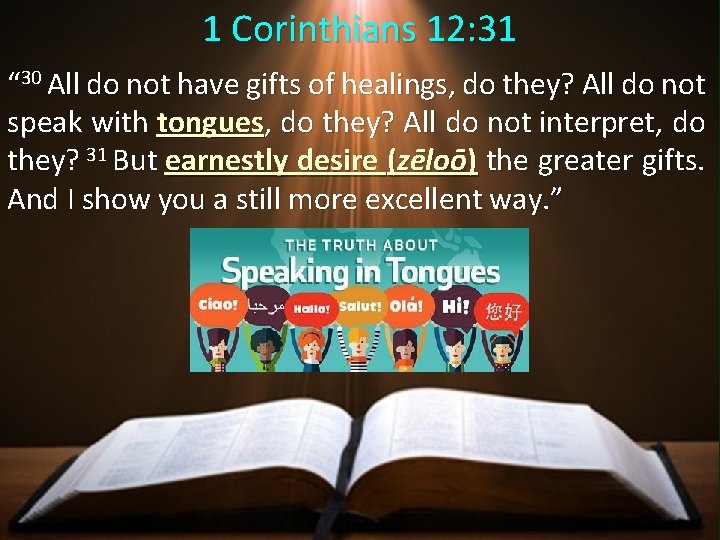
1 Corinthians 12: 31 “ 30 All do not have gifts of healings, do they? All do not speak with tongues, do they? All do not interpret, do they? 31 But earnestly desire (zēloō) the greater gifts. And I show you a still more excellent way. ”
II. Proper Rules for Tongues A. B. C. D. E. F. G. H. I. J. No gibberish or incoherent speech (1 Cor. 12: 10) Tongues are low priority in Church (1 Cor. 12: 28 -30) Teaching edification = priority over tongues (1 Cor. 14: 19) No untranslated tongues in Church (1 Cor. 14: 23, 28) Only 2 to 3 tongue speakers at a time (1 Cor. 14: 27) Speakers are in control of their faculties (1 Cor. 14: 32) Services = orderly absent confusion (1 Cor. 14: 33, 40) Not all Christians speak in tongues (1 Cor. 12: 30) Christians need not seek tongues (1 Cor. 12: 31) Tongues are not a prayer language (1 Cor. 14: 26 -27)
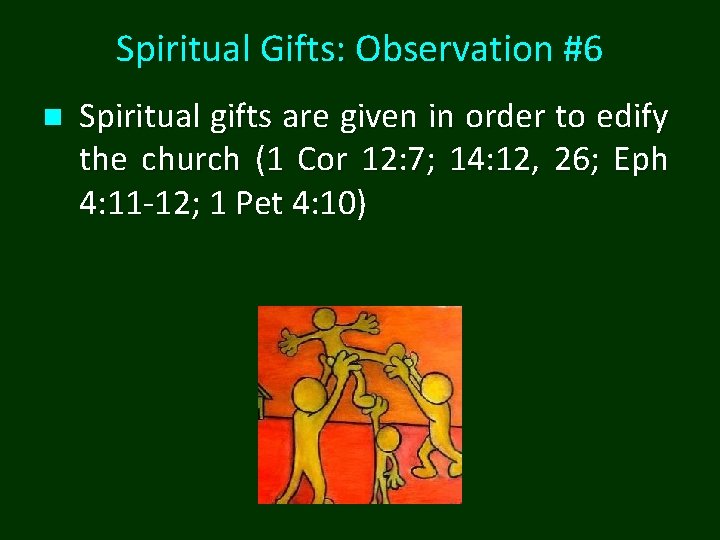
Spiritual Gifts: Observation #6 n Spiritual gifts are given in order to edify the church (1 Cor 12: 7; 14: 12, 26; Eph 4: 11 -12; 1 Pet 4: 10)
1 Corinthians 14: 26 -27 “ 26 What is the outcome then, brethren? When you assemble, each one has a psalm, has a teaching, has a revelation, has a tongue, has an interpretation. Let all things be done for edification. 27 If anyone speaks in a tongue, it should be by two or at the most three, and each in turn, and one must interpret. ”
1 Corinthians 14: 21 -22 “ 21 In the Law it is written, ‘BY MEN OF STRANGE TONGUES AND BY THE LIPS OF STRANGERS I WILL SPEAK TO THIS PEOPLE, AND EVEN SO THEY WILL NOT LISTEN TO ME, ’ says the Lord. 22 So then tongues are for a sign, not to those who believe but to unbelievers; but prophecy is for a sign, not to unbelievers but to those who believe. ”
1 Corinthians 14: 1– 2 1 Pursue love, yet desire earnestly spiritual gifts, but especially that you may prophesy. 2 For one who speaks in a tongue does not speak to men but to God; for no one understands, but in his spirit he speaks mysteries.
1 Corinthians 14: 4 “One who speaks in a tongue edifies (oikodomeō) himself; but one who prophesies edifies the church. ”
1 Corinthians 8: 10 “For if someone sees you, who have knowledge, dining in an idol’s temple, will not his conscience, if he is weak, be strengthened (oikodomeō) to eat things sacrificed to idols? ”
1 Corinthians 14: 28 “but if there is no interpreter, he must keep silent in the church; and let him speak to himself and to God. ”
Romans 8: 26 -27 “ 26 In the same way the Spirit also helps our weakness; for we do not know how to pray as we should, but the Spirit Himself intercedes for us with groanings too deep for words; 27 and He who searches the hearts knows what the mind of the Spirit is, because He intercedes for the saints according to the will of God. ”
Conclusion
II. Proper Rules for Tongues A. B. C. D. E. F. G. H. I. J. No gibberish or incoherent speech (1 Cor. 12: 10) Tongues are low priority in Church (1 Cor. 12: 28 -30) Teaching edification = priority over tongues (1 Cor. 14: 19) No untranslated tongues in Church (1 Cor. 14: 23, 28) Only 2 to 3 tongue speakers at a time (1 Cor. 14: 27) Speakers are in control of their faculties (1 Cor. 14: 32) Services = orderly absent confusion (1 Cor. 14: 33, 40) Not all Christians speak in tongues (1 Cor. 12: 30) Christians need not seek tongues (1 Cor. 12: 31) Tongues are not a prayer language (1 Cor. 14: 26 -27)
The Case for Selective Cessationism I. Preliminary thoughts II. Four categories of gifts A. Foundational (Eph 2: 20) B. Confirmatory (Heb 2: 3 -4) C. Revelatory (Jude 3) D. Edificatory gifts continue (Eph. 4: 11 -16) III. Church history and selective cessationism IV. Properation of the Sign & Revelatory gifts V. True source of the charismatic movement VI. Explanation of the Charismatic movement's popularity