
ECC Update May 2020 Recent and Planned Changes
- Slides: 12
ECC Update May 2020 Recent and Planned Changes since November 2019 Presented by Robin Donoghue
Contents • Recent changes agreed by ECC • Update on SRD – Recommendation 70 -03 • Below 9 k. Hz RED-CA May 2020
Recent changes agreed by ECC – CEPT Reports • CEPT Report 73 –Report from CEPT to the European Commission in response to the Mandate “to study feasibility and identify harmonised technical conditions for Wireless Access Systems including Radio Local Area Networks in the 5925 -6425 MHz band for the provision of wireless broadband services”. Report A: Assessment and study of compatibility and coexistence scenarios for WAS/RLANs in the band 5925 -6425 MHz. RED-CA May 2020
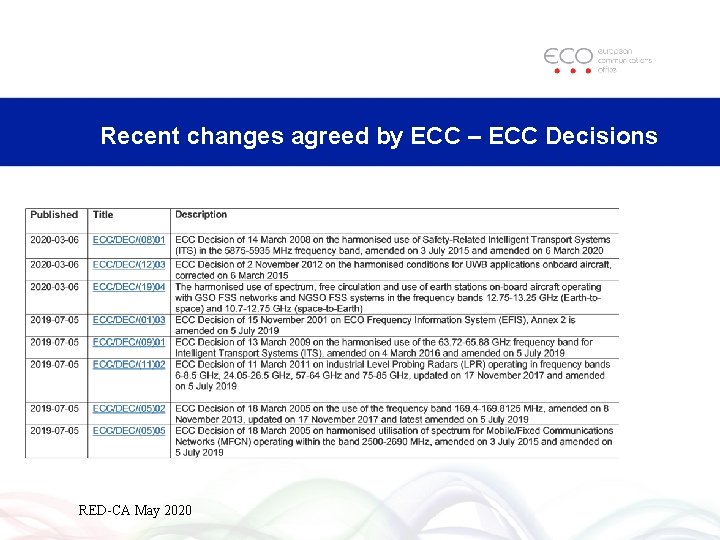
Recent changes agreed by ECC – ECC Decisions RED-CA May 2020
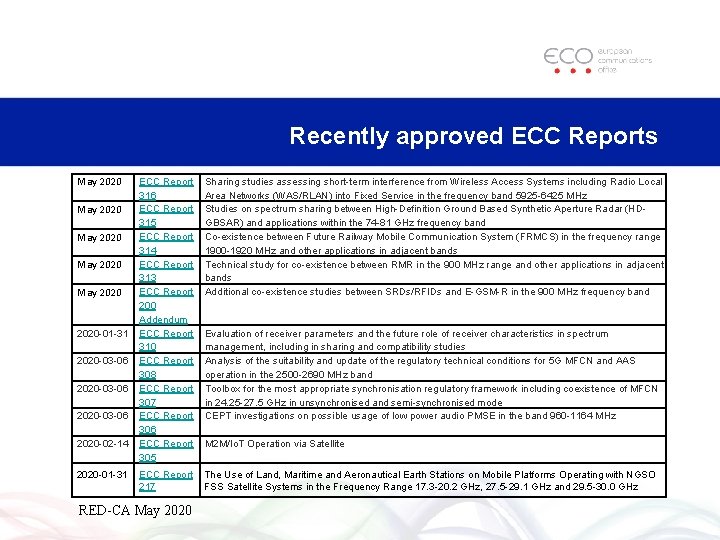
Recently approved ECC Reports May 2020 May 2020 -01 -31 2020 -03 -06 2020 -02 -14 2020 -01 -31 ECC Report 316 ECC Report 315 ECC Report 314 ECC Report 313 ECC Report 200 Addendum ECC Report 310 ECC Report 308 ECC Report 307 ECC Report 306 ECC Report 305 Sharing studies assessing short-term interference from Wireless Access Systems including Radio Local Area Networks (WAS/RLAN) into Fixed Service in the frequency band 5925 -6425 MHz Studies on spectrum sharing between High-Definition Ground Based Synthetic Aperture Radar (HDGBSAR) and applications within the 74 -81 GHz frequency band Co-existence between Future Railway Mobile Communication System (FRMCS) in the frequency range 1900 -1920 MHz and other applications in adjacent bands Technical study for co-existence between RMR in the 900 MHz range and other applications in adjacent bands Additional co-existence studies between SRDs/RFIDs and E-GSM-R in the 900 MHz frequency band ECC Report 217 The Use of Land, Maritime and Aeronautical Earth Stations on Mobile Platforms Operating with NGSO FSS Satellite Systems in the Frequency Range 17. 3 -20. 2 GHz, 27. 5 -29. 1 GHz and 29. 5 -30. 0 GHz RED-CA May 2020 Evaluation of receiver parameters and the future role of receiver characteristics in spectrum management, including in sharing and compatibility studies Analysis of the suitability and update of the regulatory technical conditions for 5 G MFCN and AAS operation in the 2500 -2690 MHz band Toolbox for the most appropriate synchronisation regulatory framework including coexistence of MFCN in 24. 25 -27. 5 GHz in unsynchronised and semi-synchronised mode CEPT investigations on possible usage of low power audio PMSE in the band 960 -1164 MHz M 2 M/Io. T Operation via Satellite
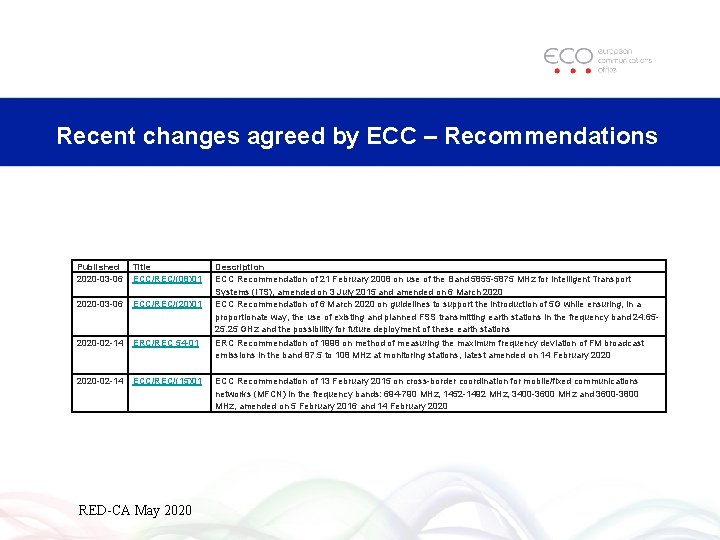
Recent changes agreed by ECC – Recommendations Published 2020 -03 -06 Title ECC/REC/(08)01 2020 -03 -06 ECC/REC/(20)01 2020 -02 -14 ERC/REC 54 -01 ERC Recommendation of 1998 on method of measuring the maximum frequency deviation of FM broadcast emissions in the band 87. 5 to 108 MHz at monitoring stations, latest amended on 14 February 2020 -02 -14 ECC/REC/(15)01 ECC Recommendation of 13 February 2015 on cross-border coordination for mobile/fixed communications networks (MFCN) in the frequency bands: 694 -790 MHz, 1452 -1492 MHz, 3400 -3600 MHz and 3600 -3800 MHz, amended on 5 February 2016 and 14 February 2020 RED-CA May 2020 Description ECC Recommendation of 21 February 2008 on use of the Band 5855 -5875 MHz for Intelligent Transport Systems (ITS), amended on 3 July 2015 and amended on 6 March 2020 ECC Recommendation of 6 March 2020 on guidelines to support the introduction of 5 G while ensuring, in a proportionate way, the use of existing and planned FSS transmitting earth stations in the frequency band 24. 6525. 25 GHz and the possibility for future deployment of these earth stations
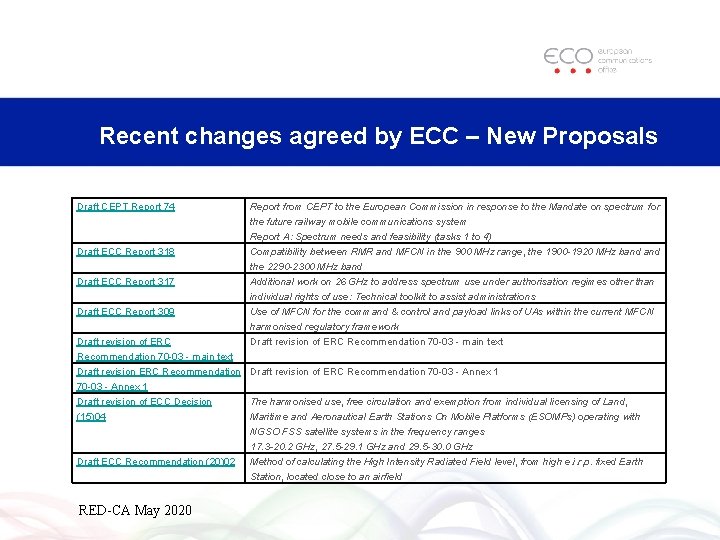
Recent changes agreed by ECC – New Proposals Draft CEPT Report 74 Draft ECC Report 318 Draft ECC Report 317 Draft ECC Report 309 Report from CEPT to the European Commission in response to the Mandate on spectrum for the future railway mobile communications system Report A: Spectrum needs and feasibility (tasks 1 to 4) Compatibility between RMR and MFCN in the 900 MHz range, the 1900 -1920 MHz band the 2290 -2300 MHz band Additional work on 26 GHz to address spectrum use under authorisation regimes other than individual rights of use: Technical toolkit to assist administrations Use of MFCN for the command & control and payload links of UAs within the current MFCN harmonised regulatory framework Draft revision of ERC Recommendation 70 -03 - main text Draft revision ERC Recommendation Draft revision of ERC Recommendation 70 -03 - Annex 1 Draft revision of ECC Decision The harmonised use, free circulation and exemption from individual licensing of Land, (15)04 Maritime and Aeronautical Earth Stations On Mobile Platforms (ESOMPs) operating with NGSO FSS satellite systems in the frequency ranges 17. 3 -20. 2 GHz, 27. 5 -29. 1 GHz and 29. 5 -30. 0 GHz Draft ECC Recommendation (20)02 Method of calculating the High Intensity Radiated Field level, from high e. i. r. p. fixed Earth Station, located close to an airfield RED-CA May 2020
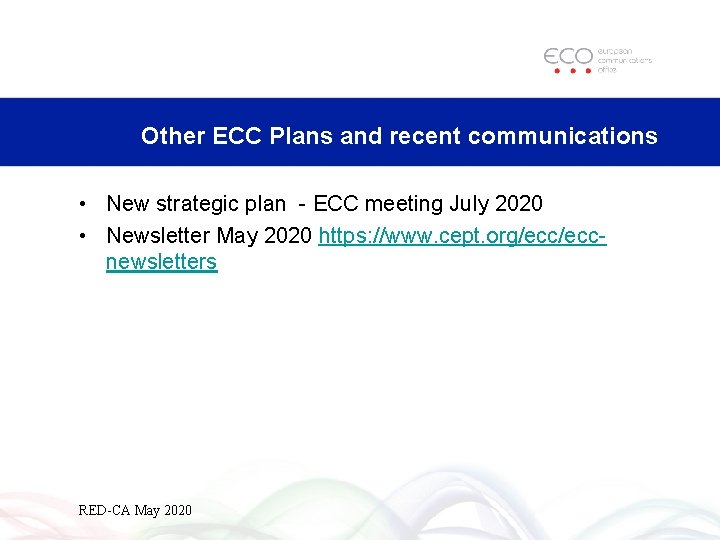
Other ECC Plans and recent communications • New strategic plan - ECC meeting July 2020 • Newsletter May 2020 https: //www. cept. org/eccnewsletters RED-CA May 2020
Update on SRD – Recommendation 70 -03 • Draft June 2020 version of Rec 70 -03. changes to; – Main Text. Modernisation of text. – Annex 1. Removal of power density restriction at 433 MHz. RED-CA May 2020
Update on SRD – Recommendation 70 -03 • SRDMG continue development of the 8 th update of the EU Decision for SRD – Guidance letter DG CNECT/B 4/SRD 8 dated 16 July 2019 – The draft of the CEPT report will be finalised at the September 2020 meeting of SRDMG with the aim that ECC approve this draft for Public Consultation at their meeting in November 2020. • WPT - SRDMG have developed a set of questions that need to be answered before any recommendation of WPT can be developed. RED-CA May 2020
Below 9 k. Hz • SRDMG (22 -24 April 2020) developed a proposal to amend the Implementation Status options in EFIS. This will enable CEPT Administrations to correctly show where Below 9 k. Hz apparatus can be used. • WG FM in June 2020 will decide on this proposal. If agreed, the ECO will amend the implementation options in EFIS so that CEPT Administrations can accurately show whether they permit the use or not of Below 9 k. Hz apparatus. RED-CA May 2020
Contact Robin Donoghue Spectrum Management ECO Nyropsgade 37, 4 1602 Copenhagen Denmark T: +45 33 89 63 12 F: +45 33 89 63 30 robin. donoghue@eco. cept. org RED-CA May 2020