
EC 130 B 4 Initial Pilot Ground School
EC 130 B 4 Initial Pilot Ground School Chapter 8 Flight Controls and Servo Controls
Chapter 8 - Flight Controls and Servo Controls Main Rotor Controls …………. . . ……………. . . …. … 8. 3 Cyclic Controls ………………………. . 8. 5 Lever Support Brackets ………………………… 8. 8 Mixing Unit Accessories ………………. . . ……………. 8. 10 Collective Twist Grips ……. . ……………………. . 8. 11 Twist Grip Warning Light ………………. . ……………… 8. 16 Collective Controls …………………………… 8. 17 Tail Rotor Controls …………………. . 8. 21 Tail Rotor Potentiometer …………………………. 8. 24 Servo Controls ……………. . . ………………………. . 8. 26 Servo Control Operation …………………. . ……………… 8. 28 Limit Caution Light ………. . …………………………. 8. 35 Distribution Valve Operation - Seizure Sensing ……………. 8. 36 Servo Caution Light …………………………… 8. 38 Servo Caution Light Summary ………………………. 8. 43 Review Questions ……………………………. . . 8. 44 8. 2

Main Rotor Controls Relay Lever Support Brackets Mixing Unit Collective Control Rod Longitudinal Lateral Control Rods Torque Tube Collective Torque Tube Lateral Synchronizer Rod Longitudinal Control Rod Lateral Control Rod Longitudinal Bellcrank Lateral Bellcrank 8. 3

Main Rotor Controls Fore & Aft Cyclic Lateral Cyclic Collective Pitch d r a rw Fo 8. 4

Standard Cyclic Grip 8. 5

Optional Cyclic Grip 8. 6

Cyclic Friction Pilot’s Side Only 8. 7
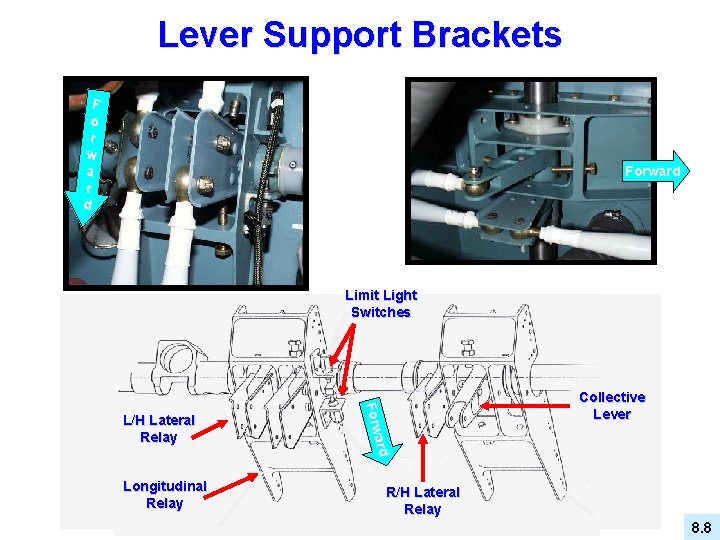
Lever Support Brackets F o r w a r d Forward Limit Light Switches ard Longitudinal Relay Forw L/H Lateral Relay Collective Lever R/H Lateral Relay 8. 8
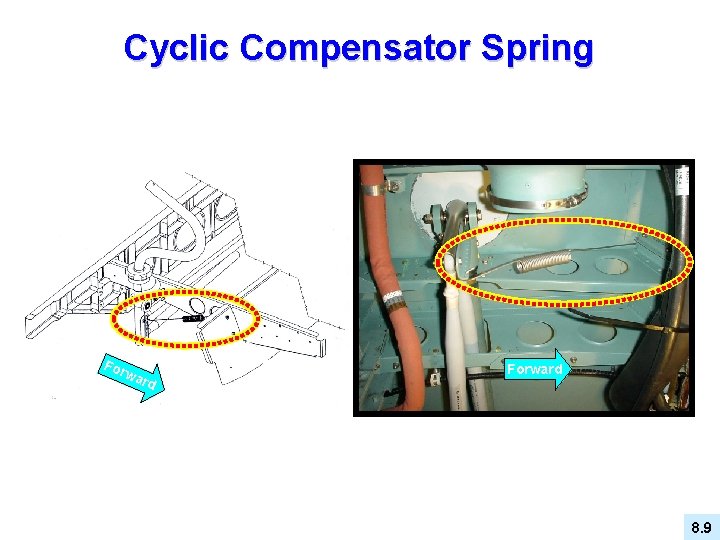
Cyclic Compensator Spring For wa rd Forward 8. 9
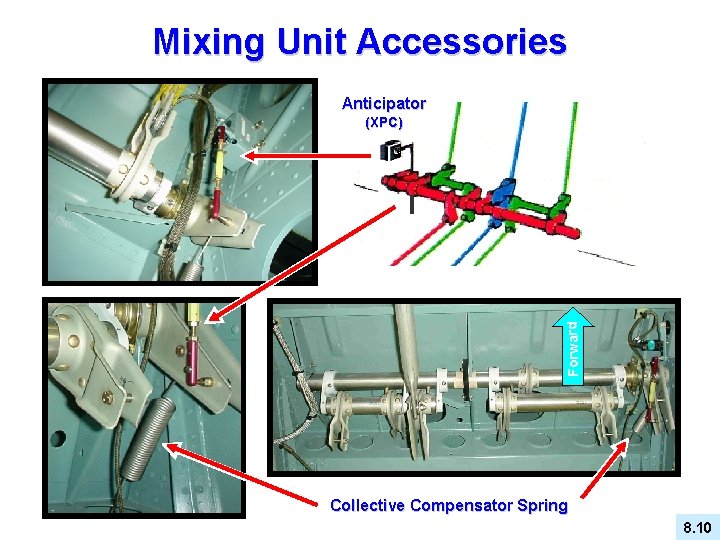
Mixing Unit Accessories Anticipator Forward (XPC) Collective Compensator Spring 8. 10
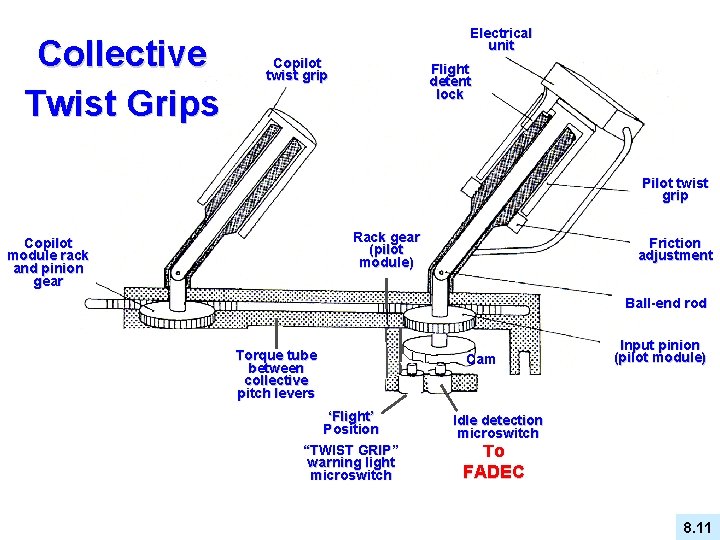
Collective Twist Grips Electrical unit Copilot twist grip Flight detent lock Pilot twist grip Rack gear (pilot module) Copilot module rack and pinion gear Friction adjustment Ball-end rod Torque tube between collective pitch levers ‘Flight’ Position “TWIST GRIP” warning light microswitch Cam Input pinion (pilot module) Idle detection microswitch To FADEC 8. 11
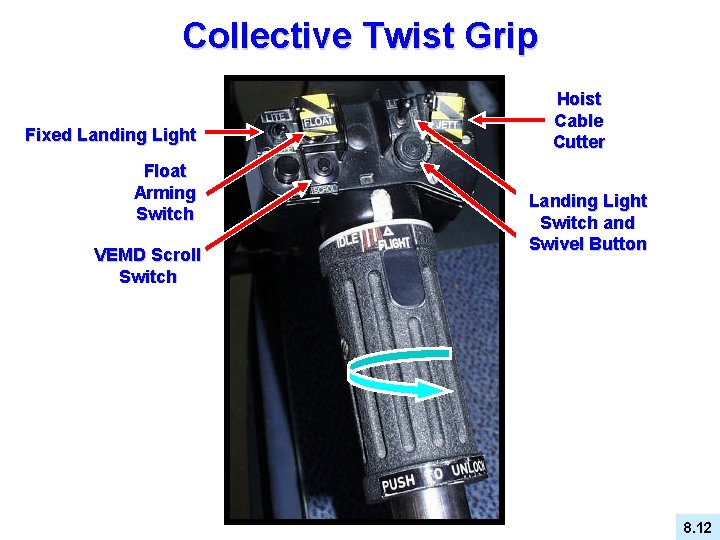
Collective Twist Grip Fixed Landing Light Float Arming Switch VEMD Scroll Switch Hoist Cable Cutter Landing Light Switch and Swivel Button 8. 12
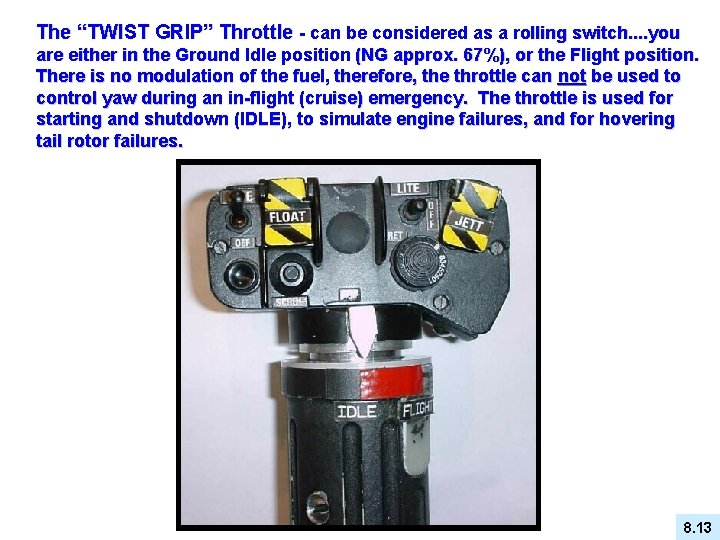
The “TWIST GRIP” Throttle - can be considered as a rolling switch. . you are either in the Ground Idle position (NG approx. 67%), or the Flight position. There is no modulation of the fuel, therefore, the throttle can not be used to control yaw during an in-flight (cruise) emergency. The throttle is used for starting and shutdown (IDLE), to simulate engine failures, and for hovering tail rotor failures. 8. 13
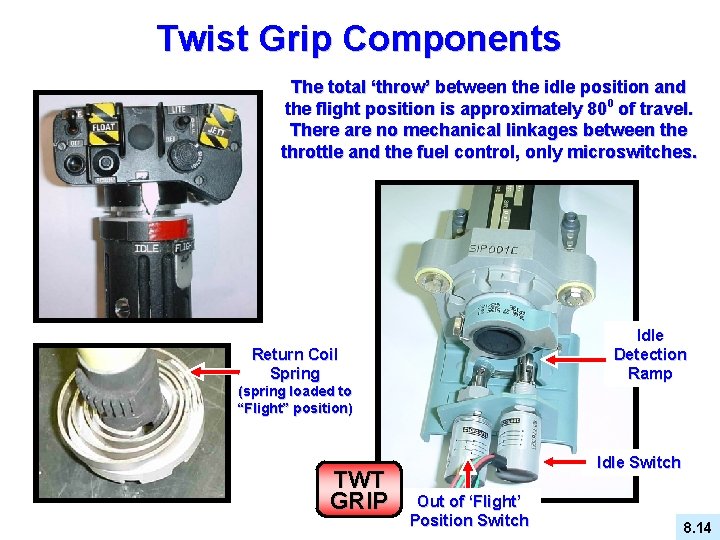
Twist Grip Components The total ‘throw’ between the idle position and the flight position is approximately 800 of travel. There are no mechanical linkages between the throttle and the fuel control, only microswitches. Idle Detection Ramp Return Coil Spring (spring loaded to “Flight” position) TWT GRIP Idle Switch Out of ‘Flight’ Position Switch 8. 14
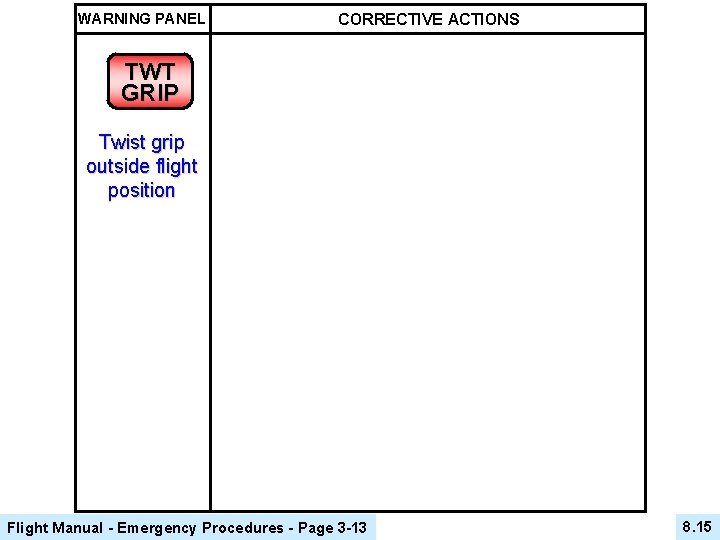
WARNING PANEL CORRECTIVE ACTIONS TWT GRIP Twist grip outside flight position Flight Manual - Emergency Procedures - Page 3 -13 8. 15
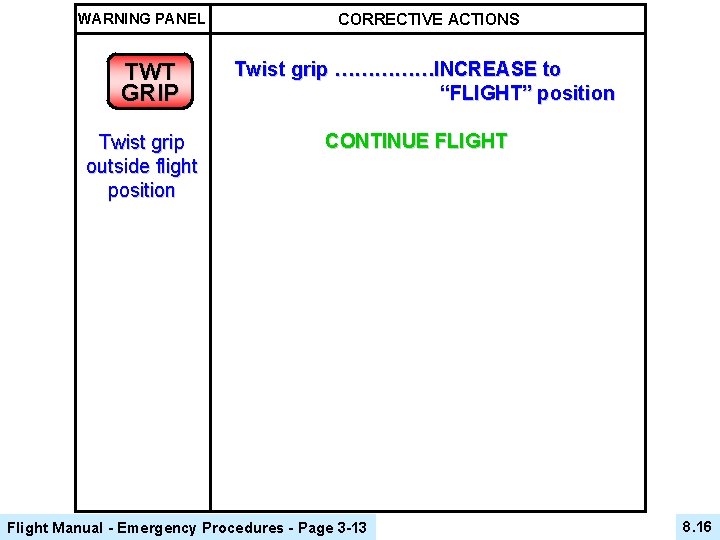
WARNING PANEL TWT GRIP Twist grip outside flight position CORRECTIVE ACTIONS Twist grip ……………INCREASE to “FLIGHT” position CONTINUE FLIGHT Flight Manual - Emergency Procedures - Page 3 -13 8. 16
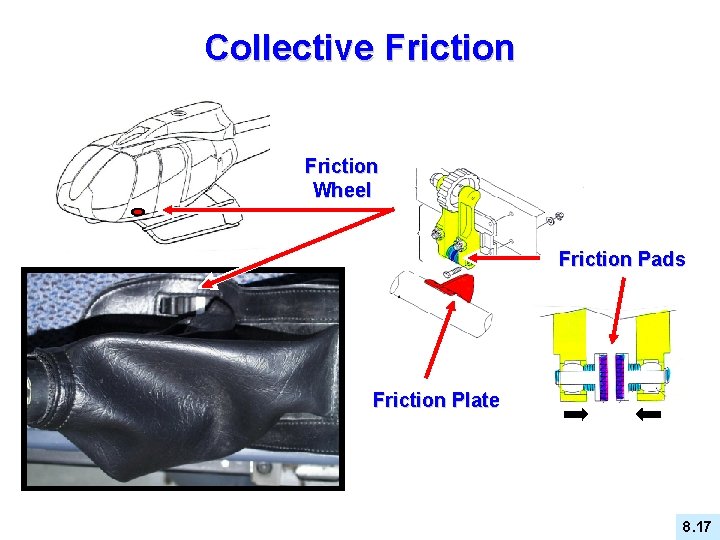
Collective Friction Wheel Friction Pads Friction Plate 8. 17
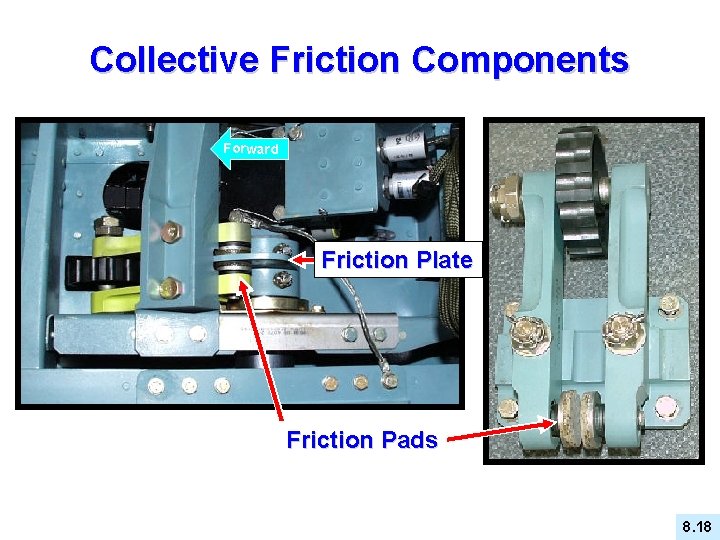
Collective Friction Components Forward Friction Plate Friction Pads 8. 18
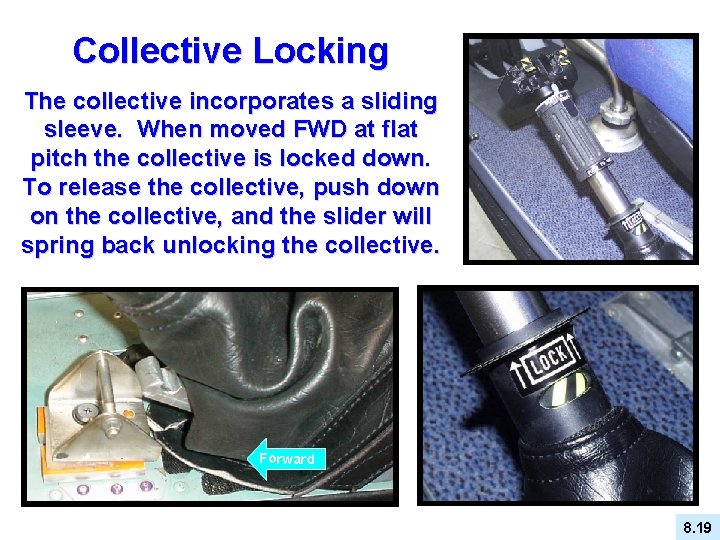
Collective Locking The collective incorporates a sliding sleeve. When moved FWD at flat pitch the collective is locked down. To release the collective, push down on the collective, and the slider will spring back unlocking the collective. Forward 8. 19
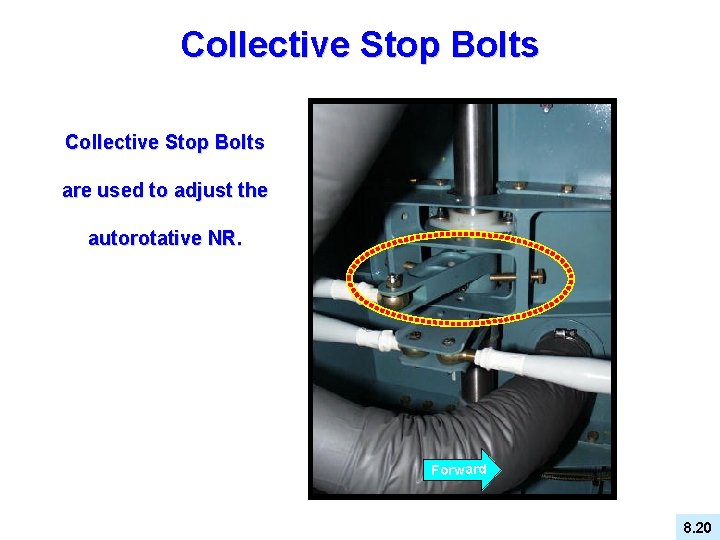
Collective Stop Bolts are used to adjust the autorotative NR. Forward 8. 20
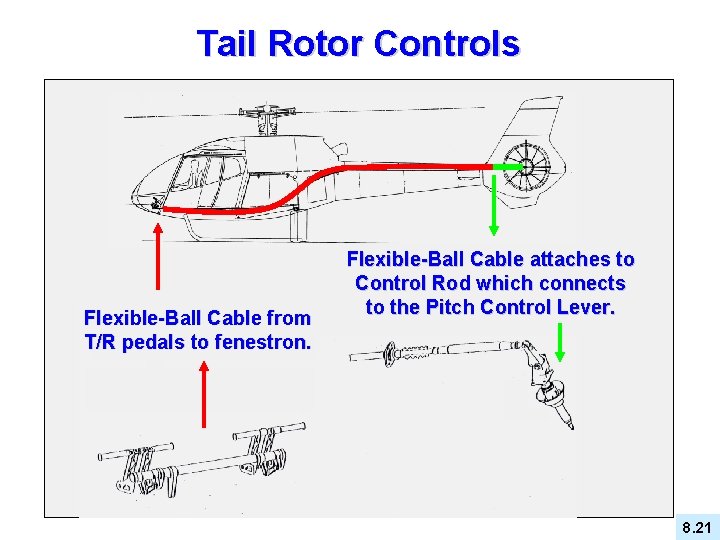
Tail Rotor Controls Flexible-Ball Cable from T/R pedals to fenestron. Flexible-Ball Cable attaches to Control Rod which connects to the Pitch Control Lever. 8. 21
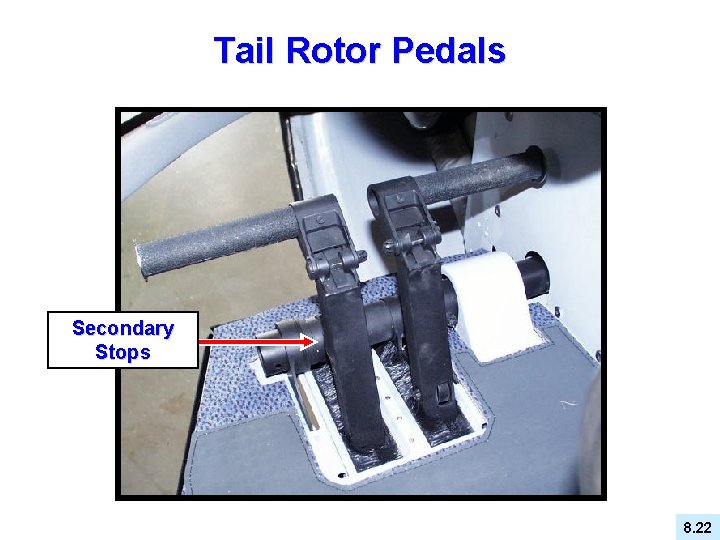
Tail Rotor Pedals Secondary Stops 8. 22
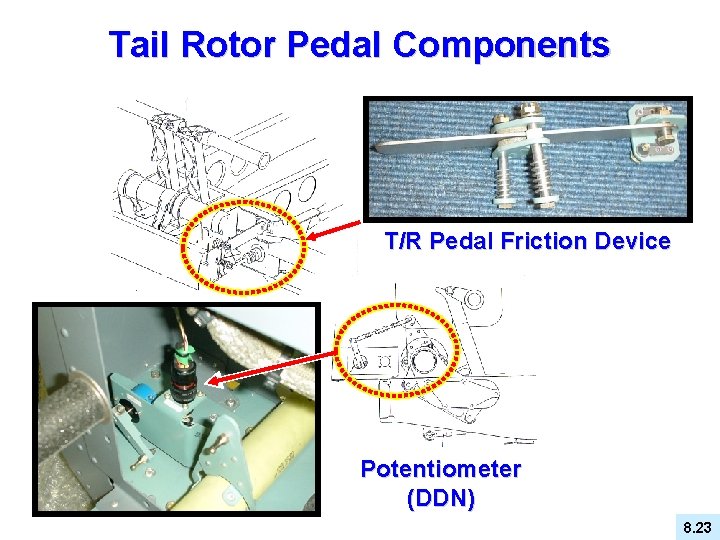
Tail Rotor Pedal Components T/R Pedal Friction Device Potentiometer (DDN) 8. 23
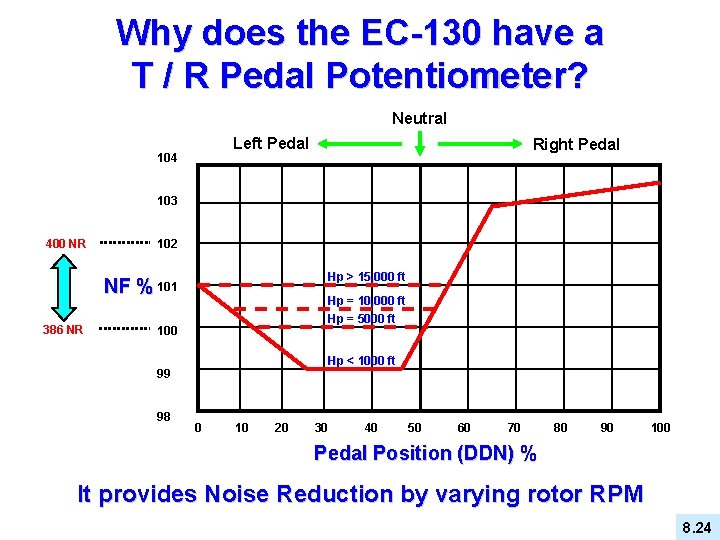
Why does the EC-130 have a T / R Pedal Potentiometer? Neutral Left Pedal 104 Right Pedal 103 400 NR 102 Hp > 15, 000 ft NF % 101 386 NR Hp = 10, 000 ft Hp = 5000 ft 100 Hp < 1000 ft 99 98 0 10 20 30 40 50 60 70 80 90 100 Pedal Position (DDN) % It provides Noise Reduction by varying rotor RPM 8. 24
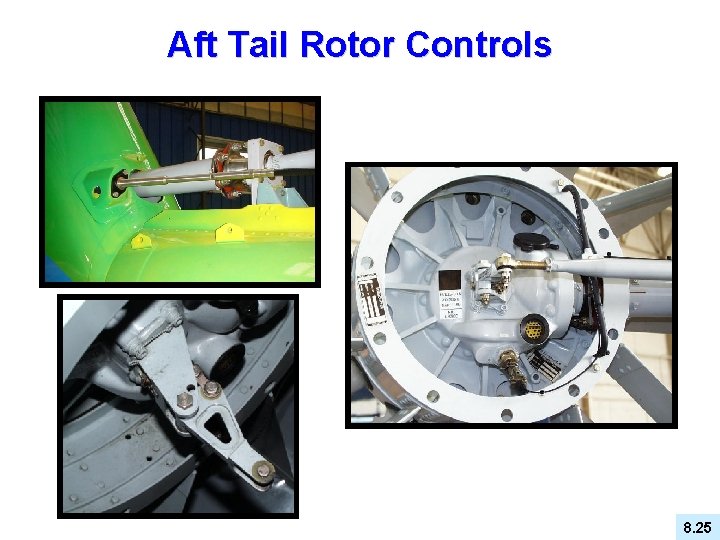
Aft Tail Rotor Controls 8. 25
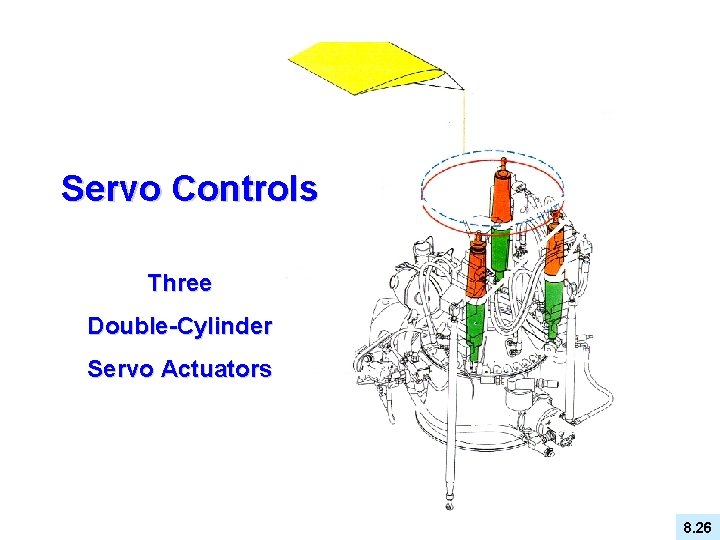
Servo Controls Three Double-Cylinder Servo Actuators 8. 26
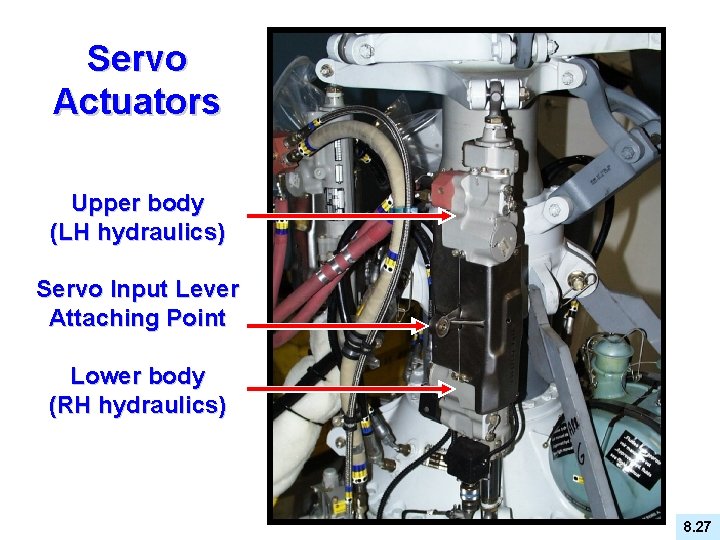
Servo Actuators Upper body (LH hydraulics) Servo Input Lever Attaching Point Lower body (RH hydraulics) 8. 27
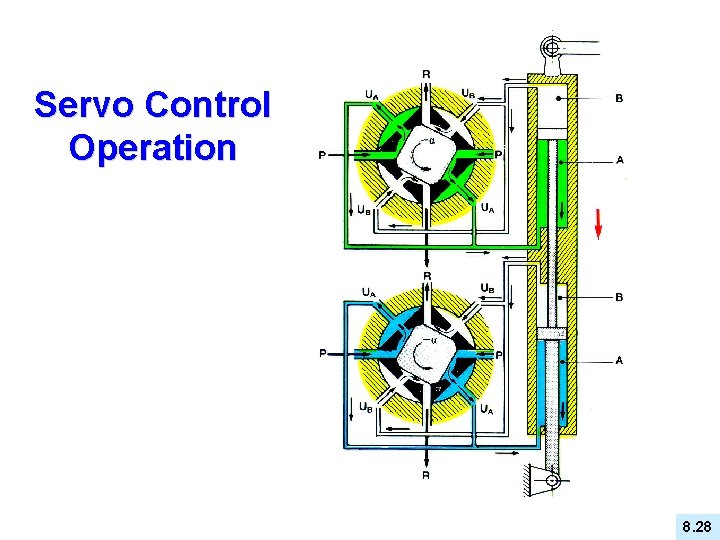
Servo Control Operation 8. 28
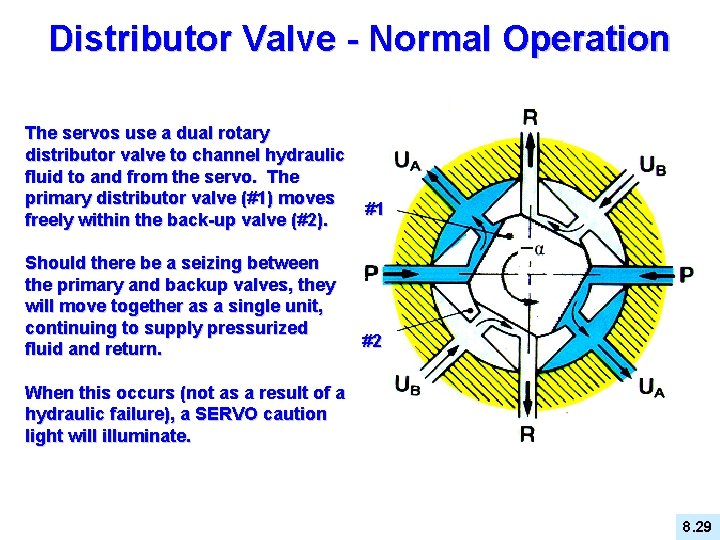
Distributor Valve - Normal Operation The servos use a dual rotary distributor valve to channel hydraulic fluid to and from the servo. The primary distributor valve (#1) moves freely within the back-up valve (#2). Should there be a seizing between the primary and backup valves, they will move together as a single unit, continuing to supply pressurized fluid and return. #1 #2 When this occurs (not as a result of a hydraulic failure), a SERVO caution light will illuminate. 8. 29
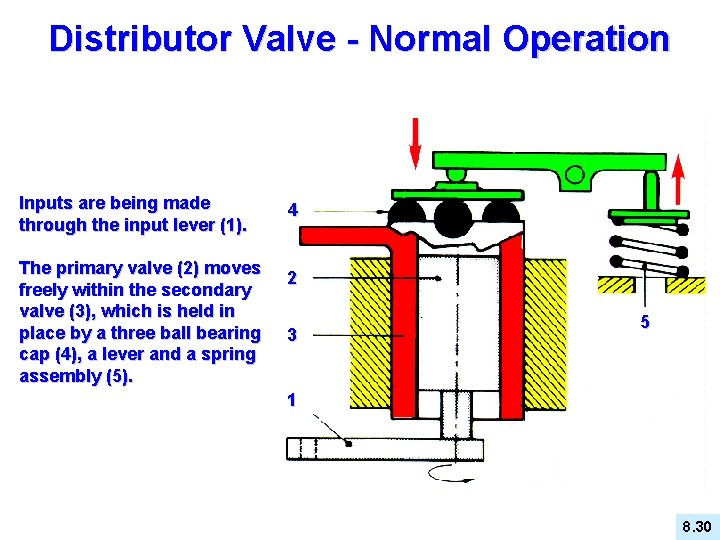
Distributor Valve - Normal Operation Inputs are being made through the input lever (1). The primary valve (2) moves freely within the secondary valve (3), which is held in place by a three ball bearing cap (4), a lever and a spring assembly (5). 4 2 3 5 1 1 8. 30
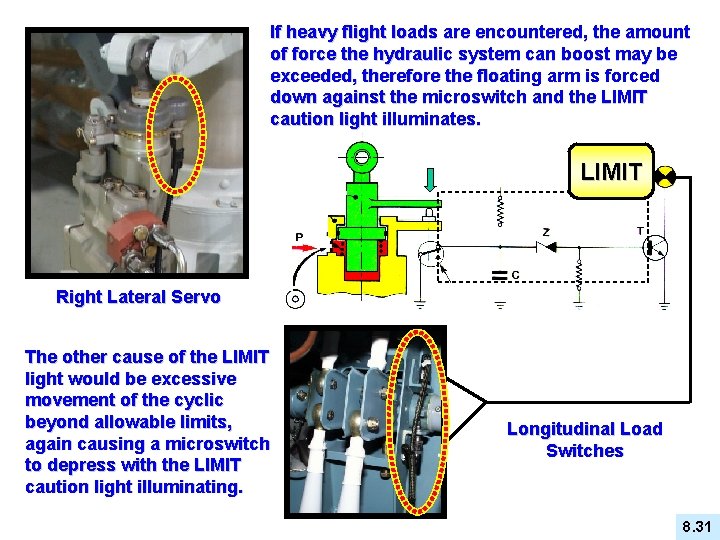
If heavy flight loads are encountered, the amount of force the hydraulic system can boost may be exceeded, therefore the floating arm is forced down against the microswitch and the LIMIT caution light illuminates. LIMIT Right Lateral Servo The other cause of the LIMIT light would be excessive movement of the cyclic beyond allowable limits, again causing a microswitch to depress with the LIMIT caution light illuminating. Longitudinal Load Switches 8. 31
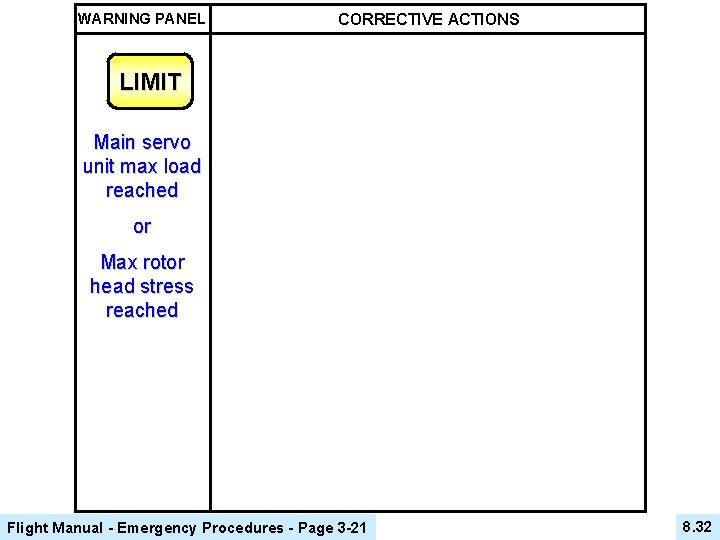
WARNING PANEL CORRECTIVE ACTIONS LIMIT Main servo unit max load reached or Max rotor head stress reached Flight Manual - Emergency Procedures - Page 3 -21 8. 32
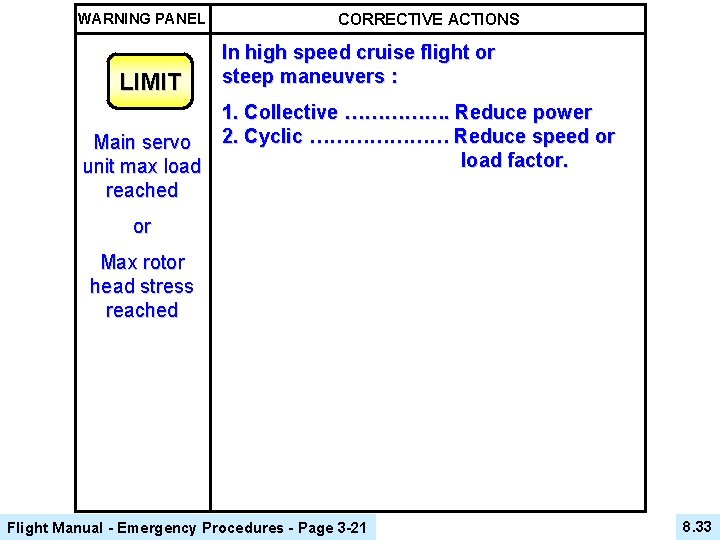
WARNING PANEL LIMIT CORRECTIVE ACTIONS In high speed cruise flight or steep maneuvers : 1. Collective ……………. Reduce power 2. Cyclic ………………… Reduce speed or Main servo load factor. unit max load reached or Max rotor head stress reached Flight Manual - Emergency Procedures - Page 3 -21 8. 33
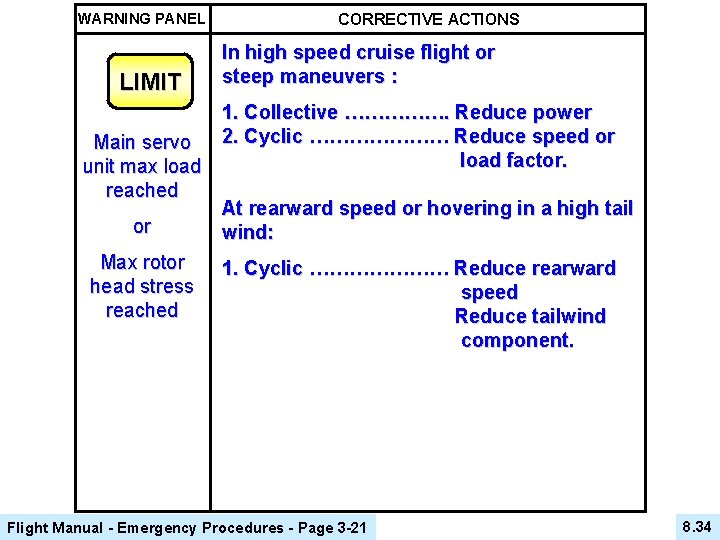
WARNING PANEL LIMIT CORRECTIVE ACTIONS In high speed cruise flight or steep maneuvers : 1. Collective ……………. Reduce power 2. Cyclic ………………… Reduce speed or Main servo load factor. unit max load reached At rearward speed or hovering in a high tail or wind: Max rotor 1. Cyclic ………………… Reduce rearward head stress speed reached Reduce tailwind component. Flight Manual - Emergency Procedures - Page 3 -21 8. 34
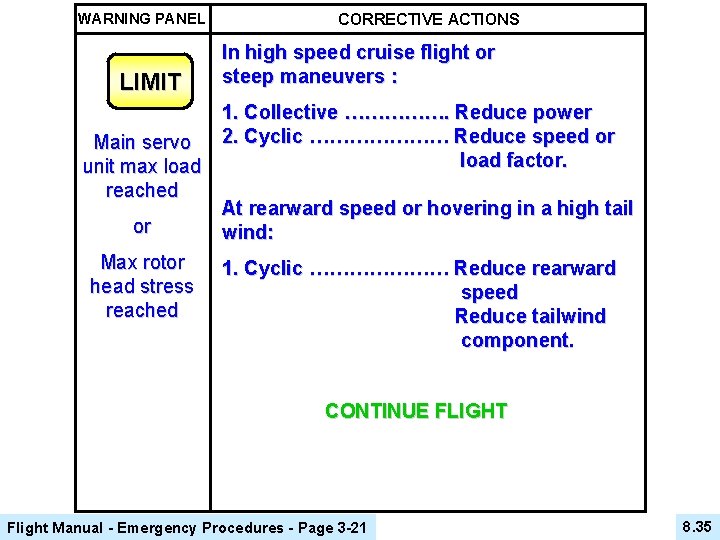
WARNING PANEL LIMIT CORRECTIVE ACTIONS In high speed cruise flight or steep maneuvers : 1. Collective ……………. Reduce power 2. Cyclic ………………… Reduce speed or Main servo load factor. unit max load reached At rearward speed or hovering in a high tail or wind: Max rotor 1. Cyclic ………………… Reduce rearward head stress speed reached Reduce tailwind component. CONTINUE FLIGHT Flight Manual - Emergency Procedures - Page 3 -21 8. 35
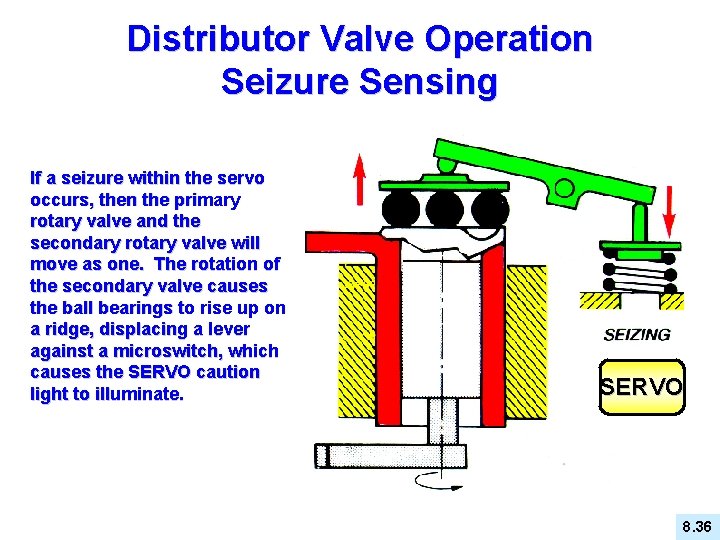
Distributor Valve Operation Seizure Sensing If a seizure within the servo occurs, then the primary rotary valve and the secondary rotary valve will move as one. The rotation of the secondary valve causes the ball bearings to rise up on a ridge, displacing a lever against a microswitch, which causes the SERVO caution light to illuminate. SERVO 8. 36
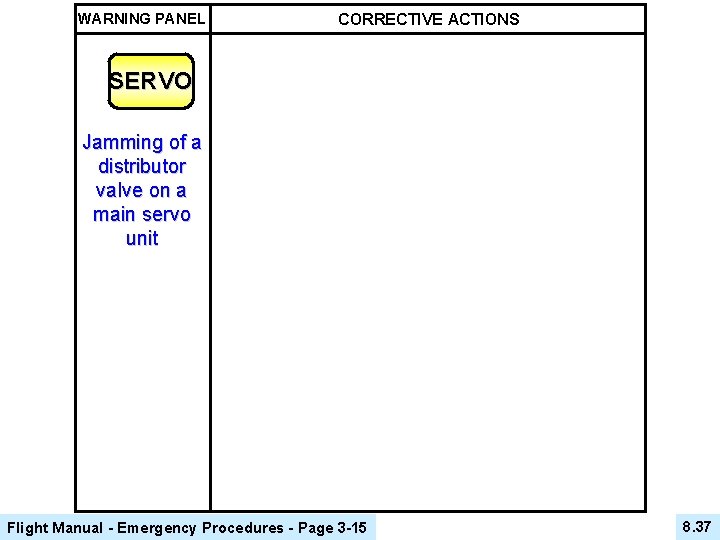
WARNING PANEL CORRECTIVE ACTIONS SERVO Jamming of a distributor valve on a main servo unit Flight Manual - Emergency Procedures - Page 3 -15 8. 37
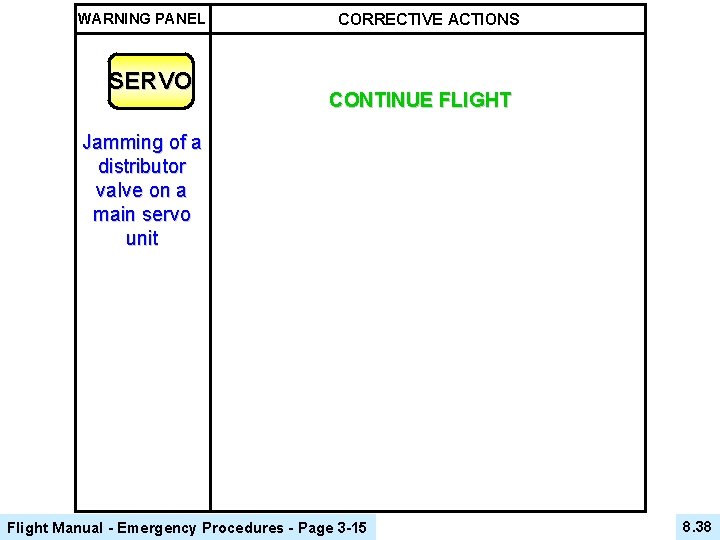
WARNING PANEL SERVO CORRECTIVE ACTIONS CONTINUE FLIGHT Jamming of a distributor valve on a main servo unit Flight Manual - Emergency Procedures - Page 3 -15 8. 38
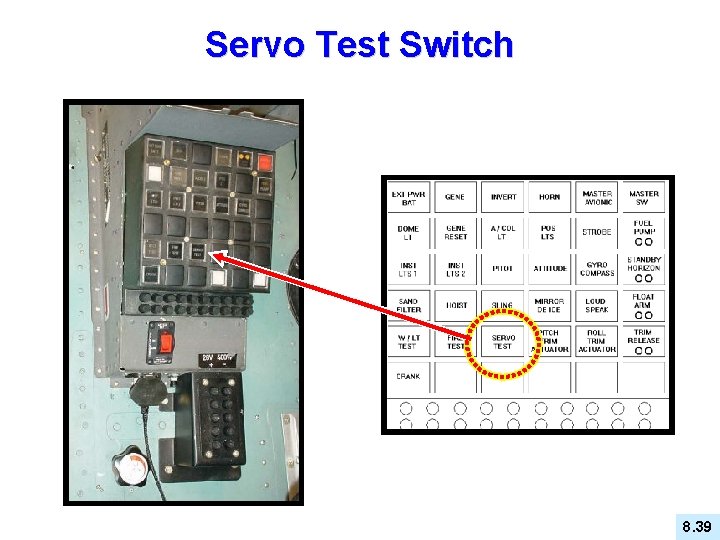
Servo Test Switch 8. 39
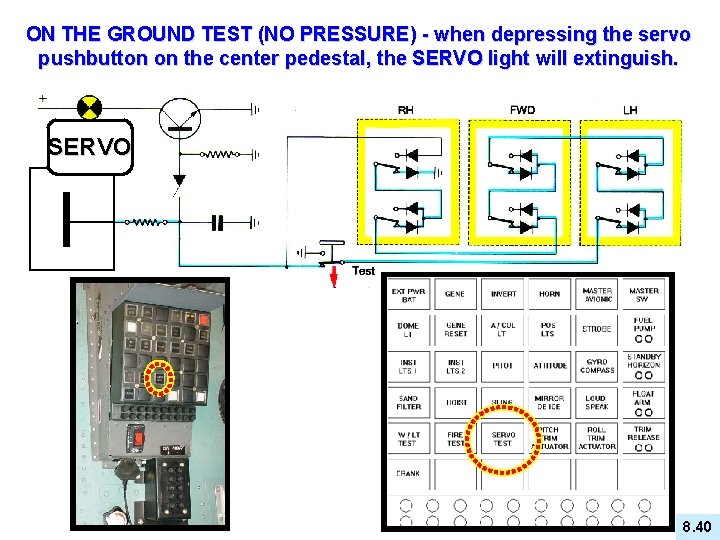
ON THE GROUND TEST (NO PRESSURE) - when depressing the servo pushbutton on the center pedestal, the SERVO light will extinguish. SERVO 8. 40
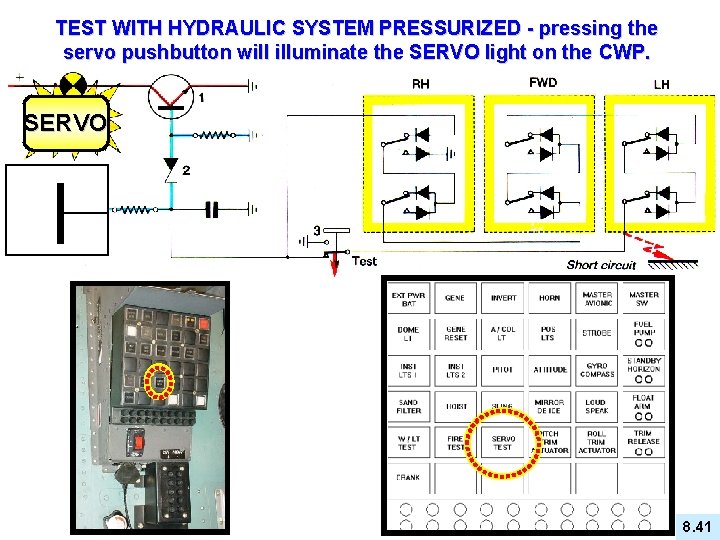
TEST WITH HYDRAULIC SYSTEM PRESSURIZED - pressing the servo pushbutton will illuminate the SERVO light on the CWP. SERVO 8. 41
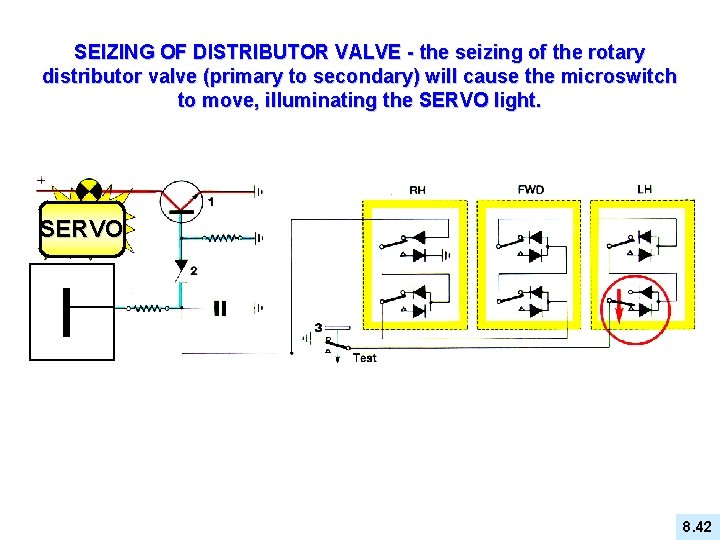
SEIZING OF DISTRIBUTOR VALVE - the seizing of the rotary distributor valve (primary to secondary) will cause the microswitch to move, illuminating the SERVO light. SERVO 8. 42
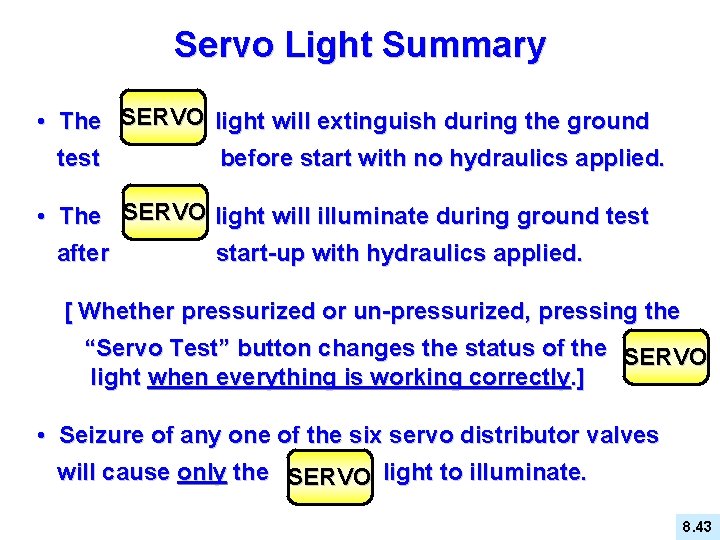
Servo Light Summary • The SERVO light will extinguish during the ground test before start with no hydraulics applied. • The SERVO light will illuminate during ground test after start-up with hydraulics applied. [ Whether pressurized or un-pressurized, pressing the “Servo Test” button changes the status of the SERVO light when everything is working correctly. ] • Seizure of any one of the six servo distributor valves will cause only the SERVO light to illuminate. 8. 43

Review Questions 8. 44
68. What are the main components in the main rotor / tail rotor flight system controls? B. Push-pull tubes and bell cranks / flexball cable and a push-pull tube.
69. What is the purpose of the mixing unit? D. Sum (add) the cyclic inputs with the collective inputs.
70. Which main rotor servo moves to pitch the aircraft nose up or down? A. The left forward servo.
71. What adjustments need to be made for an autorotation rpm change IAW Section 8 of the Flight Manual? D. Low pitch adjustment stop / lock strip (down-stop bolt).

72. How many hydraulic servos are utilized in the EC 130 B 4? A. Three dual bodied servos.
73. When the pilot inputs control forces through the flight controls to the servo stops, where does the distributor valve stop? D. Hydraulic zero.
74. What are the separate aerodynamic functions of the three servos? B. Right lateral (roll), left lateral (roll), and pitch (longitudinal).
75. What is the upper rod end bearing of each main servo attached to? D. Non-rotating swashplate.

76. What is the lower rod end bearing of each main servo attached to? A. Conical housing of the main gear box.
77. What happens to the SERVO light when the SERVO TEST pushbutton on the console is pressed & everything is working correctly? C. The status (illuminate / extinguish) of the SERVO caution light will change.
78. On the tail rotor servo, what attaches to the pilot control input lever and provides input from the yaw pedals? C. There is no tail rotor servo on this aircraft.
79. What type of control linkage interconnects the cyclic, collective, and the swashplate? D. Rigid control tubes.
80. What component allows the collective and cyclic to interface without interference? A. The mixing unit.
EC 130 B 4 Initial Pilot Ground School End of Chapter 8 Flight Controls and Servo Controls
- Slides: 58