
EBT within European Regulatory Framework FROM LEGACY TO

EBT within European Regulatory Framework FROM LEGACY TO EBT AIR FRANCE EASA C/L TRANSITION EXPERIENCE EATS MADRID – 7/11/2018 Cpt Michel Lacombe Page 1
Cpt Michel Lacombe QUALIFICATION "Boeing 777 - Captain, TRE-TRI, 20, 000 Hours Total Flight Time. Member of ICAO Competencies Working Group and IPTC) Member of IATA Training & Qualification Initiative (2008 – 2012). Member of RMT. 0696 - Mixed EBT Implementation Member of EASA RMT 599 – EBT implementation Cpt Lacombe EXPERIENCE 2013 – present: AF Training Facilitation Group Manager - AF ATO Safety Manager 2009 -2013: Head of Air France Training Standards, ATQP leader - Captain B 744 2005 – 2009: Head of Air France Training, TRTO – Captain 747 1992 – 2004: Deputy Manager, Air France Training Standards - Captain B 737 1988 – 1992: Chief Instructor Pilot, French National Pilot Training School. FO A 300/A 310 1983 – 1988 : FO B 727, Air France entry 1979– 1983: CPL/IR/ATPL Instructor, Royal Air Morocco 1979: “Bush” pilot - Ivory Coast, Africa EDUCATION Graduate of “Ecole Nationale de l’Aviation Civile” (ENAC). Ab-initio cadet pilot. Page 2
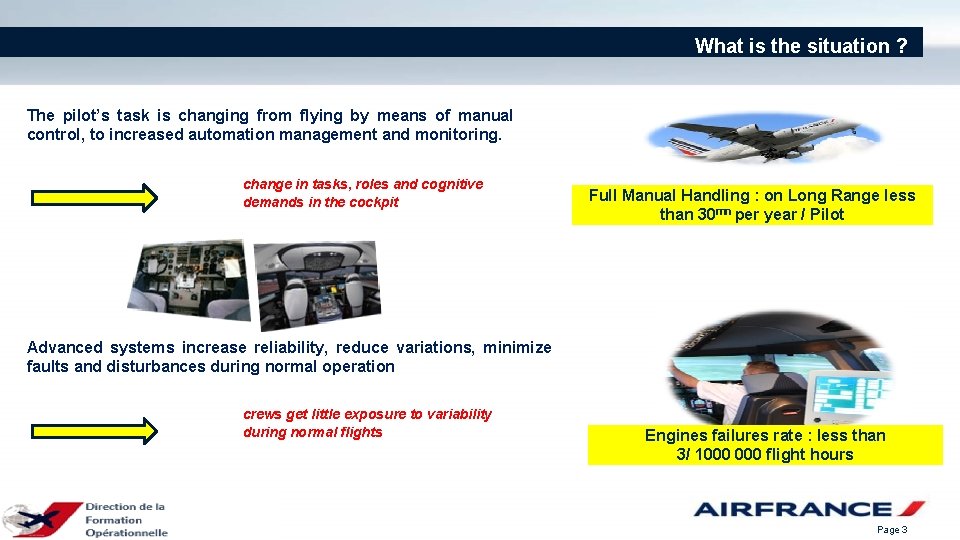
What is the situation ? The pilot’s task is changing from flying by means of manual control, to increased automation management and monitoring. change in tasks, roles and cognitive demands in the cockpit Full Manual Handling : on Long Range less than 30 mn per year / Pilot Advanced systems increase reliability, reduce variations, minimize faults and disturbances during normal operation crews get little exposure to variability during normal flights Engines failures rate : less than 3/ 1000 flight hours Page 3
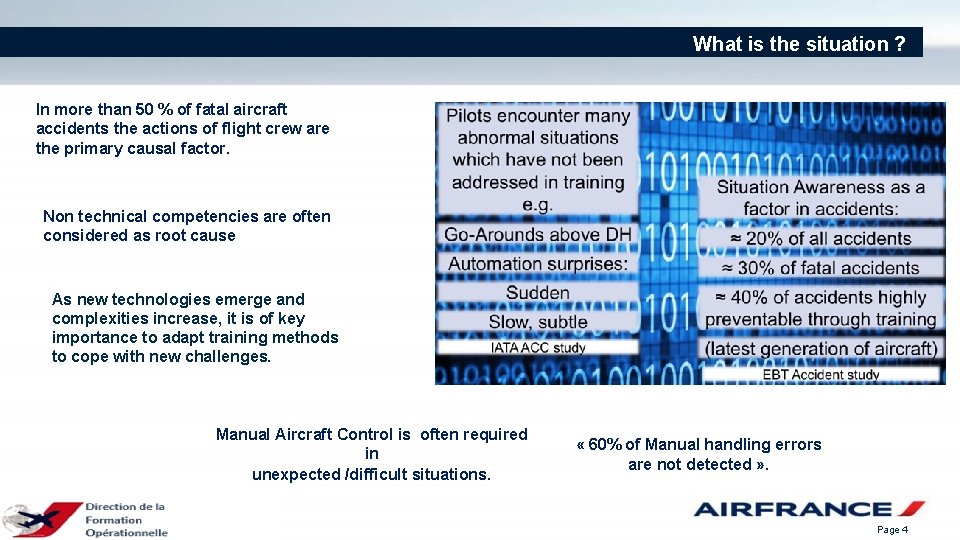
What is the situation ? In more than 50 % of fatal aircraft accidents the actions of flight crew are the primary causal factor. Non technical competencies are often considered as root cause As new technologies emerge and complexities increase, it is of key importance to adapt training methods to cope with new challenges. Manual Aircraft Control is often required in unexpected /difficult situations. « 60% of Manual handling errors are not detected » . Page 4
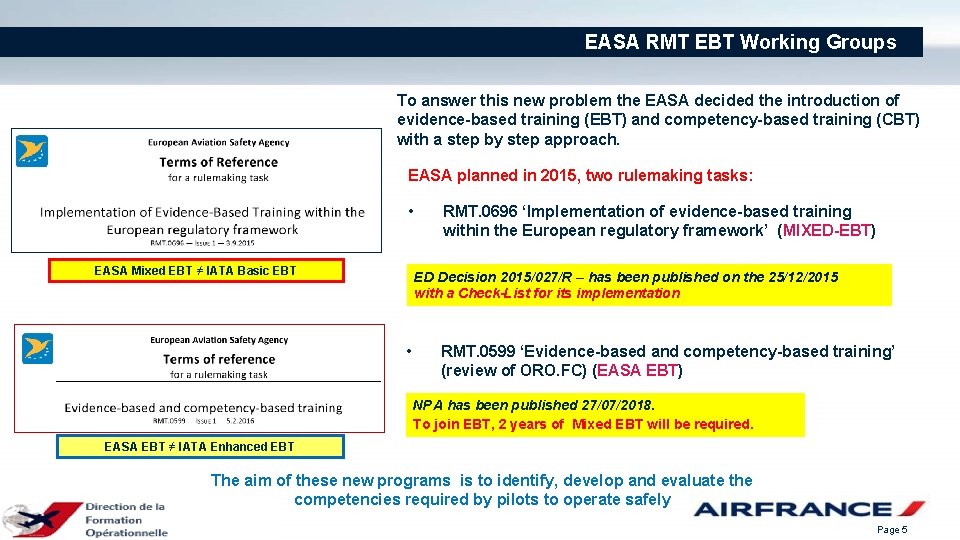
EASA RMT EBT Working Groups To answer this new problem the EASA decided the introduction of evidence-based training (EBT) and competency-based training (CBT) with a step by step approach. EASA planned in 2015, two rulemaking tasks: • EASA Mixed EBT ≠ IATA Basic EBT RMT. 0696 ‘Implementation of evidence-based training within the European regulatory framework’ (MIXED-EBT) ED Decision 2015/027/R – has been published on the 25/12/2015 with a Check-List for its implementation • RMT. 0599 ‘Evidence-based and competency-based training’ (review of ORO. FC) (EASA EBT) NPA has been published 27/07/2018. To join EBT, 2 years of Mixed EBT will be required. EASA EBT ≠ IATA Enhanced EBT The aim of these new programs is to identify, develop and evaluate the competencies required by pilots to operate safely Page 5
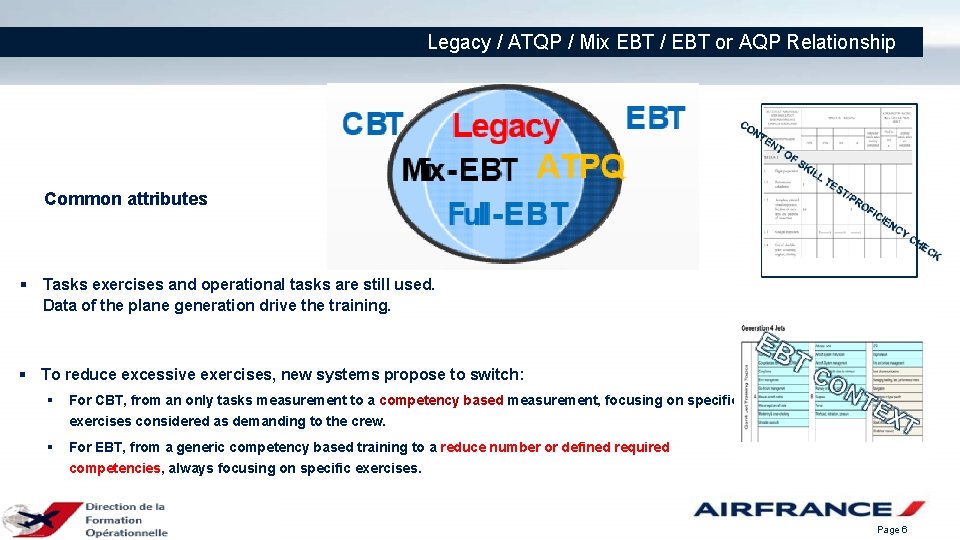
Legacy / ATQP / Mix EBT / EBT or AQP Relationship Common attributes § Tasks exercises and operational tasks are still used. Data of the plane generation drive the training. § To reduce excessive exercises, new systems propose to switch: § For CBT, from an only tasks measurement to a competency based measurement, focusing on specific exercises considered as demanding to the crew. § For EBT, from a generic competency based training to a reduce number or defined required competencies, always focusing on specific exercises. Page 6
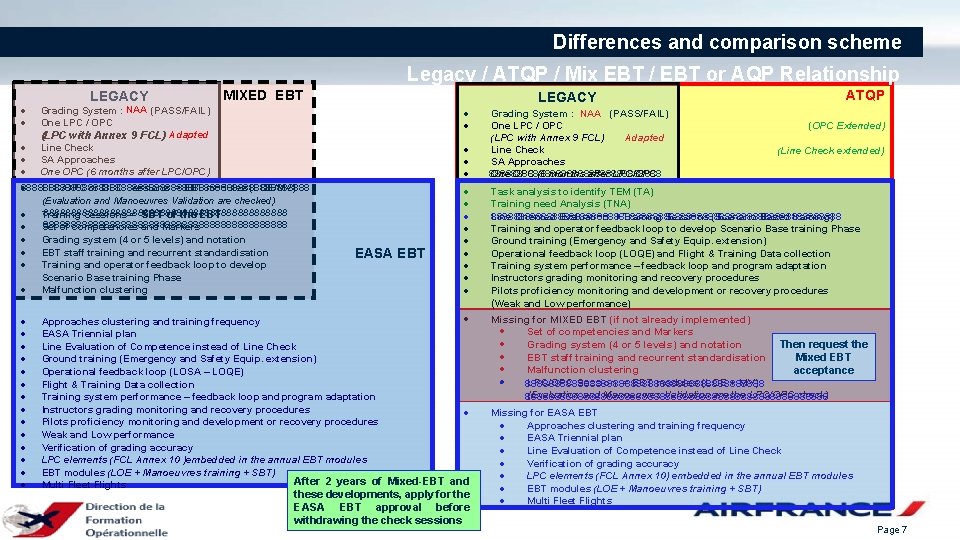
Differences and comparison scheme Legacy / ATQP / Mix EBT / EBT or AQP Relationship ATQP LEGACY MIXED EBT LEGACY NAA Grading System : (PASS/FAIL) NAA Grading System : (PASS/FAIL) One LPC / OPC (OPC Extended) Adapted (LPC with Annex 9 FCL) Adapted Line Check Line Check (Line Check extended) SA Approaches One OPC (6 months after LPC/OPC) • 8888888888888888 One OPC (6 months after LPC/OPC 88888888888888888888888888 LPC/OPC or OPC Sessions = EBT modules (LOE/MV) Task analysis to identify TEM (TA) (Evaluation and Manoeuvres Validation are checked) Training need Analysis (TNA) 8888888888888888888888 Training Sessions = SBT of the EBT Line Oriented Evaluation + Training Sessions (Scenario Based training) 88888888888888888888888888888888 Set of competencies and Markers Training and operator feedback loop to develop Scenario Base training Phase Grading system (4 or 5 levels) and notation Ground training (Emergency and Safety Equip. extension) EBT staff training and recurrent standardisation Operational feedback loop (LOQE) and Flight & Training Data collection EASA EBT Training and operator feedback loop to develop Training system performance – feedback loop and program adaptation Scenario Base training Phase Instructors grading monitoring and recovery procedures Malfunction clustering Pilots proficiency monitoring and development or recovery procedures (Weak and Low performance) Missing for MIXED EBT (if not already implemented) Approaches clustering and training frequency Set of competencies and Markers EASA Triennial plan Grading system (4 or 5 levels) and notation Then request the Line Evaluation of Competence instead of Line Check EBT staff training and recurrent standardisation Mixed EBT Ground training (Emergency and Safety Equip. extension) Malfunction clustering acceptance Operational feedback loop (LOSA – LOQE) LPC/OPC Session = EBT modules (LOE + MV) • 888888888888888888888 Flight & Training Data collection (Evaluation and Manoeuvres Validation are the LPC/OPC check) Training system performance – feedback loop and program adaptation 88888888888888888888888888 Instructors grading monitoring and recovery procedures Missing for EASA EBT Pilots proficiency monitoring and development or recovery procedures Approaches clustering and training frequency Weak and Low performance EASA Triennial plan Verification of grading accuracy Line Evaluation of Competence instead of Line Check LPC elements (FCL Annex 10 )embedded in the annual EBT modules Verification of grading accuracy EBT modules (LOE + Manoeuvres training + SBT) LPC elements (FCL Annex 10) embedded in the annual EBT modules After 2 years of Mixed-EBT and Multi Fleet Flights EBT modules (LOE + Manoeuvres training + SBT) these developments, apply for the EASA EBT approval before withdrawing the check sessions Multi Fleet Flights Page 7
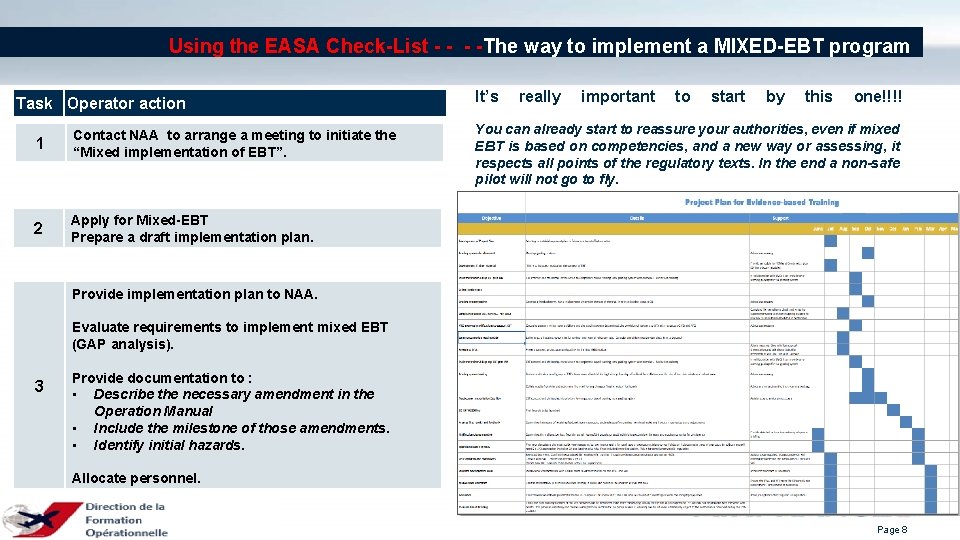
Using the EASA Check-List - -The way to implement a MIXED-EBT program Task Operator action 1 Contact NAA to arrange a meeting to initiate the “Mixed implementation of EBT”. 2 Apply for Mixed-EBT Prepare a draft implementation plan. It’s really important to start by this one!!!! You can already start to reassure your authorities, even if mixed EBT is based on competencies, and a new way or assessing, it respects all points of the regulatory texts. In the end a non-safe pilot will not go to fly. Provide implementation plan to NAA. Evaluate requirements to implement mixed EBT (GAP analysis). 3 Provide documentation to : • Describe the necessary amendment in the Operation Manual • Include the milestone of those amendments. • Identify initial hazards. Allocate personnel. Page 8
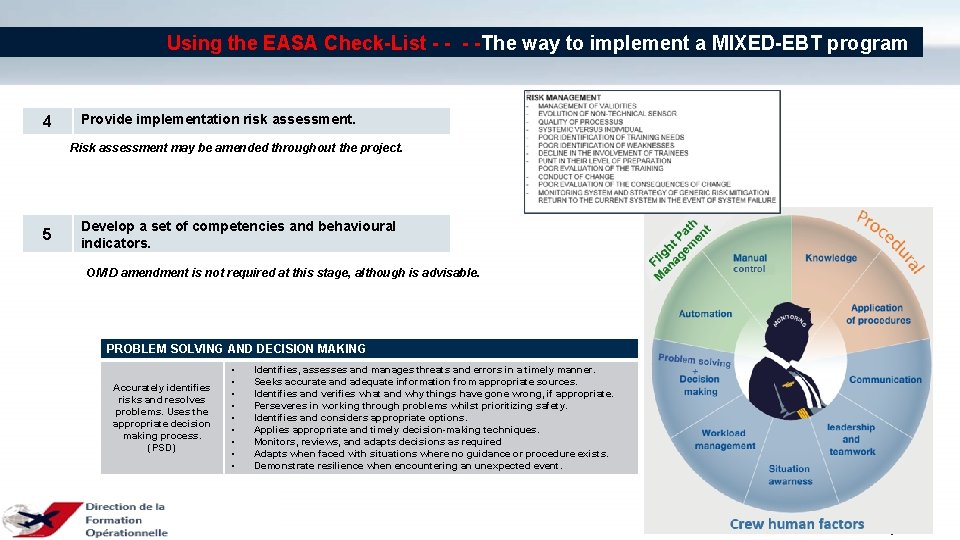
Using the EASA Check-List - -The way to implement a MIXED-EBT program 4 Provide implementation risk assessment. Risk assessment may be amended throughout the project. 5 Develop a set of competencies and behavioural indicators. OM D amendment is not required at this stage, although is advisable. PROBLEM SOLVING AND DECISION MAKING Accurately identifies risks and resolves problems. Uses the appropriate decision making process. (PSD) • • • Identifies, assesses and manages threats and errors in a timely manner. Seeks accurate and adequate information from appropriate sources. Identifies and verifies what and why things have gone wrong, if appropriate. Perseveres in working through problems whilst prioritizing safety. Identifies and considers appropriate options. Applies appropriate and timely decision-making techniques. Monitors, reviews, and adapts decisions as required Adapts when faced with situations where no guidance or procedure exists. Demonstrate resilience when encountering an unexpected event. Page 9
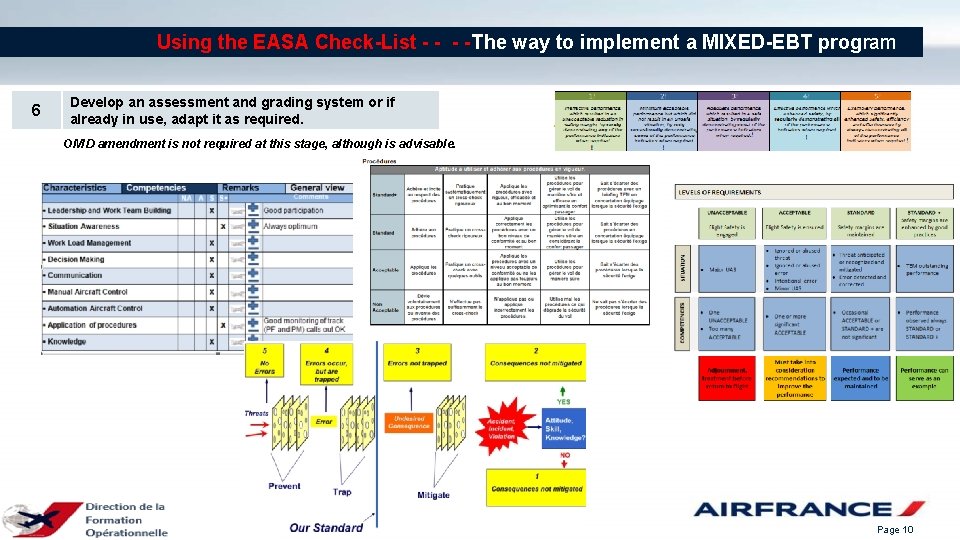
Using the EASA Check-List - -The way to implement a MIXED-EBT program 6 Develop an assessment and grading system or if already in use, adapt it as required. OM D amendment is not required at this stage, although is advisable. Page 10
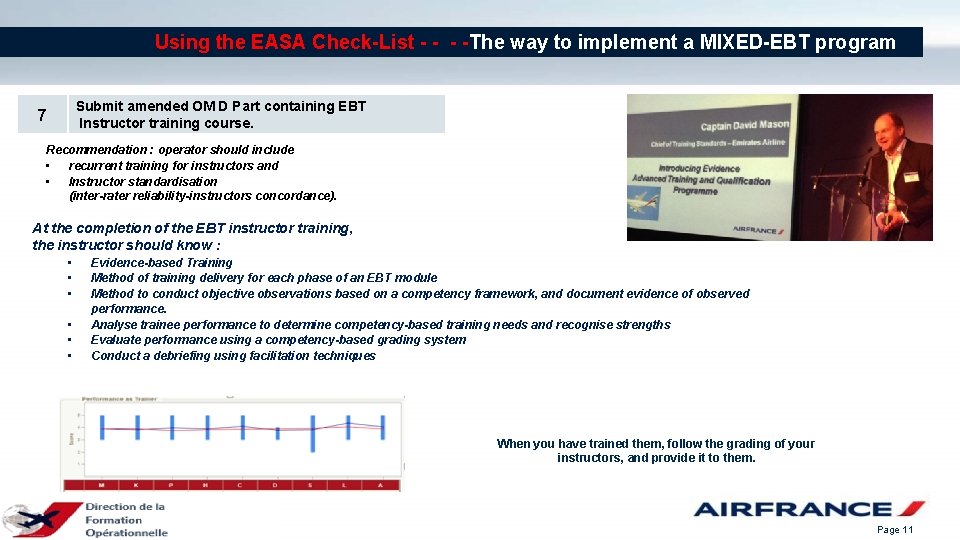
Using the EASA Check-List - -The way to implement a MIXED-EBT program Submit amended OM D Part containing EBT Instructor training course. 7 Recommendation : operator should include • recurrent training for instructors and • Instructor standardisation (inter-rater reliability-instructors concordance). At the completion of the EBT instructor training, the instructor should know : • • • Evidence-based Training Method of training delivery for each phase of an EBT module Method to conduct objective observations based on a competency framework, and document evidence of observed performance. Analyse trainee performance to determine competency-based training needs and recognise strengths Evaluate performance using a competency-based grading system Conduct a debriefing using facilitation techniques When you have trained them, follow the grading of your instructors, and provide it to them. Page 11
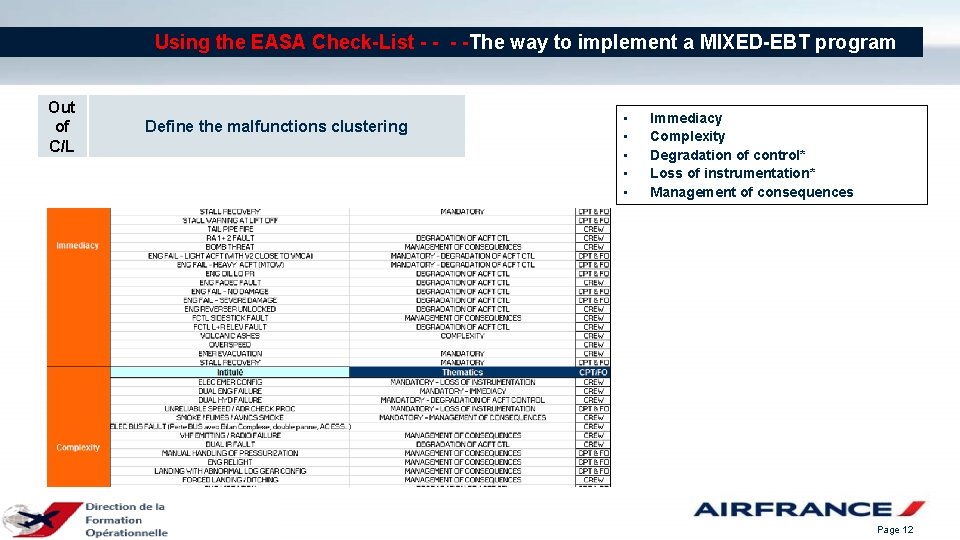
Using the EASA Check-List - -The way to implement a MIXED-EBT program Out of C/L Define the malfunctions clustering • • • Immediacy Complexity Degradation of control* Loss of instrumentation* Management of consequences Page 12
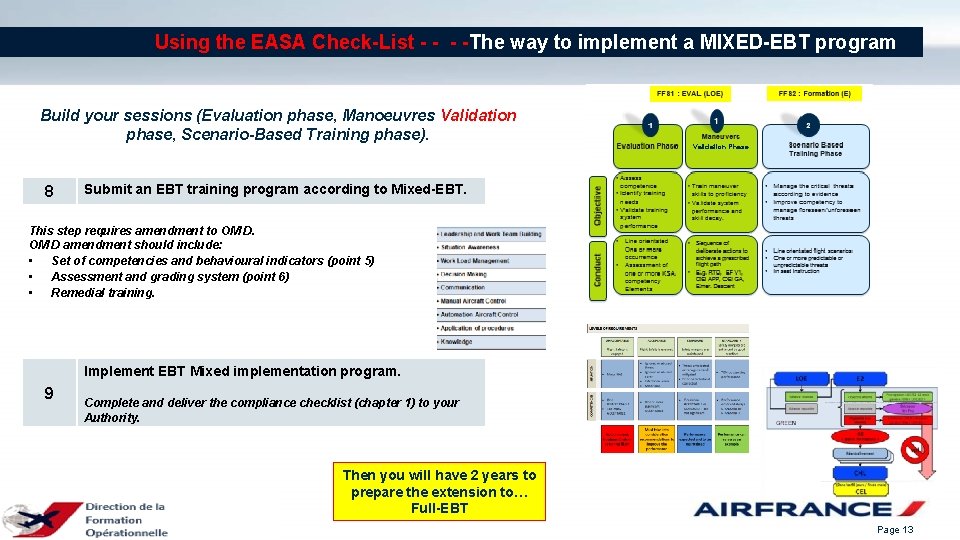
Using the EASA Check-List - -The way to implement a MIXED-EBT program Build your sessions (Evaluation phase, Manoeuvres Validation phase, Scenario-Based Training phase). 8 Validation Phase Submit an EBT training program according to Mixed-EBT. This step requires amendment to OM D amendment should include: • Set of competencies and behavioural indicators (point 5) • Assessment and grading system (point 6) • Remedial training. Implement EBT Mixed implementation program. 9 Complete and deliver the compliance checklist (chapter 1) to your Authority. Then you will have 2 years to prepare the extension to… Full-EBT Page 13
From Mixed-EBT to EBT What to do during the 2 years of Mixed-EBT to prepare the EBT? Page 14
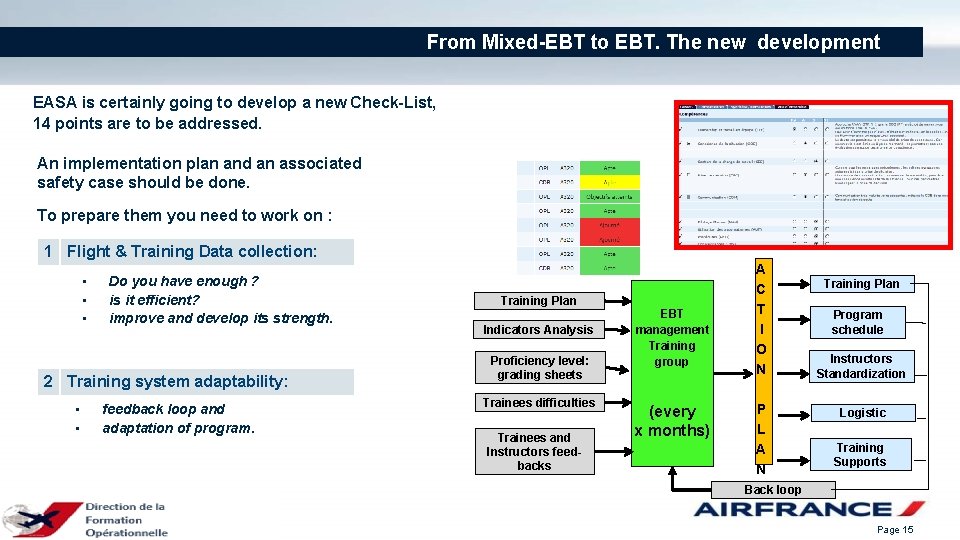
From Mixed-EBT to EBT. The new development EASA is certainly going to develop a new Check-List, 14 points are to be addressed. An implementation plan and an associated safety case should be done. To prepare them you need to work on : 1 Flight & Training Data collection: • • • Do you have enough ? is it efficient? improve and develop its strength. 2 Training system adaptability: • • feedback loop and adaptation of program. Training Plan Indicators Analysis Proficiency level: grading sheets Trainees difficulties Trainees and Instructors feedbacks EBT management Training group (every x months) A C T I O N P L A N Training Plan Program schedule Instructors Standardization Logistic Training Supports Back loop Page 15
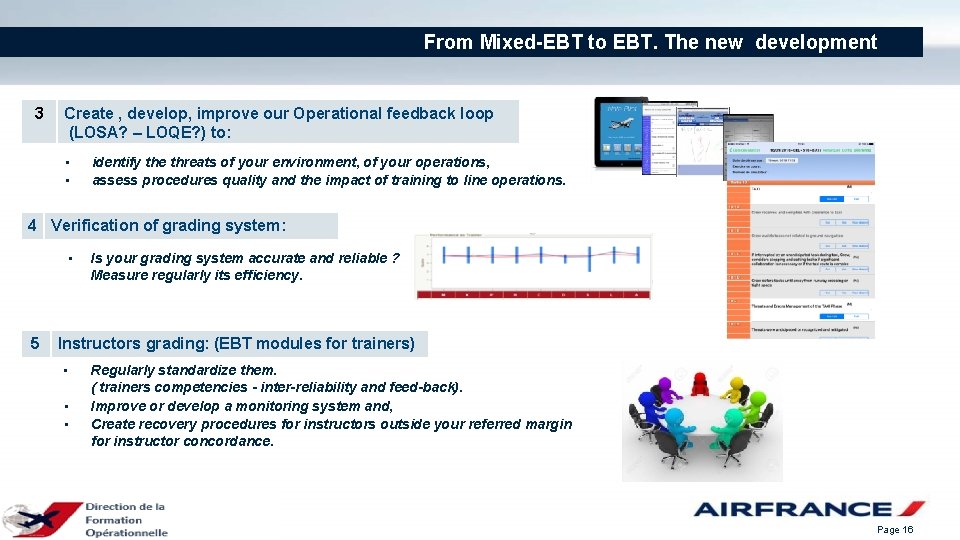
From Mixed-EBT to EBT. The new development 3 Create , develop, improve our Operational feedback loop (LOSA? – LOQE? ) to: • • identify the threats of your environment, of your operations, assess procedures quality and the impact of training to line operations. 4 Verification of grading system: • 5 Is your grading system accurate and reliable ? Measure regularly its efficiency. Instructors grading: (EBT modules for trainers) • • • Regularly standardize them. ( trainers competencies - inter-reliability and feed-back). Improve or develop a monitoring system and, Create recovery procedures for instructors outside your referred margin for instructor concordance. Page 16
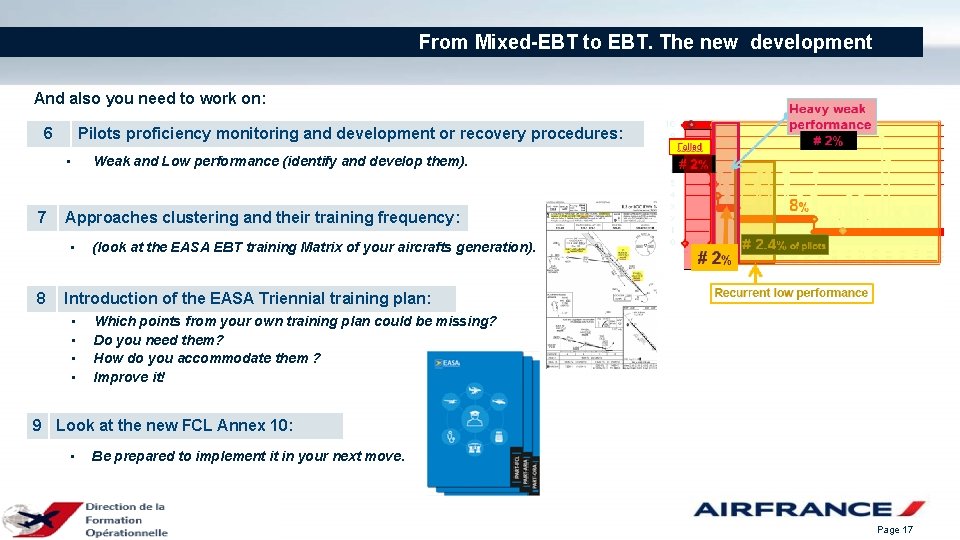
From Mixed-EBT to EBT. The new development And also you need to work on: 6 Pilots proficiency monitoring and development or recovery procedures: • 7 Weak and Low performance (identify and develop them). Approaches clustering and their training frequency: • 8 (look at the EASA EBT training Matrix of your aircrafts generation). Introduction of the EASA Triennial training plan: • • Which points from your own training plan could be missing? Do you need them? How do you accommodate them ? Improve it! 9 Look at the new FCL Annex 10: • Be prepared to implement it in your next move. Page 17
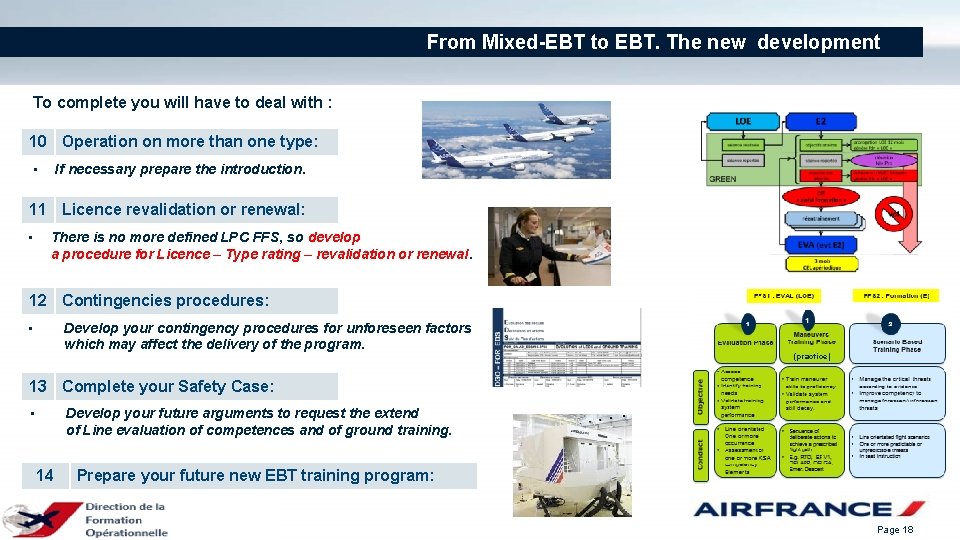
From Mixed-EBT to EBT. The new development To complete you will have to deal with : 10 Operation on more than one type: • If necessary prepare the introduction. 11 Licence revalidation or renewal: • There is no more defined LPC FFS, so develop a procedure for Licence – Type rating – revalidation or renewal. 12 Contingencies procedures: • Develop your contingency procedures for unforeseen factors which may affect the delivery of the program. (practice) 13 Complete your Safety Case: • Develop your future arguments to request the extend of Line evaluation of competences and of ground training. 14 Prepare your future new EBT training program: Page 18
Moving from Legacy towards EBT To conclude just a look to the data you can expect from Mixed EBT or EBT Page 19
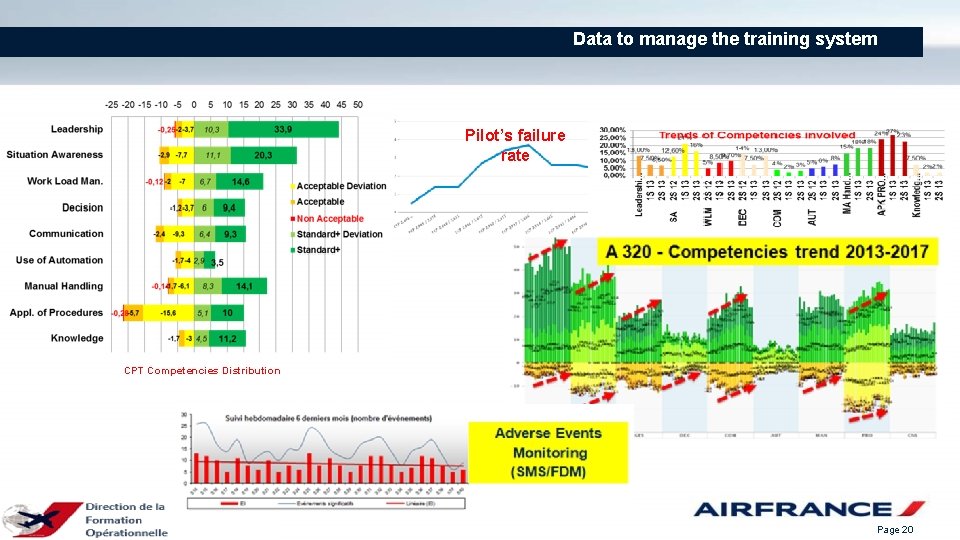
Data to manage the training system Pilot’s failure rate CPT Competencies Distribution Page 20
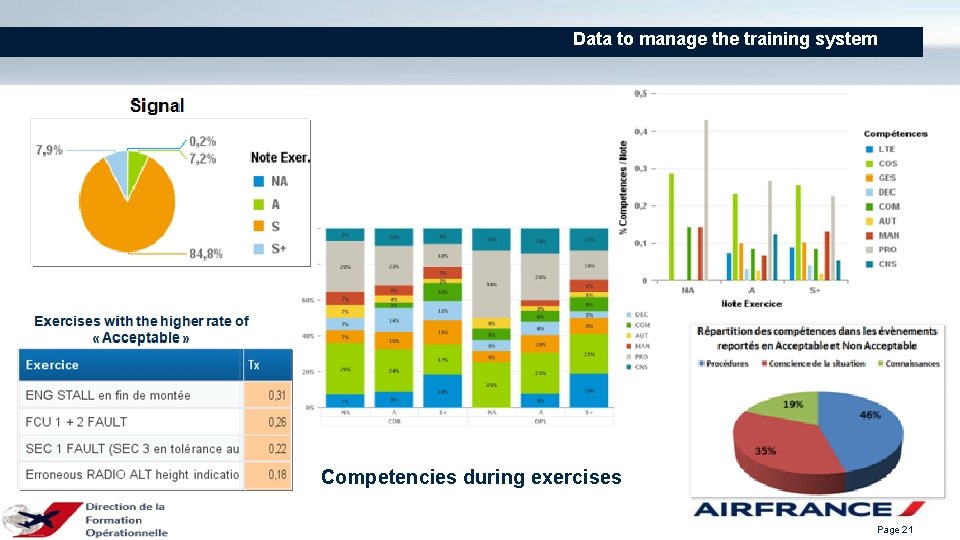
Data to manage the training system Competencies during exercises Page 21
When launching an EBT program, including or not an ATQP program, Operators and NAA shall keep in mind that the main goal is: To improve the overall safety through a more efficient training and checking program for pilots. Thank you !! milacombe@airfrance. fr One major component to reach this goal is a close and efficient collaboration between the operator and its NAA. Page 22
- Slides: 22