
EBSD Fundamentals SEM based technique 70 tilted specimen
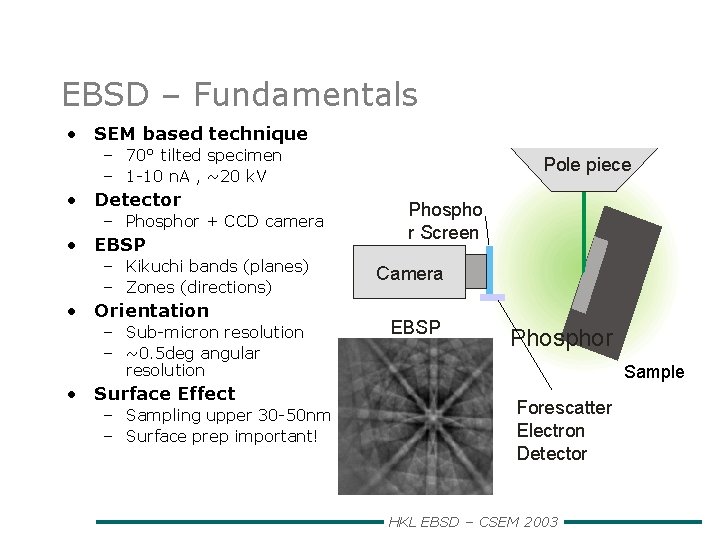
EBSD – Fundamentals • SEM based technique – 70° tilted specimen – 1 -10 n. A , ~20 k. V • Detector – Phosphor + CCD camera • EBSP – Kikuchi bands (planes) – Zones (directions) • Orientation – Sub-micron resolution – ~0. 5 deg angular resolution • Surface Effect – Sampling upper 30 -50 nm – Surface prep important! Pole piece Phospho r Screen Camera EBSP Phosphor Sample Forescatter Electron Detector HKL EBSD – CSEM 2003
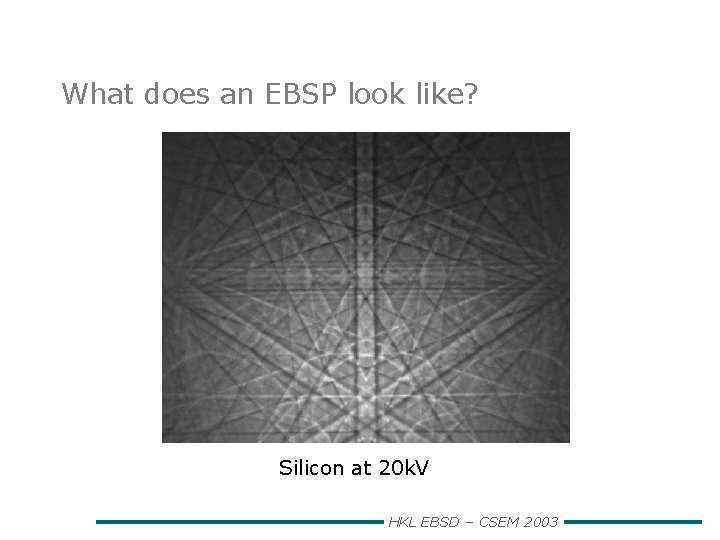
What does an EBSP look like? Silicon at 20 k. V HKL EBSD – CSEM 2003
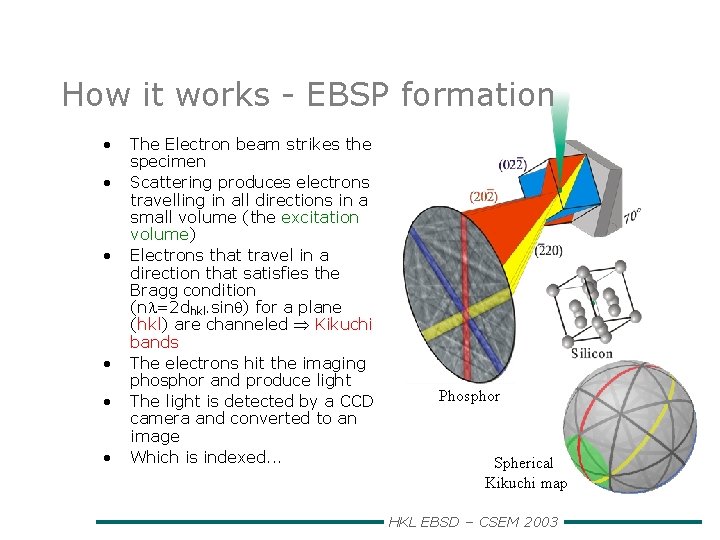
How it works - EBSP formation • • • The Electron beam strikes the specimen Scattering produces electrons travelling in all directions in a small volume (the excitation volume) Electrons that travel in a direction that satisfies the Bragg condition (nl=2 dhkl. sinq) for a plane (hkl) are channeled Kikuchi bands The electrons hit the imaging phosphor and produce light The light is detected by a CCD camera and converted to an image Which is indexed. . . Phosphor Spherical Kikuchi map HKL EBSD – CSEM 2003
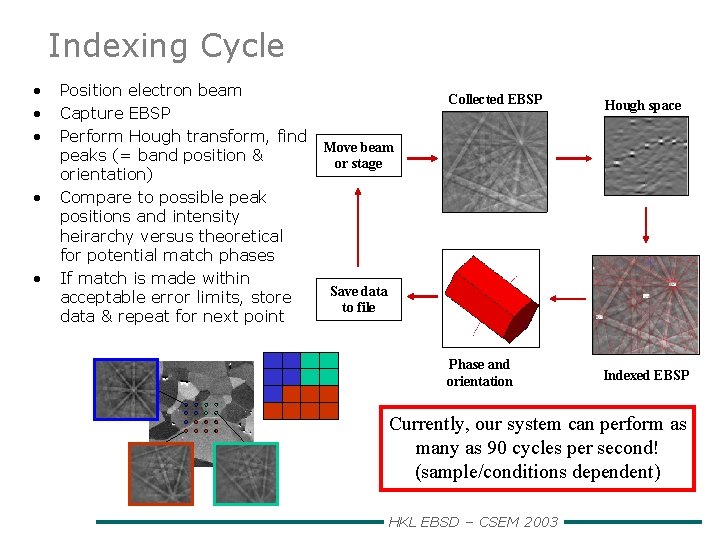
Indexing Cycle • • • Position electron beam Capture EBSP Perform Hough transform, find peaks (= band position & orientation) Compare to possible peak positions and intensity heirarchy versus theoretical for potential match phases If match is made within acceptable error limits, store data & repeat for next point Collected EBSP Hough space Phase and orientation Indexed EBSP Move beam or stage Save data to file Currently, our system can perform as many as 90 cycles per second! (sample/conditions dependent) HKL EBSD – CSEM 2003
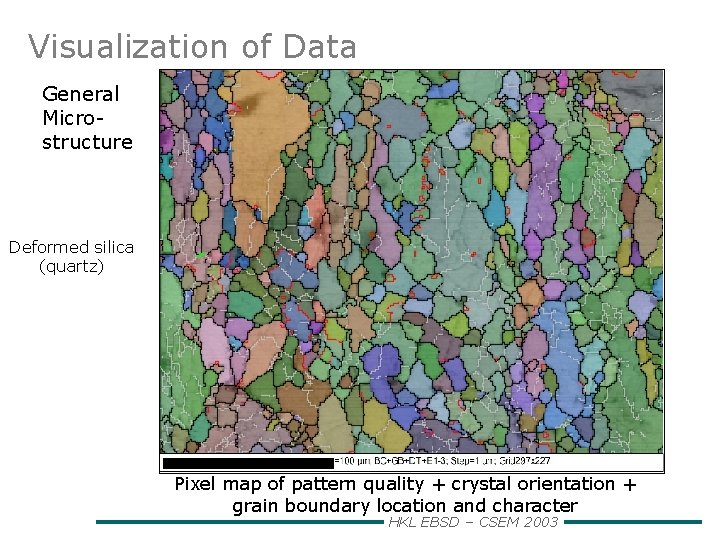
Visualization of Data General Microstructure Deformed silica (quartz) Pixel map of pattern quality + crystal orientation + grain boundary location and character HKL EBSD – CSEM 2003
- Slides: 5